A guest post by Bruce Everett
Day three – Saturday: The meat of the GAC… or the TVP…
Early to bed, early to rise… sigh. I went to bed late, owing to running into an old school friend at the GAC, and going out for drinks. On our crawl, we even ran into the messiah…
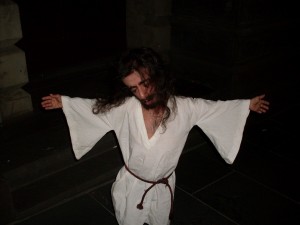
Imaan – Bigger Than Jesus
He shares at least one thing in common with Richard Dawkins, incidentally; he doesn’t like Andrew Bolt.
***
Okay… Saturday… Early to rise…
Saturday morning, after being unintentionally awoken by one of my jetlagged Italian roommates (which was welcome because my alarm clock had broken), I got off my backside and made my way to the convention to see Peter Singer.
Singer, if you don’t know, is a vegetarian, which kind of suggests certain things about what the catering may need to take into account. Kylie Sturgess reminded the audience as much as we went into a break later in the day (respect those vegetarians!)
Catering turned out to be more amenable to us animal-cruelty avoiding weirdos in the audience.
Singer invoked the old device of The Expanding Circle to discuss the extent to which we are willing to extend our moral concern beyond our selves, and our immediate kin, though the tiers of groups, all the way up to and including all life on Earth capable of suffering. It was argued, predictably, that the circle is expanding; however, Singer referred to Steven Pinker’s recent Better Angels of Our Nature as an empirical basis for this claim, which was novel.
Although I think Singer was bested in terms of overall value by other speakers at the convention, he was still no slouch. Indeed, he’s the academic I most anticipated seeing at the convention; I wasn’t disappointed.
Leslie Cannold however, stole the show. It was at least a tie between her and Lawrence Krauss, who would follow later in the night, in terms of sheer energy and engagement.
The myths surrounding section 116 of the Australian Constitution were torn asunder by Cannold, especially in light of the DOGS 1981 case, where the High Court used what appears to be pure sophistry to interpret the separation of church and state inAustraliaout of existence. This was made apparent, and obvious, through a comparison of the incredibly similar wordings of our section 116 and the establishment clause of the first amendment in theUSconstitution.
Prepared with Max Wallace, and delivered by such a proficient communicator as Leslie Cannold, the issue was rendered vivid and undeniable. The success of the delivery of this message is important because of a common misconception; Australiahas no separation of church and state – it’s a soft theocracy.
***
Dan Barker was, well, Dan Barker. Lovable, but still with the oratory of a preacher; a kind I personally find off-putting. I emphasise; ‘personally’.
I can understand Dan Barker’s appeal to those leaving fundamentalist Christianity though. He nails biblical absurdities with wit and emotion, and just a bit of camp value, if you like that kind of thing. I especially appreciated Barker’s disclosure of how he spends the royalties from an old piece of Christian propaganda he produced back in the day; on a charity supporting women’s reproductive autonomy.
Others may differ, but aside from light entertainment, I got only one thing from Dan Barker’s performance, but it was a good-un; I gained a trust in his motives I otherwise couldn’t have.
When I discussed the Convention with Warren Bonnet (editor of the Australian Book of Atheism, and co-owner of Melbourne’s Embiggen Books), he emphasised the importance of these conventions as a means to humanise our networks; that we don’t just leave our interactions purely at the mercy of communications technologies, with all the social problems that can arise out of them.
While it wasn’t necessarily the high-profile atheists Warren and I had in mind, I think my experience watching Dan Barker, whom I’ve had (healthy) doubts about, demonstrates the point. I trust others can corroborate experiences like this.
***
After the morning break (with very nice, vegetarian-friendly biscuits – BISCUITS!), a political panel discussing the need for secular reform, in particular in the regulation of education, consisted of Fiona Patten, Colleen Hartland, Dick Gross, and Marion Maddox, with Derek Guille as moderator.
Marion Maddox stole the show, and given she was the biggest believer on the panel, it was perhaps ironic that she was easily most worthy of the title ‘secular fundamentalist’ – taking Dick Gross and Colleen Hartland to task for their comparatively soft touch. (It also helped that Maddox knew her material.)
Dick Gross was a waste of space on the panel, which isn’t to say I dislike him. It’s just that aside from a single salient point – concerning a matter of opportunity cost between comparative religion and science funding in schools – he listlessly equivocated and vacillated, seemingly wasting a lot of energy just to position himself as some kind of moderate.
All the positioning could have been justified if only he’d committed himself to clearer, more lucid disagreement with the others on the panel. But that isn’t what he gave us (and I don’t care one jot about his long-standing status as a popularFairfaxblogger.)
(Right on the back of the publication of Freedom of Religion & the Secular State, Dick’s was a seat that would have easily been better filled by Russell Blackford.)
Fiona Patten, of the Australian Sex Party, was largely in agreement with Marion Maddox, although the sequence of questioning left her largely nodding her head and adding occasional secondary points after Maddox spoke. I would have liked to have seen Patten given the lead more often – not to displace Maddox, but so that at least Patten had a chance to direct discussion towards the political niches where she has more specialised experience than Maddox. As an experienced newsperson, Derek Guille should have taken this into account.
General consensus was reached, which was more or less unsurprising; to do secular education right, public schools needed better funding across a number of curriculum learning areas. I’m in agreement; however, there are those libertarians in the ‘atheist movement’ who support voucher systems and privatisation who may be at odds with this.
I don’t say this to be all fuzzy and inclusive; rather, I think it would be interesting to see, especially of those plying a trade in the Skeptic movement (effectively placing them in competition with public education, and making them beneficiaries of widespread scientific ignorance), which libertarians disagree.
On balance, I think the event at Embiggen Books two nights earlier, with Meredith Doig, Russell Blackford and Graham Oppy, was better, although I think adding Maddox and Patten to the mix, based on their GAC appearance, would make for a dream-card. Maybe if there’s another GAC inMelbourne?
***
Dan Dennett followed, giving a lecture on closet atheists – directed especially at any undercover believers in the audience. I’ve already seen much of what Dan Dennett has to say on the matter, so I won’t discuss the substantive points (if you’re curious, there’s The Evolution of Confusion), however there are signs of Dennett’s project progressing, with further refinements to the theory, as well as practical developments (see The Clergy Project).
Dennett was cuddly, friendly and funny, as usual (we even got the ‘deepity’ spiel). Technical terms were bridged with puns, criticism with good humour, and as always with Dennett, commonly accepted implications of well established theory were exposed as having either logical flaws, or obvious exceptions.
***
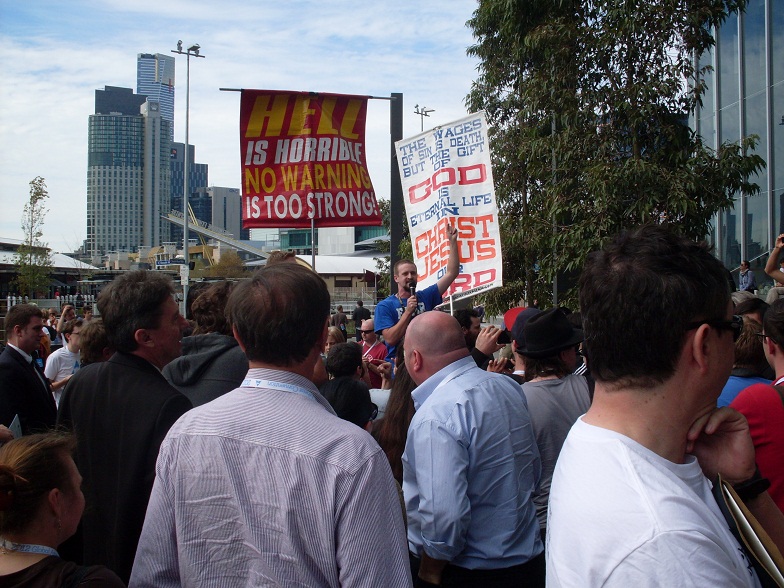
Lunch saw visitors arrive, or at least, it was the first I saw of them during the day.

‘Eternal Life in Christ Jesus Our Lord’? What, these guys will be living in JC’s intestinal lining as irritants?
Really, what on Earth did they hope to achieve? And ‘no warning is too strong’? That almost sounds like a threat, although I suspect it may actually refer to the sulphurous odour wafting from sweaty, angry Christians.
After a suitably wonderful vegetarian lunch (the wraps were awesome), and fundamentalists largely already forgotten, I have to confess I was getting a little tired. Which isn’t to say I fell asleep, however…
AC Grayling was on next, and for the life of me I can’t remember the substance of his presentation. In part, I recall agreeing with him in advance, and having no particular objection to what he had to say. I recall good humour, but not the actual jest.
I feel as if I’ve done him a disservice, like I’m a disrespectful undergrad.
This, I guess, is just a part of the reality of these things – the chaos of travel, especially on a low budget like my operation (the gold ticket was really pushing it, but I intended to make a go of things). I’m new to writing on the road, or rails, as it were.
My only defence, in my poor study of AC Grayling, is that I’ve had distractions of all sorts on this trip. In this case, having lost my earlier company, I was seated next to this ultra-defensive, thirty-something guy, who was insisting that a general statement about the first night’s comedy made by Daniel Dennett was specifically a defence of Jim Jeffries (it’d be interesting to find out what Dennett actually thinks).
***
Lawrence Krauss was next to give a talk; adapted from one he gave a few years ago at the request of Richard Dawkins, and which led to Krauss’ latest, A Universe From Nothing. Krauss was very much alive, and I was very much awake, and while I was familiar with the content, I was still captivated by the delivery.
If I could have asked for anything more, it would have been rather than having it asserted that it doesn’t matter that Krauss’ definition of ‘nothing’ is different from the traditional metaphysical definition, to be told why it doesn’t matter. Perhaps something similar to how Einstein’s refutation of the traditional, supposedly logically necessary, Euclidean definition of space, shows us how our traditional-intuitive approach to ‘nothing’ (or any other traditional-intuitive truth) may also be wrong. The history of intuitive ideas is a graveyard.
***
After a break where I took in a subjective impression of the demographics of the audience (there seemed to be more ethnic diversity and a more even gender balance in the younger generations), Geoffrey Robertson took to the stage to deliver the inaugural Christopher Hitchens Memorial Lecture. Hitchens’ various exploits against tyranny were re-told in brief, with anecdotes from Robertson’s privileged perspective as a friend.
Robertson took to criticising religion in a way I’d never really seen of him – a trite little poem, and suggestions for the re-purposing of empty churches as public toilets. I’m left wondering where and when the next Christopher Hitchens Memorial Lecture will be held.
Ayaan Hirsi Ali followed, discussing the nature of the Arab Spring protests, and what an Islamist Winter would look like for those living in theMiddle East. Often, when Ayaan Hirsi Ali addresses matters of politics, rather than autobiography, I find a lot to take exception with, although in many cases I’m never quite sure if it’s an infidelity of language (and perhaps a leftish prejudice on my part), that’s to blame.
I do think that this is generally true – that Ayaan Hirsi Ali isn’t as precise in discussing politics as many, including myself, may want (consider, for that matter, what she had to say about her own non-existent affinity for statistics in Infidel). Then consider the literary pareidolia that arises in the media whenever it’s a ‘New Atheist’ that’s being covered; the result is a lot of myth surrounding the woman, which can be hard to cut through to ascertain what it is exactly that she wants, and what it is that motivates her politics.
There’s an obvious passion for feminism there, but I’m talking particulars and nuance (her critics almost always seem to be after something else – a caricature). The need for cooperation being a theme that emerged out of various talks by this point (with a lot of disagreement on how to go about it), Ayaan Hirsi Ali delivered a plea to the audience: secular Muslims need your help.
If you hadn’t followed her for some time, with a fair mind and parsing her prose through a fine-tooth comb, you could be forgiven for thinking this was a little inconsistent with her politics. I’m still not sure it absolutely isn’t, but I can’t for the life of me say why it is, if it is. The only kinds of interpretations I can subscribe to at this point, are ones that whatever else, at least acknowledge Ayaan Hirsi Ali’s sincere concern for people’s welfare, including Muslims, and especially Muslim women.
Yet still, accepting this kind of interpretation will get you chewed out by sanctimonious sorts.
***
Finally, with Now Praise Intelligent Design, was Richard Dawkins. Often it seems, Dawkins is in the game of repeating himself, over and over and over. This is in part, I think, due to people demanding answers to the same questions, in particular in relation to ideas he put forth in The God Delusion, over and over and over. With such public fixation, you’d think he hadn’t authored a book since.
In fact, that was largely the case with Dawkins’ Q&A debate on the ABC – Dawkins was positioned against Pell and yet again introduced as the author of The God Delusion (but nothing else), to be asked the same questions by the audience that he’s been getting for years.
It’s worth giving viewers and readers new to the discussion, their on-ramp, but some of us more rusted-on followers of discussion, occasionally need a little more to keep our attention.
It may be that Dawkins was quite aware of this. His talk, focusing on taking back the phrase ‘intelligent design’ to refer to designs by humans, that are intelligent, touched on neglected territory – explicitly raising the issue of the reproductive design of babies: eugenics.
Dawkins sorted eugenics into positive and negative categories, respectively adding desirable traits to a child’s genome, and editing away inherited diseases.
Dawkins warned of the need for much care in the implementation of positive eugenics, and confessed disquiet, going as far as pointing out that there is the Hitler factor to it; Hitler attempted it (albeit with dubious morals, and insufficient understanding of biology, as per the period).
I’m waiting for some clever RadiCool, or creationist, to edit this talk into the appearance of some kind of doomsday scenario where Dawkins is calling for a eugenic New World Order, or some such.
I’d really like to see more of this kind of thing from Dawkins, and I think there’s also a need for it – this kind of technology is going to take-off somewhere in the world, at some point, irrespective of what naysayers say. Eugenics needs to be discussed, irrespective of the risk of being misunderstood by the wilfully scientifically illiterate.
***
Saturday night: The gala dinner.
I have to confess that I’m not a big fan of Mr Deity, and to be more honest, I have to say that I’m still not really sure why. I’ve got nothing at all against Brian Dalton (aka Mr Deity).
There was interesting discussion, aside from the comedy; the fact that Mr Deity was also popular with some liberal theists. For those advocating the maximum of cooperation at the GAC and events like it, this can only be a good thing.
I’m not a good judge for this. Mr Deity is just as much geek culture as it is atheist culture, and I’ve another confession; by default I’m not well disposed to any convention with a significant geek demographic.
This was my first convention, ever. Honestly. I still don’t think I could manage to withstand a DragonCon, ComicCon, or any of those other Nerdventions. Yuck.
So please don’t take my lack of appreciation too seriously.
Now this chap called Simon Taylor was the MC for the gala dinner, and it’s good that Kylie Sturgess and Lawrence Leung got a break. But there were a few more things I would have liked from Taylor, or at least one…
Specifically, when getting the various tables to design rationalism/atheism/science slogans, which he read out from little blue cards, he didn’t read out mine! (Hrmph!)
I’ll re-write it here and now…
‘Science: It’s self-correcting. Hopefully like whoever it was that booked Jim Jefferies.’
Maybe Mr. Taylor wanted to keep getting work… I still think it’s sufficiently light-hearted.
***
Dinner was good, incidentally, though the serving arrangements made it difficult to distinguish which guests at a table required vegetarian food.
I had to point this out with each course. That being said, my main meal was quite awesome; some kind of spicy, roast pumpkin number.
***
Shelly Segal. Maybe you’ve heard of her; she’s got an atheist album, oddly titled ‘An Atheist Album’.
The main problem I have with Segal’s performance was not of her own making – the sound was clearly set up wrong, with the volume up too high, and all sorts of distortion during the higher notes.
And Shelly Segal can hit her notes pretty hard. Couple this with the occasional acoustic ‘TWANK!’, and you have something potentially jarring for people who are, in large part, trying to enjoy a meal.
I won’t stop being an ass there though. Her lyrics were too didactic, too descriptive by far. It’s as if a conclusion has been decided upon, and the lyrics reverse engineered to that end, by committee. The songs, those which I’ve heard, state their premises explicitly, rather than proceeding artistically from them.
An Atheist Album.
It’s much the same difference as between Parrot (shown the following afternoon) and the clumsily scripted The Ledge. I hope at some point, Shelly Segal is afforded the opportunity to take creative influence from the likes Craig Foster and Emma McKenna (the directors of Parrot).
***
Of all the comedians at the GAC other than Stella Young, Tom Ballard managed to pace his routine the best, with the least desperation. His material was all quite fresh, even referencing goings on this far into the convention, yet in a way that made his material look as if it had been run through days of polishing, and numerous trial performances.
It made a refreshing difference from the comparatively… aged routine of Ben Elton. (‘How about those spam emails, kids?’)
Ballard of course was preparing the audience for Catherine Deveny.
***
I have to confess I have a chip on my shoulder when it comes to Deveny’s work. When she was sacked as a Fairfaxcolumnist some time back, I was quite open with my belief that she didn’t deserve the column in the first place (which is not to say I thought she deserved nothing).
(Deveny, I am told, was instrumental in gaining what women appearing at the first GAC in Melbourne had in the way of prominence – this prior to involvement with ‘No Chicks, No Excuses’; making Deveny worthy of more than ‘nothing’.)
Her angle in writing, passed off as ‘edgy’, to me comes across as entirely conventional, unsympathetic bogan (aka ‘chav’, aka ‘white trash’) bashing. Odd considering her background – but then again, she’s got new middle class friends to impress now.
Enough of the past, I’ve made my point – I’m prejudiced.
I’ve never seen Deveny live before. I’ve been told not to judge her until I do. Well I have now, and…
…I liked most of her act. It was quite good, especially the moment’s silence for Christopher Hitchens,. during which Hitchens’ quote concerning the overrated reputation of lobster, champagne, anal sex and picnics was displayed on-screen.
‘Maybe he shouldn’t have tried them all at once!’ announced the end of the moment of silence.
I was almost willing to call this performance near-flawless, until the end…
‘But just remember people, Christians, Muslims, Buddhists …. are all human, so treat them with respect. Except the Hindus; they’re cunts! Goodnight!’ (I paraphrase).
At least I won’t have to eat my hat.
I kept my eye on Dawkins and Dennett during this performance, because I could see them more or less, face to face to judge their reactions. Dawkins had loudly applauded an earlier portion of the routine addressing the clerical buggery of children, but he seemed quite disengaged by the end, and while Dennett was politely clapping at the conclusion, he wore an expression that said ‘what was that, that just happened?’
Lost in translation from Strine, exhaustion from jetlag and performing, dislike for crass humour, or all these and more? It’s hard to tell. Something was cool about the way Deveny was received by the horsemen at the final moment.
~ Bruce