I missed this when it first aired, but saw it when it was recycled the other day. I think I’ll watch it again online…maybe a few times.
Author: Ophelia Benson
-
How many stories weren’t written?
Jill Filipovic on harassment of women online. (Hey have you ever noticed that this seems to happen to quite a lot of women? That’s interesting, isn’t it.)
We want to believe that the Internet is different from “real life,” that “virtual reality” is a separate sphere from reality-reality. But increasingly, virtual space is just as “real” as life off of the computer. We talk to our closest friends all day long on G-Chat. We engage with political allies and enemies on Twitter and in blog comment sections. We email our moms and our boyfriends. We like photos of our cousin’s cute baby on Facebook. And if we’re writers, we research, publish and promote our work online. My office is a corner of my apartment, and my laptop is my portal into my professional world. There’s nothing “virtual” about it.
Or separate. It’s really not separate.
Imagine going to work and every few days having people in the hallway walk up to you and say things like, “Die, you dumb cunt” and “you deserve to be raped” and, if you’re a woman of color, adding in the n-word and other racial slurs for good measure. Consider how that would impact your performance and your sense of safety. But you still love your job and your co-workers. That’s how the Internet feels for many of us.
Except for the part about every few days. It’s all day every day. Not walking up to you, to be sure, because blocking, but it’s there.
I know these harassment stories are ubiquitous to the point of being boring. “Women get rape threats” is not news. Amanda Hess helpfully details the actual costs of these threats: The hours of work lost to tracking someone down online, to reporting someone to the police, to developing self-protection mechanisms when the police fail, to, in extreme cases, hiring professional enforcement for speaking gigs. For me, the costs included a law school education, professional contacts, and a robust work life.
But what about the things you can’t put a price on? How many stories weren’t written because the women who could best tell them were too afraid? How many people like me, damaged and lashing out, paid their online cruelties forward? How many women look back at the person they were before their skin thickened, before they learned how to deal, when they were a little more sure-footed, and how many of them grieve a little bit for all the good things that got lost in the process of surviving?
What does an online landscape look like when the women most able to tolerate it are the same ones who are best capable of bucking up and shutting parts of themselves down?
Like this one. It could look a lot better than it does.
-
Women are relegated
Sheema Khan is not keen on the idea of “accommodating” requests for exemption from class participation with the Wrong Gender.
In Muslim communities, gender segregation has led to the marginalization of women, as they are shut out of debate, discussion and decision-making. Under the pretext of “religious purity”, women are discouraged from full participation in community development. At some events sponsored by Muslim campus groups, women are relegated to the back of the hall. At such events, men may freely ask questions; women are encouraged to write their questions on paper, so their voices won’t be heard. Some groups even forbid women speakers, or offer the excuse that there are no qualified females to address the audience. As in the UK, there should be greater scrutiny and debate of accommodations made to groups where gender equality is compromised.
Professor Grayson should be commended for taking a principled stand. Allowing such an exemption will open the door to further requests that are contrary to the advances made in gender equality. Just ask Muslim women. We don’t want to go backwards.
But of course the whole idea behind this “accommodation” is that you don’t ask the women, because it’s a man who requested it. You don’t ask the women and you don’t inform them; you just secretly “accommodate” the man’s request.
-
No parades for you
Yes I’m all over Russia like a bad rash today. This business of calling for people to be burned alive gets on my nerves.
Human Rights Watch reported on the ECHR’s ruling in October 2010.
In a stinging ruling issued against Russia, the European Court of Human Rights rebuked the Moscow authorities for repeatedly denying activists the right to hold gay pride marches, Human Rights Watch said today. The court, ruling on October 21, 2010, said the ban violated the right to freedom of assembly. It also ruled that the Moscow authorities had unlawfully discriminated against activist Nikolay Aleksandrovich Alekseyev and the organizers of gay pride events on the basis of sexual orientation, and had denied them a remedy having violated their rights.
And yet, oh look, more than three years later they’re behaving worse instead of better.
Alexeyev, a Russian LGBT activist, had requested permission, as required by law, from the-then Mayor of Moscow Yuri Luzhkov to hold a peaceful demonstration to draw attention to discrimination against gays and lesbians in Russia, to promote respect for human rights and freedoms, and to call for tolerance on the part of the Russian authorities and the public at large towards gays and lesbians. He requested permission to demonstrate three years in a row, in 2006, 2007, and 2008. Each time the Moscow authorities denied permission on the grounds of public order, prevention of riots, protection of health and morals, and rights and freedoms of others.
Luzhkov repeatedly stated that he would not allow gay activists to hold public events in the streets of Moscow “as long as he was the city mayor.” He claimed that authorizing gay parades would breach the rights of those people whose religious and moral beliefs included a negative attitude towards homosexuality.
Ah yes that one again. It’s what the US Catholic bishops claim about employers having to provide health insurance that includes (gasp) contraception. It’s what B&B owners claim when they want to refuse to rent rooms to gay couples. It’s what theocratic bigots do these days: they wrap their bigotry in the kryptonite of “religious beliefs” in order to violate other people’s rights.
The court reiterated that it would be incompatible with the underlying values of the European Convention if the exercise of rights like the freedom of assembly by a minority group were made conditional on its being accepted by the majority: “Were this so, a minority group’s rights to freedom of religion, expression and assembly would become merely theoretical rather than practical and effective as required by the Convention.”
Rather than banning demonstrations on the basis of their potential to threaten public order and cause riots, the authorities should be fulfilling their duty to ensure that police protect peaceful demonstrators when they are exercising their freedom of assembly, Human Rights Watch said.
The court reminded the Russian government that demonstrators “must be able to hold the demonstration without having to fear that they will be subjected to physical violence by their opponents. It is thus the duty of …[s]tates to take reasonable and appropriate measures to enable lawful demonstrations to proceed peacefully.”
See how that works? Not “you can’t have a march because if you did thugs would beat you up” but “it is our job to make sure thugs don’t beat you up.” The latter is civil society; the former is a failed state.
HRW has been there.
On May 27, 2007 Human Rights Watch was present in Moscow, when Alekseyev and a small group of LGBT activists and their supporters tried to stage a peaceful public demonstration to claim their rights. Anti-gay nationalist groups assaulted them, beating some severely, pelting others with rocks and eggs. Police sided with the violent rather than the victims, failing to protect the peaceful demonstrators. Human Rights Watch documented this in “‘We have the Upper Hand’: Freedom of assembly in Russia and the human rights of lesbian, gay, bisexual and transgender people,” a 20 page report, co-authored by ILGA Europe.
It appears that this battle may take some time.
-
Ivan Okhlobystin please note
From the ruling of the European Court of Human Rights on October 21, 2010, in the case of Alekseyev v Russia – a useful note.
63. Referring to the hallmarks of a ‘democratic society’, the Court has attached particular importance to pluralism, tolerance and broadmindedness. In that context, it has held that although individual interests must on occasion be subordinated to those of a group, democracy does not simply mean that the views of the majority must always prevail: a balance must be achieved which ensures the fair and proper treatment of minorities and avoids any abuse of a dominant position (see Young, James and Webster v. the United Kingdom, 13 August 1981, Series A no. 44, § 63, and Chassagnou and Others v. France [GC], nos. 25088/95 and 28443/95, § 112, ECHR 1999-III).
The ECHR ruled against Russia in that case. Russia, of course, simply paid the fine and carried on regardless.
-
Russian church demands vote on banning all the gays
You think that’s a joke? Satire? Hyperbole?
It’s not.
‘There is no question that society should discuss this issue since we live in a democracy,” [Church spokesman] Chaplin told pro-government Izvestia daily.
‘For this reason, it is precisely the majority of our people and not some outside powers that should decide what should be a criminal offence and what should not.’ he said.
Chaplin said he was ‘convinced’ homosexuality should be ‘completely excluded from the life of our society’.
Christopher Stroop has more at Religion Dispatches:
There are few bright spots in LGBT issues in Russia today. A recent media hubbub over the (as yet remote) possibility of recriminalizing “sodomy” may in fact be an indicator that things are getting even worse. The most recent buzz began when entertainer and anti-gay provocateur Ivan Okhlobystin published an open letter to Putin calling for the question of sodomy laws to be put to referendum.
That’s the guy Masha Gessen fired as a columnist, but without telling him that it was because “certain opinions simply will not be accepted”…like ones calling for people like her to be burned alive. He’s one of the reasons she and her partner and adopted child fled Russia for the US.
Back to Religion Dispatches:
As Global Voices Online’s Kevin Rothrock has pointed out, many in the liberal Russian blogosphere had until recently tended to regard Okhlobystin as only a charlatan and provocateur making outlandish statements as a form of performance art. His recent actions, however, are causing some of them to change their views and to see the man as a genuine fascist. It says something about the state of the ROC that leading hierarchs are willing to associate themselves with the likes of Okhlobystin and other radical conservatives.
Chaplin, who, as Chairman of the Synodal Committee on Church-Society Relations functions in many respects as the public face of official Orthodoxy, exhibits a pattern of such behavior. He has praised the radical Orthodox activist known as Dmitry Enteo, for example, and even joined with Enteo in a prayer service for the passage of laws against abortion, ‘propaganda of homosexuality,’ and blasphemy.
Chaplin’s is a prominent voice among Orthodox Russians, and the message he consistently sends is that the absolute worst, most violent and oppressive elements and tendencies within Russian Orthodoxy, even when their demands go beyond what the (hardly liberal) Russian state will countenance, have the moral high ground.
It’s frightening.
-
Guest post on Walt Disney and anti-Semitism
Originally a comment by flippyshark on Meryl Streep the rabid, man eating feminist.
He formed and supported an Anti-Semitic industry lobby
There is no turning Walt Disney into a liberal hero. But as far as I can tell, this claim is just plain not factual. After the animator’s strike in the 1940s, Walt Disney was most certainly anti-union, and happy to help the McCarthy witch hunt. But I cannot find any credible evidence that he harbored any specific animus against Jews. The worst I can find are some anecdotal accounts of him using insensitive phrases in casual conversation (“Have the accountants Jew up the numbers”) – and animator Art Babbit (who was Jewish and active in the unionizing of the animation studio) alleged that Walt and Roy Disney attended meetings of the German-American Bundt (for business reasons) in the years before WWII. (Can’t be confirmed) During the war, the Disney Studio produced plenty of anti-Nazi wartime propaganda, and there is no evidence that Walt had any pro-Nazi sentiments at that or any time. Indeed, he proudly took home an Oscar for the zany anti-Hitler Donald Duck short “Der Fuehrer’s Face.”
He received a Man of the Year award from the B’nai Brith in 1958, an occasion he happily showed up for – not likely to happen if he had at any time been known as the organizer and supporter of an organized anti-Semitic lobby. Many of his closest associates and creative lights in the company were Jewish (which doesn’t disprove the personal accusation, I know.) The Sherman Brothers (the songwriters for Mary Poppins) knew Walt well in the last ten years of his life. They spoke warmly of him and considered the anti-semite charge a calumny. I have personally worked with and spoken to Marty Sklar, recently retired head of Walt Disney Imagineering. Also a Jew, he regards the idea as slander. (While admitting that Walt was often brusk and tactless in his day to day dealings)
Not meaning to sound like an apologist – he was an imperfect man, and his creative legacy has its good and awful points. But the anti-Semitic notion seems to be more of a popular myth than anything rooted in fact. (Unlike Henry Ford, who left us plenty of documentary evidence of his racial hatred for the Jewish people.) And yes, hiring practice at the studio was utterly sexist. (And I love Emma Thompson for all the reasons Streep cites here.)
-
The hell with sincerity
From the Globe and Mail story on York University and the tension between human rights and religious accommodation –
“Each request for accommodation based on religious beliefs is considered based on the facts in accordance with the Ontario Human Rights Code,” Rhonda Lenton, York’s provost, said in an e-mail. But she also said the case is “complicated” by the fact that alternate arrangements were made for the other student to complete the work.
“Students often select online courses to help them navigate all types of personal circumstances that make it difficult for them to attend classes on campus, and all students in the class would normally have access to whatever alternative grading scheme had been put in place,” she said.
In a series of confidential letters, Dr. Singer also argued that granting the request “does not, in my opinion, qualify as a ‘substantial impact’ on any other student’s rights.”
To grant a religious accommodation, the university must decide the beliefs are sincere, and that it will not interfere with other students’ experience or harm the course’s academic integrity.
If that’s accurate, it’s truly sinister. The stipulation that to be granted a religious accommodation must not interfere with other students’ experience is the wrong kind of stipulation: it’s too shallow and too literal. Equality is not just a matter of in the moment “experience”; it’s a lot more than that. It doesn’t necessarily “interfere” with anyone’s experience if a particular set of people is denied entry, or indeed if those people are enslaved or killed. It’s very easy to ignore the unequal treatment meted out to people who aren’t oneself. My “experience” isn’t the criterion for whether or not you should be treated as inferior or alien or impure (and vice versa).
And sincerity isn’t the right criterion either. People tend to be all too “sincere” in their hatred of designated outgroups, and that’s exactly why they treat them like shit.
-
Meryl Streep the rabid, man eating feminist
There was some awards partly last night and Meryl Streep was there to say something, and what she said was not the usual emollient drivel.
Ezra Pound said, ‘I have not met anyone worth a damn who was not irascible.’ Well, I have: Emma Thompson. Not only is she not irascible, she’s practically a saint. There’s something so consoling about that old trope, but Emma makes you want to kill yourself, because she’s a beautiful artist, she’s a writer, she’s a thinker, she’s a living, acting conscience.
Emma considers, carefully, what the fuck she is putting into the culture. Emma thinks: Is this helpful? Not will it build my brand? Not will it give me billions? Not does this express me? Me! Me! My unique and fabulous self, into all eternity in every universe for all time? Will I get a sequel out of it, or a boat? Or, a perfume contract?
Ezra Pound said, ‘I’ve never met anyone worth a damn who was not irascible.’ Well, he would say that because he was supposedly a hideous anti-Semite. But, his poetry redeems his soul. Disney, who brought joy, arguably, to billions of people, was perhaps, or had some…racist proclivities. He formed and supported an anti-Semitic industry lobby. And he was certainly, on the evidence of his company’s policies, a gender bigot.
Here’s a letter from 1938 stating his company’s policy to a young woman named Mary Ford, of Arkansas, who had made application to Disney for the training program in cartooning. And I’m going to read it here in Emma’s tribute because I know it will tickle our honoree, because she’s also a rabid, man eating feminist, like I am.
You remember that letter, right? I posted about it here quite recently.
Dear Miss Ford,
Your letter of recent date has been received in the inking and painting department for reply. Women do not do any of the creative work in connection with preparing the cartoons for the screen, as that task is performed entirely by young men. For this reason, girls are not considered for the training school. The only work open to women consists of tracing the characters on clear celluloid sheets with India ink, and then filling in the tracing on the reverse side with paint, according to the directions.
When I saw the film, I could just imagine Walt Disney’s chagrin at having to cultivate P.L. Travers’ favor for 20 years that it took to secure the rights to her work. It must have killed him to encounter, in a woman, an equally disdainful and superior creature, a person dismissive of his own, considerable gifts and prodigious output and imagination.
I do like a good rabid feminist.
-
Ubi solitudinem faciunt
And still in Pakistan…another police chief taken out.
A senior police officer known in Pakistan for campaigning against the Taliban has been killed in a bomb blast in Karachi.
Chaudhry Aslam, the head of the city’s anti-terror operations, and at least two others died in an attack on a police convoy in the Essa Nagri area of the city, reports say.
Mr Aslam had survived a number of previous attempts on his life.
The Pakistani Taliban said they carried out Thursday’s attack.
Where they made a wilderness and called it peace.
-
Masha Gessen
There was a very disturbing interview on Fresh Air yesterday with the Russian-American (dual citizenship) journalist Masha Gessen. The interview was disturbing on several different subjects that Gessen talked about. Putin’s Russia is…a bad place.
Gessen has just written a book about Pussy Riot. One disturbing item was the working conditions at the prison where Nadezhda Tolokonnikova served time. The sewing factory in the prison was taking on more and more orders, so the prisoners worked more and more hours.
By the end of the summer, the workday was about 17 hours, so they were allowed to sleep about four hours a night, if that. They wouldn’t get days off except maybe every six weeks or so. So they were incredibly sleep deprived. The working conditions were very unsafe and they were also … fed very, very poorly in the prison colony.
So Nadezhda decided to protest first inside the prison by going to complain to the warden and saying that they needed to return the workday to the legal limit of eight hours. In response, he threatened her with murder.
Gee. Makes the Irish industrial “schools” sound like a holiday camp in comparison.
And then there’s the new level of murderous hostility toward LGBT people.
What [the anti-gay propaganda law] means is that any portrayal of LGBT people, LGBT relationships and LGBT families is now illegal in Russia if it’s accessible to minors, which of course is a problem for LGBT families because we are ourselves examples of LGBT families and are by definition accessible to minors who live in our own homes.
So the natural consequence of these laws is a campaign against LGBT parents which began with the second law … which is a ban on adoptions by same-sex couples or single people from countries where same-sex marriage is legal. … It’s not just new adoptions; it can be used retroactively to annul adoptions that have already taken place. …
Gessen and her partner – a woman – have an adopted kid. Gessen’s parents emigrated from Russia to the US when she was herself a kid, then she went back about twenty years ago, but now she and her partner and kid have moved to New York because of the fear that he will be taken away from them.
t’s Putin’s effort to shore up his constituency around this very vague but very potent idea of traditional values — the Russian family, the Orthodox religion — and against the West. Nobody represents the alien West in Russia better than LGBT people do.
Part of the reason for that is because there was never any conversation about sex and sexual orientation in Russia. While the Western world was having the sexual revolution, we were having the Soviet Union.
That’s a good line. We had the sexual revolution, they had the Soviet Union. Yeah.
From a piece Gessen wrote for a New York Times blog last month:
The only thing more creepy than hearing someone suggest the likes of you should be burned alive is hearing someone suggest the likes of you should be burned alive and thinking, “I know that guy.” With various Russian public persons competing for the role of the country’s most virulent homophobe, I have had that experience a few times.
Dmitry Kiselev, the head of the new Russian ministry of truth, suggested last year — when he was a highly placed executive in Russian state broadcasting — that the hearts of gay people should be buried or burned “for they are unsuitable for the aiding of anyone’s life.”
Not used for transplants, you see, but disposed of.
Last week Ivan I. Okhlobystin, an actor and writer, who is also an ordained Russian Orthodox priest, called for burning gays alive in ovens. He explained this was necessary to protect Russian children.
I have known Okhlobystin for a long time, and for a couple of years I was his editor: He wrote a weekly column for a website I headed up. He had a reputation as something of a loose canon — a very popular one — and at one stage I felt he had gone too far in trying to shock readers. He had written a column titled “Alas, I am a racist,” in which he said that if one of his daughters brought home an African man, he would drive them both out into the woods and shoot them.
It took me several months to convince my boss to allow me to fire Okhlobystin: The publisher feared we’d get a reputation as stuck-up politically correct editors who policed their writers’ opinions. Plus, the man was a traffic-generating celebrity. And we suspected that many of our readers felt he spoke for them when he claimed no one wants their children to marry black people.
In the Fresh Air interview when she talked about that situation, she put it a little differently – that the publisher (and maybe she too) wasn’t comfortable as a publisher saying there are some things you can’t say.
I was interested by that, because I know it’s uncomfortable, but at the same time, I think there are things that no publisher would want in a magazine or newspaper. Serious proposals for genocide for example; calm reasoned arguments for euthanizing children with cognitive disabilities for example; unabashed undisguised racism for example. I think there are things you can’t say, in the sense that no reputable publisher will touch them. Gessen regrets not telling Okhlobystin that:
By agreement with my boss, when I did fire Okhlobystin over the phone, I mumbled something about needing to vary our columnist base and get some fresh blood onto the website. I avoided any hint that he was being terminated for expressing his opinion.
In other words, I am one of the many people who have over the years failed to communicate to Okhlobystin that certain opinions simply will not be accepted — paving a tiny piece of the way for this guy I know to call for people like me to be burned alive.
That’s a real issue.
-
Talk about reification…
Something I’ve noticed in passing before but noticed more slowly this time: referring to people as “hijabis”. It was in a Twitter exchange between Adele Wilde-Blavatsky and someone I don’t know.
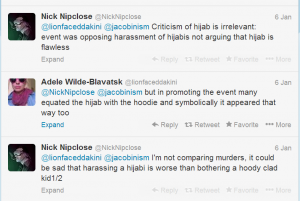 Nick Nipclose @NickNipclose
Criticism of hijab is irrelevant: event was opposing harassment of hijabis not arguing that hijab is flawless
Adele Wilde-Blavatsk @lionfacedakini
but in promoting the event many equated the hijab with the hoodie and symbolically it appeared that way too
Nick Nipclose @NickNipclose
I’m not comparing murders, it could be sad that harassing a hijabi is worse than bothering a hoody clad kid1/2
It struck me more forcibly than it had before what a horrible way to refer to a person or set of people that is. It’s so dehumanizing. She’s not a person, she’s the thing she wears to conceal her head because her religion treats it as an “obligation.”
It’s obvious that the guy doing it sees it as a particularly respectful way of talking, but it isn’t.
-
One Law for All, Southall Black Sisters, and LSESUASH statement
Joint statement on legal note to Universities UK against their guidance condoning gender segregation
We are pleased to learn of the legal note submitted to Universities UK (UUK) yesterday in the name of Radha Bhatt, a student of Cambridge University, against their Guidance condoning gender segregation. Legal note can be found here [pdf].
We share Radha’s apprehensions that gender segregation reinforces
negative views specifically about women, undermines their right to
participate in public life on equal terms with men and
disproportionately impedes women from ethnic and religious minorities,
whose rights to education and gender equality are already imperilled.Radha’s legal submission makes it unmistakably clear that despite
UUK’s protestations, the law could scarcely be more unequivocal on
gender segregation. The practice is specifically condemned by the
Equality Act as amounting to less favourable treatment of women. We
hope it will be noted that this condemnation applies equally to
‘voluntary’ segregation, a notorious misnomer used to pressure
students to comply with ‘Mixed’ and ‘Segregated’ zones.The existing rights legislation recognises that gender segregation
undermines the dignity of both men and women and creates a hostile,
degrading and humiliating environment. We hope Radha’s
representations will remind UUK of its Public Sector Equality Duty
towards the imperatives of eliminating discrimination, advancing
equality of opportunity and fostering good relations between those who
share protected characteristics.Abhishek Phadnis, President of the LSE SU Atheist, Secularist and
Humanist Society commented: “The beliefs of visiting speakers are no
excuse to legitimise discrimination against women or any group. We
applaud Radha for her principled and courageous stand, and hope that
UUK will heed her solicitors’ advice to redraft its guidance to
reflect the manifest illegality of gender segregation. Following up on
our rally against gender segregation
< http://freethoughtblogs.com/maryamnamazie/2013/12/12/uuk/>
, we are looking forward to continuing to work with Southall Black
Sisters, One Law for All and Fitnah – Movement for Women’s Liberation
to ensure that the rights of all students in the UK are fully upheld
at all times.”Pragna Patel of Southall Black Sisters commented: “We welcome the
legal advice which clearly states that UUK’s position on gender
segregation in universities breaches both domestic and international
human rights and discrimination law in substance and in process. We
note that not a single women’s rights organisation was consulted about
the guidance. Had it gone unchallenged, it would have had a profoundly
detrimental impact on black and minority women who already struggle to
assert their fundamental rights to education, freedom and
independence. The whole sorry affair is symptomatic of a bigger battle
waged by the religious right (aided and abetted by public bodies like
the UUK) to control women’s minds and bodies. We must remain alert to
the dangers of religious fundamentalism in all religions because its
very goal is to use public spaces to gain power and to destroy the
very principles of democracy and the universality of women’s human
rights.”Maryam Namazie, spokesperson for One Law for All and Fitnah –
Movement for Women’s Liberation said: “For too long, cultural
relativists have excused discrimination against women in the name of
‘respect’ for religious beliefs. Whilst the right to belief is
absolute, the right to manifest it is not. Equality must trump
religious beliefs, particularly if we want to respect human beings
rather than beliefs. Moreover, let’s not forget that Muslims are not
a homogeneous group. Endorsing segregation of the sexes means siding
with far-Right Islamists – like Hizb ut-Tahrir, the Federation of
Student Islamic Societies
< https://twitter.com/LSESUASH/status/419618999303819264/ photo/1>
, the Islamic Education and Research Academy and the Islamic Human
Rights Commission – at the expense of rights and equality of many
Muslims, ex-Muslims and others. We unequivocally support Radha’s
stand and will continue to fight for an end to gender segregation at
universities, including via teams of sex apartheid busters and a rally
on March 8th
< http://www.onelawforall.org.uk/8-march-2014-london-rally- and-march-against-sex- apartheid-london/>
.”You can find regular updates on our campaign here.
< https://www.facebook.com/pages/Separate-is-never-equal- Yes-to-equality-no-to- segregation/1389037734676086> For further enquiries please contact:
Maryam Namazie
One Law for All and Fitnah – Movement for Women’s Liberation
maryamnamazie@gmail.com
077 1916 6731
@maryamNamaziePragna Patel
Southall Black Sisters
Pragna@southallblacksisters.co.uk
02085719595
@SBSistersChris Moos
LSE SU Atheist, Secularist and Humanist Society
c.m.moos@lse.ac.uk
074 2872 0599
@LSESUASH -
One brave schoolboy gone
Aitzaz Hasan, 15, was with friends outside school when they spotted a man wearing a suicide vest.
Despite the pleas of his fellow students, he decided to confront and capture the bomber who then detonated his vest, his cousin told the BBC.
So that’s the end for Aitzaz Hasan, at age 15.
The incident took place on Monday in Ibrahimzai, a Shia-dominated region of Hangu, in north-western Pakistan. There were almost 2,000 students in attendance at the time of the attack, media reports say.
“My cousin sacrificed his life saving his school and hundreds of students and school fellows,” his cousin Mudassar Hassan Bangish told the BBC’s Aleem Maqbool.
I’m having trouble seeing the screen clearly enough to compose this post.
His family have also spoken of Aitzaz’s actions in Pakistan’s Express Tribune newspaper.
“My son made his mother cry, but saved hundreds of mothers from crying for their children,” Mujahid Ali, Aitzaz’s father is quoted as saying.
Damn this screen.
On Twitter, users are paying tribute to Aitzaz using the hashtags #onemillionaitzaz and #AitzazBraveheart echoing the language used online around figures such as Malala and the Delhi rape victim, whose death galvanised Indian public opinion and prompted changes in rape laws there.
Former Pakistani ambassador to the US Sherry Rehman tweeted:“Hangu’s shaheed Aitzaz Hasan is #Pakistan’s pride. Give him a medal at least. Another young one with heartstopping courage #AitzazBraveheart.”
Hangu is close to Pakistan’s semi-autonomous tribal regions, which have a strong Taliban and al-Qaeda presence and the area is also known for sectarian violence against Shia Muslims.
Wouldn’t it be nice if human beings would just stop killing each other over “sectarian” bullshit?
-
Their “obligation to accommodate”
A jaw-dropper from York University in Toronto.
After refusing to honour a male student’s request to be separated from his female classmates for religious reasons, a York University professor has found himself at odds with administrators who assert he broke their “obligation to accommodate.”
Say WHAT???
There’s an obligation to accommodate a male student’s request to be “separated” from female students? Are you fucking kidding me?
Do these administrators not realize where this goes? It goes back to what we’ve been struggling to escape from for centuries. Men getting “separation” from women means women are imprisoned in seclusion, purdah, the harem, the kitchen. It is not something that should be “accommodated” in a university or anywhere else public. (Except a church or mosque or temple? No, actually, not except those. If women don’t want to be separated, then no, I don’t think male requests for separation should be “accommodated.” But I get that that’s usually not something for outsiders to mess with [unless perhaps the women ask them to]. But on principle? No. No, I don’t think such requests should be accommodated, even in religious buildings.)
The professor ran the student’s initial memo past a Judaic scholar and two Islamic scholars, all of whom were puzzled by the request.
The Judaic scholar found no problem with an Orthodox Jew attending a co-ed group session. One of the Islamic scholars, in turn, declared simply, “unless he is asked to be physical with a female student, which I assume he isn’t, there is absolutely no justification for not interacting with females in public space.”
Mr. Grayson’s colleagues appeared to agree. At an October departmental meeting they passed a resolution forbidding any religious accommodations that contributed to the “marginalizations of other students, faculty or teaching assistants.”
And the student backed off. Grayson said the student was a reasonable guy. All was copacetic…except not quite.
Nevertheless, the rejection incensed university brass. According to Mr. Grayson, on October 18, he received a letter from the Dean of the Faculty of Liberal Arts and Professional Studies ordering him to accommodate the student’s wishes.
As per documents provided by the professor, one of the keystones of the Dean’s position is the assertion that allowing the student to opt out of female interaction would not affect the “experience of other students in the class”—provided the professor kept quiet about it.
Oh yeah? So of course Grayson, being a sociologist, surveyed his female students, who saw the matter rather differently.
The response confirmed his suspicions. Female students in particular reacted with outrage and even threats of legal action.
“What if the male student asked that the women be seated at the back of the class or on the other side of a partition so that he would not have to see them?” wrote one.
What if a white student requested separation from non-white students? The parallel is obvious enough, except apparently to the Dean of the Faculty of Liberal Arts and Professional Studies at York University…which is a pretty shocking state of affairs. “Liberal” Arts? Really? You sure about that?
The Dean dismissed the November survey, saying he was not “persuaded that other students’ political views on the subject are either a relevant or an appropriate consideration.”
“I am unpersuaded that it is even arguable that the non-participation of this one male student in group work affects in any way any other student’s human rights,” he wrote.
As York’s winter semester kicks off, said Mr. Grayson, the order is still standing.
“There’s been no reversal of position,” he said.
The Facebook page Separate is never equal urges writing to the Dean.
Dean of the Faculty of Liberal Arts and Professional Studies of York University Martin Singer ordered Professor Paul Grayson to “accommodate” the wishes of a student who requested to be separated from his female classmates for religious reasons.
Dean Singer said that allowing the student to opt out of female interaction would not affect the “experience of other students in the class”—provided the Professor Grayson kept quiet about it. In an October 18 email, the Dean specifically told Prof Grayson that if he was worried about the “course experience of our female students” he would make sure they “are not made aware of the accommodation.”
This is simply outrageous. The issue has not been resolved yet, so please email Dean Singer to tell him about our experience with gender segregation in the UK, how it affects vulnerable students and the huge reputational damage Universities UK had for condoning gender segregation.
martin.singer@yorku.ca
You can also tweet here: https://twitter.com/YorkUnews
You know your duty.
Update: there is a petition to sign. Well done Kiran Opal for creating it. Thank you Kausik for pointing it out.
-
Full bag or partial bag?
Pew did a survey on –
well this is how they titled the summary:
How people in Muslim countries prefer women to dress in public
Which is annoying, because there aren’t “Muslim countries.” Even the ones that have constitutions saying Islam is the official religion aren’t “Muslim countries”…
…but never mind, one knows what they mean.
Then again it’s annoying for another reason, which is that it sounds so bossy.
Never mind, never mind – what about the survey?
It’s depressing. Almost everyone in every country surveyed thinks women should have their heads bandages up to one degree or another. Lebanon did manage a whopping 49% who think no bandage at all is best, but even that is under half. In Saudi Arabia 63% opt for the black bag with a slit for the eyes.
-
The dangerous breadth and intrusiveness of these powers
Liberty is not happy about the Anti-social Behaviour Crime and Policing Bill.
The Anti-social Behaviour Crime and Policing Bill proposes to replace existing orders (such as ASBOs) with a new generation of injunctions which are easier to obtain, harder to comply with and have harsher penalties.
The Bill would also introduce unfair double punishment for the vulnerable, as social tenants and their families will face mandatory eviction for breaching a term of an injunction.
Other measures in the Bill include some restrictions on Schedule 7 stop and search powers which, while welcome, unfortunately come nowhere near addressing the dangerous breadth and intrusiveness of these powers.
The Bill also weakens key safeguards in our already heavily-criticised extradition system by removing the automatic right of appeal against extradition orders.
Another item to keep a beady eye on then.
-
Guest post on the Antisocial Behaviour, Crime and Policing Bill and free speech
Originally a comment by Dan Bye on He looked it up in a dictionary.
Those who think the law as written is potentially a danger to free speech are quite correct, and it’s also worth noting that it mirrors the law in relation to snail mail, originally dating to 1935, where case law has established (my source is the commentary in Halsbury’s Laws of England) that “The test of obscenity is objective and the character of the addressee is immaterial.”
In the wake of the Gay News Trial in the UK, the then editor of The Freethinker, the late great Bill McIlroy, was fined for sending copies of the poem through the post. He was hoping to trigger another blasphemy prosecution at the time, but the authorities sidestepped that embarrassment by using different legislation!
The current law in relation to post, if anyone wants to look it up is ss.85 of the Postal Services Act 2000:
(3) A person commits an offence if he sends by post a postal packet which encloses—
(a) any indecent or obscene print, painting, photograph, lithograph, engraving, cinematograph film or other record of a picture or pictures, book, card or written communication, or
(b) any other indecent or obscene article (whether or not of a similar kind to those mentioned in paragraph (a)).
Similar laws apply to telephone communication.
It’s also worth noting that there is case law in relation to all this, so you have to read the laws in relation to the way cases have been decided.
In relation to “menacing”, that was tested in the successful appeal in Chambers v DPP (the airport bombing joke on Twitter case), where context was found to be important. The judges in that case also said:
Satirical, or iconoclastic, or rude comment, the expression of unpopular or unfashionable opinion about serious or trivial matters, banter or humour, even if distasteful to some or painful to those subjected to it should and no doubt will continue at their customary level, quite undiminished by this legislation. Given the submissions by Mr Cooper, we should perhaps add that for those who have the inclination to use “Twitter” for the purpose, Shakespeare can be quoted unbowdlerised, and with Edgar, at the end of King Lear, they are free to speak not what they ought to say, but what they feel.
Which of course might help you win if you got to trial, but wouldn’t necessarily stop a prosecution in the first place.
“Grossly offensive” was tested in Collins v DPP (2006). According to Halsbury’s:
It is for the justices to determine as a question of fact whether a message is grossly offensive for these purposes, applying the standards of an open and just multi-racial society (ie via the application of reasonably enlightened, but not perfectionist, contemporary standards); and the words must be judged in the context of the message and all relevant circumstances
So whether something is “indecent” or “obscene” is an objective test based on community standards, but whether something is “offensive” can take other aspects into consideration.
Halsburys:
Whether a message falls into the category of grossly offensive depends on whether it is couched in terms liable to cause gross offence to those to whom it relates
and:
For an offence to be committed the defendant has to intend his words to be grossly offensive to those to whom they relate, or be aware that they might be taken to be so.
The Collins case, by the way, involved racist language via telephone and telephone answerphone to the office of an MP over 2 years. At the original trial the charges were dismissed, the language found to be offensive but not grossly offensive, and arising from frustration at the way his, Collins’, concerns were being dealt with. The DPP appealed, and won.
The judgment is worth reading.