Category: Notes and Comment Blog

  • Such a deep chord

    Kimberly Winston looks at why atheists got so het up about Oprah’s casual aspersions on atheists. (Well one reason is just that it’s something to do. If someone mentions us, we talk about it. If someone mentions it – atheism – we talk about it. But besides that.)

    Why has this struck such a deep chord? Ryan Cragun, an associate professor of sociology at the University of Tampa who studies atheists, said it may be because atheists are beginning to be more public about their lack of belief, seeing this as an opportunity to express their difference, their presence and their rights — much like the gay community has done before.”

    Well yeah. That’s what I said – we talk about it. Mention us or it, and we’ll talk about it.

    Marcia Z. Nelson, author of “The Gospel According to Oprah,” agreed, saying Winfrey may be exhibiting more unawareness than intolerance.

    “As I see it, Oprah was being her spiritually and professionally curious self,” Nelson said. “The problem atheists have is partly one of language; the God and religion people have been working on refining their descriptive languages for millennia. Oprah was actually doing atheists a favor by quizzing Nyad. Atheists need to concentrate more on expressing awe and less on taking hyperbolic offense where none is intended.”

    ARE YOU CALLING ME EASILY OFFENDED?!?


  • Women ____________________

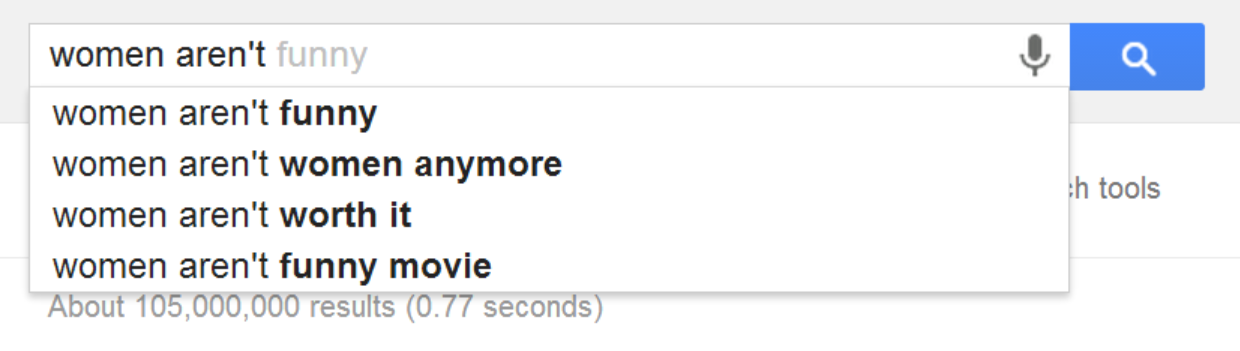
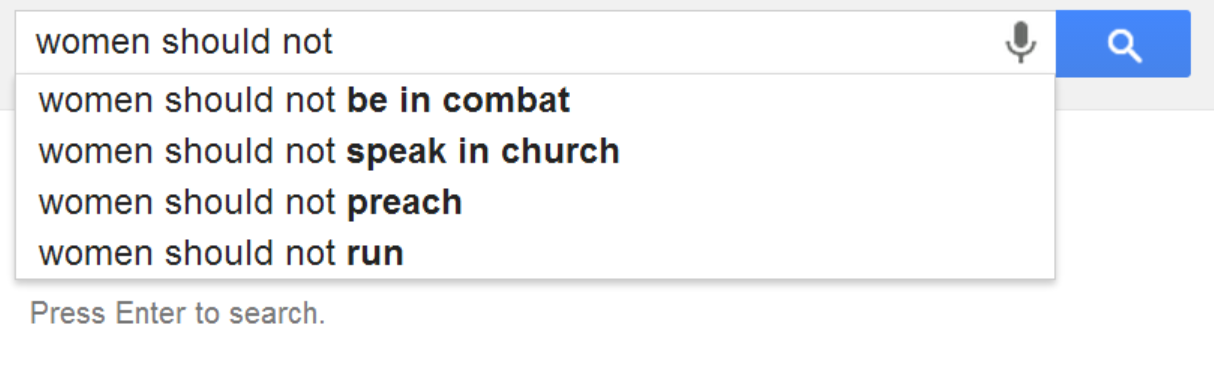
    No doubt you’ve heard about the Google search item.

    Here’s a simple and powerful campaign idea from UN Women using real suggested search terms from Google’s autocomplete feature. Campaign creator Christopher Hunt, head of art for Ogilvy & Mather Dubai, offers this summary: “This campaign uses the world’s most popular search engine (Google) to show how gender inequality is a worldwide problem. The adverts show the results of genuine searches, highlighting popular opinions across the world wide web.” Each ad’s fine print says “actual Google search on 09/03/13.” While Google users in different countries are likely to get different results, a quick test shows that several of these suggested terms definitely come up in U.S. searches. Since its creation, autocomplete has become a popular device for social debate and even inspired a recent epic visual from xkcd, but these ads do a stellar job driving home the daunting fact that enough people around the world share these vile opinions that Google has come to expect them.

    So I tried, and sure enough. Of course some of them will be people like me looking for nasty bullshit, but all the same.

    Check out the article for what the campaign did with some. Here are the ones I harvested.

    bb

    bbb

    bbbb

    Women should not put up with this crap.

  • Not to sit on the fence and bleat “balance”

    Rachael Dunlop wonders why the hell media stories about medicine include bullshit for “balance.”

    There’s a term to describe giving more time to opposing view points than the evidence actually supports – false balance.

    So okay, my “feelpinions” might get hurt, but does it really matter otherwise? Well yes, it turns out it does.

    A recent study reports that stories about vaccines that include false balance are actually more dangerous than those that are purely anti-vaccine. Yes, you read that correctly. Stories that offer both sides of the coin can have a greater negative influence on people’s decision to not vaccinate than those that are purely anti-vaccine.

    Why? Perhaps because they give an impression of genuinely divided opinion among experts.

    The Australian media, to their credit, have moved away from false balance in vaccine stories over the last few years. I like to think that grassroots campaigning has contributed to that, even if only a little. Certainly, I personally have made an effort to explain why false balance is bad and in some cases I’ve even declined to participate in stories if journalists insist on including anti-vaccine campaigners.

    I now know of a couple of mainstream media outlets who have policies of not speaking to anti-vaxers at all when they do science based vaccine stories, which is a fantastic result. Indeed, one prime time magazine-style programme issued this statement on their Facebook page following a complaint from a viewer about an appearance I made on the show to discuss a measles outbreak.

    Anti-vaccination is a fringe opinion. For every 5 doctors who oppose vaccination there are 95 who support it. We are not obliged to provide equal time and space to unscientific and dangerous viewpoints.

    But not everyone is that level-headed, and it matters.

    Recently, WIN television were reported to the Australian Communications and Media Authority (ACMA) for including false statements from a prominent anti-vaccine lobbyist in a news story about a measles outbreak. Media Watch’s Jonathan Holmes didn’t mince his words when he said:

    There’s evidence and then there’s bulldust. It’s a journalists job to distinguish between them, not to sit on the fence and bleat balance, especially when people’s health is at risk.

    Holmes’ last point really highlights the crux of the issue. In recent years in Australia, several babies have died from whooping cough as a result of outbreaks in areas where levels of vaccination are dangerously low. The media was also partly blamed for contributing to another measles epidemic in Swansea, Wales that persisted for eight months, resulting in a total of 1,219 cases and the death of one person.

    Large numbers of children in the 10-18 age bracket had not received their scheduled measles, mumps, rubella (MMR) vaccines, partly due to significant, uncritical coverage by the British media of false claims about the safety of MMR in 1998. The vaccine/autism claims were initiated by Andrew Wakefield who was subsequently struck off the medical register, his scientific study scratched from the record, and has gone onto be named by Time magazine as one of the “great science frauds” of modern history.

    Whilst no one gets hurt if you ask a flying carpet salesman questions about commercial flight, the consequences of people not vaccinating are real and potentially tragic. With vaccination, there is not debate. The science is in and the benefits far outweigh the risks. No balance required.

    Disagreeing over what flavor of ice cream to have for the party? Go for balance. Vaccinations? Do not go for “balance.”


  • Jumping

    A news item from Florida last week:

    Police on Monday arrested two girls, ages 14 and 12, in connection with the death of Rebecca Sedwick, who jumped from the top of an abandoned concrete plant last month.

    Authorities said the 14-year-old girl was Rebecca’s chief tormenter, and the girl posted a taunting message Saturday on the Internet about what had happened.

    “Yes IK I bullied REBECCA nd she killed her self but IDGAF,” the Facebook post read.

    What a horrible sentiment, if it’s hers or if it’s someone else’s pretending to be hers.

    According to Judd, the girl was upset that Rebecca had once dated her current boyfriend and began bullying and harassing her more than a year ago when they were both students at a Florida middle school.

    In addition to sending harassing messages over the Internet, the girl physically attacked Rebecca at least once, Judd said. She also recruited the girl’s former best friend — the 12-year-old charged Monday — to bully her, Judd said.

    Ironically enough, that Judd is Sheriff Grady Judd, who’s done some bullying of his own.

    Among the online messages that drove Rebecca to jump to her death were, “You should die” and “why don’t you go kill yourself?” Judd said.

    The night before Rebecca killed herself, authorities say, she messaged a boy she had befriended online, writing, “I’m jumping. I can’t take it anymore.”

    Judd, clearly upset about the incident, expressed frustration that neither girl’s parents were willing to bring them in for questioning. He said he was astonished to find out that the 14-year-old in the case was still being allowed to post to the Internet after what had happened.

    Dude, free speech.

    Norman said she blamed the parents of the two girls and the staff at the middle school. She and Rebecca reported the bullying to the school, she said.

    While bullying was not in itself against the law, Judd said, the girls’ actions allegedly harassing Rebecca in school and online formed the basis for the stalking charge. He did not expect any other charges would be filed.

    Clearly the school didn’t manage to do anything about it.

    First, do no harm. Second, try to prevent harm you can see happening.


  • It’s our word and you can’t use it

    Last week a Malaysian court ruled that people who aren’t Muslims can’t call their god “Allah” because that name is just for Muslims.

    The appeals court said the term Allah must be exclusive to Islam or it could cause public disorder.

    People of all faiths use the word Allah in Malay to refer to their Gods.

    Christians argue they have used the word, which entered Malay from Arabic, to refer to their God for centuries and that the ruling violates their rights.

    No because they stole the word. From Arabic. It’s not theirs and they can’t have it.

    Upholding the appeal on Monday, chief judge Mohamed Apandi Ali said: “The usage of the word Allah is not an integral part of the faith in Christianity. The usage of the word will cause confusion in the community.”

    The Herald editor Reverend Lawrence Andrew said he was “disappointed and dismayed”, and would appeal against the decision.

    “It is a retrograde step in the development of law in relation to the fundamental liberty of religious minorities,” he said.

    Plus it’s a frank admission that their god is a purely local god, not a universal one. That seems like shooting themselves in the foot, but whatevs.

  • “It just didn’t go the way we wanted it to go.”

    There’s this Evangelical church near Sacramento, Adventure Christian Church. Last weekend the church hosted a debate between David Marshall, a Christian author, blogger and founder/director of the Kuai Mu Institute for Christianity and World Cultures, and Phil Zuckerman, Professor of Sociology and Secular Studies, Pitzer College in Claremont, California, who reports how things went.

    The question at hand: “What provides a better foundation for civil society, Christianity or Secular Humanism?” David Marshall took the Christian position, and I took the secular humanist position.

    There was advance planning for months. They provided nice snacks.

    I was repeatedly told — via e-mail, as well as in person — that not only would the debate be video’ed by their expert video team, but the video of the debate would be posted on vimeo soon after the debate.

    And so we had the debate. And I won. Now, that’s not my opinion — its the opinion of Adventure Christian church, because they now refuse to post the video on-line.

    Instead, what they’ve done is post a series of rebuttals to the debate — refutations and criticisms. But they won’t post the actual debate. And they’ve disabled my ability to even comment on their posted refutations.
    When I called pastor Bryan, and asked him why they are refusing to post the video — even after repeated promises of doing so — he replied, “It just didn’t go the way we wanted it to go. We were not represented well.”

    Thus neatly demonstrating that Christianity of the more absolutist variety (at least) is not good at doing civil society.

    Does that sound familiar? Yes, it does. Two years ago, Jerry Coyne debated the theologian John Haught and then Haught refused to let the video be released. I did a post about it at the time.

    Zuckerman is surprised and disappointed at Adventure Christian church, but not willing to tar all evangelicals with the same brush.

    I don’t think all Evangelicals are like those at Adventure. I am sure that there are many, many evangelical Christians who keep their word, are open to debate and dialogue, and have the courage of their convictions.

    But, unfortunately, that wasn’t my experience at Adventure Christian Church. They are indeed afraid to air the underling truth of my position: that no civil society can thrive if it does not exist upon a bedrock of democracy, and democracy is not a Christian value — it is not articulated anywhere in the Gospels, nor is it promulgated, in any way, by Jesus or Paul. Rather, democracy is a secular humanist ideal — something dreamed up and established by and for people.

    But the good pastors at Adventure Christian church would you prefer not to know that!

    There are Christians who claim – indeed, insist – that democracy is a Christian value and that we wouldn’t have it if it weren’t for Christianity. I think that’s bullshit, but counterfactuals are hard to rebut.

  • Still raw

    A scorching comment from “Janis” on Erin Podolak’s post on not looking away from difficult embarrassing issues like sexual harassment.

    It gratifies me beyond belief after leaving behind the career I’d wanted since I was 4 (and been more than qualified for) some two decades ago because the atmosphere was simply so poisonous I couldn’t get anything done, to see that this is finally being talked about.

    It depresses me more than I can say that, twenty years later, it still needs to be said.

    I am sick of the locker room.  I am sick of the “this is our space and you’ll play by our rules” attitude.  I’m sick of pathetic excuses being made for people who have achieved middle age and hence can be damned well expected to know when they are being unpardonably OBNOXIOUS.  A grown man who doesn’t realize that nonstop sexual conversation will make the young women around him cringe?  GMAFB — he’s not a toddler.  He damned well knows what he’s doing.

    I am also sick of the unsubtle message that’s communicated to women that there can be only one “girl” in the room at a time, because it sets us against one another if we’re all competing only for one spot.

    And I am sick and tired enough to SCREAM over the lip-service being done to attracting women to STEM careers that glosses over the fact that this horseshit is a HUGE part of why women don’t go into or aren’t retained in STEM careers.

    I am SICK AND TIRED of the chipper, cute little commentary about “telling girls it’s cool to be in science!” and the stupid interviews with women at NASA that always make sure to ask them, “Did you *gasp!* like math?” with the implication shoveled at girls — who are all completely incompetent at math, right? — not to worry, girls!  You can stink at math and still work at NASA!  I’ve never once read an interview with Mohawk Guy or Adam Steltzner that asks them, “So here’s your chance to say that you suck at math so men who can’t add two and two can still feel heartened that there’s a place at NASA for them.”

    I’m tired of having the “problem” of women in STEM being equated to a problem with WOMEN.  They’re not confident enough! Their too scared at being thought uncool!  They’re too stupid at math and think they can’t work there!  They think it’s not girly pink-n-frilly enough!

    Never once is the idea even floated that maybe, just maybe, they get treated like shit by the men there and often abandoned by the lone woman who’s afraid of losing her Queen Bee status as the only woman allowed in the room.

    Not enough women in STEM?  Gosh, what’s wrong with them?

    Here’s a possibility: NOTHING.  Maybe we can ask what’s wrong with STEM instead?

    Sorry — that was quite a rant.  But after twenty years, this is still raw and leaves me sputteringly angry.  The older I get the angrier I get — age does not bring serenity when I see young girls and women still going through this fucking shit after I’ve started going grey.  Call me bitter, I don’t fucking care anymore.  I’ve spent the last two decades trying not to tell myself that Mother Nature made a mistake putting a brain like mine into the body of a creature destined to never be taken seriously, so if you call me bitter thinking it’s some conversational secret weapon that will make me collapse in a pile of little girly tears, you’re a fucking amateur.

    Sorry for the profanity.

    It was supposed to be better by now. Wasn’t it? I thought it was.


  • Not so fast, there, Syria – there’s more

    Because things aren’t bad enough yet in Syria.

    The World Health Organization says it believes polio has erupted in war-torn Syria, a dire development in the fight to eradicate the disease.

    The Geneva-based agency says a cluster of more than 10 paralysis cases have been detected in Deir Al Zour province in eastern Syria, a contested area of the country.

    The WHO’s senior official for polio eradication says initial tests indicate polio is the cause, and efforts to address what could be a crisis situation are being geared up.

    Dr. Bruce Aylward says the potential exists for a large scale outbreak that will take some time to bring under control.

    That’s because the collapse of health services during the civil war has meant there are young children in Syria who haven’t been vaccinated.

    Where there’s misery, there will be more misery.

    While polio remains endemic – meaning transmission has never been stopped – in only Pakistan, Afghanistan and Nigeria, several countries this year have seen spread of polio resume as a result of imported viruses. Among them is Somalia, where polio vaccination efforts were abandoned for four years because of conflict in the southern part of the country.

    Misery—>worse misery.

  • Occupational hazard

    Some skeptical questions that are less than useful.

    • Why should I do no harm?
    • Why should I care what other people want?
    • If it’s fun for me to make fun of fat people on the bus, why shouldn’t I go ahead and do that?
    • If I can trick people into giving me all their money to “invest” why shouldn’t I do that?
    • If I enjoy sex with children why shouldn’t I have it?
    • If I’m a priest why shouldn’t I use that as a way to get access to children to have sex with?
    • Why should I inconvenience myself to help someone else?
    • Why should I worry about the working conditions in the factory where my inexpensive Tshirt was made?
    • Why should I care about the problems of people in Bangladesh or Somalia?

    There’s an infinite number of questions of that type. They’re not skeptical in the sense of taking a hard look at pseudoscience or woo or fairy tales, but they’re skeptical in the philosophical sense.

    This is probably one reason organized skepticism can attract a lot of assholes. It doesn’t always happen, but it’s a hazard.

  • Archiocese v Girl cooties

    Oh no, a girrrrrrrul wants to play a sport that’s supposed to be only for guys! This must be stopped, at least according to the Archdiocese of Philadelphia.

    My name is Amanda. I’m a 16 year old Catholic school junior at Archbishop Ryan High School in Philadelphia. I love martial arts including wrestling, jiu jitsu, and muay thai. I want an equal opportunity to wrestle in school, but the Archdiocese of Philadelphia says no. I’m being discriminated against just because I’m a girl.

    This November will be the inaugural season for our school’s wrestling team. Everyone’s excited, and I want to be part of it because I love the sport and hope to get a college scholarship for wrestling. I train twice a day most days of the week and am involved in anti-bullying programs to help empower people. It’s not fair that being a girl denies me the opportunity to compete at school despite having years of experience in mixed-martial arts.

    No it’s not. The link is to a petition. You can sign it.

  • The fast depleting tribe of genuine human rights activists

    More from Nigeria on Baba Omojola.

    President Goodluck Jonathan has condoled with the government and people of Ondo State on the death of the highly respected pro-democracy activist and renowned economist, Dr. Baba Oluwide Omojola.

    A press statement by the Special Adviser to the President on Media and Publicity, Dr Rueben Abati, said the President extends his sincere condolences to Dr. Omojola’s immediate and extended family, friends, associates and professional colleagues of the late nationalist, patriot and indefatigable advocate of good governance who dedicated his life to the pursuit of social justice and a better life for others.

    The President noted that Baba Omojola remained  faithful to the cause of justice, equity and progress for all Nigerians till the end of his life.

    The kind of person the world needs more of.

    Governor Olusegun Mimiko has described the late Baba Omojola as a committed, bold and resourceful human rights crusader and nationalist.

    Mimiko said this in a condolence message to the immediate and ideological families of the late Baba Omojola.

    The Governor in a statement by his Chief Press Secretary, Eni Akinsola, said his death is not just a sad loss to the family but an unfortunate departure from the fast depleting tribe of genuine human rights activists and nationalists with conscience.

    Mimiko, in the statement, said: “Baba Omojola represented the best of the generation of human and political rights activists who never compromised in the face of serial treachery and consistent oppression of the ruling class.

    “He was dogged, committed, resourceful and unwavering. His was a life lived in moral decency, material modesty and social and political relevance. He was brave, bold, strong and reliable. He will be sorely missed.”

    I wouldn’t have known about him if it weren’t for Yemisi. I’m grateful that Freethought blogs has a strong internationalist bent, so that now I do know about him.

  • Purity and contamination

    One of the things we get accused of a lot – we feminists, we “social justice warriors,” we “#FTBullies” – is puritanism.

    A new puritanism is on the march, and just as in the case of the old puritanism, its leaders are unconscionable bullies.

    That’s a tweet from one of the regulars. It’s typical of the genre in its scare-mongering – note the sinister overtones of “on the march” coupled with puritanism, which is made explicit at the conclusion.

    Does the accusation have much merit? Let’s try to figure it out.

    What kind of purity is at issue? Political purity, or doctrinal purity, I take it. Feminism as opposed to anti-feminism, and so on for other identities. We’re accused of being purists or even puritans because we don’t want to collaborate with anti-feminists or racists or homophobes, and the like. It’s true that we don’t want to, those of us who don’t – it’s true that there are people who fit that description. So the question is, is it reasonable to call that puritan or purist?

    I don’t see it, myself. I don’t think it’s a matter of taint or pollution, it’s a matter of not wanting to interact with people who have contempt for the brand of person you are.

    Looked at that way, it’s even possible that the puritanism is the other way around: that people of the top caste don’t want their groups or movements polluted by underlings like women and other races and incorrect sexual orientations, or by people who agitate for the fuller inclusion of such people.

  • Rape culcha? Wozzat?

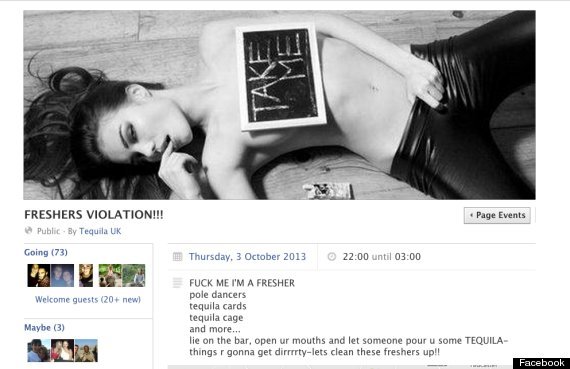
    Ask Tequila UK.

    The controversial Leeds club night which used a pro-rape video to promote its events was previously banned from a club in Newcastle, it has emerged.

    Tequila UK has been slammed for using a video featuring a man who expressed his intentions to rape a female student.

    tequila uk

    Educational innit.

  • And give to the poor

    So in Germany people are cross with the bishop of Limburg, who treated himself to a very pricey new place to live at the expense of none other than Jesus’s own Catholic church.

    he €31-million bill for Franz-Tebartz Van-Elst’s residence, including €15,000 on a bath tub and €350,000 on built-in-wardrobes, has put the finances of the Catholic Church, much of which comes from taxpayers and state subsidies, into the spotlight.

    Carsten Frerk, an outspoken critic of the Catholic Church in Germany, estimated its wealth at around €430 billion with about €140 billion of that in capital, the Frankfurter Allgemeine newspaper reported.

    You’re starting to talk about real money there.

    The opaqueness of the church’s finances was no surprise to Frerk. “For the big churches, transparency is very damaging to their business plan. Nobody wants to donate to a rich organization,” he said.

    Ah no, no they don’t!

    The church’s largest public form of income is the “church tax”, a system whereby taxpayers register their membership of a church or religious group, and a percentage of their tax goes to that church.

    The tax dates back to the medieval tithes, a one-tenth share of goods collected by churches in the Middle Ages.

    Anti-Church campaigner Peder Iblher told The Local there was little appetite among the country’s main parties to reform or scrap the “church tax”.

    “All attempts to bring into question the church tax fall on deaf ears with conservatives, but also with large parts of the SPD,” he said.

    Germans may avoid the tax by registering as having “left” the church, but it costs money to do so – in strongly-catholic Bavaria, opting out will set you back €31 in fees.

    That is one hell of a racket they’ve got going.


  • Owooooo

    There’s this tv add I’ve seen a few times, and if I’ve seen it a few times that means it’s been aired like a million times.

    See a problem here?

    http://www.youtube.com/watch?v=ANhmS6QLd5Q

  • Comrade Baba Omojola

    A giant of the Nigerian left and a beloved friend of Yemisi’s died suddenly today. From Sahara Reporters:

    A renowned pro-democracy activist and prominent economist, Baba Omojola, has died in Akure, the capital of Ondo State.

    Mr. Omojola, who earned a PhD, died a few hours after submitting a presentation to the National Dialogue Committee in Ondo State early today.

    Baba, as he was famously known, was a prominent figure during Nigeria’s pro-democracy struggles of the late and early 1990s.

    Mr. Omojola was one of five activists known as “Kuje Five” who were arrested and clamped into military detention after Nigerian students engaged in massive protests to force out the Ibrahim Babangida dictatorship in 1992.

  • Daisy Coleman speaks up

    Daisy Coleman is the teenage girl at the center of the Maryville rape storm, and she wants to tell the world what really happened.

    She was 14. She had her best friend Paige, who was 13, over for the night to hang out and watch scary movies – and drink alcohol, against her mother’s known wishes and rules. She was texting with an older boy her brother had warned her about. Update: That looks censorious, and that’s not what I meant. I meant to summarize so as not to paste in the whole article, and to give all the relevant facts. I needed to include both the drinking alcohol and the fact that it wasn’t with parental approval.

    It wasn’t until later that night that Matt, a popular senior boy, had asked to hang out. Of course, I knew my brothers wouldn’t allow this so, we had to sneak out. It was about one in the morning when my friend and I climbed out of my bedroom window. 

    Dumb move. I can imagine what it felt like at the time though – an adventure; exciting; a secret. Update: As above. Just editorial comment – yes, obviously that was a dumb move, but I remember that teenage longing for adventure.

    There were bedrooms and a living room area in the basement. I sat on the couch and gathered familiar faces from the room. Four of Matt’s friends were there. Matt emerged from one of the bedrooms with a bottle of clear alcohol he wanted me to drink. This is when one of Matt’s friends suggested I drink from a tall shot glass, which they labeled the “bitch cup.”

    About five shots tall, I drank it. I guess I didn’t know how badly it would mess me up. But the boys who gave it to me did.

    Then it was like I fell into a dark abyss. No light anywhere. Just dark, dense silence — and cold. That’s all I could ever remember from that night. Apparently, I was there for not even an entire hour before they discarded me in the snow.

    Not a fun adventure. Her life turned to shit. Update: She did a couple of silly things, as teenagers do, and the boys at that party did horrible, callous, brutal things and turned her life to shit. It is the boys who are at fault, not Daisy and Paige.

    I was suspended from the cheerleading squad and people told me that I was “asking for it” and would “get what was coming.”

    Why would I even want to believe in a God? Why would a God even allow this to happen? I lost all faith in religion and humanity. I saw myself as ugly, inside and out. If I was this ugly on the inside, then why shouldn’t everyone see the ugly I saw?

    I burned and carved the ugly I saw into my arms, wrists, legs and anywhere I could find room.

    On Twitter and Facebook, I was called a skank and a liar and people encouraged me to kill myself. Twice, I did try to take my own life.

    When I went to a dance competition I saw a girl there who was wearing a T-shirt she made. It read: “Matt 1, Daisy 0.”

    Gee, Daisy never knew she’d entered a competition.

    Since this happened, I’ve been in hospitals too many times to count. I’ve found it impossible to love at times. I’ve gained and lost friends. I no longer dance or compete in pageants. I’m different now, and I can’t ever go back to the person I once was. That one night took it all away from me. I’m nothing more than just human, but I also refuse to be a victim of cruelty any longer.

    This is why I am saying my name. This is why I am not shutting up. Matt put on Twitter something recently. It read: “If her name begins with A B C D E F G H I J K L M N O P Q R S T U V W X Y Z, she wants the D.”

    Since Anonymous has gotten involved, everything has changed. #justice4Daisy has trended on the Internet, and pressure has come down hard on the authorities who thought they could hide what really happened.

    I not only survived, I didn’t give up. I’ve been told that a special prosecutor is going to reopen the case now. This is a victory, not just for me, but for every girl.

    I just hope more men will take a lesson from my brothers.

    They look out for women. They don’t prey on them.

    A simple, good rule.

  • For Norm Geras: What is it like to be a blogger?

    My contribution to Thinking Towards Humanity: themes from Norman Geras, Manchester University Press, 2012.

    What is it like to be a blogger?

    Hume famously observed that it is not contrary to reason to prefer the destruction of the whole world to the scratching of his finger. He wasn’t expressing a whimsically inflated sense of his own importance, but pointing out that logic doesn’t determine how we weigh the world versus our finger. We have to love the world in order to be able to weigh it properly. Looking it up in a table of weights and measures won’t do the job – we could see the arithmetic and still shrug and say yes but it’s my finger, the world is none of mine and I don’t care. We have to care in order to make choices properly – to make them in such a way that we don’t place our own petty desires above everyone else’s deepest needs. (We have been learning lately, if we didn’t already know, that bankers and investment wizards could use some intensive training in this.) Morality is rooted in feeling, Hume told us, and researchers such as Antonio Damasio and Jonathan Haidt have been elaborating on the idea recently.

    To be moral we need feeling, we need the right kind of feeling, we need educated feeling – we need to do what Martha Nussbaum called ‘cultivating humanity.’ It is arguable (and many people have argued) that the education of the feelings, and in particular sympathy, is one thing that literature and story-telling can do better than anything else. Numbers, by themselves, don’t tell us enough; ‘100,000 women raped and killed’ has less force than a pain in our own finger; but a story about one woman raped and killed can turn us inside out. In a world where ‘100,000 women raped and killed’ is no invented paradigm but a brute fact, along with row upon row of similar facts, clearly anything that can help to cultivate sympathy and empathy is of the highest value.

    The primatologist Frans de Waal notes in Our Inner Ape, citing research on children and empathy by Carolyn Zahn-Waxler, that empathy precedes language. Zahn-Waxler has found that children a little over the age of one year respond to feigned sadness, pain or distress in family members, and attempt to comfort them. Cognition and feeling mix, and the mixing is all important. Few animals can do it, even a little, as De Waal observes:

     All scientists who’ve set out to find consolation in monkeys have come up empty-handed…Monkeys fail to provide reassurance even if their own offspring has been bitten. They do protect them, but show none of the cuddling and stroking with which an ape mother calms down an upset youngster.

    Monkeys, it appears, are more like the autistic narrator of Mark Haddon’s novel The Curious Incident of the Dog in the Night-time, who describes human anguish as one might describe a cloud-burst.

     And then Mother said, ‘Oh my God.’

    And then she didn’t say anything for a long while. And then she made a loud wailing noise like an animal on a nature programme on television.

    And I didn’t like her doing this because it was a loud noise, and I said, ‘Why are you doing that?’

    Empathy is all-important (yet, De Waal notes, until very recently scientists lumped it ‘with telepathy and other supernatural phenomena’) and anything which promotes and strengthens and expands it is of the greatest importance. The haunting final book of The Iliad illustrates this, when Priam begs Achilles to remember his own father and in doing that to pity Priam’s grief for his own son – and it works: Achilles consents to let Priam retrieve Hector’s body, and the two of them mourn together.

    Literature and the liberal arts have long been seen as one way, or the way, to cultivate these capabilities – to awaken and foster what the Eighteenth century called ‘sensibility.’ Hardness and indifference were thought to be incompatible with a taste for Cowper. That is far too easy, of course; we know all about the cultivated slave-owner or colonial administrator or Nazi officer who read Aeschylus or Goethe in the morning and had someone whipped in the afternoon. But the effect needn’t be as lawful and predictable as a pharmaceutical to be real. In a world where lapses into brutality seem to beckon on every corner, anything that gives people experience of empathy and compassion must be of value.

    Story-telling is not the only thing literature can do, however, and literature is not the only source of story-telling. Movies and television are full of stories (though often ones that convey the thrill of violence and leave suffering and empathy out of the picture). Journalism relies heavily on stories to build a bridge between ‘100,000 raped and killed,’ and felt human misery. Parallel to journalism, another rich source of an inward, subjective view of human experience and suffering is the personal diary. It’s a great pity that Western literature took so long to come up with the idea – wouldn’t we love to have a diary of Euripides, Augustus, Shakespeare, of merchants, soldiers, farmers going back many centuries. Historical novelists have been inventing some, but how we would love to have the real thing.

    We don’t have the real thing going far back in time, but we do have a new abundance of contemporary diaries in the form of blogs; they travel only a few years back in time but they reach out widely in space. Blogs can’t tell us anything directly about the inner life of a victim of the Inquisition or the Black Death or a 6th century invasion, but they can tell us a lot about the inner life of someone in Khartoum or Baghdad or Peshawar right now.

    There is a lot of journalistic condescension toward the genre, which is perhaps inevitable between the paid and the unpaid, but it overlooks the usefulness (to put it crudely) of this new window.

    Many writers prefer the formal, finished, professional, impersonal work to the loose unbuttoned conversational essay or diary. None but a fool ever writes except for money, Samuel Johnson said with characteristic bluntness, and his young friend Boswell was a bit of a fool, artlessly filling his diary with his furtive sexual bargains, his toadying, his dreams of glory. But how fortunate for us that he did. Another way of looking at the blog is that it is not merely a slovenly intrusion on the guild, but a vast sample of our contemporaries’ inner lives of a kind that no one has had before.

    One of many recurring themes on Norm Geras’s blog is the myopia of critics of the genre – the genre as such rather than particular instantiations of it – who focus on potential or actual flaws while ignoring potential and actual virtues. Of course, a genre with no barriers and no editors is just that – but boring badly-written self-obsession is not the only outcome. It turns out not to be true that none but a fool ever writes except for money.

    But we already knew that. Pepys wasn’t paid to write his diary, nor was Kilvert paid to write his, nor was Keats paid to write his letters. What of it? They are now valued a good deal more highly than any number of salaried works.

    The flaw in Johnson’s dismissal is that not everything worth saying can command a market. Voluntary writing, writing done for its own sake, may be mere self-indulgence, or incompetent, or of interest to no one but the author, but that is not the only possible outcome. The great advantage of voluntary writing is freedom from other people’s agendas and constraints, and some people – many people, in fact – make good use of that freedom.

    Just for one thing, paid commissioned writing has a pre-determined size and shape, which conform to existing conventions – the short article, the long article, the story, the novel. There’s little if any market for a single paragraph – but it is perfectly possible to have an interesting single paragraph to say. There’s no law of nature that says a single paragraph is inherently too small to bother with; it’s just not a publishing convention. (The New Yorker’s ‘Talk of the Town’ is one home of the very short piece, but that’s an exiguous niche.) Weblogs (to give them their full baptismal name) offer a capacious platform for brief observations, thoughts, overheard remarks; they make it possible to think, dreamily, that nothing is lost.

    They also offer a platform for long pieces, and middle-sized ones, and any combination of short and long and medium one chooses. The weblog is, in short, a new literary genre, a new branch of the liberal arts – an expansive, flexible, always-evolving, shape-shifting, liberating genre. It is like the novel in this. The novel has always been the antithesis of Aristotelian rules governing dramatic unities – capable of jumping from continent to continent, from century to century, from narrative to reflection to dialogue, with an involved author or a distant one. Blogs have the same ability to make their own rules on the fly.

    In that sense blogs have a kind of natural alliance with human rights. It is possible for conservatives and theocrats hostile to the concept of human rights to be bloggers, but the fit is inherently uneasy. The two endeavours fight each other. Blogging is an undeferential activity, so a deferential mindset or an authoritarian one will feel out of place practicing it. This intuition is backed up by the fact that authoritarian regimes make a habit of arresting bloggers – China, Saudi Arabia, Iran, Egypt, Burma to name a few.

    Norm Geras’s blog fits into this situation as a key fits a lock, by being just the kind of blog that authoritarians fear most, because it is everything that the authoritarian mind is not: broad, curious, reasonable, argumentative, inquiring, thoughtful, ironic, secular, and adamant about the importance of human rights. It is in short a conspicuously liberal blog, and this in more than one way, yet the ways are interconnected.

    It is liberal in the obvious sense in that it is very often focused on issues to do with human rights, interventionism, tyranny and what to do about it, international law and justice, war crimes, universalism and the like. But it is also liberal in the way it approaches such issues: via measured argument as opposed to vituperation and misrepresentation, and via open unfettered inquiry rather than by peremptory demands for conformity or silence. And in the broadest and most basic sense it is liberal in the breadth of its interests. Along with discussing liberal politics it also converses about the liberal arts – literature, jazz, cricket, films, popular music.

    Cricket at first blush may seem to have nothing to do with human rights (although in fact authoritarian terrorists have recently been targeting, precisely, international cricket matches), but games and recreation and play are part of an expansive rights-based conception of human beings. Other ideas conceive of humans as tools or slaves or disobedient subjects, whose pains and pleasures don’t register on the tyrant’s meter. A universalist egalitarian liberal picture of our species empathizes with and relishes its pleasures, it achievements, its works of art, whether the poem, the film, the well-played match, the song.

    To put it another way, a somewhat therapeutic way, it seems plausible that fostering an enthusiasm for a variety of kinds of human accomplishment is one way to foster a profound reluctance to smash human beings in large (or small) numbers. Norm Geras’s blog is one place where a new branch of the liberal arts shows how a passion for various human games and concern for human rights can join hands and work together.

  • Nick and Norm

    Nick Cohen at the Spectator blog, on Norm Geras:

    I was shocked this morning to log on to Twitter and learn that Norman Geras had died. I can think of few political writers, who have influenced me more comprehensively. Whenever I faced a difficult moral question, I would at some point think ‘ah, what is Norm saying about this,’ go to his blog and see that Norm had found a way through.

    Last year Norm’s colleagues Stephen de Wijze and Eve Garrard published acollection of essays in Norm’s honour. I was flattered when they asked me to write about Norm’s dual life as Manchester University’s Emeritus Professor of Politics and one of the first writers to embrace the Web.

    As a tribute to him, I reprint it below.

    Ah. I too contributed an essay to that collection (and I too was flattered to be asked). I can do that as a tribute too. So I will.

    For this post – appreciate Nick’s.

    Monday 28 July 2003 Normblog began.

    Norman Geras, Emeritus Professor of Politics at the University of Manchester, dispensed with his titles and became Norm – the proprietor of and sole writer for Normblog. “In the immortal words of Sam Peckinpah ‘Let’s go’,” he declared – and off he went.

    As Geras is most certainly not a conservative in his politics, his embrace of the freedom the new medium allowed is not as surprising as it seems. “I only really got wise to the blogosphere earlier this year during the lead-up to the war in Iraq,” he explained in his first post. “I began to acquaint myself with other blogs, following the links from one to another in pursuit of the debate that was taking place on this subject. My desire to do so was strengthened by the fact that, since September 11 2001, I’d come to find much of what was appearing on the opinion and letters pages of my daily newspaper of choice [the Guardian] repellent. And as a supporter of the war for regime-change reasons I was also less than comfortable with the balance of views I was encountering in the circles, professional and social, in which I move.”

    I could fill the rest of this book with describing what was wrong (and remains wrong) with the liberal consensus which turned Professor Geras into Blogger Norm. A short list includes: its unwillingness to support the victims of psychopathic regimes and movements if their suffering cannot be blamed on the West; a concomitant and inevitable failure to hold onto the old leftish virtue of solidarity with those who share your principles when they are suffering at the hands of ultra-reactionary forces; a preference for the status quo, even when it is intolerable; and a relativist willingness to tolerate abuses in other cultures you would never tolerate in your own, which is really just parochialism dressed up in its Sunday best.

    Plenty to argue about, but where to argue? As Geras half-recognized when he described his discomfort he felt about the arguments he was hearing in his circles, social pressure can be the most powerful and debilitating force in intellectual life. If everyone you know, every newspaper you read, every person you once admired is all saying the same thing, it takes an effort of will to argue back. As important – and I speak from experience here – it is hard to disagree rationally; to break from a consensus with intelligent arguments rather than instinctive revulsion. Unreflective consensual thinking is, I believe, more prevalent in England than in any other European democracy because the media are centralised in the capital. Everyone knows everyone else: they talk with, work with, socialize with and, on occasion, sleep with members of their tribe.

    The result is stale conformism.

    For some purposes, I think, consensus is a good thing. I’ve talked about this often. There’s a stale conformism about the idea that it’s wrong to torture people for the lolz, for example. You need some stale conformism of that kind to avoid living in a hell on earth where brutal sadistic violence lurks around every corner. But you want to keep the stale conformism as minimal as possible.

    Which is, more or less, what my essay for Living Towards Humanity is about, so I’ll post that now.