Category: Notes and Comment Blog
-
A bumpy week
Laura Helmuth wrote about it in Slate yesterday.
I take back every bad thing I have ever said about Twitter. It’s fast, responsive, and efficient, and it’s the medium of record when gossip breaks. Like pretty much every other science journalist in the world, I’ve been glued to Twitter for the past several days. It all started when a biologist named Danielle Lee, who writes a blog called the Urban Scientist, tweeted that some minor-league editor had called her an “urban whore.”* Really, that is what he called her. To show support for her, people started renaming their own blogs with the word whore using a #WhoreItUp hashtag. The insult was infuriating and the response heartening, but things got more serious whenScientific American removed Lee’s blog post about the exchange. The magazine issued a misleading explanation, then an apology, then it finally reposted her story with a not entirely satisfying update.
Then it got better. I mean, sorry, it got worse—what follows is all terrible and sad. But it’s also fascinating and useful to examine. A writer named Monica Byrne wrote on her blog about being harassed by one of the most influential people in the science blogging world, Bora Zivkovic. He founded an extremely popular conference for science bloggers, established science blog networks at various publications, and now (at least as I write) runs the well-respected collection of blogs at Scientific American. His nickname is the Blogfather. One common route into a science writing career in the past several years has been through Zivkovic: He routinely publishes young writers and promotes their stories with his large social media audience. Zivkovic has always been extremely solicitous of young journalists, generous with his time, charming, enthusiastic, gregarious. A Twitter meme popped up at science blogging conferences: #IHuggedBora.
And now all that is looking somewhat different, as Ibis said in a comment at Stephanie’s.
And with all the good Bora’s done mentoring women in their science comm careers… he could have done SO MUCH BETTER by leaving all of them at peace to do their work
Maybe it’s worse than that. Maybe the only reason he mentored women at all was so as to give himself ready access to a pool of women to sexually harass (& exploit?). Not unlike the way predators of children volunteer to be scout leaders or big brothers or church youth group leaders or community centre mentors of disadvantaged young people.
I hope that’s not the case, but I sure as hell can’t tell it’s not.
Zivkovic has a lot of friends, and after Byrne’s story went public, many of them expressed support for him, and others questioned Byrne’s decision to name him.
Zivkovic admitted to the incident, apologized, and said it was not “behavior that I have engaged in before or since.”
Only apparently it was. Another science writer, Hannah Waters, then described similar experiences:
I saw him at various events and he began flirting a little. It didn’t ring any alarm bells; he is flirtatious by nature. But sometimes talk would veer into more uncomfortable territory, but only vaguely uncomfortable, which made it hard to call out.
And then today there was yet another, and it became all too clear that it wasn’t a one-off but a settled script, a pick-up line.
Helmuth went on:
Waters and Byrne were careful to be precise and not exaggerate what happened to them, which is that they felt very uncomfortable when their conversations with one of the most powerful people in their profession turned sexual. They weren’t raped or groped, and they suffered no obvious career setbacks by failing to take Zivkovic up on what they perceived as the implicit request for sex. But they felt lousy and confused. Here’s what I found most distressing in Waters’ post: “At my most insecure moments, I still come back to this: Have I made it this far, not based on my work and worth, but on my value as a sexual object? When am I going to be found out?”
Exactly – that’s the part I singled out too – he blew a big hole in their confidence, for the sake of his own sex-jollies. That is crap.
I told Waters directly and repeat here that she and Byrne are talented writers who are not faking it. But of course they wonder about how their career trajectories will be perceived, and I’m sure many other people who have gotten a break or a boost from Zivkovic have the same nagging worries.
Here’s how the score stands after several days of turmoil. The racist and sexist blog editor who called Lee an urban whore has been fired. Lee is blogging away and working on a feature story related to the ordeal. Zivkovic has apologized on Twitter to Byrne and Waters and resigned from the board of the conference he helped found. Byrne and Waters are getting a deluge of positive responses. Scores of science bloggers are writing powerful stories (many of them published by Scientific American about harassment, microaggression, sexism, and racism. The whole extended episode has made the community more aware of the problems of harassment and more welcoming to people who call out inappropriate behavior. It’s been an amazing consciousness-raising session, and the science writing world is stronger for it.
Yes, but at a stiff price. There are a lot of very sad scientists around today.
-
Bora Zivkovic resigns from Scientific American
Press Release October 18, 2013
Following recent events, Bora Zivkovic has offered his resignation from Scientific American, and Scientific American has decided to accept that resignation.
The Scientific American Blog Network is a vibrant group of voices who challenge, educate and widen the discussion about science and science communication, and Bora played an important part in that. The bloggers who write on the Scientific American Blog Network are important to us, as is the science online community. We will be in regular contact with members of the Scientific American Blog Network over the coming days. Learning from recent events, we are also looking at how we support our bloggers in future.
Scientific American has an anti-harassment policy. We offer live and online anti-harassment training to those who manage employees. We’ve recently begun providing such training to individuals who work with freelancers and contractors as well. We take allegations, such as those that have appeared online this week, very seriously. When Monica Byrne contacted Scientific American a year ago, we investigated her report, offered the Company’s apologies and Ms. Byrne acknowledged in her blog that she was satisfied with our response. We were unaware of any additional allegations until this week. Our investigation of those is continuing and we will investigate any additional allegations that are reported to us. For employees, our employee handbooks and policies provide detailed information about how incidents should be reported. Our corporate Code of Conduct is publicly accessible online here: http://se.macmillan.com/Who-We-Are/Responsible-business/Responsible-business/. It includes contacts for reporting inappropriate behavior.
MEDIA CONTACT:
Grace Baynes Head of Corporate Communications, Nature Publishing Group Tel: +44 (20) 7014 4063 Email: g.baynes@nature.com -
How little girls get their “virginity tested”
Acharya S has had her Facebook account shut down, apparently because she posted a photo of “virginity testing” of little girls in Nigeria. She needs our help pushing Facebook to reinstate her account.
My Facebook account has been permanently disabled because – I’m guessing here – I shared a photo of little African girls suffering a “virginity test.” After I contacted Facebook, I received the following form response, in which, naturally, FB doesn’t give the specific reason:
Hi,
Your account has been disabled because you violated the Facebook Terms.
Unfortunately, we won’t be able to reactivate your account or respond to your email directly.
For more information about our policies, please read the Facebook Community Standards: https://www.facebook.com/communitystandards/
Thanks, The Facebook TeamAs we can see, there is no recourse, no ability to communicate, no consideration for the many years and thousands of posts I’ve made on FB, along with the several pages I created there, including my business pages for Stellar House Publishing and my books.
The (uncensored) photo I posted on Facebook is graphic, as it reveals the horrible TORTURE of little girls. It was published in the mainstream media, perhaps in 2009. I found the photo on Google Images, and include a blurred edition here – I don’t want to lose my blog too! Since it was in the MSM, evidently published in a magazine, and since I am a lifelong scholar of anthropology, I didn’t consider that it was anything but an anthropological news item, like those published in National Geographic for the past century. Apparently, by FB standards it was something else.
Acharya used a blurred version of the picture in her post but I’ll give you the original. With a trigger warning.
[Picture removed because I’m tired of the shouting.]
As we can see from the blurred edition to the right, the image is of a man with a row of little girls in front of him, lying on their backs with their lower bodies naked and legs spread, while he feels around inside them to make sure their hymens are intact. These little half-naked girls are lying on the ground out in the open, in public, with others crowding around and also performing these tests. What an utter humiliation!
For exposing this hideous sexist child abuse, apparently, I’m banned from FB for LIFE.
“For exposing this hideous child abuse, apparently, I’m banned from Facebook for LIFE.”
Just looking at this image, blurred or not, is so very upsetting to me. I cannot stress enough how this traumatizing tradition needs to be stopped! But now, instead of being part of the solution, Facebook’s policies here are only helping to keep this misogynistic behavior alive.
Seriously. The problem is not Acharya posting the graphic image, the problem is what is being done to those little girls.
The photo in question may have been taken in Nigeria, where such virginity tests have been performed frequently. In the past years, a principal in Nigeria was suspended for performing this humiliation on students, while we also read this headline out of Nigeria: “Lagos state seeks 50 virgins to avert flooding”:
Spiritualist who ply their trade in Lagos have warned that the state will experience another deluge of torrential rainfall and flooding of Biblical proportions unless 50 virgins can be found for a ritual to appease the gods.
I have many freethinking Nigerian supporters, and I see Nigeria as one of the places globally where the “light” can come in, so to speak. Let us hope that media suppression such as Facebook’s behavior here does not end this budding African “Age of Enlightenment.”
Why I posted the image
I posted the uncensored, shocking photo on Facebook because it is important to see the utter indignity these poor girls must suffer – this horrible abuse is now being done in the West. How can we battle it, if we can’t see what it is? As we can see from this Google Images search, the photograph is still there – is Facebook going to ban Google Images as well?
This abuse of girls can be found in many areas, including among Muslims and Christians in other countries. Such virginity examination is now spreading to the West. In fact, I attached the apparent FB-offending photo to an article about the battle in Canada to put an end to this practice there: “‘Degrading’ virginity tests on women must stop, Quebec doctors’ group urges.”
Time to rattle Facebook’s cage again.
-
Not appropriate for this area
Remember what Mariette DiChristina @mdichristina said a week ago about why Danielle Lee’s SciAm post was taken down?
Re blog inquiry: @sciam is a publication for discovering science. The post was not appropriate for this area & was therefore removed.
Kate Clancy, one of the SciAm bloggers, wrote a post the other day that was not about discovering science. You can tell this if you look closely.
This is not a post about discovering science. This is not a post about discovering science. This is not a post about discovering science. This is not a post about discovering science. This is not a post about discovering science. This is not a post about discovering science. This is not a post about discovering science. This is not a post about discovering science. This is not a post about discovering science. This is not a post about discovering science. This is not a post about discovering science.
Then she lists some posts of her own that were also not posts about discovering science.
- “I had no power to say ‘that’s not ok’”
- Numbness, vulnerability, oppression, privilege on the tenure track
- Survival, on the roller derby and tenure tracks
- Motherhood won and lost: one woman’s story of miscarriage
- Canopy Meg happy in her job, tra la la
Then she summed up.
I almost never write about discovering science, and in fact write frequently about oppression and privilege. But when a black woman writes about an oppressive experience, it is grounds for removal. Folks, this is Ally Work 101: it doesn’t matter your intent, what matters is the impact. Silencing a black woman who just got called an “urban whore” is sexist, racist, silencing behavior. It is wrong, and it is shameful.
That was a week ago though. Since then DiChristina has clarified that Lee’s post “veered into the personal.”
It’s been a personal kind of week at SciAm blogs. It’s been getting more personal every day – in ways that are relevant to blog post titles like “I had no power to say ‘that’s not ok’”. If you don’t already know, and want to catch up, you could start at the (current) end, with the latest no power to say no post. It’s about the blogs editor at Scientific American, Bora Zivkovic. Or you could start at the beginning with Monica Byrne’s post from a year ago, updated on Tuesday to name the man in the post as Bora Zivkovic. You could follow that up with Bora’s post confirming and apologizing.
This one is downright tragic, because Bora has done a lot to promote women bloggers and an egalitarian environment. I don’t know him, but I know a lot of people who do, and they were all crazy about him. And then there’s his wife.
First, do no harm.
-
Idealism in action
From Andy Borowitz at the Borowitz Report –
WASHINGTON (The Borowitz Report)—Acknowledging that the government shutdown was coming to an end, an emotional Sen. Ted Cruz (R-Texas) took to the Senate floor today to make an impassioned speech, telling his colleagues, “The dream of keeping poor people from seeing a doctor must never die.”
His eyes welling up with tears, Sen. Cruz said, “I embarked on this crusade with a simple goal: to keep affordable health care out of the reach of ordinary, hard-working Americans. And while this battle was lost, that dream—that precious, cherished dream—will live on.”
What could make Ted Cruz a better human being? Skepticism?
No.
-
To praise Jesus and Mo
My friend Author of Jesus and Mo did an interview with the Council of Ex-Muslims of Britain Forum a couple of days ago.
CEMB started with a summary of the recent nonsense over Jesus and Mo at LSE, then linked arms.
In a spirit of solidarity, the ex-Muslim forum would like to praise Jesus and Mo and state our admiration for his empowering, important and deeply progressive, not to mention hilarious cartoon.
And then the interview.
Could you tell us a little about your influences as a cartoonist and stylist, and in a wider sense, who influenced you in terms of your sense of playfulness towards the conceits of religion, and your satirical sensibility?
I’m still a bit reluctant to call myself a ‘cartoonist’ even after 8 years of making Jesus & Mo. I think cartoonists need to be able to draw, and that is not a skill I would claim for myself.
That said, as a child I read a lot of Peanuts – had a load of Charlie Brown paperbacks which I’d read and reread. I still do. I love the gentle tone of Peanuts, the mixture of innocence and worldliness, the lightly worn wisdom. Schulz was a great artist – much too good for me to declare him an “influence” in any way other than the fact that he instilled in me a love of the 4-panel form.
Ah, so did I. I had a boy cousin best friend, a year younger, and we were both Peanuts fiends, as well as Mad magazine fiends and Jules Feiffer fiends. They did a lot to shape both of us, I think.
Your cartoons often are very topical. Do your ideas mostly come to you spontaneously? Are you always switched on and looking for an angle on these issues in the news and elsewhere?
I carry a notebook around, and keep online notes, too. When something happens in the news, often the irony jumps out at you. I get a lot of mileage out of religious people saying funny things – sometimes all I need to do is transcribe them (credit is always given to these unknowing guest scriptwriters). Other times I just sit down and tap away until something funny-ish comes out. Or not, as the case may be.
No, that doesn’t happen – the not.
We think that broadcasters like Channel 4 who consider themselves cutting edge should produce more religious satire and should give you a series. Do you think Jesus and Mo would lend itself to animation?
They’d have to be very short animations, but yes – I do think it would work. If not for Channel 4, then certainly for YouTube. If any animators out there would like to collaborate, get in touch!
Any animators out there? Do it!!
In your cartoons the barmaid is the sceptic who teases Jesus and Mo, answers back, exposes them and presses them on their beliefs. She is the audience for their comical folly, pomposity and hypocrisy. She is always unseen. She seems like great fun. Can you talk a little about her, her role, and the importance of their questioner being a woman?
I feel oddly uncomfortable talking about the barmaid. Not sure why.
She’s the voice of reason, obviously. It seems appropriate that the figureheads of patriarchal religion should be schooled by a woman. Her relationship with J&M is an affectionate one, though, if not exactly respectful.
I think that even when faced with the folly, pomposity and hypocrisy of the boys, the barmaid still recognises them as human beings, and so treats them humanely.
Religion is a human invention, after all.
And the barmaid is a humanist as well as a skeptic. Ba dum.
-
There is such a thing as skepticism about morality
I’d better go back to the beginning, and explain very carefully, for the inattentive. (Not you, obviously.)
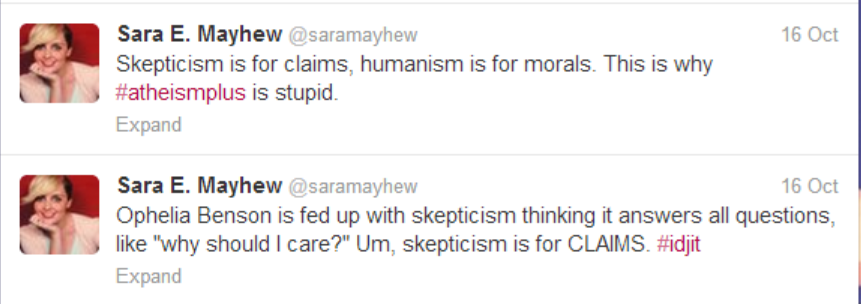
There is such a thing as skepticism about morality. There really is. There are people who ask why we should care about [the poor, immigrants, people who fall through the cracks, victims of natural disasters, all of the above in Bangladesh or Ethiopia or DR Congo, animals, climate change, future generations, other people’s children, schools, famines, droughts, factories that collapse, slave labor, forced marriage, stonings, for example]. There are people who ask why we shouldn’t just take as much as we can of everything for ourselves or for ourselves and our families or for ourselves and our tribe. There are people who say we shouldn’t care, and we should take as much as we can. Those are all claims, about morality, and people make them.
Apparently I didn’t make that clear enough (because I thought anyone who bothered to read this blog would already know it).
Sara E. Mayhew @saramayhew
Ophelia Benson is fed up with skepticism thinking it answers all questions, like “why should I care?” Um, skepticism is for CLAIMS. #idjit
Skepticism is for claims, humanism is for morals. This is why #atheismplus is stupid.
See? Obviously I didn’t explain carefully enough, because that’s completely uncomprehending. I didn’t say skepticism thinks it answers all questions. I said it asks questions like “why should I care?” and that it’s not skepticism that can answer them. That’s really…quite different.
There are skeptics who think the whole concept of “morals” is bullshit. More skepticism isn’t the way to convince them otherwise. Skepticism isn’t the boss of all claims, and morality doesn’t float free of all claims. It’s not that easy.
-
Throughout the ceremony, she wept and shook with shock and fear
Well here’s a gut-wrenching story. A father forces his daughter into an unwanted marriage, then rescues her from that marriage when he realizes how horrible it is.
The parents are from Turkey. The father had lived in London for 25 years but still thought that his daughter’s having a boyfriend at 17 meant she was falling victim to “the ways of the western world” and had to be married off to a stranger in Turkey, no matter how much she didn’t want to.
He and my mother tricked me into thinking we were going to Turkey just for a holiday, something we had done every summer throughout my life. On the final day, Dad took me to one side and firmly explained that I wasn’t going back with them. “You’re staying here with your uncle and he’s going to find you someone to marry. You want to get married, then it will be to someone we choose rather than a stranger you bring home.”
Terrified, I pleaded with my father to take me back. I was a good girl. I didn’t drink alcohol or go clubbing and had mutely accepted all the restrictions he had put on my life that saw me spend most of my time outside college helping run the family home. Taking my first boyfriend at 17 didn’t mean I wanted marriage. Dad was unmoved, and drove away with my younger brother and sister sobbing in the car just as hysterically as I was. My mother swallowed any upset she must have felt through total loyalty to my father, which compounded my sense of betrayal.
My passport and notebook with all my friends’ contact details were locked away and, within weeks, a match had been hurriedly made and the wedding arranged. I lived with my uncle and his wife, who weren’t happy with the arrangement but wouldn’t go against my father’s wishes. I didn’t see my parents or siblings again until they returned for the ceremony. Again, my desperate pleas for them to take me home were blankly ignored.
On the day, as custom dictated, my soon-to-be in-laws arrived to collect me from the family home. I was led, sobbing, away from the house. When I saw tears fill my father’s eyes, I dared to hope he was about to change his mind. That he suddenly had become as fearful as I was about the kind of life I would have married to a man seven years older than me who I didn’t even know. But there was no reprieve.
Throughout the ceremony, I wept and shook with shock and fear. The so-called celebrations afterwards were sober. People were subdued, having witnessed my distress. Many were clearly uncomfortable with what had happened.
And then her husband and his family treated her like dirt, and she was trapped.
In the end he worked out a way to trick her in-laws and get her safely out. But…
I spent the flight home in stunned silence, as I listened to Dad explain how the British embassy in Istanbul and local police had been on standby, ready to step in if things had turned nasty. When we finally walked through arrivals at Heathrow I collapsed on the floor, overwhelmed with relief that I was safe and frustrated anger that my rescuer was the person who had put me in that terrible situation in the first place. Dad got on the floor with me and held Ali and me close. He’s been doing the same ever since.
I’m sure Dad’s guilt at what I went through has shaken his belief in himself as a man and a father. However much bringing me home again might have assuaged his guilt, I know he looks at my son and finds it very difficult to live with the feelings that get stirred up.
He has apologised to me repeatedly – my mum, too. Of course, Dad could never have known when he first set the wheels in motion for my forced marriage that it would cause me the suffering it did. But the idea that the very man who had provided me with a loving and secure childhood could abandon me to the vagaries of a culture that I’d only previously experienced through holidays and family weddings still hurts.
Dad certainly could have known that forcing a completely unwilling daughter to marry a stranger would cause her suffering, even if the stranger turned out to be a decent guy (and how decent could he be, really, when he accepted such an arrangement?). He could have and should have.
-
Becauses
Chris Clarke has 10 reasons you should stop being so irrationally upset about your hair being repeatedly set on fire.
6. Because some people prefer their hair bright red, and they deserve respect and not shaming.
7. Because that man’s head is cold and he says that if someone set his hair on fire he would take it as a compliment.
8. Because if we just start putting out every fire we see without going through a calm and measured deliberative process in which we consider all the facts at hand, we will eventually be unable to cook food or smelt useful alloys.
9. Because you really ought to be used to it by now. It’s just the way life works in an oxygenated atmosphere.
10. Because my hair has never been set on fire.
11. Because it’s just disagreement.
12. Because it’s just criticism.
13. Because there have been very good caricaturists.
14. Because if you don’t like it all you have to do is stop writing on the internet.
-
No can say
Hmm. American Atheists is having a hard time finding a billboard company in Salt Lake City willing to take one of their billboards to run during next year’s convention. This one for instance:
So it’s taboo, apparently, to say (conspicuously) that you were once a Mormon and are now an atheist.
Well if it’s taboo, how voluntary is the religion then? If you can’t do something as simple (and, admittedly, visible) as announce that you have left a particular religion…is that religion really fully voluntary? It seems to me it’s not. If there’s that much social disapproval, then it’s not.
-
The manosphere in the tv spotlight
Manboobz tells us that mainstream media in the form of ABC’s 20/20 is airing a long-awaited show on the manosphere tomorrow.
It’s here at last! After numerous delays, the 20/20 story looking at the manosphere — and the part it plays in the online harassment of women — will be running on ABC this Friday, October 18, at 10 PM EST. Among the featured participants: the always charming Paul Elam of A Voice for Men; Anita Sarkeesian, the much-harassed feminist video game critic; and Jaclyn Friedman, the ass-kicking founder of Women, Action & the Media.
Here’s a teaser story on the ABC website which suggests that the 20/20 piece isn’t exactly going to be a triumphant moment in the history of the Men’s Rights Movement.
Yes, it does rather suggest that. Right from the title.
Women Battle Online Anti-Women Hate From the ‘Manosphere’
Deep in the underbelly of the Internet is a hidden corner known as the “Manosphere”— a collection of websites, Facebook pages and chat rooms where men vent their rage and spew anti-women rhetoric.
Protected by the anonymity of the Internet, men feel free to post hateful and violent comments. Posts such as “I really wouldn’t mind shooting a [expletive] dead in the face, they are evil, all of them,” and “Women are the natural enemies of men” are commonplace on sites like “A Voice for Men,” a Manosphere blog run by Paul Elam.
I’ve featured on the front page of that site. It wasn’t the very best moment of my life.
While Elam told “20/20″ that his site does not promote violence or hate toward women, some of his writing appears otherwise. In a post on his website, Elam wrote that women on welfare are “little more than thinly disguised layabouts.”
Elam claimed it’s not anger but satire and social commentary. “What I do is reflect and study what the attitude is in the culture,” he told “20/20.” “I am not creating the problem, I am documenting some of it.”
But experts like Mark Potok, from the Southern Poverty Law Center, believe this rhetoric is problematic. “The Manosphere is an underworld of so-called men’s rights groups and individuals on the Internet, which is just fraught with really hard-line anti-woman misogyny,” Potok told “20/20.”
And when a woman is on the receiving end of this misogyny, the Manosphere is unflinching in its attacks.
“Women who are targeted by these sites get a tidal wave of hate mail with rape threats and death threats,” Jaclyn Friedman, founder of Women, Action & the Media, told “20/20.”
And it’s not the best fun there is. I know there are skeptics who say it is, but they’re mistaken.
Friedman was also the subject of a cyber attack after campaigning on Facebook to remove photos and groups that promoted hate speech toward women.
“I got emails and tweets and posts on Facebook that say, ‘You are disgusting. You are fat. No one would ever want you. You should be raped,” Friedman said.
Friedman said the Manosphere is not satire as Elam claimed, but a space for people to cause damage to women.
“If you look at what they actually do, it’s all hateful rhetoric,” she told “20/20.”
“And it has real impact in the real world.”
It’s good to see major media paying attention.
Update: this show has nothing to do with our colleague Mano Singham. Heh heh.
-
We have met the enemy and you know the rest
One of the comments on The Troublemaker really stood out for me, because I’ve been thinking the same thing. It’s by one ADHDJ:
There is a huge overlap between skepticism and mansplaining.
I find cowardice in so much of what skeptics spend their time on — writing a 20 page article debunking a photo of Bigfoot or the Loch Ness Monster and believing you did something intellectually valuable, like that makes you some kind of big thinker. Considering whether or not fairies exist is worthy of great study and serious analysis, but whether some drunk dude acted like a creepy asshole at 3AM is so unlikely as to never merit a thought.
To quote the great Harry Frankfurt, “one of the most salient features of our culture is that there is so much bullshit.” And most of it is pretty easily debunked. So if you’re fairly smart, lazy, and argumentative, skepticism is very emotional satisfying, as it supplies a constant stream of unequivocally silly bullshit and bullshitters to do battle with, a constant stream of reasons to feel superior.
Call it Cognitive Assonance. Can you believe people who think the earth isn’t spherical? (Seriously, there are.) Good thing there are people like me to point out someone was wrong on the internet! It leads to this mindset where you are the high arbiter of truth, the world’s designated bullshit-caller. One can feel like a great intellectual even though you’re doing the equivalent of dunking over your 5 year old cousin on a Nerf hoop.
From this position, anything that makes one uncomfortable (like teh lay-deez and their mysterious lay-dee ways) is a target to be debunked or rebutted, and can be assumed to be wrong about everything. One starts adopting the language of skepticism to opine about social issues and other things that are not debunkable, but just happen to be your opinion.
The skeptic community says that everyone is stupid except for you, and needs the benefit of your munificent belligerence — “what you ________ just don’t understand about science is _____”, etc. It leads to a conversation that has the same shape as when I talk to my crazy brother about conspiracy theories. “What the mainstream media don’t want you to understand about flouridation…” Or my crazy uncle about economics. “What you tax and spend liberals don’t understand about the laffer curve is…”
It’s fucking toxic. It’s science that’s been bitten by a radioactive asshole. It’s people who nominally detest conspiracy theories taking up the very language of conspiratorial certainty, in the name of rationality, to justify their own stupidity. It’s a way to feel righter than everyone, smarter than everyone, because science, all while not having to challenge your own cultural beliefs or prejudices no matter what.
ADHDJ then responds to being called an anti-skeptic:
What on earth is an anti-skeptic? I enjoy and in some circumstances see great value of debunking crazy bullshit. I was a member of CSICOP for several years in the mid 80′s, I was an active on alt.folklore.urban for a long time, and read many books by Shermer, Randi, Nickell, etc.
I was trying to describe what I’ve seen the movement turn into in the internet age: it’s another venue for Internet Tough Guys to feel smart, while either turning their rhetorical guns on social issues — feminism, “political correctness”, etc. often couched in a completely uncritical embrace of the pseudoscience of evolutionary psychology — or on the easiest targets in the world (faith healing, Bigfoot, etc).
Seeing a movement that’s supposed to be devoted to rationality and critical thinking turn anti-intellectual and authoritarian pisses me off. I don’t think that makes me an asshole. Plenty of other stuff does, though, so point taken I guess. However if you do consider yourself a skeptic, you should give the No True Scotsman bullshit a rest.
So this is internal criticism, not external. It’s the same with criticisms I make here, and many of us make elsewhere on FTB and on social media. I’ve been writing on skeptical-type subjects since B&W started in the fall of 2002 (by the way it had its 11th birthday last month sometime), but by god I have plenty of criticism of “movement” skepticism. It’s what ADHDJ said. For a lot of people it’s just another way to be an asshole.
There are “skeptics” on Twitter right now offering “reasons” to think fat-shaming is a good idea. Yeah.
-
Another spam compliment
You have to admit.
…this website is genuinely fastidious and the people are actually sharing good thoughts.
-
And the dimple on the baby’s chin and the dew on the rose
Oh, please. Oprah.
Winfrey asked Nyad: “You told our producers you’re not a God person, but you’re deeply in awe?”
Nyad replied: “Yeah, I’m not a God person. I’m an atheist”, prompting Winfrey to question: “But you’re in awe?”
Nyad said: “I don’t understand why anyone would find a contradiction in that. I can stand at the beach’s edge with the most devout Christian, Jew, Buddhist and weep at the beauty of this universe, and be moved by all of humanity. So to me, my definition of God is humanity, and is the love of humanity.”
Winfrey, who has spoken about her Christian faith on television before, replied by telling Nyad that her beliefs did not fit with traditional atheism. “Well I don’t call you an atheist then. I think if you believe in the awe and the wonder, and the mystery, then that is what God is. That is what God is. It’s not the bearded guy in the sky,” she said.
No it is not. Being blown away by a sunset or a starry night or a sunset seen from the beach on a starry night is not what “God” is. Don’t bullshit us. Don’t move the goalposts. Don’t pretend the word “God” doesn’t mean what most people take it to mean but instead means a really good hazelnut gelato. Don’t conscript everyone into God’s army by pretending everything is god. Just don’t.
-
Inbloodyadequate
The Guardian published the not yet released Ofsted report on Al-Medinah school. It’s grim.
Overall effectiveness: Inadequate.
Achievement of pupils: Inadequate.
Quality of teaching: Inadequate.
Behaviour and safety of pupils: Inadequate.
Leadership and management: Inadequate.
An Ofsted report, due to be published imminently, declares that the Al-Madinah Islamic school in Derby is “in chaos” and has “not been adequately monitored or supported”.
The report, which has been leaked to the Guardian, says teachers at the faith school are inexperienced and have not been provided with proper training.
Pupils are given the same work “regardless of their different abilities” and the governing body is “ineffective”, according to the report which was commissioned amid reports of irregularities at the school.
But it’s reform. Reform is good, isn’t it?
Tristram Hunt, the shadow education secretary, said the Ofsted report showed that Michael Gove’s reform programme, in which the new schools are freed from local education authority control and allowed to appoint unqualified teachers if they choose, has become a “dangerous free-for-all”.
Hunt told the Guardian: “What this report exposes is that David Cameron and Michael Gove’s Free School programme has become a dangerous free-for-all: an out of control ideological experiment that has left 400 children losing an entire week of learning.”
The Ofsted report gives the school the lowest “inadequate” ranking in every area, prompting the chief inspector of schools Sir Michael Wilshaw to call for it to be placed in special measures. The inspectors also complain that teachers without proper qualifications have been given key posts.
It’s the free market. Give it time.
-
A useful guide
Things that are not good in coffee:
- olives
- anchovies
- cauliflower
- shrimp
- pineapple
- mustard
- onions
- smoked salmon
- pumpkin
-
Not crazy and not alone
Hannah Waters has been where Monica Byrne found herself.
At the time of posting a year ago, Monica didn’t call Bora out by name. But she updated her blog post this week with his identity after recent unprofessionalism on Scientific American’s part, seemingly linked to unrealized sexism and racism. Bora didn’t deny what happened.
The reaction on Twitter was one of disbelief and anger from his network of science bloggers and friends. “Science blogosphere, I am tweetless… I can’t even retweet what has left me so stunned.” “Enraged children with a persecution complex are out on a witch hunt, it’ll blow over eventually…” “My closest friend is @boraz. I know him better than almost everyone. I would give my life for him. Thought you should know that.”
At first, I was paralyzed. But when I saw the “protect the herd” mentality among my friends, with some doubting that this behavior even qualified as sexual harassment, I had to speak up. I couldn’t leave Monica ridiculed and alone. Bora has been a friend and mentor for years. He recruited me to blog for Scientific American. And yet, even if she hadn’t named him, I would have recognized him from his behavior because I have gone through it too.
And she goes on to tell the story. Comparatively mild; flirtating and sexual talk rather than groping or plying with wine; but not therefore harmless.
When I first met Bora at a Philadelphia pub in June 2010, I was new to the scene; hardly anyone read my blog. He was enormously enthusiastic and supportive of my efforts to blog about science and, soon thereafter, he began to share my posts. Suddenly, I was getting readers, making friends, and connecting to a community. It was wonderful, and I felt I owed it to him.
That’s one reason it’s not harmless. Guess what happens when the flirting and sexual talk start?
Bora and I were walking in the same direction and chatting, a bit tipsy, when he asked me if I would walk him back to his hotel. I lost my breath for a second. I froze and stuttered, “No, I have to go.”
After a hug goodbye that lasted a second too long, we split ways, my head spinning. Did I imagine that? Was he trying to sleep with me? And then: Am I actually any good at writing, or was he just supporting me because he was sexually interested in me?
I doubted myself, my value to a community in which I had found a home, my worth as a writer. I came home crying to my roommate, so unsure of what this meant for my future, whether all my seeming accomplishments were no more than a ruse.
I’ve carried those thoughts with me ever since.
That’s what happens. And it’s corrosive; it’s terrible. Remember what Claire Ramsey commented on Not again yesterday:
Something on these lines happened to me in my senior year of college in 1972. I thought “my professor thinks I’m smart.” And he thought “What’s in those pants?” I was crushed, confused, ashamed, and plunged into a state of absolutely no confidence. Embarrassed and mortified that I was so stupid and naive. And that goddamn state lasted fifteen fucking years.
Not good.
What makes this so hard to talk about—my experience and Monica’s—is that it may not look like sexual harassment. There was no actual sex or inappropriate touching. Bora wasn’t vulgar toward me, nor did he even directly announce his interest. It was all reading between the lines, which made it easy for me to discount my own experience. Instead, I did my best to ignore my discomfort to avoid conflict, or otherwise convinced myself that I was reading too far into it. How vain! To imagine all men want to have sex with me!
No one should be made to feel this way, no less someone early in her or his career. The nagging self-doubt is enough to turn people away from doing the things they love. Monica wrote that she’s okay, “as science journalism isn’t my principal interest by far.” But imagine how many people have been driven away from their main goal because their experiences don’t align with traditional definitions of harassment. The focus then is not on getting over it; instead, there is the added stress of figuring out whether what you experienced was harassment at all. In that case, maybe that goal doesn’t seem worth the effort.
I’ve made it far enough now that I know my work is valuable on its own. And I’m writing today to let anyone else who has experienced sexual harassment—especially the type of harassment that can be mistaken for acceptable behavior—that you aren’t alone. Whoever did this to you is the one in the wrong. They are the one who did not examine their own power and the effect their “harmless flirting” could have on you.
It’s easy to say that now but, at my most insecure moments, I still come back to this: have I made it this far, not based on my work and worth, but on my value as a sexual object? When am I going to be found out?
I don’t think Bora intended to make me feel this way. In fact, if he knew I were carrying this with me, I’m sure he’d be horrified. But it’s our actions that matter, not our intentions. He did make me feel that way. His actions degraded my self-worth.
I’m not here to dig a grave for Bora. That’s not up to me. It’s up to each person his actions have affected to decide whether or not to forgive him. I am here to let Monica know that she is not crazy, as people on Twitter are saying, and that she is not alone.
Not crazy, not alone.
-
Collaborate for a better world
Bora Zivkovic has resigned from the board of Science Online.
Since its earliest days, ScienceOnline has sought to gather, grow and support a community of diverse faces, experiences and voices who share a desire to celebrate science, improve our communication skills and collaborate for a better world.
Bora Zivkovic, a cofounder and member of the ScienceOnline board of directors, has been an integral and vital leader in this community. Recent events, though, have identified actions on Bora’s part that are not consistent with the ScienceOnline values he himself vigorously promoted. Bora has taken steps to address these issues, and we look forward to any further clarity and resolution he might offer.
Our lives are full of overlapping communities – personal and professional. While several of us on this Board are good friends with Bora and his family, we must not allow this to affect our responsibility to manage the ScienceOnline organization and uphold the community values that each of us is committed to protecting.
Props to all of them for dealing with it as opposed to attacking the messengers. It would be nice if everyone did that.
-
Munching in Seattle
Ha! Explanation found. Howdidweeverlivewithoutgoogle.
I went for a long walk yesterday, down the hill, into Elliott Bay park, along the waterfront to Pioneer Square. During the along the waterfront phase I looked up to my left at the steep hillside between the shoreline and downtown Seattle – and stopped in amazement because it was full of goats. Goats, I tell you! Goats in downtown Seattle, goats in an urban landscape. They were all browsing away, as goats do. Huh. Obviously they were there to weed the slope, but I wanted to know more.
So I found more. From King-5 News last June:
Farhan Syed spends his free time at the office these days looking out the window with his co-workers.
“We are men who watch goats,” said Sayed, who works for a software company in downtown Seattle.
120 goats are at work on the hillside below the Alaskan Way Viaduct outside Sayed’s window. The goats are under the supervision of Head Goat Wrangler Tammy Dunakin, who also owns the Rent-A-Ruminant company.
Dunakin said the Seattle Department of Transportation hired her and her goats to clear a site that is too steep and dangerous for humans and their equipment.
No noisy polluting weed-eaters, no herbicides – just a hillside dotted with sweet goats.