Category: Notes and Comment Blog

  • That on both sides

    Here it is again, the fake symmetry. Let’s split the difference! You don’t believe in god, I do believe in god, it’s basically the same thing only one is no and the other is yes. Right? Right? Both are just guesses. Both are just a hunch. Both are a toss-up either way. Both are equally reasonable and equally unreasonable. Right? Right? Right? Great, let’s go have a beer.

    This time it’s Francis Spufford, writing in August 2012, via the latest Jesus and Mo.

    Spufford’s Dear Atheists:

    Allow me to annoy you with the prospect of mutual respect between believers and atheists. The basis for it would be simple: that on both sides, we hold to positions for which by definition there cannot be any evidence. We believe there is a God. You believe there isn’t one. Meanwhile, nobody knows, nobody can know, whether He exists or not, it not being a matter susceptible to proof or disproof.

    No. No no no no no no no no.

    The fact that something is not susceptible to proof or disproof does not mean it is unknowable. I know some things I did yesterday, which are not susceptible to proof or disproof. I know some thoughts I had today, which are not susceptible to proof or disproof. Multiply those by infinity and you have a tiny fraction of the things that are knowable without being susceptible to proof or disproof.

    Notice the jump Spufford makes, from “for which by definition there cannot be any evidence” to “it not being a matter susceptible to proof or disproof.” Evidence is not the same thing as proof.

    There is a lot of evidence that there is not a god of the kind described in normal monotheistic holy books and sermons. There is precious little (if any) evidence that there is such a god.

    It’s true that nobody knows for certain that a god doesn’t exist, just as nobody knows for certain that we’re not just part of a vast computer simulation run by mice. But knowing for certain isn’t the real issue. The real issue is what we have better reasons to believe as opposed to worse reasons to believe.

    The wafflers need to be called out on this every damn time they say it.
  • Cut open with a rusty blade

    Pamela Gay published a wrenching, heartbreaking, infuriating post early today about her struggles as a woman in science and skepticism.

    With ever increasing difficulty I’ve been dealing with issues of gender related to my career. Right now, I am struggling with hearing that an event I categorized as “A drunk ass  tried to grab my boobs,” is now being discussed by witnesses as, “He tried to sexually assault her in a bar while intoxicated.” I had created a euphemism for myself, and having that euphemism striped away is making me realize that I have been hiding from myself the true degree to which I have been harmed.

    I have previously tried to confront and to give voice to the harm that sexual harassment and gender discrimination can do. I don’t think I’ve ever allowed myself to be totally vulnerable in my words, but during my July 2012 talk at The Amazing Meeting (script I vaguely followed and video here) I came close. My goal was to focus on inspiring people to do good, but I briefly addressed many of the issues that hold women like me back: Issues of being inappropriately touched, issues of hearing workplace banter about our boobs, and the effects all this and more has on our self-esteem. I made the following point as clearly as I could: “I know as I say this that it sounds unbelievable – and how can we report the unbelievable and expect to be believed?

    Well we know from bitter experience that we can’t expect to be believed, whether we report the believable or the unbelievable, at least not by a very large and entrenched segment of the relevant population. But more and more of us are reporting it now, and the ground seems to be shifting.

    I did not give this talk lightly. I suspected I’d experience backlash for daring to admit that I too am one of those women who has been touched, who has been held back, who has suffered self-doubt related to my gender. What shocked me was the form and degree of backlash. As a result of this talk I faced threat of professional reprimand. Let me state this more clearly, because I admitted that gender related comments hurt my self esteem, there were authority figures who demanded I be punished. While my direct supervisor and the dean we report to have always made me feel respected and have supported me, there were others within my profession who demanded I publicly apologize; that I be formally punished for what I said.

    I was horrified when I read that this morning. I’m not the only one. My friend (and Pamela’s friend) Brian Engler is another. So is Leonard Tramiel, whom I met and liked enormously at the CFI Summit. The news is getting around.

    And then last week, the fading scars of what happened were cut open with a rusty blade.

    I learned that a witnesses to an event that occurred in 2008 is discussing that event and naming names. During the event in question, a man in power who I’d previously never met made a lunge at my breasts. This is one of the events that weighed on me when I wrote my TAM talk. It weighed on me when I said, “As an astronomer, at conferences, I’ve randomly had my tits and ass grabbed and slapped by men in positions of power and by creeps who drank too much. This is part of what it means to be a woman in science and skepticism.”

    I’ve been warned this may all hit the internet. I’ve been warned the social media maybe about to explode. I’ve been warned this could be devastating to my career. Let me put this more clearly: Because someone witnessed a man in power attempt to grab my boobs, I have been warned that I need to worry about my career being actively destroyed by others.

    And that is fucked up. I run a program that works to spread science education, to generate science results – we are doing good – and I have to be worried that my ability to do good is going to be limited because I have boobs someone thought would be fun to grab at.

    And then that man with power – the one who staggered at my breasts at the moment of our introduction – emailed me out of the blue on Halloween, denying anything happened between us because he’s never done anything like that, and if he has never… then he never did with me. He went on to ask why I never confronted him later, why I never did many things, and I found myself explaining, “There is absolutely no way for a woman to walk up to any man, let alone a prominent man they don’t really know, and say, ‘Pardon me, while you seemed to be drunk, you did this inappropriate thing.’ Inappropriate physical contact is so common at these events as to be just part of being a woman in science and skepticism. People drink. Inappropriate things happen, remembered or not, and for the most part we just move on as though it had never happened because otherwise we could never work.”  I told him he should get help, and I dug out my own prescription for dealing with the PTSD that had me shaking. He promised he would share with no one our communications and I told him I didn’t want to communicate with him at all.

    This exchange left me broken – it broke me on my favorite holiday of the year.

    I am still broken.

    There’s more. As I said, it’s heartbreaking.

    It’s a long, long road.

  • Carving up little girls with sharp blades

    The Guardian on the FGM report itself.

    Thousands of girls in danger of genital mutilation are being failed by the health and justice systems, a coalition of health professionals has warned in a report that recommends aggressive steps to eradicate the practice in the UK.

    Female genital mutilation (FGM) should be treated the same as any other kind of child abuse and evidence of it must be reported to the police, according to the report.

    Janet Fyle, a policy adviser of the Royal College of Midwives and one of the report’s authors, said that just as it was inconceivable that a health worker would not report evidence of child abuse to the police, it should be equally important to report evidence of FGM.

    Imagine someone just carving up a little girl’s genitalia for the hell of it, then imagine FGM, then try to see what the difference is. There isn’t any.

    The report clearly emphasises the importance of an individual’s safety over the respect for religious and racial sensibilities, a point welcomed by Shaista Gohir, the chairwoman of the Muslim Women’s Network.

    “We need to be mindful of cultural and religious sensibilities but safeguarding the child from FGM has to be the priority. If a child is at risk it is better to protect them rather than religious and cultural feelings,” she said.

    Cultural and religious sensibilities that require mutilating children are not worth having or respecting or treating deferentially.

  • She felt every single cut

    At Comment is Free, Leyla Hussain on FGM.

    I was cut when I was seven years old. Four women held me down. I felt every single cut. I was screaming so much I just blacked out. I didn’t know what female genital mutilation (FGM) was until the day it happened to me. FGM is one of the worst physical and psychological scars a girl can be left with and I therefore completely endorse and welcome the new report on tackling FGM.

    Shudder. It’s an atrocity, yet there are places where it’s both commonplace and mandatory.

    A key point of the report, Tackling Female Genital Mutilation in the UK, launched on Monday in the House of Commons, is about holding frontline professionals accountable and empowering them to act to prevent this. Reporting abuse should not be an opt-in or opt-out matter. Also very important is implementing an awareness campaign; I believe FGM should be given the same publicity as HIV and knife crime. Historically there has been such a lack of urgency in confronting and tackling it – we seem to be closing our ears and pretending it’s not happening.

    The most important aspect of the report is to treat FGM as a safeguarding issue, as it is child abuse and needs to be stopped. One misconception is that it is similar to male circumcision. It’s much more painful, it can lead to serious and sometimes life-threatening complications and there is no medical reason to do it.

    Plus it’s done on girls, not infants. The pain is not forgotten.

    I have been heading up a campaign to ask the government to take charge and demanding we stop FGM in the UK for good. It has been filmed as part of a documentary for Channel 4. During filming I looked at British attitudes to FGM and raising awareness among people in this country, as well as visiting practising communities and challenging them to look at why this is happening. My colleagues in Europe often say to me that Britain is a soft touch because their girls are being brought over to the UK to be cut. I think that’s a clear sign that not enough is being done to tackle it. To me, cultural sensitivity is one of the biggest barriers to stopping FGM in Britain. One of the most powerful and disturbing parts of the filming for me was when, to demonstrate that we are walking on cultural eggshells in Britain, I took to the streets asking people to sign a petition in favour of FGM. I was shocked that in less than 30 minutes I got 19 signatures. The fact that people thought it was OK because it’s someone’s culture, was really scary.

    She asks that you sign her petition. It’s only for people in the UK though, so I couldn’t sign it. But lots of you do live there. You can’t fool me, I know you do. I watch you.

  • The community

    A new low in lowness.

    haterz

  • Nothing out there apart from all the stuff that’s out there

    From the Washington Post’s reliably irritating “On Faith” blog, Jeffrey Stanley writes about being the faculty adviser for a student-led paranormal investigation club while being a skeptic, but not happy about being a skeptic.

    Friends and fans assume I am a true believer but the truth is that I am not. I am a healthy skeptic. And that’s depressing for me because it means that on some level I feel certain there’s nothing out there. I try contacting the spirit world before live audiences to keep an element of hope simmering on the back burner of my mind.

    Nothing? Why does he call it nothing? There’s a lot. The fact that he doesn’t think he can find magical stuff doesn’t mean there’s nothing.

    He explains about “spirit boxes”…sort of.

    You turn on a video or audio recorder to document your session.  You now ask a question into the air and await a response.  Sometimes the responses are immediate and crystal clear.  Others are difficult to understand beneath all the static and only come to light during amplified playback.  Some responses have to be slowed down and have their volume boosted to improve clarity.  In my experience, a five-minute recording might contain 20 or 30 audible “responses.”  Only about 10 of these will be easily understandable to the average listener.  So while the results are not as instantly gratifying or dramatic as using a Ouija board in front of an audience, the results after post-production can be quite stunning and difficult to explain away.

    Skeptics will try, though. I chuckled when I first Googled “EVPs debunked” and read various naysayers’ biased conclusions. They generally start from their subjective presupposition that listening to the dead is impossible, then loop to their own self-gratifying conclusion that spirit boxes are indeed not receiving voices from the dead.

    Wait, what? Their subjective presupposition that listening to the dead is impossible? Subjective? Really? Aren’t there very good objective reasons for thinking that listening to the dead is impossible?

    This is like agnostic atheism, and science doesn’t have the tools to investigate the supernatural, again. Same old bullshit – it’s all a tossup either way; the two are evenly matched; it could be yes or it could be no and nobody knows anything either way. Yeah no that’s not right. It’s not just some stupid prejudice to think that the dead are dead. And what’s “self-gratifying” about that anyway? It’s the longing for immortality that provides the motive for wishful thinking, not the opposite.

    Subjective presupposition nothing.

    H/t The Morning Heresy.

  • Do what the majority tells you

    They have the same confusion in Greece, New York, the Greece of Greece v Galloway, as Sarah Posner reports in Aljazeera America.

    In Greece, supporters of the town’s position insist the religious freedom of Christians is at stake.

    Pastor Vince DiPaola of Greece’s Lakeshore Church, who has delivered invocations at the council meetings, said the “majority of people certainly believe in God in our community. The majority of people would believe in Jesus Christ. And so it represents our community, and it would be pathetic if our community could not even express itself in that way.”

    No it wouldn’t. They can express it in their churches…and at home, and out in the street, and any number of places. They don’t need to make it part of the town government, and doing so takes away the freedom of the minority. It’s the minority that needs protection from coercion, not the majority. Saying it’s a majority thing therefore it should sweep all before it is the very opposite of protecting religious freedom.

    Posner quotes several religious people who do understand that.

    Pastor Courtney Krueger of First Baptist Church of Pendleton, S.C., a town of 3,000 people, said his town’s council does not open its sessions with any prayer.

    “Sectarian prayers don’t serve any positive purpose in official government settings,” he said. Not having legislative prayers, he said, “is the way it should be.”

    “The last thing I’d want to do,” Glaze said, would be to pray in a manner that suggested to any citizens attending the meeting that their “interests are not as fully represented here” or that they were “not welcome.”

    That, he added, “would really break my heart.”

    There.

  • Freedom is doing what you’re told

    Sometimes the stupid is too grating to bear. On October 25th the Air Force Academy made a decision to allow cadets taking their honor code to opt out of saying “so help me God” at the end of the oath. Well I should hope so – it’s a federal institution, so obviously it shouldn’t be requiring employees to swear an oath to a god. But two Texas Congressional Representatives want to put a stop to it – they want the federal government to force people to swear an oath to a god.

    Republicans Sam Johnson of Plano and Pete Olson of Sugar Land introduced a bill last week to require Congressional approval before any changes may be made to oaths to enlist in the Armed Forces.

    Their legislation comes on the heels of a decision by the Air Force Academy on Oct. 25 to allow cadets taking their honor code to opt out of saying “so help me God” at the end of the oath.

    Olson, a former Navy pilot, said military personnel who undergo stressful training to prepare for protecting the nation should be allowed to exercise their religious freedoms.

    That last item is the part that’s too stupid to bear. Allowing people to exercise their religious freedoms would be making the oath to god optional, not keeping it mandatory. The Air Force Academy decision was to allow people to opt out, not to forbid people. Opting out is freedom; not allowing opting out is not freedom.

    Jeezis. There should be a “can you think?” test before people can run for Congress.

    Johnson spent seven years as a prisoner of war in Vietnam, during which time he said he found strength in God.

    “I can tell you from experience, there are no atheists in foxholes,” Johnson said in a statement. “Many people don’t know this but when you survive a near-death experience you realize that the only thing you had to hold on to was your faith in God.”

    And yet – notice that that has nothing to do with swearing an oath to god because told to by the Air Force Academy in the name of the US government. Nothing at all. It’s laughably easy to believe in a god who thinks oaths are a bit of petty human bossiness and an insult to god.

    According to Religion News Service, the Air Force changed the oath after the New Mexico-based Military Religious Freedom Foundation complained about the presence of religion in the military. The group says Christianity is given a higher pedestal at the Air Force Academy and has been critical of its use in official military practices.

    Other military academies do not use the word “God.”

    “It’s not only my experience, but that of my fellow POWs, veterans, and those currently in harm’s way that make ‘so help me God’ vital to the oath,” Johnson said.  “I urge my colleagues to join this effort to protect the legacy of freedom of religion.”

    Has he picked a fight with the army, the navy, and the marines, yet?


  • “It is useful to contrast…”

    There’s a rather tendentious piece by Murtaza Hussain in Aljazeera, comparing the treatment of Malala Yousafzai to that given to Nabila Rehman, an eight-year-old girl whose family was the victim of a drone strike.

    This past week Nabila, her schoolteacher father, and her 12-year-old brother travelled to Washington DC to tell their story and to seek answers about the events of that day. However, despite overcoming incredible obstacles in order to travel from their remote village to the United States, Nabila and her family were roundly ignored. At the Congressional hearing where they gave testimony, only five out of 430 representatives showed up. In the words of Nabila’s father to those few who did attend: ”My daughter does not have the face of a terrorist and neither did my mother. It just doesn’t make sense to me, why this happened… as a teacher, I wanted to educate Americans and let them know my children have been injured.”

    It stinks that they were ignored, but that doesn’t make the comparison a reasonable one.

    It is useful to contrast the American response to Nabila Rehman with that of Malala Yousafzai, a young girl who was nearly assassinated by the Pakistani Taliban. While Malala was feted by Western media figures, politicians and civic leaders for her heroism, Nabila has become simply another one of the millions of nameless, faceless people who have had their lives destroyed over the past decade of American wars. The reason for this glaring discrepancy is obvious. Since Malala was a victim of the Taliban, she, despite her protestations, was seen as a potential tool of political propaganda to be utilized by war advocates. She could be used as the human face of their effort, a symbol of the purported decency of their cause, the type of little girl on behalf of whom the United States and its allies can say they have been unleashing such incredible bloodshed.

    Or not, but Murtaza Hussain doesn’t mention the or not part.

    As described by the Washington Post‘s Max Fisher:

    Western fawning over Malala has become less about her efforts to improve conditions for girls in Pakistan, or certainly about the struggles of millions of girls in Pakistan, and more about our own desire to make ourselves feel warm and fuzzy with a celebrity and an easy message. It’s a way of letting ourselves off the hook, convincing ourselves that it’s simple matter of good guys vs bad guys, that we’re on the right side and that everything is okay.

    How smug, how glib, how less than universally true.

    I like one comment on the article, by Ashhad Khan Yusufzai. (Any relation? I have no idea.)

    I agree with the heading of the article; not with anything else in it though. You seem to suppose as if Malala and Nabila have a similar story and are being treated differently. Nabila is an innocent bystander who was a victim in this war. I agree with you that she and her family deserve our sympathy and that it was a travesty that so few congressmen showed up at the hearing. To compare that to Malala however is intellectually dishonest because the case with Malala is entirely different. Malala was NOT an innocent bystander who was shot by the Taliban. Malala spoke out against Taliban oppression by anonymously blogging for the BBC when the Taleban had taken over the Swat Valley, and then publicly spoke out for the right of education for girls, and against Taliban oppression, after that. She was targeted because she chose to speak out. That is the difference. That is why they are worlds apart. Their treatment by the media might have been worlds apart (and I agree that Nabila and her family should have been given more coverage and attention) but to compare that with Malala’s case is being intellectually dishonest. One was an innocent bystander victim, the other someone who spoke out publicly against an oppressive regime and was then targeted for it. It is only natural that the media attention one would get would be worlds apart from what the other did. Malala’s bravery in speaking out was also world’s apart from most other children and that’s why she deserves all the attention and accolades she receives.

    The Taliban didn’t shoot Malala by accident or in the crossfire; they shot her on purpose, to punish her for and prevent her from encouraging girls to go to school. High tech automated bombing of distant countries is ethically dubious, to say the least, but argue the case honestly.


  • Guest post by Anonymous: How timely

    Revised and edited by Anonymous, so not identical to the comment on It was so disruptive.

    How timely.

    My 5-year-old daughter has referred to herself as a boy from the time she could talk. A mere taste of this: her imaginative play started at age 2 and has gone on for the next 3 years. Over all this time, never once, not with prompting or cajoling, has she so much as considered stepping into a female character. She’s adopts an average of 3-5 characters per day, which means she is about 4,000 for 4,000 in adopting boy instead of girl characters. Always a Chipmunk, never a Chippette.

    After my wife and I realized the behavior was consistent and not “a phase” (and definitely not explicable as older-brother-worship), we’ve let her dress in “boyly” clothes (her word, invented at age 3), bought her boyly toys, get a boyly haircut (the “Bieb”), and have marveled at the pure delight she’s taken in this.

    Cue preschool 3 months back. I’d long expected (feared?) that her immersion into the social environment of preschool would serve as a tipping point. For almost 3 years, she was happy to be a girl who was free to act/dress/play as a boy. But the other shoe was bound to drop, and sure enough, her female name and baseline female identity ran smack into the inevitable social pressures toward gender conformity…. And drop the shoe did. Last week, with maturity way beyond her years, she approached us and told us we needed to stop calling her by her birth name. We needed to use a boy name from now on. And we needed to talk to her teachers and tell them to do that, too.

    With all the lead-up, with all the signs, with the writing having been so clearly on the wall… nevertheless, it’s been a surprisingly emotional hit to both my wife and me. We’ve done our research, we’ve read our books, we suspected this might come, academically. But now – shit got real.

    Speaking for myself, nothing about my daughter’s transition [no – that’s not right – truthfully our daughter hasn’t changed one bit – this is “our transition”] (not even the fact that there may be mere weeks – perhaps days – separating me from ever again referring to her as “daughter” or “her”) has really been that troublesome. She’s a person of remarkable character; spirited, happy, precocious, and every kind of awesome; and nothing about this, or any changes to come, will touch that.

    What has been keeping me up at night is the world that waits for her – and how it seems set to chew that up and spit it out. We’re raising her in the bible-belt, and though individuals have thus far been incredibly supportive, I’m extremely worried about how this bible-belt culture, at large, will treat a gender-creative (or possibly trans-gendered) child.

    And I wake to read a post like that from DJ Grothe. And realize it’s not just the conservative Christians I’ll need to worry about. From the pit of my heart, on behalf of my daughter, who’s thus far been shielded from such hatefulness:

    Fuck you, DJ. I hope you read this post, reread your words, and decide, for my daughter’s sake, to go away. Resign and go into isolation, stay away from the mic, disable your twitter feed; whatever it takes to stop injecting your poisonous hatred into the world my daughter is entering.

    Frankly, it’s the only real way I can see you making the secular community a better place.

  • A puerile display of sniggering frivolity

    Richard Dawkins has a piece in the Guardian wondering why people don’t believe in public-spirited concern like the kind he showed when he tweeted about his little jar of honey. Yes really.

    He describes trying to explain to a bank how to improve its customer service website, and then a piece he wrote for Prospect in 2009 about a woman who was upset about not being allowed to take her child’s eczema ointment on a plane (which does sound like a real issue). Then he comes to the present day.

    Once again my motive was public-spirited, and now there was no question of self-interest because the fated ointment wasn’t mine. The woman’s experience had been a particular peg on which to hang a general point. Unfortunately, when I returned to make a similar point on Twitter this week, I foolishly chose a peg that was vulnerable to misinterpretation as self-interested. And the result was a puerile display of sniggering frivolity such as only Twitter can serve up.

    Ahhhhhhh there it is again – the denunciation of the sniggering frivolity on Twitter, when he himself has posted more than a few sniggeringly frivolous tweets and then been surprised by the reactions to them. Some of his best friends wish he would stop using Twitter, but they apparently can’t get his attention.

    This time the dangerous explosive was not eczema lotion but honey. And it belonged to me, at Edinburgh airport, bound for Heathrow with only carry-on luggage. Though the jar was small, it exceeded the limit laid down by the rule-happy officials of airport security, and it was thrown away.

    I tweeted to the effect that every time I see an incident of this kind I sense it as a victory for Bin Laden. However calamitous the destruction of the twin towers, doesn’t the bureaucratically imposed vexation to airline passengers all over the world mount up to a prolonged and distributed, albeit far less traumatic, victory? And aren’t our rule-merchants playing into Bin Laden’s dead hands by their futile displays of stable-door-shutting?

    Erm…many people have argued seriously that clogging up travel is indeed a victory for the jihadists, but they don’t do it on Twitter via a dirge for their own small jar of honey.

    But because the honey was mine not a young mother’s, my motive could surely not be other than selfish. “Stop whining about your lost honey.” In vain did I protest that I couldn’t give a damn about my honey. I was making a point of general principle, trying to be public-spirited. “If you weren’t so ignorant, you’d know the rules about liquids.” In vain did I reassure the tweeting twerps that I know the rules all too well. That’s precisely why I’m campaigning against them.

    I say nothing of the feeble jokes on “bee” and “be” and Pooh Bear. My point here is the one brought out by my encounter with the bank clerk. What is it that renders some people incapable of conceiving how a person might be motivated not by narrow self-interest but by a public-spirited concern for the common weal?

    He also says nothing of the not-feeble jokes and serious points about “Dear Muslima” and “zero bad.” Those items were the only reason I paid attention to the dirge for the jar of honey. It wasn’t, in my case and in the case of many many others,  ”Stop whining about your lost honey.” It was “why are you whining about your lost honey when you pitched such a fit at Rebecca for objecting to being hit on in an elevator at 4 a.m.?” It wasn’t a “poor you” objection, it was a double standards objection.

    By the way Rebecca wasn’t just talking about her own personal interest either. That was and is one of the reasons some people got so pissed off at her: because she was “trying to speak for all women” – as if that were somehow bizarre or impermissible. As if Thurgood Marshall for example shouldn’t have “tried to speak for all African-Americans” in Brown v Board of Education.

    So there it is, Richard. A lot of us are going to be turning a skeptical eye on your public interest tweets because you’ve never seen fit to withdraw your ridiculous, uncalled-for, sniggering and frivolous sneering and condescending “Dear Muslima.”

  • Oh for the dear pre-PC days of yore

    You know, nostalgia for the 80s, before people started frowning on homophobia and transphobia and we all lived happily together. (That’s not how I remember it actually. I remember frowning on homophobia in the early 70s. I remember knowing people who agreed with me about that. Lots of people.) (Granted, transphobia not so much. That was more buried.)

    carlie has a good comment on the subject at PZ’s place.*

    My mind is still stuck on Barbara’s “Oh, how I long for the days when no one would call us on shit when we talked about people” comment, because that sentiment comes up so often in this stuff. And what it comes down to is that they just don’t realize that people in those marginalized groups were never ok with those comments, but didn’t have the social standing to even complain about it back then. So they’re creating a fantasy past in which people in marginalized groups were all ok with everything, when really it was a world so oppressive that they couldn’t even risk voicing any negative opinion and at most just laughed nervously to cover their pain.

    And people like her think that was a good time to live in.

    I think that’s a shrewd observation.

    Addendum: the remark in question.

    bad

    Barbara A. Drescher I want the 1980s back. Yes, it was a bit oppressive, but people laughed at such over-the-top PCness. Today, we aren’t even allowed to be direct or honest without being accused of bigotry and “privilege”. Frankly, I don’t think most people would recognize real bigotry if it bit them in the ass.

    Like 30

    *Last sentence revised.

  • Fascism Telegraph-style

    Eamon pointed out the source of the rather…harsh description of atheists that Michael Nugent quoted in his address to the constitutional convention in Ireland. It’s by Sean Thomas last August 14th in the Torygraph.

    He starts with the science of theists are better.

    A vast body of research, amassed over recent decades, shows that religious belief is physically and psychologically beneficial – to a remarkable degree.

    Mental health – blood pressure – recovery from broken hips – more children – coping with stress – more happy – less suicidal – ALL THE THINGS.

    What’s more, these benefits are visible even if you adjust for the fact that believers are less likely to smoke, drink or take drugs. And let’s not forget that religious people are nicer. They certainly give more money to charity than atheists, who are, according to the very latest survey, the meanest of all.

    So which is the smart party, here? Is it the atheists, who live short, selfish, stunted little lives – often childless – before they approach hopeless death in despair, and their worthless corpses are chucked in a trench (or, if they are wrong, they go to Hell)? Or is it the believers, who live longer, happier, healthier, more generous lives, and who have more kids, and who go to their quietus with ritual dignity, expecting to be greeted by a smiling and benevolent God?

    Obviously, it’s the believers who are smarter. Anyone who thinks otherwise is mentally ill.

    Well, in that case, it must be time to round us all up.

    And I mean that literally: the evidence today implies that atheism is a form of mental illness. And this is because science is showing that the human mind is hard-wired for faith: we have, as a species, evolved to believe, which is one crucial reason why believers are happier – religious people have all their faculties intact, they are fully functioning humans.

    Therefore, being an atheist – lacking the vital faculty of faith – should be seen as an affliction, and a tragic deficiency: something akin to blindness. Which makes Richard Dawkins the intellectual equivalent of an amputee, furiously waving his stumps in the air, boasting that he has no hands.

    All that, just to end up with yet another Telegraph bashing of Dawkins. As is well apparent I’m very annoyed with Dawkins myself, but stupid arbitrary bullying like that might be the one thing that could make me more sympathetic to him.

  • It was so disruptive

    So things must have been too calm and boring, so D.J. Grothe decided to throw a little bomb on Facebook and Twitter.

    aa

    No hyperbole: I just saw the worst-passing transsexual I’ve ever seen in the lounge here. It was so disruptive that I am forced to believe it was an intentional way to protest against rigid gender binaries. Or so I’d like to think.

    There were some shocked comments, and then a bunch of “PC gone mad/it’s all the fault of rage bloggers” people rushed in to circle the wagons in such a tight circle that not even an atom could get through.

    Update: Part of the wagon-circling: Sara Mayhew posted her view of the matter on that Facebook thread:

    That’s PZ, me, Rebecca, Amy, Melody, and in the front row, Carrie and…Elyse. That last one is so vicious I can hardly believe my eyes.

  • Atheist Ireland at the Constitutional Convention

    Michael Nugent provides video and transcripts of three speeches Saturday at the Constitutional Convention meeting about blasphemy law.

    A bit from Michael’s:

    You have rights, your beliefs do not. That is the essence of freedom of conscience.

    You can respect my right to believe that there is no God, while not respecting the content of my belief. And I can respect your right to believe that there is a God, without respecting the content of your belief.

    But blasphemy laws discriminate against atheists. They treat religious beliefs and sensitivities as more worthy of legal protection than atheist beliefs and sensitivities.

    For example, we were recently at a conference in Limerick about religious pluralism in Irish schools, at which two Catholic theologians said that atheists are not fully human.

    A recent edition of the Catholic newspaper Alive quoted an article from the Telegraph that said that “atheists live short, selfish, stunted little lives, often childless, before they approach hopeless death in despair, and their worthless corpses are chucked in trench.”

    That’s pretty disgusting. In fact it’s incitement to hatred, and morally (as opposed to legally) speaking, it shouldn’t happen.

    Jane’s:

    Asia Noreen Bibi is the face of blasphemy laws. She is a 43-year-old Christian mother from Pakistan, who faces execution by hanging after being convicted of blasphemy. And two politicians who supported her have been murdered for doing so.

    In April 2009, Dermot Ahern told the Dail that the Irish Constitution obliged him to introduce a new law against blasphemy. Two months later, in June 2009, in Pakistan, Asia Bibi went to fetch water while picking fruits in the fields near her village.

    Some Muslim co-workers objected to Asia touching the water bowl because she was a Christian and therefore unclean. Five days later, her co-workers claimed that Asia had made critical comments about Muhammad, and a mob gathered to punish her.

    Asia was convicted of blasphemy, and sentenced to hang. When the Governor of Punjab questioned her conviction, he was murdered by one of his own bodyguards. The Minorities Minister in the Government, a Christian, defended her and he was murdered too.

    We in Atheist Ireland, along with other human rights campaigners, have sought the release of Asia Bibi, and other such victims. We are regularly told that we in Ireland have just passed our own new blasphemy law, so why are we complaining about theirs?

    During all of this, the Pakistani Government was leading the Islamic States at the United Nations in calling for an extension of blasphemy laws around the world, using wording taken directly from Ireland’s new blasphemy law.

    In today’s world, our actions in Ireland affect real people elsewhere. Please send a message to Asia Bibi, the face of blasphemy laws, and to her captors, by voting to remove the blasphemy clause from our Constitution.

    Please do, and without the blasphemy-by-another-name law either.


  • Loosen the screws, the better to tighten them

    Hmm, it’s good to get rid of a blasphemy law, but it’s not good to replace it with “a new general provision to include incitement to religious hatred” – meaning, apparently, to include something that forbids so-called incitement to religious hatred. Unfortunately that’s just what Ireland’s constitutional convention has recommended, according to the Irish Times.

    The constitutional offence of blasphemy should be replaced with a new general provision to include incitement to religious hatred, the constitutional convention has recommended.

    Voting today on whether the reference to the offence of blasphemy should be kept as it is in the Constitution, 38 per cent said Yes, 61 per cent said No and 1 per cent were undecided or had no opinion.

    In a follow-up question, 38 per cent of members believed the offence should be removed from the Constitution altogether, 53 per cent said it should be replaced with a new general provision to include incitement to religious hatred and 9 per cent had no opinion.

    A provision that would criminalize “incitement to religious hatred” is in effect a blasphemy law, ffs.

    But it appears that the problem with the law against blasphemy is that it’s drawn so narrowly that the “crime” can’t be prosecuted. It appears that the problem is not that “blasphemy” should not be a crime at all, anywhere, ever.

    Dr Neville Cox of Trinity College Dublin said the relevant part of the 2009 Defamation Act, which sets a maximum fine of €25,000 for those found guilty of publishing or uttering blasphemous material, was too tightly drawn to be applied in practice.

    He said the law’s requirement that a publisher must be proven to have intended to cause outrage among a substantial number of a religion’s adherents in effect meant “that will be very difficult successfully to prosecute the offence”.

    The law also makes it a defence to the crime to prove that a reasonable person would find genuine literary, artistic, political, scientific or academic value in the publication of the material. “It makes it so hard to operate the law… that I think the 2009 act effectively kills off the crime,” Dr Cox said.

    So the point of the provision that would criminalize “incitement to religious hatred” would be to make sure that “blasphemy” could be prosecuted after all, under a different name?

    Not progress.


  • Good morning Jesus, listen up

    Amanda Knief of American Atheists was on CNN yesterday along with a Dallas Baptist pastor to discuss Greece v Galloway. Amanda said better things than the pastor said.

    http://www.youtube.com/watch?v=wlZSwYuZ57g

  • He had a little jar of honey

    First you need this:

    ab

    Richard Dawkins @RichardDawkins

    Bin Laden has won, in airports of the world every day. I had a little jar of honey, now thrown away by rule-bound dundridges. STUPID waste.

    The tragedy!!!!!

    Wait, some dismal pedant might object, what about starvation in Somalia and malnutrition in Bangladesh? Is it really worth an all-caps STUPID for a little jar of honey? When if it’s really that important you can always just check the bag?

    IT’S A MATTER OF PRINCIPLE!!!!!!

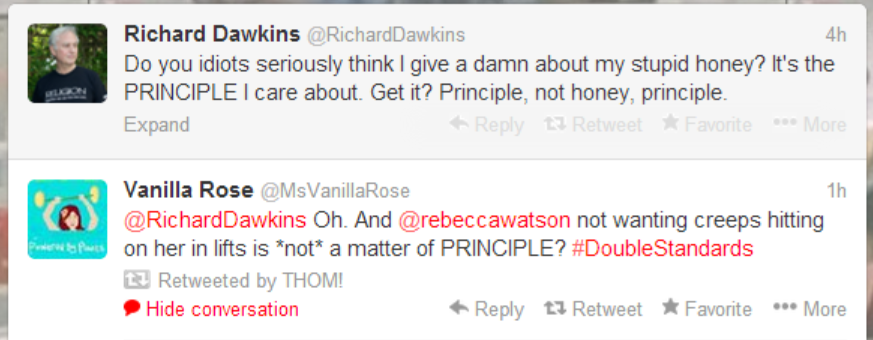
    abc

    Richard Dawkins @RichardDawkins

    Do you idiots seriously think I give a damn about my stupid honey? It’s the PRINCIPLE I care about. Get it? Principle, not honey, principle.

    Vanilla Rose @MsVanillaRose

    @RichardDawkins Oh. And @rebeccawatson not wanting creeps hitting on her in lifts is *not* a matter of PRINCIPLE? #DoubleStandards

     Now you need Doubting Tom’s Dear Muslimo. You have to go there to read the whole thing because it’s only right, but here’s how it ends:

    But stop whining, will you. Think of the suffering your poor British brothers have to put up with.

    Only this week I heard of one, he calls himself “Richard Dawkins,” and do you know what happened to him? A TSA security agent took away his jar of honey. I am not exaggerating. He really did. He took his jar of honey. Of course he protested, and of course he knew the preexisting security rules, but even so . . .

    And you, Muslimo, think you have inconvenience, intrusion, and harassment to complain about! For goodness sake grow up, or at least grow a thicker skin.

    Tom

    Oh my stupid honeeeeeeeeeeeeeeey.

    Update

    Via @BoingBoing

    EXCLUSIVE: Photograph of Richard Dawkins at TSA screening point.

    Embedded image permalink