Tag: Avijit Roy

  • A person and an institution

    The Guardian has an excellent long and sympathetic essay on Avijit Roy, by Oliver Laughland in New York and Saad Hammadi in Dhaka.

    His friends told him it was too dangerous to go to Bangladesh, but he wanted to visit his mother.

    Roy’s death led secular activists to take to the streets in Dhaka to demand justice and to refocus international attention on freedom of speech in Bangladesh. As violence and political tensions in the country re-emerged after a year of relative calm, the murder has exacerbated existing rifts between the country’s secular incumbents the Awami League and its rightwing opposition, the Bangladesh Nationalist Party and Jamaat-e-Islami, its Islamist ally.

    “I think we lost not just a person, but an institute. He was a movement,” said Jahed Ahmed – a New York based co-founder of Mukto-Mona. “He created an online renaissance.”

    He had a source of inspiration himself.

    It was a family trip to the small town of Shantiniketon in West Bengal that first inspired Roy to write. The east Indian town was where the humanist author and philosopher Rabindranath Tagore, the so-called “father of the Bengal Renaissance” had penned many of his most important works at the turn of the 20th century. The visit had a profound impact on the young man in his third year of an engineering undergraduate degree.

    “It helped him come out of the mechanical attitude engineering students develop,” Ajoy Roy, Avijit’s grief-stricken 80-year-old father told the Guardian in Dhaka. “As he came closer to nature and Tagore’s peaceful and spiritual establishment, they instilled a literary mindset within him.”

    “I encouraged him to write … about world identity, keeping Rabindranath’s views on background,” said Roy – himself a noted physicist and human rights campaigner.

    Martha Nussbaum is a big admirer of Tagore’s, too.

    But it was the internet that would allow Avijit’s talent to flourish. In 2000, while studying for a PhD in software engineering in Singapore, Roy would spend hours in Bengali expat forums, discussing (among others) the prose of the secular humanist poet and philosopher Taslima Nasrin, exiled from Bangladesh in 1994 and the works of prominent American atheist philosopher Paul Kurtz.

    It sounds so familiar.

    The death threats started around 2010 but, friends recall, were really only taken seriously after the murder of Ahmed Rajib Haider, a Dhaka-based atheist blogger murdered in a strikingly similar attack to Avijit’s in February 2013.

    Haider, who had contributed to Mukto-Mona under a pseudonym, was dragged from his home and hacked to death by a gang of machete-wielding assailants in February 2013. His brutal murder happened as tens of thousands of people took to the streets demanding the death penalty for prominent Islamists who had recently been convicted of war crimes committed in the country’s Liberation war of the early 1970s.

    “Avijit took the threats seriously [then],” Farid Ahmed recalled, “[But he said] we know that nothing comes easily. If we have to give blood, we have to give blood.”

    It was around the time of Haider’s death that Roy first contacted Michael De Dora, director of public policy at the Washington-based Center for Inquiry, a global secularist NGO. The pair would frequently talk about the increasing death threats he had been receiving, particularly from Farabi Shafiur Rahman, an extremist blogger and member of the banned pan-Islamist outfit Hizb ut-Tahrir, who this week was arrested in connection with Roy’s death after posting death threats to Facebook before the attack.

    A revealing March 2014 email exchange between De Dora and Roy, shared with the Guardian, shows that Roy appeared more concerned that the threats had resulted in his books being taken off the shelves than any fear for his life. Roy wrote:

    I am astounded to see that no legal action has been taken against this maniac. Instead, Rokomari [an online bookstore that received death threats for selling Roy’s work] decided to withdraw my books from its store. This incident proves that even Facebook threats from figures as minor as Farabi work effectively in Bangladesh.

    The bad people win, often.
     

  • Two living, breathing human beings

    A “godless science-researcher” wrote an impassioned, humane post about the murder of Avijit Roy, who was his friend.

    Hacked to death. Hacked. To death. Two living, breathing human beings, returning home after their day’s work, set upon by murderous assailants who dragged them to the pavement and hacked away at them with machete-like sharp instruments. Two human beings, a man who has succumbed to his deadly injuries, and a woman, who sustained severe injuries to her hands and forehead as she tried to protect her companion. Two human beings, my friend and his wife.

    It is particularly horrifying. It’s all too easy to imagine what it would be like.

    Bangladesh-born, resident of suburban Atlanta in the state of Georgia, and an engineer by profession, Avijit has consistently been a prominent voice for reason and free thought, denouncing religious extremism and intolerance. I haven’t had the pleasure of being acquainted with his wife, Rafida Ahmed Bonya, but from common friends and acquaintances, I gathered the impression that she was his perfect partner, a blogger who shared his passion for rationality. Avijit founded the Bangla-language blog Mukto Mona (“One with a Free Mind”) in 2000 to offer the Bangla-speaking freethinkers from the subcontinent and beyond a valuable platform to discuss science, reason and humanity.

    I had the privilege of writing for Mukto Mona a few times. I couldn’t continue writing on relevant topics for various reasons, but it was – to my good fortune – enough to create a bond between Avijit and me. Sometime in 2012, Avijit wrote me a message on Facebook asking if I was the same person who wrote for Mukto Mona. I was elated to be so recognized – because by that time I was already acquainted with his scholarship, the books in Bangla on science and religion he had authored, and his persistent, powerful and courageous efforts to defend reason and bring enlightenment to an increasingly fractious and irrational world. We became friends on Facebook, and continued to be in touch.

    We make friends in these ways, so it all becomes personal. Damn right it does.

    Avijit was an avowed atheist, but the predominant theme of his writings was secular humanism, guided by reason. (If you are able to read Bangla online, do read his public Facebook note on his experience in authoring and publishing books.) He was a strong voice for opposing irrational beliefs, blind faith and superstitions, and especially reactionary fundamentalism in religion regardless of specific creeds. He also spoke out against the false equivalence between secularism and fundamentalism often drawn by so-called moderates in Bangladesh, and held them culpable for the cultural decline of that country – a country which, in a matter of decades, has turned from its scholastic traditions marked by thought and intellectual query to a regressive society where radical Islamic hardliners hold sway over public life, liberally dispensing abuse and death threats to freethinkers, atheist writers and bloggers with impunity, and in effect rewriting the cultural norms of that society to suit their ideology; a country where authorities do nothing to ensure safety of those opposed to religious extremism, where rationalist bloggers and writers have been attacked and murdered, and arrested under the odious, medieval ‘Blasphemy law’. Avijit and his daughter, Trisha Ahmed, had chronicled this painful state of affairs in a 2013 op-ed in the Free Inquiry magazine.

    That’s happened in the US to some extent too – a turn away from secularism, a valorization of “faith” and goddy thinking, a rejection of rational inquiry. It’s a bad trend.

    The shock of Avijit’s death – he was of my age – numbed me enough to make it difficult to get the words out. But if there is one thing that gave me courage and hope, it was the wise and intrepid words from young Trisha, who wrote: “To say that I’m furious or heartbroken would be an understatement. But as fucked up as the world is, there’s never a reason to stop fighting to make it better. I’ll carry the lessons he taught me and the love he gave me forever.” As would we, in our hearts.

    Violence perpetrated for whatever reason has become commonplace in the daily lives of many societies across the world. And religion ranks amongst the highest of such reasons. A recently released report by Pew Research Center shows a global region-wise map of social hostilities around religion. Not shockingly, the Indian subcontinent features prominently as a region with very high religious hostilities in the society.

    But that statistic did not hit home as much as it has done now.

    It’s personal.

  • Never a reason to stop fighting to make it better

    Alom Shaha nudges everyone to notice and remember Avijit Roy.

    He was a hero to many Bangladeshis, but few if any in the west will be declaring that they are Avijit in the way so many of us announced we were Charlie after the Charlie Hebdo attacks. But there are lots of Avijits outside the west, genuinely brave individuals who put their lives on the line to uphold values and freedoms that we take for granted: Ahmed Rajib Haider, another Bangladeshi atheist who was killed because of what he wrote; Raif Badawi, a Saudi Arabian blogger who has been flogged in public and is in prison for “insulting Islam”; Karim Ashraf Mohamed al-Banna, jailed for three years in Egypt, again for “insulting Islam” by simply declaring he is an atheist; Kacem El Ghazzali, who lives in exile after death threats in his home country of Morocco – the list is long and depressing.

    The list includes also Taslima Nasreen, Zineb el-Rhazoui, Deeyah Khan, Maryam Namazie.

    After the Charlie Hebdo killings there was much debate about whether the cartoonists had provoked the killers, about the cartoonists “punching down”, about whether there should be limits to giving offence and so on. The brutal, cowardly murder of Avijit Roy shows how dangerous such arguments can be. Challenging religion is challenging those in power, and many pay a heavy price – we betray people like Avijit when we are half-hearted in our commitment to free speech.

    Let’s not be mistaken about why Avijit was killed: he said and wrote things some people didn’t like. There will be more such killings. More people will die because they say, write or draw things that other people don’t like. More people will die until we are all united in stating unequivocally that anyone who commits such atrocities is entirely in the wrong, that it is unjustifiable to kill people who “offend” you, that blasphemy is a ridiculous notion and that no one should ever, ever be killed for “insulting” a religion or drawing a cartoon.

    I didn’t know Avijit Roy, but I know people who did, and their grief and rage at his murder is far more keenly felt than mine. For that reason I had reservations about writing this piece, but Avijit’s daughter said that: “To say that I’m furious or heartbroken would be an understatement. But as fucked up as the world is, there’s never a reason to stop fighting to make it better … What would help me the most right now is if everyone (even people I’ve never met) could share his story.” So that’s what I’m doing here.

    Same here. I was sharing his story already, but his daughter’s statement motivates me to share it even more loudly and urgently, if that’s possible.

  • Rahman is busted

    Law enforcement people in Bangladesh have arrested Farabi Shafiur Rahman in connection with the murder of Avijit Roy.

    A spokesman for the police’s elite Rapid Action Battalion (RAB) said Farabi Shafiur Rahman had been arrested at a bus station in the capital over the brutal murder of Avijit Roy. “He is the main suspect,” RAB spokesman Maj Maksudul Alam said.

    Rahman had threatened Roy several times before, including on Facebook, where he said Roy would be killed upon his arrival in Dhaka. The suspect has been handed over to the police’s detective branch, which is investigating the killing.

    The RAB paraded Rahman before the press at its headquarters in Dhaka where another RAB spokesman, Mufti Mahmud, described him as a member of the banned pan-Islamist outfit Hizb ut-Tahrir.

    “On different occasions, he exchanged [Roy’s] location, his identity and his family’s photographs with various people,” Mahmud told reporters.

    With a view to getting him killed, and it worked.

    A source within the RAB, which is mainly responsible for tackling religious militancy within the Muslim-majority country, said correspondence between Rahman and another person about killing Roy had been discovered.

    The atheist blogger had angered fundamentalist groups through his blogs and books, including Biswasher Virus (Virus of Faith), about science and religion.

    Nope nope nope. You’re doing it again. Your putting the agency on Avijit when it belongs on the fascist theocrats. The fascist theocrats chose to get in a rage at Avijit for writing books and blog posts. The responsibility is on them,  not on Avijit.

    Roy, a mechanical engineer and founder of the blog Mukto-Mona (free-mind), was killed when he was returning with his wife Rafida Ahmed from the book fair held every February. The couple arrived in Dhaka on 15 February to attend the launching of Roy’s books at the fair. His wife lost a finger on her left hand, but is out of danger, said doctors. She was due to fly back to the US on Monday, said family members.

    That’s good to know, at least. But what a horror she’s left with.

    Free speech advocates have called on the Bangladeshi government to protect the right of writers to speak freely.

    “Instead, it has adopted a policy of appeasement of ‘religious sentiment’,” wrote Salil Tripathi, for English Pen, which campaigns for the freedom of expression. “This comes alongside intimidation of the mainstream media that are critical of the government, including the leading national newspapers. The media that has supported free thought and critical thinking is under assault from a government showing increasingly authoritarian tendencies.”

    Salil is a comrade.


  • Light the darkness

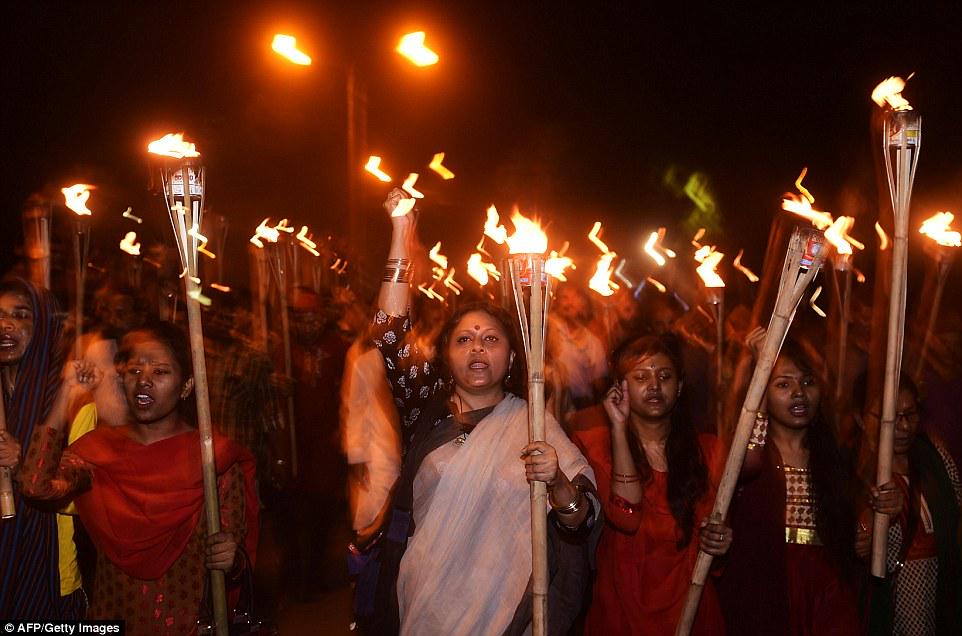
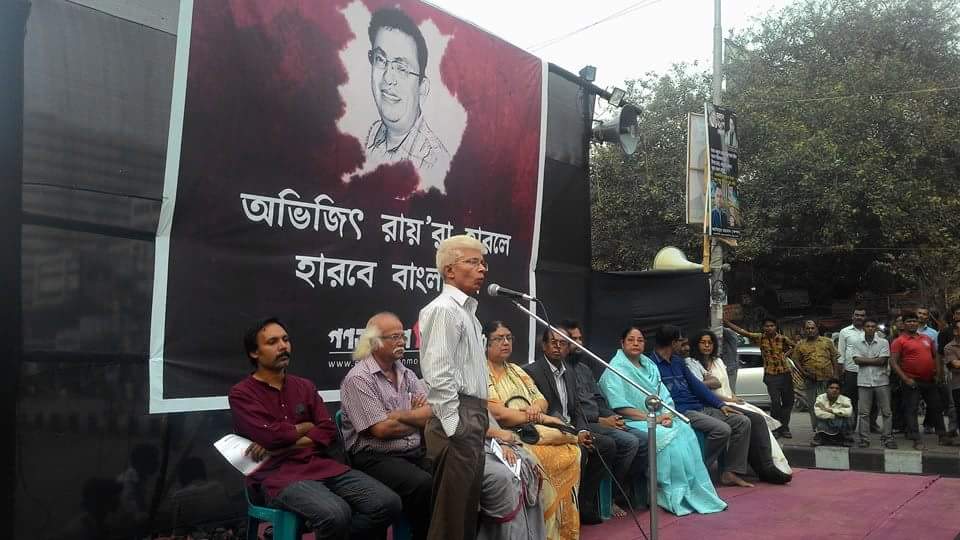
    There were rallies for Avijit Roy in Bangladesh, too.

    Embedded image permalink

    Embedded image permalink

    Also Kolkata:

  • But you cannot kill ideas

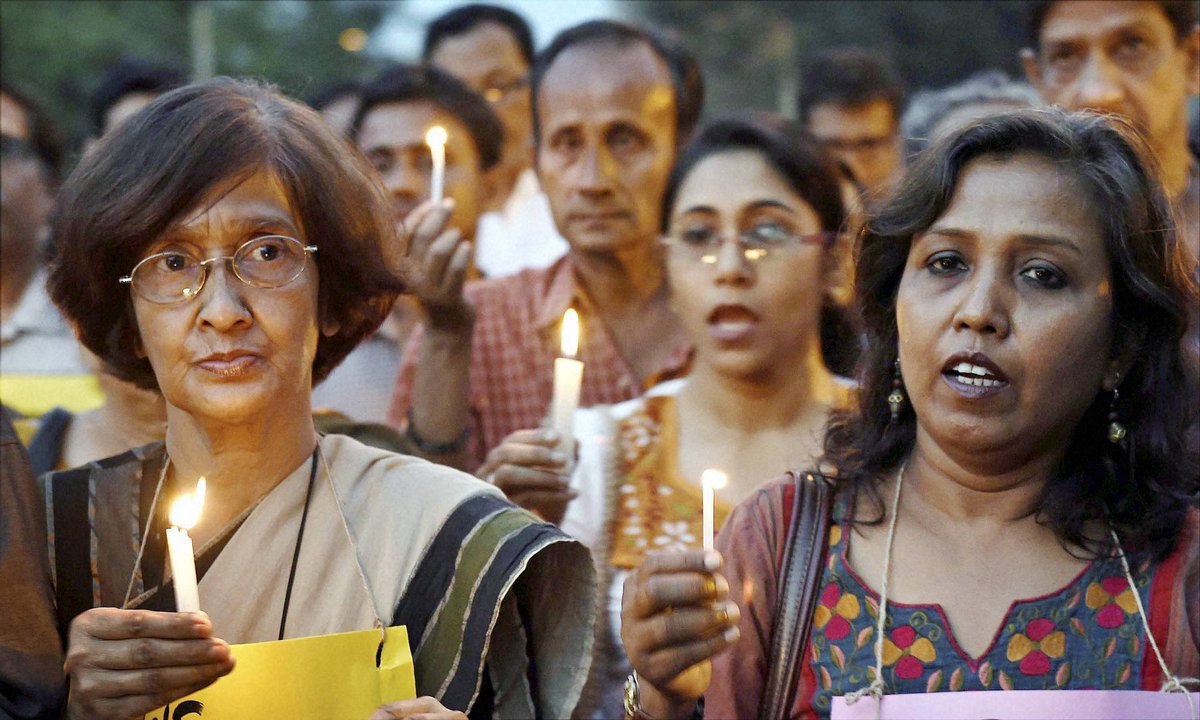
    More from the vigil for Avijit Roy:

  • We mourn but we are not out

    There was a vigil in honor of Avijit Roy in Trafalgar Square this afternoon.

  • If everyone could share his story

    Trisha Ahmed, daughter of Avijit Roy, asks us all to share her father’s story. The IHEU has more.

    Criticism of a “culture of impunity” and the apparent failure of authorities to act on strong, credible threats by known individuals in the past year alone has been a common feature of the international outcry over the killing, including our own commentary which named one of the hostile individuals Fellow humanist bloggers like Asif Mohiuddin have called for pressure to be piled on the Bangladesh government.

    Roy’s daughter, Trisha Ahmed, a student in the United States, has also written about her father in tribute and calling for his story to be shared far and wider. Her words below, originally posted on Facebook, are re-published with permission.

    “My dad was a prominent Bengali writer, most famous for his books about science and atheism. He and my mom went to Bangladesh last week to publicize his books at Bangladesh’s national book fair. 15 hours ago, Islamic fundamentalists stabbed my dad to death. My mom was severely wounded from the attack and is still in the hospital. His death is headline news in Bangladesh.

    The reason I’m sharing this is less for me and more for my dad. He was a firm believer in voicing your opinion to better the world.

    He and my mom started dating when I was six years old. In the twelve years that followed, he became my friend, my hero, my most trusted confidante, my dance partner (even though we’re both terrible dancers), and my father. Not once did he tell me to simmer down or be more polite; he taught me to be informed, bold, and unafraid.

    To say that I’m furious or heartbroken would be an understatement. But as fucked up as the world is, there’s never a reason to stop fighting to make it better. I’ll carry the lessons he taught me and the love he gave me forever. I love you so much, Dad. Thank you for every single thing

    What would help me the most right now is if everyone (even people I’ve never met) could share his story. His story should be heard in the US because Bangladesh is powerless; it’s corrupt, there is no law and order, and I highly doubt that any justice will come to the murderers. I want his story to be on US headline news, not only Bangladesh’s. If you could just do all you can to spread word of what’s happened, I would appreciate it so so much. Inform your schools, your communities, write all that you can. Please don’t allow my dad to die in vain.

    Please use your influence to help bring some sort of justice to the atrocious acts that have been committed against my parents.

    Share and share and share. We’re not letting Saudi Arabia forget about Raif and Waleed; let’s also not let Bangladesh forget about Avijit and Rafida.

    H/t Salty Current

  • The cause is highly personal

    Avijit Roy and his daughter Trisha Ahmed wrote an op-ed for Free Inquiry, October/November 2013: Freethought Under Attack in Bangladesh. (I had a piece in that issue too. I never met him, but it was one degree of separation.)

    It’s chilling to read now – all the more chilling, that is. It was chilling then and it’s more so now.

    On April 1, 2013, the Bangladeshi government played the fool in a disgraceful affair that we only wish had been an April Fool’s Day prank. On that day, several bloggers were put behind bars in Bangladesh on the sole basis that they were openly atheist. When we say “openly atheist,” we do not mean that the bloggers denounced religion in public squares or emphatically condemned theists to the ugliest patches of ground after death. Instead, the government criminalized these four men for simply voicing their rational, skeptic, and scientific thoughts on blogging forums—sites that exist for free inquiry, self-expression, and, most important, free speech.

    And why did the Bangladeshi government do that? Because Islamists made a stink.

    Following the Shahbag Protest, members of one Islamist faction waged a disinformation campaign to defame the bloggers. They claimed that the young bloggers had offended Islam and Muhammad and published a list of nearly eighty bloggers and forum participants whom they labeled atheists and attackers of Islam. The group publicly demanded capital punishment for the bloggers’ “blasphemy.”

    It is worth noting that Bangladesh has no blasphemy laws. Though it is a Muslim country, the nation’s constitution proclaims “freedom of thought, conscience and expression” as a fundamental right. Nevertheless, the government disregarded this right and attempted to appease the Islamists by arresting three popular bloggers—Subrata Adhikari Shuvo, Rasel Parvez, and Mashiur Rahman Biplob—on April 1. The very next day, police also arrested Asif Mohiuddin, another one of the country’s most outspoken “atheist” bloggers. The men were paraded in handcuffs at a news conference as if they had committed a heinous crime. By arresting these four bloggers—and threatening dozens more bloggers with potential charges—Bangladesh’s government demonstrated that it regards freedom of speech as a constitutional formality, not a fundamental right.

    It’s like living in the 11th century and the 21st century at the same time. It’s like sitting next to Savonarola on the bus.

    Of course, attacks against atheist and secular-minded writers are hardly a new phenomenon in Bangladesh. Humayun Azad was a renowned Bangladeshi atheist, writer, and linguistic scholar popular among younger and more progressive readers. When Azad was returning home from a book fair, he was attacked by a group of radical Islamists who attempted to slit his throat.

    What I said – chilling. Azad survived the immediate attack but he died some months later.

    A similar case unfolded in 1994, when Taslima Nasrin—a feminist writer well known for her critical views toward Islam—had to flee Bangladesh after Islamic extremists threatened to kill her for her criticisms of the Qur’an. Although Nasrin denied the accusation, she was forced into hiding when an Islamist leader offered a bounty for her beheading. Eventually she fled the country. [Taslima Nasrin is now a senior editor of FREE INQUIRY.—Eds.]

    And my friend.

    Many of us freethinkers decided to organize to protest the government’s violation of freedom of speech. For us, the cause is highly personal. The imprisoned atheist bloggers have long been known to us as active writers on sites including Mukto-Mona (an Internet site popular among freethinkers, rationalists, skeptics, atheists, and humanists of mainly Bengali descent). We have created several Facebook pages, written individual blogs, issued formal statements, and penned articles for newspapers in Bangladesh as well as for international media. We also worked closely with the Center for Inquiry, the International Humanist and Ethical Union (IHEU), Atheist Alliance International, American Atheists, and other secular organizations. They demonstrated immense concern, and some issued multiple statements condemning the Bangladeshi government for suppressing the voice of the freethinking community. Michael De Dora, director of the Center for Inquiry’s Office of Public Policy and the organization’s representative to the United Nations, suggested a worldwide protest rally complete with demonstrations in Washington, D.C., London, Ottawa, Dhaka, and other cities around the world. The demonstrations were held on April 25, 2013, and May 2, 2013, under the banner of “Worldwide Protests for Free Expression in Bangladesh.” They succeeded in drawing global attention to this new threat to freedom of belief and expression. More important, the demonstrations put pressure on the Bangladeshi government to release the freethinkers. As pressure mounted, the government responded and it released the arrested bloggers on bail at the end of June 2013. Still, the bloggers are awaiting trial and face continual death threats from fundamentalist groups. Their names, pictures, and even addresses have been widely publicized, and they are now easy targets.

    Clearly global attention cuts both ways – it puts pressure on governments but it also puts targets on people and gives the theofascists more fuel for their murderous rages.

    But we have to resist.

  • Nothing new in Bangladesh

    The BBC reports on the murder of Avijit Roy and what it means for Bangladesh and other dissenters.

    Hundreds of people gathered in Dhaka to mourn the blogger’s death.

    Mr Roy’s family say he received threats after publishing articles promoting secular views, science and social issues on his Bengali-language blog, Mukto-mona (Free Mind).

    He defended atheism in a recent Facebook post, calling it a “rational concept to oppose any unscientific and irrational belief”.

    His Mukto-mona website on Friday bore the message in Bengali “we are grieving but we shall overcome” against a black background.

    Like Charlie Hebdo last month.

    In a forthcoming article to be published in the Free Inquiry magazine of April-May 2015, Mr Roy likens religious extremism to a “highly contagious virus”.

    I have a column in that issue. What’s it about? Charlie Hebdo and Raif Badawi, and the nature of the Saudi regime. It’s almost as if there’s only one subject these days.

    Death threats against atheist writers and bloggers are nothing new in Bangladesh.

    Prominent writer Taslima Nasreen had to leave Bangladesh after she received death threats from hard-line Islamists in the mid-1990s.

    She wrote on her blog: “Avijit Roy has been killed the way other free thinker writers were killed in Bangladesh. No free thinker is safe in Bangladesh.

    “Islamic terrorists can do whatever they like. They can kill people with no qualms whatsoever.”

    That’s what god-obsession gets you.

  • As they were

    I’ve just seen a horrific photo just after the attack on Avijit Roy and Rafida Ahmed Banna, which I’m not going to post, but in a comment on the post there is one from shortly before it, so it’s one of his last moments. It seems worth sharing.

  • Nothing new in Bangladesh

    The newspaper The Hindu talked to Taslima about the murder of Avijit Roy.

     “It was Avijit’s criticism of all kinds of religious fundamentalism including Islamic fundamentalism that may have been the cause behind the murder,”Ms. Nasreen, who knew Mr. Roy for about two decades, told TheHindu.  She also said that such attacks on writers “is nothing new” in Bangladesh.

     “There is no freedom of speech in Bangladesh. Such murders of writers had taken place there before,” she added. In 2013, another blogger Ahmed Rajib Haider who advocated secularism, was allegedly murdered by extremist elements. In 2004 writer Humayun Azad was attacked near the Dhaka University campus, during the book fair. He later died mysteriously in his apartment in Germany.

    The Hindu also quotes Bengali film director Gautam Ghosh.

     “The incident indicates that all kinds of tolerance, whether religious or political, were decreasing. Such attacks are attempts to muzzle the voice of free thinkers,” he said. The social media in Bengal and across the world condemned the incident.

     Ganamancha, a platform of leftist activists, claimed that the “religious fundamentalists” in Bangladesh carried out the attack. “Rationalist activities are increasingly coming under attack in the South-Asian sub-continent as was seen in the assassination of Govind Panasare (senior Communist Party of India leader) and Narendra Dabholkar (noted rationalist) by extremists in India,” said a statement issued by Ganamancha.

    Theocrats on a rampage.

  • An inspiration

    A moving statement from CFI yesterday on the murder of Avijit Roy, ally and friend.

    * * * UPDATE: Read Dr. Roy’s final article for Free Inquiry, to be published in the upcoming April/May issue: “The Virus of Faith.” [PDF] * * *

    We at the Center for Inquiry are shocked and heartbroken by the brutal murder of our friend Dr. Avijit Roy in Bangladesh, it is speculated at the hands of Islamic militants. Dr. Roy was a true ally, a courageous and eloquent defender of reason, science, and free expression, in a country where those values have been under heavy attack.

    Dr. Roy was the founder of the website Mukto-mona, an online network of freethinkers of mainly Bengali and South Asian descent, as well as the author of several books, and a contributor to our own magazine Free Inquiry and our Free Thinking blog. When seven Bangladeshi atheist bloggers were arrested for blasphemy in 2013, Dr. Roy worked closely with us to connect us with the bloggers and their families, focus the international community’s attention on the injustice, and help organize and promote protests around the world.

    “I cannot overstate how great a loss this is,” said Michael De Dora, CFI’s chief UN representative and friend of Dr. Roy. “Avijit was brilliant, yes, and a devoted advocate of free expression and secularism, but also just a very good person. Avijit was an inspiration to countless other freethinkers, in Bangladesh and around the world, and he was an inspiration to me. I valued our friendship deeply, as I valued his contributions to our shared mission. I will miss him, and the global freethought community will feel the impact of his loss. His example will no doubt continue to shine.”

    It’s heartbreaking.

  • The secular government reacted by arresting some atheist bloggers

    People in Bangladesh are fighting back.

    The couple were on a bicycle rickshaw, returning from a book fair, when two assailants stopped and dragged them on to the pavement before striking them with machetes, local media reported, citing witnesses.

    Hundreds of protesters rallied in Dhaka to denounce the murder, chanting slogans including “we want justice” and “raise your voice against militants”.

    Imran Sarker, the head of the Bangladesh bloggers’ association, said the protests would continue until those responsible were apprehended. “Avijit’s killing once again proved that there is a culture of impunity in the country,” Sarker told Agence France-Presse. “The government must arrest the killers in 24 hours or face non-stop protests.”

    Warning if you read this article: there’s a photo of Rafida Ahmed Banna on a stretcher, soaked in blood. It’s a bit of a shock to see if you’re not expecting it.

    Police have launched an inquiry and recovered the machetes used in the attack but could not confirm whether Islamists were behind the incident.

    But Roy’s father said the writer, a US citizen, had received a number of “threatening” emails and messages on social media from hardliners unhappy with his writing. “He was a secular humanist and has written about 10 books,” Ajoy Roy told AFP.His most famous work was Biswasher Virus (Virus of Faith).

    The Center for Inquiry, a US-based charity promoting free thought, said it was “shocked and heartbroken” by the brutal murder. “Dr Roy was a true ally, a courageous and eloquent defender of reason, science, and free expression, in a country where those values have been under heavy attack,” it said in a statement.

    We can’t afford to lose true allies. There aren’t nearly enough of us.

    Roy’s killing also triggered strong condemnation from his fellow writers and publishers, who lamented the growing religious conservatism and intolerance in Bangladesh.

    “The attack on Roy and his wife, Rafida Ahmed, is outrageous. We strongly protest this attack and are deeply concerned about the safety of writers,” said Sarker.

    Pinaki Bhattacharya, a fellow blogger and friend of Roy, claimed one of the country’s largest online book retailers was being openly threatened for selling Roy’s books.

    “In Bangladesh the easiest target is an atheist. An atheist can be attacked and murdered,” he wrote on Facebook.

    Atheist blogger Ahmed Rajib Haider was hacked to death in 2013 by members of a little-known Islamist militant group, triggering nationwide protests by tens of thousands of secular activists.

    So the government acted to protect the rights and freedom and lives of the atheist bloggers, right?

    No.

    After Haider’s death, Bangladesh’s hardline Islamist groups started to protest against other campaigning bloggers, calling a series of nationwide strikes to demand their deaths, accusing them of blasphemy.

    The secular government of the Bangladeshi prime minister, Sheikh Hasina, reacted by arresting some atheist bloggers.

    So murdering atheists is ok, while being atheist is a crime. Thanks, BossGod.

    The government also blocked about a dozen websites and blogs to stem the furore over blasphemy, as well as stepping up security for the bloggers.

    On Friday Sarker said: “Communal and militant groups have threatened the very spirit of our nation. Yet instead of crushing them, the government was keen on appeasing them by arresting secular bloggers.”

    But none of this has anything to do with “true Islam.” It’s all impostors and usurpers.

  • No action taken

    The IHEU on the murder of Avijit Roy and the potentially lethal attack on Rafida Ahmed Bonna.

    “Abhijit Roy lives in America and so, it is not possible to kill him right now. He will be murdered when he comes back.”

    These were the words of an Islamist activist referring to Avijit (or Abhijit) Roy early last year. The man making the threat, who is well-known to the authorities, has repeatedly and openly talked about wanting to see secular and freethought writers dead, and those under threat have complained that authorities have ignored his threats and incitement, despite his credible links to Islamist extremists and similar murders taking place.

    Tonight, IHEU joins with freethinkers and humanists from Bangladesh in calling for an end to this fatal appeasement of death threats by the authorities in Bangladesh.

    Avijit Roy was a well-known writer, founder of the freethought blogging platform Mukto-Mona, which he described to IHEU as “an Internet congregation of freethinkers, rationalists, skeptics, atheists, and humanists of mainly Bengali and South Asian descent”. He had previously provided IHEU with analysis around the arrest and threats against “atheist bloggers” in Bangaldesh in 2013.

    Bob Churchill comments:

    This loss is keenly felt by freethinkers and humanists in South Asia and around the world. He was a colleague in humanism and a friend to all who respect human rights, freedom, and the light of reason. Our thoughts are with his family, and his many friends, supporters, and admirers who will be deeply hurt by this senseless crime.

    We cannot know the assailants who carried out tonight’s vicious murder. But we do know this: Those who have openly made the most serious and credible threats on Roy’s life have been allowed to do so with impunity and now he is dead. As Roy himself warned, Bangladesh is appeasing the most insidious and violent strains of Islamism, and he knew his own life was under threat. That appeasement of theocratic demands and naked threats must end, now.

    We mustn’t be pushy, now. We must respect the faith of people of faith, even when they’re attacking us with machetes.

    Bangladeshi writer and activist, Asif Mohiuddin, who spoke in a plenary session at last year’s World Humanist Congress about the threats by Islamists against himself and others for for their humanist writings and secular activism, said of Avijit Roy tonight:

    “He was like my brother. This a great loss for the nation, and for all freethinkers in the world. We called him Richard Dawkins of Bangladesh. He was the nicest person I ever met. Just yesterday he wished me well on my birthday, today he is dead. I can’t believe this! He was my dearest friend and we worked together for 6 years against religious fundamentalism.

    He was my hero, and hero of many young freethinkers in Bangladesh. Many young people were inspired by him so much. Now we have a big atheist and agnostic community, gay and lesbian community, that was possible only because of him. He was our support in every step. Whenever we had any problem, he solved that very quickly.

    I am very much upset. Please do something, create some pressure on Bangladesh government by writing. Many freethinkers are in risk, they will die.”

    Then there are extracts from emails Roy wrote about the Islamist who called for his murder.

    The following text is from emails exchanged from 21 March 2014 onwards; the first email was almost certainly sent to multiple organisations and media. (The square brackets are his own, except where otherwise stated with emphasis in italics.)

    [21 March 2014] I am often involved in causes that rally support for free speech movements in Bangladesh through my writing and activism. Recently, I found that I have been targeted by a group of militant Islamists and terrorists. Farabi Shafiur Rahman, an extremist who is allegedly linked to the radical Islamist party Jamaat-e-Islami and Hizbut Tahrir [a terrorist organization that operates in 40 countries (including Bangladesh) around the world] has given me a death threat through a facebook status. It is worth noting that he is the same Farabi who threatened to kill a Muslim cleric officiated at Ahmed Rajib Haider’s (a popular blogger known by the psuedonym Thaba Baba, who was hacked to death last year by machete-wielding Islamic militants) funeral last year during Shahbagh Movement. Police at that time arrested Farabi on charges of “instigating the murder” but he was granted bail. Although he has continued to threaten many progressives in Bangladesh, no official action has been taken against him.

    There’s more. It’s all sickening.