Tag: Balthus

  • Properly appreciated

    From another piece reporting on the Met and Balthus and the petition:

    In a 2013 review of the Balthus show in The New Republic, critic Jed Perl called Balthus the “last of the mystics who transformed twentieth-century art.” Perl said mystics are “by turns revered, reviled, demonized, and ignored—and at one point or another in his very long career Balthus was regarded in all of those ways.”

    Perl added that Balthus’s paintings of girls “have stood in the way of a full appreciation of his achievement.” He wrote that these works “can be properly appreciated only when we accept them as unabashedly mystical, the flesh a symbol of the spirit, the girl’s dawning self-awareness an emblem of the artist’s engagement with the world.”

    Oh come on.

    That’s one way of looking at it, certainly, and one way to appreciate it, but if it’s really the only way to appreciate it properly then Balthus fucked up, because another way of looking at it is pretty damn hard to ignore.

    What it most obviously is is a very young girl in a skirt sitting with her legs apart in a way that young girls’ mothers teach them not to do when they’re wearing skirts and other people are around. Young girls’ friends and peers and enemies also teach them that, by laughing and shouting and taunting. It’s a thing girls grow up with: the fact that skirts make you vulnerable to accidentally showing your Naughty Bits, and to men and boys who like to put cameras in places where you show your naughty bits even though you’re standing up straight or sitting in a toilet stall.

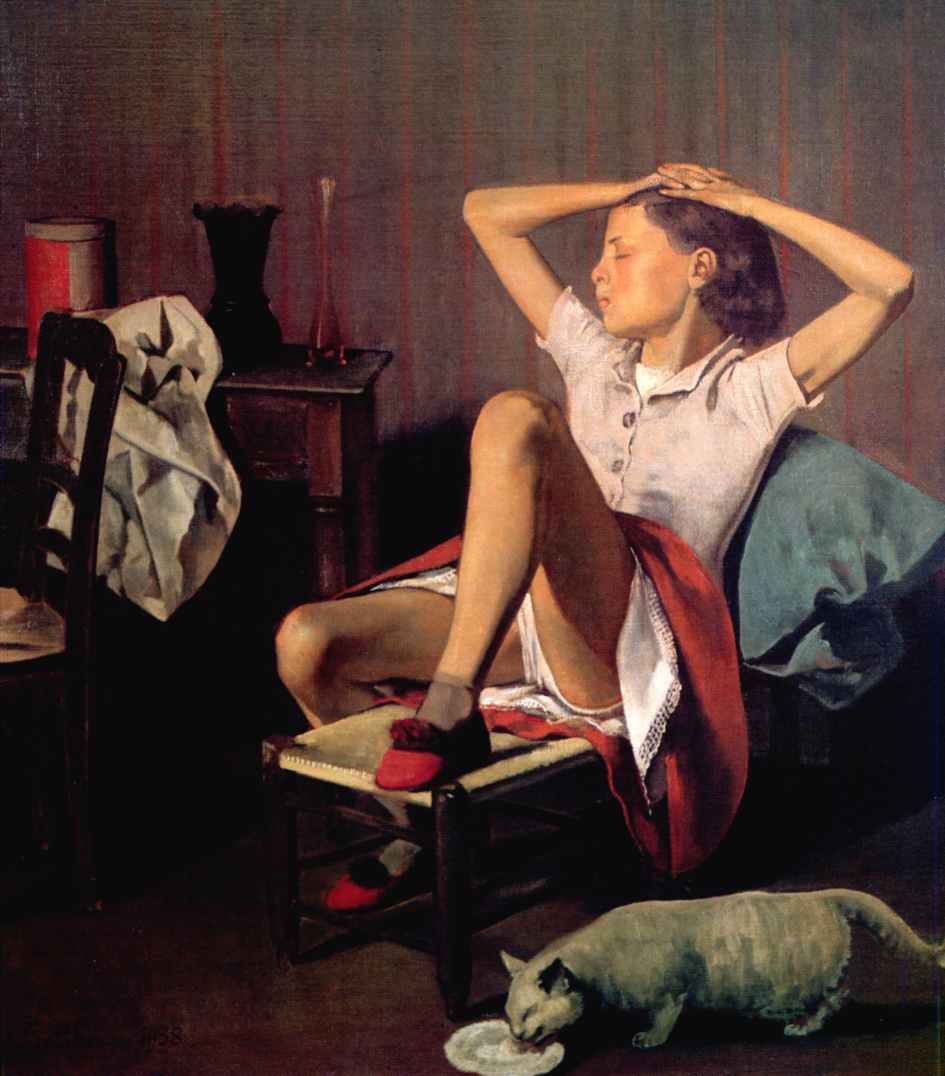
    The glaring fact here is that Thérèse Blanchard would not have been sitting that way in front of Balthus unless he had told her to. He posed her sitting that way. How, exactly, is that calculated pose (calculated by him, not by her) supposed to be unabashedly mystical? How can we tell the flesh is meant to be a symbol of the spirit? What indicates that the girl’s dawning self-awareness is an emblem of the artist’s engagement with the world as opposed to a “look up my skirt” self-awareness imposed on her by the artist?

    Mystics forsooth.
  • Hovering between innocence and knowledge

    The Met on a Balthus exhibition in 2013:

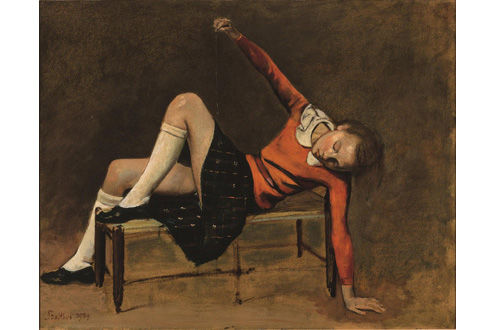
    Balthus: Cats and Girls—Paintings and Provocations explores the origins and permutations of the French artist’s focus on felines and the dark side of childhood. Balthus’s lifelong fascination with adolescence resulted in his most iconic works: girls on the threshold of puberty, hovering between innocence and knowledge. In these pictures, Balthus mingles intuition into his young sitters’ psyches with an erotic undercurrent and forbidding austerity, making them some of the most powerful depictions of childhood and adolescence committed to canvas.

    That’s a very Humbert Humbert sort of take. It frames the girls as budding prostitutes, gradually learning how to lure men. It also frames them as being all about sexuality and nothing else, when in fact it’s Balthus who is leering at them.

    Between 1936 and 1939, Balthus painted the celebrated series of 10 portraits of Thérèse Blanchard (1925-1950), his young neighbor in Paris. They are regarded as his most perceptive and sensitive portrayals of a young sitter and are among his finest works. At this point in Balthus’s career, the artist was chafing under the burden of portrait commissions, which he resented. So his neighbor’s youth must have been a welcome respite. But then, Balthus always felt a kinship with children; even as a child himself, he had been conscious of childhood’s importance. The portraits of Thérèse show her reading or daydreaming, posing alone, with her cat, or with her brother Hubert.

    Therese teaser


    And lounging with one foot on the floor and the other on the same plane as her body, with Balthus positioned between her knees and her skirt dropped back toward her hips. She’s “daydreaming” and the nice man next door is painting her crotch.

    Thérèse became the inspiration of the leitmotif in his oeuvre until the years toward the end of his life, as the artist found other models and muses. In Balthus’s work, all of the girls who play with cats peer into mirrors, read, daydream, or appear completely self-absorbed. Their ostensibly unself-conscious postures sometimes suggest sensuality and languor, sometimes ungainliness—a contradiction that is perfectly in keeping with the phenomenon of puberty. Balthus rendered his young models with as much dignity and importance as someone their own age would have perceived them.

    And with their legs wide open for the viewer’s convenience.

    I wonder what killed poor Thérèse Blanchard at 25.

    Thanks to Sackbut for the link.

  • Lullaby

    What is art? How do we know, how does anyone know? Does it become art when it’s framed and hung in a museum?

    Like Balthus’s Thérèse dreaming for instance.

    Image result for therese dreaming

    Is that art? Or is it a voyeur peering up a teenage girl’s skirt and masturbating?

    It may be art, but it for sure is an adult man posing a teenage girl in such a way that we’re staring at her crotch.

    Phillip Kennicott, probably not a teenage girl, says It’s Art.

    The Metropolitan Museum of Art has made the right decision, to reject the demands of an online petition calling for the removal of an erotically charged work by the Polish French artist Balthus. The 1938 painting, “Thérèse Dreaming,” shows an adolescent girl sitting on a chair, with one leg raised to expose her undergarments. The petition, which has gained more than 9,000 signatures, argues that the painting “romanticizes the sexualization of a child.”

    The word “sexualization” itself is too polite, too valorizing, too romanticized. It’s creepy peering up the skirt of an underage girl, is what it is, and making an ArtWork out of that so that we can all feel enlightened for looking at it and not screeching in disgust.

    There is a difficult and emotional conversation to be had about Balthus’s works, which frequently depicted adolescent or pubescent girls in a sexualized way. No serious exhibition of Balthus, who died in 2001, can avoid confronting those issues.

    BUT. You know there’s a but. Of course there’s a but. We can’t possibly just decide that making Art out of creepy perving on underage girls might be surplus to our aesthetic requirements. Nosir. We have to Confront the Issue, but only in such a way that no difference is made.

    We must deal with sexual harassment and sexual abuse without losing all that was gained during the sexual liberation of the last century.

    And if that means underage girls become fodder for men’s masturbation fantasies, it’s totally worth it because SEXUAL LIBERATION by god.

    The danger in the wings is a new Puritanism that would only increase the shame surrounding sexuality (a convenient weapon wielded by abusers) while undoing the painful, 20th-century process of deregulating sexuality from religion and heterosexual male power.

    And there should be no shame in this very natural desire men have to look up the skirts of teenage girls, it’s a healthy natural joyous urge, the display of which is part of the process of deregulating sexuality from heterosexual male power.

    Or not. Whatever. Who knows. Just don’t take away the paintings of girls letting us peer up their skirts, that’s all.