Tag: Charleston terrorist attack

  • Remember the nine

    It’s a good day, with the ruling, but it’s also the day of Clementa Pinckney’s funeral.

    There’s live video of the funeral service.

    And live updating by the Guardian.

    The pastor is singing – Ship of Zion. Quite impossible not to be moved by it.

    The Obamas and Biden have arrived. Everyone is singing “It is well in my soul.” There are a lot of pastors in purple on the…stage? Podium? The raised place in front, facing the congregation. It occurs to me that they can all be thinking, “I could have been one.”

    “Put his eyes to the telescope of eternity.”

    This song I actually know.

    The Guardian is transcribing live for me, so I don’t have to.

    The president is speaking now.

    “The bible tells us to hope and persevere,” he began.

    Obama went on to say that while he did not know Pinckney well, he did meet him when they were both young – when Obama had fewervisible grey hairs.

    Obama said Pinckney came from a family of preachers and a family of protesters who fought for the right to vote and helped desegregate the South.

    As he speaks, you can hear murmurs of agreement from the crowd.

    Pinckney was a good man, Obama says, adding: “You don’t have to be of high station to be a good man.” According to Obama, that js all one can hope for when eulogizing anyone – that after all the résumés are read, that the person be a good person.

    Obama names all nine people shot dead last week: Cynthia Hurd, Susie Jackson, Ethel Lance, Reverend DePayne Middleton-Doctor, Reverend Clementa Pinckney, Tywanza Sanders, Reverend Daniel Simmons Sr, Reverend Sharonda Singleton, Myra Thompson.

    “To the families of fallen, the nation shares in your grief. The church is and always has been the center of African American life. A place to call our own in often hostile world. A sanctuary from many hardships.”

    It’s very very churchy and goddy. It had to be.

    The Black church is our beating heart, says Obama.

    “There is no better example of this than Mother Emanuel.”

    Obama says that it is not known if the suspect in the shooting knew the history of the church he targeted, but says he probably sensed its meaning.

    “[It was] an act that he imagined would incite fear and recrimination, violence and suspicion, an act that he presumed would deepend divisions that track back to our nation’s original sin,” says Obama.

    “God works in mysterious ways. God has different ideas. He didn’t know he was being used by God.”

    He said the mysterious ways part with a preacherly little chuckle. It was a peripateia – he set up the tragedy and then turned it.

    To great applause, Obama says that “the alleged killer” was blinded by hatred; that the alleged killer could not see the grace around Pinckney and the bible study group as they opened the doors of the church to him.

    He could not see, the president says, that the families of victims would respond with words of forgiveness or that the nation would respond not with revulsion but with a retrospection and self-examination that we so rarely see.

    And now he’s talking directly about race and racism. The Guardian has paused in its transcribing for the moment.

    “For too long” – that gets a stir of applause and murmurs.

    “We talk a lot about race. There’s no shortcut – we don’t need more talk.”

    “An open heart” – that’s what we need now, he says.

    The dude is singing.

    That’s it.

    The Guardian has caught up:

    Obama says that South Carolina governor Nikki Haley’s remarks calling for removal of the Confederate flag from the state capitol were worthy of praise.

    Obama says that the “flag has always represented more than just ancestral pride” – a remark which is greeted by great applause.

    “For many, black and white, that flag was a reminder of system oppression and racial segregation,” Obama says.

    Removing the flag is not an act of political correctness, Obama says, but a sign that the cause for which the Confederates fought, the cause of slavery, was wrong.

    That got a lot of applause.

    Here’s the part where he got into it:

    Obama says we all must think about conscious and unconscious racial discrimination in our every day lives. Not just about racial slurs, but also about how we want to call Johnny back for a job interview, but not Jamal.

    We have to begin by treating every child equally no matter their race or the station they were born into, he says.

    Obama also says we need to open our eyes to the mayhem of gun violence.

    “Sporadically our eyes are open,” he says, as when people are shot at an elementary school, at a movie theatre, or in the basement of a church.

    We should also not forget about the 30 lives lost to gun violence every day, he adds. Or the survivors, who are crippled by guns, or children now fearful and communities overflowing with grief.

    Every time another act of gun violence occurs, someone says we need to talk about race, says Obama.

    We talk a lot about race. There’s no shortcut. We don’t need more talk.

    Pinckney “understood that justice stems from recognition … that my liberty depends on you being free too. That history can’t be a sword to justify injustice,” says Obama.

    Instead, he says, history must be used as a manual to break the cycle.

    It was powerful.

  • Ethel Lee Lance and Sharonda Coleman-Singleton

    The first two funerals for the victims of the racist shootings in Charleston are being held today.

    The services for Ethel Lee Lance and Sharonda Coleman-Singleton will both take place after viewings at Baptist churches in North Charleston.

    Ms Lance, 70, worked for the church for 30 years and was a mother of five.

    Abigail Darlington at the Charleston Post and Courier wrote a profile of Lance last week.

    Ethel Lance loved to dress up and take her family to see performances at the Gaillard Municipal Auditorium when she wasn’t on duty there as a custodian.

    She started working at the venue in 1968 when it first opened, and she stayed until retirement in 2002, according to Cam Patterson, director of special facilities for the city of Charleston, who worked with Lance at the Gaillard for many years.

    Patterson said Lance was not only a co-worker, but a friend.

    Ethel Lance

    “She was funny and a pleasure to be around. And she was a wonderful mother and grandmother,” Patterson said. “She would have her children and grandchildren come to the Gaillard from time to time. She was like me, a no-nonsense grandmother and I know they are going to miss her terribly.”

    She wasn’t someone who needed to be shot dead inside her church by a murderous racist.

    “A strong woman,” was the first phrase that came to Esther Lance’s mind to describe her mother.

    Her voice cracked as she fought back tears, explaining that this isn’t the first time her family has dealt with loss.

    Lance’s husband and the father of her children, Nathaniel Lance, died in 1988. In October 2013, her daughter Terrie Washington died of cancer at age 53.

    And Ethel Lance was the matriarch, the “strong woman who just tried to keep her family together,” Esther Lance said.

    She was dedicated to Emanuel AME Church, where she was a lifelong member, Esther Lance said. As its custodian, she took pride in looking after the historic church.

    “If she saw a scuff on the floor she’d say, ‘Oh no, don’t y’all mess up my floor’,” Esther Lance said, adding that’s just the way her mother was.

    “If she saw something wrong, she’ll tell you,” Esther Lance said. “When you right, you’re right. But if you’re wrong, she will let you know. She’s not going to sugar-coat anything.”

    But her mother was happy, full of joy, she added. She always found time to spoil her seven grandchildren and four great-grandchildren, by buying them gifts and taking them to the movies.

    She should be still doing that.

  • Rich symbols

    The Times did some background on Emanuel AME church and Clementa Pinckney the other day.

    Intentionally or not, the gunman had found in Emanuel A.M.E., and in its 41-year-old pastor, rich symbols to attack with deadly racial hatred. Pastor Pinckney was a well-known civil rights leader in Charleston. He was elected to the South Carolina House at age 23, and then to the State Senate at age 27.

    After Walter Scott, an African-American, was shot in the back by a North Charleston police officer in April, Mr. Pinckney helped guide through the State Legislature a bill requiring officers to wear body cameras.

    Jaime Harrison, chairman of the South Carolina Democratic Party and a friend of Mr. Pinckney’s since their teenage years, said all the young Democrats coming up together in the state looked up to Mr. Pinckney. “We all aspired to be like Clementa,” Mr. Harrison said.

    Mr. Pinckney was not a divisive figure, community and political leaders say. State Representative James E. Smith Jr., the minority leader and a Democrat who was elected to the State House at the same time as Mr. Pinckney, called him, “a giant voice for justice in South Carolina,” and a conciliatory leader, not a bomb thrower.

    Tyler Jones, political director of the South Carolina House Democratic Caucus, said, “I have never heard anyone utter a negative word about Clem Pinckney, and that’s not an exaggeration.”

    But the church was a rebel church, a slave revolt church.

    In 1822, the authorities were tipped off before plans for the slave revolt could be put in effect; 313 suspected conspirators were arrested, and 35, including Denmark Vesey, the organizer who was a founder of the church, were executed. Angry whites in town burned the original church down.

    The church, rebuilt in 1891, holds that history dear. A memorial to Mr. Vesey within its Gothic Revival walls is a reminder not only of the revolt, but also of Charleston’s past.

    In the 1960s, the church was a center of civil rights organizing. The Rev. Dr. Martin Luther King Jr. spoke at the church in 1962.

    In his remarks on the killings on Thursday, President Obama acknowledged the church’s special history.

    “This is a place of worship that was founded by African-Americans seeking liberty,” he said. “This is a church that was burned to the ground because its worshipers worked to end slavery. When there were laws banning all-black church gatherings, they conducted services in secret. When there was a nonviolent movement to bring our country closer in line with our highest ideals, some of our brightest leaders spoke and led marches from this church’s steps.”

    So no wonder an ambitious racist went there to murder some of its members.

  • Ooops

    Rick Perry called the terrorist shooting at Emanuel AME church an “accident” while complaining about Obama’s suggestion that unrestricted availability of guns is not a fabulous idea.

    The former Texas governor was asked about the mass shooting at Emanuel AME church during an interview with the conservative NewsmaxTV. A spokesman for Perry later clarified that the Republican presidential candidate meant to say “incident,” but the soundbyte drew immediate attention and backlash.

    Hi, just an ordinary citizen here, but I think “incident” is a pretty callous word to use too. That was no incident, that was a racist mass murder.

    In addition to steering the conversation away from race and terrorism, Perry also accused Barack Obama of trying to take firearms away from the American people by pushing for stricter gun laws in the wake of mass shootings like the one in Charleston.

    “This is the MO of this administration, any time there is an accident like this, the president is clear. He doesn’t like for Americans to have guns and so he uses every opportunity, this being another one, to basically go parrot that message,” Perry said.

    Right. Obama probably told Roof to kill those people, just so that he could be harsh about guns. Let’s not forget, this is America, where the right of white men – not black anyone, don’t be silly – to have all the guns they want is way more important than the right of black people to go on living.

  • The hell with the Southern way of life

    Why is there even “debate” about the slavery flag?

    The conflict over the banner of the Confederacy has been raging for decades between those who feel it is a symbol of free speech, and others who see it as a symbol of white supremacy.

    What?

    Who the hell sees that rag as a symbol of free speech? Of course it’s not – it’s no such thing. (The Confederacy outlawed lots of kinds of speech, because it had to, because it held people in slavery. It couldn’t afford free speech. It was a tyranny keeping a majority in chains – does that sound like a home of free speech to you?) If you see the Confederate flag you don’t think ah yes, free speech. It’s a symbol of the Confederacy, and slavery. That’s it.

    Cornell William Brooks, national president of the N.A.A.C.P., said on Friday that those who said the flag was “merely a symbol of years gone by” had it all wrong. The flag, he said, is an “emblem of hate” that should be banished from public life.

    People have been watching too much Gone With the Wind if they think that. If they want years gone by they can get some Shaker furniture, or read Dickens, or listen to Mozart. They don’t need a damn white supremacist flag.

    Elsewhere, writers and academics found fault in the argument that the flag was meant to preserve a Southern way of life. In a post for The Atlantic titled “Take Down the Confederate Flag — Now,” Ta-Nehisi Coates wrote that the argument that the flag preserves a heritage of racist behavior was what motivated Mr. Roof to attack black people.

    “More than any individual actor, in recent history, Roof honored his flag in exactly the manner it always demanded — with human sacrifice,” Mr. Coates wrote.

    Edward E. Baptist, a professor at Cornell University who specializes in the history of slavery, said in a series of posts on Twitter that the flag had been used as justification for attacks on blacks since the Civil War.

    Yes but days of yesteryear. Magnolia. Miss Scahlet.

    A post published Friday on League of the South, a niche website defined as a “neo-Confederate” group by the Southern Poverty Law Center, said the flag should not be taken down. Calling it “the most recognizable historic flag of the South,” the league said the Confederate flag “stands for the heroic effort our people made 150 years ago to avoid the fate were are experiencing today.”

    What fate is that? Climate change? The internet, on which League of the South has a website? Frequent flyer miles? Gluten-free orange juice?

    At least the people at League of the South weren’t shot to death a couple of days ago. Lucky fate.

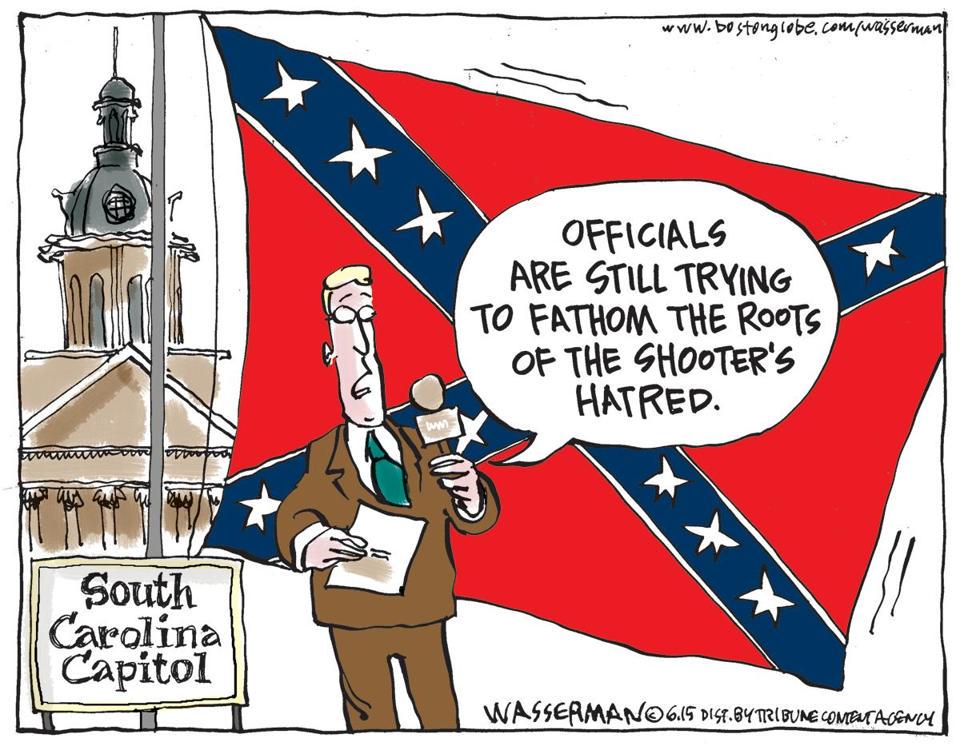
  • Still trying to fathom

    Dan Wasserman of the Boston Globe tweeted his own cartoon:

    Embedded image permalink


  • Picturesque

    A little about the history of Charleston, South Carolina.

    The 1808 ban on the United States’ participation in the international slave trade led to a renewed demand for slave labor, which was satisfied, in part, by the creation of a domestic slave-trading system in which Charleston functioned as a major slave collecting and reselling center. The Old Slave Mart Museum, located at 6 Chalmers St., recounts the story of Charleston’s role in this inter-state slave trade by focusing on the history of this particular building and site and the slave sales that occurred here.

    In the seven decades between the drafting of the U.S. Constitution and the Civil War, more than one million American-born slaves were sold away from plantations in the upper South to work the rapidly expanding cotton and sugar plantations in the lower South. In Charleston, enslaved African Americans were customarily sold on the north side of the Old Exchange Building. An 1856 city ordinance prohibited this practice of public sales, resulting in the opening of the Old Slave Mart and a number of other sales rooms, yards, or marts along Chalmers, State and Queen Streets.

  • What we have looked upon as safety

    Rebecca Carroll yesterday at Comment is Free.

    Six black women were shot to death during a community prayer service by a young white man who allegedly declared: “You rape our women.”

    These women and men welcomed a white man into their close-knit church, and likely encouraged others in their community to join and listen and pray and let God into their hearts.

    I read somewhere else yesterday that during the hour discussion that preceded the terrorist attack, while the terrorist sat at the back of the church, people at the front several times urged him to join them. That fact breaks my heart.

    And think of it. He sat there for an hour, staring ahead at a group of kind, warm people who tried to welcome him…and then he went ahead and took out his gun and shot them.

    There is something inconsistent with the Charleston shooter’s alleged evocation of the historical myth of black man as beast and rapist of white women, and the fact that he killed mostly black women. Did he only shoot black women because there were no more black men to kill? Because black women birth, care for and love black men? Or because he didn’t see black women as women at all, and, as something less than women (and certainly lesser than white women), felt us undeserving of the same valiance he conjured on behalf of the women he claim to be protecting?

    I can’t even begin to imagine why he did that. Why, or how; I can’t imagine how he did it, after that hour.

    In the opening scene from Ava DuVerney’s film Selma, she captured the innocence of four black girls detonated in the 16th Street Baptist Church bombing in Birmingham, Alabama in 1963. Four black girls were just walking down the wooden steps to the basement for prayer meeting; DuVerney showed the light trickling through the stained glass window, let us listen to them talk about their hair and how they do it and how they like it, showed us their Sunday clothes pressed and colorful. And then, in the movie as in our history, they were just dead.

    The girls killed in Birmingham in 1963 are the child forebearers of the grown women killed in Charleston in 2015, in a country where our ancestors keep getting younger and younger because violence too often prevents us from getting older, from growing fully into our lives. Somehow, protecting the world from black men has, far too often, meant killing, beating and raping black women and girls. So we have prayed in solidarity and what we have looked upon as safety. On Wednesday, a white man took that from us, too. What remains to be seen is whether the law and this country will recognize that there is now nothing left to take from us.

    Nowhere is safe.