
Tag: Hefner

  • Hefner’s natural enemy

    A bit more on Hefner, by Liz Posner at AlterNet:

    Hefner claimed to have been a leader in the sexual revolution, liberating Americans from their puritanical views of sex. At least, that was his moral justification for objectifying women, as he told Vanity Fair:

    A new documentary entitled Hugh Hefner: Playboy, Activist and Rebel makes a persuasive case for Hefner the liberal who not only agitated for sexual tolerance but, among many good, brave causes, also was an early protagonist for racial equality and gay rights. “But feminists still oppose you for treating women as objects,” I reminded him.

    “They are objects!” he insisted. “Playboy fought for what became women’s issues, including birth control. We were the amicus curiae, friend of the court, in Roe v. Wade, which gave women the right to choose. But the notion that women would not embrace their own sexuality is insane.”

    And “their own sexuality”=being objects?

    But what did Playboy ever do to encourage female sexuality? How does a magazine published explicitly for the male gaze offer sexual liberation?

    Defenders of Hefner and his Playboy lifestyle will say that the Playboy bunnies freely chose their destinies, were treated well and that Hefner provided Playboy’s Playmates with career-boosting exposure. But not all the models who appeared in Playboy went on to fame and fortune. A disproportionate number of Playmates have died young from drug overdose, suicide, homicide, or some other unnatural cause. When Gloria Steinem went undercover as a Playboy bunny in 1963, she found the models were forced into painful, body-contorting costumes, poorly compensated and generally treated as though they were disposable. Maybe the bunny costumes are a little looser in the 21st century, but they still promote a retrograde notion that women’s bodies look better when they’re forced into corsets.

    Hefner, who is praised for promoting racial equality, hated feminists and pushed a heteronormative, 1950s view of gender division. In an internal memo in 1970, he wrote, “These chicks are our natural enemy. What I want is a devastating piece that takes the militant feminists apart. They are unalterably opposed to the romantic boy-girl society that Playboy promotes.”

    Ahhh there it is.

    What he means by “romantic boy-girl society” of course is the one in which boy is dominant and girl is subordinate, in which boy pokes and girl is poked, in which boy is any age from 12 to dead while girl is age 3 to 19, in which boy is an actual human being with an inner life while girl is a dolly with no brain. Yeah we are opposed to that understanding of women and men and how they can interact.

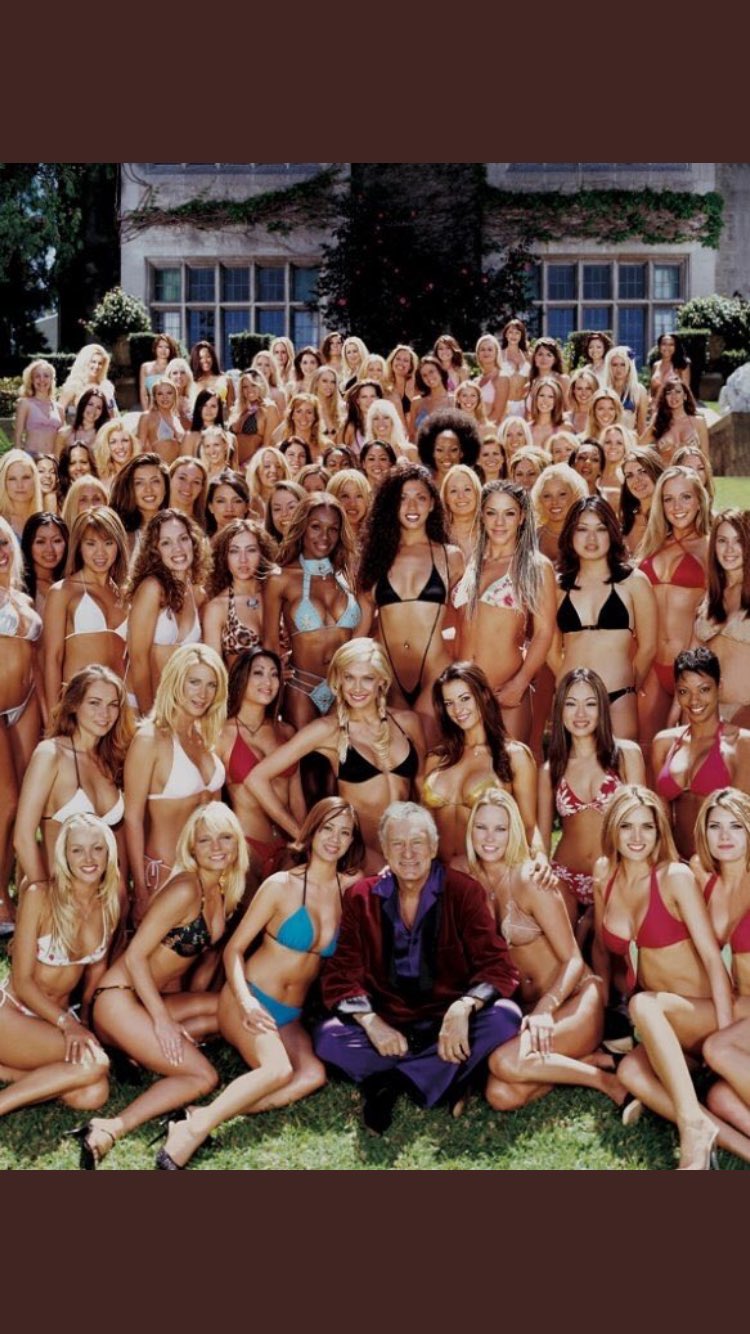
  • More of that civil rights icon stuff

    Another charming Playboy cartoon:

    Image may contain: 1 person

  • Le pimp célèbre

    Hefner threatened to sue Suzanne Moore once.

    Journalists live in dread of such calls. I had called Hefner a pimp. To me this was not even controversial; it was self-evident. And he was just one of the many “libertines” who had threatened me with court action over the years.

    It is strange that these outlaws have recourse in this way, but they do. But at the time, part of me wanted my allegation to be tested in a court of law. What a case it could have made. What a hoot it would have been to argue whether a man who procured, solicited and made profits from women selling sex could be called a pimp. Of course, central to Playboy’s ideology is the idea that women do this kind of thing willingly; that at 23 they want nothing more than to jump octogenarians.

    Now that he’s dead, the disgusting old sleaze in the smoking jacket is being spoken of as some kind of liberator of women. Kim Kardashian is honoured to have been involved. Righty ho.

    Ah well if Kim Kardashian is cool with it what more is there to say? She has gotten rich by selling herself like so much Wagyu beef, so she’s exactly the right person to decide.

    The accounts of the “privileged few” who made it into the inner sanctum of the 29-room Playboy mansion as wives/girlfriends/bunny rabbits are quite something. In Hefner’s petting zoo/harem/brothel, these interchangeable blondes were put on a curfew. They were not allowed to have friends to visit. And certainly not boyfriends. They were given an “allowance”. The big metal gates on the mansion that everyone claimed were to keep people out of this “nirvana” were described by one-time Hefner “girlfriend no 1” Holly Madison in her autobiography thus: “I grew to feel it was meant to lock me in.”

    They were given an allowance? Something tells me it wasn’t exactly a fair wage.

    The fantasy that Hefner sold was not a fantasy of freedom for women, but for men.

    It was never, ever, ever about the women. The women were just the stiffeners for the liberated men. The men were the subjects; the women were the means, the implements, the dolls, the apertures, the lagomorphs.

    But this man is still being celebrated by people who should know better. You can dress it up with talk of glamour and bunny ears and fishnets, you can talk about his contribution to gonzo journalism, you can contextualise his drive to free up sex as part of the sexual revolution. But strip it all back and he was a man who bought and sold women to other men. Isn’t that the definition of a pimp? I couldn’t possibly say.

    The headlines should all have read Famous Pimp Dies.

  • The man was a saint

    The Washington Post just cannot rave about Hefner enough.

    The actress Kat Denning remembered meeting Hugh Hefner at his famed mansion, where he was “very nice to my mom.”

    Kim Kardashian said she was “honored to be part of the Playboy team.”

    Larry King called him a “GIANT in publishing, journalism, free speech & civil rights.”

    Pamela Anderson says he taught her everything important about freedom and respect.

    visionary editor who for decades threw lavish parties at his home, the Playboy Mansion, Hefner lived a glamorous Hollywood life, sharing time and photo ops with a diverse cast of celebrities, civil rights leaders and journalists.

    So glamorous! So much fucking of so many compliant young rabbits!

    As The Washington Post’s Matt Schudel wrote: “From the first issue of Playboy in 1953, which featured a photograph of a nude Marilyn Monroe lounging on a red sheet, Mr. Hefner sought to overturn what he considered the puritanical moral code of Middle America.

    “His magazine was shocking at the time, but it quickly found a large and receptive audience and was a principal force behind the sexual revolution of the 1960s.”

    Yeah, because it’s puritanical to think women shouldn’t be viewed as fuck toys for the consumption of men.

    While the magazine helped launch some women’s entertainment careers, it also outraged feminists who found his magazine’s depictions of women degrading.

    Crazy feminists, right? So damn crazy. What’s degrading about it? What’s degrading about framing men as the viewers and women as the objects viewed? What’s degrading about this lovely snapshot?

    View image on Twitter

    Civil rights leader Jesse Jackson noted that the magazine editor was a “strong supporter of the civil rights movement,” a part of Hefner’s legacy that others also wanted to highlight.

    Because women are just meat.

  • Selling subordinate female sexuality

    Samantha Berg wrote about the free pass Playboy got in 2004.

    I attended Playboy’s 50th Anniversary Club Tour when it stopped by McMenamin’s Crystal Ballroom because as a feminist writer I knew I wanted to do some sort of story around the event. What I encountered there was nothing unexpected; almost wholly white and young male attendees taking many pictures of the far outnumbered “bunnies” and female attendees.

    Coverage of the event by Portland’s alternormal media was similarly predictable with lots of nudge nudge wink wink praise of the fifty year history selling subordinate female sexuality to male consumers and talk about how tasteful Playboy’s porn is compared to other types. Neither conservative nor liberal media had a bad word to say about Playboy Magazine and its influence on the not-so-tasteful porny saturation of American culture in 2004.

    Smoking jacket. Brandy. Jazz in the background. Move along, nothing to see here.

    For decades Playboy Magazine has published child pornography and incest materials which could cause “copy-cat” crimes, wherein consumers criminally act out sadosexual and child abuse scenarios. This is not my declaration, but the ruling of an Amsterdam court in 1994 which defended these statements made on a Dutch television station. When the station reported on a study by the U.S Department of Justice and said Playboy was facilitating child sexual abuse and incest en masse, Playboy Inc. sued for libel and defamation. Presented with the evidence of photographs, illustrations, cartoons, letters, and stories depicting positive portrayals of sex between adults and children as well as incest, the court ruled against Playboy in a case widely reported in the Netherlands but conspicuously unreported in the United States.

    National pride.

    The September 1988 issue of Playboy Magazine featured the article “The Child-Pornography Myth” by American lawyer Lawrence Stanley in which the harms of child sexual exploitation are downplayed as baseless hysteria. Playboy editors neglected to inform readers the article originally appeared in Paidika,The Journal of Paedophilia, and that Stanley specialized in defending people accused of child pornography. He was also affiliated with Uncommon Desires, a pedophile newsletter calling itself “the voice of a politically conscious girl-love underground.”

    One year after his article appeared in Playboy, Stanley was accused of conspiring with photographer Don Marcus to import child pornography into Canada. Marcus is still a wanted fugitive and Stanley was acquitted on his lawyer’s claim that he did not know the suitcase he picked up from Marcus contained child pornography. Two years after his Playboy Magazine article Stanley was charged with “sexual aggression” against a girl in Quebec but Canadian officials never sought extradition.

    Ah don’t worry about it, little girls love acting in porn movies.

    There are numerous examples to draw from when making the argument that Playboy Magazine has often spread false information to advance its “sexual liberation” agenda. My intent is to open up the question among liberals as to why there is an almost complete lack of media criticism aimed at one of the most widely circulated magazines in the world despite evidence of misinformation and biased “expert” writers.

    The complete record on Playboy Magazine’s unethical journalistic standards and role in facilitating child sexual assaults remains to be written as the will to investigate Playboy Magazine and other widely circulated porn publications remains curiously absent from the largest progressive media watchdog groups. Surely it is not at cross purposes with the First Amendment to honestly review and critique the content of pornographic magazines, and such self-imposed censorship by liberals does a disservice to the basic tenets of free speech.

    There are also many rape cartoons.

  • “Civil Rights leaders”

    So I type his name into Google news and the top stories are:

    Hugh Hefner, the Pajama Man

    ‘Godspeed, Hugh Hefner’: Playmates, celebrities, civil rights leaders remember the Playboy founder

    Washington Post 7h ago

    He sold women as if they were potato chips. He was not a beacon of civil rights unless you simply don’t think women are human beings.

  • Hefner hated women

    Julie Bindel on Hefner:

    “The notion that Playboy turns women into sex objects is ridiculous,” said the sadistic pimp in 2010. “Women are sex objects… It’s the attraction between the sexes that makes the world go ‘round. That’s why women wear lipstick and short skirts.”

    Hefner was responsible for turning porn into an industry. As Gail Dines writes in her searing expose of the porn industry, he took it from the back street to Wall Street and, thanks in large part to him, it is now a multibillion dollar a year industry. Hefner operated in a country I live in, a country where if you film any act of humiliation or torture – and if the victim is a woman – the film is both entertainment and it is protected speech.

    He caused immeasurable damage by turning porn – and therefore the buying and selling of women’s bodies – into a legitimate business. Hefner hated women and referred to them as “dogs”.

    But he was sex positive.

    “These chicks [feminists] are our natural enemy. It is time to do battle with them,” wrote Hefner in a secret memo leaked to feminists by secretaries at Playboy. “It is time we do battle with them… What I want is a devastating piece that takes the militant feminists apart.”

    Because how dare women claim to be human beings just as men are?

    As I was writing this, a flagship news programme asked if I would take part this evening in an item in Hefner’s legacy. “We’re looking to discuss whether he was a force for good or bad. Did Hefner revolutionise feminine sexuality, or encourage the degradation of women by constructing them merely as objects of desire?”

    Well that’s an incredibly easy question to answer.

  • Our most influential pimp

    Gail Dines on Hefner:

    PLEASE SHARE!
    Article I wrote with colleague and friend Robert Jensen to “celebrate” Hefner’s 80th birthday 11 years ago. What we said then holds true today. But now he is dead! Hopefully this is an antidote to the all the fawning over Hefner you are likely to be subject to by mainstream press.

    Hugh Hefner is 80 today. America, say happy birthday to our most influential pimp. Houston Chronicle, April 9, 2006
    By Gail Dines and Robert Jensen

    Hefner, the legendary founder of Playboy magazine, a pimp? Yes, if we told the truth about Hefner’s “contribution” to society, we would refer to him as a pimp, as someone who sells women to men for sex. While pornography has never been treated as prostitution by the law, it’s fundamentally the same exchange. The fact that the sex is mediated through a magazine or movie doesn’t change that, nor does the fact that women sometimes use pornography. The fundamentals remain: Men pay to use women for sexual pleasure.

    These days Hefner is more likely to be called an entrepreneur, publisher or philanthropist. He’s the subject of endless feature stories focused on his personal life and typically is treated as an elder statesman of the so-called sexual revolution. As a CNN anchor put it last year, “He lives almost every man’s fantasy — surrounded by sex, celebrities, and a lifestyle many envy.” He stars in an E! reality show called The Girls Next Door, featuring Hefner and three girlfriends young enough to be his granddaughters.

    Hefner certainly is all those things. He made his name as the risk-taking publisher of the first sex magazine to win wide distribution in the United States and Europe. Behind his public playboy image, Hefner was a tough businessman whose strategic gambles paid off. Some of those profits created the Playboy Foundation, which describes its mission at “protecting and enhancing the American principles of personal freedom and social justice.” And many men dream of “Hef’s” life of sexual freedom — defined as the freedom to access women’s sexuality based on men’s needs and rules.

    All that’s true, but it doesn’t change the fact that Hefner is every bit as much a pimp as the men who hustle prostituted women on the street. But Hefner is the most influential pimp in postwar U.S. history, the person who launched the mainstreaming of pornography that has led to easy availability of hardcore sexually explicit material that is overtly cruel and degrading to women.
    When the first issue of Playboy hit the newsstands in 1953, it is unlikely that even in his wildest dreams Hefner had any idea that his fusion of a sex and lifestyle magazine would lay the economic, cultural and legal groundwork for a global pornography market estimated at $57 billion a year.

    The risks Hefner took have led to the pornographic culture we live with today; in 2005, 13,000 new hardcore videos were released in the United States, and any genre of pornography imaginable is easily available on any media platform. Playboy Enterprises, which has evolved into a multimedia entertainment company run by daughter Christie Hefner, has a healthy share of the market. Although it posted a slight net loss in 2005 and the publishing end of the business is sinking, the company’s revenue from licensing fees is strong. Technology changes, but selling women to men remains good business.

    In that market, the fastest growing segment is what the industry calls gonzo pornography — sex on tape with no pretense of plot, characters or dialogue. This low-cost/high-profit genre is where pornographers push the limits, legally and culturally. Hefner’s original images of the girl-next-door with a coy smile have been replaced by the body-punishing penetration of a woman by any number of men. Gone is any pretense — and it always was pretense — of pornography being a celebration of women’s beauty, and in its place is an industry that promotes itself as overtly cruel and sadistic to women.

    This is the world that Hefner helped create. Along with other pornographers, he would have us believe it’s a new expansion of freedom. But it’s an old story about men’s domination and use of women.

    As he nears the end of his life, it’s tempting to see Hefner as self-parody, a pathetic character struggling to hold onto adolescent fantasies long past the time he should have grown up. But in the pornographic world he helped create, Hefner is not alone — men of all ages hold onto those fantasies about sex and domination. And all too often those fantasies become a grim reality for the women, children, and vulnerable men who end up as targets of men’s violence.

    Dines, an American Studies professor at Wheelock College in Boston, and Jensen, a journalism professor at the University of Texas at Austin, are co-authors of “Pornography: The Production and Consumption of Inequality.” They can be reached at gdines@wheelock.edu and rjensen@uts.cc.utexas.edu.