Tag: Jeff Sessions

  • His shameful career

    A former federal prosecutor tells us what it’s like to watch Jeff Sessions be the Attorney General.

    I guess I tried to put out of my mind that Jeff Sessions, the hand-picked Trump-appointed attorney general, lost his nomination for a federal judgeship in the 1980s because of racist remarks he’d made while working at the Alabama U.S. attorney’s office. And, it’s only recently that I learned of Sessions’ claim that the American Civil Liberties Union and the NAACP are “un-American,” and that he voted as a senator against hate crime bills, the Violence Against Women Act, and Loretta Lynch as attorney general because President Barack Obama’s nominees had “ACLU DNA.”

    Against the backdrop of Sessions’ historical shame, I’ve tried to come to terms with the fact that he had contacts with members of the Russian government and then lied about those contacts to Congress during his confirmation hearing.

    I’ve tried to put the best spin on that fact that Sessions left President Donald Trump in a room alone with then-FBI Director James Comey, likely knowing that Trump was going to try and extract an oath of loyalty from Comey and a promise to drop the investigation of national security adviser Michael Flynn. I tamped down my feelings of anger and injustice when Sessions directed DOJ attorneys to file a series of briefs and internal memos ensuring that raw discrimination is protected and encouraged when it is frosted with a claim of religious freedom.

    And when Sessions supported the nomination of anti-civil rights attorney Eric Dreiband to be in charge of DOJ’s civil rights division and Brian Benczkowski, a former attorney for a Russian bank, to run the criminal division at DOJ, I bit my tongue — hard. When Sessions directed federal law enforcement officers to rip children from their parents, who were seeking legal asylum in this country, I did what I needed to do to hold back the tears.

    Each of these daggers to the heart of DOJ made me question if the DOJ I knew and dedicated my professional career to still existed in some semblance of what I knew it to be. Then, a story hit the internet recently that the attorney general of the United States, while at a rally of right-wing high school students, chimed in with chants from students who were screaming “Lock her up.” And, according to reports, while repeating the mob-inspired anti-Clinton creed, Sessions laughed.

    I didn’t believe it so I searched for the video and found it. There was the head of law enforcement in the United States laughing and joining the crazed chants of an angry gang of teenagers calling for Trump’s defeated political opponent to be locked up.

    He felt sick, not figuratively but literally.

    Don’t we all.

  • Teehee titter guffaw

    Swamp.

  • Sessions wants more theocracy please

    Jeff Sessions gave a speech at the conservative Christian law firm the Alliance Defending Freedom, in which he promised new guidelines on “religious freedom.” We know what that means when someone like Jeff Sessions says it.

    When the speech at Alliance Defending Freedom’s Summit on Religious Liberty appeared on the Attorney General’s public schedule, it was cause for concern among LGBTQ advocacy groups and Democrats — many of whom issued statements questioning why Sessions would speak to what some call an anti-LGBTQ hate group due to its history of litigating against LGBTQ rights.

    But after reading the transcript and learning of the Justice Department’s plans to create a new federal policy on protecting religious liberties and doubling down on enforcing the Religious Freedom Restoration Act, advocates suggested Sessions was more interested in protecting the right to discriminate than the freedom of religion.

    Or both. They may be inextricably tangled together. He may think that’s what freedom of religion means.

    The Trump administration has promised several times to enact some form of increased religious liberty protections. During the campaign, Trump said he would sign the First Amendment Defense Act, a bill that would allow businesses to turn away LGBTQ people as well as unmarried couples and single mothers.

    Before being confirmed as Attorney General, then-senator Sessions was a sponsor of the First Amendment Defense Act.

    In May, President Trump signed an executive order on religious liberty that allows companies to reject the Affordable Care Act’s mandate on birth control coverage.

    Thus violating the religious freedom of women who need birth control and think their health insurance should cover it.

    Sessions has also faced criticism from LGBTQ rights advocates. In a January interview, the mother of slain gay college student Matthew Shepard told NBC News that Sessions fought against the Matthew Shepard and James Byrd Hate Crimes Act when it was being debated in 2009. In a lengthy speech decrying the legislation designed to help victims, Sessions said that “gays and lesbians have not been denied access” to anything, and that hate crimes were “thought crimes.”

    In his senate career, Sessions displayed strong anti-LGBTQ leanings. According to a report issued by the Human Rights Campaign, then-senator Sessions argued in favor of anti-sodomy laws used to imprison gay men, opposed same-sex marriage, sought to terminate National Endowment for the Arts funding because it once went to black lesbian filmmaker Cheryl Dunye, opposed repealing the military’s “don’t ask, don’t tell” policy keeping lesbian and gay service members in the closet, and tried to block federal funding for HIV-prevention programs if they appear to “promote sexual activity and behavior” among “homosexual men and women.”

    Apparently only straight people get to have religious freedom.

  • Shan’t tell you

    Sessions is stonewalling.

    Attorney General Jeff Sessions offered an indignant defense on Tuesday against what he called “an appalling and detestable lie” that he may have colluded with the Russian effort to interfere in the 2016 election, showcasing his loyalty to President Trump in an often contentious Senate hearing but declining to answer central questions about his or the president’s conduct.

    Sounding by turns defiant and wounded, Mr. Sessions, a former senator from Alabama, often infused his testimony with more emotion than specifics. He insisted repeatedly that it would be “inappropriate” to discuss his private conversations with the president, however relevant they might be, visibly frustrating senators who have been conducting their own inquiry into Russia’s election meddling.

    This isn’t a cotillion, it’s a Senate hearing. It would not be “inappropriate” to tell the legislators and the people what the fuck these thieves and traitors have been getting up to.

    Yet at times, Mr. Sessions seemed committed to revealing as little information as possible, particularly about his interactions with the president. Pressed on his rationale, Mr. Sessions allowed that Mr. Trump had not invoked executive privilege concerning the testimony of his attorney general.

    “I am protecting the right of the president to assert it if he chooses,” Mr. Sessions said.

    As many people have sharply pointed out, Sessions doesn’t get executive privilege. It applies only to the president. The worm from Alabama is just refusing to tell the government and citizens what he’s been doing, as if he were the dictator’s lieutenant-dictator.

    This is basically a junta.

  • A bad hombre

    Jeff Sessions is evil. While Donnie Twoscoops flounders around in his own ever-proliferating messes, Jefferson Beauregard is taking care of business.

    Even amid the scandal of the firing of FBI director James Comey—an action in which Sessions himself had a central part—Sessions has quietly continued the radical remaking of the Justice Department he began when he took the job.

    On May 20, Sessions completed his first hundred days as attorney general. His record thus far shows a determined effort to dismantle the Justice Department’s protections of civil rights and civil liberties. Reversing course from the Obama Justice Department on virtually every front, he is seeking to return us not just to the pre-Obama era but to the pre-civil-rights era. We should have seen it coming; many of his actions show a clear continuity with his earlier record as a senator and state attorney general.

    He’s especially shitty on punishment-revenge issues, which of course fits well with his racism.

    In the Senate, he was to the right of most of his own party, and led the charge to oppose a bipartisan bill, cosponsored by Republicans Charles Grassley and Mike Lee, that would have eliminated mandatory minimums and reduced sentences for some drug crimes. As attorney general, he has rescinded Eric Holder’s directive to federal prosecutors to reserve the harshest criminal charges for the worst offenders. Sessions has instead mandated that the prosecutors pursue the most serious possible charge in every case. Prosecutors ordinarily have wide latitude in deciding how to charge a suspect—they can select any of a number of possible crimes to charge, decline to pursue charges altogether, or support a diversion program in which the suspect avoids any charges if he successfully completes treatment or probation. Not all crimes warrant the same response, and prosecutorial discretion makes considered justice possible. Yet Sessions has ordered prosecutors to pursue a one-size-fits-all strategy, seeking the harshest possible penalty regardless of the circumstances.

    Hence my choice of the word “evil.” That’s evil more or less by definition – wanting to inflict harsh punishment on people regardless of circumstances, in other words for no fucking reason. If you explicitly rule out taking circumstances into account, then it’s just sadism. It also renders the criminal justice system meaningless. It amounts to saying “If we can pin something on you, it doesn’t matter what, that gives us license to torment you and by god that’s what we’re going to do, because we like it.”

    And he plans to do away with all these pesky investigations into police departments around the country. We can’t be holding law enforcement to account! Oh hell no, that would allow the brown people to take over and eat all the cake.

    Under previous administrations of both parties, the Justice Department’s Civil Rights Division has responded to reports of systemic police abuse in cities like Los Angeles, Cincinnati, New Orleans, Chicago, Baltimore, and Ferguson by investigating, reporting, and entering “consent decrees”—court-enforceable agreements with local police departments—designed to reduce or eliminate abuse. Before his confirmation, Sessions condemned such consent decrees as “dangerous” and an “end run around the democratic process.” As attorney general, he has ordered a review of all such decrees, expressing concern that they might harm “officer morale,” about which he seems to care more than about the constitutional rights of citizens.

    The cops are always right, regardless of circumstances. The accused must always get the maximum sentence, regardless of circumstances.

    When Sessions was a senator, he opposed extending hate crimes protections to women and gays and lesbians, explaining that “I am not sure women or people with different sexual orientations face that kind of discrimination. I just don’t see it.”

    I can think of a reason for that that’s not the same as “it doesn’t happen.”

    As Alabama attorney general, Sessions prosecuted black civil rights activists for helping to get out the vote. The judge dismissed many of the charges even before getting to trial; the jury acquitted the defendants on the rest. When the Supreme Court in 2013 gutted the Voting Rights Act by invalidating a provision requiring states with a history of discriminatory voting practices to prove that any changes they sought to make to voting law not undermine minority voting opportunities, Sessions called it “good news…for the South.” As attorney general, his Justice Department took the extraordinary step of withdrawing its claim, already fully litigated and developed in trial court, that Texas had adopted a voter ID law for racially discriminatory reasons. The court nonetheless ruled that Texas had in fact engaged in intentional race discrimination. It refused to close its eyes to evidence of racial intent, even if the new Justice Department was willing to do so.

    His determined opposition to civil rights and voting rights goes all the way back. It’s been his life’s work.

    And then David Cole gets to an item I didn’t know about:

    As Alabama attorney general, Sessions oversaw the filing of a 222-count criminal indictment against TIECO, a competitor of US Steel, at a time when US Steel and its attorney were contributors to Sessions’s Senate campaign. Every single count was dismissed, many for prosecutorial misconduct. The judge wrote that “the misconduct of the Attorney General in this case far surpasses in both extensiveness and measure the totality of any prosecutorial misconduct ever previously presented to or witnessed by the Court.”

    Wow. What a package.

    Plus of course he lied at his confirmation hearing, and meddled in the Comey business after he “recused” himself.

    The attorney general is the nation’s top law enforcement officer. He is responsible for investigating federal crimes, advising on the appointment of judges and the constitutionality of bills, defending federal government programs, and enforcing the civil rights laws. It’s an awesome responsibility in any administration. But perhaps never before has it been so important, given President Trump’s lack of interest in the rule of law, ignorance of constitutional laws and norms, and hostility to basic civil rights and civil liberties. What’s needed at the Justice Department is a strong, independent, and thoughtful leader who can exert some restraint on the president. Instead, we have Jeff Sessions, a man who, when asked whether Trump’s grabbing women by the genitals would constitute sexual assault, replied, “I don’t characterize that as a sexual assault. I think that’s a stretch.”

    That’s our attorney general: willing to throw the book at drug offenders and undocumented immigrants, but unwavering in his defense of a president who brags about assaulting women and targeting Muslims.

    He’s got that chipmunk voice and that smarmy grin, but he’s evil.

  • Where’s your sense of humor?

    Ah the joys of having an unregenerate racist as Attorney General.

    Jeff Sessions on Sunday declined to apologize for his controversial remarks about Hawaii this week, which the attorney general dismissed as “an island in the Pacific” while criticising a judge’s decision to block Donald Trump’s travel ban on several Muslim-majority nations.

    “Nobody has a sense of humour any more,” Jeff Sessions said in an interview with ABC’s This Week, two days after he told CNN: “I wasn’t criticising the judge or the island.”

    Speaking to CNN, Sessions added: “I think it’s a fabulous place and had a granddaughter born there. But I got to tell you, it’s a point worth making that a single sitting judge out of 600, 700 district judges can issue an order stopping a presidential executive order that I believe is fully constitutional, designed to protect the United States of America from terrorist attacks.”

    He believes it’s fully constitutional – oh well then. The guy with the long ardent history of trying to undermine voting rights for non-white people believes Trump’s racist EO is fully constitutional; what more do we need?

    Trump’s travel ban order was his second attempt to impose drastic limits on travellers and refugees from six Muslim-majority countries. In March Derrick Kahala Watson, the only Hawaiian-born federal judge now serving on a bench, issued a nationwide stay against it.

    Watson found grounds for a violation of the constitutional prohibition of discrimination on grounds of religion. His ruling, like those by other judges that stayed Trump’s first attempted travel ban in January, prompted furious complaint from the administration about supposed judicial overreach.

    “This order is lawful,” Sessions said on Sunday, “it’s within [the president’s] authority constitutionally and [his] explicit statutory authority. We’re going to defend that order all the way up and so you do have a situation in which one judge out of 700 in America has stopped this order.”

    Plus he’s a judge on an island in the Pacific, if you get my drift. I’d better spell it out for you, just in case you don’t. People from islands in the Pacific are brown. They’re not white, you see. They shouldn’t be able to tell white people not to exclude brown people from these great United States. Also, please have a sense of humor about it.

    The controversy over Sessions’ description of Hawaii erupted on Tuesday. In an interview with conservative radio host Mark Levin, the attorney general said: “I really am amazed that a judge sitting on an island in the Pacific can issue an order that stops the president of the United States from what appears to be clearly his statutory and constitutional power.”

    Attorneys and legal experts reacted with alarm that the country’s top prosecutor would question the authority of the judiciary, as the third independent branch of government to the president and Congress. Trump has repeatedly questioned the motives of judges who have ruled against, raising fears that he might undermine the legitimacy of courts.

    Demoralizing, isn’t it. But never mind – just look on the funny side.

    Hawaiians, including the state’s two US senators, both Democrats, reacted angrily to Sessions’ remarks. Senator Mazie Hirono said the remark was “dangerous, ignorant and prejudiced” and an attack “against the very tenets of our constitution and democracy”.

    Well not all the tenets of our constitution. There’s the 3/5ths clause for instance. Sessions’s comments are in the spirit of that.

  • Because he told porkies under oath

    It’s almost as if the Attorney General is supposed to be especially punctilious about not breaking laws.

    The American Civil Liberties Union has filed an ethics complaint against Attorney General Jeff Sessions over his testimony to a Senate committee that he had no communications with the Russian government.

    The complaint, filed with the Alabama State Bar’s disciplinary commission, comes less than two weeks after The Washington Post revealed that Sessions met with Russia’s ambassador to the United States twice last year and did not disclose those communications when asked during his confirmation hearing in January.

    Well you see he didn’t know they meant that kind of communications with the Russian government. He thought they meant the other kind. He didn’t think it worth the trouble to give a full answer and let the senators decide whether chatting with the ambassador was or was not what they were asking about. He thought it would be better to decide they didn’t mean that, and so say nothing at all about it.

    Chris Anders, deputy director of the ACLU’s legislative office in Washington, claims that Sessions had violated Alabama’s rules of professional conduct preventing lawyers from engaging in “conduct involving dishonest, fraud, deceit or misrepresentation,’” according to the complaint, which cites The Post’s story.

    The complaint, filed Thursday, says the report of the meetings with the Russian ambassador “does not square” with Sessions’s sworn testimony in the Senate.

    Yes but he explained all that – he thought the Russian ambassador was not one of the Russians they were asking about. He really thought that; it wasn’t a lame excuse at all.

    Following The Post’s article, Sessions acknowledged briefly speaking with Russian Ambassador Sergey Kislyak at the Republican National Convention in Cleveland in July and again at his Senate office in September. But he said there were no discussions about the Trump campaign.

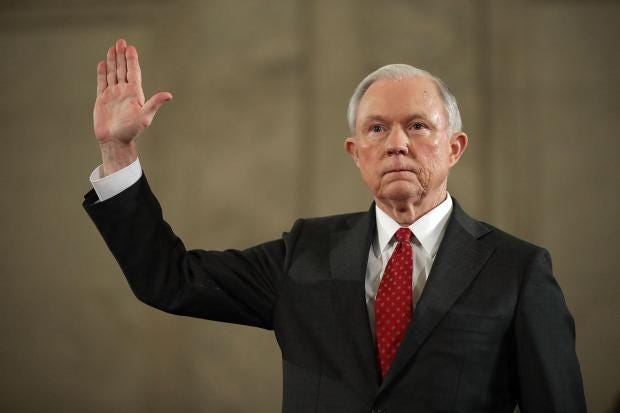
    And everyone should totally take his word on that. He’s an honest guy. We know that from how high and far out to the side he holds his hand up when he’s being sworn in.

    Image result for jeff sessions oath

    Anders said Sessions’s communications with the Russian ambassador during the presidential campaign raises two concerns.

    “One is that it’s highly corrosive of a democracy to have a future AG make false statements to the Senate related to a matter that’s under investigation,” he said. “And then, as part of that, the underlying matter of whether a foreign government illegally influenced the U.S. election goes to the very heart of our democracy and the sanctity of the election process. You can’t have a functioning legitimate democracy if foreign governments are influencing the outcome.”

    Ok, you can’t have a functioning legitimate democracy, but you can have a functioning nightmare.

  • Overcompensating

    Also – why can’t Jeff Sessions swear in like a normal person? What’s with that ridiculous way out to the side and way up in the air arm-raise?

    Image result for jeff sessions oath

    Image result for jeff sessions oath oval office

  • Jaworski didn’t buy it

    Richard Painter explains why Jeff Sessions should be fired.

    He points out that we’ve been here before:

    In 1972 Richard G. Kleindienst, the acting attorney general, appeared before the Senate Judiciary Committee in a confirmation hearing on his nomination by President Richard Nixon to be attorney general. He was to replace Attorney General John N. Mitchell, who had resigned to run Nixon’s re-election campaign (and who would later be sent to prison in the Watergate scandal).

    Several Democratic senators were concerned about rumors of White House interference in a Justice Department antitrust suit against International Telephone and Telegraph Corporation, a campaign contributor to the Republican National Committee. They asked Kleindienst several times if he had ever spoken with anyone at the White House about the I.T.T. case. He said he had not.

    That wasn’t true. Later, after Kleindienst was confirmed as attorney general, the special prosecutor, Leon Jaworski, and his team uncovered an Oval Office tape recording of a phone call in which Nixon told Kleindiesnt to drop the I.T.T. case. Kleindienst claimed that he thought the senators’ questions were limited to a particular period, not the entire time during which the case was pending.

    Jaworski didn’t buy it. He filed criminal charges against Kleindienst, who had earlier resigned as attorney general. Eventually Kleindienst pleaded guilty to failure to provide accurate information to Congress, a misdemeanor, for conduct that many observers believed amounted to perjury. He was also reprimanded by the Arizona State Bar.

    Sessions is attempting a similar sort of dance.

    Once again, we see an attorney general trying to explain away misleading testimony in his own confirmation hearing. A spokeswoman for Mr. Sessions says that “there was absolutely nothing misleading” about his answer because he did not communicate with the ambassador in his capacity as a Trump campaign surrogate. His contacts with the Russian ambassador, he claims, were made in his capacity as a member of the Senate Armed Services Committee.

    That may or may not have been the case (individual senators ordinarily do not discuss committee business with ambassadors of other countries, particularly our adversaries). Regardless, Mr. Sessions did not truthfully and completely testify. If he had intended to say that his contacts with the Russians had been in his capacity as a member of the Senate Armed Services Committee and not for the Trump campaign, he could have said that. He then would have been open to the very relevant line of questioning about what those contacts were, and why he was unilaterally talking with the ambassador of a country that was a longstanding adversary of the United States.

    He did not reveal the communications at all, however. He did so knowing that Senator Franken was asking about communications with the Russians by anyone working for the Trump campaign, including people who, like Mr. Sessions, had other jobs while they volunteered for the Trump campaign. Mr. Sessions’s answer was at best a failure to provide accurate information to Congress, the same conduct that cost Attorney General Kleindienst his job.

    And, further weakening his explanation, he’s a lawyer. It seems pretty feeble for a lawyer to claim confusion about the question. Lawyers are trained not to be confused about such things.

    And this time, unlike in 1972, the attorney general’s misleading testimony involves communications not with the president of the United States, but with a rival nuclear superpower. In 1972, any federal employee who provided such inaccurate information under oath about communications with the Russians would have been fired and had his or her security clearances revoked immediately, and probably also would have been criminally prosecuted.

    The Cold War may be over, but Russia in the past few years has once again sought to destabilize the democratic process not only in the United States, but also in much of Europe.

    Russia is not an ally. Putin’s Russia is an enemy as well as a rival. Putin’s Russia is an enemy without the figleaf of socialism.

    Sessions should be fired and prosecuted.

  • If it turns out he lied under oath

    Elijah Cummings put it clearly:

    Rep. Elijah E. Cummings (Md.), ranking Democrat on the House Committee on Oversight and Government Reform, put out a written statement, declaring, “It is inconceivable that even after Michael Flynn was fired for concealing his conversations with the Russians that Attorney General Sessions would keep his own conversations secret for several more weeks.” Cummings said Sessions’s statement denying contact “was demonstrably false, yet he let it stand for weeks — and he continued to let it stand even as he watched the President tell the entire nation he didn’t know anything about anyone advising his campaign talking to the Russians.” He concluded, “Attorney General Sessions should resign immediately, and there is no longer any question that we need a truly independent commission to investigate this issue.”

    It just won’t do. It’s no good having an Attorney General who screws up this badly this early – not to mention the fact that he has that long history of opposing voting rights for a large segment of the population.

    Now, it is possible — but unlikely — that Sessions did not recall the meetings with the Russian ambassador. His excuse — that he was not officially acting as a surrogate or that the conversation was not about the campaign — doesn’t absolve him over his blanket statement to Franken that he was unaware of contacts or his assertion to Durbin that he didn’t know of any reason he would need to recuse himself in an investigation of campaign figures speaking with Russian figures.

    He should be immediately recalled to the Senate to explain his actions. Talk of “perjury” is premature, since such a charge would require, among other things, an intent to deceive. But members of Congress plainly think that Sessions was trying to hide something. Nadler told me, “If it turns out he lied under oath, he of course will be subject to criminal prosecution and should immediately resign.” Swalwell likewise stated, “At best, he was careless with a subject of great importance; at worst, like General Michael Flynn, the Attorney General lied about prior contacts with Russia.”

    Flynn had to go. Sessions has to go.

  • It is crucial to our system of justice that we demand the truth

    Matt Zapotosky and Mark Berman at the Washington Post point out a touch of hypocrisy or double standarding in Jeff “lied to Congress” Sessions:

    Sessions served as a senator for two decades, and he was an outspoken surrogate for Trump on the campaign trail. Because of that, he has talked extensively on all the topics for which he now faces criticism — lying under oath, the importance of meetings, handling sensitive investigations and even correcting the Congressional record. He was particularly critical of Trump’s opponent, Hillary Clinton, and spoke extensively about the investigation of her use of a private email server while Secretary of State.

    They found examples of his stated views on items like lying under oath.

    After former president Bill Clinton was impeached by the U.S. House of Representatives in December 1998 on charges of perjury and obstruction of justice, Sessions—then a freshman senator from Alabama—went on television to discuss the significance of lying under oath.

    “I am concerned about a president under oath being alleged to have committed perjury,” Sessions said in a January 1999 interview with C-SPAN that was resurfaced and widely shared on social media Tuesday night. “I hope that he can rebut that and prove that did not happen. I hope he can show that he did not commit obstruction of justice and that he can complete his term. But there are serious allegations that that occurred.”

    Well but to be fair, Clinton was accused of lying under oath about his non-marital sexual adventures. That’s serious business, unlike lying under oath about being in cahoots with Russia in its campaign to promote Donald Trump.

    Clinton was acquitted by the Senate in February 1999. Sessions, who voted to convict Clinton on both charges, said he was worried that the Senate’s decision would help anyone looking to lie under oath and could damage the country’s respect for the rule of law.

    “It is crucial to our system of justice that we demand the truth,” Sessions said in a statement at the time. “I fear that an acquittal of this President will weaken the legal system by providing an option for those who consider being less than truthful in court.”

    Sessions said that to him, it was “proven beyond a reasonable doubt and to a moral certainty” that Clinton committed perjury, and he assailed “the chief law-enforcement officer of the land, whose oath of office calls on him to preserve, protect and defend the Constitution,” for what he called an attack on the law.

    Oh did he. Did he really.

    This is important because during his confirmation hearing, Sessions testified under oath that he had not communicated with the Russian ambassador — despite two such contacts.

    There’s plenty more.

  • He did not have sex with that ambassador

    Well great. Brilliant. The new US Attorney General lied at his confirmation hearing. Just what we need: a lying corrupt racist Attorney General, working for the most authoritarian and corrupt administration we’ve ever had.

    Then-Sen. Jeff Sessions (R-Ala.) spoke twice last year with Russia’s ambassador to the United States, Justice Department officials said, encounters he did not disclose when asked about possible contacts between members of President Trump’s campaign and representatives of Moscow during Sessions’s confirmation hearing to become attorney general.

    That should be it. Fire him. Never mind recusing himself, he should be gone.

    One of the meetings was a private conversation between Sessions and Russian Ambassador Sergey Kislyak that took place in September in the senator’s office, at the height of what U.S. intelligence officials say was a Russian cyber campaign to upend the U.S. presidential race.

    The previously undisclosed discussions could fuel new congressional calls for the appointment of a special counsel to investigate Russia’s alleged role in the 2016 presidential election. As attorney general, Sessions oversees the Justice Department and the FBI, which have been leading investigations into Russian meddling and any links to Trump’s associates. He has so far resisted calls to recuse himself.

    He should be gone.

    At his Jan. 10 Judiciary Committee confirmation hearing, Sessions was asked by Sen. Al Franken (D-Minn.) what he would do if he learned of any evidence that anyone affiliated with the Trump campaign communicated with the Russian government in the course of the 2016 campaign.

    “I’m not aware of any of those activities,” he responded. He added: “I have been called a surrogate at a time or two in that campaign and I did not have communications with the Russians.”

    Is that scummy enough? It certainly seems scummy enough to me.

    In January, Sen. Patrick J. Leahy (D-Vt.) asked Sessions for answers to written questions. “Several of the President-elect’s nominees or senior advisers have Russian ties. Have you been in contact with anyone connected to any part of the Russian government about the 2016 election, either before or after election day?” Leahy wrote.

    Sessions responded with one word: “No.”

    Sessions is saying wull he didn’t talk to Kislyak about the election, so he told the truth.

    When asked to comment on Sessions’s contacts with Kislyak, Franken said in a statement to The Post on Wednesday: “If it’s true that Attorney General Sessions met with the Russian ambassador in the midst of the campaign, then I am very troubled that his response to my questioning during his confirmation hearing was, at best, misleading.”

    Senators have to be polite. I don’t.

    Several Democratic members of the House on Wednesday night called on Sessions to resign from his post.

    “After lying under oath to Congress about his own communications with the Russians, the Attorney General must resign,” House Minority Leader Nancy Pelosi (D-Calif.) said in a statement, adding that “Sessions is not fit to serve as the top law enforcement officer of our country.”

    He never was. The racism is a major disqualifier before we even get to the lying to Congress.