Tag: Palmyra

  • Palmyra being destroyed in front of their eyes

    Oh, horrors.

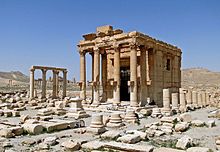
    ISIS militants on Sunday blew up the temple of Baal Shamin, one of the most important sites in Syria’s ancient city of Palmyra, said Maamoun Abdul Karim, the country’s antiquities chief.

    The temple bombing would be the first time that the insurgents, who control large parts of Syria and Iraq and who captured Palmyra in May, have damaged monumental Roman-era ruins.

    Wikipedia has an image by Bernard Gagnon:

    Temple of Baal-Shamin, Palmyra.jpg

    Now that’s rubble.

    “We have said repeatedly the next phase would be one of terrorizing people and when they have time they will begin destroying temples,” Abdul Karim told Reuters.

    “I am seeing Palmyra being destroyed in front of my eyes,” he added. “God help us in the days to come.”

    They destroy people, and the irreplaceable objects that people value. They do that for the sake of an imaginary god who hates people and the irreplaceable objects that people value. At the core of human life there is this devotion to an imaginary god who hates people and everything people value except itself.

  • Stones

    IS has taken Palmyra.

    Islamic State militants have locked Palmyra’s museum and placed guards outside its doors, days after seizing the ancient city, Iraqi officials say.

    Antiquities director Maamoun Abdulkarim said they had destroyed some modern plaster statues and also raised their flag on the ancient castle overlooking the Roman ruins.

    Most of the museum’s antiquities had been transferred to Damascus, he said.

    Dr David Roberts of King’s College, London has thoughts on the destruction of ancient sites and their treasures.

    In Syria alone, the Great Mosque and the Citadel in Aleppo, the castle of every child’s imagination at Crac des Chevaliers, and the ancient city of Bosra have been damaged or destroyed.

    Arguably Syria’s most impressive and arresting site, the sprawling ruins at Palmyra (Tadmur to Syrians), is now under Islamic State control and many fear the worst.

    Having visited Palmyra and these other sites while studying Arabic at Damascus University back in 2007, I am far from alone in feeling that something truly terrible is happening.

    That these symbols from a bygone era might be destroyed by modern-day barbarian forces when they have survived for hundreds or even thousands of years seems somehow deeply offensive and wrong.

    He also talks about the fact that stones are not people and it may seem grotesque to pay attention to stones when so many people are being killed or enslaved or otherwise damaged. He suggests reasons why the stones matter anyway.

    Some reasons in addition to the ones he mentions – they’re our common heritage, they are a way of introducing us to each other. They’re a sign of human creativity and sense of beauty or wonder or adventure or many other things beyond survival or a full stomach. They could well outlast us.