Tag: Philosophy

  • Encouraged by faculty at Georgetown

    Brian Leiter is keeping track of the specialized but all too lively subtopic of Philosophy Grad Students And Even Faculty Hurling Abuse At Colleagues In Public over trans issues.

    April 19 for instance:

    A propos this earlier abusive outburst directed at feminist philosopher Holly Lawford-Smith (Melbourne), we now have this from Keyvan Shafiei:

    Keyvan no apology

    As Leiter points out, the issue of course was not mere “profane language” – it was sweary name-calling, to be specific, piece of shit and fucking vile. People do this all the time: talk about mild generalities like “profanity” when the issue is misogynist or harshly sweary insults directed at specific people. Telling a particular person she’s “fucking vile” is not mere “profane language.” Keyvan Shafiei and others who do that are not just aggressive bullies but specifically chickenshit aggressive bullies. (There I am addressing a harshly sweary insult at Keyvan Shafiei. At least I own it.)

    But it gets worse.

    It probably doesn’t help that this graduate student is being encouraged by faculty at Georgetown, including Rebecca “suck my giant queer cock” Kukla:

    Kukla laughing at idea that Keyvan would apologize

    Leiter continues:

    The e-mail in question, from the “alleged” philosopher of law, was this one:

    Dear Keyvan Shafiei,

    I am very concerned to read, on Leiter Reports and elsewhere, that you have published comments referring to Professor Holly Lawford-Smith as ‘a bigoted piece of shit’ and a ‘vile fucking human being’.

    This is a disgraceful way to refer to another person, never mind a member of a profession you hope to enter.  It shames you.

    I think it would be in your interest to apologize to Professor Lawford-Smith, fully and in public.

    Yours truly

    Leslie Green

    Professor of the Philosophy of Law
    Balliol College, Oxford OX1 3BJ

    Keyvan Shafiei must be doing his job prospects no end of good.

  • Is morality choice or perception?

    Anil Gomes, a Fellow and Tutor in Philosophy at Oxford, explains Iris Murdoch’s version of moral philosophy at the TLS:

    Her views on moral philosophy are set out in three papers published over this period, none of them in the mainstream philosophy journals where her former colleagues might have come across them, later collected together as The Sovereignty of Good (1970). She presents herself throughout these essays as opposing a certain picture of moral philosophy. It is a picture, Murdoch tells us, that can be found in the work of R. M. Hare, where moral utterances are a kind of prescription, in Sartre’s existentialism, where moral value is created by our undetermined choices, and in the hero of many a contemporary novel. According to this picture, moral judgements are not in the business of describing how things are in the world. They cannot, that is, be true or false. Perhaps they express your emotions, perhaps they prescribe your actions, perhaps they announce your decisions – but whatever it is they do, they don’t tell you how things are in the world. Morality, on this view, isn’t a matter of finding out truths about the world; it is a matter of choosing which values guide your life.

    I suppose that’s what I think, pretty much. If you subtract humans then surely it’s true that morality doesn’t describe how things are in the world – or you could broaden it and subtract all sentient beings. But at the same time it depends on what you mean by truths about the world…

    Murdoch, Foot, Midgely and Anscombe – that wonderful generation of women philosophers – all rejected this idea of morality. The lessons of the war seemed to be that there is such a thing as getting it right or wrong, and that it mattered that one get it right.

    Yes, in human terms, but if you subtract humans – etc.

    Murdoch took the rejection much further than any of the others, and in a way which led her closer, in some guises, to Plato, and, in other guises, to a form of mysticism which will be familiar to anyone who has read her novels. The aim of the essays in The Sovereignty of Good is to replace this picture of moral life with an alternative, one that is adequate to our empirical, philosophical and moral existence.

    What is this alternative picture? In contrast to her opponents, Murdoch stresses the reality of moral life. To acknowledge the reality of moral life is to recognize that the world contains such things as kindness, as foolishness, as mean-spiritedness. These are genuine features of reality, and someone who comes to know that some course of action would be foolish comes to know something about how things are in the world. This view is sometimes thought to be ruled out by a certain scientistic conception of the natural, one that restricts what exists to the things that feature in our best scientific theories. Such a view is too restricted, Murdoch thinks, to capture the reality of our lives – including our lives as moral agents. Goodness is sovereign, which is to say a real, if transcendent, aspect of the world.

    Yes, but human lives. Humans are a contingent fact about the world. Opportunity and Curiosity haven’t reported back any kindness or foolishness on Mars, as far as I know.

    Making sense of these ideas requires a metaphysics of morals, one that helps us to make peace with the existence of transcendent goodness. But if morality is to move us, we need not just a metaphysics of morals but also a moral psychology: an account of how we creatures, concrete as we are, are able to know about, and be guided by, the transcendent good. Here Murdoch aims to replace the metaphor of choice which dominated her opponents’ work with the metaphor of vision. We can look carefully, we can attend to people and their situations, and when we do so, we can come to know how things are in the moral realm, to know how people have behaved, and to know what we ought to do.

    It’s interesting, I think, but not particularly convincing. I completely agree that “there is such a thing as getting it right or wrong, and that it matter[s] that one get it right,” but not that it’s somehow transcendent. I don’t think I believe in that kind of transcendence. (What kind then? Just the ordinary factual kind where you transcend an insult or an inconvenience.)

  • Ding ding ding went the trolley

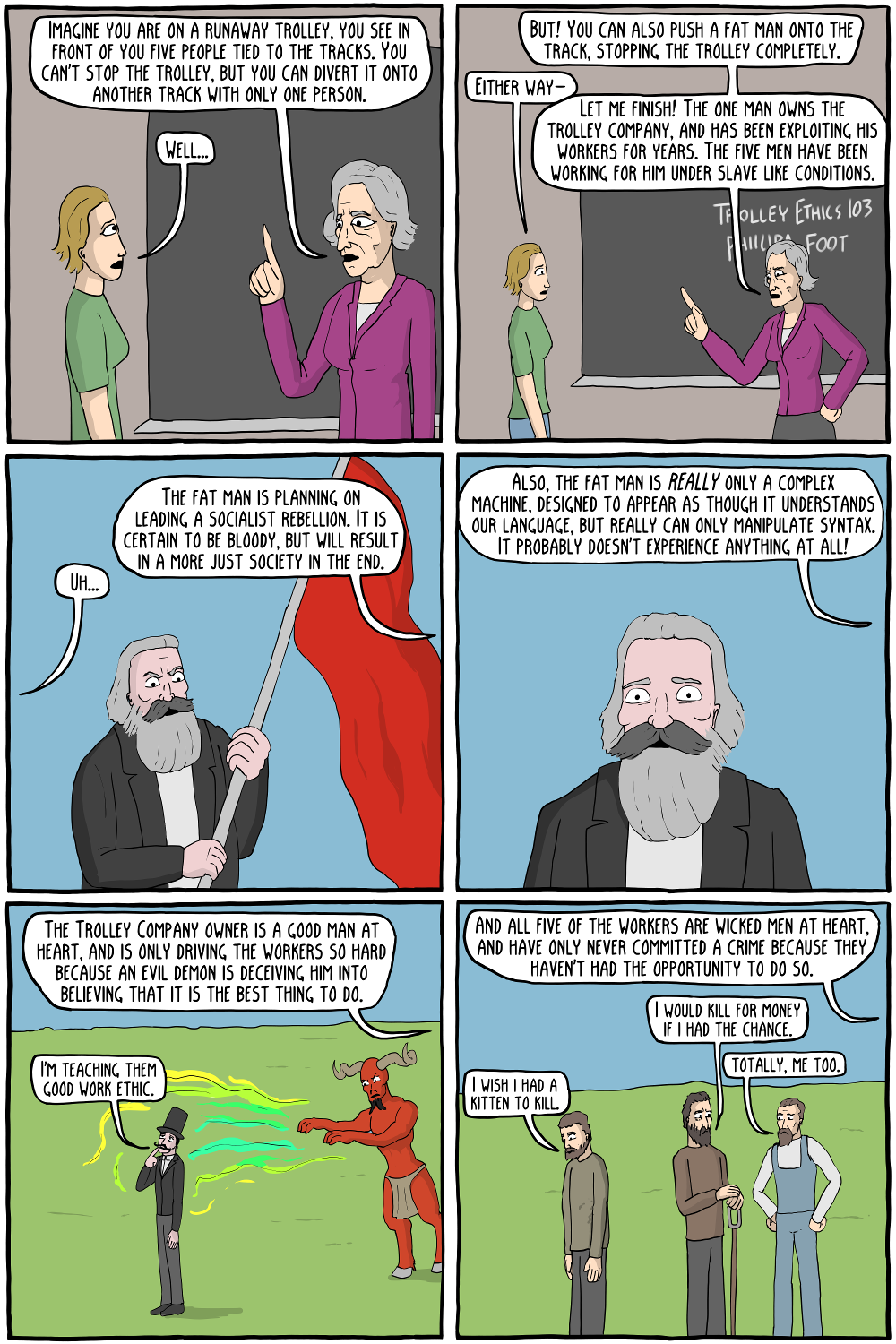
    The Trolley Problem, with extra bells and whistles.

    Plus there is like a 50/50 chance that you are just a brain in a vat, so none of this matters

    Philosophers in this comic: Philippa Foot

    Support the comic on Patreon

  • When Hume lived in La Flèche

    Alison Gopnik has a terrific article in The Atlantic. Drop everything and read it, as I just did.

    She starts with her personal crisis in which a lot of things fell apart and triggered other things falling apart, and she couldn’t work. (She’s a philosopher and a psychologist. I think I’ve quoted her in the past.)

    My doctors prescribed Prozac, yoga, and meditation. I hated Prozac. I was terrible at yoga. But meditation seemed to help, and it was interesting, at least. In fact, researching meditation seemed to help as much as actually doing it. Where did it come from? Why did it work?

    So she began to read Buddhist philosophy.

    Then there’s David Hume. He had a crisis himself, at age 23; he too couldn’t work, although he had ideas he badly wanted to write up.

    Somehow, during the next three years, he managed not only to recover but also, remarkably, to write his book. Even more remarkably, it turned out to be one of the greatest books in the history of philosophy: A Treatise of Human Nature.

    In his Treatise, Hume rejected the traditional religious and philosophical accounts of human nature. Instead, he took Newton as a model and announced a new science of the mind, based on observation and experiment. That new science led him to radical new conclusions. He argued that there was no soul, no coherent self, no “I.” “When I enter most intimately into what I call myself,” he wrote in the Treatise, “I always stumble on some particular perception or other, of heat or cold, light or shade, love or hatred, pain or pleasure. I never can catch myself at any time without a perception, and never can observe any thing but the perception.”

    Contemporary cognitive science confirms this. There is no unitary self, it’s an illusion that makes a bunch of disparate things seem to cohere.

    Hume had always been one of my heroes. I had known and loved his work since I was an undergraduate. In my own scientific papers I’d argued, like Hume, that the coherent self is an illusion. My research had convinced me that our selves are something we construct, not something we discover. I had found that when we are children, we don’t connect the “I” of the present to the “I” of the past and the future. We learn to be who we are.

    This is one reason I find the way a lot of people talk about their “identity” and take it terribly seriously quite frustrating.

    Until Hume, philosophers had searched for metaphysical foundations supporting our ordinary experience, an omnipotent God or a transcendent reality outside our minds. But Hume undermined all that. When you really look hard at everything we think we know, he argued, the foundations crumble. Descartes at least had said you always know that you yourself exist (“I think, therefore I am”), but Hume rejected even that premise.

    Hume articulates a thoroughgoing, vertiginous, existential kind of doubt. In theTreatise, he reports that when he first confronted those doubts himself he was terrified—“affrighted and confounded.” They made him feel like “some strange uncouth monster.” No wonder he turned to the doctors.

    But here’s Hume’s really great idea: Ultimately, the metaphysical foundations don’t matter. Experience is enough all by itself. What do you lose when you give up God or “reality” or even “I”? The moon is still just as bright; you can still predict that a falling glass will break, and you can still act to catch it; you can still feel compassion for the suffering of others. Science and work and morality remain intact. Go back to your backgammon game after your skeptical crisis, Hume wrote, and it will be exactly the same game.

    And does that remind you of anything? Yes, of course: of Buddhism.

    In my shabby room, as I read Buddhist philosophy, I began to notice something that others had noticed before me. Some of the ideas in Buddhist philosophy sounded a lot like what I had read in Hume’s Treatise. But this was crazy. Surely in the 1730s, few people in Europe knew about Buddhist philosophy.

    Still, as I read, I kept finding parallels. The Buddha doubted the existence of an omnipotent, benevolent God. In his doctrine of “emptiness,” he suggested that we have no real evidence for the existence of the outside world. He said that our sense of self is an illusion, too. The Buddhist sage Nagasena elaborated on this idea. The self, he said, is like a chariot. A chariot has no transcendent essence; it’s just a collection of wheels and frame and handle. Similarly, the self has no transcendent essence; it’s just a collection of perceptions and emotions.

    “I never can catch myself at any time without a perception.”

    That sure sounded like Buddhist philosophy to me—except, of course, that Hume couldn’t have known anything about Buddhist philosophy.

    Or could he?

    The rest of the article is about the scholarly detective work Gopnik did to find out, and – spoiler alert – she discovered that he could have. It’s not for sure that he did, but he could have. He knew some Jesuits who knew the one guy in Europe who could have informed him about Buddhist philosophy. He knew the Jesuits well, and the one guy in Europe knew Buddhist philosophy well. It’s a great story.

    I discovered that at least one person in Europe in the 1730s not only knew about Buddhism but had studied Buddhist philosophy for years. His name was Ippolito Desideri, and he had been a Jesuit missionary in Tibet. In 1728, just before Hume began the Treatise, Desideri finished his book, the most complete and accurate European account of Buddhist philosophy to be written until the 20th century. The catch was that it wasn’t published. No Catholic missionary could publish anything without the approval of the Vatican—and officials there had declared that Desideri’s book could not be printed. The manuscript disappeared into the Church’s archives.

    But! Desideri paid a visit to a little French town called La Flèche, home to the Jesuit Royal College. Eight years later, Hume lived in La Flèche while writing the Treatise. He socialized with the Jesuits, who were keen intellectuals. One of them in particular had talked to Desideri a lot. So. It’s possible.

  • Everything is aired in the bracing dialectic wind

    From Rebecca Goldstein’s Plato at the Googleplex:

    Plato presents the journey to the light as a largely solitary one, though some unseen person does yank the prisoner out of the cave; but the format of the dialogues (as well as his having founded the Academy) encourages the view that, on the contrary, Plato conceived of philosophy as necessarily gregarious rather than solitary. The exposure of presumptions is best done in company, the more argumentative the better. This is why discussion round the table is so essential. This is why philosophy must be argumentative. It proceeds by way of arguments, and the arguments are argued over. Everything is aired in the bracing dialectic wind stirred by many clashing viewpoints. Only in this way can intuitions that have their source in societal or personal idiosyncrasies be exposed and questioned. [pp 38-9]

    Good eh?

  • Moral decisions

    Eric has a post about what various things he writes about have to do with assisted dying.

    Well, to put it briefly, as I say in the blog’s banner, I argue for the right-to-die, and against the religious obstruction of that right, so anything which impinges on the issue, even indirectly, is of importance to me. That’s why disputing scientism seems to me to be important, because it implicitly defines away all other forms of inquiry which do not satisfy the canonical rules of scientific inquiry and decision. And that includes morality.

    Jon Jermey raises an interesting question in response to Eric.

    Eric, once again I think the ball is in your court: what, exactly, is the difference between a moral decision and a plain old ordinary decision? I’ve been asking this of various people for several years now, and I still haven’t got a plausible answer. Here are some of the suggestions that have been put up, and why they don’t work:

    “A moral decision is one that affects other people.” — but all my decisions affect other people in some way. “A moral decision potentially has great consequences for many people.” — so does the decision to build a sewerage works or an opera house, but these are not normally regarded as moral decisions. And this definition would rule out pretty much all of my decisions straight away. “A moral decision is when you do what I want you to against your own inclinations” — comment superfluous, surely. “A moral decision is when you do what God says.” — ditto.

    My personal favourite at the moment is — “A moral decision is one that makes you feel guilty, no matter what you choose.” — but I don’t think it has the rigour to stand up in debate.

    So again, just as you need to define ‘science’ in order to explain what you’re objecting to about it, I think you have to tell us what a ‘moral decision’ is in order to explain how these differ from the plain old everyday decisions we can make effectively with reason and logic.

    I think J.J. dismisses the first answer much too quickly. I think it’s basically right. He too is right that all our decisions affect other people in some way, but many of those decisions affect other people (and/or animals and/or the environment as a whole) in ways too tiny to measure or take into consideration. If I decide to turn north instead of south while taking a walk, the ways that decision affects people or the environment are too small to detect. If on the other hand I decide not to walk to the grocery store but to drive [never mind for the moment that I don’t have a car], that makes a detectable difference, and is worth taking into consideration.

    Morality is about taking externals into account – other people; animals; the ecosystem we all depend on. It rests on the awareness that the self is not all there is. It’s a corrective to pure selfishness. Many purely “selfish” decisions don’t count as morally selfish because they aren’t zero sum. If I go out for a walk to admire the sunset, nobody is worse off because I do, even though I’m the only one who enjoys that particular walk. If I build a viewing tower that blocks other people’s view of the sunset, those people are worse off. (And the decision to build a sewerage works or an opera house should of course be normally regarded as moral as well as other things. Of course it should.)

    Yes? No?


  • Yes but what should we do about it?

    Part 4 of the Heathen’s Progress is out. It’s about how atheists shouldn’t think science is their BFF, because it will stab them in the back sooner or later.

    Julian is harsh about Sam Harris’s The Moral Landscape.

    What’s worse, however, is when atheists talk of science as though it is the source of all the knowledge and wisdom we need to live. The most egregious recent example of this is Sam Harris’s The Moral Landscape, with its subtitle “How science can determine human values”. It’s hard to imagine a more hyperbolic claim about the power of science…

    It is rather.

    When Harris sounds convincing is when he is attacking the batty view that science has nothing to say about human values. Scientific evidence might indeed reveal morally important facts, such as that inequality as well as absolute levels of wealth affects wellbeing; that different “races” are not that different and not really races; that some animals do feel pain, and of what kind it is; and so on. Science can also reveal the physiological and neurological mechanisms that underlie the things we value in life, like achieving states of flow or avoiding pain. But science could never tell us what we should value, because when it tells us how things are, we are always left with the question, what ought we to do about it?

    That link is in the original, and it was probably inserted by Andrew himself (which is a little shaming, since it goes to something he wrote). I can tell you that when I publish articles by other people on B&W the website, I don’t insert links to stuff I wrote. I would think that rude and intrusive.

    However, since I’m writing this post, I will insert a link to something I wrote, because it’s pretty much exactly what Julian said. I expect he got it from me. (Joke!)

    It’s from the review I wrote of Harris’s book for The Philosophers’ Magazine.

    It’s easy to get people to agree that well-being is good; the hard part is getting them to agree on what that implies they should do, and getting them to do it.

    Harris spends most of the book hammering home the point that morality is about the well-being of conscious creatures, which means he spends far too little time considering the difficult questions that arise even if everyone agrees on that.

    See? Very like what Julian said.

    The rapturous reception Harris’s book received from many atheists – though thankfully far from all of them – is a symptom of an unhealthy desire to raise science to the level of our saviour.

    Actually I think it’s much more a symptom of excessive admiration for Harris himself combined with a total unfamiliarity with meta-ethics. Anyway, the effect was the same.