
Tag: The Global Secular Council

  • He’s done his time in prison and is now funding secular start-ups

    Nostalgia time. Let’s look back at the first blushing days of the new Global Secular Council, later to be the Secular Policy Institute – by which I mean, let’s look back at what I had to say about it starting in May 2014.

    In Global shmobal, for instance, the first whisper of its arrival.

    Oops. There’s a thing called the “Global Secular Council.”

    global

    First? It’s not so global. They’re nearly all American or Ukanian, and the whole thing is clearly Anglophone.

    Last? Its team of experts – 23 of them. Five women. Five.

    Look at the glam picture at the top of the front page – what do you see? Four men and three women – not parity, not more women than men, but close to parity. Funny how the conspicuous glam photo on the front page looks as if there are almost as many women as men when in fact, there are not.

    That’s not all you see, but I won’t go into that.

    In The adorbs Secular Council.

    They’re adding stuff, the Top of Their Field geniuses at The Global Secular Council. We get to watch them add stuff.

    They’ve added a page for something called The Bella & Stella Foundation, which has a link at the bottom of the Team page. It’s some sweet whimsy-whamsy so that we’ll know they don’t take themselves too seriously. (Right, because a few US/UK white guys declaring themselves a Global Council has no trace of taking themselves too seriously.)

    adorbs

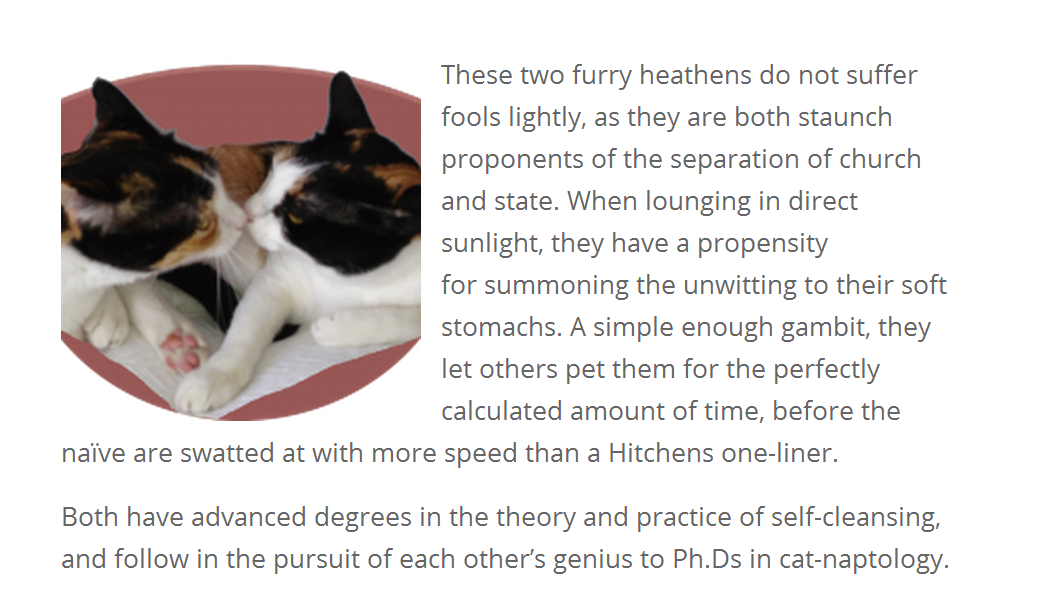
    These two furry heathens do not suffer fools lightly, as they are both staunch proponents of the separation of church and state. When lounging in direct sunlight, they have a propensity for summoning the unwitting to their soft stomachs. A simple enough gambit, they let others pet them for the perfectly calculated amount of time, before the naïve are swatted at with more speed than a Hitchens one-liner.

    Both have advanced degrees in the theory and practice of self-cleansing, and follow in the pursuit of each other’s genius to Ph.Ds in cat-naptology.

    Isn’t that just adorable? Doesn’t it make you forget all about wondering what the hell this handful of white mostly-males from the US/UK has to do with anything global? Aren’t Bella and Stella just a perfectly fine substitute for people with some actual global reach and experience? Why wonder where Taslima Nasreen and Maryam Namazie and Gita Sahgal and Pragna Patel are when you can have Bella and Stella?
    We understand about the cats now. It’s Lloyd Rubin. Who? Stephanie pulled it all together a couple of months ago:

    It took Edwina Rogers being fired by the Secular Coalition for the money behind Bella and Stella to come forward.

    “I can be a good and generous friend, or I can be a very effective adversary,” wrote one major donor, Lloyd S. Rubin, in an email to board members and the heads of member organizations last week.

    One enterprising commenter on Ophelia’s blog made the Panamanian connection. Who is Lloyd Rubin?

    One day in the mid-1980s, Rubin, a portly American in his 50s, steps off a plane. In no time, he is ensconced in opulent offices, complete with an imitation jungle brook. He proceeds to filch millions from visiting countrymen, despite repeated complaints to the U.S. embassy. He tools around in a wine-colored Jaguar. Even after Noriega falls, Rubin continues to con with impunity. He seems untouchable…but is he?

    In June, 1991, Rubin travels to Thailand with his new Panamanian wife, Rachell Constante. They drive to a dusty village, where Lloyd is admitted to a drug rehabilitation center run by Buddhist monks. Constante returns to Panama alone. Some weeks later, a New York judge hearing a fraud case against Rubin gets a Thai death certificate in the mail. It states that Rubin died on July 26 at the rehab center and was cremated. As translated, the cause of death is listed as “complication disease, unhealthy.” He was 60.

    Rubin is back in Panama now, having failed to convince anyone that he died. He’s done his time in prison and is now funding secular start-ups.

    Classy, classy stuff.

  • Asking a question

    So anyway, on Friday, I wrote again to the press contact person at the Global Secular Council to ask the question the GSC’s Twitter account never did answer, and first insulted me and then blocked me for asking.

    Why did the Global Secular Council launch before inviting more “global” people to be on its panel of Experts?

    She replied that she wanted to be sure I would not “not misconstrue or “twist” [her] text reply, and perhaps repopulate that misconception publicly.”

    I couldn’t quite fathom how I would be able to do that as long as I quoted her exactly, which obviously I would do; I said as much, and with that she answered my question. Here is her answer:

    What I will say to you is that most of my answer was dictated by me to the Social Media Team (at their request) and, as I understand it, sent back to you in snippets (or “tweets”).  I looked over what actually was sent back to your questions and it seems, though loaded with a little too much “internet personality”, to be congruent with the reply I intended; although, perhaps because of the forced brevity of those responses, those remarks were not received by you as actual answers.  So far, those answers seem to have been missed, “twisted”, or at least, misconstrued, consistently by you and your loyal followers.  But, I’m happy to recap here, and you can perhaps help me to fill in the blanks in my answer.  This is my personal understanding of the situation, and by no means represents every single member of our organization:

    The Global Secular Council “launched” only its website and social media at the behest of many involved, mainly donors, and not without concern from many others involved, similar to yours.  I speak for myself, but echo others, when I say many agreed that on the face of it, we did not yet display enough racial, gender, and national diversity in our Council Members.  However, since we were by no means at the close of some finite process, but rather, at the beginning of a far-reaching project, we did not determine there would be any actual harm done announcing that the Council was being formed, while further “human resources” continued to gather and make commitments.  Taslima Nasreen, for instance, has agreed to join, but we have not yet solidified.  We were and are excited!  To that end, from the start, the name “Global” was a statement of purpose, as well as an indication of what we were already doing–gathering resources such as surveys, articles, and academic papers from around the world in support of a secular cause.

    So the answer to my question is: they “did not determine there would be any actual harm done announcing that the Council was being formed, while further “human resources” continued to gather and make commitments.”

    As you see, she had also said “you can perhaps help me to fill in the blanks in my answer” so I basically asked my question all over again:

    Since you suggest I help fill in the blanks, I’ll ask again about why you launched before getting more global people on board. You say you (plural) did not determine there would be any actual harm done, so I would ask why not? It’s the same question all over again, really. It seems to be an obviously bad idea to launch a global project with no one “global” on the roster.

    I know you’ve invited Taslima; she’s a good friend of mine. But you invited her after you invited other people, people with less experience and knowledge of matters outside North America and the UK. That seems like a slight. I would think you (plural) would want to avoid giving that impression.

    I hope she doesn’t see that as me misconstruing or twisting her reply, much less repopulating that misconception publicly. I see it as just pressing the question, which wasn’t very satisfactorily answered. Why didn’t they think there would be any harm done?

    Why did they think it would be a good idea to set up a panel of people they dubbed “Experts” for a council to deal with global issues when the experts have no obvious expertise at all in the global issues in question? American and British physicists, biologists, zoologists – how are they experts in global issues? I see of course how they are “Experts” tout court, but what does that have to do with anything? Having a PhD in field X doesn’t make you a universal seer. Given the completely random qualifications of the people on that list, it certainly would have helped to have had at least a broader geographical reach.

    In one way it’s obviously none of my business, but then again they certainly sent out press releases asking us all to spread the word about their new council, plus there are all these people who seem to expect our infinite loyalty, so from that point of view it is my business, it’s all of our business. And then, I know a lot of people they should have asked to be on that panel but didn’t, and it annoys me. (No, I emphatically don’t mean me. I mean people from other parts of the world.)

    Then again, the description of their planned activity that she ends with perhaps indicates that none of this matters after all:

    …the name “Global” was a statement of purpose, as well as an indication of what we were already doing–gathering resources such as surveys, articles, and academic papers from around the world in support of a secular cause.

    Oh. That’s their plan? To gather papers?

    Oh. Oh well, never mind then.


  • Atheists who can’t see past that label

    Early this month Hemant posted a love note to the Secular Coalition for America.

    I don’t love the SCA myself. I love it now a lot less than I did a week ago (which wasn’t much), because of its “Global Secular Council” and its way of responding to my questions about same. But Hemant, for some reason, is more gung ho about it. He did an email interview with Edwina Rogers that was worded in such a way as to indicate a certain amount of…distaste for her critics.

    When you first took the position, the fact that you were a Republican was a point of controversy. Do you still get pushback from atheists who can’t see past that label? If so, how do you respond to it?

    See there? Those atheists who thought a Republican lobbyist wasn’t an ideal choice for a secular organization “can’t see past that label.” It’s not that they have reasons for thinking there are tensions between the two, it’s that they can’t see past the label. How friendly.

    As a female leader in our movement, what do you think are some of the biggest issues we must address as a community in regards to sexism?

    We must continue to fight efforts to legislate away women’s rights on the basis of religion, especially the right of women to make their own health care decisions. Harmful legislation passed in many state legislatures this past year making it difficult or nearly impossible to get an abortion. Supporters claim they want to protect women, but in reality they are assaulting women’s bodily autonomy.

    Our society needs to stop trying to control women’s sexuality. A woman’s right to a health care plan that includes contraception and abortion coverage is her choice, not her employer’s, not the government’s, and not the churches’. We also need to make sure we are teaching medically-accurate sexual education in our schools and eliminate the so called “slut-shaming” culture and damaging gender stereotypes that often come along with it.

    Not a word about the sexism within the “community.” That’s not surprising, given how cozy the SCA is with Richard Dawkins and his eponymous foundation, but it’s cynical and annoying.

    At the end Hemant sums up.

    More importantly, I have yet to hear any reason that Rogers’ political affiliation has done any damage. While some of her responses still sound awkward (getting the attention of CPAC board members won’t win her many atheist fans…), I still believe there’s a benefit in getting Republicans to hear our message. It’s not like our side’s more progressive leaders will get GOP members to change their minds about atheists, so if anyone can, it’s her. (And if they don’t change their minds, well, it’s not like we were making any headway in the first place.)

    I also appreciate that she hasn’t allowed herself to get dragged down by criticism that doesn’t affect her organization. She appears to be focused on her job — and doesn’t get distracted by commentary from Internet critics (for better or for worse). Her staff, in my experience, has worked in a similar way. They’re dedicated to their work and, while they hear what we’re saying, they won’t be getting into online wars anytime soon.

    Another way of putting that would be “I also appreciate that she ignores all criticism from people outside her organization.” That’s a bizarre thing to appreciate. What’s so great about an organization’s ignoring criticism from its core demographic? The mere fact that people are on the Internet doesn’t magically turn them into aliens whose criticism is wholly irrelevant, especially if they criticize under their own names. I don’t think it’s clever of a secularist organization to display contempt for (let’s spell out what Hemant only implied) bloggers, since blogs can after all help with publicity and communication.

    I’d love to hear from anyone who criticized Rogers’ appointment two years ago. Has your opinion changed since then? If not, what’s holding you back?

    Yes my opinion has changed since then; it’s changed since last week; it’s gone way down.

  • The people in the glossy photos

    Stephanie notices some things about the Secular Coalition for America and its brainchild The Global Secular Council (you know, the one that’s not the least bit global, in fact about as unglobal as you can get).

    Will the people in the glossy photos do great work under the Global Secular Council banner? Hard to say. There are some people on that list who have done truly impressive work, but I find it a bit odd that they didn’t hold the launch of the website for the release of work from at least a few of them. I’d like to believe they had the time for that between dinner and going live. There had to at least have been work those people had done that they were willing to repurpose under the GSC banner, right?

    Not as of launch, no. But maybe they’ll start producing their own content soon, something more than a blog, since that’s what they’ll need to influence government. They’ll have to produce in order to survive. Big names only bring in so many donations before people want them to do more than have dinners and get their pictures taken.

    That seems plausible, although there do seem to be a surprisingly lot of people out there who are utterly entranced by people merely having dinners and getting their pictures taken.

    This is particularly true when the parent organization has been the subject of financial mismanagement rumors for several months.

    [Nope. I don’t have anything but rumors on this one. They’ve come from multiple directions, which suggest they’ve gotten a lot of traction, but not necessarily that they’re true. I have no idea what happened with SCA’s finances, if anything, but that doesn’t keep the rumors from making fundraising harder.]

    So they’ll get productive, or they’ll sink. They don’t want my help with the first and wouldn’t need it with the second. Initiatives start and die every day.

    Like restaurants and little shops selling silk scarves and crystal.

    If SCA has some real challenges, they also have some outstanding assets, at least in potentia.

    Speaking of those challenges–the lack of diversity, the huffiness and counterattacks in the face of criticism, the poor understanding of basic concepts revealed in that discussion–pulling those posts of Ophelia’s into one place finally made something click for me.

    I was reminded of something I’d tweeted from Barbara Ehrenreich’s talk at Women in Secularism.

    Barbara Ehrenreich recently invited to an atheism & science think tank a bit short on “ladies” to contribute on “women’s health”. 

    I’d forgotten that. I took a lot of notes, because I forget everything, but I haven’t looked at the notes yet.

    Then all this happened. Do I know that it was the GSC that invited Ehrenreich? No, but the description and timing sure fit.

    Ohhh – I had not thought of that. If so…oy.

    Here’s a piece of free advice for whomever is doing the invitations for the GSC: Don’t ever tell someone from an underrepresented group that you’re inviting them to help improve your representation.

    No, I’m not telling you to lie by omission. I’m not telling you to cover up something that’s best not raised in polite company. I’m telling you inviting someone to help improve your representation is a crappy thing to do. Hell, it’s probably not even what you’re really doing anyway.

    When you notice that your gender or other ratios are badly skewed, not at all representational of the community you claim to speak for (whether global or merely national), it’s a signal that your process was flawed. Maybe you’ve subconsciously been thinking that thinking in tanks is “more of a guy thing” or “more of a white thing”. Maybe the white men who fit your mission just get so much more press that they’re more easily called to mind when you’re brainstorming. Maybe the definition of “big-name atheist thinker” has been historically constructed in such a way that it largely excludes the thinking women and people of color do.

    Or maybe you’ve had to take most of the outspoken feminists and anti-racists off your list for one political reason or another, and that made you shy about including marginalized people.

    Whatever the reason, the fact that you’ve come up with a list of atheist thinkers and policy people that doesn’t include Barbara Ehrenreich should tell you that your process didn’t work right the first time. Your problem isn’t that you “don’t have enough ladies”. Your problem is that you left amazing talent on the table because your process failed you.

    Yes, and yes, and yes. One after another. Especially Maybe the white men who fit your mission just get so much more press that they’re more easily called to mind – which is exactly what I thought when I saw the GSC’s list of “Experts,” and is exactly what I still think. It’s a list of mostly The Guys Who Come To Mind First – which, ironically (or is it ironic?), makes the list boring as well as contemptuous and insulting. Can you really not get away from DawkinsandKraussandHarris for even a second? Why Harris over and over and over and fucking over again, and Churchland never? Patricia Churchland is orders of magnitude more interesting than Harris, but we get Harris for breakfast lunch tea and dinner, year in and year out. And then to take up Steph’s point, why Harris rather than Ehrenreich? And to take up my points from last week, why Harris rather than Namazie or Nasreen or Sahgal? Why is Sam Harris thought to be infinitely interesting, so that people want to hear him talk again and again and again and again, while Ehrenreich and Namzie and Nasreen are thought to be not interesting at all, so that people don’t want to hear them talk even once?

    I don’t know if it’s just laziness or just a brainless hero-worship, but either way, it’s deeply unimpressive.

  • A major public face of the secular movement

    Oh gee, the things you find when you glance at the site stats, which show links from other sites. Like this time a bunch from the JREF forum, which surprised me enough that I went to see why. The why? It’s Damion Reinhardt gloating over the fact that Michael Shermer is still popular in skepto-atheo land.

    I know that we mostly talk about the accusations levelled against Radford (so much publicly available data to comb through!) but I’d like to pause to consider a hypothesis about the accusations levelled at Shermer.

    Ho: Anonymously accusing someone of serious sex crimes (at a rageblog website) will make it difficult for the accused to continue as a major public face of the secular movement, in the company of high profile luminaries such as Dawkins, Tavris, Harris, Goldstein, Pinker, etc.

    Ha: Such accusations, in the absence of some corroboration and investigation, carry little weight outside of the social justice wing of the secularist movement.

    I’m going to say that there seems to be some preliminary evidence in favour of rejecting the null hypothesis: http://www.secularcouncil.org/team/

    http://freethoughtblogs.com/butterfliesandwheels/files/2014/05/global.png

    Naturally, some of the folks over at FtB are rage vomiting about their collective inability to take Michael Shermer down for good.

    (more…)

  • If it doesn’t look the right color I suppose

    More bonus! Global Secular Council on Twitter shyly calls me a racist. I love this group!

    color

    Luther @Luther101010 12h

    @SecuarCouncil pointless to engage and her ilk. No matter what your Org goal is unless it promotes their causes it’s bad.

    Secular Council @SecularCouncil 11h

    Or even if it does support their causes, apparently. If it doesn’t look the right color I suppose.

    Well it’s like this – one of my “causes” is recognition that the United States is not the whole world, and that the whole world contains a lot more than the United States. It follows from that that another of my “causes” is recognition that it’s outrageously arrogant to call yourself “Global” when your personnel is confined to the United States and the United Kingdom (and one person from Sweden).

    So that’s two of my “causes” that the Global Secular Council doesn’t support.

    That’s not an exhaustive list though.

  • To I, to she, to he, to they

    And there’s their About page.

    Every ideological movement has a policy center. Republicans have The Heritage Foundation, New Democrats have the Progressive Policy Institute, Libertarians have The Cato Institute, and Secularists have the Global Secular Council.

    First, well, no. Ideological movements don’t usually have just one policy center. Also, not all participants in the movements take any one center to speak for them. Second, “ideological” is usually used as a weapon in this “movement” – feminists are constantly accused of importing an “ideology” into the crystalline purity of the atheist or skeptical “movement.” That’s complete bullshit, of course, but it’s still rather funny to see this group so cheerfully identifying itself with an ideology.

    With these organizations as models, Global Secular Council is the international policy research and resource center for atheists, humanists, and other secularists who speak out for science and reason instead of religion and faith.

    There’s the arrogance already. No, Global Secular Council is not the international policy research and resource center for atheists, humanists, and other secularists. It may be (at best) one of several, but it’s not the. It doesn’t get to appoint itself “the” anything that way.

    The world’s greatest thinkers are already making the case for rationalism, but as free agents their impact on international discourse is hindered.

    Oh dear god stop talking about yourselves that way. Stop calling yourselves the world’s greatest thinkers. Most of you are not, and in any case it’s a terrible look.

    We coordinate the thought leaders of our movement, providing an arena where compelling information from a secular perspective can be organized, published, and disseminated.

    And don’t ever, ever, ever call yourselves (or anyone else) “thought leaders.” Nobody wants “thought leaders” and you’re not it anyway. We can do our own thinking, thank you. We can educate and inform each other, we can help clarify each other’s thinking, but we don’t have thought soldiers and thought officers. Forget it. You’re not our bosses, our mullahs, our stars, our heroes, our anything of that kind. You’re an embarrassment if you claim otherwise.

    Our team of social and political thought leaders compiles the knowledge and data that uphold our worldwide community, providing substance and fresh leverage to we who think scientifically, as we lobby for government and societal change in the United States and around the globe.

    Too bad our “thought leaders” don’t even know to write “to us” instead of “to we”…(Seriously? To we?)

    To we who are hungry, it’s time for lunch.