Year: 2013

  • Nice little economy you got here

    Countries other than the US are puzzled by the US’s reckless destructive way of governing.

    That leaders of one of the most powerful nations on earth willingly provoked a crisis that suspends public services and decreases economic growth is astonishing to many.

    American policymakers “are facing the unthinkable prospect of shutting down the government as they squabble over the inconsequential accomplishment of a 10-week funding extension”, Mexico’s The News wrote in an editorial.

    In the United States, however, government shutdowns – or the threat thereof – have become an accepted negotiating tactic, thanks to the quirks of the American federal system, which allows different branches of government to be controlled by different parties. It was a structure devised by the nation’s founders to encourage compromise and deliberation, but lately has had just the opposite effect.

    Oh I don’t think it’s become an accepted negotiating tactic. Most people see it as plain gangsterish extortion.

    “Canadians can only pray their economy won’t be collateral damage,” writes John Ibbitson in Canada’s Globe and Mail. “Anything that drags down the American economy drags the Canadian economy down with it.”

    And this could be another reason why the United States has shutdown crises and other countries don’t – because the United States can afford to. At least up until now, the American economy has been able to continue to grind along despite shutdown disruptions that would stagger other nations.

    And it also makes it all the more disgusting – dragging down not just our economy but those of other countries too, out of sheer infantile pigheadedness and resentment.

  • Well don’t you?

    A useful item that someone gave me on Facebook.

    Eneraldo Carneiro's photo.

  • Nonsense on stilts

    So the Tories are planning to ditch the European Convention on Human Rights.

    The Conservative party is prepared to withdraw from the European convention on human rights (ECHR) after the next election, the home secretary Theresa May has said, as she detailed a fresh drive to curb the appeal rights of 70,000 people who face deportation every year.

    “The next Conservative manifesto will promise to scrap the Human Rights Act. It’s why Chris Grayling is leading a review of our relationship with the European court [of human rights],” she told the party’s conference. “And it’s why the Conservative position is clear – if leaving the European convention is what it takes to fix our human rights laws, that is what we should do,” she said to applause.

    May was followed by the justice secretary, Chris Grayling, who set out a timetable for the development of their policy for a radical reform of human rights law. He said the Conservatives would publish a document in 2014 “setting out what we will do, when we will do it, and how we will do it”, followed by a draft bill setting out the legal detail later in the year.

    May’s explicit statement followed David Cameron’s hint on Sunday that the Tories were openly considering the “nuclear option” of withdrawing from the ECHR, despite warnings from the attorney general, Dominic Grieve, and others, of the damage to Britain’s international standing.

    What could possibly go wrong?


  • The Monday mendacity

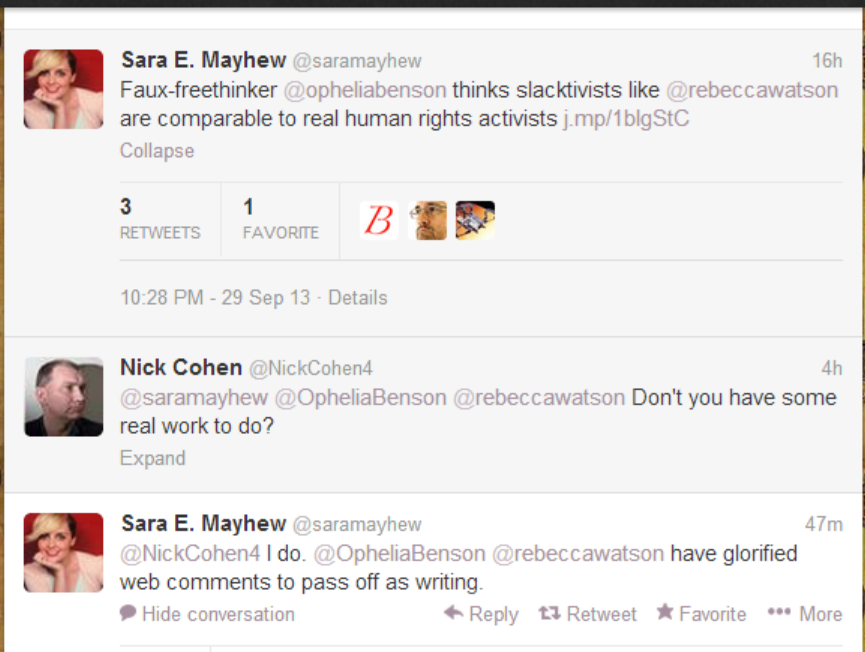
    Sara Mayhew is still desperately seeking attention. Every once in awhile I grant her wish. Today is one such time. She fired off a bunch of tweets at me earlier today; I retweeted some; Nick Cohen (who’s a friend of mine) replied to one.

    aa

    Not quite accurate.

  • Blackadder celebrates the day

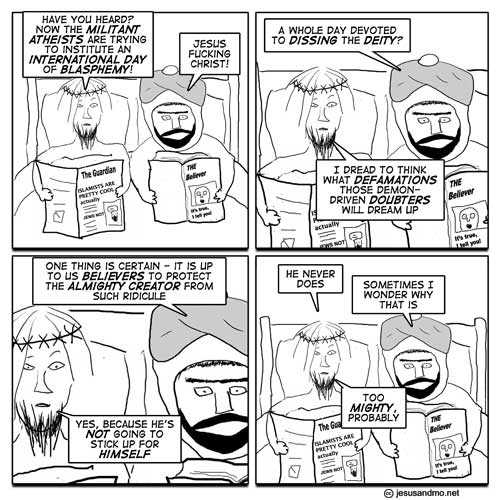
    It’s International Blasphemy Day, people!

    Photo

  • Christos Pappas turns himself in

    More on Golden Dawn.

    A Greek lawmaker sought by police surrendered on Sunday, bringing to six the number of legislators from the extreme-right Golden Dawn party now in custody and facing criminal charges.

    Christos Pappas — a lawmaker described by prosecutors as the Golden Dawn’s No. 2 official — was formally charged with membership in a criminal organization with intent to commit crimes, like his five fellow legislators, including Golden Dawn leader Nikos Michaloliakos.

    Besides the six lawmakers, another 14 Golden Dawn members and two police officers have been arrested and charged with the same crimes. Another 10 suspects, for whom arrest warrants were issued Saturday, are still at large, officials said.

    They’ve been gathering the goods.

    The prosecution was made possible by a report from a Supreme Court prosecutor, Haralambos Vourliotis. The report lays out the allegations against the Golden Dawn leadership, including murder, attempted murder, carrying out explosions, possessing explosives and robbery.

    The prosecutor’s report says that from the moment Golden Dawn was founded, in 1987, as a neo-Nazi organization, the party structure was paralleled by a military-type operational force whose trained members attacked people, mainly immigrants, based on the party’s ideology. The strict hierarchical structure meant the party leadership knew of every local attack and commands flew from the top to local chapters, the report says.

    The recurring lust for fascism.

  • Holy holy holy yawn

    Have you ever noticed what a terrible literary character “God” is?

    Not like the Greeks. Athena, Aphrodite, Apollo – they were interesting, and they got involved. But “God”? Blegh.

    That’s why Jesus, you know. People got bored, and they wanted a god who could put bums on seats, one with some good lines. Jesus can be pretty entertaining, in a rebel without a cause way. He’s uneven, but he has moments.

    But “God” is so boring they had to get George Burns to play the part, so that people would think there’s someone interesting behind the name. But there isn’t. George Burns was just acting (he was acting George Burns), and the ____________ behind George Burns is boring as fuck.

  • Boko Haram kills about 50 students at agricultural college

    Education is Forbidden but murder is not. That’s a strange thing.

    Suspected Islamist gunmen have attacked a college in north-eastern Nigeria, killing up to 50 students.

    The students were shot dead as they slept in their dormitory at the College of Agriculture in Yobe state.

    A witness quoted by Reuters news agency counted 40 bodies at the hospital, mostly those of young men believed to be students.

    College provost Molima Idi Mato, speaking to Associated Press, also said the number of dead could be as high as 50, adding that security forces were still recovering the bodies and that about 1,000 students had fled the campus.

    I suppose they were jealous of the statistics from the Westgate Mall in Nairobi.

  • Changing the size of the mesh

    Emer O’Toole relates the misadventures of David Gilmour and her reactions to same to, first, her struggles with devising a new curriculum for an introduction to Irish theatre, and, second, internet dating.

    Yes, internet dating. I’m new in town, and I’ve joined a site for the first time. Having indulged in outrageous fanfaronade on my profile page and started shopping for mates, I noticed that hardly any of the other singletons on sale – male or female – listed fiction by women in their “favourite books” section. Were they afraid they’d catch pregnancy or menopause from female writers or something? I changed my profile to stipulate that I only wanted to hear from people who read books by women.

    Then something weird happened. People started messaging me about their relationships with gender and literature. Like, lots of people. The messages ranged from good (the person who wrote to say that they’d changed their profile to honour female authors), to bad (the person who listed six male writers on their page, but explained they didn’t define themselves around literature), to ugly (the person who said “I like motorcycles, but I don’t expect you to like motorcycles – why do I have to like books by women?” Answer: because motorcycles are not one half of the human race).

    Hmm. That’s not a good answer.

    A lot of things follow from the fact that women are half the human race, but having to like books by them isn’t one of them, at least not directly. There’s a case that can be made, and O’Toole goes on to make a case, but that answer doesn’t make it, and it echoes the dopy stereotype of what’s meant by affirmative action. (She could have said, for instance, “I didn’t say you had to like them, I stipulated people who read them, and the reason for that is that no one should systematically ignore all books by half the human race.”)

    People wrote to tell me that, in spite of their all male book lists, they didn’t discriminate when assessing literature. These were just the books that they, personally, liked best. Ergo, I was being judgmental. I could have ignored them, but my pedagogical urges are just too strong. I found myself explaining that, of course, I didn’t imagine anyone was thinking “screw those silly scribbling bitches, they can’t teach me nothing, yo” when filling out online dating profiles. I explained that we live in a society that teaches people to value male thought, art, and leadership above female thought, art and leadership. I explained the difference between active and passive discrimination.

    That’s more the kind of thing.

    It’s funny how people (I’m sure I do it too) assume the sifting process somehow magically chooses only the genuinely actually factually Best. Everybody should be much more sharply aware of what happened when orchestras started doing blind auditions. OMG would you believe it suddenly women started being hired! It turned out that when you couldn’t see that they were women they were just as good as the not-women. It’s almost as if the sifting process sifts for gender first instead of for quality first.

  • Guest post: Meera Nanda on India’s superstition industry

    First published in India’s Frontline magazine; reposted here by permission.

    Asaram Bapu’s alleged sexual assault on a young girl offers an opportunity to throw light on India’s superstition industry and lift the veil on the state-temple-corporate complex. By MEERA NANDA

    At one level, the arrest of Asaram is a rather humdrum, same-old story. One more godman has fallen from grace. So, what is new under the sun? Aren’t we used to discovering the clay feet of our sadhu sants? Perhaps George Orwell was on to something when he said that “saints should always be judged guilty until they are proved innocent”, for no all-too-human godman can ever live up to the qualities of godliness. Perhaps the wise course to take is to reflect upon the tragedy of overweening human ambition of these fallen gurus and move on.

    Yet, if one pauses to think about it, Asaram’s arrest is not just a matter of one more godman’s personal failings. Rather, this episode dramatises the thin line between faith and blind faith, and the near complete merger of faith, politics and money in contemporary Indian society.

    Asaram’s alleged rape of a 16-year-old girl is proof—if more proof is needed—why Narendra Dabholkar’s struggle against superstitious beliefs and practices is indeed the need of the hour. The young girl was brought to the guru for an exorcism, of all things. From the revelations that are trickling in, it appears that this girl and her parents were made to believe by Asaram’s associates that she had been possessed by evil spirits which the guru had the ability to drive out. This kind of andh shraddha, or blind faith, which our godmen so routinely encourage and exploit, is precisely what Dabholkar and his Maharashtra Andhshraddha Nirmulan Samiti were fighting against, a fight that cost him his life.


    Asaram’s case is also proof—if more proof is needed—that a state-temple-corporate complex is always and everywhere at work in India. Most of the times, it lies hidden in plain sight: we are so used to the sight of our elected representatives and the pillars of civil society—from prominent scientists, business tycoons to Bollywood superstars—prostrating themselves before gods and godmen that we do not notice how smoothly faith, politics and money blend into one another. It is when the godmen behave badly (as in Asaram’s case), or when they fall foul of the powers-that-be (as happened to Baba Ramdev after his anti-corruption rally last year), that the veil is lifted. It is on occasions like these that we see what has been lying under our noses all along, namely, the state-temple-corporate complex.

    Narendra Modi and other political leaders may want to distance themselves from the fallen godman for strategic reasons. But it is no secret that Asaram was treated as the de facto rajguru in Gujarat under both BJP and Congress governments. Indeed, when you examine the record closely, it is clear that Asaram’s hugely profitable empire of ashrams, gurukuls and schools was built up with the largesse of land given by the state as grant (which he later expanded through encroachment) and as private donations from the wealthy Sindhi-Marwari community. His political connections created a protective shield around him, immunising him from many allegations of crimes (including murder of children) and misdemeanours. The godman could literally get away with murder. Asaram, of course, is hardly alone in using his political clout to amass a fortune. Behind every successful godman in India today stands a cluster of powerful politicos with free access to the public assets and the machinery of the state. Once launched, the successful gurus build business empires, which attract other corporate interests, especially those with interests in the burgeoning market in education and tourism.

    Under the neoliberal regime that India put in place to attract private capital, both global and indigenous, it has become easier than ever before to funnel public money and public assets into religion-cum-business empires. Often all that is needed is an authorisation for a change in land use (from agricultural to institutional or commercial) and the University Grants Commission (UGC) or the State legislature conferring the status of a “university” on a teaching shop set up by a guru’s trust under the pretext of imparting “value-based” education. The neoliberal mantra of public-private partnerships has benefited religious entrepreneurs as much as any other corporate interests. The difference is that the aura of holiness and the layers of shraddha and andh shraddha protect the former from any serious inquiry, let alone a challenge.


    Until recently, State governments, especially in BJP-led States, were falling over each other to offer public land to Swami Ramdev to set up subsidiaries of Patanjali Yogpeeth, his flagship ashram-cum-ayurvedic hospital in Haridwar, Uttarakhand. Uttarakhand conferred the status of a “university” on Ramdev’s ashram and Haryana recognised the gurukul set up by the baba. These are fee-charging, for-profit teaching shops, not charities, though perhaps they get tax-breaks as charities. Ramdev’s government-sponsored ayurvedic formulary has made millions selling drugs of dubious safety and efficacy, while Aastha, the TV channel he owns through his proxies, has raked in huge profits. In their take-off stage, these businesses were, in part, subsidised by wealthy donors in India and abroad. Once the physical assets are in place, subsidiary government agencies and corporate interests step in to develop infrastructure such as roads, hotels and resorts and run luxury buses.

    This triangular relationship between the state, the peddlers of “ancient values” of Hindu sanskriti and private money has become the standard operating model adopted by nearly all brandname gurus. It makes no difference if the State in question is “secular”, as States ruled by the Congress and the various regional parties claim to be, or is allied with the Hindu nationalists.

    Ashram on leased land
    Take, for example, the case of Sri Sri Ravi Shankar, who has constructed the headquarters of his Art of Living (AOL) ashram on land leased to him for 99 years by the State of Karnataka. The corporate support of AOL from Infosys and other Bangalore-based software companies is well known. But, wait, there is more: AOL got a land grant of 200 acres (one acre is 0.4 hectare) from the State of Odisha, where a new university offering “modern teaching with ancient values” started operations last year. The same business model was adopted by Madhya Pradesh, which honoured its native son, Maharishi Mahesh Yogi, with a land-grant university. (My book, The God Market, provides evidence of the extensive state involvement in these cases, as it does for Baba Ramdev as well. I have only gathered the publicly available evidence and connected the dots between the active partners involved—the gurus and their political and corporate backers.)


    Such state subsidies to gurus are over and above the direct subsidies many State governments provide for paying the salaries of temple priests, covering the cost of temple renovation, conducting pujas on behalf of those who cannot afford them, and setting up Vedic pathshalas, where students learn karma kanda, or priest craft. Perhaps the biggest indirect subsidy temples get from the state is through tourism. New “pilgrimage circuits” are created by States with grants from the Central government. Indeed, it is not uncommon for State tourism departments, in collusion with temple management committees, to invent prachin itithas (ancient history) for the temples they want to promote, to sponsor cultural traditions associated with religious festivals (the spate of state-sponsored Navratri and Makar Sankranti celebrations in Gujarat and Himachal Pradesh, for example) or to invent brand new traditions altogether (the golden cart processions in the Meenakshi temple in Madurai, the staging of the “celestial” lights in the Sabarimala temple in Kerala, for example).

    The open diversion of public funds and assets into religious institutions of Hindus (and of minority faiths as well, depending upon political calculations) is bad enough. But the damage the collusion of state and religions does to the cultural habitat of civil society cannot be measured in rupees alone. The state-temple-corporate complex is grounded in the shared belief in gods and a shared blind faith in gods’ sales representatives here on the earth.


    Faith-based nexus
    When our elected representatives, policymakers and state functionaries approach the religious establishment as devotees, rather than as officials of a secular state with a constitutional mandate to create a secular public culture, what we get is a culture seeped in a disregard for the law, and a culture that protects irrational beliefs from critical scrutiny.

    Take the case of the senior police officer D.G. Vanzara, charged with staging fake encounters in Gujarat. One of such encounters took the life of Ishrat Jahan, 19, and three others. In a letter of resignation written from Sabarmati Central Prison where he is lodged, Vanzara declared Narendra Modi to be his “God” and none other than Asaram to be his “guru”. It appears that his resignation was provoked by the fact that his “God” failed to protect his “guru”. The close entanglement of a law enforcement officer with the Hindu nationalist agenda of Modi on the one hand and with the godman on the other is obvious. The irony is that the “spirituality” he got from his guru was uncontaminated by any ethical considerations against killing innocents in fake encounters. It is indeed sobering to think how many Vanzara-type law enforcers are out there who revere Asaram-type gurus who openly prey upon their devotees. As long as this faith-based nexus is in place, what hope can one reasonably have that lawbreakers will be punished and justice will be done, at least in those cases where the godmen themselves are implicated in the crimes being investigated?


    Even more damaging is the state protection that irrational beliefs and damaging religious practices get when the powers that be approach religious authorities on bent knees and with folded hands. A case in point is Lalu Prasad’s recent visit to the ashram of the ‘tantric’ Vibhuti Narayan aka Pagla Baba in Uttar Pradesh’s Mirzapur district, where he conducted a fairly elaborate prayer.

    It is well known that many of the tantric beliefs involve paranormal and occult powers for which there is no scientific evidence whatsoever. Indeed, the bhuta pretas that Asaram was promising to exorcise from the young girl he is alleged to have raped are very much a part of the tantric belief system. So ask yourself this question: will Lalu Prasad use his political clout to promote his “god” or will he promote values of critical thinking which question the existence of bhuta preta? We all know the answer.

    A law against superstition?
    What is to be done? Can a law against superstition—the kind that Dabholkar and his associates fought so long and hard for—help? Could such a law have prevented the latest horror story that is reported to have taken place in Asaram’s ashram?

    Crimes like rape and murder, of course, do not need any new laws. They only require a more stringent and thorough prosecution of the alleged criminals without the fear of god-like powers of either the godmen or their political godfathers.

    But what if there were to be a law that prevents any public discourses, advertisements and/or demonstrations by anyone, regardless of which faith or tradition he/she belonged to, about their ability to expel evil spirits, or to bring about miracles that defy all the known laws of physics and biology, or to provide cures for diseases with no known cures as yet? Imagine also that such a law were enacted at the national level, with each State mandated to put it into practice. Let us also imagine—highly improbable though it is—that this law is applied stringently and with no fear or favour. (Our hypothetical law is modelled after the law that had been pending in the Maharashtra State legislature for many years, and was passed as an ordinance following the murder of Dabholkar.)

    Could such a law have prevented the rape and other crimes that allegedly happened in Asaram’s ashram?

    The answer has to be a qualified “yes”. Such a law could have prevented someone like Asaram from claiming god-like abilities in the first place. It would not, of course, make crimes disappear, as most rapes and murders do not require the cover of faith. But such a law would make it harder for faith to provide cover for crimes, frauds and other misdemeanours.

    Even more important, such a law can prevent the corruption of the public discourse that goes on day and night when alleged godmen instil blind faith in occult powers and phenomena that are entirely without any basis in the facts of nature as we know them.


    Will such a law deprive people of their constitutional right to freely practice the faith of their choice, as the civil libertarians fear? Is a law against superstition really a law against religion itself, as the conservative forces aligned against Dabholkar’s initiative have asserted?

    The right to believe and practise one’s faith is a precious right that must not be infringed upon. On that there is no debate whatsoever. But the question really is this: does the freedom of religion include the freedom to profess, encourage and profit from superstition? Where does religion end and superstition begin? Or, are the conservative critics of an anti-superstition Bill right in assuming that religion cannot exist without superstition?

    Those who fear that such a law will deprive Indian citizens of their freedom of conscience and free profession and practice of religion ought to read the Constitution carefully. Freedom of religion in the Constitution is subordinate to the Fundamental Rights of citizens. That means the state reserves the right to regulate or restrict any “economic, financial, political or other secular activity that may be associated with religious practice” if that activity can be shown to contradict “the norms of public order, morality, health and other provisions of this Part” (“this Part” refers to Part III of the Constitution which enumerates the Fundamental Rights of citizens). One would think that curing someone of mental stress falsely attributed to possession by evil spirits, as Asaram was claiming to do, legitimately constitutes a “secular activity associated with religious practice”. There is no reason why the state cannot regulate it in the interest of protecting people’s fundamental interests in life and liberty.

    Under the Constitution, the Indian state not only has the authority, but is in fact duty-bound, to curb those secular activities associated with religious practices that it deems contrary to the other fundamental rights of the citizens. Cultivation of a scientific temper, humanism and the spirit of inquiry and reform is indeed one of the Fundamental Duties of every citizen of India, as enshrined in Article 51A (h) of the Constitution inserted by the Constitution 42nd Amendment during the Emergency in 1977. The Supreme Court has, in a few cases, accepted the principle that as these duties are obligatory on citizens, the State should also observe them.

    Those who find the prospect of such regulation an unbearable restriction on their faith have some soul-searching to do. Is their faith so fragile that it stands or falls with irrational, superstitious and harmful practices? Is it not the duty of those who claim to uphold the faith to see to it that their faith tradition cleanses itself of outmoded beliefs and irrational ways of knowing?

    All said and done, there is nothing more important than to carry on with the struggle against blind faith that Dabholkar gave his life for. Commitment to a scientific temper and critical thinking is the only weapon we have against the peddlers of blind faith and their political enablers.


    Meera Nanda specialises in the history of modern science. Her most recent book is The God Market: How Globalization is Making India more Hindu, published by Random House in India (2009), Monthly Review Press in the United States (2011).

  • If you accept rather than interpret

    Aphorisms. I can’t figure out if I like them or hate them. I suppose the answer is, banally enough, that I like the good ones and the bad ones not so much.

    I spotted one I do like a lot. Of course it’s on Twitter; where else would it be? (It’s a funny thing but just a few days ago I heard someone on NPR grumbling about “being told what entrée you chose.” Come on. I was born just as the Vikings invaded Britain and even I know that’s not what Twitter is. There is plenty of random chatty personal stuff, sure, but there are also many many other categories, including fomenting revolution and organizing protests outside the Dáil. And for that matter random personal chatty items have their value, and clever people can make them into an art form, which we might not have known if Twitter hadn’t come along. Stop griping.) It’s Neil deGrasse Tyson.

    If the world is something you accept rather than interpret, then you’re susceptible to the influence of charismatic idiots.

    It says a lot. There are many things that could follow the first eleven words. I might make mine “…you miss out on a great many ways of understanding.” You?

  • The beatific smile

    This image combined with its caption made me laugh.

    Embedded image permalink

    You believe in what?

  • Golden Dawn BUSTED

    Yes busted. Booya!

    The leader of Greece’s extreme-right Golden Dawn party and four other of its lawmakers were formally charged Saturday with membership in a criminal organization with intent to commit crimes, in an escalation of a government crackdown after a fatal stabbing blamed on a supporter.

    It was the first time since 1974 that sitting members of Parliament have been arrested. The arrests underline the Greek government’s efforts to stifle the fiercely anti-immigrant party, which has been increasingly on the defensive since the killing.

    Golden Dawn leader Nikos Michaloliakos, party spokesman Ilias Kassidiaris and Yannis Lagos, Nikos Michos and Ilias Panayiotaros were arrested by counterterrorism police. The latter two gave themselves up voluntarily. A sixth lawmaker, Christos Pappas — described in a prosecutor’s report as the Golden Dawn’s No. 2 — remains at large.

    An additional 15 people, including 13 Golden Dawn members and two police officers, have also been arrested and are due to appear before a prosecutor and an examining magistrate soon. They face the same charges.

    That is good news.

    H/t Simon but tell me more promptly next time.


  • Little North Korea on the prairie

    Welp, it appears that Pat Condell got pissed off at PZ the other day.

    Expect a few rounds of fuming racist comments today — I have been discovered by Pat Condell, and he’s sending his pals over to set us all straight.

    Pat Condell @patcondell Many thanks to @pzmyers and everyone at the North Korea of free thought for a most amusing start to the day. http://freethoughtblogs.com/pharyngula/2013/09/23/feminism-is-not-an-excuse-for-your-racism-pat-condell/

    Ha ha, yes, because a blog network is just like a totalitarian state. I was just telling my kids they need to grow a beard and put on some weight if they ever expect to succeed me.

    Pat Condell @patcondell Ha ha. Honoured to be slandered as racist by @pzmyers and his fellow carpet-chewing PC fanatics at the ludicrously named Freethought Blogs.

    “PC” is one of those dogwhistles blown by racists, Republicans, and small-minded thugs who don’t want to recognize the rights of all people…only their own privileged subset. It’s a pretty good marker for regressive idiots.

    This is FreethoughtBlogs, which means we don’t kowtow to self-appointed leaders of the freethought movement. To the Condells of the world, it’s only freethought if it properly abases itself before the Loud White Men On Pedestals.

    Carpet-chewing? What’s that about? I thought it was a slur for gay sex; I wonder what Condell thinks it means.

    The Condell fans chimed in, with lashings of stale right-wing formulas – PC feminist warblegarble.

    There is something deeply wrong with you if you believe that feminism and Islam are friendly allies. It requires a deeply twisted perspective; it seems to be a story that the right wing press has been pushing hard, though, so if you only read the Daily Mail and Stormfront and Sarah Palin fan sites and the Blaze and Tea Party organs, you’ll get nothing but this breathless assertion that feminists don’t protest against Islam vehemently enough. But note one commonality: these kinds of sites hate both feminism and Islam.

    You’d think they’d notice that abortion is outlawed under Sharia, and feminists tend to be pro-choice, just to name one issue. Yet somehow they think they’re allies? Bizarre.

    Michael Stephenson @mcsadapted @patcondell @pzmyers Those folks are fully indoctrinated… to deny that feminists ignore Muslim depredations is absurdly dishonest.

    I know these guys ignore what I write, for sure. I rattled off a list of feminists I read — Taslima, Maryam, Ophelia, Sikivu, Heina — to claim that any of them ignore Islamist oppression of women is simply willfully ridiculous and ignorant.

    Yeah!!

  • If you’re not Nabokov

    And then there’s the academic peonage aspect.

    In all the recent talk about dead white males and the living white males who teach them, we’ve missed something about the David Gilmour controversy. It’s not at all unusual for people to want to teach only the things they like, but, generally speaking, it is unusual for them to get what they want.

    In other words, why did David Gilmour get such a sweet deal?

    Consider this set of well-worn truisms about higher ed: arts enrolment is at an all-time low. The academic job market is bleaker than a house in a novel by Charles Dickens. Actual PhDs, who have trained to teach the curriculum, compete with hundreds of qualified applicants for every one position available. Those who don’t opt out altogether fall back on “sessional” instructor work, which is widely known for its poverty-line wage, lack of job security and low status.

    Sessionals don’t get to teach the material they love. They’re usually just grateful if they land in the right department. The image of the overworked instructor working out of the trunk of her car as she commutes between two (and sometimes three) colleges or universities is the poster child for the new “working poor” academic. In many universities, sessionals account for about half the teaching staff, since universities can’t afford to hire more full-timers — what with the system being in crisis and all.

    Yet David Gilmour got one of those scarce jobs. It’s hard not to wonder why.

    As I’ve said, I can see wanting to have a working novelist teach novels and stories. But…why David Gilmour when there is, say, Rohinton Mistry?

    Aside from the alleged sexism, one of the many offensive aspects of Gilmour’s comments is his cavalier attitude about what to teach. Academic inquiry is all about giving reasons — for many things, including what to teach. Sometimes they are bad reasons, like many of the ones provided by both sides of the culture war the first time the dead white male topic blew up. But at least they were reasons.

    Which leads one to believe that what Gilmour is doing at Victoria College might not be all that academic. It’d hard to blame him for that, frankly. If U of T offered me “ENG 350 — Books I Like,” I’d teach it in a heartbeat. And if I were offered an office with a view of the fall foliage, I’d even throw in “BIO 310 — Evolution: How I See It” as part of the deal.

    Gilmour has every right to prefer literature written by whatever small portion of the population he chooses. But, since the university is publicly funded and the system is in “crisis,” it’s fair to question whether or not it’s right for an institution to spend resources on a course that seems to fall outside of the normal confines of academic inquiry.

    To be fair, this is not without precedent. In fact, bringing in a real live author or critic is a time-honoured tradition. But writer-in-residence gigs generally last a year and Gilmour’s been there for six. Now it’s not entirely unheard of for it to be extended, either. For example, the PhD-less Vladimir Nabokov taught at Cornell from 1948-1959 and it’s pretty likely he had free reign to teach books he was passionate about. Of course, he was Nabokov.

    Well quite – he was Nabokov. Gilmour is not. I don’t mean to be all “Rebecca isn’t Ayaan Hirsi Ali so ha,” not least because I’m not Ayaan Hirsi Ali either, but I do wonder why Gilmour is being treated as if he were a Nabokov-equivalent.

    The university needs non-academic voices. But choice is key and the university better start providing some good academic reasons for their choice of Gilmour, given that, at present, it’s apparently impossible to pay the sessional teachers who are doing all the heavy lifting. When appointing writer-in-residence types, the candidates need to have both serious literary chops and be entirely above reproach. Since a good deal of Gilmour’s fame seems to have come from his most recent gaffe, it looks like the University of Toronto has failed. On both counts.

    Looks that way to me.


  • If you be mainstream everyone will love you

    Yeah I already knew that, thanks.

    Study: Everyone hates environmentalists and feminists

    Of course everyone does. And you know why? Because lots of people work hard to make everyone hate environmentalists and feminists. People who hate feminism and feminists themselves work hard to convince everyone else that feminists are witch-hunters from North Korea. Oil companies and other interested parties hire PR firms to make environmentalists seem like soppy tree-hugging fools who will steal your SUV to plant potatoes in.

    Writing in the European Journal of Social Psychology, Bashir and her colleagues describe a series of studies documenting this dynamic. They began with three pilot studies, which found people hold stereotyped views of environmentalists and feminists.

    In one, the participants—228 Americans recruited via Amazon’s Mechanical Turk—described both varieties of activists in “overwhelmingly negative” terms. The most frequently mentioned traits describing “typical feminists” included “man-hating” and “unhygienic;” for “typical environmentalists,” they included “tree-hugger” and “hippie.”

    Another study, featuring 17 male and 45 female undergraduates, confirmed the pervasiveness of those stereotypes. It further found participants were less interested in befriending activists who participated in stereotypical behavior (such as staging protest rallies), but could easily envision hanging out with those who use “nonabrasive and mainstream methods” such as raising money or organizing social events.

    Or writing blog posts and speaking at conferences.

    No no no no no no no! That’s even more abrasive and not-mainstream than “staging protest rallies.” Except that one of the much-recycled indictments of the feminist blogging conspiracy is that it’s all slacktivism. Like this for instance:

    Embedded image permalink

    See? Feminist baaaaaaaaaad because she doesn’t happen to be Ayaan Hirsi Ali (which she has in common with everyone else in the world except one person, so why it’s a rebuke is somewhat mystifying). Feminist does nothing but whine a lot. We hates feminists, precious.

    Let’s face it: being a feminist is seen as “abrasive” and non-mainstream no matter what we do. The only way we could be “mainstream” enough to change that is to stop being feminists at all, which would suit the people who hate feminism but would rather defeat our purpose (we who are feminists). In other words, no.

    This is, needless to say, frustrating news for activists, and not just the ones mentioned here. The researchers suggest this dynamic may very well apply across the board, such as to activities advocating gay rights or Wall Street reform.

    “Unfortunately,” they write, “the very nature of activism leads to negative stereotyping. By aggressively promoting change and advocating unconventional practices, activists become associated with hostile militancy and unconventionality or eccentricity.”

    “Furthermore, this tendency to associate activists with negative stereotypes and perceive them as people with whom it would be unpleasant to affiliate reduces individuals’ motivation to adopt the pro-change behaviors that activists advocate.”

    So the message to advocates is clear: Avoid rhetoric or actions that reinforce the stereotype of the angry activist. Realize that if people find you off-putting, they’re not going to listen to your message. As Bashir and her colleagues note, potential converts to your cause “may be more receptive to advocates who defy stereotypes by coming across as pleasant and approachable.”

    And by shutting the fuck up.

    No.

  • Just because it made me laugh

    A bit of spam, exactly as is, including quotation marks and line breaks.

    “Wow, this post is fastidious, my sister is analyzing these kinds of things, therefore I am
    going
    to let know her.”

  • The First Amendment right not to be taught science

    So Judge John Jones might as well not have bothered writing that opinion in the Kitzmiller case? I ask because some eternally hopeful types in Kansas have filed a federal lawsuit claiming that science is religion and must be kept out of the public schools.

    TOPEKA, Kan. — An anti-evolution group filed a federal lawsuit Thursday to block Kansas from using new, multistate science standards in its public schools, arguing the guidelines promote atheism and violate students’ and parents’ religious freedom.

    So is it promoting atheism and violating students’ and parents’ religious freedom to teach about gravity without any balancing teaching that actually it’s God pushing everything down?

    The nonprofit organization based in the small community of Peck, south of Wichita, was joined in its lawsuit by 15 parents from across the state with a total of 18 children — most of them in public schools — and two taxpayers from the Kansas City-area community of Lake Quivira. The parents say they’re Christians who want to instill a belief in their children that “life is a creation made for a purpose.”

    “The state’s job is simply to say to students, ‘How life arises continues to be a scientific mystery and there are competing ideas about it,’” said John Calvert, a Lake Quivira attorney involved in the lawsuit.

    Is it? Is that also the schools’ job? If so is it the state’s job and the schools’ job to say that to students about everything? Are public schools supposed to throw up their hands and say “there are competing ideas about it” on the Civil War, the table of elements, the structure of the atom, the Holocaust, the solar system, the location of Brazil, math, writing, reading?

    Calvert was a key figure in past Kansas evolution debates as a founder of the Intelligent Design Network, contending that life is too complex to have developed through unguided evolution. Joshua Rosenau, programs and policy director for the Oakland, Calif.-based National Center for Science Education, said Calvert has been making such an argument for years and “no one in the legal community has put much stock in it.”

    “They’re trying to say anything that’s not promoting their religion is promoting some other religion,” Rosenau said, dismissing the argument as “silly.”

    Way to go, Josh.
            The lawsuit argues that the new standards will cause Kansas public schools to promote a “non-theistic religious worldview” by allowing only “materialistic” or “atheistic” explanations to scientific questions, particularly about the origins of life and the universe. The suit further argues that state would be “indoctrinating” impressionable students in violation of the First Amendment to the U.S. Constitution’s protections for religious freedom.
    Desperate measures, eh. Once they admit indoctrination is a bad thing, they’re doomed.