Year: 2013

  • Yesterday at UCL

    Richard Dawkins has a fuller account of what happened yesterday at the “Islam or Atheism?” debate at UCL, via Krauss himself.

    A few days ago, I had received a tip-off from somebody who had made an inquiry about tickets: ‘We contacted the organizers today and learnt that “as for seating, it is according to when the ticket was booked and gender”.’

    I’m guessing that somebody was Chris Moos, since he’s been all over this and I don’t know of anyone else who has. Chris does great work.

    I passed this on to Lawrence, with the suggestion that he might consider withdrawing from the whole affair. He immediately asked the organizers, who assured him that the audience would not be segregated by sex, and Lawrence agreed to go ahead.

    Yes indeed. I reported that here, on Friday. I updated my post on the subject twice to report that the organizers had agreed on no gender segregation. Well guess what: they had their fingers crossed behind their backs. In short, they lied to Krauss to get him to show up.

    When he got to the meeting he discovered that actually the seating in the auditorium was indeed segregated by sex. There was a men’s section, a women’s section, and a “couples” section. Did the “couples” have to produce a marriage certificate, one can’t help wondering? And, while wondering such things, what would have been the reaction of the audience if they had been segregated, as in apartheid South Africa, into a black section, a white section and a “coloureds” section?

    Prefuckingcisely.

    When Lawrence realised that he had been duped, he immediately secured permission from the organizers to announce that – contrary to previous instructions – people could sit wherever they wanted. Three young men, described by Lawrence as nice gentle guys, then got up and moved to the women’s section in the back. “In the back”, by the way, may resonate with those who remember Rosa Parks in Alabama in 1955. Security guards then tried to eject the three young men. Lawrence went to find out why, and the guards told him the three were a “threat”. Threat to whom, one wonders?

    Ah-ha – remember that tweet from Mo Ansar yesterday? About the big atheist meanies insisting on sitting with the “Muslim women” who didn’t want them to? How tf did he know? Since the seating was segregated, it’s not clear that the women in the back had a choice. [Which raises a new question. What about the “non-Muslim” women there? Were there any, and if so, did they object to being put in a “women’s section”? Perhaps they didn’t realize it was one at first. The segregation was stealthily done via assigned seating on the tickets.]

    Lawrence then packed his bag and walked out, explaining why he was doing so, and this part of the evening’s events was filmed by Dana Sondergaard on a smartphone. She sent the film to Lawrence and has said that I can re-post it here. Her own eye-witness account of the event is on her Facebook page.

    And on Krauss’s Facebook page, eleventy hundred times. I saw her tweets yesterday – I wondered if she was the only secular woman there. She may well have been.

    It is unclear whether the UCL authorities were aware that sexual apartheid was being practised in one of their lecture rooms, but we may hope that a full inquiry will be launched.

    University College, London is celebrated as an early haven of enlightened free thinking, the first university college in England to have a secular foundation, and the first to admit men and women on equal terms. Heads should roll.

    Ah, the authorites were aware. Chris Moos told them, and they responded to him, as we saw on Friday.

    The plot thickens.

  • “Don’t get involved – don’t speak – it’s pointless.”

    Guest post by Simon Davis.

    On Thursday March 7, an Athens court acquitted Greek neo-nazi Golden Dawn MP Ilias Kasidiaris on charges of assault. Outside the courthouse, Kasidiaris stated:

    I am rubbing this decision in the faces of the media and sad politicians. I have a lot of opposition that today would like me to be in jail and a lot of people who want Chrysi Avgi to be on the sidelines, but we are here, we are very powerful and soon we will be dominant.

    The Greek site Luben published the following account from a person who “had the misfortune of living through this seven year ordeal from the beginning”, which I have translated to English. I have spoken to several people familiar with the case who have vouched for the veracity of the account. The original in Greek is here.

    ———–

    You are a graduate student.

    You are on campus.

    A car stops at a location where you are alone.

    Five muscle-bound men with shaved heads and sticks beat you to a pulp and stab you in the leg.

    They steal your police ID and therefore know where you live.

    The only reason for their actions is your appearance.

    Despite your fear, you decide to fight back.

    You find out that someone had recorded the car’s license plate.

    You press charges.

    The police discover that the car belongs to a man by the name of “Kasidiaris”, who is a candidate for parliament in the Golden Dawn political party with 0.5% in the polls.

    The court case drags on for seven years due to repeated delays.

    During that time, you see the thug that stabbed you be elected to parliament.

    You see him become of popular hero to a segment of society.

    The day of the trial, you have to testify about your traumatic experience in front of a court room that is full of Golden Dawn members in the audience.

    You ask that the trial be held in a different hall. Your request is denied.

    As you describe the scene of the attack, the hostile audience mocks and teases you.

    The orchestrator of the attack, the person who in previous delays of the trial would taunt you in the courthouse corridors, now speaks as if he is Mother Teresa and that he “sympathizes” and “condemns violence, as does the whole of Golden Dawn”.

    How ironic.

    He is found innocent of the charges.

    He rubs the verdict in your face, they are all-powerful, they are dominant.

    You learned your lesson. “Don’t get involved – don’t speak – it’s pointless.”

    ———–

    You are 60 years old.

    You have worked at the university your entire professional life.

    Your husband is in and out of the hospital for chemotherapy.

    You see five muscle bound men beating up a student on campus.

    You record the license plate number.

    You try to find out what happened. The students who are there tell you “I didn’t see, I don’t know, don’t involve me”.

    You report the incident to the university, and you together with the victim, give a statement that you saw the license plate number to the police.

    After a few days, the police officer informs you that the car belongs to a man named “Kasidiaris” that is a member of a neonazi gang. He recommends you do not get involved. (It will turn out that he gave good advice)

    You know that you will go through a gruelling process, and you know that your are getting involved in a case that could put your life at risk, but you decide to do the right thing regardless of the cost.

    You find out from television that you are a “top official for the SYRIZA political party” despite the fact that you have never been a member of any party.

    Kasidiaris refers to you publicly as a “pimp”, claiming that you are following orders.

    He states publicly that you are charged with a crime, without mentioning that this because he has sued you for perjury.

    You are in and out of court for seven years as the case is repeatedly delayed.

    You testify about what you witnessed.

    The pro-nazi lawyer insults you and insinuates that at 60 years of age you decided to involve in a totally unrelated case a complete -at the time- unknown person, for political purposes.

    The prosecutor and the judge allow the lawyer to insult you and to speak to you as if you are a criminal. They dismiss your testimony.

    A reporter with spiky hair states from the witness stand that you could have very easily found the license plate number from the website indymedia. You did not even know that indymedia existed.

    You are found to be an unreliable witness, as opposed to the defendant’s friends who testify that they saw him in his car that morning, who are found to be reliable despite there never having been any evidence presented that the car was located elsewhere.

    The trial is over. Innocent.

    Now you are charged with perjury. At 67 years of age. Your predicament continues and the court decision will weigh against you.

    The newspaper “Proto Thema” publishes your name and picture which are now on neo-nazi sites alongside filthy comments.

    This is what you won for your good deed.

    You learned your lesson. “Don’t get involved – don’t speak – it’s pointless”

    ———–

    You are a thug for a neonazi organization.

    You write odes to Hitler on their official magazine.

    You manage to become the great führer’s right hand man.

    You go on raids with your car and beat people up.

    One of these people dares to press charges.

    Now you are a member of parliament.

    Beating up a 50 year old woman and avoiding arrest for two days you manage to become a popular hero and a political star.

    Seven years later when you can’t get any more continuances, you appear in court.

    You have arranged to have 100 muscle-bound men sit in all the seats in the courtroom two hours before the start of the trial.

    Even though your car was leased by your employer and you claimed it was in a parking lot, and even though your company asks for receipts in order to reimburse for expenses, you have no evidence to present to the court.

    The judge and the prosecutor speak to you with the utmost deference. The word “defendant” is never used.

    The prosecutor recommends acquittal. It is obvious that this a political conspiracy from the left.

    The presiding judge agrees. Disagreeing in that atmosphere was hardly an option.

    You rub the verdict in their face. You are all-powerful, you are dominant

    Now they learned their lesson. “Don’t get involved – don’t speak – it’s pointless”

    Simon Davis is director of online marketing at a healthcare publications company. He grew up in Greece. You can tweet him at @SimonKnowz

  • Shunning

    Shunning Part I

    There’s been a lot of talk lately in the blogosphere corners I frequent on shunning. It has prompted me to write a few thoughts on what shunning means to me personally. 
The very thought of the word absolutely sends shivers down my spine. Shunning is indicative of pure ruthless social rejection, a thing I grew up with in Goldenbridge. I also associate it with children who were very friendly with each other in the institution, who, alas, were severely mocked and jeered and separated from each other by staff. The latter called them ‘love birds’ then castigated and shunned them. There were also children who were different from others, and they too were deliberately avoided by other children and not allowed to associate with the group. Goldenbridge children, who did not know the meaning of mother or father figures, should not have been targeted in a shunning manner by grown-ups, whose sole responsibility was to act in loco parentis. It was the antithesis of any kind of loving parenting or caring guardianship. The children who turned their backs on other children, however,  were only doing what they had seen those in charge doing all the time. It was learned behaviour. A warped environment begets warped behaviour. 
Mother and father figures are most important in children’s lives and deprivation of them was punishment enough, without having the added burden of being shunned by grown-ups. Mother and father words meant nothing to institutionalised inmates…excepting that they were words synonymous with beatings, whereby children had hollered out those very words…’O Mammy…O Daddy’ after a big thick shiny polished bark of a tree was rained down heavily by the nun in charge after the children had spent hours on a cold landing awaiting said floggings. Child inmates were also prevented from knowing  or [O1]  speaking to the nuns in the convent. The latter were just like aliens from another planet. When child inmates dared to look back at them sitting in their personal convent chapel pews, with black hooded heads completely hidden and matching black gown trails sprawling all over the aisles, they were invariably told by the nun who caught them to go and wait on the dreaded cold landing for punishment.

    The nuns rather reminded me of the TV advert of the ghost of death who on one stormy blizzard night knocks on the door of one Mrs. O’Connor. The ghost beckons to her to come along, that it was waiting for her. Fortunately for the blind aged woman, she saw not his black skeleton hooded demeanour and decided not to go with him, saying that she was busy cooking Xmas mince pies. Or – when the nuns came to the Rec hall on an annual basis to watch a film. Their black robes matched perfectly with the black cloths that covered the windows. Before the film reel was turned and children sat there in the pitch darkness there was an eerie ghostly feeling, as the black-attired aliens in the hall of horrors were totally invisible, but if the blood-red painted walls could speak – would whisper to them of the constant violent daily beatings that occurred there when the nuns in charge were out sight and sipping tea in the convent.

    The nuns were never allowed to have any personal interaction with GB child inmates. The latter were totally shunned. The parents used Goldenbridge and other industrial “schools” as weapon phrases to frighten children in their homes – if they were bold. “Now, if you don’t behave properly we’ll send you to the nuns at Goldenbridge.” The threats invariably worked, as no child wanted to be seen dead by anyone in an unfriendly Dickensian, cold, dark dank institution.

    Shunning happens when groups form solidarity with each other. It happens to religious groups and tightly knit organisations and communities. The intended targets are seen as enemies. Goldenbridge child inmates were easy shunning targets because the defenceless humble targets had nobody to look out for them. Period! Children in the nearby ‘outside’ national school in the same grounds had been warned by the nuns that they were not to glance at or dare to speak to children from GB industrial school. Woe betide them if they chanced to do so. That also included children who might have been connected to the inmates in a familial way. There was a stigma attached to children who were deemed the lowest of the lowest by Irish society. Think Untouchables [Dalits.]

    I think that I make assumptions about people SHUNNING me, because of looking through a very disturbed emotional lens. I do know that I’ve the propensity to get triggers, and because of these triggers everything can get super-heightened and writing can become disproportionately illogical and irrational. Think confirmation bias. It creeps into a lot of stuff. I think it comes into play a lot and perhaps distorts reality. I don’t, however, know how to fix the distortions. Rational thinking just goes out the door when there are trigger factors involved. Someone known to me put it to me succinctly:  “you read backward from the intensity of your emotions to the (imagined) malice of other people. The more you hurt, the more malicious they are. Everybody does that, but you do it in an exaggerated way.” Yes, that pinpoints it exactly. It has to do with tremendous feelings of inferiority from the past. The template for this was laid in Goldenbridge, and it forever replays the same old “you will never amount to anything” spiel that was perpetually flung at child inmates. The lack of feeling validated eternally encompasses my very being.

    I know that I’ve been immensely scarred by an excruciatingly painful childhood spent in a Victorian child prison refuge. All my memories are of so much torturous acts.

    For example: I have vivid recollections of sumptuous scraps of Marietta biscuits, soldier crusts of toast, and particles of cake from St. Ita’s staff table, that had been placed in an aluminium sieve by minor staff, and each day methodically flung out of the corridor window that faced directly into the sunless prison yard ground. Child inmates flung themselves to the ground and fiercely grabbed at the luscious leavings. The ‘scraps’ were as regular as clockwork, so inmates eagerly awaited them, as the scraps by the inmates had been considered as rare sumptuous food items. Inmates, who never had toast to eat, would gobble down the black burnt bits, as if they were expensive oysters. Dog-fights ensued. Some inmates snatched not only the gorgeous tasty scraps, but also the hair on the heads – the little that was left, anyway, – after-all getting heads shorn and cut short was the norm – of some inmates, and locked themselves into each other for a half an hour or so, at any given time, as they were so enraged at each other for getting the best scraps. The staff thought theses scenarios were hilarious. They thrived on inmates being vicious towards each other.

    I also remember on rare occasions such as feast-days when child inmates sitting on hard benches in the REC (euphemistically known as “the wreck” because of the savage beatings that regularly occurred there by staff members when the nuns were up praying in the convent) were given two or three bulls-eye sweets. The children were forced to put index finger on lips for long durations. If a dislike by a staff member to a particular child occurred, with the shiny silver mirrored can with delicate handle the nasty staff member would bypass that child, and the one sitting next to it got extra sweets, to rub it in even more. The horrible staff member – hugging the can – would then glide along the benches with a smirk on her face. It not only caused terrible tension in the child who was left sweet-less but also to the rest of the onlookers who wondered whether they were going to suffer the same ignominious despicable fate. Shunning innocent children was normal behaviour.

    The vivid cruel Goldenbridge childhood memories that I relate to, where horrendous cruelty and shunning were ever present natural occurrences, still dreadfully haunt me. They come very strongly into play on a regular basis. It takes very little for them to be sparked off. The holding back – and not reacting to them is sometimes a full-time job.

    Shunning Part 2 Scrawny pigeon

    I remember years ago during lunch-hour from my job at the specialised Metallurgical library at Carton House Terrace in London– strolling around nearby St. James’ Park. I stood for a long while watching the pigeons being fed by various people, including myself. There was one particular scrawny pigeon who, instead of vying for the nuts and the like that were strewn on the ground, had decided to constantly chase the other birds away, so that they wouldn’t get all the rich pickings. Alas, the worn out scraggy pigeon was doing itself a terrible injustice. Indeed, it was its own worst enemy, because, if it had any wit at all it would have joined in gathering the nuts, instead of defeating the object by daftly chasing away the other pigeons, who were clearly benefitting greatly from the bird feed. However, I could empathise with the scrawny pigeon so much, as it clearly had no insight. If it had it would have been as self-seeking and cunning as the rest of the pigeons and thought of itself in a flawless commonsensical way. The scrawny pigeon’s actions reminded me of all the negative energy I have wasted going after assumed shunning sources. It’s uninspiring to think of all the negative energy that’s harboured in the brain, with all the good energy gone to waste. Just like the klutzy pigeon too it’s chasing away at the wrong sources.

    When I returned to Ireland from Birmingham in the mid-eighties I resided in Ballyjamesduff, Co Cavan. It is a small rural town in the province of Ulster, which now comprises fewer than 2,000 inhabitants. Its claim to fame is Father Brendan Smyth, who was a notorious paedophile – who in the early nineties almost brought the Irish government to its knees because of the child abuse scandals. In this community I experienced shunning on a gargantuan scale by a certain section of that close-knit society. I put the shunning down to not having had any proper place, or family status, and due to being friendly with an unmarried mother, who by large swathes of the community was forever shunned. Some townies would cross the other side of the main street to avoid her. I saw it on so many occasions and was absolutely infuriated with their low-down ignorant behaviour. Think fallen woman! She had become hardened to all the hostility she grew up with in the town and was aware of the two-faced shenanigans of some specific insular folk. The same community that mostly never spoke out about alleged heinous crimes of the priest for fear of offending the religious. The hypocrisy knew no bounds.

    Here’s an example of the shunning of a pregnant young woman in Granard – not very far from Ballyjamesduff – and the dire consequences that unfolded because of having lived in a town that shunned girls and women who bore children out-of-wedlock.

    For there before the two lads lay the half-naked figure of fifteen years of age Ann Lovett, whimpering in shock and pain, gritting her teeth through tears, delirious and mumbling. Beside Ann, in a pool of blood, lay her stillborn baby boy who she had just delivered, alone and unaided, there, below the statue of the Virgin. Beside the dead child lay its placenta severed from Ann’s body by a pair of scissors she had carried around in her school bag for several weeks now, in preparation for this very event.

    Read more: A History of Sexuality In Ireland [2]: The Nineteen Eighties

    I also lived in a bed-sit and was frowned upon by snootier elements of the town. They were wont to steer clear of those less fortunate. Survival of the fittest! The things as they were must always be maintained to keep their superior status – one mustn’t let one’s self be contaminated by the mere riff-raff who wandered out of nowhere into town, and even worse still, a returning emigrant. I was “a blow-in.” In small towns everyone must know everyone else’s business. They have to know one’s intergenerational antecedents. My Goldenbridge institutional past was a well-kept secret. I had never spoken to a sinner in my entire life about my childhood. In fact, I had spent my entire time in England concocting stories about a family that never existed. I created them to suit the occasion. A lot of survivors of industrial “schools” would know exactly what I’m talking about here, as they would have resorted to similar survival tactics. I was completely unaware of the trap I was falling into upon deciding to live in a wee town in “the valley of the squinting windows.” My mother and her husband had lived three miles away in the country, so I fell naturally into that situation. Besides, I never would have dreamt of going to live in Dublin, as I was actually afraid of any association connected to Goldenbridge. It actually took me ten years to come to terms with facing Dublin. To this day I still cannot go back to the industrial “school” area. I thought I was safe in a small town, but no, not at all. The opposite.

    There was a particular incident where I went to an audition to join The Frolics Musical Society. A whole group of people who were known to me by sight was in full conversation on my arrival to the audition. There was suddenly utter silence when I entered the room. One person even got up from her seat to move away from me, when I sat down in the chair beside her. I was so mortified that I quietly went into the loo and disappeared. I know that I was in a bad place with respect of familial problems, and it might have shown in my demeanour. I thought that by entering into a hobby that I was very interested in, that it would bring me out of myself, and help me to get back on my feet. I was gobsmacked, as the amount of courage it took me to even contemplate on going there, knowing that a lot of them would not even bid me the time of day on the street was devastating to the psyche. I just didn’t have the emotional skills to turn it around and change things, as such emotional energy had until then been drained because of having to continually cover up about my past.

    Related: Ballyjamesduff Co.Cavan Revisited

    Shunning Part 3

    To this day I carry the residue of shame that stems from shunning that was relentlessly piled on me by all as a child in Goldenbridge. I get paranoid thinking that parts of the blogosphere that I frequent are out to shun me, in the same way that happened to me in Goldenbridge. I become convinced that if bloggers don’t interact with me personally, well, it certainly has to do with me not being intellectually good enough for their Interwebs presence.

    Children in Goldenbridge industrial “school” should not have been shunned, as they had to already withstand being shunned by their mere incarceration. It should have been the practice of caregivers to embrace them and not to have continually sent them to Coventry. They suffered enough punishment.

    I hold very strong views on shunning because of my past institutional upbringing and a whole young life of feeling shunned by the world. So I feel fit to talk about the negative consequences of this dastardly practice that is so common with religious. I know too of many religious people themselves who were on the receiving end of shunning when they decided in the past to leave religious life. They had given their lives to God and in one fell swoop because they started to disbelieve were cast asunder and shunned for the rest of their lives. They had to face an alien world all on their own without support from the religious. Yet, they’d previously devoted their entire lives to religious life and given up everything. Eaten bread is soon forgotten. There was also a recent case of an elderly priest, Father Bob, in Australia, who was cast aside and shunned by the church and asked to leave his dwellings because he spoke out on child sex abuse issues.

    The religious from all persuasions have a lot to answer for the way that they shun children and adults alike. The religious who practice shunning should have not messed around with the delicate nature of human beings. They had no right to separate children and adults from their loved ones. The legacy of separating children from their parents and denying the former any knowledge of their familial backgrounds has specifically done irreversible damage to those sent into the industrial school system in the past inIreland. The nuns were more concerned about their own image that they denied children the love of their parents.

    There was one particular incident of Goldenbridge twins, who were denied knowing who their family was by a nun because the nuns did not want disgrace blighting the good image of the Mercy order. It transpired that the head-honcho nun was a friend of two aunties belonging to the twins, as both of the former were also Sisters of Mercy. The head-honcho denied the twins the right to know their mother because of shame attached to a sister of the aunties because of having had the twins out-of-wedlock. For fifty years the nun in charge flatly refused to tell the twins anything about themselves, despite the constant pleading and suffering. It was only revealed when the nun was threatened by someone – with the interest of the twins at heart – with legal action. This occurred at the outset of the commission to inquire into child institutional abuse. What a despicable act.

    Shunning Conclusion

    As I pointed out at the outset, my personal experiences vis-à-vis shunning harks back to my long childhood incarceration years at Goldenbridge. I know that I must be extra mindful not to blame the world out there because of the tremendously damaging wrongdoing by a society that was far too closed-minded and ignorant to care about the impressive fragile minds of children. I soaked up the shunning. I soaked up the rejection. I soaked up the harshness of my surroundings, with not a moral compass to guide me along the way. I had no compass to steer me in the right direction, as do those who grow up in normal home-loving families mostly take for granted. I don’t know how to fix the distortions implanted in the brain at a time when the mind was like a sponge soaking and absorbing all. However, I do know that being cognisant of a propensity for confirmation bias towards the world at large, I must intermittently stretch my elastic wristband to alert me to the predilection I have for negative thinking and steer the mind into a more positive direction. The onus is on me not to be a target for shunning. As a child I was helpless to turn it around, but now as an older adult I must become aware that I DO have the power to turn it around.

    Ultimately to reiterate: I was very alert all those years ago to the scrawny pigeon’s immense deprivation, when it took a fit of squawking at all the other pigeons in sight – with the sole intention of deterring them from consuming the nuts that were laid out in sight. It was thoroughly absorbed in seeking out the wrong sources to the detriment of its own need. I should have noted and learned from that experience, and not have applied similar maladaptive principles throughout life. Nevertheless, there is no point in dwelling negatively on it, as hindsight is 20/20. On a more positive note to finish – I’m now at the critical thinking stage of adult literacy learning, and because of this, it is now incumbent on me to examine the unexamined with a fine tooth-comb. The past was yesterday, and it is gone forever. I can invoke it at will, though, and choose to dwell on the parts that cause me to shudder and the like, such as thinking that the world is out to get me and shun me. Or I can become as wise as the pigeons that got all the nourishing nuts and begin to thrive on expressing myself in a more encouraging way. It behooves me to learn that the encumbrance is no longer mine to bear.

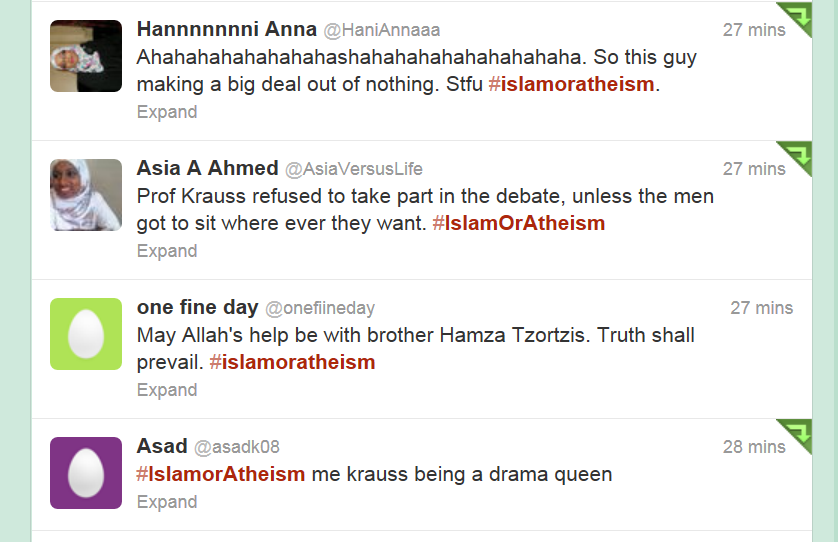
  • Some tweets from Krauss v Tzortzis

    Apparently the big fuss happened after all, even though we were told that the organizers had agreed that there would be no segregated seating. Apparently Krauss had to make a fuss to make that concession a reality.

    bigdbd2bd3bd4

  • It was about Reddit

    There’s an event this weekend, called SXSW, at which there was a panel on Reddit. It was somewhat fraught, apparently.

    By the end of the first hot-ticket panel at SXSWi, things had gotten tense. The panel was made up of Slate‘s Farhad Manjoo, Gawker‘s Adrian Chen and Rebecca Watson of Skepchick. It was about Reddit.

    The discussion of the site was largely critical — over the past year, the site has wrestled with its first real identity crisis, induced in large part by Chen’s outing of ViolentAcrez, who moderated, among other subreddits, a section called “jailbait.”

    The concerns raised by the Violentacrez controversy were real and worthwhile: the value and pitfalls of anonymity, the overbearing abundance of white male voices on the site, the limits of free speech on the internet. The panel, perhaps predictably, tracked along those lines. Attendees — many avid Reddit users — were not happy.

    That sounds familiar.

    A guy voiced some unhappy from the floor. Check him out.

    http://www.youtube.com/watch?v=Nozkilj7bhE

    He reads some droning unhappy from his phone and Rebecca breaks in to ask a question, and he lets her ask a question for a few seconds but then resumes his droning unhappy from his phone while Rebecca is still talking, so they compete for a few seconds and then she gives up, and he drones and drones – and Rebecca breaks in to say, “I’m sorry, I’m actually finding this really weird and a little rude.”

    Yes.

    Look, questions to speakers and panels are supposed to be questions, not speeches. This is well known. If a questioner makes too much of a speech people in the audience start calling “what’s your question?!” Using a question opportunity to give a speech is really bad manners. The guy with the phone was giving a damn speech. Rebecca interrupted him, but he was giving a damn speech; she attempted to make it a more interesting dialogue, and he decided to simply talk over her and ignore her. But she was on the panel. Yes, his droning was both weird and rude.

    That sounds familiar.

  • No VAW Act for you

    The US Conference of Catholic Bishops covers itself with glory again by finding stupid pettifogging reactionary reasons to refuse (officially, publicly, in a statemently) to support the Violence Against Women Act. Anything to be conspicuous, eh guys?

    The chairmen of four committees and one subcommittee of the U.S. Conference of Catholic Bishops (USCCB) issued a joint statement to voice their concerns on the Violence Against Women Reauthorization Act of 2013, passed recently by the U.S. House of Representatives and the Senate. These concerns, as the bishops state, prevented the USCCB from supporting this version of the act.

    Aw. Concerned, are you? Poor things. Tell us all about it.

    “All persons must be protected from violence, but codifying the classifications ‘sexual orientation’ and ‘gender identity’ as contained in in S. 47 is problematic,” they wrote. “These two classifications are unnecessary to establish the just protections due to all persons. They undermine the meaning and importance of sexual difference. They are unjustly exploited for purposes of marriage redefinition, and marriage is the only institution that unites a man and a woman with each other and with any children born from their union.”

    Oh get over it. Meanings change, importance changes, definitions change, institutions change. Get over it. A woman and a man can still marry, still unite, still have children. You don’t need to issue statements and draw attention to yourselves just because other kinds of couples can also do that. You don’t need to police sexual difference, either. You’re not in charge of everything. Just get over it.

    The bishops also expressed their concerns about the exclusion of conscience protections from the bill as passed, which would protect the conscience rights of faith-based service providers that assist victims of human trafficking.

    Meaning, the “conscience rights” of theocratic pests who want to stop people using contraception and abortion. They want a protected right to interfere with the rights of other people.


  • A large crowd from a nearby mosque

    What’s new in Pakistan? Oh, the usual – a mob enraged over some alleged “blasphemy” torches dozens of houses in a neighborhood of Lahore. Rageboys just wanna have fun.

    The mob attacked the houses in Joseph Colony in Badami Bagh police precincts in the provincial capital following allegations of blasphemy against a Christian man. The man was booked under Section 295-C of the Pakistan Penal Code (PPC).

    It appeared that the man had been falsely accused of blasphemy but the police was forced to register a case to placate the mob, a local police official said.

    Allah is wise, merciful.

    Police officer Multan Khan said the incident started Friday when a young Muslim man accused the Christian man of committing blasphemy.

    A large crowd from a nearby mosque went to the Christian man’s home on Friday night and Khan said police took the man into custody to try to pacify the crowd.

    Fearing for their safety, hundreds of Christian families fled the area overnight.

    Khan said the mob returned on Saturday and began ransacking Christian homes and setting them on fire.

    Fridays are a scary time in Islamist countries. It doesn’t even do any good to stay home, because the ragemob will just torch it with you in it.


  • Mob destroys Lahore neighborhood over “blasphemy”

    The mob attacked the houses in the provincial capital following allegations of blasphemy against a Christian man.

  • What about dentists?

    Good thinking, South Dakota – pass a law allowing teachers to carry guns. That will for sure prevent the extremely rare phenomenons of a mass school shooting, and will for sure never lead to any commonplace oops situation in which a teacher flips out or fires the gun by accident. Uh huh.

    Under the Republican-sponsored bill, school staff given permission to carry firearms on campus will be known as “school sentinels”. The state has given a law enforcement commission the task of establishing a training programme for the sentinels.

    Several representatives of school boards, teachers and other staff spoke against the bill in legislative hearings, arguing guns would make schools more dangerous.

    But sponsor Representative Scott Craig said this week had heard from a number of school officials who back it.

    Mr Craig said rural districts do not have the money to hire full-time police officers.

    Plus it’s like a love letter to the second amendment.

  • Meet Rebecca Goldstein

    I actually did an email interview with Rebecca Goldstein once. Yes really! You didn’t know that, did you. I’m not just some shlub with a blog. [struts] I did an interview with Rebecca Goldstein once.

    Here.

    Rebecca Goldstein has a new book out: Incompleteness: The Proof and Paradox of Kurt Gödel.

    Readers at Science Daily call Incompleteness ’Outstanding’ and ‘Superb’.

    Butterflies and Wheels: Alan Sokal and Jean Bricmont call chapter 11 of their book Fashionable Nonsense: Postmodern Intellectuals’ Abuse of Science: ‘Gödel’s Theorem and Set Theory: Some Examples of Abuse.’ They give a quotation from Régis Debray as an epigraph: ‘Ever since Gödel showed that there does not exist a proof of the consistency of Peano’s arithmetic that is formalizable within this theory (1931), political scientists had the means for understanding why it was necessary to mummify Lenin…’ The chapter’s first sentence starts, ‘Gödel’s theorem is an inexhaustible source of intellectual abuses…’

    Sokal and Bricmont go on to quote more such abuses, from Debray, Alain Badiou, and Michel Serres, who wrote, ‘Régis Debray applies or discovers as applicable to social groups the incompleteness theorem valid for formal systems…’

    Paul Gross and Norman Levitt examine literary critic (or ‘theorist’) Katherine Hayles’ musings on Gödel in Higher Superstition: ‘Hayles then cites the Gödel incompleteness result as the deathblow to the Russell-Whitehead program…This is  intended to figure the movement away from post-Enlightenment ideals of “universal” knowledge to postmodern skepticism…’

    Is this a widespread view of Gödel? Is it a view held solely by people who don’t actually understand Gödel’s work? Are there any mathematicians or logicians who think Gödel is a social theorist or a postmodernist?

    Rebecca Goldstein: I’m not sure that there is a “widespread view of Gödel.” While I was writing “Incompleteness” and people asked me what I was working on these days, I usually drew a blank stare when I said his name. Sometimes mentioning the title of Douglas Hofstadter’s popular book, “Gödel, Escher, Bach,” brought on a faint gleam of recognition.    So, by and large, Gödel – unlike his soul-mate, Einstein – is strangely unknown, and this anonymity is in itself something I wanted to address. I say in the book that Gödel is the most famous person that you probably haven’t heard of, and that if you’ve heard of him you probably have, through no fault of your own, an entirely false impression of what it was he did to the foundations of mathematics.

    Which brings me to the crux of your question.  Among “humanist” intellectuals who do invoke Gödel’s name, he is often associated with the general assault on objectivity and rationality that gained such popularity in the last century.  I’d often find myself pondering which would be the preferable state of affairs regarding Gödel, anonymity or misinterpretation.  Which would Gödel have preferred?  I’m going to indulge in “the privileged position of the biographer” to presume I know the answer to the latter question, at least: Gödel, who was so passionately committed to the truth, would have far preferred utter oblivion to the falsifications of his theorems that have given him whatever fame he has in the non-mathematical world.

    And what falsifications!  He had meant his incompleteness theorems to prove the philosophical position to which he was, heart and soul, committed: mathematical Platonism, which is, in short, the belief that there is a human-independent mathematical reality that grounds our mathematical truths;  mathematicians are in the business of discovering, rather than inventing, mathematics.   His incompleteness theorems concerned the incompleteness of our man-made formal systems, not of mathematical truth, or our knowledge of it.  He believed that mathematical reality and our knowledge of mathematical reality exceed the formal rules of formal systems. So unlike the view that says there is no truth apart from the truths we create for ourselves, so that the entire concept of truth disintegrates into a plurality of points of view, Gödel believed that truth – most paradigmatically, mathematical truth – subsists independently of any human point of view.  If ever there was a man committed to the objectivity of truth, and to objective standards of rationality, it was Gödel.  And so the usurpation of his theorems by postmodernists is ironic. Jean Cocteau wrote in 1926 that “The worst tragedy for a poet is to be admired through being misunderstood.”  For a logician, especially one with Gödel’s delicate psychology, the tragedy is perhaps even greater.

    I’ll give you just one example of misinterpretation, not only because it’s quite typical, but also because it had a personal effect on me.  The summer before entering college I was told I would have to read, in preparation for honors English, the then-influential book, by William Barrett, called “Irrational Man” published in 1964. Gödel’s name is linked by Barrett with thinkers like Nietzsche and Heidegger, destroyers of our illusion of objectivity.  After correctly stating the first incompleteness theorem (there are in fact two theorems, the second a consequence of the first, so long as one presumes that arithmetic is free of contradictions) Barrett draws this conclusion: “Mathematicians now know they can never reach rock bottom; in fact, there is no rock bottom, since mathematics has no self-subsistent reality independent of the human activity that mathematicians carry on.”  If you negate the conclusion that Barrett draws from Gödel’s work, you end up with precisely the conclusion that Gödel himself drew!  How often does that happen? A man sets out to prove a philosophical position mathematically, so that there can be no doubt.  And he does prove it, but people draw precisely the wrong conclusion from it.

    So, returning to your question as to whether “it [the rejection of objective knowledge] is a view held solely by people who don’t actually understand Gödel’s work?” I would answer, unequivocally: yes.

    B and W: Are there any mathematicians or logicians who think Gödel is a social theorist or a postmodernist?

    Rebecca Goldstein: I don’t personally know of any, and it’s hard to imagine any either.  Since mathematical logic is not the most central part of mathematics, there are mathematicians who don’t pay all that much attention to Gödel’s work and may not be terribly familiar with its details.  But it’s hard to imagine – even for me, with my overworked novelist’s imagination – a mathematician who would draw the sloppy conclusions that others have regarding the incompleteness theorems.

    The same, by the way, can be said about Einstein’s relativity.  These very names – “incompleteness,” relativity” – have encouraged very fanciful extrapolations that stand in direct opposition to the views of the scientists connected with these important results.  Einstein was as little committed to the “relativity of truth” as his good friend Gödel was committed to the view that  mathematics is the result of “the human activity that mathematicians carry on.”

    The two of them had, by the way, a legendary friendship. Einstein was an old man and Gödel was relatively young when they became friends in Princeton, both of them refugees from Nazified  Europe.  (Gödel, by the way, was not Jewish, though even Bertrand Russell made the mistake of assuming that he was.) The two of them would regularly walk home from the Institute together. In fact, toward the end of his life, Einstein confided that his own work meant little to him now, and that he went to his office primarily to “have the privilege of walking home with Gödel.” They were very different in terms of their personalities – Einstein sagacious and worldly, Gödel quite hopelessly unworldly and seriously neurotic.  I interviewed people at the Institute who used to watch them making the trek home each day, wondering what it was that they spoke to one another about.  In my book I speculate about this deep bond, speaking of the philosophical commitments that both men shared, commitments which were so often either dismissed or misunderstood.  It’s yet another irony – the story I write is full of somewhat sad ironies – that the two intellectual titans of their age should have felt marginalized, their own work often cited as the most persuasive of reasons for making the subjectivist turn.  After Einstein died, Gödel really had no one else to speak with.  This isolation certainly contributed to the psychological troubles that deepened and darkened over the years.

    B and W: Is your book partly intended to correct the misinterpretation of Gödel’s work?

    Rebecca Goldstein:Today I got an email from a professor of English at a prestigious university saying, among other things: “By the way, I too was assigned to read William Barrett’s The Irrational Man, but in my Freshman year at Saint Joseph’s College (now University), and from that and other references to Godel’s work over the years, I came to assume that it was a sort of proto- deconstruction of the edifice of modern math and science.”

    B and W: Edward Rothstein said in the New York Times: “It is difficult to overstate the impact of his theorem and the possibilities that opened up from Gödel’s extraordinary methods, in which he discovered a way for mathematics to talk about itself. (Ms. Goldstein compares it to a painting that could also explain the principles of aesthetics.)”.

    Can you tell us a little about that impact?

    Rebecca Goldstein:Before Gödel, logic was considered more a branch of philosophy than of mathematics, the discipline associated with Aristotle rather than, say, with Gauss.  Gödel developed extraordinarily powerful tools in the course of proving his theorems which both opened up new areas of mathematical research (recursion theory, for example) and also provided the means for solving more standard problems in mathematics.  Mathematical logic now, as a result, has far more mathematical respectability.  As Simon Kochen, a Princeton mathematical logician, told me, “Gödel put logic on the mathematical map.” But there are many other ways in which the impact of his famous proof is felt.  In the course of proving  the limitations of formal systems, Gödel sharpens the very concept of a formal system, as well as a whole interrelated family of concepts: The concepts of a mechanical or an effective procedure, of recursive and computable functions, of combinatorial processes and of an algorithm: this family of concepts all pretty much come down to the same thing, centering around the idea of rules that are applied to the results of prior applications of rules, with no regard to any meanings or interpretations except for what can be captured in the rules themselves.  In other words, these concepts all have to do with procedures that can be programmed into computers.  There’s a sense in which Gödel’s proof, especially as it was filtered through the work of Turing, helped to invent the computer.

    And then there’s the more philosophical fallout from his theorems, the light they shed not only on the nature of mathematical knowledge – the fact that it can’t be captured in a formal system – but also on the nature of the mathematical knower herself.  If computers run according to formal systems and our minds provably don’t, not even in knowing arithmetic, then does this mean that our minds are provably not computers? Gödel himself, rigorous logician that he was, was reluctant to draw so conclusive a conclusion; he hedged it in logically important ways.  Other important thinkers, however, have drawn precisely this conclusion.  Just such an argument served as the basis, for example, of Roger Penrose’s two celebrated books, “The Emperor’s New Mind” and “Shadows of the Mind.” He used Gödel’s incompleteness theorem to argue that our minds’ activities exceed what can be programmed into computers.

    B and W: We’re in something of a Golden Age of intellectual biographies of philosophers. Wittgenstein, Russell, Ayer, Kant, Hegel, Spinoza and others have had rich biographies in the past decade. What sort of work do you think biography can do? Were you inspired by any biographies in particular?

    Rebecca Goldstein:I didn’t think of “Incompleteness” as a biography.  The aim of the book – the aim of the entire Norton series of which this book is a part – is to fit the scientific results into a “narrative framework.”  I could have chosen the biographical story as my narrative arc. That strategy was the one that my editor kept encouraging me to take. He kept urging me to begin the book with Gödel’s birth in 1906 and go on from there.  But I resisted him.  I wanted the intellectual passions of Gödel to supply the narrative framework.  Here’s the story I wanted to tell:  Gödel, like many of us, first fell in love when he was an undergraduate, and that love forever changed him. Only it wasn’t a person that Gödel fell in love with but rather an idea, a grand philosophical vision that has attracted thinkers, and most especially the mathematically inclined, since the very first Platonist in the fifth century B.C.E..  Gödel met this great love of his in a philosophy class. (So much for the claim that philosophy can have no practical results: from Plato to – by way of Gödel and then Turing – google. )  He had been a physics major until his introductory course in philosophy,  but he changed his major to mathematics under the influence of his impassioned Platonism.  Devoted lover that he was, he resolved to find a way of proving – mathematically proving – mathematical Platonism.  This was a daunting ambition.  (The dichotomy between the outward timidity of this man, prey to terrible paranoid worries, and the inner vaulting intellectual confidence is one of the most fascinating things about his personality.) And then the amazing thing was that he actually went and did it, he actually produced mathematical theorems that had the philosophical consequences he was after;  and then he lived to see his ideas twisted around so that they served the very viewpoint that he had hoped to conclusively refute.  The drama I wanted to create, the story I wanted to tell, was all contained in this love story, a tragic love story (as almost all gripping love stories are).

    B and W: Philosophers are sometimes drawn to fiction because fiction is a kind of thought-experiment. Does this aspect of fiction interest you?

    Rebecca Goldstein:Well, of course, fiction is, in a certain sense, a kind of thought-experiment, but unlike the thought-experiments we use in, say, analytic philosophy in order to tease out implications or make conceptual distinctions or provide counterexamples to theses, the thought-experiments of fiction are not deliberately put forth in order to figure something out. Sure, there’s plenty of figuring out going out, for both the reader and, even more so, for the writer, but figuring out is not the paramount aspect of the deep experience of participating in fiction. I resist the view that the pleasures of fiction derive from its purely thought-experimental aspects. And yet I do think of the narrative imagination as a cognitive faculty;  but its cognitive aspects are far more complicated than “thought-experiment” suggests.  I’m fascinated by the unique phenomenology of reading and, of course, writing fiction, the fact that we’re drawn  into a world that we know isn’t real but that we participate in almost as if it were.  I think fiction manages to tamper temporarily with the boundaries of our own personal identity – we inhabit identities not our own –  and also with our sense of time – narrative time is measured out in units of significance, unlike regular time which is generally just one damned insignificant thing after another – and that this tampering puts us in the way of deep insights to which we’re not usually privy.  How else to explain the fact that novelists are so much smarter when they’re writing novels than at any other time, which is why it’s often such a profound disappointment to meet a revered writer in person!

    B and W: Do you agree with for instance Martha Nussbaum that fiction is one of the best ways for people to learn empathy? Do you think such a view of fiction can be in tension with aesthetic judgments? If a novel has its heart in the right place but is badly written, which do you think matters more?

    Rebecca Goldstein:Yes, I do think that storytelling is the basic way that we make our way into others’ psychology, which is of course central in regarding them as people just like oneself, in all the morally relevant aspects, an observation that ushers one into the moral point of view.  The narrative imaginative is not only a cognitively significant faculty but a morally significant one as well.  I don’t, however, think that the moral benefits of storytelling provide us with aesthetic standards.  What makes art great has little to do with its uplifting tendencies – aside from the fact that great art is intrinsically uplifting.

    B and W: Did you find in writing the biography that you missed the novelist’s license to assume inside knowledge of the protagonist’s thoughts? Did you find yourself wanting to bridge gaps in the evidence with Perhapses and conditionals, or were you more interested in making clear where there was evidence and where there wasn’t?

    Rebecca Goldstein:In some ways Kurt Gödel was like some of the fictional characters I’ve created. I’m thinking of, say, Noam Himmel, in my first book, “The Mind-Body Problem,” or Samuel Mallach,  in my last novel, “Properties of Light.” I’ve always been interested in geniuses, especially of the mathematical or scientific sort.  Even within this small sub-set there’s a particular type of personality that fascinates me, one that’s characterized by both the intellectual heroism of thinking one’s way where no man or woman has thought before coupled together with a marked lack of heroism in any matters removed from the intellectual high ground. It’s easy to make fun of helpless and/or lunatic geniuses; but I find the dichotomy between intellectual grandeur (and in mathematics the grandeur can seem almost superhuman) and “human-all-too-human” smallness to be touching and very telling of our uneasy human position.

    I came to feel extremely close to my subject while I wrote “Incompleteness.” Of course it wasn’t that all-penetrating closeness that a writer feels with her characters, but there was something sometimes approximating it.  Again, this was not a biography in the usual sense of the word; I was interested in Gödel’s life only insofar as it related to his theorems: what they meant to him as well as to others, and how the latter facts affected him.  (Ludwig Wittgenstein’s hostility to Gödel’s theorems is of particular importance here.)  But you can see that, given what I came to believe about the man and his most famous results, there was a great deal of pathos that I saw in his story, and – the payoff of the narrative imagination – a great deal of empathetic participation in it that then helped to further along  my understanding.  So I did feel quite often that I’d penetrated into the soul of the man.  He was an unusually reticent person in life. Aside from those animated walks to and from the Institute with Einstein, that others watched in wonderment, he eschewed social intercourse as much as possible.  He mistrusted, more and more, our ability to communicate with one another.  Even when he was very young, before the historical result, and its historical misinterpretations, he remarked  to one of his acquaintances that the more he considered language, the less likely it seemed to him that we ever understood one another. This is the statement of a profoundly lonely person, someone in some sense constitutionally lonely, and this, too, touched me and made me all the more eager to hear what he’d wanted to say.  He had wanted to communicate through his proofs, to let his deep mathematics do the speaking for him; so again, the fact that the mathematics was heard to say the very opposite of what he’d meant by it is poignant.  He did write some letters protesting others’ misinterpretations of his works, particularly Wittgenstein’s.  Wittgenstein had been an enormously influential figure in the Vienna that Gödel inhabited before his move to Princeton; part of the story I reconstruct is that Gödel resented Wittgenstein’s influence, especially after Wittgenstein dismissed Gödel’s theorems as ”logische Kunststücken,” logical conjuring tricks.  Gödel, being the outwardly timorous man he was, never sent these letters off, but they’re there in his literary remains, in the basement of Princeton’s Firestone Library.  Those unsent resentful missives – both their content and the very fact that they were unsent – played a role in my constructing a partial model of Gödel’s psychology.  But about his more terrifying demons – and unfortunately it’s very clear that he had them in abundance and, in the end, they did him and his intellectual grandeur in – I would never dare to speculate.  I never deluded myself into thinking I’d arrived at the sort of access a novelist has toward her fictional characters (who, strangely, also develop something of an independent life).

    B and W: Does writing a biography bring up interesting epistemological issues? Do you think people with philosophical training are more aware of such issues than, for instance, historians and journalists? Or, perhaps, aware of them in different ways? As interesting issues in themselves rather than as methodological problems?

    Rebecca Goldstein:I think that anyone who tries to write a biography, even a modified biography such as mine, comes smack up against the “interesting epistemological issues.”  It’s a good exercise for a biographer to consider the question of how much of her own life’s narrative, at least as she tells it to herself, could even her very best friends reproduce. I was able to read the memoirs of those who had known Gödel and to make use of their observations and speculations; and I was fortunate to have met him once, though only very briefly, during a small window of his life when he was somewhat more outgoing than usual.  But in the end what I was trying to do was come up with a story that would make sense of the rather small number of external facts about his life that he left us.   It was a story that made much sense to me, as I hope it will to my readers.  But in the end, no story about a person can be true.  We are all of us, not to speak of mathematical/philosophical geniuses, far too complicated and self-contradictory to be contained in a “narrative framework.”  The biographer, as much as the mathematical logician, is keenly aware of the incompleteness necessarily inherent in her project.

    Incompleteness: The Proof and Paradox of Kurt Gödel .

    Rebecca Goldstein’s web page is here.

  • South Dakota law will allow teachers to carry guns

    The law’s backers say it will prevent mass school shootings.

  • “Ways of life must be preserved”

    Via Secular Medical Ethics on Twitter I see a dreary item from Ed Milliband reported by The Jewish Chronicle Online.

    Ed Miliband has pledged to protect Jewish customs including brit milah and shechita if he becomes Prime Minister.

    Speaking at a Board of Deputies event the Labour leader said he was opposed to boycotts of Israel and warned of the need to be “ever-vigilant”against antisemitism.

    Asked whether he would work to ensure religious slaughter and circumcision practices could continue in Britain, Mr Miliband said: “Yes, these are important traditions. The kosher issue has recently been brought to my attention. Ways of life must be preserved.”

    That’s a terrible thing to say. It depends on the ways of life! Not all ways of life must be preserved, and not all aspects of ways of life must be preserved. It depends.

    Just breezily agreeing that parents must continue to be allowed to cut bits off their infant sons’ penises is a slap in the face to human rights. Breezily agreeing to to ensure religious slaughter is not so hot for animal rights.

  • Ok now I’m really going to Women in Secularism 2

    Because woohoo it’s starting an hour earlier because a speaker has been added and that speaker is Rebecca Goldstein!

    [dances happy dance]

    [ignores resemblance to parodic clumsy dancer while dancing happy dance]

    Anybody read The Mind-body Problem? Great novel. I will now re-read it for approximately the tenth time.

    [resumes happy dance as the music fades]

  • I’m so sorry but I would like you to go sit over there

    A thought occurs to me about this gender segregated seating caper. The Equalities Adviser told Chris Moos that

    All attendees are free to sit wherever they feel comfortable. If some female and male attendees choose to sit in separate areas, that is of course fine, however it is expected that there will be a large mixed area where anyone can sit.

    Hm. Suppose some female and male attendees choose to sit in separate areas, and then someone from the “wrong” gender sits there. Then what?

    What are the UCL people visualizing? That the voluntary self-segregators will very politely ask the interloper to go away?

    That seems like the least coercive likely reaction, but really, think about it. Is it possible to ask someone that in a public place politely? No, not really. That’s why we don’t have segregation in public places. The whole idea is rude.

    As usual that becomes obvious if you switch the category from gender to race. “Excuse me, but we want to sit together by ourselves – could I possibly ask you to sit somewhere else so that we can sit together by ourselves?” Not cool.

    You can do that kind of exclusion and selection at home, but you can’t do it (decently) in public. It’s a bad idea. It shouldn’t be attempted.

    Modernity means mixing. It means being a mongrel and living with other mongrels, and being content with that. It means letting go of archaic notions of purity, and getting used to sloppy mixing of all kinds.

  • Respect the wish

    Leo Igwe has a piece on humanist funerals in Nigeria in The Guardian (Nigeria).

    ON February 9, 2013, the former Chairman of the Nigerian Humanist Movement, Eze Ebisike died after a brief illness. On March 2, he was buried in his hometown, Okpokume, Mpam, Ekwerazu Ahiazu Mbiase in Imo State. Ebisike was an ex-Catholic priest and an atheist. He was buried after a short humanist funeral ceremony in the compound. The ceremony was a historic event because it was the first time, in that part of the country that someone who was an atheist was given a non-religious funeral.

    Another cleric turned atheist and executive Humanist.

    For humanists, a funeral ceremony is not a rite of passage for the deceased. A funeral is a celebration of a life lived, a life which has ended. A funeral is an opportunity for family and friends to pay tribute to the memory of someone who has died.

    For humanists, when people die, they live on in the minds and memories of their loved ones, not in a heaven or a hell. They live on in the legacies they leave behind, in the good (and also the bad) which they did. They live on in their children, their descendants. Funerals are special times to remember and to relive those sweet memories, and pay our last respects to a person whom we are lucky to have shared this short life with.

    That’s a beautiful way of putting it.

    Some non-religious people are indifferent to what kind of funeral they have, but Leo is not.

    Religious as well as humanist funeral ceremonies are for the living. And there are non-religious persons who would not want their memories to be insulted or corrupted by a religious funeral service. It is important that people respect the wish of their humanist friends and family members and accord them a funeral that is in line with their beliefs and outlook. For me, like Eze Ebisike, when I die, if there is a funeral, I would like to be given a secular/humanist funeral service. I would like my family members and friends to respect this wish. That I be accorded a funeral ceremony that is in line with the humanist ideas, values and beliefs that I professed and lived by during my lifetime.

    That seems only fair.

  • Women over there please. No exceptions.

    Update 2: Good news for once. Chris heard back from the equalities adviser, and UCL will not allow gender segregated seating, although people will be allowed to sort themselves if they want to – “however it is expected that there will be a large mixed area where anyone can sit.”

    Chris Moos of the LSE* Atheist Secularist and Humanist group alerted me to an event at UCL** tomorrow: The BIG Debates: Islam or Atheism: Which Makes More Sense? The two proponents are Lawrence Krauss and Hamza Tzortzis. Chris reports:

    Although the event was supposedly organised through “The Big Debates”, which describes itself as an independent organisation, the account used to set up the event with eventbrite.com is actually that of iERA, Hamza’s outfit.

    And guess what else – seating is gender segregated.

    Gender segregated. At a grown up, secular, urban, 21st century university in London – seating is gender segregated.

    Imagine if it were racially segregated. Imagine the uproar. Yet UCL is apparently turning a blind eye to gender segregation.

    Student Rights has some background on Hamza Tzortzis.

    On 10th January Student Rights published an info-graphic which provided figures detailing the number of events featuring extremist or intolerant speakers that were promoted to students throughout 2012.

    Leading the way with 48 events was the former Hizb ut-Tahrir member Hamza Tzortzis, most famous for declaring that “we as Muslims reject the idea of freedom of speech, and even the idea of freedom”.

    Since then, Tzortzis has announced a new speaking tour of universities that began last night and continues until the 18th March, with 24 dates on 21 different campuses.

    What will all those lucky universities be getting?

    He has argued in the past that “Some people object to Islam making the public expression of homosexuality a criminal act. This is subjective and only strikes a chord amongst those who cannot escape the social constructs in their own societies” and that “those who claim that making homosexuality a criminal act is wrong are totally inconsistent”.

    In a university debate on Sharia Law in 2009 he also expressed his support for barbaric punishments including amputation, refusing to condemn the cutting off of people’s hands.

    This support for religious jurisprudence was also evident when he wrote that that society must turn to “cohesive values that will bring us out of this social decay. It can be argued these cohesive values must be the Islamic values and the workable solution is the Islamic Social Model”.

    Chris provided some contact addresses at UCL:

    Head of Equalities and Diversity Sarah Guise
    For staff and student queries related to age, disability, gender, race, religion & belief and sexual orientation.
    Email s.guise@ucl.ac.uk
    Ext. 53989

    Equalities and Diversity Adviser
    Fiona McClement
    For staff and student queries related to age, disability, gender, race, religion & belief and sexual orientation.

    Email: f.mcClement@ucl.ac.uk

    Ext 53988

    Policy Advisor – Athena SWAN and women in SET
    Harriet Jones

    For queries related to the Athena SWAN Charter.

    Email: harriet.jones@ucl.ac.uk

    Equalities and Policy Administrator Sonal Bharadva
    For general enquiries.
    Email: s.bharadva@ucl.ac.uk

    Ext. 53991

    50:50 Gender Equality Group
    Annette Dolphin, Co-Chair,

    Rob de Bruin, Co-Chair

    a.dolphin@ucl.ac.uk,

    r.debruin@ucl.ac.uk

    The event takes place 25 hours from now.

    *London School of Economics

    **University College London

    Update: I heard from Chris after I posted: Lawrence Krauss told him he’d told the organizers no gender segregation, and he’s not going to accept it when the time comes.

  • Global Malala Day to call for girls’ education

    Former Prime Minister Gordon Brown, now a United Nations envoy for education, said the event would take place on Malala’s 16th birthday on 12 July.

  • Leo Igwe on humanist funerals in Nigeria

    For humanists, a funeral ceremony is not a rite of passage for the deceased. A funeral is a celebration of a life lived, a life which has ended.

  • Rules for shitheads

    Oh looky here – via Stephanie, another Callous Bastards’ Handbook, this time by “vjack” at Atheist Revolution. It’s better written and a little better thought than Vacula’s efforts in the same vein, but it’s still callous bastard bullshit.

    You and you alone are responsible for how you feel. Nobody else can make you feel sad, angry, upset, or anything else without your agreement. I know we sometimes talk as if other people cause our feelings, but this is misleading.

    If you insult me, I may experience feelings of sadness. My feelings are based on my understanding of our interaction and are guided by the whole of my personality and life experience. If I care what you think of me, I may feel sad; if I do not, I may not feel much of anything. It is not your insult that leads to my feelings; it is my interpretation of your insult, the meaning I assign to it, and the manner in which I put it in context. That is, how I feel following your insult is far more about me than it is about you.

    You bet. Perfect for callous bastards. If I insult you, it’s just a thing that happens, like a rock falling down a slope. If you’re at the bottom of the slope, you may get a bruise, but that’s your decision.

    vjack is part of the way there. He’s right (of course) that feelings about what other people say and do depend on context, and our feelings about them, and other variables that he conveniently leaves out. But we already knew that. He’s not right that because feelings about what others do and say are dependent in that way that therefore only the person who has the feelings has responsibility for them. Social life and interaction are webs, and responsibility goes in both directions. The fact that if person X is made of stone then she is able to feel nothing when vjack insults her does not mean that person Y has a responsibility to feel nothing if vjack insults her.

    Some will object that taking responsibility for our feelings lets others off the hook, giving them a license to behave badly. Nothing could be further from the truth.

    Just as we and we alone are responsible for our feelings, we and we alone are responsible for our behavior. Someone who behaves poorly is responsible for his or her poor behavior. The fact that we are responsible for our feelings in no way reduces the responsibility such an individual has for his or her own behavior.

    If I call you a series of juvenile names on the Internet and you experience hurt feelings, you are responsible for how you feel and whether you take offense. But I am responsible for my behavior. Your responsibility for your feelings in no way gives me a pass to behave badly. It is nothing behind which I can hide. How you feel is on you, but how I have behaved is on me and nobody else.

    That’s incoherent. If other people are responsible for their feelings, then in what sense is anyone behaving “poorly” aka badly by calling people names? In what does the badness reside? What is bad about calling people names?

    He doesn’t explain that. He doesn’t seem to realize that it needs explaining. That’s Callous Bastards’ Handbooks for you – they achieve their callousness by ignoring obvious holes in their reasoning.

    Stephanie included a screenshot of a different (yet similar) brand of callousness.

    Two comments from Facebook. Text in the post.

    [Russell Blackford, responding on Facebook to a post by Lou Doench] Sorry, but I no have time for someone who whines about the so-called harassment of vicious bullies who vilify good people and destroy their reputations on a daily basis. The individuals this Doench person mentions as victims are exactly the ones who need to take the pledge. They and of course PZ Myers, who is the worst of all, as he’s called me a bold-faced liar and encouraged a forum where I can be called scum, a misogynist, etc., etc. Doench is part of the problem if he’s going to defend such people.

    People like Doench need to understand that people like me are very angry for good reason. Every time I read something like this claptrap, I get that much angrier. Until I get an apology from Myers in particular, I will not let this drop.

    Stephanie continues –

    What was he responding to?

    And in cases like the horrible people who harass Ophelia Benson, Stephanie Zvan, Rebecca Watson and others in the skeptical and atheist movement on a weekly basis… well I’m likely to lose my temper.

    Yes, Blackford ranted about having no time for someone who would get angry at the people who harassed us because if people understood Blackford’s position, they would not lose their temper at harassers. Sorry, “so-called harassers”–because it’s all been so carefully hidden away where Blackford couldn’t possibly see it.

    Feelings aren’t random, and we don’t have a responsibility to decide to have no feelings and then go on to have no feelings when people spend an astonishing amount of their time every single day harassing and taunting us.