
Dave Ricks posted the link to Emily Lakdawalla’s post on why rocks are evenly spaced on Mars so I read it so now I have to share it More.
On Mars there are rocks everywhere. The difference is that Mars’ landscape is shaped in large part by impact processes. Far-away impacts can toss rocks for miles, and they fall where they land. So it’s not particularly surprising that you see rocks everywhere, even in flat places on Mars. What is a bit surprising is their even spacing. Here’s an example of a rock-strewn landscape selected more or less at random from the early part of Spirit’s mission, when it was dashing across the flat plains to the east of its landing site toward the Columbia Hills.
NASA / JPL / Cornell / calibrated color by Daniel Crotty
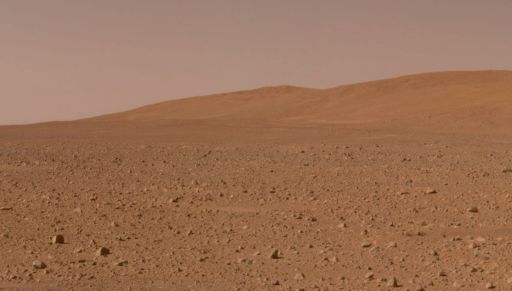
She adds a closeup of some rocks and then explains how they get to be evenly spread.
…the wind doesn’t move the rocks, at least not directly. What the wind does do is lift sand; sand particles jump (or “saltate”) along the ground, knocking into each other and launching more sand particles. When the wind runs into a rock, it loops and whirls, scouring the area right in front of the rock. Over time, it digs a pit in front of the rock. At the same time, the sand that was scoured from in front of the rock gets deposited in the wind shadow behind the rock. Do this for long enough, dig a steep-sided enough pit, and one random day the rock will tip forward, rolling in the upwind direction, into the pit. Rinse and repeat, and you get rocks trooping across the landscape over time. (The press release didn’t give a time scale for this process.)
That explains how rocks can move, but how does it explain an even spacing? Well, according to the release, when you have a cluster of rocks, “those in the front of the group shield those in the middle or on the edges from the wind, Pelletier said. Because the middle and outer rocks are not directly hit by the wind, the wind creates pits to the sides of those rocks. Therefore, they roll to the side, not directly into the wind, and the cluster begins to spread out.”
Well how stinkin’ cool is that? Not to mention the photo.
We live in interesting times.