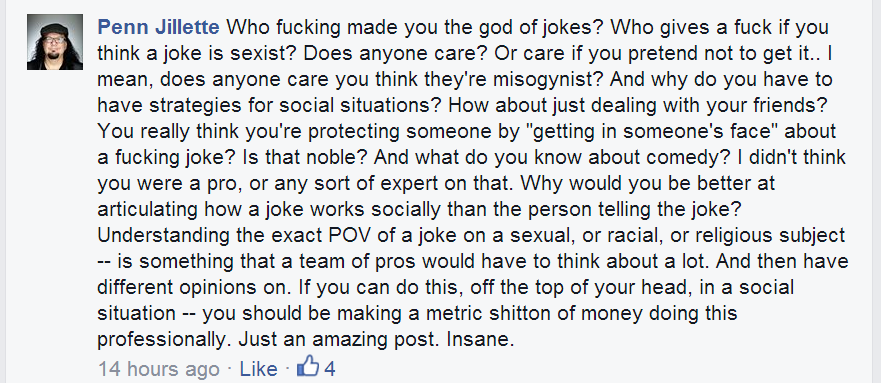
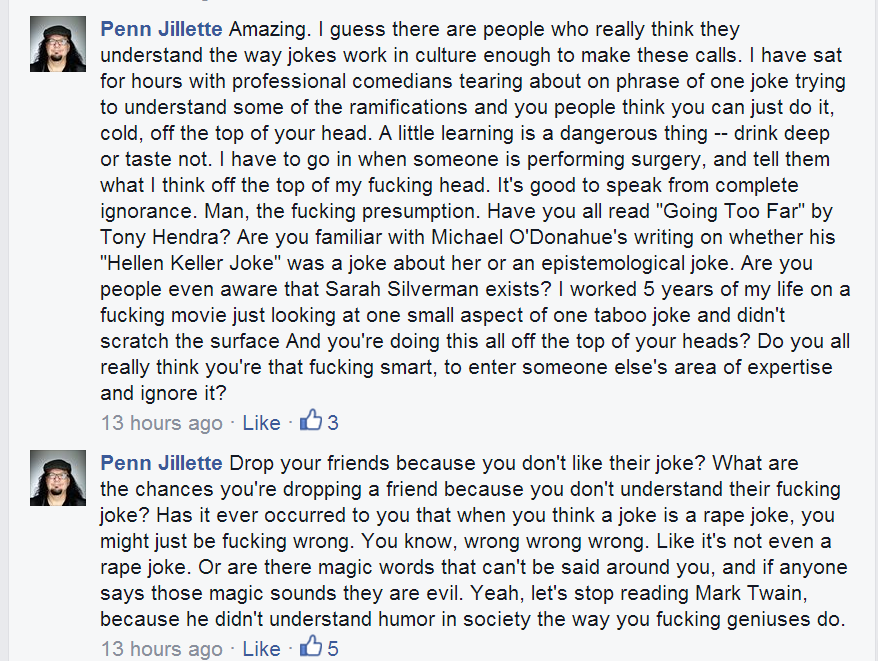
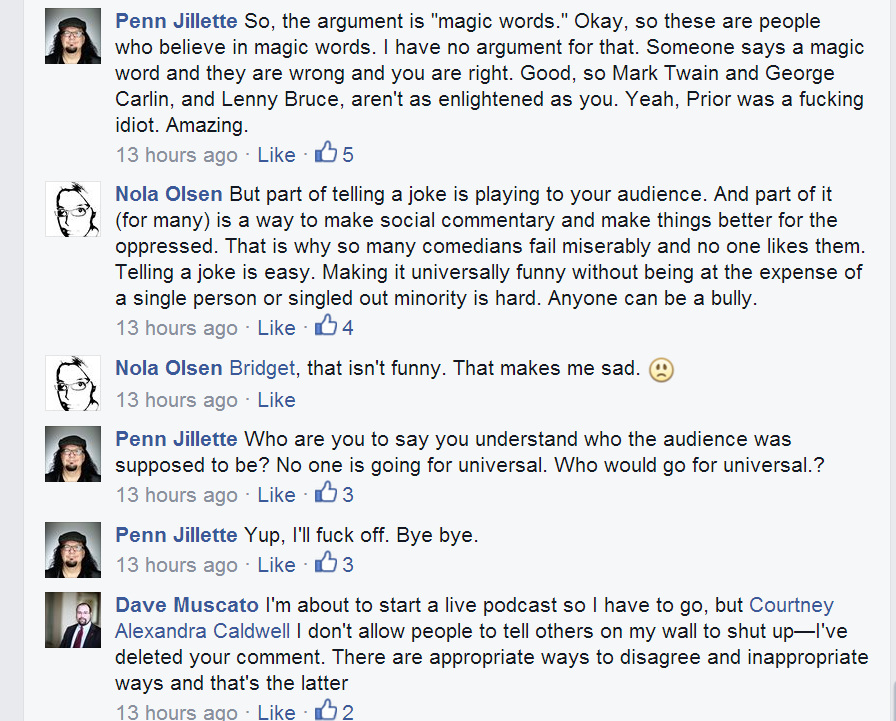
Originally a comment on Penn Jillette on how to Professional Comedy With Added Misogyny.
What pompous overblown impulsive reactivity!
We all individually have a say in what is funny and what is not. Every one of us is a “God of Jokes” and a comedian should realize that. I’m pretty sure that comedians don’t totally ignore the surrounding culture and adapt to it in order to hone their craft. That culture has a structure made up of our individual dispositions, experiences and beliefs that are the source of jokes. It’s a pretty clear attempt to use his authority to bully a disliked opinion down.
We should consider why things are funny and what the effect of humor is on the subject of the joke’s objects. Why we have jokes about other people that draw on stereotypes and unflattering associations is a totally valid subject of concern. How to deal with jokes that make like more difficult for other people is a totally valid subject of concern. I definitely smell some paranoia about criticism of humor in Penn’s chosen approach here.
There is not a whole lot of research into humor, but I have looked at it because Tourette’s comes with some altered appreciation of humor, in addition Tourette’s is the subject of much social humor, thinking about these things is self-defense. It seems to me that when you scratch beneath the surface of a joke you find tension. Lots of comedians (professional and non) joke about things that they are troubled with on some level, family, age, politics, religion, sex, race, more. The joke relieves the tension and makes the person laughing at it feel better about the thing.
But not every means of reducing tension is valid and a professional comedian should be able to maturely discuss that fact. If someone is tense because of sex, gender, or race issues spreading around a stereotype to hide, or distract the source of tension is a bad idea. It’s puts an emotional bandage on a social wound that will still be leaking after the joke or show except now the persons telling and laughing at the joke can go pretending that reality is something else easier for a while. It won’t be funny to a person personally harmed by the social wound that is being replaced by an exaggeration or falsehood for the amusement of others.
And maybe we don’t want these sources of tension to be funny anyway. The worse we feel about social problems, the more attention gets directed to them, and the sooner something gets done about them. The temporary emotional salve of humor can effectively let us put things off for a while, but can be habit forming on a group level.
(This is a syndicated post. Read the original at FreeThoughtBlogs.)