Question for the day, from Mike Booth @somegreybloke:
Would you rather fight a thousand wasp sized mountain lions or one mountain lion sized wasp?
(This is a syndicated post. Read the original at FreeThoughtBlogs.)
Question for the day, from Mike Booth @somegreybloke:
Would you rather fight a thousand wasp sized mountain lions or one mountain lion sized wasp?
(This is a syndicated post. Read the original at FreeThoughtBlogs.)
Originally a comment by Eamon Knight on She is too enraptured by the mystery of the divine.
I’ve occasionally found myself caught up (the literal meaning of “enraptured”) in a bit of mathematics or physics, such that I would ponder on it during otherwise mindless moments (like long drives, or when falling asleep at night). And there’s this sense of exploring a mysterious, fascinating territory. Eventually I either figure it out, or write a program to brute-force it, or (these days) consult Google and find that real mathematicians and physicists (ie. people who aren’t me) have already been there and devised tools to describe it. Sometimes I get into a similar mindset when trying to figure out how to do some personal project.
The point is: the exploration is fun, but it leads to an answer — I get an expression, or a number, or the thing gets built, and there’s an esthetic satisfaction to the experience. My “seeking understanding” actually finds something.
Can theology ever say it’s found something out about the Divine? Something that isn’t just a reflection of the theologian’s own mind? Can it ever know that, eg. Paul Tillich was right and Rick Warren is wrong in the way we know that Einstein was right and classical mechanics was wrong, or this bridge design will stay up whereas that one will collapse?
Or do theologians just enjoy being “enraptured” and “seeking understanding” too much to ever spoil it with anything so mundane as, you know, answers?
(This is a syndicated post. Read the original at FreeThoughtBlogs.)
Amnesty International issued a new report a few days ago, Education under attack in Nigeria.
In the week that saw more than 50 students killed by gunmen in an agricultural college in Yobe State, Amnesty International publishes a new report assessing attacks on schools in northern Nigeria between 2012 and 2013.
“Hundreds have been killed in these horrific attacks. Thousands of children have been forced out of schools across communities in northern Nigeria and many teachers have been forced to flee for their safety,” said Lucy Freeman, Amnesty International’s deputy Africa director.
“Attacks against schoolchildren, teachers and school buildings demonstrate an absolute disregard for the right to life and the right to education.”
According to the report Education under attack in Nigeria, this year alone at least 70 teachers and scores of pupils have been slaughtered and many others wounded. Some 50 schools have been burned or seriously damaged and more than 60 others have been forced to close.
The Islamist group commonly known as Boko Haram has claimed responsibility for many, but not all, of the attacks.
Between 2010 and 2011 attacks were mostly carried out when schools were empty. However since the beginning of 2013 they appear to have become more targeted and brutal. They frequently happen when schools are occupied, and according to reports received by Amnesty International, teachers and pupils are now being directly targeted and killed.
Trying to wipe out education is as fascist as it gets.
(This is a syndicated post. Read the original at FreeThoughtBlogs.)
There’s another odd thing that Meghan Florian said in that Religion Dispatches/Salon article that’s been nagging at me.
I can’t pull off atheism. I am too enraptured by the mystery of the divine, too convinced of human limitations, too busy continuing this life of faith seeking understanding.
In a way it’s not worth trying to make sense of it or pointing out why it doesn’t make sense, because it’s just normal religious bafflegab – just a string of poeticky words that don’t actually mean much, but sound nice. That’s what they do. They have license to do that, because religion. That’s one of the many reasons I dislike religion: because it not only allows, it encourages empty bafflegab, and expects everyone to be impressed by it. It’s yet another subhead in the major category Cheating, and I’m seriously annoyed by religious cheating.
So in another way it is worth trying to make sense of it or pointing out why it doesn’t make sense, because it disrupts the social habit of politely ignoring the emptiness of the bafflegab.
1. She can’t pull off atheism because she’s too enraptured by the mystery of the divine.
What is the divine?
Does she mean “God”? She must sort of mean that, since the subject is atheism, not adivineism. I don’t bother being an adivineist, because I don’t know what “the divine” refers to.
I suppose she sort of means “God,” but also sort of means something more nebulous and poetical and “mysterious” and pretty.
What does she mean when she says she’s “enraptured” by it? I suppose that it’s nebulous and poetical and “mysterious” and pretty, while also being “God,” who both is and is not mysterious and distant.
Or maybe not. Maybe I’m wrong. Maybe she means something much deeper and also more sophisticated and also full of particulars, that she learned from Duke Divinity School, where she earned a Master of Theological Studies. But if so, what?
What does she mean about being enraptured by the mystery? What’s enrapturing about it? Why is it never instead seen as a cold cruel heartless withholding? At least, never except by people who actually take “doubts” seriously as opposed to brandishing them at outsiders as a badge of haha skepticism. Imagine a cold starving ill child whose parents hide themselves. Is that child “enraptured” by the “mystery” of the hidden parents? Or, to look at it another way, is anyone “enraptured” by the “mystery” of the non-appearance of Hamlet or Medea or Huckleberry Finn? Of course not, because we know they’re characters in stories. So why do people bother to be “enraptured” by the “mystery” of the “divine”? What is that melodious phrase but an endlessly repeated advertising slogan?
2. She can’t pull off atheism because she’s too convinced of human limitations.
Wtf? What, because atheism is not convinced of human limitations? Atheism thinks humans are infinite?
Why isn’t it the other way around? Why isn’t it theists who aren’t convinced of human limitations? Theists think we’re immortal! It’s ludicrous to claim that atheists as such are not convinced of human limitations. You don’t have to subscribe to the idea of “sin” to be convinced of human limitations.
3. She can’t pull off atheism because she’s too busy continuing this life of faith seeking understanding.
No, she’s not. She’s kidding herself. “Faith” is not the right way to try to achieve understanding. It’s exactly the wrong way. Atheists have a much better shot of achieving some understanding, other things being equal, because they’re not impeded by the need to defend all the things that are accepted on “faith.”
I take it that what Florian means is that she doesn’t want to be atheist. She should just say that.
(This is a syndicated post. Read the original at FreeThoughtBlogs.)
Meghan Florian in Salon (via Religion Dispatches) notes that Teresa MacBain isn’t a reason to bash atheists. What she goes on to say after that got my rather annoyed attention.
(I haven’t said anything here about Teresa. That’s because I don’t want to. I like her a lot, so I don’t feel like it. I’m assuming that you already know the story.)
Florian recounts the recent events and disclosures first.
What strikes me as inappropriate is to use this as an opportunity to bash atheists—even those who we might feel misrepresent the Christian faith. Did it irk me when MacBain said, in an interview on Religion Dispatches,“I’d always been a thinker so when questions relating to my faith began to pop up, I ignored them at first. You see, questioning and doubts were sinful in my faith tradition”? Of course it did. I wanted to jump up and raise my hand, to shout, “I am a thinker too!” and “Doubt is not sinful! Who the hell told you that?”
But I am pretty sure that’s not the right thing to do here. After all, growing up in a conservative Christian subculture myself, I wrestled with doubt for years also. In college I encountered professors who modeled a “faith seeking understanding” approach to both the study and practice of Religion. For me, that process of asking questions—of seeking—actually saved my faith. For MacBain, it appears to have been the opposite. I respect that, as I hope anyone who has seriously wrestled with doubt can respect that.
That seems like bullshit to me. Self-flattering bullshit. It annoys me, the way religious people use “doubt” that way as some kind of empty badge of honor that doesn’t make any actual difference to anything. It’s just something they “wrestle” with for a little while in order to come out anyway on the side of Team God. People don’t wrestle with “doubts” about whether or not Elmer Fudd will be coming over to play poker. Adults don’t bother with “doubts” about Santa Claus. People shouldn’t brag about their precious “doubts” if they’re going to go right on believing the legless stories just the same. It’s nothing but pious preening. “That process of asking questions” – only to end up with the authority-based answers. “Seeking” – forget seeking and try filtering or razoring, instead. Doubts that do nothing but “save faith” are just posturing.
(This is a syndicated post. Read the original at FreeThoughtBlogs.)
Ok you wanted a Sunday afternoon quiz, so here is one.
Friendly wags on Facebook have been creating new “Should Miri Mogilevsky…” pages – be given a goldfish, be given a cheesecake, be given a goldfish, a cheesecake, and a tardis. So on the goldfish one, I commented
Yes but make sure she remembers where the car is before the fish goes into the plastic bag.
What is the reference?

(This is a syndicated post. Read the original at FreeThoughtBlogs.)
Oh great, the return of the great push to enact global blasphemy laws. This time it’s not the OIC but a group of Arab countries.
Manama: Arab countries are working on a draft law that bans the defamation of religions and empowers them to take abusers to court even if they are not residents.
The draft, presented by Qatar, is being reviewed by delegates from several Arab countries at the Arab League.
Under its provisions, all forms of defamation, derision or denigration of religions and prophets will be considered crimes.
Is that sweeping enough? Under that wording, anything could be considered a crime – something that doesn’t explicitly mention religion could just be treated as allegory or sarcasm.
Oh and also? Fuck you. Seriously. Religions depend for their survival on everyone just politely not noticing that there is no good reason to believe any god exists or that any humans know what any putative god wants. They’re frauds, in short. If you start making it a crime even to have a laugh at them now and then, the politeness is over. (No, I haven’t been all that polite as it is, but I can get much worse, I promise you.)
“The main feature of the draft is that it gives every state the right to put on trial those who abuse and hold in contempt religions even if they are outside the country,” Ebrahim Mousa Al Hitmi, the Qatari justice ministry assistant undersecretary for legal affairs, said, local Arabic daily Al Arab reported on Wednesday.
Well that will keep people out of your countries, for sure.
The official insisted that the draft law does not clash with freedom of expression.
“The law does not interfere in any way with the freedom of opinion and expression which is well protected and guaranteed. All penal laws in Arab countries criminalise defamation of religions but there are no specific sanctions when an abuser is outside the country. Therefore, the main goal of this law is to deter all forms of defamation of religions and give each country that ratifies it the right to file lawsuits against those who offend religions, even if they are not residents,” he said.
What an imbecile. Deterring all forms of “defamation” of those persistent frauds called religions does interfere with the freedom of opinion and expression, in fact it terminates it. If people aren’t free to question and mock open cheats like religion then they have very little freedom at all.
(This is a syndicated post. Read the original at FreeThoughtBlogs.)
It’s ironic. On the one hand we get Facebook going “no, a page that threatens a named college student is not a problem, we won’t take it down,” and on the other hand we get the LSE student union going “omigod tshirts with Jesus and Mo cartoons on them, you have to take them off or get out immediately.”
Wrong, wrong, wrong, wrong - completely backwards. Death threats and passive-aggressively veiled death threats are the thing to resist. Cartoons that make jokes about the tenets of religions are not the thing to resist.
It’s so simple. Do try to pay attention.
(This is a syndicated post. Read the original at FreeThoughtBlogs.)
So as I mentioned, this Mike Shaver, an engineering director at Facebook – he generated a whole bunch of tweets last night explaining that the title of the Facebook page, Should named person be murdered?, was not a threat. Offensive, yes, tasteless, yes, but not a threat.
A small sample of his explanations, in chronological order.
Mike Shaver @shaver
[to Miri and a couple of other people] I was disputing your point of it being necessarily a threat. law on threatening statements pretty clear here, IMO
[to Miri and a couple of other people] to be clear, I find the page title offensive too, but I don’t want my tastes mandatory for 1B people either
[to someone else] I aim to please. do you have a specific example of a *threat*? title def wasn’t. maybe incitement, I think probably not
[to Improbable Joe] what am I promoting, exactly? I’ve said that I find the title distasteful, and why IMO the SRR doesn’t consider it a threat.
[to Improbable Joe] someone should be allowed to say “I want to kill Mike Shaver” on the Internet. It’s happened before. It’s not a threat.
[to Miri and a couple of other people] that I disagree about whether those words are a threat seems an unusual basis for this scale of reaction, no?
[to Miri and a couple of other people] the page title was offensive, I say over and over. offensive doesn’t mean a threat.
This is very confused stuff.
The subject is not arresting people or prosecuting them; the subject is Facebook removing pages. The bar is lower for the latter than it is for the former. One of his first tweets on the subject, the first one I quote, cites the law, but the law isn’t the issue.
Calling it a matter of “taste” or “offense” trivializes it. It’s not just “bad taste” to set up a Facebook page with multiple posts that natter about murdering a real person. It’s not just “offensive” to do that. (Shaver kept insisting he was talking only about the title, but in that case he should have said nothing at all; nevertheless the title itself was threatening.)
Facebook’s removal of a page doesn’t make anyone’s “taste” mandatory. People’s freedom to say “I want to kill X” on the Internet does not depend on Facebook. There are places on the Internet that aren’t Facebook. Facebook doesn’t have to allow people to have “I want to kill [named person]” or “should [named person] be murdered?” pages in order for people to be free to express their desire to kill someone on the Internet.
If what Shaver says bears any relationship to Facebook policy – which he kept insisting it doesn’t, but then why did he speak up in the first place? – then they badly need to rethink what they’re doing. At the very least they should remove all those stupid claims about Safety and No bullying or harassment, because they’re fraudulent boasts.
(This is a syndicated post. Read the original at FreeThoughtBlogs.)
Right. Facebook. Let’s take a look at that.
It has a Safety page, which has a Safety Philosophy page.
There we find:
Our Part
In reviewing reports of abusive content, we remove anything that violates the Facebook Terms or Community Standards.
So we look at the Rights and Responsibilities page, which is also a Terms page, aka a TOS page. I assume that “terms of service” means what it says – these are the terms on which we let you use the service.
Item 3 on that page is Safety.
Safety
We do our best to keep Facebook safe, but we cannot guarantee it. We need your help to keep Facebook safe, which includes the following commitments by you:…
6. You will not bully, intimidate, or harass any user.
7. You will not post content that: is hate speech, threatening, or pornographic; incites violence; or contains nudity or graphic or gratuitous violence.
So, if people report a page that is, decidedly and emphatically and obviously, hate speech and threatening, and does decidedly and emphatically and obviously incite violence, then Facebook should do something about it.
There are two more items under Safety that are relevant.
10. You will not use Facebook to do anything unlawful, misleading, malicious, or discriminatory.
12. You will not facilitate or encourage any violations of this Statement or our policies.
A page that asks “should Named Woman be murdered?” is obviously in violation of 6,7, 10, and 12.
Item 5 is Protecting Other People’s Rights.
We respect other people’s rights, and expect you to do the same.
- You will not post content or take any action on Facebook that infringes or violates someone else’s rights or otherwise violates the law.
- We can remove any content or information you post on Facebook if we believe that it violates this Statement or our policies.
They shouldn’t claim that they respect other people’s rights when they brush off multiple reports of a page suggesting someone should be murdered.
They also shouldn’t say, as they do on the Safety page, “In reviewing reports of abusive content, we remove anything that violates the Facebook Terms or Community Standards.” That’s a false statement. It says “we remove anything that violates” the terms or standards. No they don’t, so they shouldn’t say they do.
Now what about the community standards.
Safety is Facebook’s top priority. We remove content and may escalate to law enforcement when we perceive a genuine risk of physical harm, or a direct threat to public safety. You may not credibly threaten others, or organize acts of real-world violence.
Now there they’ve been more careful; they’ve made sure to hedge what they claim. “Genuine” risk, “direct” threat, “credibly” threaten, “real-world” violence. So apparently you are allowed to create a fake risk or an indirect threat, and you may non-credibly threaten others. (I’m not sure what organizing acts of non-real-world would mean, so I omit it.)
But. Then there is Bullying and Harassment.
Facebook does not tolerate bullying or harassment. We allow users to speak freely on matters and people of public interest, but take action on all reports of abusive behavior directed at private individuals. Repeatedly targeting other users with unwanted friend requests or messages is a form of harassment.
Well so much for the careful hedging. No you fucking do not. You do not take action on all reports of abusive behavior directed at private individuals. Don’t tell lies.
And then there is Hate Speech.
Facebook does not permit hate speech, but distinguishes between serious and humorous speech. While we encourage you to challenge ideas, institutions, events, and practices, we do not permit individuals or groups to attack others based on their race, ethnicity, national origin, religion, sex, gender, sexual orientation, disability or medical condition.
Hollow laughter. Yes you do. Of course you do. It’s notorious that you do. And we have personal experience that you do.
And then there’s their employee Mike Shaver, who was explaining things on Twitter last night, but that’s for another post.
(This is a syndicated post. Read the original at FreeThoughtBlogs.)
More on that law that lets Iranian men marry and fuck their own adopted daughters, from the Guardian.
Parliamentarians in Iran have passed a bill to protect the rights of children which includes a clause that allows a man to marry his adopted daughter and while she is as young as 13 years.
In a bill to protect the rights of children? How…paradoxical.
To the dismay of rights campaigners, girls in the Islamic republic can marry as young as 13 provided they have the permission of their father. Boys can marry after the age of 15.
In Iran, a girl under the age of 13 can still marry, but needs the permission of a judge. At present, however, marrying stepchildren is forbidden under any circumstances.
As many as 42,000 children aged between 10 and 14 were married in 2010, according to the Iranian news website Tabnak. At least 75 children under the age of 10 were wed in Tehran alone.
Oh, they’re just sex-positive, that’s all. Sex is good, so it’s a kindness to make it possible for children to have it.
Shadi Sadr, a human rights lawyer with the London-based group Justice for Iran, told the Guardian she feared the council would feel safe to put its stamp of approval on the bill while Iran’s moderate president, Hassan Rouhani, draws the attention of the press during his UN visit to New York.
…
According to Sadr, officials in Iran have tried to play down the sexual part of such marriages, saying it is in the bill to solve the issue of hijab [head scarf] complications when a child is adopted.
An adopted daughter is expected to wear the hijab in front of her father, and a mother should wear it in front of her adopted son if he is old enough, Sadr said.
Oh good god. See what that’s about? Women aren’t allowed to ditch the hijab when any males are around unless they are close relatives – so the thinking here is that adopted children aren’t relatives. A thought pregnant with possibilities for cruelty and exclusion. Thank you, religion.
(This is a syndicated post. Read the original at FreeThoughtBlogs.)
The hinges of my jaw are not large enough to accommodate the drop it wants to do.
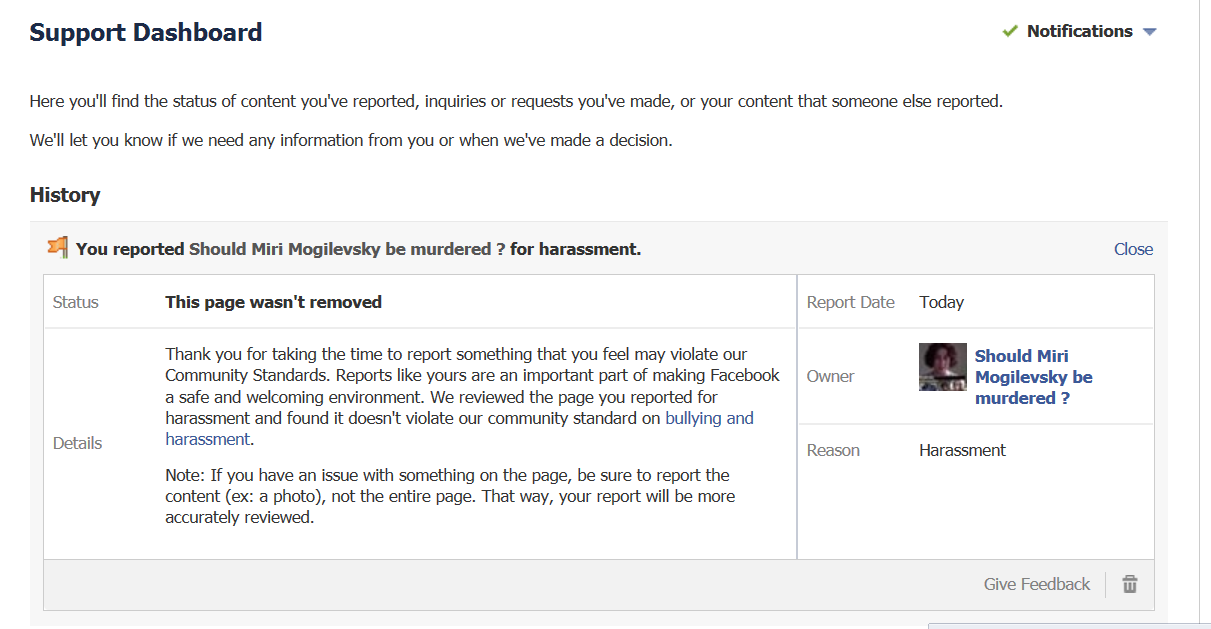
Support Dashboard
Here you’ll find the status of content you’ve reported, inquiries or requests you’ve made, or your content that someone else reported.
We’ll let you know if we need any information from you or when we’ve made a decision.History
 You reported Should Miri Mogilevsky be murdered ? for harassment.
Status This page wasn’t removed Details Thank you for taking the time to report something that you feel may violate our Community Standards. Reports like yours are an important part of making Facebook a safe and welcoming environment. We reviewed the page you reported for harassment and found it doesn’t violate our community standard on bullying and harassment. Note: If you have an issue with something on the page, be sure to report the content (ex: a photo), not the entire page. That way, your report will be more accurately reviewed.
So Facebook won’t remove a page that suggests that a named woman should be murdered.
This is war.
(This is a syndicated post. Read the original at FreeThoughtBlogs.)
Rory Fenton, president of the National Federation of Student Atheist, Humanist and Secularist Societies (in the UK), made a statement on the way officers of the LSE Student Union bullied the LSE ASH group on Thursday and Friday.
For the second day in a row our affiliated society, the LSE Atheist, Secularist and Humanist Society, have faced intimidation and threats from its students union and university for their refusal to remove t-shirts featuring the cartoon Jesus and Mo. Their statement on today’s events can be read below. For their statement on yesterday’s event please click here.
The LSESU’s statement, which omits any reference to the use of security guards, can be read here.
The National Federation of Atheist, Humanist and Secular Student Societies strongly condemns the actions of the LSESU. President Rory Fenton said, “Our member societies deserve and rightly demand the same freedom of speech and expression afforded to their religious counterparts on campus. Universities should be open to and tolerant of different beliefs, without exception. That a students’ union would use security guards to follow and intimidate their own members is deeply concerning and displays an inconsistent approach to free speech; if it is for some, it must be for all. The AHS will work with our partners at the British Humanist Association and National Secular Society to assist our affiliated society and seek engagement with both the LSESU and LSE itself. It is the duty of universities countrywide to respect their students’ rights, not their sensitivities.”
Rory can be contacted at president@ahsstudents.org.uk and 07403141133.
(This is a syndicated post. Read the original at FreeThoughtBlogs.)
On 22 September 2013, one day before the start of the school year in Iran, the Islamic Republic of Iran’s Majlis or parliament passed a law permitting a stepfather to marry his adopted child.
In defence of the law, one Member of Parliament said: “According to Islam, every child who is accepted as an adopted child is not considered a real child. Islamic jurisprudence and Sharia law allow the guardian of the child to marry and have sex with his step-child.”
This shocking law will encourage child ’marriages’ and is nothing more than legalised paedophilia and child rape. It will further endanger the welfare of the child and violate her basic rights. It will deny the child any sense of security and safety in the home.
We unequivocally condemn this inhuman law. This law, like many other laws in the Islamic regime of Iran, violates the dignity and rights of children. And it must be stopped.
What a sickening, horrifying, and revealing law. A whole major religion and a country organized around the prime duty of giving men access to fresh tight young vaginas. It’s enough to make you vomit your insides out.
(This is a syndicated post. Read the original at FreeThoughtBlogs.)
Krishnan Guru-murthy went to Afghanistan to report on abused women for channel 4. He found it unsettling. He has a daughter, who is 8. He loves her.
So listening to a young woman in Kabul describe how her father stabbed her 16 times, slashed her throat and left her for dead because she refused to marry the man he’d chosen is an unsettling experience. I was in Afghanistan for Unreported World making a film about how some fathers and husbands treat their daughters and wives.
There is all sorts of cultural history and religious pressure to explain how women have been deprived basic rights in Afghanistan. But this kind of violence? I can’t pretend to understand how anyone can do it, but the voices of the survivors are compelling.
I can’t understand it either. I can understand rage and ragey impulses, but I can’t understand actually carrying them out. There’s a wall there, that bars comprehension.
(This is a syndicated post. Read the original at FreeThoughtBlogs.)
Deeyah’s documentary film about the “honor” murder of Banaz Mahmod won the 2013 Emmy for Best International Current Affairs Documentary Film on Tuesday. That’s fantastic news, because it will obviously bring more attention to the subject.
Well done Deeyah, and congratulations.
(This is a syndicated post. Read the original at FreeThoughtBlogs.)
Facebook pages can be reported. Facebook pages that threaten people can and should be reported. I was being quiet about this in public in case Miri wasn’t aware of it, but she is aware of it now, so if you’re on Facebook and you have a minute, you could report this.
https://www.facebook.com/pages/Should-Miri-Mogilevsky-be-murdered-/465247246924802
(This is a syndicated post. Read the original at FreeThoughtBlogs.)
Rebecca has a transcript of the ThunderfQQt video at Skepchick.
I know all of this seems very silly to those of you who don’t know as much about preventing rape as Thunderfoot, but let me tell you, I’ve done a lot of research into this and a lot of what Thunderfoot says in his video is indistinguishable from the words of wisdom offered by actual admitted rapists in prison. There have been several studies looking into their stories and what they have to say and let me tell you Thunderfoot has done a great job of sounding exactly – exactly- like those rapists.
For instance, there was a study done in 1984 that included in-depth interviews with rapists in prison and these rapists went into their justifications for why they raped. And the researchers found several major themes throughout all of the answers, one of which was that many of the rapists believed that the women they raped didn’t do enough to convey the fact that they did not want to be raped. Even though many of the rapists were holding deadly weapons at the time, they still believed that the women just didn’t fight back because they secretly wanted it.
One woman one of the rapists described she was abducted at knifepoint in the middle of the night and gang-raped, and actually they interviewed two of her rapists, and they reported that she didn’t resist it so she was probably into it. They don’t go into detail on what would have happened with the knife if the woman had resisted but many of the other rapists mention that they only got violent with women because of resistance but who knows maybe if she had resisted they would have just left her alone.
Who knows, right? As Rebecca says. Who, who knows. How can we possibly tell. That’s good skepticism, see, knowing that we don’t know. Expert advice is don’t resist, but who who knows. If rapists say the women they raped didn’t do enough to convey the fact that they did not want to be raped, then maybe the thing to do is convey the not wanting to be raped really strongly. Who knows, maybe the rapist will leave you alone, who knows, maybe the rapist will kill you. The jury is still out. No dogmatism here, folks.
Another common theme in the study was the idea that nice girls don’t get raped. A large percentage of rapists in prison vociferously agreed with many of Thunderfoot’s points here, using their victims’ dress and behavior as a way to excuse raping them. Their comments ranged from pointing out that a woman they raped was wearing tight black clothes or wearing a skirt, or that a woman spread her legs when exiting a car, or that a woman claimed she was a virgin but seemed much more experienced while being raped, or this gem: “She was a waitress and you know how they are.”
One rapist claimed that his victims deserved it because they had been prostitutes, even though pre-sentence reports indicated that none of them were prostitutes.
Much like Thunderf00t, these rapists believed that these traits made their victims more rapable. So to follow Thunderf00t and the convicted rapists’ thinking, women can avoid being raped by not wearing tight black clothing or skirts, by keeping their knees locked while exiting cars, by not being waitresses, by not being mistaken for a prostitute by a deranged rapist, or even by not having sex, ever. By not being experienced in bed. Don’t get me wrong, there is still a very good chance you’ll get raped, but at least there will be fewer ways for Thunderf00t and your rapist to blame you for it.
And you know what, it might just be worth it. It might just be worth almost anything not to have to hear Thunderfcct explaining about rape ever ever again.
(This is a syndicated post. Read the original at FreeThoughtBlogs.)
Wuhey, Rebecca’s back at the video game – and it’s a corker. It’s about ThunderfQQt and his Excellent Advice About Rape.
(This is a syndicated post. Read the original at FreeThoughtBlogs.)
Abhishek Phadnis and Chris Moos report:
The following is an account of the events at the LSE Freshers’ Fair on Friday, October 4th:
We (Abhishek Phadnis and Chris Moos) arrived at the Fair at 10 am. In silent protest at our treatment the day before (see account of events of October 3rd), and still unsure as to what parts of the t-shirts had allegedly caused “offence”, we put tape (with the words “Censored”, “This has been censored” and “Nothing to see here”) over the faces of the “Jesus and Mo” figures on the t-shirts.
Shortly after midday, the LSESU Deputy Chief Executive Jarlath O’Hara approached us, demanding we take the t-shirts off as per his instructions of the previous day. We explained to him that we had covered the “offensive” parts this time, and offered to use our tape to cover any other areas deemed “offensive”. He refused to hear us out, insisting that if we did not take off the whole t-shirt, LSE Security would be called to bodily remove us from the premises. He left, warning us that he was summoning LSE Security to eject us.
At about 2:30pm, Paul Thornbury, Head of LSE Security, delivered a letter from the School Secretary Susan Scholefield. The letter claimed that some students found our t-shirts “offensive”, even though we had covered up the “offensive” parts of the t-shirts. It claimed we were in possible breach of the LSE Harassment Policy and Disciplinary Procedure, and that our actions were “damaging the School’s reputation”, and “undermining the spirit of the LSESU Freshers’ Fair and good campus relations at LSE”. It concluded by asking us to “refrain from wearing the t-shirts in question and cover any other potentially offensive imagery”, and warning us that the School “reserves the right to consider taking further action if warranted”.
Shortly thereafter, having completed our work at the stall, we began packing up. As we were about to leave, Paul Thornbury returned to confirm we were leaving. We told him that we were, and as we left the room, we saw that he was accompanied by several security guards, LSESU General Secretary Jay Stoll and Deputy Chief Executive O’Hara. The Security officials left the building at the same time as we did, confirming our impression that they had only been there to monitor us, like the two security guards positioned at our stall the day before to stop us attempting to put our t-shirts back on.
We can confirm that the aforementioned Students Union and LSE Security staff were the only visitors to our stall who expressed offence at our clothing. We had students from all kind of backgrounds come to us to express their support and astonishment about the heavy-handed actions of the LSE and LSESU, including several students who self-identified as Muslims.
We are still in shock about the intimidating behaviour of the LSESU and LSE staff. Again, we strongly reject the claim that our clothing or behaviour could be reasonably interpreted as “harassing” or “offensive”. In any case, we believe that in an open and multi-cultural society, there can be no right not to be offended without undermining freedom of expression, which is essential to the functioning of universities as much as of wider society.
We have written to the LSE Pro-Director for Teaching and Learning, Paul Kelly, and the Head of LSE Legal and Compliance, Kevin Haynes, expressing indignation at our treatment and seeking a full explanation of the grounds of the allegations against us. We are still awaiting a detailed reply.
Abhishek Phadnis & Chris Moos
(This is a syndicated post. Read the original at FreeThoughtBlogs.)