Really? They’re going with that? “No safeguarding for children in schools!!!” They think that’s a good move?
Category: Notes and Comment Blog
-
Royal footprint
King Charles III challenged a gathering of world leaders to take “genuine transformational action” to slow the spiral of greenhouse gas emissions, declaring that “the hope of the world rests on the decisions you must take.”
Speaking at the opening ceremony of the United Nations climate summit in Dubai, Charles listed a cascade of climate-related natural disasters that had afflicted the world in the last year: wildfires in Canada; floods in India, Pakistan, and Bangladesh; cyclones in the Pacific; and a drought in East Africa.
He’s not wrong, of course, but…
For Charles, who was asked by the British government not to attend the 2022 COP meeting in Egypt, this was a high-profile return to the stage on an issue he has championed since before climate change was part of everyday vocabulary.
…
“I’ve spent a large proportion of my life trying to warn of the existential threats facing us,” said Charles, who recently turned 75. But despite his efforts, he noted that “there is 30 percent more carbon dioxide in the atmosphere now then there was” when he first began warning about greenhouse gas emissions.
Yes but…
-
Bien sûr
Of course. Of course some horses are tigers. Of course some cars are hammers. Of course some trees are daffodils. Of course some people are witches. Of course we can just announce that words now mean something new and absurd and order everyone to agree with us on pain of banishment.
-
Define “suitable”
This is a book for FIVE year olds??
When I saw that Jessica Kingsley were publishing a new book for children on gender, I was immediately interested. Jessica Kingsley are a respected publisher who often produce specialist psychology books. They have a solid reputation and I have many colleagues who have published books with them. I was predisposed to liking the book.
I order The Gender Book. It is advertised as suitable for five to twelve year olds, but the illustrations make it clear that it’s focused more on the younger kids. It’s brightly coloured and looks like lots of other picture books. The characters are ethnically diverse and wide-eyed. Two of them, Casey and Ellie, are our guides. They start off by telling us their pronouns.
Little kids don’t think in terms of “pronouns,” let alone luxury personalized pronouns.
There’s only one mention of biological sex in this book. It’s this. “When each person is born, they’re given an assigned gender at birth based on their perceived biological sex. Generally this gender will be either male or female’.
Excuse me? In a book for young children? Wtf is an “assigned gender” to a small child? It’s nonsense to sane adults, but to little kids it’s just jabberwocky. And as for “perceived biological sex”…come on. That one word “perceived” stands for a tricky abstract concept that is way beyond the ken of a 5 or 6 or 7.
The language seems quite complicated for five-year-olds, and I wonder how they’ll explain ‘perceived biological sex’. They don’t.
Understatement. It’s absurdly complicated for fives.
In the next page we’re told that being assigned male or female at birth is determined by chromosomes, but there’s no explanation of reproductive differences or what being male or female actually means.
Fives know all about chromosomes do they?
From here on in it gets more confusing. We’re told that people can be gender non-conforming – the picture shows a man with long hair and make up, and a woman with short hair and a tool box. Then we learn about cis people and trans people, there’s a cis man baking cookies and a transwoman knitting. We’re told that there’s a difference between gender identity and gender expression. The gender identity is the ‘gender that most feels like ours’ – but how do we know? What does it mean to feel like a male or female? The book doesn’t explain.
The book continues to throw confusing statements at us. We meet new people, one of them is agender, another is greygender. It’s not clear what any of it means or why a person might decide that that is the right label for them. We’re told that 1.7% of people are ‘intersex’, which seems a bit complicated for young children who may not yet have learned how to add and subtract – but it’s also wrong. This statistic is often quoted and is not backed up by evidence because the definition used for ‘intersex’ is not a valid one. The real figure is 0.018%.
Enough. Throw it all away. Give the kids Pooh and Tigger, Laura and Mary and Ma and Pa, Ballet Shoes, Mary Poppins, Swallows and Amazons. Let kids be kids.
-
He added captions
The gag order tells Trump not to shout insults and threats at the judge and his staff, so what does our resourceful monstrosity do? He shouts insults at the judge’s wife. Of course he does.
Trump on Wednesday attacked Dawn Engoron, the wife of the judge, Arthur Engoron, and the judge’s clerk, on his social media platform Truth Social.
He called Dawn Engoron a “Trump hating wife” and said that she and Arthur Engoron’s law clerk had “taken over control of the New York State Witch Hunt Trial aimed at me, my family, and the Republican Party”.
On Thursday, the gag order against him, which had been paused two weeks ago, was reinstated, but it did not stop Trump lashing out further. The order only specifies comments about members of Judge Engoron’s staff, not his family.
Trump posted screenshots of vulgar and profane anti-Trump messages on X, formerly known as Twitter, purported to have been made by Dawn Engoron – prompting her swiftly to assert that she does not have an account.
“I do not have a Twitter account. This is not me. I have not posted any anti-Trump messages,” Dawn Engoron told Newsweek.
It’s a wonder he didn’t call her a bitch and a slut and a whore.
One meme shows Trump digitally altered into wearing an orange prison jumpsuit and mopping floors. The caption read: “He’ll never be in the WHITE HOUSE again. He’s headed for the BIG HOUSE.”
Trump then added captions to his posts, such as one that read: “This is the Judge’s Wife and Family that are putting these things out. I am not entitled to a Jury under this Statute. Can this be happening in America?”
Can it be happening that we all have to live in the horrible school playground that is Trump’s brain?
-
Guest post: Their desperate oppression envy
Originally a comment by Your Name’s not Bruce? on No YOU are.
And I’m pretty sure no GC feminist has told anyone who is trans (or an ‘ally’) to die in a grease fire. I am willing to be corrected on that if anyone has evidence otherwise.
If transactivists had evidence for any of the horrible things that feminists have been accused of doing, they’d be broadcasting it 24/7. They would only need one example, and they’d be repeating it over and over. Forever. But they don’t. They can’t even honestly report the actual words of JKR, because they’re completely innocuous. But because she says “No” she is bigoted, subhuman scum. If she was a tenth as evil as her reputation amongst trans activists (and the Three Ingrates she made rich and famous), she’d already be serving multiple life sentences for crimes against humanity.
Despite their desperate oppression envy, the threats, bullying, and violence are all in the other direction. Do women stalk and harass transactivists? No. Do they try to get trans meetings and events cancelled, or disrupt them when they can’t? No. Do women regularly assault transactivists, and openly call for their murder on their placards and online-purchased apparel? No. So transactivists have to resort to dogwhistles, innuendo, and subtext (in which “misgendering,” for example, can be indicative of anything and everything up to and including “trans genocide”). But trans activism’s awfulness to women is the gift that keeps on giving. They keep doing and saying horrible things, perpetually refreshing the ever-growing compendium of examples of terrible behaviour.
-
He’s 18; they’re 14
Wisconsin Public Radio reports:
The U.S. Department of Education is opening an investigation into whether the Sun Prairie Area School District failed to report sexual harassment following an incident this spring involving a transgender student in a girls’ locker room.
Note the usual obfuscation – a transgender student who is male, they mean but carefully don’t say.
Dawn Matthias with the department’s Office for Civil Rights sent a letter to the conservative law firm, the Wisconsin Institute for Law & Liberty, on Wednesday, confirming the Title IX investigation.
So the progressive law firms think girls should just shut the fuck up about boys in their locker rooms? What’s progressive about that?
WILL filed a complaint against the district in June alleging the school district violated Title IX rules in March, when, according to the law firm, four 14-year-old freshman girls at East High School were exposed to the genitalia of an 18-year-old senior who is transgender.
That is, the school forced them to share their locker room with an 18-year-old boy, on the grounds that he claims to be a girl. That doesn’t sound at all progressive to me.
Lux said the Sun Prairie Area School District does not condone “any student of one sex being present in a state of undress in the presence of students of another sex on school property, or a student of one sex showering in the presence of students of another sex.”
“What happened in this incident was not in line with our district’s practices,” Lux said.
So it’s not school policy to let boys who claim to be girls use the girls’ locker room?
Really?
H/t J.A.
-
Don has to shut up again
The gag order on Trump is back.
An appeals court on Thursday reinstated a narrow gag order on Donald J. Trump that bars him from attacking court staff in his civil fraud trial in New York. The former president has already violated the order twice, incurring a total of $15,000 in fines.
The order was first put in place by the trial judge, Arthur F. Engoron, in early October, after Mr. Trump attacked the judge’s law clerk on social media…
With their client barred from attacking Ms. Greenfield, Mr. Trump’s lawyers continued to take issue with her prominence…
Eventually, Justice Engoron placed a gag order on the lawyers as well, prohibiting them from commenting on his conferences and written exchanges with Ms. Greenfield.
The lawyers appealed, and another judge, David Friedman, halted both gag orders, giving Mr. Trump free rein to attack Ms. Greenfield, who, like the judge, is a Democrat. He did so, frequently insulting her on social media as partisan. As recently as Wednesday, he called her “disturbed and angry.”
Unlike the extremely placid and mellow Donald Trump.
On Thursday, a panel of appeals court judges put the orders back in place in a written order. Shortly after that decision, Justice Engoron alerted Mr. Trump’s lawyers in open court.
It’s all so disgusting and shaming, watching this horrendous sadistic vulgarian acting out his sadistic vulgarity in public.
Lawyers for the court system had fought to have the gag orders reinstated. In an affidavit, a courts employee, Charles Hollon, who handles security for judges and their staff, said that after Mr. Trump’s initial attack on Ms. Greenfield, she began to receive serious and credible threats and disparaging comments, many of which were antisemitic.
I bet they were also extremely sexist.
-
Conflict in the middle
If you get mugged and beaten up in the street your birthday party will be cancelled.
No Hanukkah this year for Havering Council in London.
Havering Council, a municipality located in East London, announced today that the annual Hanukkah installation would not be taking place this year due to “conflict in the Middle East.”
In a statement, the council released: “The Council has taken the difficult decision to pause the planned installation of the Chanukah Menorah outside Havering Town Hall this year. We appreciate this is a hugely sensitive issue but in light of escalating tensions from the conflict in the Middle East, installing the candelabra now will not be without risk to the Council, our partners, staff and local residents.”
You could argue that councils have no business putting up religious installations in the first place, but if you’re not doing that but just saying no to this one religion and set of people…well yes, that’s “a hugely sensitive issue.”
-
Undershirt boy strikes back
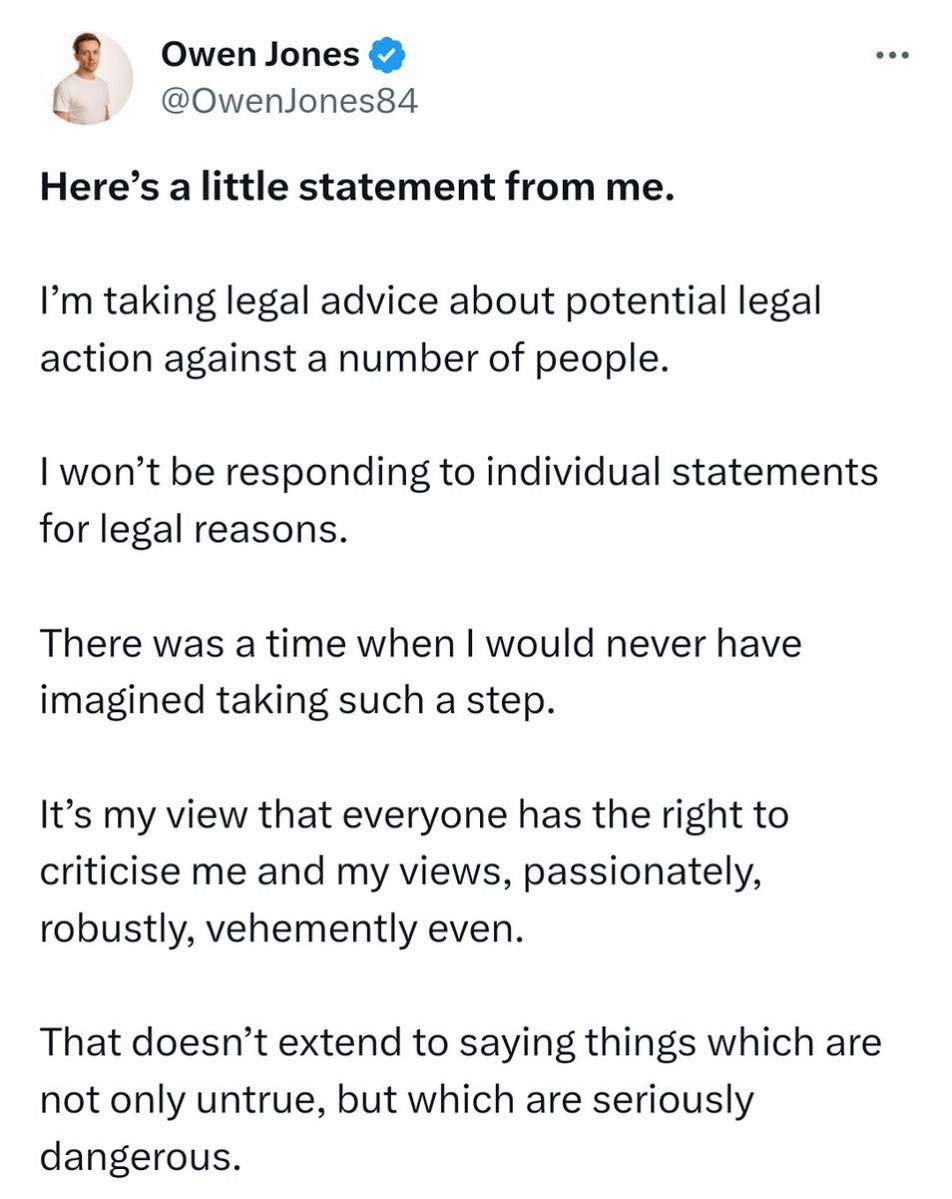
Ok Jones has had enough now. He’s angry. You’ve been warned.
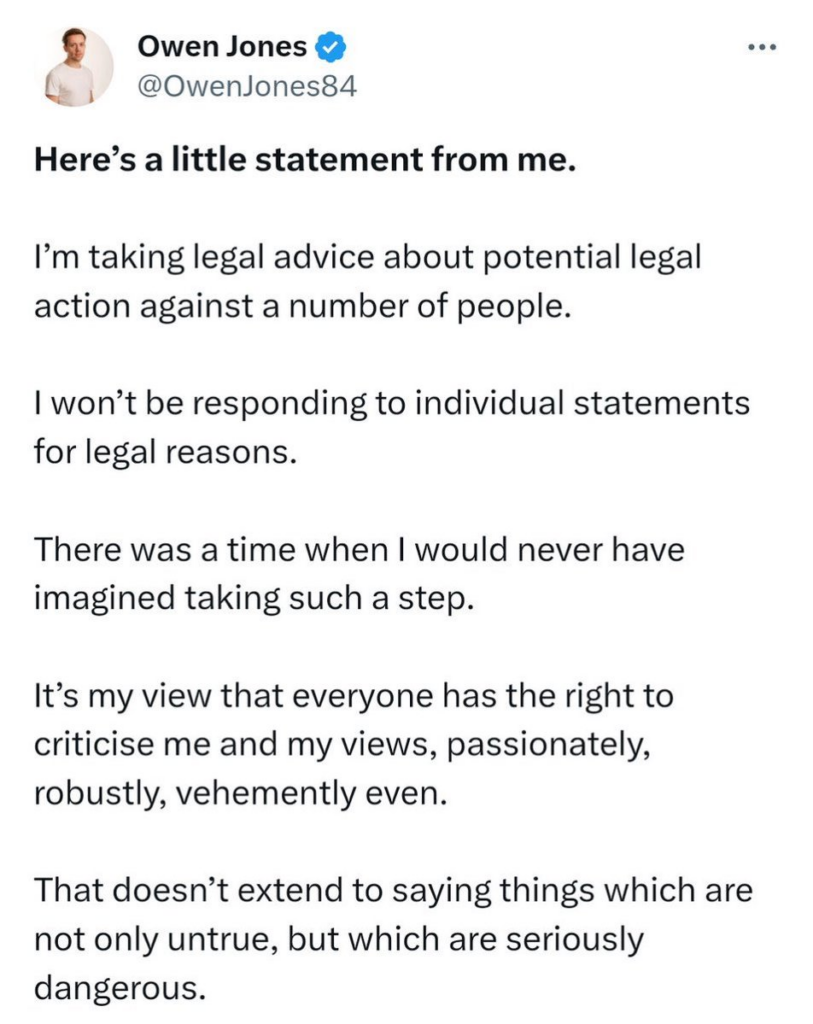
He’s taking advice. I wonder if it will be anything like “Dude you don’t have a case. The claims have to be false or else you don’t have a case.”
-
Oh no she “sparked controversy”
Yes, and?
Martina Navratilova Says Transgender Women Can’t Be Lesbians
Well of course they fucking can’t. Frying pans can’t be owls, cities can’t be paella, we could go on like this forever.
It’s The Advocate whining this whine. Not much of an advocate these days, is it.
Martina Navratilova, the renowned out tennis star, recently sparked controversy with her remarks on a tribute by Stonewall, a leading LGBTQ+ advocacy group in the U.K. Navratilova took to social media on Tuesday to voice her opposition to the inclusion of a transgender woman in Stonewall’s Lesbian Visibility tribute, bluntly writing, “a bloke cannot be a lesbian.”
Oooh how rude of her to be so blunt.
But we have to these days, don’t we. We’re surrounded by mystifications about who is what.
The former athlete continued her troubling commentary, “No matter what they say, no matter how they feel, no matter how much they try to convince us otherwise. A bloke≠ a lesbian.”
Troubling shmoubling. News flash: it’s a million times more troubling that formerly LGB outlets are now scolding people for not pretending that bloke over there is a laydee. What does lesbian or gay or straight even mean if people are not allowed to know which people are which sex?
She made the assertions in response to a video by Stonewall that promoted diversity and inclusion of lesbians from diverse backgrounds, including transgender women who identify as lesbians.
Yeeah that’s cute but a man claiming to be a lesbian isn’t “from a diverse background”; he’s a man claiming to be a lesbian.
Her remarks, widely perceived as transphobic, have occurred amidst growing tensions and discussions about inclusivity within the LGBTQ+ community.
“Widely perceived” – well that’s easy to say, but how do you know? And how widely perceived as simply the truth are her remarks? And anyway why should we care? Lesbians and gays were once “widely perceived” as scary perverts, so what’s your point?
We know what their point is of course. To denounce and demonize and rebuke a lesbian for knowing that men are not lesbians. Pathetic.
-
No YOU are
Endless spiral of opposites until we get lost in the not not not nots.
You can shout “AGAIN” all you want but it’s still the opposite of the reality. The women you’re calling “terfs” are not misogynists (nor are we misandrists, for that matter). We’re women who know that men are not women. That’s all it is. Hate is an emotion; facts are not emotions. It’s not hate to know a man when we see one.
It is true that we reject and dislike the ideology that tries to force us to agree that men are women if they say they are, but that’s in no way a hatred of women aka misogyny. It’s brazen theft to pretend it is.
There’s no such thing as a “transmisogynist.” That’s a meaningless label.
I do dislike some particular trans ideologues, but that’s not because of “misandry”; it’s because of what they are so determined to do to women, as in this very tweet. This shithead is deliberately working up hatred of women by accusing us of seeing trans women as inferiors to exploit. That’s a disgusting thing to say and ludicrously at odds with the reality. It’s the “Karen” ploy yet again – women who don’t submit to trans bullying are rich white bitches who exploit the working class.
Everything is the opposite of what it is. The world and everything in it is trans; resistance is futile.
-
Be more inclusive of cheating
The BBC breathlessly tells us that not letting men compete against women is a failure to be inclusive.
A top amateur cyclist says his sport is less inclusive and welcoming than ever after it banned transgender women from competing in the female category. Josh Jones, 31, from Cambridge, believes British Cycling’s new rules “fail the cycling community”.
But that’s stupid. Men can compete in the male category, which is only right, because they’re male. It’s not “less inclusive” to keep on having men compete against men instead of letting a few selected men invade women’s sports because they claim to be trans.
Jones, who has been competing for 12 years, has 44 wins across all disciplines and is currently 13th in the British Cycling National Rankings. He believes he is the first and only openly gay rider to hold a world ranking in any cycling discipline, but recent moves within the sport have left him dismayed.
“Dismayed” that men won’t get to invade and ruin women’s cycling.
Dude needs to stay in his own lane.
-
To make the event look diverse
How to diversity and inclusion: invent some diverse speakers to promote your conference and then on the day say they all have food poisoning.
After an event organizer, Eduards Sizovs, was accused of making up fake female speakers to attract high-profile speakers to an online developer conference called DevTernity, several of the event’s top-billed speakers promptly withdrew.
…
On Monday, Sizovs confirmed that the conference, DevTernity—which sold tickets for as much as $870 a pop and anticipated 1,300 attendees—was cancelled.
The controversy arose after Gergely Orosz, the author of a popular tech newsletter called Pragmatic Engineering, first posted the allegations on X on Friday. Orosz alleged that out of three women—Kristine Howard, Julia Krisina, and Anna Boyko—scheduled to speak at DevTernity, Krisina and Boyko were fake profiles created by the event organizers to make the event look diverse in order to “successfully attract some of the most heavy-hitter men speakers in tech.”
Which is so interesting because another way to make the event look “diverse” would be to invite some actual women. I wonder if he thought of that at all.
“The amount of hate and lynching I keep receiving is as if I would have scammed or killed someone,” Sizovs posted on X. “But I won’t defend myself because I don’t feel guilty. I did nothing terrible that I need to apologize for. The conference has always delivered on its promise. It’s an awesome, inclusive, event.”
That post has a community note—X’s fact-checking method—that says, “Sizovs has been shown creating fake female speaker profiles for his conferences. He is claiming one of them was a test/bug, but investigation uncovered he’s done this for multiple years with multiple fake speakers. This presented a fraudulent focus on diversity.”
And also underlined his determination to exclude women from speaker roles at his conferences. If you pretend you’ve invited some when you haven’t, that just makes it clear you don’t want to and don’t plan to. It underlined the fact that this is deliberate with malice aforethought exclusion of women.
Orosz alleged that DevTernity’s addition of Boyko to the lineup was “not a one-off.” He posted what he said is evidence from past years of more fake speakers that were advertised at both DevTernity and other events organized by Sizovs, and 404 Media also claims that a hugely popular female tech influencer Instagram account called Coding Unicorn may have been secretly managed by Sizovs.
According to 404 Media, Coding Unicorn bills itself as the “most popular coding account on Instagram.” It’s allegedly managed by a real woman named Julia Kirsina, but 404 Media found that IP logs, a YouTube video, social media posts, and other evidence seems to suggest Sizovs controls the account.
Perhaps most glaringly obvious, coders revealed to 404 Media that “some of Kirsina’s Instagram posts are word-for-word copies of Sizovs’ LinkedIn posts, sometimes published more than a year later.” In addition, “some of the images [Kirsina] posted on Instagram show computer monitors with code that show her logged in under Sizovs’ name.” But perhaps most striking is the fact that an administrator told 404 Media that both Sizovs’ and Kirsina’s accounts were banned “multiple times” by the Lobste.rs coding forum for “sockpuppeting”—using a false identity to deceive others—in 2019 and 2020.
“At a minimum,” 404 Media concluded that Sizovs has been “heavily influencing” Coding Unicorn’s posts and seemingly had access to at least one of Kirsina’s accounts.
There are no good enough women. They’re all too stupid and too frivolous, so a guy has to fake them to tick the diversity boxes.
H/t Sackbut
-
A snip at £450 million
The Telegraph on the NHS organ inventory lunacy:
Doctors are being asked to tick whether patients have a penis or vagina under a new NHS medical form being rolled out at some hospitals.
Medics are being faced with “nonsensical” forms asking for a patient’s “organ inventory” at NHS hospitals using a new £450 million IT system.
The new “sexual orientation and gender identity form” makes up part of someone’s Electronic Patient Record (EPR) on the new system, regardless of the care or relevance to any treatment they are receiving.
It’s kind of like getting used to a new laptop – all kinds of bells and whistles you didn’t ask for and don’t want.
It asks for information around a patient’s sexual orientation, gender, sex assigned at birth, preferred pronouns, if they have transitioned, to what extent, and what future plans they have, if any, to change gender.
It’s the normalization plan. Pretend that almost everyone wants to have special gourmet gender idenninies, and that if you don’t you’re weird and abnormal and kind of wrong.
The medical forms then go on to ask staff to fill in “organs the patient currently has”, “organs present at birth”, “organs surgically enhanced or constructed” and “organs hormonally enhanced”.
It looks even crazier the second time we read it, doesn’t it.
The forms also provide default answers to questions. For example around gender identity, a patient will be by default labelled as “cisgender”, a term used to describe someone who identifies as the sex they were born as.
No, a term used by a few lunatics to describe people who aren’t trans, in other words 99.9 percent of people.
“People are automatically cisgender unless they are classed as trans, even though most people in a hospital wouldn’t know what that means, let alone being classified as something,” a staff member familiar with the new system said.
Well quite. It’s like putting a label on people who aren’t from Mars, or 100 feet tall, or 500 years old. We don’t need to label people as not-this-thing-nobody-is. Everybody is “cis.” Some people claim not to be, but they’re either delusional or lying.
Women’s rights campaigners have blamed activists for trying to impose it “by stealth”.
Helen Joyce, author and director of advocacy at Sex Matters, said the “anti-scientific fringe ideology has been imported wholesale from America”.
Sorry. Sorry sorry sorry. I apologize for my people.
-
Guest post: Hearing hoofbeats and assuming zebras
Originally a comment by Your Name’s not Bruce? on Personalized organ inventories.
There are default settings for men and women as “cisgender” if they do not express a trans identity.
This is like hearing hoofbeats and assuming zebras. They might as well just come out and call us all “non-trans.” We still haven’t gotten ourselves out of the age in which “male” was the standard and default for everything, with women being considered aberrant, non-standard, or flawed. Now “trans” is the standard, and everyone else is ho-hum, run-of-the-mill “cis.” It’s an attempt at normalizing the abnormal, of turning the impossible into mental wallpaper instead of a material and moral imposition.
To be honest, when I saw the title of the post, and started reading it, I’d thought some rich dude was subverting the NHS to come up with lists of personal potential organ donors, should they ever need to harvest one at short notice. I think that would have been less sinister. This sneaking in ideology via software is pretty scary, as well as a stupid waste of time and money. It’s about as worthwhile as building a system in which it is assumed that everyone has polydactyly, and forcing staff to go in and enumerate the number of digits on each hand ad foot of every patient, and then ask whether or not patients ever planned to have digits added or removed. Are the parties responsible going to plead ignorance, or fall on their swords? This is a little more involved than adopting US software where there’s nothing more awkward being imported than the American spelling of words like “colour” and “neighbour”. This is much less benign, and intended to be so.
-
A moment of profound importance, or not
Malcolm Clark at Spiked is very amusing about luxury pronouns.
Remember when Doctor Who was fun? Watching it now is about as much fun as being publicly humiliated at work by some jumped-up nonbinary form-filler from HR who thinks he’s amazing because he’s painted one of his fingernails black.
A good example of this joylessness is a scene in the most recent special, ‘The Star Beast’, which has been treated by right-on broadsheet types as a moment of profound importance. Yet all that happened was a transwoman character – played by transwoman actor Yasmin Finney – lectured the Doctor about pronouns. In a moment of unforgivable Time Lord-cis privilege, the Doctor had assumed a diminutive alien called Beep the Meep used male pronouns. What was he thinking?
Not, we can be pretty confident, of the very longstanding convention of referring to all generalized people (lawyers, voters, workers, students etc) as “he” in the singular, as if males are normal and females are some eccentric aberration.
You can tell how out of touch Doctor Who has now become by the fact its enormously pompous showrunner, Russell T Davies, seemed to think that the new series would shock viewers with its ‘progressive’ radicalism. The only shock was the alien pronoun scene’s patent stupidity.
I mean, why on Earth would the Doctor assume the gender of any alien? He has been encountering aliens with no fixed gender since the 1960s. The Doctor has effectively been asking aliens for their pronouns for nigh on 60 years.
Davies may think he’s blazing a trail with the new series of Doctor Who. But the truth is that gender-bending in science fiction is as old as the frozen hills of Gallifrey. In The War of the Worlds, published 125 years ago, HG Wells regaled us with Martian invaders who reproduced asexually. And hermaphrodites pepper sci-fi, from the work of Philip K Dick to that of Ursula K Le Guin.
It’s a sign of the bubble Davies has blown around his throbbing ego that he thinks the notion of genderfluidity is a jaw-dropper. I hate to break it to Davies, but his central protagonist routinely breaks the laws of actual physics by time travelling. In comparison, breaking the laws of our Earth-based mammalian biology is no biggie.
I do like the image of a bubble blown around a throbbing ego.
-
Personalized organ inventories
Sex Matters reports An Epic crisis is unfolding in the NHS.
Since October, several NHS trusts in England have been using new £450 million NHS patient-data software produced by US-based IT company Epic Systems. This has been programmed by local teams to record the “gender identity” of babies. For adults, the system has been programmed to register patients according to their “legal sex” rather than their actual sex, and to record men and women who don’t express a trans identity as “cisgender”. It asks medical staff to complete “organ inventories” of the reproductive features of all patients.
The new electronic patient record software was launched at the start of October at hospitals including King’s College Hospital, and Guy’s and St Thomas’ Hospital. It is also being used by Frimley Health NHS Trust, South London, Maudsley NHS Trust and several other hospitals across London and England.
On 26th November, the Mail on Sunday reported that a whistleblowing midwife had evidence that babies were being registered according to “gender identity” on discharge forms under the new system at London’s Guy’s and St Thomas’ Hospital, and King’s College Hospital, which Sex Matters’ Maya Forstater called “absurd and chilling”
How can babies possibly have a gender identity?? They don’t have any kind of “identity” of the kind that means “how I think of myself inside my head” – they don’t even know they’re babies, or human, or alive, or on Planet Earth. They don’t really “know” anything at all – because they’re babies.
On the form, patients are registered according to their “legal sex” rather than their actual sex.
There are default settings for men and women as “cisgender” if they do not express a trans identity. As reported by The Telegraph, the form asks for information on a patient’s sexual orientation, gender, sex assigned at birth, preferred pronouns, if they have transitioned, to what extent, and what future plans they have, if any, to change gender.
I trust there is also a place on the form for vampires, and one for werewolves, and one for gremlins, and one for witches, and…
Staff are then asked to fill in an “organ inventory”, including “organs the patient currently has”, “organs present at birth”, “organs surgically enhanced or constructed” and “organs hormonally enhanced”.
Under each section is a list of possible organs to add, including penis, vagina, uterus, cervix, breasts, prostate, testes and ovaries. Healthcare staff then have to click “add” on the relevant organs to specify which genitalia the patient has, and at which point they were acquired.
And by the time staff have finished all that it’s quitting time, and the patient has to make a new appointment.
As Helen Joyce said in The Telegraph, this anti-scientific fringe ideology has been imported wholesale from America. Activists within the NHS have attempted to impose it on the UK’s healthcare system by stealth. What they are trying to do is incredibly dangerous, and will damage patient care. It’s also anti-democratic, since it’s being presented to NHS users as a fait accompli.
The fact that healthcare employees have not felt able to raise concerns about a grossly flawed new process shows the extent of the fear that now dominates NHS workplace environments, thanks to gender-ideology indoctrination.
Oh you mean fear of shunning and hostility and bullying? For this noble cause of pretending everyone is like a doll with an extensive wardrobe of customized organs?
-
Safe and inclusive for?
It can be hard to identify the facts in reporting of this kind, because of the usual careful obfuscation. Starting with the headline:
Broward high school principal reassigned amid investigation involving transgender athlete
What kind of transgender athlete?
The kind it always is, of course. The male kind. I wonder if the news media Five Families had a meeting at some point and agreed that male transgender athletes must always be identified as simply “transgender” with no mention of the m word. Why would they do that? Because women and girls have very obvious material reasons not to want males bouncing into their sports. Men and boys don’t have those very obvious material reasons. Therefore it must always be concealed that it’s male transgender people who are the problem in a given story.
The principal of a high school in Broward has been reassigned amid an investigation into a transgender student athlete playing on a girl’s sports team, sources told NBC6.
The principal at Monarch High School in Coconut Creek, along with several staff members, have been reassigned to non-school sites pending an investigation into allegations of improper student participation in sports, officials with Broward County Public Schools said in a statement Monday.
The statement didn’t give further details on the investigation. Students at the high school told NBC6 that the investigation involved the girl’s volleyball team.
“Although we cannot comment further, we will continue to follow state law and will take appropriate action based on the outcome of the investigation,” the statement read. “We are committed to providing all our students with a safe and inclusive learning environment.”
Ironic, isn’t it, that with all this careful tiptoeing around we can’t be sure what the statement means. Safe and inclusive for girls? Safe and inclusive for boys who call themselves girls? Both? We can’t tell. If only we were all allowed to tell the truth on this subject.
Sources with Broward County Public Schools told NBC6 the reason for the reassignment has to do with a transgender student athlete playing on a girl’s sports team.
Again – what kind? Transgender what? Given that it’s the girls’ team we’re left to decide for ourselves that the student is male, but that would be a mistake, because it could be a girl who’s on steroids. This is crap reporting, and it’s everywhere.
A Florida statute says athletic teams or sports designated for females, women, or girls are not open to male students, and says a “statement of a student’s biological sex on the student’s official birth certificate is considered to have correctly stated the student’s biological sex at birth if the statement was filed at or near the time of the student’s birth.”
“He should not be able to play on the team,” a student told NBC6. “If he is a biological boy, I don’t think he should be able to play on a girl’s team.”
There it is at last. Finally we get clarification.
Some students were mobilizing for a protest and a possible walk-out in protest of the reassignment and in support of the transgender community.
“If we were to just sit here and just get them to go to the boy’s team, then it would look like we are not supportive of people’s perspective on things, like, being a girl or a boy or whatever, and this school is really big on LGBTQ+ clubs and stuff like that, so, it kind of would look more hypocritical on our part,” another student said.
Yes it’s all about “people’s perspective on things” and not at all about inconvenient facts. Or whatever.