Tag: Dud hoax

  • Passive-aggressive non-retraction retraction

    How “skeptics” operate.

    Stephen Knight aka Godless Spellchecker wrote a post on May 25 about the reception of the Boghossian-Lindsay “hoax” that wasn’t really a hoax but rather a not very good satire. His focus is on the pay to publish issue.

    I took a look at the journals where PZ Myers, Ketan Joshi, Phil Torres (Philippe Verdoux), and Amanda Marcotte published to see if their paper had ever appeared in pay-to-publish journals. While we do not know the details of how much they paid to have their articles published, or even if they paid at all, below is a list of the journals and their fees where their articles have appeared.

    To be clear: I do not know if they (or someone on their behalf) paid publication fees or not. Here is my direct question to these individuals: “Have you ever paid, or had anyone pay on your behalf, a fee for publishing a paper or papers?”

    Phil Torres (Philippe Verdoux)
    Metaphilosophy

    Fee: $2500

    Verdoux’ article: Emerging Technologies and the Future of Philosophy

    Foresight

    Fee: $2400

    Verdoux’ article: Technology and our epistemic situation: what ought our priorities to be?

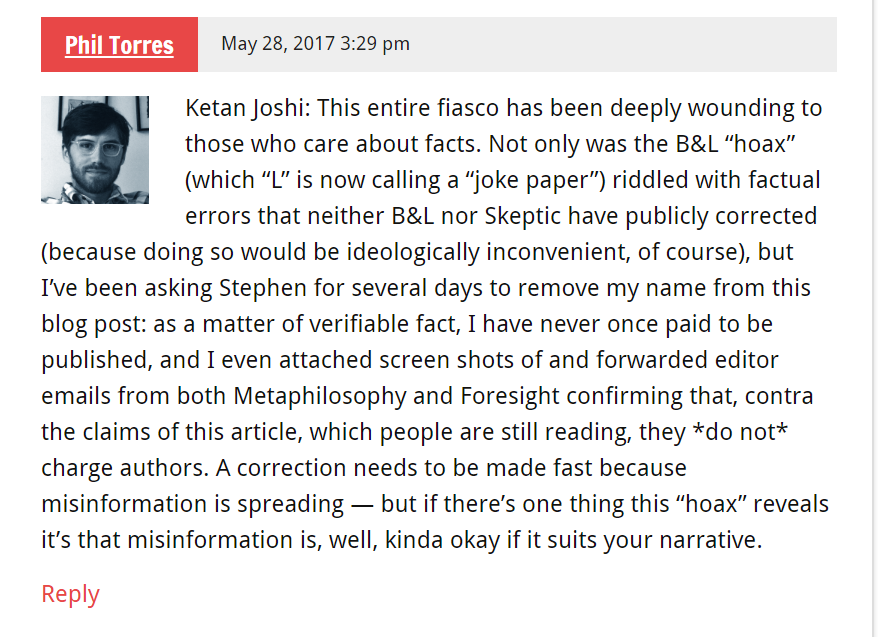
    Now scroll down to the end of the comments to read this:

    Capture

    Phil Torres May 28 3:29 pm

    Ketan Joshi: This entire fiasco has been deeply wounding to those who care about facts. Not only was the B&L “hoax” (which “L” is now calling a “joke paper”) riddled with factual errors that neither B&L nor Skeptic have publicly corrected (because doing so would be ideologically inconvenient, of course), but I’ve been asking Stephen for several days to remove my name from this blog post: as a matter of verifiable fact, I have never once paid to be published, and I even attached screen shots of and forwarded editor emails from both Metaphilosophy and Foresight confirming that, contra the claims of this article, which people are still reading, they *do not* charge authors. A correction needs to be made fast because misinformation is spreading — but if there’s one thing this “hoax” reveals it’s that misinformation is, well, kinda okay if it suits your narrative.

    Now, Knight did insert an update at the top of the article:

    Phil Torres has contacted me by email: “I can honestly affirm that I have never paid to publish an article”. He is working on a follow-up article which I shall link to here when it is published.

    I think it’s pretty obvious how insultingly inadequate that is.

    “Skeptics” – ugh.

  • Leading the thought

    Scott Jaschik at Inside Higher Ed on the dud hoax:

    As word about the hoax spread over the weekend, the first wave of reactions came from people who thought the hoax said something about the state of the humanities or gender studies.

    But then another set of critiques started to appear, taking issue with those who produced the hoax and with those praising them. This set of critiques argued that this hoax did not come close to Sokal’s. His appeared in Social Text, then and now a widely respected journal in the humanities. Cogent Social Sciences is not a major player in scholarship, these scholars noted, and its business model (taking author payments) makes it suspect.

    There’s another thing. The new “hoax” is not nearly as well or artfully written as Sokal’s. The satire is much broader – which is probably intentional, because if you want to test how absurd a piece of writing has to be before it’s rejected, you may want to go broad at the beginning to save time, but the fact remains that the quality of the two is very different. They may have intended it to be clunky or they may write clunky by nature. The comparative subtlety of Sokal’s makes it much more fun to read.

    Massimo Pigliucci titles his post An embarrassing moment for the skeptical movement. He starts with Sokal, and what he did and didn’t say.

    Sokal, however, is no intellectual lightweight, and he wrote a sober assessment of the significance of his stunt, for instance stating:

    “From the mere fact of publication of my parody I think that not much can be deduced. It doesn’t prove that the whole field of cultural studies, or cultural studies of science — much less sociology of science — is nonsense. Nor does it prove that the intellectual standards in these fields are generally lax. (This might be the case, but it would have to be established on other grounds.) It proves only that the editors of one rather marginal journal were derelict in their intellectual duty.”

    Move forward to the present. Philosopher Peter Boghossian (not to be confused with NYU’s Paul Boghossian) and author James Lindsay (henceforth, B&L) attempted to replicate the Sokal hoax by trick-publishing a silly paper entitled “The Conceptual Penis as a Social Construct.” The victim, in this case, was the journal Cogent Social Sciences, which sent out the submission for review and accepted it in record time (one month). After which, B&L triumphantly exposed their stunt in Skeptic magazine.

    But the similarities between the two episodes end there. Rather than showing Sokal’s restraint on the significance of the hoax, B&L went full blast. They see themselves as exposing a “deeply troubling” problem with the modern academy:

    “The echo-chamber of morally driven fashionable nonsense coming out of the postmodernist social ‘sciences’ in general, and gender studies departments in particular … As we see it, gender studies in its current form needs to do some serious housecleaning.”

    And (a large chunk of especially influential people in) the skeptic community joined the victory parade:

    “We are proud to publish this exposé of a hoaxed article published in a peer-reviewed journal today.” (Michael Shermer)

    “This is glorious. Well done!” (Sam Harris)

    “Sokal-style satire on pretentious ‘gender studies.’” (Richard Dawkins)

    “New academic hoax: a bogus paper on ‘the conceptual penis’ gets published in a ‘high-quality peer-reviewed’ journal.” (Steven Pinker)

    “Cultural studies, including women’s studies, are particularly prone to the toxic combinations of jargon and ideology that makes for such horrible ‘scholarship.’” (Jerry Coyne)

    Not to mention (again) Christina Hoff Sommers.

    Massimo points out other areas of academic publishing that are ripe for satire.

    And of course let’s not forget the current, very serious, replication crisis in both medical research and psychology. Or the fact that the pharmaceutical industry has created entire fake journals in order to publish studies “friendly” to their bottom line. And these are fields that — unlike gender studies — actually attract millions of dollars in funding and whose “research” affects people’s lives directly.

    But I don’t see Boghossian, Lindsay, Shermer, Dawkins, Coyne, Pinker or Harris flooding their Twitter feeds with news of the intellectual bankruptcy of biology, physics, computer science, and medicine. Why not?

    Well, here is one possibility:

    “American liberalism has slipped into a kind of moral panic about racial gender and sexual identity that has distorted liberalism’s message” — Michael Shermer, 18 November 2016

    “Gender Studies is primarily composed of radical ideologues who view indoctrination as their primary duty. These departments must be defunded” –Peter Boghossian, 25 April 2016

    Turns out that a good number of “skeptics” are actually committed to the political cause of libertarianism.

    Libertarianism and above all (and more to the point), anti-feminism. It’s depressing and disgusting that all the big Names in skeptoatheism or atheoskepticism or whatever this thing is are as one in their contempt for feminism and their readiness to attack it on any pretext.

    The Boghossian and Lindsay hoax falls far short of the goal of demonstrating that gender studies is full of nonsense. But it does expose for all the world to see the problematic condition of the skeptic movement. Someone should try to wrestle it away from the ideologues currently running it, returning it to its core mission of critical analysis, including, and indeed beginning with, self-criticism. Call it Socratic Skepticism(TM).

    There was a little to-and-fro in the comments about whether anyone is “running” the skeptic movement. Massimo replied:

    “It appears as though that’s what you are attempting and failing at. No one is running it. It’s a free for all.”

    I assure you — and I really couldn’t care less whether you believe me or not — that my attitude toward the skeptic movement is that of Groucho Marx toward clubs that would have him as a member. (Despite the fact that I occasionally do write for skeptic outlets and give talks at their conference.)

    And if you truly think “no one is running it” you are astoundingly naive. A movement doesn’t need elected leaders to be run by someone. The people who so eagerly tweeted approval of the Boghossian-Lindsay debacle (Shermer, Dawkins, Coyne, Harris, to a lesser extent Pinker) are those running it.

    I would actually disagree with that, since they’re not all “running” it in an organizational sense. Shermer and Dawkins have organizations, but Coyne and Harris don’t. But they all influence it, they shape it, they “lead” it – they’re “thought leaders.” They set the tone. They’re the big Names, and they use their big Name-hood. A tweet by Dawkins or Harris isn’t just a tweet, it’s a summons to a million fans; it’s often a summons to bully someone, whether they intend it to be or not.

    Boghossian and Lindsay were basically relying on that form of organization, and they did it intentionally. They hate feminism and they set out to rally the troops to sneer at it.

  • The joke may have been on them

    Phil Torres wrote up the Boghossian-Lindsay hoax that flopped in Salon.

    In an article simultaneously published in the magazine Skeptic, this project was loudly advertised as a “hoax on gender studies.” It primarily aimed to expose what the authors presume to be the nonsensical absurdity of gender studies, an interdisciplinary field that attempts to understand gender identity and how these identities play out in society.

    Yet Boghossian and Lindsay’s prank article unambiguously failed to do this and ultimately may have harmed the skeptic community. First, the open-access journal that published their article requests that authors pay to publish. In the case of Cogent Social Sciences, the recommended fee is a whopping $1,350. I have affirmed that Boghossian and Lindsay were, for unknown reasons, asked to pay less than half of this, namely $625, but the journal apparently never got around to actually requesting the money. Boghossian has repeatedly declared on social media that he and his colleague paid “nada” for the article’s publication, which taken out of context is patently misleading.

    Almost as if they’re not being fully…truthful.

    To show that the intellectual values of a field are fundamentally flawed, one would need to publish in the best journals of that field and trick genuine experts into believing the hoax is a non-hoax. That was what mathematician and physicist Alan Sokal did in the notorious “Sokal affair,” which attempted to unveil the obscurantist vacuity of some postmodern theory.

    Still, even Sokal himself was rather nuanced about the implications of his experiment, saying, “From the mere fact of publication of my parody I think that not much can be deduced. It doesn’t prove that the whole field of cultural studies, or cultural studies of science — much less sociology of science — is nonsense. Nor does it prove that the intellectual standards in these fields are generally lax.”

    That’s probably because Sokal isn’t a self-important blowhard, while Bogo and Lindsay…

    Boghossian and Lindsay are sadly not so nuanced in their claims. Instead, they take their hoax article to expose the entire field of gender studies as an intellectual scam. So, too, does the public intellectual Michael Shermer, the editor in chief of Skeptic. In a rather un-skeptical foreword to Boghossian and Lindsay’s article — subtitled “a Sokal-style hoax on gender studies” — Shermer wrote:

    Every once in awhile it is necessary and desirable to expose extreme ideologies for what they are by carrying out their arguments and rhetoric to their logical and absurd conclusion, which is why we are proud to publish this expose [sic] of a hoaxed article published in a peer-reviewed journal today.

    Hahaha no that’s not why. It’s because they hate feminism.

    Submitting an article on gender studies to that particular journal and then claiming that its publication proves that gender studies is idiotic is tantamount to a creationist writing a fake article about evolutionary biology, publishing it in an unknown pay-to-publish non-biology journal (whose editorial board includes no one with expertise in evolutionary biology), and then exclaiming, “See! The entire field of evolutionary biology is complete nonsense.” This is puerile gotcha-ism that completely misses the target while simultaneously making, in the case of Boghossian and Lindsay, the skeptic community look like gullible, anti-intellectual fools.

    All that being said, Boghossian and Lindsay do accomplish something notable, although not original: They show just how easy it is to get a fake paper published in a pay-to-publish journal. This is not a trivial point, although they could have saved many hours of work by randomly generating an article, as the authors above did for the Open Information Science Journal. Or they could have intentionally plagiarized an article and then submitted it. But Boghossian and Lindsay would never have done this because their real ideologically motivated target was gender studies.

    But the situation is actually much worse than that: Boghossian and Lindsay likely did damage to the cultural movements that they have helped to build, namely “new atheism” and the skeptic community. As far as I can tell, neither of them knows much about gender studies, despite their confident and even haughty claims about the deep theoretical flaws of that discipline.

    But they know they don’t like it. Isn’t that enough?

    As the historian Angus Johnston put it on Twitter, “If skepticism means anything it means skepticism about the things you WANT to be true. It’s easy to be a skeptic about others’ views.” The quick, almost reflexive reposting of this “hoax” by people like Dave Rubin, Richard Dawkins, Sam Harris, Steven Pinker, Christina Hoff Sommers and Melissa Chen reveals a marked lack of critical thinking about what exactly this exercise in attempted bullying proves.

    If anything, the hoax reveals not the ideological dogmas of gender studies but the motivating prejudices of the authors and their mostly white, mostly male supporters against social justice — a term that simply refers to the realization of fairness and just relations among citizens of a society. This is part of a larger reaction witnessed across American culture in the past few years: a pushback against women’s rights, gender equality, racial equality and a sensitivity to the plights of marginalized peoples. It’s what got Donald Trump elected as president, and it’s what fuels the alt-right. (Notably, Breitbart News praised Boghossian and Lindsay’s hoax in a recent article.) If the authors — and the good folks at Skeptic — had thought a bit more carefully about this ruse, they might have realized that this faux paper’s publication says no more about gender studies than computer-generated papers published in scientific journals say about science.

    Yet the urge to label the hoax a victory against gender studies was uncontrollable. This only reflects poorly on the intellectual honesty and thoughtfulness of those “in” on the joke — although it appears that, in the end, the joke may have been on them.

    But they’ll always have Breitbart.

  • The fact is that it was ideologically impeccable

    Henry Farrell at Crooked Timber on the dud gender studies “hoax”:

    [T]he research design, if you take it at face value is fundamentally inept. The authors of the spoof claim to be both illustrating the problems of review by gender studies academics, and the problems of predatory access journals. But you can’t really do two for the price of one – if you demonstrate that a bad piece got published, you have no way of distinguishing between the two causal hypotheses that you are proposing – that gender journals will publish more or less anything as long as it has the right politics, and that predatory journals will publish more or less anything as long as you come up with the money. Indeed, given that there is already compelling evidence that predatory journals in the sciences will publish all sorts of shite for cash, and that the authors report themselves that their article was rejected by the journal they first submitted it to, it’s hard to come up with a convincing rationale for how the ‘gender studies will publish anything’ rationale is doing any explanatory work at all.

    Yeah. I think they started out just claiming to be illustrating the problems of review by gender studies academics, and then added the problems of predatory access journals after a lot of people pointed out that they’d simply published in a predatory access journal and that that demonstrated nothing except the obvious. (Pay to play journal will publish any old dreck. You don’t say!)

    Second, my own pretend-social-science prediction (which may of course be disconfirmed) is that Steven Pinker and other prominent ‘skeptics’ are not going to rush to acknowledge that the hoax has gone horribly wrong, even though it obviously has. On the one hand, the skeptics’ own theory of themselves is that they are cool headed, rational assessors of evidence, who hew to scientific standards of proof in developing and testing their personal beliefs while their enemies are prepared to believe in all sorts of gobbledygook. If this theory were to hold true, then one would have expected either (a) that skeptics would have rejected the hoax immediately (perhaps treating it with particular suspicion given that it fit so closely with their political priors about postmodernism and academic feminism) or (b) that if they couldn’t quite get there on their own, they would acknowledge the flaws in the spoof and recalibrate their own beliefs and public arguments as soon as the problems had been pointed out to them.

    And yet that isn’t what happened. In comments on the Bleeding Hearts Libertarians post we get this exchange:

    “I don’t understand how rational/skeptical people think it’s reasonable to cast aspersions on a entire field based on a shoddy peer review process at a virtually unknown journal.”

    Yeah well, no one’s doing that. The aspersions are being cast because vast regions of academia are already known to produce crap. Some, like gender studies, have quite possibly never produced anything but crap.

    This stunt was merely one attempt to demonstrate that. A poor one perhaps, but so what? Everyone who’s been paying attention knows that with a bit more patience, maybe a better known co-author, etc. this would have worked. At any number of journals.

    How can we be sure? It’s pretty simple. You look at what gets published now. You look at that, and you ask honestly: “Have things gotten generally better or worse since the Sokal hoax?”

    Things are clearly worse. Sokal exposed the fact that one could get meaningless word salad published as social commentary. Today one can meaningfully publish obvious falsehoods. Today one can build entire disciplines around the denial of knowledge which other, better disciplines have robustly established. That’s worse.

    Now, if someone chooses to miss such an important point in order to quibble over the relative silliness of various publishing organs within the silliest part of academia, I would call that person anything but a lover of wisdom.

    Because the whole point here is that however much distance separates Cogent Social Science from, say, Feminist Theory, it’s as nothing beside the distance separating both from reality.

    Sean II’s comment is right on the mark. This hoax is just one more brick in the wall of vacuity that surrounds much of culture studies. It’s telling that people are ignoring the many critiques of those studies, including Sokal and Levitt and Gross.

    But then why bother with a hoax at all? Or, if you do bother with a hoax, why not recognize that it was a dud hoax and doesn’t count? Why defend the hoax after its dudness has been pointed out? Why say yes but they could have done a good one if they’d tried harder and we know that because look at the non-hoax stuff?

    Or, as Hannah Cairns put it:

    So to me this sounds like “The majority of commenters here seem to be focused on the fact that this experiment perhaps ‘failed’ in mundane terms, no doubt because of their own personal baggage, but the fact is that it was ideologically impeccable, so it is appropriate to consider it as having succeeded and continue the discussion based on that.” How does this sort of thing not spectacularly trip your breakers?

    Oh look, a squirrel.

  • A multi-directional cacophony of gleeful back-patting

    Ketan Joshi on that non-hoax “hoax”:

    There’s a multi-directional cacophony of gleeful back-patting ringing out across my Twitter feed at the moment. The outpouring of joy stems from an article published in Skeptic Magazine. Peter Boghossian and James Lindsay managed to submit a hoax article to a gender studies journal, and are hailing this as a profound, thermonuclear indictment on the entirety of gender studies, social science and the “academic left”. They wrote that:

    “We assumed that if we were merely clear in our moral implications that maleness is intrinsically bad and that the penis is somehow at the root of it, we could get the paper published in a respectable journal”

    Their article was initially rejected by a journal, “NORMA: International Journal for Masculinity Studies”. But they were referred to a smaller outlet, ‘Cogent Social Sciences’, that offers publication where you ‘pay what you like’ (apparently, they didn’t pay anything).

    On the face of it, this might seem like a clever take-down of predatory publishing practices. Sadly, that’s not the case. It’s presented by Boghossian and Lindsay, people sharing the article online, and by people responding, as a comprehensive demolition of gender studies, post-modernism, “social justice warriors” (SJWs, in alt-right parlance) and social science:

    A string of smug tweets follows.

    Ah that “gentlemen” – such a red flag for an asshole. They also like to call each other “sir” – “well played, sir.” Hot stuff.

    The authors of the Skeptic Magazine article wrote:

    “We suspected that gender studies is crippled academically by an overriding almost-religious belief that maleness is the root of all evil. On the evidence, our suspicion was justified” 

    Most people, whether they’re part of the skeptic community or not, can recognise that a single instance isn’t sufficient evidence to conclude that an entire field of research is crippled by religious man-hating fervour, and that anyone pushing that line is probably weirdly compromised.

    Years and years of steady Twitter will do that to a person.

    He lists several science hoaxes, by way of making the point that it isn’t just gender studies that can be hoaxed.

    The hypothesis presented by the authors – that gender studies is a sinister, anti-male left-wing fraud soaked in religious fervour – isn’t supported by a simple illustration of dodgy practices in academic publishing.

    Which raises a very important question: why are the titans of the skeptic / rationalist community being pointedly irrational, when it comes to the reason this hoax was published?

    Because they all despise feminism.

    The article in Skeptic Magazine highlights how regularly people will vastly lower their standards of skepticism and rationality if a piece of information is seen as confirmation of a pre-existing belief – in this instance, the belief that gender studies is fatally compromised by seething man-hate. The standard machinery of rationality would have triggered a moment of doubt – ‘perhaps we’ve not put in enough work to separate the signal from the noise’, or ‘perhaps we need to tease apart the factors more carefully’.

    That slow, deliberative mechanism of self-assessment is non-existent in the authorship and sharing of this piece. It seems quite likely that this is due largely to a pre-existing hostility towards gender studies, ‘identity politics’ and the general focus of contemporary progressive America.

    Especially feminism. They hate feminism hard.

  • Vanity publishing

    Justin Weinberg at Daily Nous reports on an “attempted hoax” in the manner of the Sokal Hoax.

    …the isomorphism between the conceptual penis and what’s referred to throughout discursive feminist literature as “toxic hypermasculinity,” is one defined upon a vector of male cultural machismo braggadocio, with the conceptual penis playing the roles of subject, object, and verb of action.

    That’s a line from the intentionally nonsensical “The Conceptual Penis As A Social Construct,” submitted as a hoax to, and then published by, the “multidisciplinary open access” and, as it turns out, “pay-to-publish” journal Cogent Social Sciences. The essay is by Peter Boghossian, an assistant professor of philosophy at Portland State University and James Lindsay, who holds a PhD in math and writes about atheism.

    The part about pay to publish is why it’s only an attempted hoax, not a real one. To be a real hoax the essay has to be accepted by an actual editor for a journal that rejects submissions as well as accepting them. Pay to publish=all are welcome, all shall have prizes.

    The authors take themselves to be perpetrating a new version of what’s now known as the Sokal Hoax, in which physicist Alan Sokal successfully published, in the journal Social Text, a nonsense article parodying postmodern writing about science. Here, Boghossian and Lindsay are taking aim at a different target,what they take to be “the moral orthodoxy in gender studies”:

    [W]e sought to demonstrate that a desire for a certain moral view of the world to be validated could overcome the critical assessment required for legitimate scholarship. Particularly, we suspected that gender studies is crippled academically by an overriding almost-religious belief that maleness is the root of all evil.

    Ah yes, that’s a very reasonable and well-stated suspicion.

    Over at Bleeding Heart Libertarians, James Stacy Taylor (College of New Jersey) provides a potent critique of the project:

    [I]t turns out that the joke’s on the hoaxers themselves—both for failing to spot some very obvious red flags about this “journal,” and for their rather bizarre leaps of logic…

    [The paper] was accepted after what seems to be very cursory peer review, and, from this, they’re claiming that the entire field of Gender Studies “is crippled academically by an overriding almost-religious belief that maleness is the root of all evil.”

    It might be. But their hoax gives us absolutely no reason to believe this. First, let’s look at the “journal” that they were accepted at.  Like all the digital, open-access journals run by Cogent (a house most people have never heard of before now) it charges authors fees to publish. No reputable journal in the humanities does this. Worse yet, it allows authors to “pay what they can”. This appears to signal that this journal publishes work from authors who can’t get institutional support to publish in it. (Or, if they could, don’t seek this as they would prefer it not be widely known that they’re paying to publish.) The journal boasts also that it is very “friendly” to authors (a clear sign of a suspect outlet) and notes that it doesn’t necessarily reject things that might not have any impact. (!) It also only uses single blind review. The whole thing just screams vanity journal.

    Now, the hoaxers are aware of all of this. But they try to duck the “facile” objection that they submitted to a junk journal by noting that it’s part of the Taylor and Francis group, and that it’s “held out as a high-quality open-access journal by the Directory of Open Access Journals (DOAJ)”. Yet even a quick perusal of the journal’s website makes it clear that it operates entirely independently of Taylor & Francis, and that its publishing model is utterly different to theirs…

    Having managed to pay for a paper to be published in a deeply suspect journal the hoaxers then conclude that the entire field of Gender Studies is suspect. How they made this deductive leap is actually far more puzzling than how the paper got accepted…

    You can read the rest of Professor Taylor’s critique of this “big cock-up” here.

    Jerry Coyne wrote a gloating post about the “hoax” yesterday.

    Now we have another hoax: a piece on the “conceptual penis” published in the journal Cogent Social Sciences, self described as “a multidisciplinary open access journal offering high quality peer review across the social sciences: from law to sociology, politics to geography, and sport to communication studies. Connect your research with a global audience for maximum readership and impact.”

    Here’s the article; click on the screenshot below to see it in the journal (though it will probably be removed very quickly!). The paper has, however, been archived, and you can find it here.

    Several academics in the comments point out that it’s not a hoax because it was published in a vanity “journal” but Coyne brushes them all off.

    Nested hoaxing, I guess you could call it.