
Tag: Elena Ferrante

  • The H word

    Another man sighs wearily as he opens the laptop to explain why Elena Ferrante has no right to anonymity or privacy, this time in Prospect.

    The hysterical reaction in some quarters to Ferrante’s so-called “doxxing” is producing more heat than light. Books are largely read by a culturally elite group, the same people who commission think pieces, invest their cultural capital with importance. Journalists writing about this phenomenon fuel it, and to be honest, as we condemn the article that caused this mess, we are also profiting from it.

    The “hysterical” reaction. Wouldn’t you think men who write words as a profession could learn to stop calling women “hysterical”? Ok he’s calling the reaction “hysterical,” not Ferrante herself…but that’s on the literal level, and in fact he’s associating her with “hysteria” and that’s what readers will get from his use of the word. It’s a casual, deniable sexist slur, right at the beginning of his piece dismissing Ferrante’s stated wishes. I’m getting tired of men dismissing women’s stated wishes.

    Ferrante has a right to privacy, as enshrined in the European Convention on Human Rights. There is no doubt that Claudio Gatti’s article was an intrusion, but other articles have strayed into similar territory. Ferrante, we now strongly suspect, is a public figure making millions from marketing an invented identity, and it is naive to think she would escape scrutiny.

    That’s a really extraordinarily entitled thing to say. It’s a sublimated “you can grab her pussy.” Her books have sold well, and he calls that “making millions from marketing an invented identity.” She made whatever money she made from writing novels! How is it his business to claim she made it from “marketing an invented identity” and that that justifies trying to expose her identity without her consent?

    Rob Sharp wrote this article for Prospect. Does that mean we all get to break down his door and camp out in his living room?
  • A woman must be either wholly invisible or public property

    Victoria Smith aka Glosswitch asks how much of themselves writers should reveal.

    If you are male, it doesn’t really matter. You are the default human being and all experiences about which you write – regardless of whether or not you have actually had them – will be universal.

    If you are female it is more complicated. Reveal too much about yourself and you are not a real writer at all, just an over-sharer, wallowing in the petty specifics of a non-male life. Don’t reveal enough and you are suspect, manipulative, a tease. Either way you can’t win.

    Elena Ferrante avoided that bind by writing pseudonymously.

    Unlike female authors who use male pen names, she was still identifiable as a woman – but as a woman who could only be judged by her works, not her background, her appearance or her personal life.

    Well, how dare she, right? That certainly seems to have been Claudio Gatti’s view of the matter.

    When a male author tells half-truths or plays with facts we don’t call this ‘lying’; we call it ‘being postmodern’ and consider it very clever indeed. When a woman does the same, cleverness suddenly becomes deviousness. If she was never prepared to give us the whole story, then she should not have told us anything at all. Gatti describes Ferrante as “the very first person to violate Elena Ferrante’s privacy.” It is an absurd statement to make, rooted in the belief that a woman must be either wholly invisible or public property.

    And the belief that if she fails to be wholly invisible, other people get to force her to be public property, no matter how explicit and clear she is that she refuses.

    The same male entitlement leads to women being told that if they don’t like abuse on social media, they should deactivate; if they don’t like being victims of revenge porn, they shouldn’t take photos of themselves; if they don’t like having their body ridiculed on the cover of Closer, they shouldn’t do anything that could remotely lead to them being considered famous. It is a way of controlling women by limiting the space they will dare to claim for themselves.

    It’s so habitual and pervasive, this habit of treating women as public property, that I often despair of our ability ever to break it. The ice caps will melt long before we get anywhere close.

    A female writer should not have to struggle through all this and then, once she has produced something amazing, have to contend with male journalists telling her what else it is their ‘right’ to know.

    A female writer should not have to be public property against her will.

  • But no, they talk, they give interviews

    The Columbia Journalism Review interviewed Claudio Gatti yesterday.

    What’s your response to those who say she’s entitled to her privacy? That she’s not a mafia boss or politician, but just a writer of fiction?

    No, she’s not. But she’s a major public figure. Do you know who the Italian minister of the economy is?

    No.

    Do you know who the CEO of the Italian oil company is?

    No.

    But you do know who Elena Ferrante is. What I’m saying is, the biggest mystery about Italy from outside Italy is, “Who is Elena Ferrante?” It is a major issue, not that I made it such. When readers buy books by the millions, they have a legitimate desire to know more about who wrote the book. I’m not saying that; Sandra Ozzola said and wrote that.

    Point comprehensively missed. The issue about politicians and CEOs and mafia bosses isn’t whether or not we know who they are without looking it up, it’s the power they have. They have real, material power; novelists don’t. That’s the relevant difference when it comes to the right to remain anonymous.

    It doesn’t matter how big the mystery is. The size of a mystery doesn’t determine our right to know its solution.

    There’s the already-notorious Trump-impersonation:

    Do you have any regrets about doing this story?

    Absolutely not. None whatsoever. All the people that hate me for what I wrote are bad people, and I don’t mind the fact that they hate me.

    The likeness is uncanny.

    What about her personal preference to remain private? 

    It is her personal preference; we know that. But then if it is, you don’t fuel the frenzy with Frantumaglia, you just say “I’m sorry, I’m not giving interviews.” But no, they talk, they give interviews, they write a fictional autobiographical book, and then they say, “I want to keep my privacy.”

    Right, and if you don’t want to be raped, you stay home with the doors locked. You don’t fuel the frenzy by going out, you just stay inside with the curtains closed. But no, they go out, they walk around, they talk and laugh, and then they say, “I don’t want to have sex with you.”

    Explain to me how knowing that Elena Ferrante is Anita Raja would change anything for readers. I really don’t get it. Why would it change anything? People read the books because they are fascinated by them. I don’t see what argument she could have to claim that she needed to be out of the public eye to write fiction. She had no reason to hide anything. I’ve proven that there is no autobiographical information in any of her books. How can the ability of Ferrante to capture the inner lives of women in any way require her to be shielded from the public sphere?

    It doesn’t matter. It’s not for Gatti or any of us to decide that for her. It’s not our decision to make. There is no law or rule against writing books anonymously, and it is just bullying to out people against their clearly stated wishes. Gatti does not get to substitute his judgment for hers on a question of her right to be anonymous.

  • “Newsworthy” is not a justification

    Emily Nussbaum tweeted

    A wise and balanced Ferrante-take corrective by @NoreenMalone, which I agree with 95%:

    and linked to Malone’s article, Elena Ferrante’s ‘Unmasking’ Wasn’t the End of the World.

    Sigh. Yeah great, but nobody said it was the end of the world. Why do we have to be “balanced” about everything anyway? Why is “balance” necessary in this case? Why can’t we say authors have a right to be anonymous if they want to, and journalists have no duty or responsibility or obligation whatsoever to strip them of that right and that anonymity, and that it’s that much more ugly and domineering when it’s a man stripping a woman? Why is it “unbalanced” to say that?

    Malone’s piece is annoyingly dismissive.

    Gatti’s logic here is not exactly airtight, and does have an unfortunate whiff of “she was asking for it.” But Ferrante’s true biography had long been an object of interest in newspapers and magazines…Despite her anonymity, Ferrante has given plenty of interviews,especially recently. If the pseudonym allowed us to encounter her work in a specific way initially, the status of the work has changed in the last several years: Enormous success comes with burdens as well as benefits, but it certainly makes her identity more newsworthy than it was when she first started writing under a pseudonym.

    What the hell does “newsworthy” mean? Other than “people are interested in it”? People are interested in lots of things that they have no right to know more about. Again: having a desire does not create a right to have that desire satisfied. I realize that’s a terribly “unbalanced” claim, but I’m sticking to it. Curiosity about other people is all but universal, but that doesn’t translate to some universal duty to make everything public. It doesn’t matter that Ferrante’s identity was “newsworthy”; it was still hers to keep to herself if she chose.

    According to the current conventional wisdom, the exposé was a kind of emotional violence, both against the writer and the readers; further, goes this thinking, there is a particular roughness inherent to a male reporter unmasking a female author who has asked for privacy. The New Yorker’s Twitter account uses the language of consent: “In his apparent unmasking of Ferrante — the journalist does not explain why he felt free to take her ‘no’ as his ‘yes.’” As does Charlotte Shane, a writer and co-founder of TigerBee Press, who tweeted, “Leave it to a goddamn man to decide that the tremendous gift that is Elena Ferrante’s writing needs to repaid with senseless violation.” In The Guardian, Suzanne Moore writes that “those who love Ferrante’s work are appalled, partly of course because she writes so well about the ways in which men humiliate women.”

    How is that “the conventional wisdom”? Yes a lot of us thought it and said it, but that doesn’t make it the conventional wisdom. I’m not sure it’s particularly “balanced” of Malone to call it that.

    It is true that, thanks to the searing portrait of male cruelty her novels paint, the mere mention of Ferrante’s name might get many of us in the mood to discuss a generalized terribleness of men. And yet this all seems to me both an almost-insulting underestimation of the fortitude of the author, and a severe overestimation of the harm that might be done by connecting universally praised work to its actual creator.

    That’s not your decision to make. It’s not ours. It certainly isn’t Claudio Gatti’s. It’s not anyone’s but Ferrante’s. “Consent,” anyone? I don’t find Malone’s callous dismissal the least bit “balanced”; I think it’s quite warped.

  • Gatti thinks he knows better

    Deborah Orr has a blistering piece on the privacy-stripping of Elsa Ferrante. Orr is a massive fan of Ferrante’s work, has interviewed her, and is a contributor to “the new edition of Frantumaglia, a collection of writings by and about Ferrante that particularly seems to irk Gatti.”

    But here’s the thing. I do not give a stuff who Ferrante “really” is. If I have a right to know, as Gatti argues, I don’t wish to exercise it. Gatti, as far as I’m concerned, has violated my right not to know, while Ferrante protected it. I was more than willing to play my small part in giving this writer the space she needed to write as she does, and gratefully accept my reward – her books and the pleasure they give to me. I abhor the fact that this man, and those who published his speculations, rode roughshod over that perfectly satisfactory contract between writer and reader.

    And the writer’s stated wishes over more than two decades, with zero public interest reason to do so.

    [S]uccessful women are still expected to account for their ability to balance work and home. A female foreign correspondent will be expected to account for the fact that she has to leave her children behind. A female prime minister will still face insinuations that she hasn’t fully experienced life as a woman’s life should be experienced, because she hasn’t had children. This is the way in which Gatti thinks Ferrante should be held to account – checked over, to see if her creative life is a suitable match to her domestic life. Successful women can’t “have it all”, goes the mantra. We must be allowed to inspect this woman, to ensure that she hasn’t managed it. With men like Gatti in the world, it’s perfectly understandable that a person might want to avoid all that nasty, sinister scrutiny.

    Damn right. We don’t want men like him in our faces, and hiding is one way to avoid them.

    Gatti thinks he knows better than the people who know and care for the individual that Ferrante inhabits. I very much doubt that he does. The future impact that his intervention could have on Ferrante’s creativity appears not to have figured in his calculations. That’s how much he really cares about Ferrante’s readers and their rights.

    He cares about himself and his ability to tell an admired woman who’s in charge.

    Listening to Gatti on Radio 4’s Today programme on Monday morning, as he attempted to justify his vast, self-righteous intrusion, I was struck by how strongly he seemed to feel that people should be punished for their success, that somehow, by failing to subject her private self to public scrutiny, Ferrante was pulling a fast one. (The truth, I imagine, is more likely to be that he wants what she’s got, and can’t see why she should eschew the personal inconveniences that he would gladly embrace in her shoes.)

    Gatti now seems to find it unfair that a woman may have chosen to write herself out of her own writing, largely, one suspects, because such self-effacement is alien to him. I daresay he would not be able to comprehend the stitching of a patchwork quilt, just for the sake of making beauty. If you want to work, achieve money and acclaim, then play by our rules. That seems to be Gatti’s horrible message. Ferrante’s writing is suffused with explorations of how aggressive and damaging to women such attitudes are. No wonder he wants to damage her back.

    No doubt Ferrante didn’t actually want men telling her what she should really be writing about, as Gatti presumes to. Why would anyone want to be told that they were doing something bad and disrespectful by failing to write about their mother and her family? The obligation to write about and talk about her own family, and be defined at least in part by a terrible past, seems to me like something else that Ferrante would have wanted to free herself from. Gatti, however, has exercised his own perceived right to put Ferrante back where he can keep an eye on her. It is a terrible and ghastly violation.

    It only makes me more furious as the day goes on. We just can’t be allowed to get on with doing our work in our own way.

  • Random man decides what rights Elena Ferrante can have

    The LA Times on the assault on Elena Ferrante’s privacy.

    Ferrante had closely guarded her secret. The author specifically said — in her rare interviews — that she treasured her anonymity.

    And that should be her right. Authors don’t have to tell us anything about themselves. Not one thing.

    Gatti’s article was met with outrage by many in the literary community, including Roxane Gay, Ruth Franklin, Philip Gourevitch and Pamela Paul, decrying the journalist’s exposure of Ferrante’s true identity.

    Rob Spillman, the editor and cofounder of the literary magazine Tin House, called Gatti’s report “immoral” and “unethical” and suggested that readers consider canceling their subscriptions to the New York Review of Books.

    It is highly immoral and unethical and the NYRB should never have published it. Doing so is a punch in the face to all their writers, and to their readers too.

    Gatti defended his report to the Guardian, asserting that “she and her publisher seemed not only to have fed public interest in her true identity but to have challenged critics and journalists to go behind the lies. She told us that she finds them ‘healthy.’ As a journalist, I don’t. In fact, it is my job to expose them.”

    No it is not, you self-righteous shit. It is not your job to strip away the anonymity of people who want to be anonymous unless they are using that anonymity to do harm.

    Gatti told the Guardian, “I believe that by announcing that she would lie on her own ‘autobiographical’ essay, Ferrante has in a way relinquished her right to disappear behind her books and let them live and grow while their author remained unknown.”

    Spoken like a rapist. Spoken like a man who thinks he has the right to ignore the stated, explicit, fervent wishes of a woman who writes novels, and strip off her pseudonym as he would strip off her clothes before raping her.

  • The notion that Ferrante and her work are public property

    Stig Abell at the TLS on why the TLS wouldn’t have named Elena Ferrante:

    His piece bears all the hallmarks – the signs, the stretch marks – of his effortful need to explain away what on the surface might seem a needless intrusion into a fellow writer’s privacy. He wants us to be convinced of the notion that Ferrante and her work are public property: the books are a “sensational success”; despite her anonymity, she has become an “oddly public figure” (a description where “oddly” can reasonably be translated as “not a”); she wrote a book arrogantly “purporting in part to outline her family background”, offering “crumbs of information designed to satisfy her readers’ appetite for a personal story”; her identity will “assist us in gaining insight into her novels”; and so on.

    She was asking for it; she was dressed like a slut; she’s a prude who needs loosening up; she should have stayed home; she loved it; she’s a bitch.

    I am the editor of the Times Literary Supplement, one of very few titles that is analogous to the New York Review of Books. So it is reasonable to ask: if Gatti had come to the TLS, would we have published him?

    The answer, I believe, is no.  We would have been tempted, of course. A solution to a genuine literary conundrum does not arise often. It would make people talk about the TLSand bring them to our website. Of course it would.

    But I write this surrounded by people who have devoted their lives to the world of books and authors, because they believe it is worthwhile and civilized. We would have discussed the piece, and I think we would have asked: what good does this do Elena Ferrante; what good does this do the TLS; what good does this do the world at large?  The answer is, resoundingly, too little on all counts.

    Or even more simply they could have discussed the piece and observed that Ferrante clearly does not want to be outed and allowed that to settle the matter.

    I, too, would have been uneasy about the gender politics of all this.  Ferrante has talked about “male power, whether violently or delicately imposed, still bent on subordinating us”, and – while I am sure this was neither the motivation of Gatti or the NYRB – there is the regrettable, sulphurous whiff of a female artist being “mansplained” here.  We may never know all of the reasons for Ferrante’s desired anonymity, but it is dangerous to assume they are simple and straightforward.

    I wonder how he’s sure this was the motivation of neither Gatti nor the NYRB. I’m certainly not sure of that – in fact I think it was Gatti’s motivation at least. (The NYRB can’t really have a motivation, being a periodical, not a person.) I think it was part of Gatti’s motivation and I think it’s way more than a whiff. A man deliberately brushing aside a woman’s long and often stated determination to remain anonymous? More than a whiff, and more than mansplaining, too. Stripping in public, at the very least.

    Oh well, it’s only a woman.

  • As though yet another man had stripped a woman naked

    Bina Shah just posted a brilliant piece on the outing of Elsa Ferrante. She discovered the novels this summer and was smitten.

    “Reading” doesn’t describe what I did; “devoured” is the better word. I couldn’t put the novel down until I was at the last page, and then I immediately picked up the next one, like a chain smoker who wants the next cigarette before the first one is even finished (Here’s my Dawn article about the series, if you want to know more).

    She didn’t care that she didn’t know Ferrante’s real identity, but other people did.

    Particularly men, who claimed that perhaps the author was actually a man, because how could a woman write so well and so evocatively about violence, poverty, and politics?

    Oh good god.

    That’s why Mary Ann Evans wrote as George Eliot: so that she could write about big subject without men saying she was getting everything wrong.

    Shah quotes Ferrante on her reasons for liking to be anonymous, and her threat to stop writing if anyone outed her, and cites her dismay on reading last night that an anyone had done just that.

    To what end? Is she Donald Trump that her tax statements had to be searched out and leaked?

    No she is not! Writers are not automatically public people, and they don’t owe it to anyone to be public. It’s none of our damn business.

    Shah wonders if Gatti felt he’d struck a blow for truth.

    It didn’t feel that way to me. To me, it felt as though yet another man had stripped a woman naked and paraded her around, the way they do in villages in rural Pakistan when an insult to a family or tribe or man’s honor has been perceived. The village elders decree that the only way to avenge that honor is to take a woman from the offending party or family, strip her, shave her head, and make her walk in front of everyone.

    We’ll bring Ferrante down to size, is what it feels like.

    Exactly. It does feel like a man publicly stripping a woman.

  • She felt she had gained a space of her own

    Ruth Spencer at the Guardian compiles a collection of observations by Elsa Ferrante on why she wants to be anonymous.

    “The wish to remove oneself from all forms of social pressure or obligation. Not to feel tied down to what could become one’s public image. To concentrate exclusively and with complete freedom on writing and its strategies.” – The Guardian

    “I’m still very interested in testifying against the self-promotion ­obsessively ­imposed by the media. This demand for self-promotion diminishes the ­actual work of art, whatever that art may be, and it has become universal. The media simply can’t discuss a work of literature without pointing to some writer-hero. And yet there is no work of literature that is not the fruit of tradition, of many skills, of a sort of collective intelligence. We wrongfully diminish this collective intelligence when we insist on there being a single protagonist ­behind every work of art. The individual person is, of course, necessary, but I’m not talking about the individual—I’m talking about a manufactured image.” Paris Review

    “I simply decided once and for all, over 20 years ago, to liberate myself from the anxiety of notoriety and the urge to be a part of that circle of successful people, those who believe they have won who-knows-what. This was an important step for me. Today I feel, thanks to this decision, that I have gained a space of my own, a space that is free, where I feel active and present. To relinquish it would be very painful.” Vanity Fair

    Over twenty years ago. It’s been working for her all that time, yet now a nosy guy and the male editor of the NYRB felt entitled to break it.

    “More than 20 years ago I felt the burden of exposing myself in public. I wanted to detach myself from the finished story. I wanted the books to assert themselves without my patronage. This choice created a small polemic in the media, whose logic is aimed at inventing protagonists while ignoring the quality of the work, so that it seems natural that bad or mediocre books by someone who has a reputation in the media deserve more attention than books that might be of higher quality but were written by someone who is no one. But today, what counts most for me is to preserve a creative space that seems full of possibilities, including technical ones. The structural absence of the author affects the writing in a way that I’d like to continue to explore.” The New York Times

    But Gatti and Silver said no, you can’t, we won’t let you.

    “As far as I know, my readers do not despair at all. I receive letters of support for my little battle in favor of the centrality of the work. Evidently, for those who love literature, the books are enough.” Vanity Fair

    Oh, readers, and the author – who cares what they think. Strip her naked!

  • She writes so well about the ways men humiliate women

    Suzanne Moore is disgusted at the violation of Elena Ferrante’s privacy by a loathsome man and the NYRB.

    It does not matter who she really is. She is not accountable to us in any way. Oh, but apparently she must be treated like a fraud or a criminal or dodgy celeb and stripped of her privacy …

    An appalling, pompous private investigator claims to have found her through examining the financial and real estate records of a translator who lives in Rome. This literary doxxing by this self-appointed arbiter of “truth” is a nasty violation. Claudio Gatti has no right to unmask this author. His excuse is that because Ferrante had said she may “lie on occasion”, she has relinquished the right to disappear behind her books. He goes as far as to suggest that this woman’s husband writes her books. Who is this man with no grasp of literature, imagination or respect for privacy who says politicians should not lie and therefore he can do this to a bestselling author? He is just an idiotic bin rummager. And what is the New York Review of Books doing publishing this detritus?

    What indeed? What were they thinking?

    And why is it that men like Gatti (and like Trump) are so incapable of noticing how rapey it is to abuse women in this way?

    Those who love Ferrante’s work are appalled, partly of course because she writes so well about the ways in which men humiliate women. “Male power, whether violently or delicately imposed, is still bent on subordinating us.” Indeed.

    That. Exactly that. It’s infuriating.

  • We just think that this kind of journalism is disgusting

    A woman novelist writes under a pseudonym. Her books sell. One of them is nominated for the Booker. So what has to happen next? A man has to rip away her pseudonymity, that’s what. The New York Review of Books, of all publications, has to help him do it by publishing his sleuthing work.

    An Italian journalist who published the true identity of the “anonymous” author Elena Ferrante has said he did so because she is “a public figure”.

    Claudio Gatti published a story in the New York Review of Books outing the author, who writes under a pseudonym, as Italian translator Anita Raja.

    He said: “Millions of [Ferrante’s] books are bought by readers.

    “In a way I think readers have the right to know something about the person who created the work.”

    Bullshit. We may have the desire to know something about the writer, but a desire is not automatically a right. Just because we’re curious doesn’t mean we get to satisfy our curiosity, any more than Claudio Gatti’s throbbing erection would mean he gets to rape Elena Ferrante. His “justification” is just another “show us yer tits!”

    Speaking to BBC Radio 4’s Today programme, he added: “I did it because she was a very much public figure.”

    Bullshit again. A pseudonymous novelist is not a public figure. Some kinds of public figure should not hide their identities: people in government, banking, lobbying, corporations, that sort of thing – people who have real power over us. But novelists? Please.

    Ferrante’s biography on the [Man Booker] Prize’s website reads: “Elena Ferrante was born in Naples. This is all we know about her… [she] has stayed resolutely out of public view.”

    And that is her business, and not ours.

    Gatti said he was able to identify her by the significant payments that had been made to her by the company, which appeared proportionate to the success of Ferrante’s books.

    On Sunday evening, Sandro Ferri, Ferrante’s publisher and one of the few people who is known to know her identity, criticised Mr Gatti’s story.

    In an interview with The Guardian, Mr Ferri did not deny Mr Gatti had correctly identified the author.

    “We just think that this kind of journalism is disgusting,” he said. “Searching in the wallet of a writer who has just decided not to be public.”

    It is disgusting, and it’s especially disgusting when it’s a man doing it to a woman. It’s a very ugly power play, and it’s all too rapey.

    Several high-profile authors have also spoken out against the decision to publish the author’s real name.

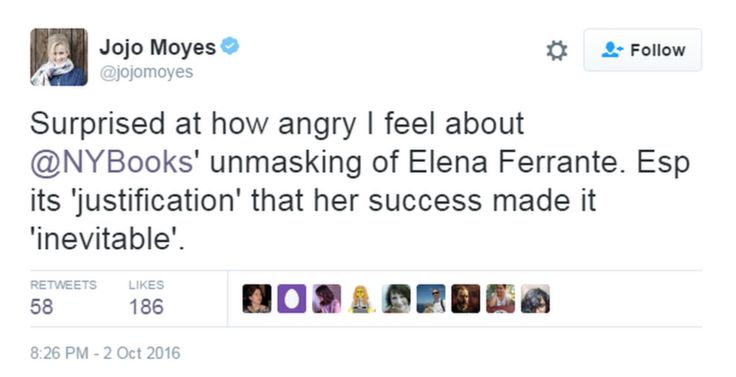
    Jojo Moyes's tweet

    JoJo Moyes, the author of Me Before You, was one of the writers to criticise the journalist in a series of tweets.

    “Maybe Elena Ferrante has very good reasons to write under a pseudonym. It’s not our ‘right’ to know her,” Moyes tweeted.

    Indeed it’s not.

    Another writer who has spoken out is Bina Shah, who said what I was thinking:

    Didn’t Elena Ferrante have the right to her anonymity? Another woman stripped naked, metaphorically, by a man.

    Precisely.

    Salman Rushdie said on Facebook that all writers should do the I am Spartacus thing. I am Elsa Ferrante.