
Tag: Gender apartheid

  • The “Men’s & motor” area

    Gender policing? What gender policing? I can’t imagine what that could possibly be.

    A supermarket has apologised after copies of a science magazine were displayed in the men’s interest section of its news stand.

    A biology graduate complained to Morrisons after the weekly New Scientist magazine was moved to the “Men’s & motor” area of the rack at the Woohouse Land store in Leeds.

    No science for women. Women are too pink and fluffy and frothy to be interested in science. Women are interested only in bride magazines and how to arrange your hair magazines. Everything else is over their heads.

    Writing in a Facebook post seen by The Tab student newspaper, former Leeds student Sophie Anam said that the display gave a negative message to girls.

    That science isn’t for them? But is that really a negative message, if you truly think about it? Women are so much happier and more content with their lot if people don’t encourage them to think they can do things like science and engineering and politics.

    The supermarket sparked further controversy when it responded to Ms Anam: “this magazine has been placed under this section is that it is a generally a men’s general interest magazine.”

    No. No, it really isn’t. Sarcasm aside, that’s a staggeringly insulting thing to say. Half, remember? We’re not some funny little fringe group, we’re half. No, we’re not mentally children.
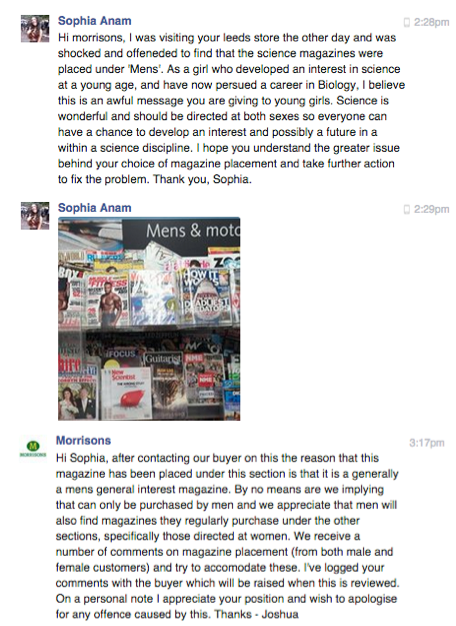
    Embedded image permalink

    Sophia Anam on Twitter

    The good news is that Morrisons pulled itself together and said the sign was a mistake.

    The incident occurred in a climate of concern that women are underrepresented and put off from careers in science, technology, engineering, and mathematics (Stem) because of societal pressures.

    Despite the constantly reiterated insistence of Christina Hoff Sommers that all that has been fixed now.

    Women currently make up around 12.8 per cent of the Stem workforce, according to the campaign group Women in Science and Engineering (Wise).

    The figure was compounded by a recent study which found that women are less likely to become scientists and engineers because they are taught to believe that such professions require innate intellectual brilliance rather than hard work.

    So let’s do better, shall we?

  • Relatively benign

    Gita Sahgal alerted me to this long article by Ann Elizabeth Mayer on “A Benign Aparheid: How Gender Apartheid Has Been Rationalized” [pdf].

    An examination of the situation of women in some Middle Eastern countries reveals patterns of systematic, egregious gender discrimination. However, to date international law has failed to classify such treatment as a kind of apartheid, and the international community has failed to impose sanctions to deter such treatment of women. This article explores why gender apartheid, despite its direct analogies to racial apartheid, has largely been seen as a relatively benign phenomenon. Both countries defending their discriminatory treatment of women and Western apologists for such treatment depoliticize laws and policies discriminating against women. Cultural relativist proclivities mean that the reality of male domination and women’s oppression is obscured and that people can be persuaded that women’s status is merely an expression of cultural and religious traditions that outsiders are bound to respect. At the same time, certain U.S. academics are working to discredit critics of gender apartheid by attacking women’s international human rights, ascribing advocacy of the latter to a destructive totalitarian ideology that is inimical to freedom of religion and religious values. A critical appraisal of the attempts to rationalize gender apartheid reveals flawed logic and serious misrepresentations of the politics of gender in Middle Eastern countries.

    That’s dated 2000. The situation hasn’t improved much since then, I think, though it may be a little more on the radar. But there were people who were outraged by LSESUASH’s use of a photo from an anti-apartheid demo for the protest against gender segregation – as if it’s just obvious that gender segregation is comparatively trivial.

    Here’s a passage that I wish Priyamvada Gopal and Laurie Penny would read carefully and take to heart. (They won’t, but I wish they would.)

    This article also analyzes attempts that have been made by some U.S. academics to induce U.S. opinion to reject international human rights law as the criterion for judging the treatment of women in the Middle East. Religion and culture are depicted by such academics as if these set parameters regarding the treatment of women that are accepted by insiders to a given society, only being contested and criticized
    by outsiders. Such depictions completely ignore the intense controversies about women’s rights that are going on within Middle Eastern societies. These academics work to discredit advocacy of women’s international human rights, deliberately associating challenges to gender discrimination with negatives like neocolonialism/imperialism and attacks on culture and religion. Specters of a feminist totalitarianism that aims to bring about genocide have even been invoked. By such tactics, apologists for systematic gender discrimination have tried to make patterns of pervasive gender discrimination and segregation seem relatively innocuous, presenting these patterns as a kind of benign apartheid.

    Why would they want to do that, do you suppose? I don’t understand it at all, myself.