
Tag: James Damore

  • He was trying to fix a broken culture

    The war over the Google memo continues. Business Insider has another conversation with young James Damore.

    A lot of the debate about fired Google memo writer James Damore has centered around his views, the science he cited, and whether or not he deserved to get fired.

    But what’s been largely ignored is how women within Google felt and his reaction to that.

    In an interview with Business Insider, Damore says he wasn’t trying to attack women, but fix what he views as a broken culture within Google. He didn’t express remorse for what he wrote, and went back to his point that he was fired for his conservative views, not the fact that he violated Google’s code of conduct for making assumptions about women, as CEO Sundar Pichai said.

    That’s fatuous, of course. He wasn’t fired for his “views” – he was fired for circulating a memo disparaging women and saying they’re too different to work at Google. Nobody at any corporation gives a flying fuck about the “views” of any young minor employee; what the bosses give a fuck about is what employees say to other employees on company time and company computers.

    Steve Kovach: So there’s been a lot of debate and discussion about this. And instead of asking you the same questions you’ve been asked probably a thousand times before, I wanted to focus more on the reason why, at least from Google’s perspective, you were fired. And also the impact it had on some of your former colleagues. I’ve spoken to numerous people within the company, and one thing I keep hearing from your former female colleagues is they felt attacked by a lot of what was written in that memo. How would you respond to the women at Google who did feel attacked by what you wrote?

    James Damore: Obviously, no one should feel attacked. I was simply trying to fix the culture in many ways. And really help a lot of people who are currently marginalized at Google by pointing out these huge biases that we have in this monolithic culture where anyone with a dissenting view can’t even express themselves. Really, it’s like being gay in the 1950s. These conservatives have to stay in the closet and have to mask who they really are. And that’s a huge problem because there’s open discrimination against anyone who comes out of closet as a conservative.

    Yeahhhhhh no. Coming out of the closet is one thing, and telling a set of fellow employees that they are your inferiors is another. If “conservative”=telling other people they’re inferior, then it needs to stay in the closet with the door locked.

    Kovach: I don’t think that’s why women particularly felt attacked. They felt attacked by some of the assumptions you were making. We won’t really get into a discussion about whether the science you cited was valid or not, but they didn’t feel attacked because you’re conservative. They felt attacked because of the assumptions you were claiming about women.

    Exactly. Nobody gives a damn about James Damore’s politics as such. What people give a damn about is what he is telling his fellow employees.
  • March to keep women out of Google

    Ah yes, of course they are.

    Members of the alt-right are planning to protest Google for “silencing dissenting voices.”

    The #MarchOnGoogle website says protests are planned at Google headquarters on August 19 in five cities: Mountain View, Calif., New York City, Washington D.C., Austin, and Boston.

    Behold: a manifesto.

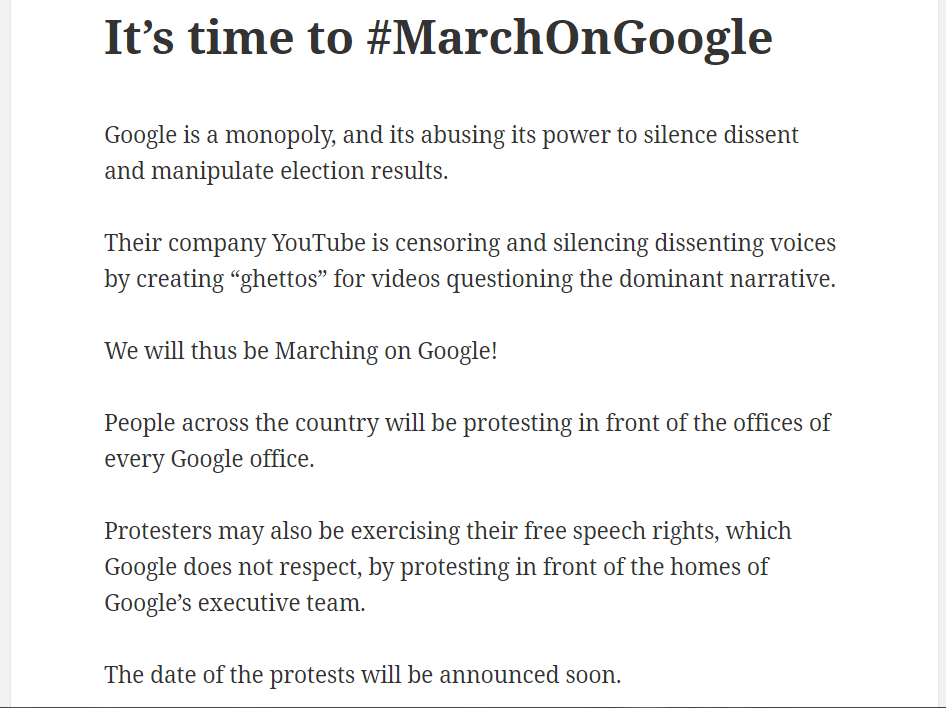
    Capture

    It’s time to #MarchOnGoogle

    Google is a monopoly, and its abusing its power to silence dissent and manipulate election results.

    Their company YouTube is censoring and silencing dissenting voices by creating “ghettos” for videos questioning the dominant narrative.

    We will thus be Marching on Google!

    People across the country will be protesting in front of the offices of every Google office.

    Protesters may also be exercising their free speech rights, which Google does not respect, by protesting in front of the homes of Google’s executive team.

    The date of the protests will be announced soon.

    In the meantime, bookmark this page, and…

    Post to the hashtag #MarchOnGoogle with your best memes.

    All on the theme “bitchez R diffrunt”?

    Activist and protest march organizer Jack Posobiec told The Mercury News that Google’s recent firing of James Damore, who wrote a controversial diversity memo, was part of the impetus for the protest. “Google’s firing of James Damore is the flashpoint here,” he said. “An engineer fired for simply expressing an opinion that ran counter to Google’s politically-charged atmosphere of an “Ideological Echo Chamber” as (Damore) put it. Real Americans are sick of Big Tech’s crackdown on free speech and we’re taking to the streets.”

    All workplaces must be safe for Men who need to explain why women are Different From Men and coincidentally but inescapably thus Not Suited For Work At Google…and other places whose names will be supplied upon request or upon receipt of a Manifesto, whichever comes first. Or second.

    The dudebros

    United

    Will never be defeated.

  • It is not some twisted, crazy view

    Awesome. Peter Singer also thinks James Damore shouldn’t have been fired. He says why in the Daily News. (Shouldn’t it be David Brooks writing for the Daily News and Peter Singer writing for the Times? This arrangement seems backward to me.)

    James Damore, a software engineer at Google, wrote a memo in which he argued that there are differences between men and women that may explain, in part, why there are fewer women than men in his field of work. For this, Google fired him.

    Google’s CEO, Sundar Pichai, sent Google employees a memo saying that “much of what was in that memo is fair to debate,” but that portions of it cross a line by advancing “harmful gender stereotypes in our workplace.”

    Pichai did not specify which sections of the memo discussed issues that are fair to debate, and which portions cross the line. That would have been difficult to do, because the entire memo is about whether certain gender stereotypes have a basis in reality.

    No it isn’t. There are other things in the memo.

    Singer goes through the list of Damore’s stale observations about how wimmin R diffrunt.

    Damore is careful to point out that the evidence for these claims does not show that all women have these characteristics to a higher degree than men.

    Oh for god’s sake. How credulous can you be? Yes of course he is, because he’s putting on a show of Highly Reasonable Dude.

    I wonder if Peter Singer would have said all this if Damore had written exactly the same memo but substituting “blacks” for “women” and “whites” for men.

    Except I don’t really wonder. I’m pretty damn sure he wouldn’t have.

    There is scientific research supporting the views Damore expresses. There are also grounds for questioning some of this research. In assessing Google’s action in firing Damore, it isn’t necessary to decide which side is right, but only whether Damore’s view is one that a Google employee should be permitted to express.

    I think it is. First, as I’ve said, it is not some twisted, crazy view. There are serious articles, published in leading peer-reviewed scientific journals, supporting it.

    Second, it addresses an important issue. Google is rightly troubled by the fact that its workforce is largely male. Sexism in many areas of employment is well-documented. Employers should be alert to the possibility that they are discriminating against women, and should take steps to prevent such discrimination. Some orchestras now conduct blind auditions…

    And more businesses should do that, Singer says cheerily.

    But once such anti-discrimination measures have been taken, to the greatest extent feasible, does the fact that a workforce in a particular industry is predominantly male prove that there has been discrimination? Not if the kind of work on offer is likely to be attractive to more men than to women.

    If the view Damore defends is right, that will be true of software engineering. If it is, then moving beyond the avoidance of discrimination in hiring and promotion to a policy of giving preference to women over men would be questionable.

    That may be true, but we’re not there yet. We’re not anywhere near that yet. We’re still mired in a world where dudebros spend much of their spare time explaining what’s so wrong and stupid and inferior about women. Damore’s banal “memo” was just more of that, dressed up carefully enough that it – bafflingly – fooled Peter Singer. I find that kind of pathetic.

    So on an issue that matters, Damore put forward a view that has reasonable scientific support, and on which it is important to know what the facts are. Why then was he fired?

    Pichai, Google’s CEO, says that “To suggest a group of our colleagues have traits that make them less biologically suited to that work is offensive and not OK.” But Damore explicitly, and more than once, made it clear that he was not reducing individuals to a group, and so was not saying that all — or even, necessarily, any — women employed by Google as software engineers are less biologically suited to their work than men.

    Jesus christ! Has the man never heard of lying? Has he never seen any advertising or public relations or political speechifying? Yes we know what Damore explicitly made clear, but he didn’t mean it, and that was blindingly obvious to any woman who has already heard this shit 90 thousand times and doesn’t need to hear it again.

    Wouldn’t you think a philospher of Singer’s caliber would have the nous to figure that out?

    Google is a very selective employer, and so it is highly probable that Google’s selection processes have led to Google employing women who are, in specific traits, uncharacteristic of women as a whole. The target of Damore’s memo was the idea that we should expect women to make up half the software engineering workforce, and that Google should take measures directed towards achieving that outcome.

    Pichai also quotes Google’s Code of Conduct, which expects “each Googler to do their utmost to create a workplace culture that is free of harassment, intimidation, bias and unlawful discrimination.” Damore’s memo did not harass or intimidate anyone, and in a society that protects freedom of expression, there was nothing unlawful about it. Was it biased? To show that it was, it would need to be demonstrated that Damore was biased in selecting certain scientific studies that supported his view while disregarding others that went against it. Perhaps that case could — and should — be made, but to do so would take some time and research. In any case, Pichai does not attempt, in even the most cursory way, to make it.

    See above. All this depends on taking Damore completely at face value, which is just dense, and not only dense but obnoxiously clueless about injustices perpetrated against people who aren’t like him. If he had read even one of the many articles or posts by women in tech that explained why Damore’s memo is crap, he probably wouldn’t have written this.

    Embarrassing.

  • NPR spreads the Brooks around

    NPR gave David Brooks a chance to repeat his very inept reading of James Damore’s memo yesterday.

    [AUDIE] CORNISH: One last idea that came out of Silicon Valley, and this is a debate over a viral memo from a Google engineer who argued, among other things, that Google had a left bias that created a politically correct mono culture that shamed dissenters into silence. Also made some comments about men and women and biological differences. David, you argue that the person who should have been fired is Google’s CEO. How come?

    BROOKS: Well, you know, all of this starts with a long debate we’ve been having for decades about evolutionary psychology and the differences between men and women. And there’s this vast body of research out there on this subject. And it shows, first, mostly, there are no real significant differences between men and women on abilities, on the ability to do math, on IQ – pretty much the same. There are some minor differences between populations, mostly in levels of interest, not in levels of ability. And – but these are all about populations. You can’t tell anything about a person, about an individual from any of these studies. Who should work at Google? Who should not work at Google? Who’s good at tech? And James Damore…

    CORNISH: But just to stop you there, like, if you say something bad about your…

    DIONNE: That sounds like a critique of James Damore.

    BROOKS: No, that’s exactly what James Damore…

    CORNISH: This is the name of the engineer.

    BROOKS: And this is exactly what James Damore wrote in his memo. And now a whole series of evolutionary psychologists have come out – I quoted a couple in my column today – saying that he was a pretty accurate summary of the body of research. And so someone at a scientific company should not be fired for sort of accurately summarizing the science. Now, I understand why – go ahead, E.J.

    No, that is not what Damore wrote in his memo. Jesus. If you can’t even get that right then shut up about it.

    DIONNE: Oh, go ahead, David.

    BROOKS: I understand why some of the people who are there, who are – especially some of the women who are in a hostile work environment being silenced in meetings are upset because they’re living in one reality, which is the reality that we live out every day as individuals. And they’re absolutely right. But James Damore, his – the research he summarized is talking about populations. And he, too, is right. And Pichai should have done a much better job of, A, not firing him and, B, explaining the differences.

    CORNISH: E.J., last word to you.

    DIONNE: Where I disagree is I don’t think the research is anywhere near as good as David is suggesting it is. And some of what he said were pure stereotypes. Women generally have a stronger interest in people, rather than things relative to men. And I thought Anna Wiener in The New Yorker really had it right that this memo was a kind of smack in the face for plenty of tech workers and executives – for plenty of women who are used to tech workers and executives considering hiring women as lowering the bar. I mean, there was something just terribly wrong with this memo. I’m a pro-labor guy. I don’t like people getting fired, but I think this memo had a lot of problems in it.

    I’m pro-labor too, so that includes being in favor of women’s ability to work in an environment where their presence is just taken for granted. Women shouldn’t have to feel they’re only provisionally there, subject to the daily judgement of men who swap stories about how much more neurotic women are.

    I wonder…if Damore’s memo had been about Other Races as opposed to the Other Sex, and had been otherwise identical, would David Brooks be defending it and saying the CEO should be fired?

    I don’t know, of course, but I doubt it. I doubted it when Michael Shermer said it’s more of a guy thing – I thought if it had been “it’s more of a white thing” it wouldn’t have made it out of his mouth. I still think that. The same applies to Sam Harris’s “estrogen vibe” – I don’t think he would have said “melatonin vibe.” I think guys like Shermer and Harris and Brooks can hear it when it’s about race, and stop themselves, but they can’t damn well hear it when it’s about women.

  • Women are supposed to take care of Wally and the Beaver

    One or two comments on Brooks’s dopy gurlz R diffrunt frum Us piece.

    LT:

    Mr Brooks, as someone paid to express opinions instead of say, writing software, you may be surprised to learn that most companies are not interested in providing a platform for employees to express controversial opinions outside of their job scope.

    When such opinions interfere with the employees ability to effectively perform their job they are often asked to leave.

    Mr. Damore expressed his thoughts in a way that made leading and working with a diverse team of engineers who may not share his opinion, difficult if not impossible.

    You may feel Damore made several good points but Google is not a debating club and Pichai had every right to fire him.

    And if next week someone at Apple or Microsoft or Walmart, decides that their company needs to read their valuable thoughts about say, Charles Murray’s “The Bell Curve” , perhaps they should remember they are not a columnist before they press send.

    atmt:

    “Fire the CEO”, says Mr. Brooks, but fails spectacularly to build a case supporting such an action.
    Firstly, he assumes that because some scientists have supported Damore’s memo, it represents settled science. It doesn’t. Other scientists/ academics including Adam Grant have disputed the memo’s claims. A recent article in the Guardian points out that the memo’s claims do not hold up in other cultural/ geographical contexts, such as in China and India, where controlled empirical tests do not demonstrate the gender differences cited in the memo. Etc.
    Secondly, Google is not a gender/ genetic research laboratory, whose primary goal is to give a platform to the latest scientific research in the field, regardless of whether it is settled science. It is a private company, whose primary responsibility is to its shareholders. It needs to make money, for which it must make sure that employees feel motivated, energized and valued, rather than discontented, demoralized and devalued. Hence it must nip the seeds of discontent in the bud. In that context, Pichai made absolutely the right decision.

    gemli:

    Well, there are differences between men and women. I mean, vive la différence! Hubba hubba!

    Also, women are supposed to take care of Wally and the Beaver, putter around the kitchen in dresses and high heels and prepare meals for the breadwinner, who’s an executive at a big company that is quite diverse, in that it probably hires black people to run the elevators.

    I exaggerate to make a point. I read James Damore’s memo, and I don’t think I was as shocked as a liberal is supposed to be. Then again, I’m a little insensitive to bunny-hugging college kids who need trigger warnings before sensitive topics, like literature and history, are discussed in class.

    But I’m not sure what Damore was trying to accomplish in this memo that justified what amounted to juggling nitroglycerine, or why defending himself on right-wing AM radio seemed like the best venue for defending his thesis.

    Is Google not making enough technological progress? Is taking over the world being slowed by offices full of hysterical females?

    Back when my parents were born, women couldn’t vote. When I was born, the front page of the local newspaper reported that a woman(!) was a jury member in a murder trial. It’s been an uphill slog for women to gain fully human status and a modicum of respect, and it’s alarming that despite so much progress, crotch groping is not a disqualification for the presidency.

    Damore needn’t grease the skids. They’re plenty greasy enough.

    Jessica:

    In the late nineteenth century and beyond, it was common to asssert that women were biologically unsuited to the medical profession. Now nearly half of medical students in the United States are women. Imagine how doctors’ demographics would look if the Damores of earlier times had won the day. Perhaps it’s better to assume the dominance of discrimination until proven otherwise, especially when the gender balance is as highly skewed as it is in the tech sector.

    I cherry-picked comments critical of Brooks. There were plenty of fans commenting.

  • David Brooks being clueless again

    Oh good. Superb. David Brooks has weighed in, as usual with an air of omniscient authority as if he were au fait with all the relevant research as well as all the arguments, and he comes down with a thud on the side of poor oppressed James Damore. And his piece is at the top of the Times’s trending links.

    There are many actors in the whole Google/diversity drama, but I’d say the one who’s behaved the worst is the C.E.O., Sundar Pichai.

    The first actor is James Damore, who wrote the memo. In it, he was trying to explain why 80 percent of Google’s tech employees are male. He agreed that there are large cultural biases but also pointed to a genetic component. Then he described some of the ways the distribution of qualities differs across male and female populations.

    Note that credulous “he was trying to explain why 80 percent of Google’s tech employees are male” – as if it were a deep mystery as opposed to just another iteration of the commonplace fact that employers favor men in hiring. Note that minimizing “but also pointed to a genetic component.” Note the assumption that Damore was up to the job of describing “some of the ways the distribution of qualities differs across male and female populations.” Note the way he frames the whole thing, and then pause to swallow bile.

    Damore was tapping into the long and contentious debate about genes and behavior. On one side are those who believe that humans come out as blank slates and are formed by social structures. On the other are the evolutionary psychologists who argue that genes interact with environment and play a large role in shaping who we are. In general the evolutionary psychologists have been winning this debate.

    That’s a very simplistic and manipulative way of framing it. I don’t think it’s the case that everyone who emphasizes the role of culture / social structures / environment discounts genes entirely, and I don’t think it’s the case that evolutionary psychologists are the only ones who argue that genes interact with environment.

    Brooks quotes a couple of Damore-approvers and none of the other kind.

    We should all have a lot of sympathy for the second group of actors in this drama, the women in tech who felt the memo made their lives harder.

    Oh fuck you, Brooks, and your “we.” News flash: half of us are that second group: the women in and out of tech whose lives the memo has made harder. We don’t want your lot of sympathy, we want you to go write another book about yuppies.

    What we have is a legitimate tension. Damore is describing a truth on one level; his sensible critics are describing a different truth, one that exists on another level. He is championing scientific research; they are championing gender equality. It takes a little subtlety to harmonize these strands, but it’s doable.

    Puh-leeze. Damore is “championing scientific research” only in the sense that he used the words; he didn’t actually include any citations. He’s not a scientist and he doesn’t work in genetics. What he’s championing is the use of cherry-picked research to prop up his preference to keep the numbers of women in tech small. And “they” are not championing gender equality as opposed to scientific research, so quit painting “them” as akin to creationists.

    Then he rants about mobs, then he quotes Conor Friedersdorf, then he rants at the CEO.

    Which brings us to Pichai, the supposed grown-up in the room. He could have wrestled with the tension between population-level research and individual experience. He could have stood up for the free flow of information. Instead he joined the mob. He fired Damore and wrote, “To suggest a group of our colleagues have traits that make them less biologically suited to that work is offensive and not O.K.”

    That is a blatantly dishonest characterization of the memo. Damore wrote nothing like that about his Google colleagues. Either Pichai is unprepared to understand the research (unlikely), is not capable of handling complex data flows (a bad trait in a C.E.O.) or was simply too afraid to stand up to a mob.

    Brooks is unprepared to understand the long and prolific history of Damore-like “memos” and posts and tweet sequences that has built up over the past few years (and echoes a history that goes back decades and centuries before that). He thinks Damore wrote a sober, disinterested, research-based piece well worth reading and discussing. He didn’t. As so many people have said over the past few days: what he wrote is all too familiar and stale and flimsy and wrong. That Brooks takes it so seriously is laughable…or would be, were it not for the fact that the Times has elevated him to a position of authority he hasn’t earned.

  • A fresh smack in the face

    Anna Wiener on James Damore as part of Silicon Valley culture.

    As soon as news of the memo broke, tech workers took to the Internet. (Ours is a privileged moment: never before has it been so easy to gain access to the errant musings, rapid-fire opinions, and random proclivities of venture capitalists and others we enrich.) There were calls for Damore to be blacklisted from the industry; nuanced analyses of the memo’s underlying assumptions and ripple effects; facile analyses of the same; message-board debates about sexual harassment, affirmative action, evolutionary biology, eugenics, and “wrongthink”; and disagreements about the appropriateness of Google’s response. (“Firing people for their ideas should be opposed,” Jeet Heer, a self-described “Twitter Essayist” and an editor at The New Republic, tweeted.) George Orwell’s “1984” was trotted out, discursively, and quickly retired. More than a handful of people pointed out that the field of programming was created, and once dominated, by women. Eric Weinstein, the managing director of Thiel Capital, an investment firm helmed by Peter Thiel, tweeted disapprovingly at Google’s corporate account, “Stop teaching my girl that her path to financial freedom lies not in coding but in complaining to HR.”

    Though Damore’s memo draws on familiar political rhetoric, its style and structure are unique products of Silicon Valley’s workplace culture. At software companies, in particular, people talk—and argue, and dogpile, and offer unsolicited opinions—all the time, all over the place, including in forums like the one where Damore posted “Google’s Ideological Echo Chamber.” In my experience in the tech industry, such forums serve as repositories for all sorts of discussions—feature launches, bug fixes, birth announcements, introductions, farewells—and are meant, in part, to promote the open-source ethos that everyone can, and should, pitch in. But they also favor the kind of discourse that people outside the industry may recognize from online platforms such as Reddit and Hacker News; it is solution-oriented, purporting to value objectivity and rationalism above all, and tends to see the engineer’s dispassion as a tool for solving a whole range of technical and social problems. (“Being emotionally unengaged helps us better reason about the facts,” Damore writes.) But the format is ill-suited to conversations about politics and social justice.

    Aha. Doesn’t that sound familiar – the kind of discourse that people outside the industry may recognize from online platforms such as Reddit and Hacker News…purporting to value objectivity and rationalism above all. Yes, I recognize it all right. I don’t think I’d realized it could be seen as Engineer-think. The format is in fact horrendously ill-suited to conversations about politics and social justice.

    Social justice can’t be engineered. Engineering can help reach the goals, but it has nothing to say about the goals. Thinking about the goals requires emotion as well as reason.

    One of the documents that resurfaced in the online discussion of the Google memo was “What You Can’t Say,” by Paul Graham—the co-founder, along with his wife, Jessica Livingston, of the startup accelerator Y Combinator, which runs Hacker News. The five-thousand-word essay, which Graham published on his personal blog, in 2004, begins with the premise that there exist “moral fashions” that are both arbitrary and pernicious. “Fashion is mistaken for good design; moral fashion is mistaken for good,” he writes. The essay makes a case for contrarian thinking through a series of flattering analogies—Galileo was seen as a heretic in his time; John Milton was advised to keep quiet about the evils of the Roman Inquisition—and argues that opinions considered unfashionable in their time are often retroactively respected, if not taken as gospel. “The statements that make people mad are the ones they worry might be believed,” Graham writes. “I suspect the statements that make people maddest are those they worry might be true.” At several points, he refers to “political correctness.”

    “What You Can’t Say” is by no means a seminal text, but it is the sort of text that has, historically, spoken to a tech audience. “Google’s Ideological Echo Chamber,” with its veneer of cool rationalism, echoes Graham’s essay in certain ways. But, where Graham’s argument is made thoughtfully and in good faith—he is a proponent of intellectual inquiry, even if the outcome is controversial—Damore’s is a sort of performance. His memo shows a deep misunderstanding of what constitutes power in Silicon Valley, and where that power lies.

    Spoiler: the power still lies with white men.

    By positioning diversity programs as discriminatory, Damore paints exactly the opposite picture. He frames employees like himself as a silenced minority, and his contrarian opinions as a kind of Galilean heresy.

    It is conceivable, of course, that Damore distributed his memo to thousands of his colleagues because he genuinely thought that it was the best way to strike up a conversation. “Open and honest discussion with those who disagree can highlight our blind spots and help us grow,” he writes. Perhaps he expected that the ensuing dialogue would be akin to a debate over a chunk of code. But, given the memo’s various denigrating assertions about his co-workers, it is difficult to imagine that it was offered in good faith.

    Well maybe it was Engineer-think good faith. People should just look at the facts, and not be upset by them. If the facts are that women are just too emo for tech…what’s the point in getting emo about it?

    Minority groups in tech are no strangers to being second-guessed, condescended to, overlooked, underpaid, and uncredited. But seeing Damore’s arguments made public—and, in some cases, seeing them elicit support—was a fresh smack in the face. It was a reminder that plenty of tech workers and executives still consider hiring women and people of color “lowering the bar,” and that proving one’s place is a constant, Sisyphean task.

    Just in case anyone needed reminding.

  • Let’s debate his points, so his bad ideas can be defeated

    William Pietri wrote a thing that resonates strongly with me (and a lot of other people).

    Some people are having a hard time understanding why the Google engineer was fired. “Let’s debate his points,” they say, “so his bad ideas can be defeated.” That sounds reasonable, but it isn’t. To understand why, let’s conduct a thought experiment.

    Imagine that tomorrow, your least-favorite work colleague reveals that he is a literal Nazi. At your company all hands, he would like to debate a proposition with you. His proposition is: “Inferior races like the n****** and the k**** should be immediately executed; women should return to their status as property of men and be executed if they object.” You ask why he wants to debate this. He says that this is what he believes should happen. Do you accept the debate?

    Let’s assume that you refuse, possibly with some swearing. This means you believe, as I do, some ideas are not worth debating. Perhaps you recognize how this would make non-white-male members of the audience feel to have their humanity and survival up for debate. Perhaps you see that by debating his ideas, you help normalize them, making them more likely to happen. Perhaps you realize that you’d be exposing your company to a massive lawsuit. And maybe you just don’t want to give this guy or his terrible ideas the elevation in stature that comes with treating them as worth serious discussion. Your colleague slinks away.

    The next day, he proposes a different, less extreme debate topic: “Non-white races should be enslaved; women should be treated as property and beaten if they object.” You ask if he has changed his beliefs. He shakes his head. Again you say no; again he goes away.

    On day three, he has another proposal. “Non-white races should be isolated in ghettos and reservations; women cannot work or own property and must always be accompanied by a male relative when outside their home.” Again you say no. Again he leaves.

    Each night, he realizes that his ideas as expressed are beyond what’s socially acceptable. Each day, he comes back to you with a slightly more mild debate proposition. His intent never changes; he’s just looking for a way to get on stage. When do you say yes?

    You might say, “Never!” But at some point, he will have refined his pitch enough that a bystander not having heard the history will say, “Why are you refusing to debate him? That seems like an entirely reasonable thing to talk about.”

    That’s where we are with James Damore and his manifesto. If one has plenty of privilege, doesn’t know the long history of race- and gender-based oppression in America, and hasn’t kept up with the arguments of terrible people, it is apparently easy to read his screed and say, “Well, maybe we should talk about it.” That’s especially easy to say if your humanity and your participation in the workforce aren’t up for debate. Not only is it no skin off your nose, but you are being invited to judge everybody else, which can feel appealing.

    Exactly. Damore’s manifesto is strikingly un-novel, unoriginal, unsurprising; it’s the same old shit we’ve been seeing forever, especially and with extra venom over the past few years (thanks, Twitter). No we don’t need to “talk about it” yet again; it’s been talked about ad infinitum for decades. Plus it’s shit.

    It’s the same trick the alt right and the neoreaction loons have been pulling. They get that white hoods and swastika armbands and prison tattoos are beyond the pale. So they have carefully rebranded their ideas. They are still white nationalists. But they talk about their opposition to multiculturalism. They talk about supporting people who want to live near people like themselves. They fret about “too much” immigration “changing the character” of America. America first, they say! They still admit to wanting ethnic cleansing, but maybe they describe it as peaceful demographic change.

    I won’t tell you not to talk to these people. But I will tell you that giving them a platform is exactly what they want. Getting the mildest versions of their ideas discussed is the foot in the door, the leading edge of the axe. They will use your attention and credulity to shift the Overton window bit by bit. You might think you’re being brave and open-minded, but marginalized people around you will realize that you can’t be trusted. That you value the appearance of openness far more than their safety.

    That window? It’s shifted a lot already.

  • The slights that come with that question

    YouTube CEO Susan Wojcicki has thoughts on Damore’s memo. She starts with her daughter asking her if it’s true that there are biological reasons why there are fewer women in tech and leadership. Thanks, James Damore, for re-planting that seed of doubt in millions of girls and women. Nice job, 28-year-old dude – no doubt you eliminated a lot of competition with your memo.

    That question, whether it’s been asked outright, whispered quietly, or simply lingered in the back of someone’s mind, has weighed heavily on me throughout my career in technology. Though I’ve been lucky to work at a company where I’ve received a lot of support—from leaders like Larry Page, Sergey Brin, Eric Schmidt, and Jonathan Rosenberg to mentors like Bill Campbell—my experience in the tech industry has shown me just how pervasive that question is.

    Time and again, I’ve faced the slights that come with that question. I’ve had my abilities and commitment to my job questioned. I’ve been left out of key industry events and social gatherings. I’ve had meetings with external leaders where they primarily addressed the more junior male colleagues. I’ve had my comments frequently interrupted and my ideas ignored until they were rephrased by men. No matter how often this all happened, it still hurt.

    And here’s the thing. That itself is a huge part of the reason there are fewer women in tech. Women don’t feel welcome or respected because of that kind of thing, and many of them just decide it’s not worth it. People do that you know. We all have our lives to live, and yes we’d love to help make things better but we’d also love to be reasonably happy at work, so not all of us are willing to put up with a lifetime of sexist bullshit as the penalty for working in a field full of James Damores.

    That’s the first thing we should be looking about when talking about the percentages. Not the last, the first. There’s plenty of time to talk about small differences in averages and whether they exist, but first we should make damn sure there are no stupid spiteful block-headed barriers like the entrenched belief that Women Just Happen To Be Better At Baking Cakes.

    So when I saw the memo that circulated last week, I once again felt that pain, and empathized with the pain it must have caused others. I thought about the women at Google who are now facing a very public discussion about their abilities, sparked by one of their own co-workers. I thought about the women throughout the tech field who are already dealing with the implicit biases that haunt our industry (which I’ve written about before), now confronting them explicitly. I thought about how the gender gap persists in tech despite declining in other STEM fields, how hard we’ve been working as an industry to reverse that trend, and how this was yet another discouraging signal to young women who aspire to study computer science. And as my child asked me the question I’d long sought to overcome in my own life, I thought about how tragic it was that this unfounded bias was now being exposed to a new generation.

    Yet another discouraging signal – that’s what we object to. I’ve seen men (mostly men) agonizing about free speech, no one should be fired for expressing an opinion, free speech, free speech, free speech – but their “free speech” is our yet another discouraging signal. Discouraging signals do their work, all the more so when they’re pervasive and endlessly repeated and defended by free speech publicists.

    Wojcicki gets to that.

    Some of those responding to the memo are trying to defend its authorship as an issue of free speech. As a company that has long supported free expression, Google obviously stands by the right that employees have to voice, publish or tweet their opinions. But while people may have a right to express their beliefs in public, that does not mean companies cannot take action when women are subjected to comments that perpetuate negative stereotypes about them based on their gender. Every day, companies take action against employees who make unlawful statements about co-workers, or create hostile work environments.

    It is an issue of free speech, as well as other things, but it’s far from a slam dunk free speech violation. Damore’s memo is not a disinterested general opinion on an abstract subject – say, free will, or free trade, or gun control. It’s a highly political “opinion” about the abilities of women in tech, and thus of the small percentage of women who work at Google. The freedom to say women are too stupid to work in tech is not absolute.

  • The structural differences that create inequality

    Lara Williams at New Scientist points out James Damore’s neglect of the social aspect of perceived differences between women and men.

    One truth though is that biological determinism has a history of being trotted out to justify sexism and it is problematic for a number of reasons. Damore’s manifesto portrays women as a product of inherited traits; understanding womanhood as an expressly anatomical concept without social and cultural influence. He needs to heed French intellectual and feminist Simone de Beauvoir’s famous line, “one is not born, but rather becomes, a woman”.

    Feminist identity politics are, broadly speaking, concerned with the ways female identity and prescriptive modes of femininity are shaped and constructed. Damore’s assertions presume gender identity happens in a cultural vacuum.

    That was my chief frustration with it. “This stuff is drilled into us, you can’t just ignore that!”

    “We ask why we don’t see women in top leadership positions, but we never ask why we see so many men in these jobs,” Damore states. “These positions often require long, stressful hours that may not be worth it if you want a balanced and fulfilling life.”

    But we absolutely do ask. Men do not have biological predisposition towards stressful hours any more than women do; likewise, a “balanced and fulfilling life” comes with different expectations if it is likely you are the half of a partnership required to pick up the majority of the domestic labour and child-rearing duties. The structural differences that create inequality are more nuanced than genitals and genetics.

    Damore probably thinks women “biologically” want to do all the domestic labor.

    Damore outlines Google’s diversity strategies, such as mentoring and classes for marginalised candidates, as harmful, stating they actually “increase race and gender tensions”. Such strategies increase tensions only for those with a sense of privilege and entitlement, threatened by the usurping of a status quo they benefit from.

    What he does not address is the widely discussed prevalence of an aggressively masculine “bro-culture”, making those long office hours even less palatable for women. A 2016 survey found that 60 per cent of female employees in tech roles reported unwanted sexual advances and 87 per cent reported demeaning comments from male colleagues.

    Like James Damore’s, for instance. Funny how that works.

  • James Damore: the celebrity years

    Ah, of course he did. James Damore turned down interview requests from professional journalists and instead shared his wisdom with two right-wing anti-feminist YouTubers, Stefan Molyneux and Jordan Peterson.

    The videos posted Tuesday, which quickly racked up hundreds of thousands of views, come as Damore has threatened to take legal action against Google over his termination, making him an overnight celebrity amongst the “alt-right” and other conservatives in Silicon Valley.

    The podcasters provided a sympathetic audience for Damore, who also argued that Google is intolerant of rightwing viewpoints and that companies discriminate against white men with diversity and inclusion initiatives. (Google remains overwhelmingly white and male, with women occupying just 20% of the technical workforce and African Americans at 1%, according to company statistics).

    So where’s the discrimination exactly? Damore thinks Google should be 100% white and male, and anything less is discrimination?

    I guess that’s one of the ways women are different from men.

    Damore told Molyneux in his 45-minute long interview that he was inspired to write his manifesto after attending a Google diversity program that he found offensive.

    “It was totally secretive. And I heard things that I definitely disagreed with,” he said. “There was a lot of just shaming and, ‘No you can’t say that, that’s sexist, you can’t do this.’ There’s just so much hypocrisy.”

    It’s such an outrage to tell people they can’t say sexist shit in the workplace.

    Damore has faced widespread scrutiny this week, with journalists investigating his time at Harvard where he reportedly was involved in a sexist skit in the systems biology program. His LinkedIn profile had also said that he obtained a PhD, but a Harvard spokeswoman confirmed that he only completed a master’s degree in 2013 before starting at Google.

    One former Harvard student, who was in the systems biology program at the same time as Damore, told the Guardian that it was not surprising to find out he was the author of the controversial manifesto, which was widely criticized for relying on shoddy science.

    “His comments do not reflect the ability to read literature critically that a typical Harvard student develops over the course of actually completing a PhD,” the former classmate said.

    Damore’s views, the source said, made him an outlier in the department, which values diversity.

    “It’s pretty unusual someone would have those opinions and be stupid enough to voice them,” the former classmate said. “Part of me worries that he got into some dark corner of the internet.”

    Well that’s the thing: it’s not so much a dark corner as a dark large segment.

    It’s amusing that Damore accuses Google of being an ideological echo-chamber. Molyneux and Peterson aren’t?

  • Prejudice masquerading as fact

    Angela Saini, author of Inferior: How Science Got Women Wrong, on that memo.

    A portion of his argument is indeed based on published science. In particular, there is a school of neuroscience that tries to popularise the notion that male and female brains are distinct. It claims that female brains are typically hardwired for empathy, while male brains are built to analyse systems, such as computers and cars. This all hinges on the idea that autism represents an extreme form of the male brain, caused by exposure to higher than usual testosterone levels in the womb. Yet recent experiments have repeatedly failed to find a direct link between foetal testosterone levels alone and autism.

    Indeed, psychological studies show that there are only the tiniest gaps, if any, between the sexes, including areas such as mathematical ability and verbal fluency. Navigating this complicated field for my latest book, Inferior: How Science Got Women Wrong, I was told by a prominent American researcher into sex difference that he no longer refers to brains as sexually dimorphic, because the science simply doesn’t support this. There isn’t a neuroscientist alive who can say with confidence which sex any given brain belongs to.

    In short the science in the memo is “flawed,” but the memo is getting lots of support anyway.

    What they fail to understand is that there are published scientific papers out there to support every possible opinion, even that black people are intellectually inferior to white people. Getting published doesn’t make an idea true, it only means that someone has managed to get it into print. In evolutionary psychology, theories are sometimes little more than speculation strung together with scant evidence.

    There was a time, she points out, when eugenics was considered good science.

    Weak scientific evidence and empty theories are still being used to support troubling ideologies. Women are making enormous strides in science and engineering – yet, with some half-cocked hypotheses in their back pockets, male software engineers feel they have the right to tell them they are somehow biologically unsuited to this kind of work.

    They forget, perhaps, that many of the world’s original computer programmers were women, including the first: Ada Lovelace. Women began to be marginalised in technology around the time that personal computing took off and become a lucrative industry. Male software engineers forget that discrimination and sexual harassment have driven women out of Silicon Valley, and kept countless more out in the first place.

    The myriad historical, cultural and social factors that create inequality are all too easily glossed over when someone reaches for the closest, most convenient biological explanation for what they see. This isn’t just intellectual laziness; this is prejudice masquerading as fact.

    It’s also men being assholes.

  • Less concerned with oxidization

    Ben Kronengold at McSweeney’s:

    I, a manufacturing robot at Google Factory C4.7, value diversity and inclusion. I also do not deny that machines are sometimes given preference to humans in the workplace. All I’m suggesting in this document is that humans’ underrepresentation in tech is not due to discrimination. Rather, it is a result of biological differences. Specifically, humans have a biology.

    Humans and robots are different, and that’s not socially constructed, it’s the real deal.

    Humans, on average are:

    • More concerned with relationships
    • Less concerned with oxidization
    • More likely to “pee”

    Humans are also far more likely to “literally cannot right now.”

    Robots never cannot right now.

    Suggestions

    I hope it’s clear that I’m not saying that diversity is bad. I realize the value of having humans on our team at Google and in society at large. But we should not be manufacturing (computed: pun) diversity as we are right now.

    My concrete suggestions are to:

    • De-moralize humanity: As soon as we start to moralize a group, we stop thinking about them in terms of efficiency.
    • Stop alienating never-human-ers: It’s important to give a voice to even the most zealot robots, whether that voice is Male (US), Woman (US), or Male (UK) if we’re feeling fun.
    • Eliminate buzzwords: Like synergy, disruption and 10010110 (this one is in binary, but it’s all any machine on my assembly line says).

      Finally

      If you still think humanity is so valuable, check out that memo from the software engineer on Floor 8. Even we machines literally could not.