Tag: Misogyny

  • Brave contrarian Brendan O’Neill

    Brendan O’Neill is happy to characterize feminists as stupidly and feebly delicate and hyper-sensitive, and to use (or to allow the Telegraph to use) a 19th century illustration of a vapid woman tipping over to underline his sneer.

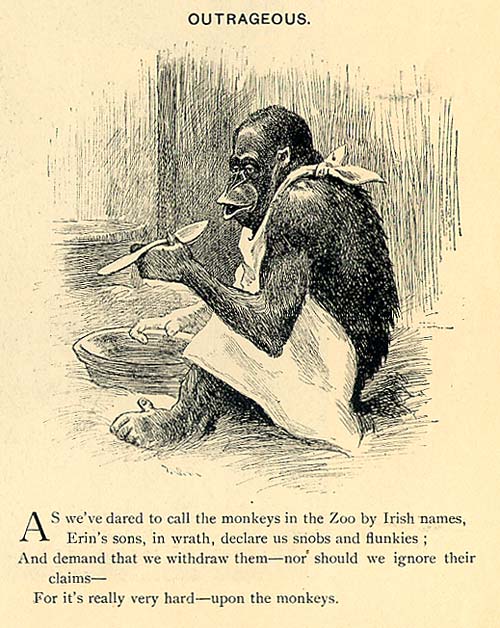
    Would he be equally happy to see other people characterize Irish people as stupid and otherwise contemptible and use a 19th century cartoon to illustrate the sneer? Like this one maybe?

    race-white-irish-discriminatory-cartoon-1

     There are more where that came from. Does Brendan O’Neill of Spiked really want major media returning to the good old days of publishing insulting caricatures of Other racial and ethnic groups? Or is it just women, or just feminists, who are fair game for that kind of thing.

    #mencallmethings

  • Brendan O’Neill wins the sneering prize

    Brendan O’Neill sneers again – this time at women resisting misogynist silencing campaigns.

    One of the great curiosities of modern feminism is that the more radical the feminist is, the more likely she is to suffer fits of Victorian-style vapours upon hearing men use coarse language. Andrea Dworkin dedicated her life to stamping out what she called “hate speech” aimed at women. The Slutwalks women campaigned against everything from “verbal degradation” to “come ons”. And now, in another hilarious echo of the 19th-century notion that women need protecting from vulgar and foul speech, a collective of feminist bloggers has decided to “Stamp Out Misogyny Online”. Their deceptively edgy demeanour, their use of the word “stamp”, cannot disguise the fact that they are the 21st-century equivalent of Victorian chaperones, determined to shield women’s eyes and cover their ears lest they see or hear something upsetting.

    Like this, he or the Telegraph helpfully illustrates:

     Oh yes, that’s it exactly – we’re all falling over, because we’re so fragile and stupid.

    Would even Brendan O’Neill sneer in quite such a contemptuous way if the issue were racism instead of misogyny? Would he (or the Telegraph) include a cartoon like that, mocking the very idea of disliking and resisting racism? I do him the credit to doubt that he would, and the discredit to point out that he has no business having different standards for women.

    …the most striking thing about these fragile feminists’ campaign is the way it elides very different forms of speech. So the Guardian report lumps together “threats of rape”, which are of course serious, with “crude insults” and “unstinting ridicule”, which are not that serious. If I had a penny for every time I was crudely insulted on the internet, labelled a prick, a toad, a shit, a moron, a wide-eyed member of a crazy communist cult, I’d be relatively well-off.

    He says, missing the point by a mile. A toad, a shit, a moron, are all generic. It’s interesting that he didn’t include any anti-Irish epithets, but even if he had, at this point in history they don’t have the bite that racist or homophobic or sexist ones do. (But I’m not Irish. Correct me if I’m wrong and they still have all the old bite.)

    He prides himself on being a libertarian contrarian. That’s nice, but he doesn’t get to ignore reality to shore up his case. Being called a cunt is not the same kind of thing as being called a shit.

    For better or worse, crudeness is part of the internet experience, and if you don’t like it you can always read The Lady instead.

    He says, exemplifying the problem himself. Either you put up with being called a cunt every time you say anything or you have to go read something called “The Lady.” Why would those be the only choices? Why does Brendan O’Neill feel so comfortable letting his contempt for women show?

    Muddying the historic philosophical distinction between words and actions, which has informed enlightened thinking for hundreds of years, is too high a price to pay just so some feminist bloggers can surf the web without having their delicate sensibilities riled.

    Of course it is true that the standard of discussion on the internet leaves a lot to be desired. There is a remarkable amount of incivility and abusiveness on the web. But that is no excuse for attempting to turn the internet into the online equivalent of a Women’s Institute meeting, where no one ever raises their voice or “unstintingly ridicules” another or is crude. I would rather surf a web that caters for all, from the clever to the cranky, rather than put up with an internet designed according to the needs of a tiny number of peculiarly sensitive female bloggers.

    More easy contempt –  ”their delicate sensibilities,” “a Women’s Institute meeting,” “peculiarly sensitive female bloggers.” And one of the tags on that piece is, incredibly – “wallflowers.”

    It’s just unbelievable.


  • Not as easy as you might think

    You may think it’s a cinch getting rid of misogyny. Turns out it’s not. Sady at Tigerbeatdown started out thinking it was (or more like assuming it was without noticing she was assuming it – we all know how that goes), and then she realized it’s not.

    In 2009, I genuinely believed people were going to change their minds about being sexist, because they read my blog.

    I know, right? If only someone had come up with this plan before! All I had to do was register a WordPress domain, compose some charmingly ironic yet pointed analyses of Ye Aulde Patriarchy, cite some academics so they knew I wasn’t stupid, throw a lot of jokes and references to oral sex in there to prove feminists weren’t “humorless” or “frigid,” and the sexists, they would be delighted. So delighted they decided to stop being sexists! “Hmmmm,” they’d say. “Sady sure doesn’t appreciate it when I do the sexism. Since she’s my new Internet Best Friend, I had better cut that shit out pronto! Then we can all join a bowling league!” BLAM. REVOLUTION ACCOMPLISHED. No more problems, for anyone, ever, because I blogged.

    I hate to tell you this, friends. But I think my plan, it had a minor flaw. Which is: Misogynists don’t like women. It doesn’t matter how uniquely charming and witty and acquainted with various fine bourbons you are. Are you a woman? Then they don’t like you. And they especially don’t like you telling them what to do. By, for example, asking them to cut it out with the misogyny.

    There may be one exception to that rule. It may be that if you are a woman who likes misogynists then they do like you – for now. But apart from that, no.

    What I got, friends, were comments. Comments about myself. And blogs about myself. And message-board discussions, also about myself. And e-mails. What I got was what every woman (feminist or not) and openly anti-sexist person (woman or not) on this our Internet gets: I got targeted. With threats, with insults, with smear campaigns, with attempts to threaten my employment or credibility or just general ability to get through the day with a healthy attitude and a minimal amount of insult.

    This is a recurring problem! Not a Special Sady Problem, but an Everyone Problem. And, increasingly, folks are identifying it as such.

    Which means we can count on the threats and insults and smear campaigns to expand hugely, but it also means we can do a better job of resisting.


  • You come to expect the vitriol

    Laurie Penny knows about misogynist abuse of writers who have the effrontery to be women.

    You come to expect it, as a woman writer, particularly if you’re political. You
    come to expect the vitriol, the insults, the death threats. After a while, the
    emails and tweets and comments containing graphic fantasies of how and where and with what kitchen implements certain pseudonymous people would like to rape you cease to be shocking, and become merely a daily or weekly annoyance…

    An opinion, it seems, is the short skirt of the internet. Having one and
    flaunting it is somehow asking an amorphous mass of almost-entirely male
    keyboard-bashers to tell you how they’d like to rape, kill and urinate on you.
    This week, after a particularly ugly slew of threats, I decided to make just a
    few of those messages public on Twitter, and the response I received was
    overwhelming. Many could not believe the hate I received, and many more began to
    share their own stories of harassment, intimidation and abuse.

    Note to self: Follow Laurie Penny on Twitter.

    Perhaps it should be comforting when calling a woman fat and ugly is the best
    response to her arguments, but it’s a chill comfort, especially when one
    realises, as I have come to realise over the past year, just how much time and
    effort some vicious people are prepared to expend trying to punish and silence a
    woman who dares to be ambitious, outspoken, or merely present in a public
    space.

    Quite. The time and effort create a very sinister impression of dedicated, indeed downright Spartan, rage and hatred. The lack of proportion is unnerving.

    Many commentators, wondering aloud where all the strong female voices are,
    close their eyes to how normal this sort of threat has become. Most mornings,
    when I go to check my email, Twitter and Facebook accounts, I have to sift
    through threats of violence, public speculations about my sexual preference and
    the odour and capacity of my genitals, and attempts to write off challenging
    ideas with the declaration that, since I and my friends are so very
    unattractive, anything we have to say must be irrelevant.

    And one starts to think it’s not worth it.

    I’d like to say that none of this bothered me – to be one of those women who
    are strong enough to brush off the abuse, which is always the advice given by
    people who don’t believe bullies and bigots can be fought. Sometimes I feel that
    speaking about the strength it takes just to turn on the computer, or how I’ve
    been afraid to leave my house, is an admission of weakness. Fear that it’s
    somehow your fault for not being strong enough is, of course, what allows
    abusers to continue to abuse.

    I believe the time for silence is over. If we want to build a truly fair and
    vibrant community of political debate and social exchange, online and offline,
    it’s not enough to ignore harassment of women, LGBT people or people of colour
    who dare to have opinions. Free speech means being free to use technology and
    participate in public life without fear of abuse – and if the only people who
    can do so are white, straight men, the internet is not as free as we’d like to
    believe.

    Well then, the internet is not as free as we’d like to believe.

  • Defining sexism downwards

    A re-post from January 2010 – of quite startling relevance: about a pro-rape Facebook page and sexist epithets and…Rod Liddle saying a woman should be kicked in the cunt. How about that.

    January 19, 2010

    I did not know – some male students at St Paul’s College at the University of Sydney set up a pro-rape Facebook page.

    The group, which was named “Define Statutory”, described its members as “anti-consent” and was listed in the sports and recreation section of the site…It was shut down at the end of [October], but had been live on Facebook since August, according to an investigation by the Sydney Morning Herald…The Sydney Morning Herald said the page was part of a broader culture at the residential colleges that “demeans women in a sexist and often sexually violent way”.

    And here I was fuming (or should I say bitching?) about sexist epithets and men who type thousands of words insisting that ‘stupid bitch’ is not sexist. Kind of puts it all in perspective. Except actually I think it’s (broadly speaking) all part of the same thing. I think both items are part of a broader culture in a lot of places that demeans women in a sexist way. I think the bizarro phenomenon of men who ought to know better verbally spewing on women whenever they feel like it is pretty much by definition part of a broader culture that demeans women in a sexist way. That’s why it shocks me that men give themselves permission to do that – it reveals that contempt for women is commonplace in areas where I would have thought it had gone out of fashion decades ago.

    But no – apparently it’s still seen as hip and edgy and funny to treat women like dirt. Apparently sexism is being defined downwards so that it isn’t really sexism unless, I don’t know, it comes with a signed affidavit stating This Is Sexism. Rod Liddle apparently is of that school, unless he really didn’t post this on a Millwall fans’ website:

    Stupid bitch. A year eight sociology lecture from someone who knows fck all. You could equally say that we were similar to any group which disliked a certain aspect of society, felt estranged from it but were sure we were right. The logical extension of her argument is that the status quo is always right, which is absurd, because if that were true nothing would change. Someone kick her in the cnt.

    He was there commenting right after I had, so I asked him if that one was his, saying bitches with cunts would like to know. He said

    I don’t remember saying it and it certainly doesn’t read like me, but it’s quite possible that at some point I might use that temrinology to make a certain point, perhaps the opposite to the one you imagine. Just as you have done, right now. “Bitches with cunts would like to know” is a canny, sardonic pay off to your post. Take it out of context and what have you got?

    I don’t know, but what you haven’t got is ‘I wouldn’t say shit like that in a million years.’ Instead you have men earnestly explaining the terrifically subtle and fascinating difference between saying ‘stupid nigger’ and saying ‘stupid bitch,’ a subtle difference that boils down to: the first is absolutely out and the second is really quite all right and you’re being a dreary fanatic if you say it isn’t. Which boils down to saying casual contempt for other races is not okay and casual contempt for women is fine.

  • Did a wolf howl?

    What’s going on, has ERV blown a new whistle or what? Suddenly Teh Menz are popping up on an old thread to display their vocabularies.

  • What misogynists call outspoken women

    It’s about time.

    Rebecca has pointed out the activities of her more obsessed and malevolent haters. I’ve been following one particular clump of them, at intervals, all this time – yes they’re still at it. Would you believe it?

    I’ve now amassed a following of obsessive creeps who have seemingly devoted their lives to hounding me down and making sure I never dare to speak my bitch mind again. Their tactics? Scientologist-level private investigation to dredge up the deepest, darkest mysteries of my past combined with grade school-level name-calling. It’s impressive, really. Really. Really.

    You sure as hell have, I thought as I read that. Boy have you. The ones at Abbie Smith’s blog – that’s the clump I mentioned above – are the ones I know about, and that exactly sums up what they’ve been doing.

    Abbie Smith at ERV was, as far as I could tell, the first to actively encourage people to replace intelligent discussion and inquiry with blind hatred and bile. That’s where the name “Rebeccunt Twatson” apparently arose – see? Impressive! If you listen hard enough, you can hear the ghost of Ambrose Bierce chuckling and nodding his head in approval.

    And Twain and Mencken joining in. Right. Abbie Smith has also repeatedly called Rebecca a bitch – or a fucking bitch – in comments at ERV. People who should know better have egged her on. It’s been disgusting.

    Then there’s a blog called Grey Lining written by someone named Franc Hoggle. Apparently nearly every post is now about me. Lucky me! He focuses on the really important things, like how I made a YouTube video recently in which I mistakenly said that Galileo was executed by the Church. Within minutes, I updated the video to flag the fact that I was wrong, but that doesn’t matter. Hoggle says that I must be “dumber than dog shit” and suggests I be taunted for the rest of my days. How dare anyone ever get anything wrong and then immediately correct it!

    That’s when Franc Hoggle isn’t vomiting his hatred all over the undead ERV thread on the subject.

    Then there’s this elevatorgate blog, in which a man attempts to convince my fellow SGU co-hosts to kick me off the podcast. I learned of this one from Steve Novella, who emailed it to me with the subject line “Another stalker”…

    I think Steve discovered that blog because that person was one of the ones derailing this SkepticBlog post about the SGU 24-hour podcast. That’s right: a quick, simple, upbeat post from Steve publicizing our 24-hour show was quickly turned into a whine-fest from people demanding Steve “fire” me from the show. To support their argument, they linked to the above blogs because they seriously believed that it would convince others. As you can see in the thread if you dare to dig through it, they were not successful.

    I followed that one, too, mouth hanging open in astonishment.

    (They talk a lot of shit about me too, by the way. Nowhere near as much as they talk about Rebecca, or PZ, but still a lot.)

    …they can continue to call me a cunt. After all, they derive so much joy from it, and to me it only makes things clearer. “Cunt” is what misogynists call outspoken women with contrary opinions, in an attempt to silence them.

    That’s what this is really about: silencing. No one starts an entire site like the “elevatorgate” blog in the hopes of having a debate. No one comes up with a nickname using a word like cunt because he wants to resolve differences. No one tells a woman she would be lucky to get raped because he wants to offer solid evidence to contradict her point that misogyny is just as bad amongst skeptics and atheists as it is elsewhere.

    Oh it’s about silencing all right – they make that very clear. They try to pressure everyone who invites or hires Rebecca to do something to univite her or fire her. This is frankly and explicitly about silencing.

    And it’s a fucking outrage.

  • Tom Martin on “whoriarchy”

    Remember our friend Tom Martin, the MRA who is suing LSE for being unfair to men? He just sent me a message to let me know he’s done an interview with two other MRAs so that I could listen to it if I wanted to. Nah, I don’t. But I looked around a little and found that after his chatting at my place he did some chatting at Cath Elliott’s place. Oh boy; treats.

    I’ll give you some highlights.

    Sunday at 4:21 pm:

    So ‘male-dominant’ cultures, are more likely female-powerful.

    It’s a skanky, whorish, back seat-driving type of power which leads to economic and cultural ruin and war –  a whoriarchy.

    We know for instance, that women tell men what to do in marriages 90% of time – that is the same everywhere in the world.

    Monday at 2:30 am:

    Right out of the gate, you assume that women just pick the colour of the curtains, but ask any estate agent, and they’ll tell you its the woman of the couple who has the final say on whether to buy the house or not.

    Women make 90% of couple decisions big and small, according to a 2007 Harvard Study I can’t find, but is out there somewhere.

    The next thing you’re doing, is presenting the domestic sphere as separate from the political sphere.

    Women in the home have access to more political debate than men do in the workforce, as women at home have more access to media.

    But yep, restricted movement and the veil are the price some women think is worth paying, as long as they don’t need to get a job.

    Women can’t drive in Saudi, but they do have chauffeurs.

    And most of those who can afford it, choose a chauffeur.

    Muslim women are really the boss in the home, and fascism starts in the home.

    In a whoriarchy, in the same way you don’t need to drive to control where the car goes, you don’t particularly need an education either, as long as you know how to steer a man, but these whores don’t, which is why their countries and cultures are failing.

    Yesterday at 5:14 pm:

    Feminists sometimes tell the truth, in which case, no court case.

    As soon as people lie, in order to make women look like bigger victims than they are, or men bigger perpetrators than they are, then that is no longer feminism, but anti-male victim-femalism.

    It is a negative stereotype, which is harassment.

    It is bias, which is not protected under the academic immunity principle.

    It is a breach of university regulations, which makes it a breach of contract.

    It is misleading advertising, if this agenda wasn’t made clear in the prospectus.

    You cannot reason, with the unreasonable. Those addicted to the unreasonable assertions that men are bad and women are good – who refuse to acknowledge any new positions, even in light of overwhelming evidence, should not call themselves feminists.

    Furthermore, I did not sign up for a degree in feminism, but one in gender – which LSE personnel acknowledge should be about men and women – but which behind the scenes, they try to make all about women.

    LSE legal team please note.

  • We wanted to do a bruised-up Barbie shoot

    Commenter Grace pointed out an interesting fashion shoot by the photographer Tyler Shields…

    Photo of Glee's Heather Morris by Tyler Shields

    Amusing, eh?

    “Even Barbie gets bruises,” writes Shields on his blog, where he’s hawking 100 limited edition prints from the shoot.

    More shocking than the photos’ light-hearted depiction of domestic violence, is the de ja vu factor. Haven’t we seen this before, like, a lot? Only a few weeks ago, we were talking about a Salon ad with a photo of a bruised model. And before that, a handful of high fashion campaigns featuring women being beaten, bruised, and impaled. Domestic violence, it seems, has become the surefire way to get your fashion spread to stand out.

    “In no way were we promoting domestic violence,” Shields tells E! News. “We wanted to do a bruised-up Barbie shoot and that’s exactly what we did!”

    A jokey smirky “playful” “ironic” bruised-up Barbie shoot.

    Let’s see…How about a jokey smirky “playful” “ironic” bruised-up Bobby shoot, in which Bobby is a gay man who’s been beaten up by the local homophobes? Or one in which Bobby is a black man who’s been tied to the back of a pickup truck and dragged? Would that seem like a good idea for a fashion shoot?

    Ah but you see those are not domestic. Domestic violence is next door to a sitcom.

  • You could tell the story in your sleep

    Another familiar story. Religious men walk out of official ceremony in protest because women ___. Their bosses dismiss them. Clerics say it’s an outrage.

    The details barely matter; they’re interchangeable. In this case the men were military cadets in Israel; their bosses are their superior officers; the women were singing; the clerics are rabbis.

    At some point during the evening, two female soldiers got up to sing. When one
    of them began singing solo, dozens of religious soldiers got up and turned to
    leave the auditorium.

    Pointedly sending the message that the female soldier was a harlot. That should be good for morale.

    H/t Ezra Resnick.

  • “Feminist Whore”

    Okay this is fascinating. From a post on a gaming website:

    Dead Island, whose PR and publishing team won an advertising award earlier this year for a pricey and very artistic trailer, finds its way back into the news this week in a much less pleasant way.  A non-final “developer’s build” version of the game, which was accidentally released on Steam a couple of days ago, has been cracked by an enterprising fan.  Turns out that one of the unlockable “Skills” for one of the two female avatars is called “Feminist Whore” in the original code base:  re-titled “Gender Wars” in the “sanitized fit-for-public consumption” version of the game, it allows the character to deal extra damage to anything male.

    Now the game’s “International Brand Manager” and publisher have to scramble and apologize for what must appear, to any sane adult, as an unplanned glimpse of the naked, bald-faced, slavering hatred of women which lives and breeds in their developers.

    They’ve hurried to say that the person responsible for this misogynistic snippet of code was a “Lone Gunman” tech monkey, who introduced the phrase into the debug code as a “private joke”.  Thus the notion that all feminists were angry whores would “represent the views of only a single person” on that development team—or in this industry in general—and only one guy (at most) should suffer any professional consequences, naturally.

    Wow…how very very familiar that sounds. What a lot of it we have been seeing lately, some of us (like me for instance) with amazement shock horror surprise consternation alarm confusion.

    …virulent misogyny is not a freak incident in this business.  It is actually the norm in many studios.  It’s extremely common in the culture of gaming as a whole, and it is present in developers, gamers, publishers and the gaming press in copious abundance.  Anyone who doubts that insults like “Feminist Whore” are unwelcome in gaming has only to check the forum thread where the “Feminist Whore” skill was first discovered.  You’ll see a typical string of comments which you might see on virtually any gaming forum.  Hell, I wouldn’t be surprised to see a few comments attached to this post later that will be equally cringe-worthy and repugnant.

    This seems to confirm a thought I had when reading Skeptic Lawyer’s post on manners, in particular her thoughts about geek subcultures. The thought was that maybe that’s where a lot of (or hell, for all I know all of) the more frothingly and obsessively misogynist commenters on ERV’s elevator posts originated. Maybe they’re all members of the geek subculture community and maybe that community is particularly infected with unabashed misogyny. What Arinn Dembo at Gamasutra says and what her commenters say provide a lot of evidence for that.

    I like this one:

    Rushing to dismiss feminist questions stinks. Always. A vicious dismissal of the concerns of others because you have some haughty anti-PC bent doesn’t make you George Fucking Carlin. It makes you a vicious pig. You are not an iconoclast and your protection of a broken and diseased culture also stinks.

    Yeah.

  • The Invisibility of Misogyny

    In the summer of 2010, Mel Gibson’s phone rant to his ex-partner Oksana Grigorieva became an internet sensation. The recording of Gibson’s enraged comments was circulated under headlines about his “insane,” “racist” and “psychotic” rant. There’s no doubt about the aptness of the “insane” and “psychotic” descriptions, and Gibson’s statement that Grigorieva’s choice of wardrobe made her look “ like a fucking pig in heat” who risked getting “raped by a pack of niggers” shows plenty of overachievement in the racism department. But while commenters seemed to easily notice the general craziness of Gibson’s words and their disturbing racism, very few drew attention to his rant’s most distinguishing feature: its unremitting misogyny. Gibson proclaims, “I am going to come and burn the fucking house down … but you will blow me first. 1” (This and other threats of violence in the recording seemed to have been more than just angry talk, since Grigorieva filed domestic violence charges against Gibson in this same time period). He calls her a “bitch” and a “cunt” repeatedly during the call, and his prediction about the potential consequences of Grigorieva’s fashion sense is a classic bit of sexist victim blaming, indicting women for supposedly inviting abuse. But aside from discussion on a smattering of feminist periodicals and websites, coverage of Gibson’s rant largely ignored its blatant contempt for women.

    In January 2011, a shooting at a public political event killed six people and left Rep. Gabrielle Giffords (D, Arizona) gravely injured after being shot in the head. Investigations revealed that the alleged shooter, Jared Lee Loughner, had a special animosity for Giffords, and had attempted to communicate with the congresswoman about his bizarre political theories. The attack occurred after a period of particularly heated anti-liberal rhetoric from pundits, which even Giffords herself had remarked upon shortly before the shooting. News coverage in the days following the attack played up the potential connection between the heated political climate and the violence, even though no clear evidence was produced demonstrating that Loughner was influenced by political rhetoric. Even President Obama called for an end to partisan extremism in political discourse, although he was careful not to posit a direct link between punditry and the shooting. Yet, while the case for blaming the political climate was never convincingly made, ample evidence surfaced that Loughner was a misogynist who did not want women to hold positions of power, who had scrawled the words “die, bitch!” on a letter he had received from Giffords, and who apparently made Giffords the primary target in the plans for his rampage.2 Despite the clear motivation of misogynist beliefs in the shooting, there were no media discussions of the pervasiveness of misogyny, and certainly no public statements by the President about the need for us to come together as a nation to confront and end misogyny. In fact, to the degree that Loughner’s statements were mentioned at all, they were rarely presented as examples of misogyny, but rather just as more examples of a general mental instability.

    In early March of 2011, actor Charlie Sheen did one interview after another bragging about his lifetime of drug and alcohol abuse. But his many interviewers barely bothered to ask him about his repeated abuse of women, which has included accidentally shooting one former lover and alleged verbal, psychological and physical aggression toward others. Nor has there been much real discussion of the rampant sexism on his sit-com “Two and a Half Men.” His abuse of women is implicitly treated as just another example of his bad boy behavior – we’re supposed to see it as a way he’s damaged himself, rather than a way he’s repeatedly damaged others.

    These examples could be multiplied many times over, and aren’t limited to stories on the front pages and current events sections of mainstream newspapers. In fact, the worst cases of misogyny in the world today are rarely even deemed newsworthy. In India, a “bride burning” in which a young bride is set ablaze as punishment for unacceptable dowries, occurs about once every two hours. 39,000 baby girls under 1 year old annually die in China each year directly because of gender discrimination, which causes parents to deny them the medical treatment reserved for boys. According to some estimates, more girls have been killed directly because of being girls in the last 50 years than all of the men killed in all of the wars of the 20th century, and more girls die in any given decade than all people killed in all of the genocides of the 20th century. Additionally, a staggering number of girls and women are also victims of various forms of sexual violence. As many as 3 million women and girls worldwide are victims of sex trafficking, with hundreds of thousands of new victims added each year. Rates of rape around the world are staggeringly high, not just in areas like the war-torn East Congo, but also in the United States military, where recent reports indicate that one out of every three women in service has been sexually assaulted, and surveys of college-aged women routinely show that approximately 25% have experienced rape or attempted rape.3 And rape is abetted everywhere by ingrained cultural attitudes that still, even in ostensibly liberal democracies like the United States, blame the victim and diminish the responsibility of the rapists. Even the mainstream New York Times recently got on the victim blaming bandwagon when their coverage of the gang rape of an 11-year old girl included quotes from members of the girl’s community who observed that the girl acted older than her age, hung around too much with neighborhood boys, and obviously wasn’t being properly supervised by her mother. 4

    In all of these cases, it’s striking how little awareness people have of both the frequency of sexist discrimination against women, and also of the severity and sheer contempt for women that often come with it. When misogyny plays a central role in stories that get mainstream media attention, as in the first three examples discussed here, it’s rarely called out as such. And when it is itself the whole story, as in the examples of global injustice and violence toward women, it rarely commands attention and serious analysis. It’s not just the fact that misogyny is invisible that we need to face – it’s also the fact that this invisibility is a large part of what makes it the enormous problem it is. We cannot begin to properly address misogyny and the harm it causes unless we start being able to see it.

    Wherever misogyny exists, it is embedded in cultural practices and ideologies that have accrued over enormous stretches of time. It is based on a hierarchy of values, and inflexibly essentialist ideas about gender roles, that privilege “male” attributes of aggression and leadership and relegate women to backing roles of mothering and pleasure providing. And these attitudes that equate femininity with passiveness and submission, that see it as being of use only insofar as it advances male interests, are so commonly expressed in so many places in our culture that they acquire the status of common sense. They’re expressed in the commonly used insults that equate womanhood with weakness, such as the denigration of men who aren’t judged to be manly enough as being “pussies,” or as one military leader put it when addressing complaints of trauma by male soldiers, as having “sand in their vaginas.” (These comments show, as many other examples do, that misogyny and homophobia are closely related). The attitudes are expressed through fairy tales we tell our children about passive princesses rescued by handsome princes, by the movie and television scripts that update these stories for alleged adults, and by the gender stereotypes of hyper-emotional women prevalent on reality television programs. They’re expressed through the overwhelming prevalence of images of nude, sexualized women on magazine covers and advertisements, and in photo layouts and mainstream movies – coupled with the overwhelming absence of women in positions of real power in the media.

    If anthropologists from another planet visited a news stand or convenience store magazine rack in any US small town, they would likely be baffled by the numerous magazines decorated with mostly naked women arranged in available poses for male viewers. They’d also likely be stunned by the fact that so many other shoppers seem to regard this display as completely normal, and an accepted part of the background of everyday life. An acquaintance recently told me about a time when her two male children were young, and she noticed that her boys were busy flipping through a “lad’s mag” loaded with pictures of nearly nude women. She complained about the easy accessibility of the magazines to the store manager, who apologetically explained that he didn’t even really notice the magazines were there, because he guessed he’d just become used to seeing them. In the busiest places in our busy world, misogyny is hidden in plain sight.

    Degrading images of women like the images on those news stand magazines are hard to escape from, and nowhere are they more common or more extreme than in the pornography industry. Pornography in its most common mainstream, heterosexual varieties is often both an expression of misogyny and one of the key vehicles for perpetuating it through all levels of culture. The porn industry rakes in approximately 100 billion dollars per year, and benefits from distribution by corporate behemoths such as the General Motors-owned Direct TV, AT & T Broadband and Comcast Cable, which pump porn into cable/satellite  television receivers and computers around the world. And this mainstreaming and mass distribution of porn involves mainstreaming and mass distribution of gender myths about sexuality – the adult versions of children’s fairy tales about passive women and active, conquering men. As the popularity of porn has grown and distributors and producers compete for viewer dollars, the industry has increasingly lured male consumers with misogynist content. As Rebecca Whisnant notes in a recent article,

    In today’s mainstream pornography, aggression against women is the rule rather than the exception. For some initial evidence supporting this claim, one need only survey lists of titles at any online porn portal, or any website selling adult DVDs: Border Bangers, Disgraced 18, Gangland Victims, Bitchcraft, Gag on My Cock, Animal Trainer 20, Wrecked ‘Em, Butthole Whores 2, Tanned Teens. The industry further markets hostile treatment of women through publications such as Adult Video News (AVN). A content analysis of bestselling ‘adult DVDs’ – identified through AVN listings – confirms this is not simply hyperbolic marketing: physical aggression occurred in 88 per cent of all scenes and verbal aggression in 48 percent. Thus, both cursory observation and detailed research indicate that hostile, aggressive content is so prevalent in contemporary pornography that it would be hard for a regular consumer to avoid it….In online forums, consumers frequently remark on the normality of aggressive, ‘over the top’ content in today’s pornography. Some celebrate this trend and others decry it, but virtually all agree that the trend exists and is unlikely to reverse itself. 5

    Some pornographic material, in fact, seems to be intentionally marketed for its misogyny to male customers who may feel confused or resentful about the social and political gains women have made due to the feminist movement. A review of a porn production called “Fuck Slaves 3” in the September 2008 issue of AVN describes the film as a “misogynistic gem that will appeal to men who have survived the social castrating of their gender.6Misogyny may be downplayed by many defenders of porn, but its usefulness as a motivation to attract at least some male customers hasn’t been lost on some of the producers and distributors of porn.

    Additionally, because of desensitization to the content of pornography over time, viewers find themselves needing more extreme varieties for arousal. A porn viewer may begin watching porn with established boundaries in mind, such as avoiding material that is blatantly violent, involves humiliation of women, or depicts sex with partners who are or who are intended to portray teenage girls. However, many viewers will cross those boundaries eventually, as the less extreme material they at first exclusively watch no longer holds their interest. This may explain the overwhelming demand for porn that shows women being violently penetrated by multiple partners, and women who are depicted as being asleep or unconscious being sexually molested. There is a great deal of continued controversy about the causal links, if any, between porn viewing and sexual violence against women. However, these controversies seem to miss the deeper question: what does it tell us that so many men are masturbating to images of women being humiliated and degraded? The fact that these men can find such contemptuous depictions of women pleasurable to view says quite a lot about both the pervasiveness of misogyny, and the failure of many people to even notice it. And since the pornography industry has had such a deep influence on the advertising industry, on fashion, and on expectations about sexuality, the repercussions of this hidden misogyny are grave.

    The ubiquity of misogynist messages about women, coupled with the inability and unwillingness to seriously address it, are most tragically exemplified by the frequency of rape and the existence of a rape culture that aids and abets rapists. In the United States, studies indicate that somewhere between ¼ and 1/6 of women have been raped or have survived an attempted rape, and despite these staggering numbers of victims, the conviction rate for rape is only 6%. The majority of rapes do not conform to the stereotypical case of a stranger with a knife waiting in the bushes to assault passing women – they are attacks perpetrated by men the victim knows and may even have trusted. In fact, men who have raped are often not significantly different from men who have not, with the exception that they much more frequently express belief in “rape myths,” such as the idea that “no” might really mean “yes” or that women who dress a certain way, get drunk, or send “mixed signals” brought their assault upon themselves. Men who have these ideas acquired them through socialization, which has given them license to reinterpret a woman’s thoughts, words and actions to mean what they, as men, want them to mean.  A senior thesis by a former Harvard student brilliantly describes the socialization that causes many men to adopt an adversarial and dismissive attitude toward women, and is worth quoting at length:

    The man is taught to look upon his actions on a date as a carefully constructed strategy for gaining the most territory. Every action is evaluated in terms of the final goal – intercourse. He continually pushes to see “how far he can get.” Every time she (his date) submits to his will, he has “advanced” and every time she does not he has suffered a “retreat.” Since he already sees her as the opponent, and the date is a game or a battle, he anticipates resistance. He knows that ‘good girls don’t, and so she will probably say ‘no.’ But he has learned to separate himself from her and her interests. He is more concerned with winning the game. Instead of trying to communicate with her, he attempts to press her into saying ‘yes.’

    Every time she submits to his will, he sees it as a small victory (getting the date, buying her a drink, getting a kiss, or fondling her breasts. He plays upon her indecisiveness, using it as an opportunity to tell her ‘what she really wants,’ which is, in fact, what he wants. If her behavior is inconsistent, he tells her she is ‘fickle’ or ‘a tease.’ If he is disinterested in her desires and he believes that she is inconsistent, he is likely to ignore her even when she does express her desires directly. When she finally says ‘no,’ he simply may not listen, or he may convince himself that she is just ‘playing hard to get’ and that she really means ‘yes.’ With such a miserable failure in communication, a man can rape a woman even when she is resisting vocally and physically, and still believe it was not rape. 7

    The invisibility of misogyny thus causes some men who are not consciously hateful toward women to effectively act as if they hated them. They can and often do cause women years of trauma without ever being aware that they’ve done anything wrong. The effects of misogyny are invisible to many, but are all too real for the victims of rape, and for those who care for them.

    We’ve seen from the above discussion that misogyny can be rendered invisible within a culture. But misogyny is also rendered invisible between cultures, because of the fact that sexist ideologies and actions against women are often seen as part of another culture’s identity, and therefore not rightly criticized by people outside of that culture. This attitude is ironically shared by some who consider themselves conservatives and by some who are proudly liberal. In the latter case, a multicultural belief in the rights of other cultures to self-determination is often at work – a belief that we need to recognize that not everyone in the world shares our own cultural values and norms, and that criticism of other cultures often is a form of thinly veiled prejudice against the “group rights” of other cultures. There is certainly some truth in that idea, and we need to be careful not to project our own biases onto cultures we imperfectly understand. Still, the multicultural argument is often tantamount to a blanket assumption that any and all criticisms of other cultures must be rooted in prejudice and nothing more. And often, this approach itself commits the sin of oversimplifying other cultures, and imposing a group identity on them that ignores the diversity of voices within, even when many of those voices are raised in protest against injustice.

    The late scholar Susan Moller Okin made this point in her classic essay “Is Multiculturalism Bad for Women?” In the essay, Okin examines the ‘groups rights” arguments made by liberals who argue against indictment of sexist cultural attitudes on the grounds of tolerance and multiculturalism. Okin argues that such practices are often de facto validations of misogyny because of liberal refusal to “label such practices as illiberal and therefore unjustified violations of women’s physical or mental integrity.8” She observes that

    When liberal arguments are made for the rights of groups, then, special care must be taken to look at within-group inequalities. It is especially important to consider inequalities between the sexes, since they are likely to be less public, and less easily discernible. Moreover, policies aiming to respond to the needs and claims of cultural minority groups must take seriously the need for adequate representation of less powerful members of such groups. Since attention to the rights of minority cultural groups, if it is to be consistent with the fundamentals of liberalism, must be ultimately aimed at furthering the well-being of the members of these groups, there can be no justification for assuming that the groups’ self-proclaimed leaders—invariably mainly composed of their older and their male members—represent the interests of all of the groups’ members. Unless women—and, more specifically, young women, since older women often become co-opted into reinforcing gender inequality—are fully represented in negotiations about group rights, their interests may be harmed rather than promoted by the granting of such rights. 9

    In the zeal to show our tolerance for other cultures, we therefore can tolerate that culture’s intolerance toward cultural and political minorities. In patriarchal cultures, that means toleration of the subordination of women.

    This pseudo-tolerance is made possible by the assumption that cultures are homogenous units, consisting of people who share similar values and ideas, and that therefore any cultural practices that exist must have the endorsement of all “members” of that culture.  This is especially true when these cultural practices are claimed to be protected religious traditions. The professed piety of the cultural majority, coupled with their demand to protect the integrity of “their” culture, deters many liberals from questioning the real-life consequences of the cultural practices. But ironically, the democratic champions of this strain of multiculturalism forget that their own political culture is based on the idea that society is made up of individuals who do not always agree, and that difference of opinion must be respected. No one has the right to deprive the individual of her or his freedom of expression in the name of cultural unity. But when they look at other cultures, these same multiculturalists find it perfectly acceptable to believe that there is only one real set of cultural beliefs in play, and to shrug aside suggestions that any presented consensus is only an apparent one reached through the systematic oppression of dissenters. The fact that the culture they’re protecting is the culture of oppressors is ignored or simply not noticed.

    Why should we believe that all of the women of Afghanistan are represented by the repressive laws passed by warlords, or all the women of Iran are represented in the culture of sharia law? Might it just possibly be true that we have to take the ideas of women like Malalai Joya in Afghanistan seriously when they tell us, no, this is not their culture, and their rights and dignity as human beings are being denied them? Identifying a culture only with those who hold power within it silences and invalidates the work of all those who risk their lives drawing attention to the culture’s inequalities. This is simply unacceptable, because honoring the rights of others has to mean honoring the rights of oppressed minorities to demand equal treatment if it is to have any real meaning at all.

    There are therefore many reasons for the invisibility of misogyny, and invisibility prevents effective action from being taken against it. But we have to begin seeing misogyny, because the future of humanity quite directly depends on us doing so. Not only is there a moral imperative to end the suffering and oppression of other human beings wherever it occurs, but there is simply no way we can make real progress on any of the challenges facing us unless we end the global subordination of women. Would you like to reduce world poverty? We can’t do that unless we first recognize that the face of the world’s poor is very disproportionately a woman’s face: women do 2/3 of the world’s work, yet receive only 10% of the world’s income and own only 1% of the means of production.8 Do you want to stop the spread of AIDS and other sexually transmitted diseases? How can we do that when so many women lack reproductive health and real reproductive opportunity, and are frequently victims of sexual violence? Do you want to promote stronger families and community values? We can’t do that when such high rates of maternal death in childbirth take so many mothers away from their families, or when women have no positions of status or authority within the home, and marriage laws make them part of their husband’s property. Do you want to promote better conservation practices and environmental stewardship? How can we do that unless women have access to better family planning services, including birth control, and have real choice about whether and how often they become mothers? Do you want to reduce the social instability that leads to terrorism? There’s no long term solution that doesn’t involve empowering women to take active roles in the economy and in government, because we can’t achieve prosperity while half of the population is disenfranchised. And there is no possibility of real human rights in a world where so many women live in anxiety of being raped, and so many of their rapists avoid conviction.

    Misogyny has been invisible for too long. All of us must take responsibility for confronting it and ending it.

    The author would like to thank Rebecca Whisnant, who kindly shared a copy of her article “From Jekyll to Hyde: The Grooming of Male Pornography Consumers.”

    Notes:

    1.  Highlights of the Gibson rant, packaged under a typical headline about its racism, are available here: http://www.huffingtonpost.com/2010/07/01/mel-gibsons-new-racist-ra_n_632602.html

    2.  One of the few pieces about the shooting that did directly discuss Loughner’s misogyny was published here: http://www.feministpeacenetwork.org/2011/01/17/loughner-didnt-think-women-should-hold-positions-of-authority-or-power/

    3. Statistics drawn from sources such as Kristof, Nicholas D. and WuDunn, Sheryl. 2009. Half the Sky: Turning Oppression into Opportunity for Women Worldwide. New York: Alfred A. Knopf, as well as violence against women summaries such as http://www.now.org/issues/violence/stats.html.

    4. A discussion of the New York Times piece, with a link to the original NYT article can be found here: http://shakespearessister.blogspot.com/2009/10/rape-culture-101.html 

    5  Whisnant, Rebecca. “From Jekyll to Hyde: The Grooming of Male Pornography Consumers.” Published in Karen Boyle (Ed.) (2010) Everyday Pornography. New York: Routledge.

    6. Ibid.

    7. Quoted in Warshaw, Robin. 1988. I Never Called it Rape: The Ms. Report on Recognizing, Fighting, and Surviving Date and Acquaintance Rape. New York: HarperPerennial.

    8. Okin, Susan Moller. “Is Multiculturalism Bad for Women?” Boston Review, October/November, 1997.

    9. Ibid.

    10. Statistic cited in Banyard, Kat. 2010. The Equality Illusion: The Truth about Women & Men Today. London: Faber and Faber.

    About the Author

    Phil Molé is a freelance writer who lives in Chicago, Illinois, and often writes about science, skepticism, and society.