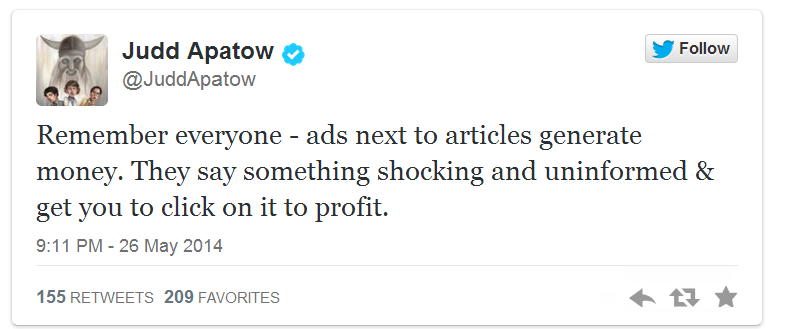
Ann Hornaday responded to the Rogen-Apatow outrage, again at the Washington Post blog.
I was surprised Monday morning to discover that an essay I’d written over the weekend – about the YouTube video posted by Elliot Rodger, who took six lives and his own in Isla Vista, Calif., on Friday – had earned the wrath of filmmaker Judd Apatow and his frequent collaborator, actor Seth Rogen. (Rogen turned down a request from The Post to film a video segment in response to the original column.)
As un-fun as it is to be slammed by famous people, I could understand Apatow and Rogen’s dismay. Why would a movie reviewer even weigh in on the Isla Vista tragedy in the first place? It happened that Rodger taped a somewhat rambling, 6-minute rant, during which he explained that a combination of social and sexual rejection, loneliness and chronic feelings of unfairness contributed to the murders he was about to commit.
The video was startlingly well-produced – featuring rich lighting, careful staging and a classic California backdrop of palm trees. That, combined with the fact that Rodger himself grew up surrounded by the film industry, led me to write about how Hollywood movies – specifically wish-fulfillment fantasies and revenge-driven vigilante thrillers – might have informed an unstable young man’s ideas about what his college years and life in general were supposed to look like. Movies aren’t accurate reflections of real life, as I wrote in the essay. But there’s no doubt they powerfully condition what we desire and feel we deserve from it.
Because why wouldn’t they? How would we go about being immune to their influence? How would that work? How can Rogen and Apatow possibly be certain that their movies have zero influence on any human beings? Advertising works, doesn’t it? It influences people. If it didn’t, at some point capitalists would have figured that out and stopped spending all this money on it. Does advertising work solely because it comes with a label “advertising” so that we know we’re supposed to be influenced, and we comply?
I say no. How are movies fundamentally different from advertising?
They’re not, except for being much longer and thus more so. Yes, Seth & Judd, movies have power over us. Yes, yours too. Yes, even the stupidest ones.
I was not using the grievous episode in Isla Vista to make myself more famous; nor was I casting blame on the movies for Rodger’s actions. Rather, in my capacity as a movie critic, I was looking at the video as a lens through which to examine questions about sexism, insecurity and entitlement, how they’ve threaded their way through an entertainment culture historically dominated by men and how they’ve shaped our own expectations as individuals and a culture. At a time when women account for less than 20 percent of filmmakers behind the camera and protagonists in front of it, I suggested that it’s long past time to expand and diversify the stories we tell ourselves.
And we get to do that, without entitled sexist thoughtless frat-boy moviemakers pitching rage-fits.
My observations struck a chord of recognition with University of Maryland graduate student Isabella Cooper:
I have taught Women’s Lit courses in the English Department several times, and did so this past semester. Sadly, I am never short on fodder to show the students how rampant misogyny and sexism still are in our culture, and this article gets right to the heart of the way Hollywood so often bolsters men’s sense of entitlement to women’s bodies, their belief that their sexual drive amounts to a right (as Adrienne Rich put it all the way back in the seventies!).
There’s plenty of fodder. I would happily do without the fodder for the sake of better stories, with women as central characters who have a place on the mattering map.