Tag: Priyamvada Gopal

  • Gopal v liberals

    Priyamvada Gopal is still throwing verbal bricks at liberals. I understand liberals here to mean people who defend universal human rights as opposed to people who carve out exceptions for “cultures” or “communities” or religions or, usually, all three. She threw her latest bricks while offering Laurie Penny support in her battle with “white” yaddayadda on Twitter.

    gopal

    Priyamvada Gopal @PriyamvadaGopal

    @PennyRed Don’t be apologetic with liberal bullies who for all their protestations,don’t like to hear non-European feminists speak nuance

    Far from being defenders of the rights of non-European/Muslim women, want them silenced uness they say the right things their way

    Faced down astonishing abuse and footstamping liberal tantrums this past week which would be horrifying if it weren’t amusing.

     I think she wants us to equate liberals with “Western” and “white”…which means she wants to hand over liberalism to the “white West”…thus making the non-West illiberal.

    I wonder if she’s really thought this through.

  • Fons et origo

    I think I know where Pryiamvada Gopal got her distorted and ignorant idea of the people behind the protest against gender segregation. I think she read a repellent article at “Loonwatch” on the website “Islamophobia Today” titled UK: Islamophobes Manufacture “Gender Segregation” Controversy. It’s wrong in just the way her article is wrong, and it does it a few days earlier.

    The author is billed as “Ilisha.”

    An Islamic society wants to host a university event where–gasp!–men and women are seated separately. Suddenly this minor event is major news in the UK.

    Yes, “gasp,” Ilisha. It’s not just routine and normal for university events to seat women and men separately.

    People who apparently never planned to attend the event in the first place have decided they must publicly protest “gender apartheid,” an intolerable affront to their sensibilities. There is no evidence men and women who planned to attend the event complained, yet the controversy has become the subject of a national debate of such importance, Prime Minister David Cameron has weighed in on the matter.

    What a charming tone – as if people ought not to consider gender apartheid an intolerable affront to their sensibilities – as if institutional inequality should just be accepted, or even embraced.

    The event gained the national spotlight through the efforts of Student Rights, a group affiliated with the Henry Jackson Society. In other words, the “controversy” has its roots in the incestuous Islamphobia network operating on both sides of the Atlantic.

    Emphasis hers.

    See there? The same ignorant mistake Gopal made: thinking Student Rights was behind the protest, when it had nothing to do with it.

    She goes on to give an irrelevant denunciation of the Henry Jackson Society and a bunch of other societies that had nothing to do with the protest, then triumphantly winds up:

    The “gender segregation” campaign in the UK is reminiscent of the manufactured “Ground Zero mosque” controversy a few years back in the US. Once again, a minor (non-)event has been transformed into a national debate by the usual suspects. The purpose is to generate another round of anti-Muslim hysteria.

    As Associate Director at the Henry Jackson Society, Douglas Murray, has openly stated“Conditions for Muslims in Europe must be made harder across the board.”

    Emphasis again hers. Several paragraphs, none of them relevant to the December 10 protest.

    Not the most reliable or careful source I’ve ever seen.


  • Rupert Sutton clears up some things

    Rupert Sutton of Student Rights has a reply to Priyamvada Gopal’s article at the Rationalist Association. It’s calm

    Unfortunately, [Gopal’s] attempt to persuade greater numbers of people to criticise reactionary religious practice was marred by a number of inaccurate attacks on my organisation, Student Rights, which seeks to highlight political and religious extremism on university campuses regardless of provenance. This included claims that we had brought the issue to national attention despite a lack of evidence for its occurrence, and presented the campaign as part of a running battle between white conservatives intent on imposing their views on others, and the beleaguered representatives of minority communities standing against this. This is simply not the case, and both misrepresents Student Rights and the campaign itself.

    He puts that so calmly and politely.

    Placed alongside the claims that Student Rights is a “reactionary and opportunistic” group which has “cynically” chosen to focus on segregation, it is clear that these criticisms were a veiled suggestion that we use issues such as this to malevolently target the Muslim community. This disregards our focus on far-right groups like the BNP and French Front National. Whilst it is true that we cover events featuring Islamist speakers more frequently than we cover the far-right, this is by no means an attempt to stigmatise Muslims, but instead reflects the fact that thankfully the far-right are an increasingly rare sight on our campuses these days.

    And in any case Islamists aren’t the same category as Muslims. I, for instance, despise the US Conference of Catholic Bishops; it doesn’t follow that I despise Catholics.

    But the most disappointing element of the article was the way in which the voices of ethnic and religious minorities were sidelined. This placed Ms Gopal in the odd position of arguing that progressives affiliating to ethnic or religious minorities should not disregard this issue, whilst ignoring those from these communities who have been the most vocal campaigners. Last week’s rally outside the offices of UUK gave a prominent voice to women and was dominated by Maryam Namazie and Pragna Patel, two leftist activists who have driven gender segregation to the forefront of the news agenda and been instrumental in ensuring cross-party political consensus against it.

    Exactly. Gopal’s ignoring of that fact, and sidelining of the voices of ethnic and religious minorities while in the very act of claiming to stand up for them, is why I’ve been so much less calm and polite about her article than Rupert Sutton has been.

    As we highlighted following UUK’s withdrawal of its guidance, the campaign drew together a broad church of students, equality groups, and human rights activists from across the political spectrum. Presenting it instead as an opportunistic attack on Muslims overlooks this, and risks furthering claims of groups like the Islamic Education and Research Academy (IERA) that criticism of gender segregation amounts to “anti-Muslim propaganda”. IERA, whose members have excused domestic violence and supported the return of execution for fornication, (a ‘crime’ which is disproportionally used to repress women), are not representative of the UK’s Muslim community and must not be allowed to claim as such.

    Ultimately, rather than being a campaign ‘hijacked’ by a cabal of ‘deeply conservative white males’, this was instead an example of an inclusive movement which showed that challenging reactionary tradition is not limited to any particular culture or community far more effectively than Ms Gopal’s article did. Had she been at the rally last week she would have seen many of the UK’s progressive activists and organisations protesting together against gender segregation regardless of race, religion, community, or political affiliation, and it is unfortunate that she has allowed her perception of the work my organisation does to blind her to that.

    There.

  • Concerns about the motivation

    Daniel Trilling at the Rationalist Association blog offered their position on gender segregation today. He started with Gopal’s article.

    The piece raised concerns about the motivation of the pressure group Student Rights, which has been campaigning on the topic, and the way in which the story had been picked up by the media, but argued that such concerns should not prevent people from criticising the policy.

    No, not exactly. Gopal was exceedingly unclear that her concerns were only with Student Rights and the way the media picked up the story. Exceedingly unclear. It was not at all clear that she wasn’t talking about the people who organized and publicized the December 10 protest that triggered the media coverage. If that’s really all she meant to say, she did a very clumsy job of it.

    Take the third and last sentence of her opening paragraph for instance.

    For us, it is especially difficult to practise a commitment to gender equality and social change in a context so heavily shaped by an intolerant Western ‘liberalism’ passing itself off as ‘secular’, ‘enlightened’ and more knowing-than-thou.

    It is just not self-evident that that is not aimed at secular liberals who protested the UUK’s guidance. I still think that looks as if she has exactly those people in mind.

    Her next sentence, in the next paragraph, is the one where she gets her facts so wrong, and says Student Rights brought the issue to national attention, with a link to the channel 4 story on the December 10 protest. That link has now been removed, but it was there before, so that is what she thought.

    No, it won’t wash. It’s really not that difficult to be clear about what you mean. I know this. I’ve done a lot of editing of other people’s writing, and I know the difference between clarity and the absence of it.

    Back to the RA.

    Regrettably, our initial choice of headline gave the impression that the piece criticised the whole range of groups who have spoken out on the issue. This includes groups we respect and support, such as the Council of Ex-Muslims and Southall Black Sisters, and a range of other individuals. The protest directed at Universities UK that took place on 10 December was broad based and worthy of support. We’ve now altered the headline but would like to apologise for any misunderstanding.

    It wasn’t just the headline though. It really wasn’t.

    Back to revisiting Gopal.

    In the wake of Student Rights’ aggressive campaign, which clearly targeted Islamic student groups, Universities UK – not a body known for championing social justice – issued guidance indicating that gender segregation of an audience at the request of a speaker at guest lectures was acceptable. The advice was withdrawn when the Equalities and Human Rights Commission deemed this advice discriminatory. The battle lines were drawn once again between so-called ‘muscular liberals’ (generally, in fact, deeply conservative white males with a commitment to the idea that West is Best) and defenders of the rights of minorities to their own customary or traditional practices.

    Again – it is far from obvious that she is raising concerns about Student Rights while not doing so about the CEMB or One Law for All or Southall Black Sisters or LSESUASH. It is far from clear that she didn’t mean the snide “muscular liberals” to apply to all opponents of gender segregation, or that she wasn’t herself siding with defenders of the rights of minorities to their own customary or traditional practices.

    After that she goes on to point out the obvious, which is that the silly two choices that she herself isolated are not the only possible choices, but she did that only after poisoning the well with all that belligerent rhetoric. If that’s not what she meant to do, she’s just not a good writer. She’s not dense or difficult, she’s just bad at it.

  • That’s not how it happened

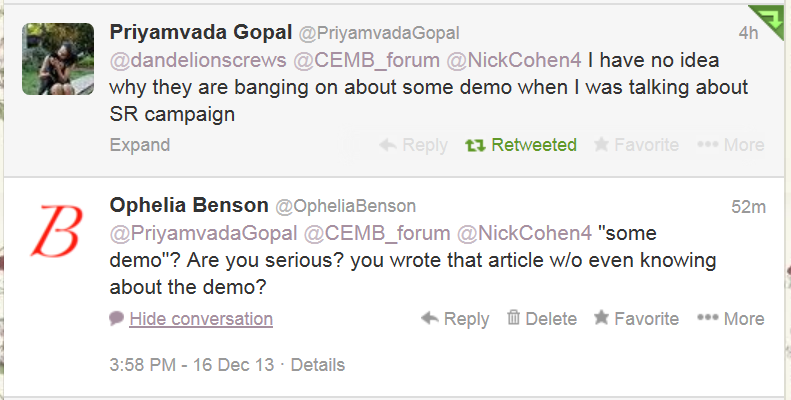
    Amazingly enough, it appears that Gopal wrote that article in complete ignorance of the December 10 protest that got major media coverage and thus the attention of politicians who then firmly rejected gender segregation.

    demo            Priyamvada Gopal @PriyamvadaGopal

    @dandelionscrews @CEMB_forum @NickCohen4

    I have no idea why they are banging on about some demo when I was talking about SR campaign

    Ophelia Benson @OpheliaBenson 

    “some demo”? Are you serious? you wrote that article w/o even knowing about the demo?

    That sheds a somewhat new light on the article, but not in a good way. Apparently she simply had no idea what she was talking about, and made a complete dog’s breakfast as a result. Let’s look at a little bit of it again, now that we know she was unaware of the December 10 protest.

    For us, it is especially difficult to practise a commitment to gender equality and social change in a context so heavily shaped by an intolerant Western ‘liberalism’ passing itself off as ‘secular’, ‘enlightened’ and more knowing-than-thou.

    I want to raise this because of the deft way in which Student Rights, an offshoot of the bullishly paternalist Euro-American think tank, the Henry Jackson Society, has managed to bring ‘gender segregation’ at some campus events to national attention despite evidence that events in which the audience is so segregated are not numerous.

    See? The link in “to national attention” is to channel 4′s story on the protest – it even says that in the url. Yet Gopal apparently somehow managed to miss it, and didn’t watch the channel 4 story. That’s unfortunate for her, because the Henry Jackson Society and Student Rights had nothing to do with the protest. The protest was organized by LSESU ASH and Maryam Namazie.

    So the major premise of Gopal’s article is flat wrong, and thus the juddering incoherence of the whole thing is explained.

    Nick and LSESU ASH were both asking for an apology from Gopal, on Twitter. She accused Nick of “white boy muscular liberalism” by way of reply. Hmm.


  • Until the West comes along to teach us progress

    I said I would continue my disagreement with what Priyamvada Gopal wrote, so here I am continuing.

    The fact is that challenging traditions and questioning authority are practices common to all societies; changing in response to circumstances is a human capacity and not one limited to a particular culture.

    Again – no kidding, and no one who is criticizing gender segregation said otherwise. It’s the other way around: Universities UK are treating authority (in the person of the external speaker who demands segregated seating) as if it is not to be challenged. It is the protesters who are challenging that authority, and the authority of UUK, from the standpoint of universal rights, which is to say, rights common to all societies, limited to a particular culture.

    It is at our peril that we, particularly women who come from non-European communities, cede or suppress that capacity in the cause of anti-racism, vital though the latter is.

    We know. That was our point. You’re the one who is talking about “an intolerant Western ‘liberalism’ passing itself off as ‘secular’, ‘enlightened’ and more knowing-than-thou.” You’re the one talking about “deeply conservative white males with a commitment to the idea that West is Best.”

    It’s a capacity that allows us to ask whether, say, women’s colleges are a useful defence against a wider institutional sexism contexts while simultaneously debating whether there’s anything to be maintained or gained by men and women sitting apart when addressed by religious speakers who demand it, even if voluntarily and non-hierarchically. Are such arrangements always just ‘harmless symbols’ of community identity? Selective attacks on our communities make the job of self-analysis more difficult but we should not let our thoughts and actions be entirely determined by those we oppose.

    It’s not an attack on “your communities” – unless you consider iERA your community, in which case I have nothing to say to you, but then why are you talking about challenging traditions and questioning authority? Liberal universalists are not your enemy. We’re not the ones who think you should be at home instead of teaching at Cambridge.

    There is no doubt that both racism and xenophobia is on the rise, with Muslims and Islam singled out for attack. It is essential to fight back. But we must also ask ourselves whether, because the evocation of issues of misogyny or gendered oppression within minority communities often plays into the wrong hands, we should let go of our own traditions and histories of self-criticism, internal dissent and change. If we do so, ironically, we play into the falsest imperialist stereotype of them all – the notion that non-European communities are static and unchanging until the West comes along to teach us progress.

    But then why are you bashing the critics of gender segregation who reject that stereotype? Why, for instance, are you ignoring Maryam Namazie and Yasmin Alibhai-Brown and Abhishek Phadnis and focusing on Student Rights who had nothing to do with the protest against gender segregation? Why are you ignoring the very possibility of international solidarity, and the reality of it that is so conspicuous in everything Maryam does? What the hell do you think that accomplishes? Why not drop the fake accusations of imperialism and just join Maryam and the rest?