Tag: Rebecca Tuvel

  • A report that found the apology inappropriate

    The CHE has useful background information on the Hypatia matter.

    Miriam Solomon, a professor and chair of the philosophy department at Temple University and president of the Board of Directors, said the journal’s publisher, John Wiley & Sons, had brought in the Committee on Publication Ethics, an outside group that consults with editors and publishers of academic journals, to review the situation. The main question: Was the apology issued by the associate editors appropriate?

    Last week the committee, known as COPE, produced a report that found the apology inappropriate, Ms. Solomon said. Even after the report’s findings were presented to the journal’s editors, the associate editors did not acknowledge any mistake in issuing the apology, and the board had to “take other measures,” she said. As a result, the board temporarily suspended the authority of the 10-member Associate Editorial Board.

    They sound kind of Trump-like. WE DID NOTHING WRONG SHUT UP.

    The associate editors “felt that they didn’t see that the COPE report had identified anything wrong with how they conducted themselves, whereas we thought they were pretty clear that you just don’t run off making public statements in your capacity as associate editors,” Ms. Anderson said.

    The associate editors should now come to terms with the consequences of undermining the board’s power, she said.

    And of doing their level best to destroy a colleague for no good reason – let’s not omit that little detail.

    Both board members acknowledged that Hypatia’governing structure is complex. Still, the board is ultimately in charge of delivering the journal to the publisher and maintaining its finances, Ms. Solomon said. After the May controversy, journal submissions went down, and reviewers said they did not want to review articles if the associate editors might issue statements as they did concerning the controversy over Ms. Tuvel’s article.

    Yep. They were all thinking, “Jeez, what if I put a foot wrong, will they tear me to shreds the same way? Better not risk it.” And they were right, too.

  • The Associate Editors did not in any way speak for the journal

    The Board of Directors of Hypatia posted a statement on the Hypatia site:

    It is with disappointment and regret that the Board of Directors of Hypatia has received the news that Sally Scholz and Shelley Wilcox [the on-line reviews editor] are resigning from their roles as editors of Hypatia. Throughout their tenure with the journal, they have stood by fundamental principles of publication ethics, which call upon all who are involved in the governance of a journal to respect the integrity of the peer-review process and to support authors published by the journal (with rare exceptions such as plagiarism and fraud). The Board is also committed to these principles and fully supports Scholz and Wilcox in their commitment to and execution of them.

    Unfortunately, the Associate Editors’ public apology for the publication of an article failed to respect these principles. Their action, appearing to speak for the journal rather than as individuals, invited confusion over who speaks for Hypatia. It also damaged the reputations of both the journal and its Editors, Scholz and Wilcox, and has made it impossible for the Editors to maintain the public credibility and trust that peer reviewed academic journal editorship requires.

    We wish to reiterate that neither Hypatia, nor the journal’s Editors, have apologized for or retracted the article in question. We also wish to reaffirm that the Associate Editors did not in any way speak for the journal, nor do they have authority to do so.

    As the board ultimately responsible for the well-being of the journal, we find it necessary at this time to take emergency measures to restore the academic integrity of the journal and shepherd it through a transition period to a new editorial team. Thus, we have temporarily suspended the authority of the Associate Editorial Board. As detailed in the Editors’ statement, Sally Scholz has generously offered to continue to take Hypatia issues already in the works through production. Hypatia Reviews Online will be managed through January 1, 2018 by Joan Woolfrey and Simon Ruchti of West Chester University. We hope to announce an Interim Editor shortly. Villanova University is continuing its support of the journal office and Managing Editor until January 1, 2018. We do not forsee any interruption in the operation and publication of Hypatia.

    Simultaneously, we are assembling a task force devoted to restructuring Hypatia’s governance in order to create a structure that is conducive to continued academic integrity and appropriate editorial autonomy, while maintaining resources for useful and diverse editorial advice. From this point forward, everyone involved in the governance of Hypatia will be required to commit to COPE (Committee on Publication Ethics) principles (https://publicationethics.org/), which include respect for the autonomy of the Editors and the integrity of the peer review process. We are focused on the future of Hypatia, and we hope to work with many in the Hypatia community and the broader communities of feminist philosophy in making the changes necessary to ensure that this future is a bright and inclusive one.

    We are very sorry to see Sally Scholz and Shelley Wilcox depart Hypatia, especially under these circumstances. In their four years as an Editorial team, they have produced journal issues of the highest quality and they have undertaken many creative initiatives to further the cause of feminist philosophy. These include the expansion of Hypatia Reviews Online (tripling the number of book reviews), a major conference on diversity in philosophy, the creation of podcasts and videos to make the work of authors more accessible, and social media initiatives on Facebook and Twitter. They substantially increased the number and diversity of peer-reviewers, the readership of Hypatia, and Hypatia’s citation record. We are proud of what they have accomplished and thank them wholeheartedly for their service. We wish them well in their future endeavors.

    Brian Leiter comments:

    Professor Scholz, unlike her Associate Editors, behaved professionally during this whole affair.

    To my  knowledge, none of the miscreants, now suspended, or others ever apologized for their mistreatment and defamation of Professor Tuvel, not even the appalling Professor Heyes.

    UPDATE:  I’m told by a reliable source that Professor Heyes did apologize privately to Professor Tuvel.  That is something, though it does not alter the basic fact about her appalling misconduct in this matter.

    Daily Nous also reports.


  • Hypatia’s statement

    The Board of Directors of Hypatia has issued a statement which is published at Daily Nous.

    The Board of Directors of Hypatia would like to clarify the nature of the controversy, since there are misrepresentations in the press and on social media. Further, we would like to articulate the principles we are committed to as we move forward beyond this controversy.

    1. The Board acknowledges the intensity of experience and convictions around matters of intersectionality, especially in the world of academic philosophy, which has an egregious history of treatment of women of color feminists and feminists from other marginalized social positions. To those unfamiliar with the issues, outrage about a particular academic publication is often dismissed as nothing more than the censoriousness of hypersensitive groups. The objectionable features of the particular case, considered in isolation, seem too minor to outsiders to warrant the degree of outrage focused upon it. Such dismissal reflects ignorance of the cumulative history of marginalization, disrespect, and misrepresentation of oppressed groups. Usually, objections to a particular academic publication reflect the objectors’ knowledge of a history of grievances of which outsiders are unaware. It is difficult to assess how much of the outrage is properly directed at Hypatia, and how much at other public, academic, or philosophical institutions. Nevertheless, the Board would like to take this opportunity to learn from the expressed outrage. Hypatia has always held itself to a higher standard of inclusion than most other philosophy journals. During the years in which Sally Scholz has served as editor, it has continued to develop these commitments to diversity (including organizing a major conference on diversifying philosophy, the solicitation of special issues and clusters specifically focused on diversity, and the creation of podcasts and video interviews to make Hypatia articles more widely accessible). Going forward, with consultation amongst those who perform various roles for our organization, Hypatia will review its governance structure, procedures, and policies, aiming to continue to improve its inclusiveness and respect for marginalized voices in a manner consistent with the continuation of Hypatia as a scholarly enterprise committed to feminist values.

    I’m sorry but no. That gives too much credit to “the expressed outrage” without probing to ask whether the outrage was at all justified, whether it was worked up, whether it was a contagion, whether it was exaggerated, whether it was properly directed, and so on. Not all outrage is justified. The cause can be bad, or the outrage can be misdirected, or both. White supremacists express outrage. Trump expresses outrage. Theocrats express outrage. MRAs express outrage. The mere fact that outrage was expressed is not automatically a reason to “learn from” said outrage.

    Also, that part suggests that Tuvel really did do something wrong that set off this outrage. The Board should not be suggesting that.

    Ok but people will say you’re not trans so you can’t judge. True, but I’m also not a white supremacist, and yet I judge. The “lived experience” thing is not a conversation-ender.

    Eventually they do tepidly defend the publication of Tuvel’s article.

    6. The Board stands behind the judgment of Hypatia’sEditor, Sally Scholz, concerning the publication of Professor Tuvel’s paper. On May 6, 2017, Professor Scholz released a statement to the Chronicle of Higher Education affirming that Professor Tuvel’s paper went through the usual double-masked peer review process and was accepted by the reviewers and by the Editor. We endorse her assessment that, barring discovery of misconduct or plagiarism, the decision to publish stands. We also approve her willingness to refer the matter to Committee on Publication Ethics (COPE).

    The Board also recognizes Professor Tuvel for her work and condemns any ad hominem and personal attacks that may have been directed against her. As a scholarly publication, Hypatia supports our authors and appreciates their contributions to advancing understanding of contemporary social issues.

    That is very tepid. It is inadequate. It’s especially inadequate since they promptly all but withdraw it.

    7. We regret the harms to current and prospective authors, editors, and peer reviewers of Hypatia that were created by this controversy. We are working hard to respond responsibly to this troubling and difficult controversy. We acknowledge the history and continuation of injustices around matters of intersectionality, and know that many of us have much to learn from those who have lived in and worked on intersections of marginalized racial and gender identities.

    That implies that Tuvel committed an injustice around matters of intersectionality. That’s crap.

  • What is this “harm” of which you speak?

    A piece by José Luis Bermúdez in Inside Higher Ed a week ago asked a necessary question about the open letter attacking Rebecca Tuvel and the apology by the Associate Editors: what are they talking about when they talk about “harm”?

    This is not the place to discuss the merits or otherwise of Tuvel’s article, which I would encourage you to read (it is clearly written, and pleasantly free of jargon) before reading the open letter and the statement. There is a persuasive analysis of the weakness of the complaints made in the open letter in this article by Jesse Singal in New York magazine. At a minimum, Tuvel appears to have been significantly misrepresented.

    I want to explore a much more general issue raised by this whole affair. This has to do with concept of harm, which keeps being raised. The main charge against Tuvel is that the very existence and availability of her paper causes harm to various groups, most specifically to members of the transgender community. This is a puzzling and contentious claim that deserves serious reflection.

    The editorial board statement specifically refers to “the harm caused by the fact of the article’s publication.” As the concept of harm is standardly used in legal contexts, this would be a tough claim to defend. It is certainly possible for someone to suffer material or tangible loss, injury, or damage as a consequence of a 15-page article being published in an academic journal. The article might be libelous, for example. But there is no such charge here. The only individual mentioned by name besides Rachel Dolezal is Caitlyn Jenner, and it seems implausible to say that Tuvel has harmed Jenner by “deadnaming” her (i.e., using her birth name), given how public Jenner has been about her personal history.

    I think we have a rough idea what they mean by it, from long unpleasant experience of the kind of thing they say. The idea is that uttering anything other than the Currently Mandated Doctrine [which shifts constantly and among doctrinizers, but never mind] causes harm to trans people because it inspires or motivates violence against them. Getting the Doctrine wrong causes people to beat up and murder trans “folk.”

    I don’t think that’s true. I think the kind of people likely to attack or murder anyone for being trans are not likely to read philosophical articles about what it means to be trans anything or to identify as anything.

    The authors of the editorial board statement have nothing to say about how they understand harm. This already should give pause for thought. Philosophers, whatever their methodological orientation or training, usually pride themselves on sensitivity to how words and concepts are used. This makes it odd to see no attention being paid to how they are understanding this key concept of harm, which is central to many areas in legal and moral philosophy.

    Well you see it’s a term of art, like “trigger” and “violent.” It doesn’t mean what it means in either ordinary discourse or philosophy and law; it has a special, political meaning, that has to do with the need to shun and punish a perceived Bad Person aka a Harmdoer.

    Surely something else has to happen for harm to occur. Most obviously, the comparison might cause someone to behave in a way that brings about some sort of injury to a specific individual or group, for example. But then, in order to substantiate an accusation of harm, Tuvel’s accusers need to explain how her juxtaposition, in a single article, of transgender people and Rachel Dolezal might reasonably be expected to have this effect.

    We’re just supposed to know. We’re supposed to be woke enough to understand instantly the kind of harm that’s at issue and the mechanism by which it takes place. Failure to be that woke could mean it’s your turn to be shunned and punished.

  • Rectifications

    I was hoping the dogpile had ended, but it hasn’t.

    Brian Leiter has a brief post about the role of Lisa Guenther.

    Lisa Guenther is the Vanderbilt philosophy professor and former member of Rebecca Tuvel’s dissertation [committee?] who not only was an early signatory of the defamatory “Open Letter” but also offered several public facebook explanations for her conduct.

    So I decided to look up her several Facebook explanations.

    Depressing shit.

    April 30:

    Robin James on the deep reckoning and accountability demanded of those of us who do work in philosophy — especially white feminist philosophers like myself, because we should know better than to keep using the master’s tools over and over and over again —

    “Rephrasing something I said in a comment elsewhere: Hypatia is not a bad apple here–it’s symptomatic of deeper and more fundamental issues in the profession, in the institutional practice of ‘philosophy’ as such. The journal and the article’s author are doing “Philosophy” perfectly. The white supremacy, racism, and transmisognoir are embedded in the project of ‘philosophy’ itself; how many scholars have *already* said this?

    Except that there was no white supremacism or racism or “transmisognoir.”

    Also April 30:

    Essential reading for anyone who is reeling from Hypatia’s publication of an article on transracialism, and trying to figure out what accountability means in the wake of this act of epistemic injustice. [Then a paragraph by Rachel McKinnon]

    People are “reeling” – over this “act of epistemic injustice.”

    May 1, linking to the Hypatia apology:

    This is what accountability looks like: “Working through conflicts, owning mistakes, and finding a way forward is part of the crucial, difficult work that feminism does. As members of Hypatia’s editorial board we are taking this opportunity to make Hypatia more deeply committed to the highest quality of feminist scholarship, pluralism, and respect. The words expressed here cannot change the harm caused by the fact of the article’s publication, but we hope they convey the depth and sincerity of our commitment to make necessary changes to move forward and do better.”

    There was no harm caused by the fact of the article’s publication.

    Also May 1:

    Via Meena Krishnamurthy: “One of the central criticism of the piece by Tuvel on the infamous Dolezal case is that it failed to engage with much of the relevant literature by POC and transgender people.”

    Then a call for help drawing up a list of relevant literature. This post is innocuous in itself, but as part of a relentless series, not so much.

    Also May 1:

    This is what a collective demand for accountability looks like:

    With a link to that disgusting Hypatia “apology.”

    May 2, one I posted about at the time:

    This article, like the post at the Daily Nous, goes through the arguments of Rebecca Tuvel’s article, “In Defense of Transracialism,” to argue that they’re not so bad after all: no outrageous claims, no offensive slurs, nothing but reasonable arguments. But this is precisely the problem: it’s what Charles Mills critiques as “ideal theory,” which attempts (in the words of author Jesse Singal) to “pull up one level from the real world and force people to grapple with principles and claims on their own merits, rather than — in the case of Dolezal — baser instincts like disgust and outrage.”

    But ideal theory is not the only alternative to irrational “baser instincts.” What ideal theory abstracts from–and this is the reason why Mills argues that ideal theory is ideology– is the network of power relations that shape particular historical contexts and meanings.

    THIS is the fundamental problem with Tuvel’s article, and with all of the defenses I have read so far: It “toy[s] around” (Singal’s words again) with a few arguments about issues that deeply and viscerally affect the lives of people whose social location is radically different from her own, with no evidence in the article of an awareness of the context, power dynamics, or stakes of these issues for trans people and people of color. This is why it should not have been published in Hypatia, and why the demand for a retraction is not simply the irrational whim of an “angry” mob, but a critique of white feminist ideal theory as transphobic and anti-black ideology.

    Full disclosure: I know Rebecca Tuvel, I was on her dissertation committee, I don’t think she intended to do harm by writing this article. But intentions do not determine or reduce impact. The point is not to avoid ever saying anything “wrong” or problematic. The point is to commit to accountability — both as actors and as bystanders. This is what all of us are called upon to do in this moment.

    She accuses Tuvel (somewhat indirectly) of outrageous claims and offensive slurs, then says “I don’t think she intended to do harm by writing this article.” Oh really.

    May 3:

    The problem is not Angry Mob vs. Vulnerable Untenured Professor. The problem is white feminism. By white feminism, I do not mean feminism that happens to be practiced by white people. I mean feminism that is invested in whiteness as power and property, and that is willing to further the interests of white women at the expense of other marginalized and oppressed groups. I mean feminism as the collective self-promotion and self-protection of the most privileged women. Feminism that would rather strategically ally itself with cis hetero anti-black patriarchy than struggle to figure out what it means to become an effective ally and accomplice of black (and) trans people. THAT is the issue here, and it’s not just an issue for one or two people, it’s an issue for all of us.

    Also May 3:

    YES to this post by Kristie Dotson — “Calling the righteous indignation against Tuvel’s objectifying and shoddy article a “witch hunt” is quite Trump-y. In fact, so much of the defenses and responses are Trump-y. Should you be allowed to say anything and introduce any range of “alternative facts” because you have free speech? Should you not be held accountable when your position is underdeveloped about issues that impacts people’s lives? Should you be able to speak about a class of people you are not part of in derogatory terms and claim ignorance as an excuse? Or that they are too touchy and should grow thicker skin? Should you by pass the criticisms with excuses or just double down on your right to objectify anyone you so chose because of your “good will” and PhD-privilege? Should you participate in playing a role, yet again, in securing white and cis-gendered privilege at the sake of everyone else’s well-being? Careful folks. Because this stuff is starting to get #unforgivable.”

    May 4:

    What SHOULD accountability look like in the wake of what some people are calling the Hypatia Affair? Some suggestions I’ve heard so far: a community accountability process; the development of professional norms for philosophical engagement with issues that affect marginalized communities; changing or clarifying the editorial review process; changing the composition of the editorial board, so that there are fewer cis het able-bodied white women on the board and more trans, queer, and disabled people of color. This is an incomplete list. Please add to it, and/or critically discuss the possibilities I’ve listed here. I have not identified the people who came up with these ideas but if you’d like to self-identify, please do.

    I have an idea! Choose one white feminist every week as a target for this kind of Correction. Be sure of course she is young and untenured, and that she hasn’t actually done anything wrong. Spend the week tearing her to shreds. The Perfect World will ensue in no time.

    Also May 4: a link to someone else’s long long long post on the chosen target.

    May 5:

    Over the past few days, I have posted a few thoughts about accountability. A close friend (and a few strangers) have challenged me to account for gaps and failures in my own scholarship as a feminist philosopher, and for my responsibilities as a mentor to past and current graduate students.

    So she does a paragraph about her own omissions and then has the fucking gall to say this:

    I still stand behind the book, but it has many flaws, gaps, and silences that I would want to address if I were writing it now, and that I would probably critique in a peer review process. I’m thankful for criticism of the book, even when it’s painful or difficult to hear, and even though there’s nothing I can do to un-write the book.

    But I have never had to contend with personal attacks or insults about my work or calls for retraction, and I don’t want to underestimate the very different kind of pain that this inflicts on a person. And I want to express my admiration for those who have been supporting Rebecca Tuvel as a person throughout the past week. I want to apologize to her personally for any pain I caused by signing the open letter requesting retraction, especially given that I was a member of her dissertation committee. I did not sign the letter lightly, and I do not consider the call for retraction a personal attack. The letter was addressed to Hypatia as a journal, and I continue to see it as a demand for accountability, made in a very intense, fraught moment, in an effort to stand in solidarity _with_ and _as_ black (and) trans feminist thinkers whose scholarship was marginalized in this article, but not only in this article.

    So in the same moment that we condemn personal attacks, I think it’s absolutely vital for us, as a community of feminist philosophers, not to conflate personal attacks with substantive critique, and not to silence black and trans critics of Tuvel’s article by dismissing the critical response as a mob of haters who didn’t even read the article. Structural inequalities in power and authority compound vulnerability. White feminists can and have deployed our own vulnerability as a weapon against others whose position is more precarious than our own. I say “we” here because I want to be clear that this is something I am deeply implicated in, and also because I want to participate in what will no doubt be a long and fraught process of abolishing white feminism and committing to a practice of feminist philosophy that is creative, responsible, and liberatory.

    What a nightmare.
  • The broad, well-established, interdisciplinary scholarly fields

    But wait, there’s more. One of the people who signed the letter attacking Rebecca Tuvel – one of the “colleagues” who signed it – wrote a piece for the CHE saying why the signers were right to sign it.

    As one of the many scholars involved in writing the open letter calling on Hypatia: A Journal of Feminist Philosophy to retract the essay “In Defense of Transracialism,” by Rebecca Tuvel, I am compelled to come forward and attempt to reclaim a narrative spinning increasingly out of control.

    Five words in the bullying starts – she has to make clear that it was many scholars. (I’m not sure they are all genuine scholars; I think some are adherents rather than scholars, adherents of a political view as opposed to scholars in a discipline.) Many scholars; we all hate you – it might as well be the playground.

    And she’s not “compelled,” and nobody stole anything so there’s nothing to “reclaim,” and it’s not a “narrative,” it’s arguments. And it’s not out of control, it’s just not what the “many scholars” had in mind.

    Many of us became involved at the request of black and/or trans scholars who feel completely demoralized by Tuvel’s article and the failure of peer review that it represents. Speaking for myself, I signed and circulated the letter because I know, firsthand, of the damage this kind of scholarship does to marginalized groups, especially black and trans scholars, in philosophy.

    Tuvel’s article is not a reason to feel “completely demoralized.” That’s more bullying language. It would be fair if she had written a vituperative attack on black and/or trans scholars or people, but she didn’t do anything like that. Saying her article does “damage” is just more of the same bullying rhetoric. It is not reasonable.

    Tuvel received substantive critical feedback at conferences from scholars in critical race theory and trans studies. We do not understand how this failed to shape the review process and can only assume that such scholars were not selected as peer reviewers.

    Why should they have been? Tuvel wasn’t writing critical theory or trans studies, she was writing philosophy.

    [T]he article’s publication signals an arrogant disregard for the broad, well-established, interdisciplinary scholarly fields of both critical race theory and trans studies.

    But philosophers are allowed to write about philosophy. They’re not required to write about other fields. Also I have my doubts about the “well-established” bit.

    While feminist philosophy should imply a critique of the field of philosophy itself, the open letter to Hypatia wasn’t aimed at the discipline over all. None of us ever expected it to circulate so widely, to garner so many signatures, or to become the object of news stories.

    No, you wanted to bully Tuvel in private with nobody watching.

    [T]he lightning-fast vituperative response by scholars who would never consider publishing in Hypatia (and who may not respect feminist philosophy) is suspect, to say the least. We authors of the open letter, and the associate editors of Hypatia, are accused of poor reasoning, poor scholarship, and lack of integrity. In other words, the overwhelmingly sexist, male, and white discipline has, once again, called out the feminists as irrational, hysterical, and immoral. To say that we’re engaging in a “witch hunt” couldn’t be more paradoxical when we, the feminist philosophers, have long been treated like the witches of the discipline.

    But what about the feminist philosophers and other feminists who think the open letter is horrible? What about the feminists who think the treatment of Tuvel has been unbelievably shitty?

    I signed the open letter as part of a continuing effort to make feminist philosophy something other than a damaged, dutiful daughter to the deeply troubled discipline of philosophy. I also signed it as part of continuing efforts to change philosophy’s practices. After all, the methodological insularity evidenced in Tuvel’s article and its publication effectively render ignored and disrespected black, trans, and other minority scholars who work in these fields doubly marginalized. The inequalities perpetuated are both conceptual and practical.

    What about the business school? What about geology? What about chemical engineering?

    The first comment is useful:

    “The fundamental problem with Tuvel’s article isn’t her ability to construct a rational argument but rather the omission of any sustained engagement with the well-developed, interdisciplinary scholarship on race and gender, particularly by black and trans scholars.”

    This seems to be a major point of disagreement among those who oppose the call for retraction and those who support it. I fall into the former category, and I do not think she had any obligation to ‘engage’ with the fields you mentioned. Hers was an analytic paper and is no different from other work, even on similar topics, in the field. Philosophers need to have the freedom to choose what method and framework they’re going to work within. Her method is a — though not the only — legitimate one, and this witch hunt (yes that’s what it is) is an attempt to violate her right to choose to use it.

    It’s not voting or real estate or schools; it doesn’t have to be representative.

    There are many excellent comments at Brian Leiter’s too. Such as:

    Chris Surprenant said…

    The two points that this article raises as defenses–the number of straight, white males in philosophy and that Tuvel supposedly didn’t cite the appropriate literature–both seem like distractions and are otherwise irrelevant. What was done by the associate editors, letter-writers, and letter-signers was egregious, professional misconduct.

    Winnubst’s response is entirely tone deaf to the reasons why there was such a quick backlash from many members of our community on all sides of the spectrum: What was done not only violated clear professional norms, but it also violated norms of decency and kindness that we should show to other people, especially other people who are especially vulnerable in our discipline (untenured, female, etc.).

    Oh but decency and kindness aren’t “well-developed, interdisciplinary scholarship on race and gender” so they don’t count.

  • can we get this person fired

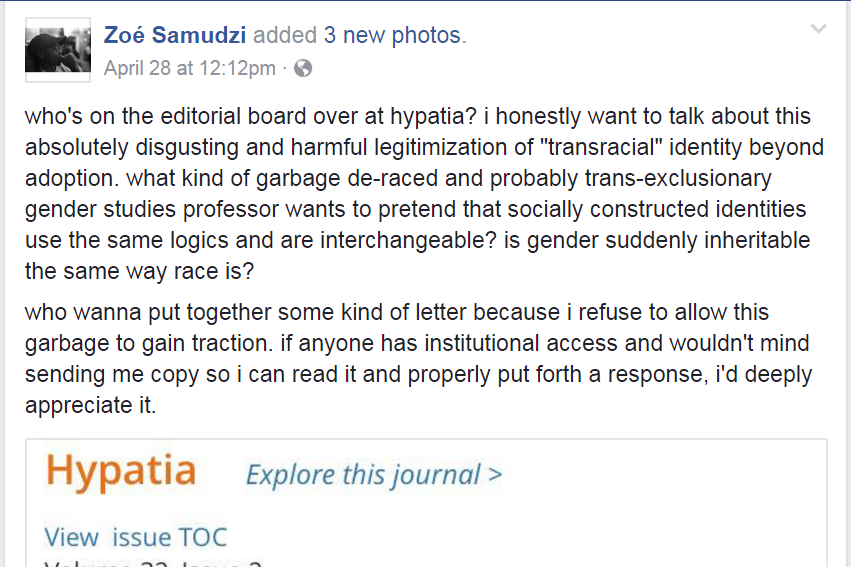
    Commenter helterskelter alerted us to a Facebook post by Zoé Samudzi on April 28 vehemently dispraising Rebecca Tuvel’s Hypatia article and suggesting a letter.

    It turns out it’s a public post, so we can all read it.

    zoe

    who’s on the editorial board over at hypatia? i honestly want to talk about this absolutely disgusting and harmful legitimization of “transracial” identity beyond adoption. what kind of garbage de-raced and probably trans-exclusionary gender studies professor wants to pretend that socially constructed identities use the same logics and are interchangeable? is gender suddenly inheritable the same way race is?

    who wanna put together some kind of letter because i refuse to allow this garbage to gain traction. if anyone has institutional access and wouldn’t mind sending me copy so i can read it and properly put forth a response, i’d deeply appreciate it.

    The first comment is

    Lol author’s name is Becky!

    But they soon get down to business.

    Capture

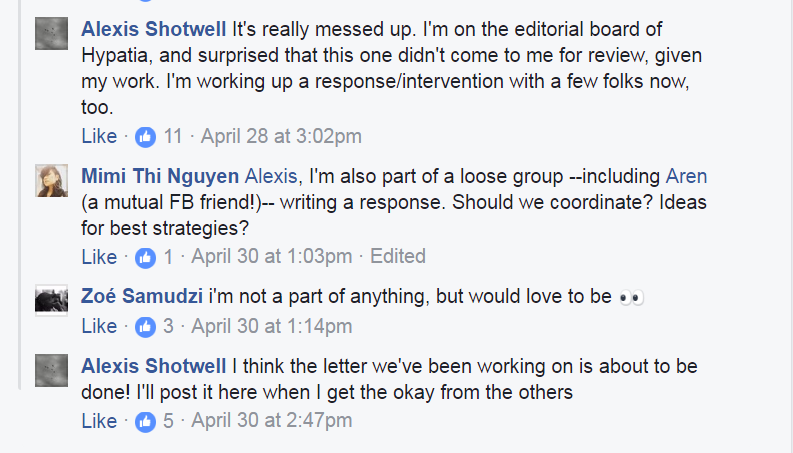
    Alexis Shotwell It’s really messed up. I’m on the editorial board of Hypatia, and surprised that this one didn’t come to me for review, given my work. I’m working up a response/intervention with a few folks now, too.
    Like · 11 · April 28 at 3:02pm

    Mimi Thi Nguyen Alexis, I’m also part of a loose group –including Aren (a mutual FB friend!)– writing a response. Should we coordinate? Ideas for best strategies?
    Like · 1 · April 30 at 1:03pm · Edited

    Zoé Samudzi i’m not a part of anything, but would love to be 👀
    Like · 3 · April 30 at 1:14pm

    Alexis Shotwell I think the letter we’ve been working on is about to be done! I’ll post it here when I get the okay from the others
    Like · 5 · April 30 at 2:47pm

    Someone else offers to connect Samudzi – or everyone reading, it’s not clear which – with people at the university where Tuvel teaches.

    Tallyn Owens If you want to get in touch with anyone at Rhodes, shoot me a message and I’ll be happy to help.
    Like · April 28 at 12:45pm

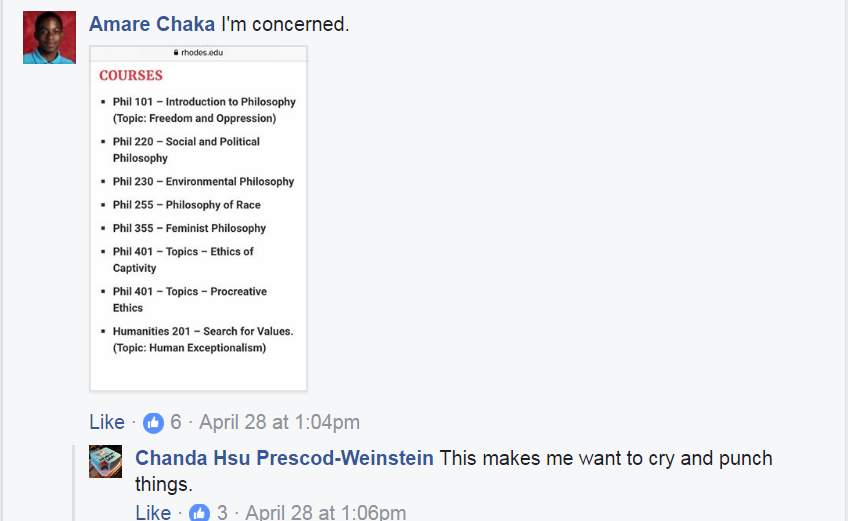
    Then someone posts what is apparently a list of her courses:

    Capture

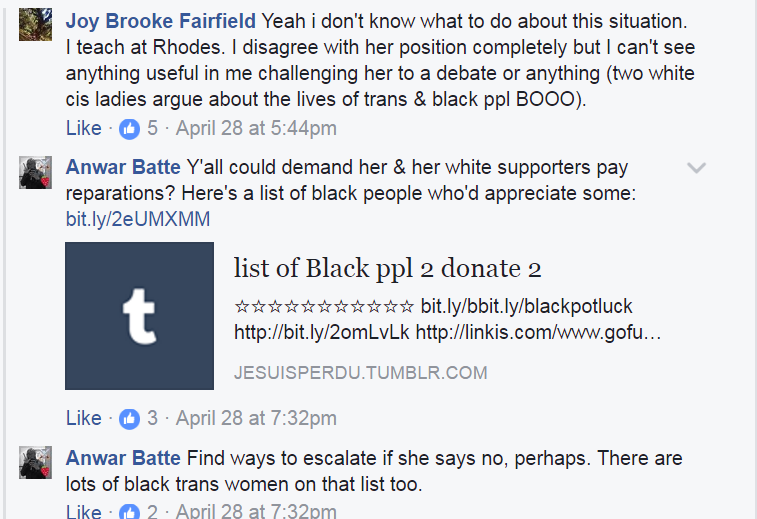
    There’s a lot more ugliness after that. A colleague at Rhodes chimes in. Someone suggests a demand that she pay reparations.

    Capture

    The final comment is “can we get this person fired” [sic]

    So that, I think, clarified Samudzi’s role in all this. She was part of the inspiration for the open letter, and she did her bit to work people into a rage at Rebecca Tuvel the person. (She told me on Twitter that her “critique” of the article wasn’t personal at all. I think this pretty effectively demolishes that claim.)

  • Ideological alignment dressed up as intellectual expertise

    At Quillette, Oliver Traldi on the Rebecca Tuvel uproar.

    The letter he refers to is the open letter explaining how Tuvel was wrong wrong wrong.

    The letter’s most important point is hidden in the first complaint: that Tuvel “uses vocabulary and frameworks not recognized, accepted, or adopted by the conventions of the relevant subfields.” In the Daily Nous comments, academics in these subfields struggled to identify precisely which arguments Tuvel failed to cite or address, or where her thinking might have gone wrong on a more than superficial level. Indeed, many philosophers of both gender and race have come out against retraction. But “the relevant subfields” are not really the academic studies of gender and race. They are the political interests and values associated with a certain conception of those topics. The real complaint is that anyone who publishes in a journal like Hypatia, itself a blatantly activist organ, ought to share those politics. In turn, the necessary politics are built in to the “vocabulary and frameworks” used by the academics. This is ideological alignment dressed up as intellectual expertise.

    That is exactly what I’ve been chewing over all along. I’ve been trying to figure out in what sense these fundamentally (and obviously) political ideas are “subfields” in philosophy. I’ve been trying to figure out in what sense they’re academic, and what “peer review” can mean in connection with them, and why other academics are trying to punish another academic for getting them “wrong.”

    Tuvel was criticized for not citing enough black or transgender scholars. Such a complaint could be leveled at virtually any philosophy paper. But Tuvel’s critics think it is especially relevant here, because they believe black and transgender scholars would have alerted her to the problematic elements of her work. In her response, however, Tuvel cited both Julia Serrano and Adolph Reed, Jr., who seem to share her methods or contentions; and black and transgender philosophers alike have come out in support of Tuvel in the face of the mob. We are back at a standard paradox of identity politics: its most fervent practitioners often seem most trapped in the delusion that marginalized groups are homogeneous.

    That too. It was drearily obvious that the issue wasn’t quantity, it was viewpoint. She didn’t cite “enough black or transgender scholars” saying the approved thing.

    Rather, it is Tuvel’s critics who don’t seem to know the feminist literature. Trans-exclusionary positions are actually quite popular among the reigning generation of feminist philosophers, who often hew to Simone de Beauvoir’s dictum that “gender is the social meaning of sex.” Sally Haslanger, the most notorious feminist metaphysician and a leader of several online mobs in her own right, gives an account of gender that both explicitly analogizes it to race and seems to have trans-exclusionary implications. (Tuvel adapts her theory in one part of the paper.) One wonders why the purported opponents of power would attack a young assistant professor at a small school in Tennessee rather than the most prominent writer in the field and a fixture on the faculty at MIT.

    By which he means one doesn’t wonder at all, one realizes they are bullies and chickenshits.

    In the same way, Tuvel was criticized for not focusing on “lived experience”—the idea being that testimony from the lived experience of black and transgender people would have spurred her to a different conclusion. Guenther similarly but not equivalently talks of Tuvel’s commitment to “ideal theory” rather than “the network of power relations that shape particular historical contexts and meanings.” But to someone who hasn’t rejected out of hand the possibility of transracialism, Tuvel will seem exquisitely attuned to a certain kind of lived experience: the transracial experience. She writes about this experience with great empathy and imagination, but her opponents offer it only ridicule and opprobrium. What then could we say about the reactions of Guenther and others? Well, we might say, for example, that they are themselves unknowingly agents of a network of power relations which we might call cisracial privilege, and that their critiques here serve not only to mock and deride transracial individuals but to marginalize, silence, and erase transracial narrative and experience. The fervency of the reaction we might call evidence of cisracial fragility. For example.

    But we had better not be untenured academics if we do.

  • Many harmful aspects

    Kelly Oliver posted the link to her piece on Facebook. There are some extraordinary comments on the post.

    Hanna Vered Lipkind I am sorry Kelly was insulted. But she reduces all of the outrage to petty insult and mischaracterizes the nature of the critiques and harms expressed by her trans and black colleagues, delegitimizing them, and doubling the harmful silencing effected by Tuvel’s article in the first place. How difficult would it be to acknowledge that, yes, there were many harmful aspects to Tuvel’s article, and there are very real contentions at play here? Real people with real pain this past week, folks. Reducing cries of epistemic injustice to “thought policing” is nowhere near a fair characterization. Generally, a staunch ally would want to cede some discursive space when accused of epistemic injustice.

    Miss the point much? That’s just more of the same catastrophizing and hyperbole that made up this whole mess from the outset. There were no harms. Tuvel’s article did not harm anyone. It’s dishonest to keep repeating that malicious lie. Real people can work themselves into “real pain” and still be wrong about the putative source of the pain. Pain can be real and inaccurately attributed.

    I wonder how much discursive space Hanna Lipkind would cede if I accused her of committing epistemic injustice against me. My guess is that the numerical value would hover right around zero.

    Hanna Vered LipkindIf Kelly genuinely believes that the deadnaming is the most egregious thing about the article, then she severely misses the point of the outrage, and is consciously neglecting a host of critiques that have been expressed over the last week (not the least of which regards Tuvel’s characterization of trans being as “changing” genders) . But Oliver cannot characterize the outrage without taking on an ironic and defensive tone. What steps has she taken to sincerely legitimize the voices of those she means to ally with? Because I haven’t seen those steps taken here.

    Ah so it’s a crime now to say that trans has to do with changing genders? Then what does “trans” mean? If it’s not changing genders, then it’s “cis,” no? And then, that bullying horseshit about having to “sincerely legitimize the voices of those she means to ally with” – by which of course she means agreeing with the voices, which is where all this started. We don’t have to agree with the voices.

  • Outrage has become the new truth

    Kelly Oliver, a philosophy professor at Vanderbilt, tells us about the backstage maneuvers in the Ostracism of Rebecca Tuvel.

    The dust-up on social media over Rebecca Tuvel’s article, “In Defense of Transracialism” published in Hypatia: A Journal of Feminist Philosophy, has given a new meaning to the public/private split central to the history of feminism. For decades, feminists have argued the personal is political, and explored the politics of our private lives. The split between what people wrote to both Rebecca Tuvel and to me in private, and what they felt compelled to say in public is one indication that the explosion of personal insults and vicious attacks on social media is symptomatic of something much bigger than the actual issues discussed in Tuvel’s article. In private messages, some people commiserated, expressed support, and apologized for what was happening and for not going public with their support. As one academic wrote to me in a private message, “sorry I’m not saying this publicly (I have no interest in battling the mean girls on Facebook) but fwiw it’s totally obvious to me that you haven’t been committing acts of violence against marginalized scholars.” Later, this same scholar wrote, again in private, saying Tuvel’s article is “a tight piece of philosophy” that makes clear that the position that “transgender is totally legit, [and] transracial is not—can only be justified using convoluted essentialist metaphysics. I will write to her privately and tell her so.”

    These are working academics, who are intimidated into public silence by the mean girls on Facebook. This is how we live now. Don’t get me wrong: I’m not blaming the academics for being intimidated, I’m blaming the mean girls for the intimidation. I’m blaming the panting eagerness with which feminist women rush to batter other feminist women into submission, or just plain into bruises and pain and defeat.

    But that’s not even the worst of it.

    Others went further and supported Tuvel in private while actually attacking her in public. In private messages, these people apologized for what she must be going through, while in public they fanned the flames of hatred and bile on social media.

    That I blame them for. Not stepping up is one thing, and joining them in the stoning is another. That’s horrifying.

    The feeding frenzy in response to Tuvel’s article couldn’t have happened without social media. The viciousness of the attacks was fueled by the mob mentality of Facebook. Dissenters, even those who just wanted a civil discussion of the issue, were shut down immediately or afraid to voice their opinions in public. Some who in private were sympathetic to Tuvel, felt compelled to join in the attacking mob. The thought police were in full force. Both Tuvel and the journal were under pressure to retract the article and apologize. In a private message to me, one of my academic friends said one editor’s Facebook apology for publishing such an “offensive” article, “sounded like something ISIS makes its captors read in a hostage video before beheading them.” Joking aside, there was (and still is) tremendous pressure to condemn Tuvel and her article. Some who joined in the protests later admitted in private that they hadn’t even read the article.

    They didn’t have time; those insulting Facebook comments don’t write themselves.

    I have to admit, I didn’t want to enter the Facebook shit-storm and face the wrath of the “mean girls” either. I felt the need to defend Rebecca Tuvel not only because she is a friend and former Ph.D. student of mine, but also because I respect her work, which is always well argued—whether or not you agree with it—and I found her arguments compelling. I summoned up the courage and entered the fray suggesting only that Hypatia invite critical responses to the article. This suggestion was met with ridicule and derision. I then asked critics to respond with philosophical arguments rather than lobbing insults, which was met with claims that I was doing “violence” to marginalized scholars.

    The right to lob insults on Facebook is the most precious human right of all.

    The most vocal figures on social media claimed they were harmed, even traumatized, by Tuvel’s article, and by my defense of its right to exist. Some said that Tuvel’s article harmed them, and I was doing violence to them, even triggering PTSD, just by calling for an open discussion of, and debate over, the arguments in the article. While I readily agree that words can do harm and that hate speech exists, my call for philosophical engagement with Tuvel’s article does not constitute harmful speech. In fact, if an essay that openly supports trans identity does violence, and defense of open debate causes PTSD, then by which name should we call the physical violence inflicted on trans people and others daily? What of the PTSD caused by domestic violence, rape, and hate crimes? If an essay written by a young feminist scholar in support of trans rights is violent and harmful, then haven’t we leveled all violence such that everything has become swept up by it, and the very notion of violence has lost its meaning?

    Or, even worse, haven’t we brushed aside physical violence inflicted on women as well as trans people and others daily, in order to focus on small conceptual disagreements over what it means to identify as a race or a gender?

    Through every medium imaginable, senior feminist scholars were pressuring, even threatening, Tuvel that she wouldn’t get tenure and her career would be ruined if she didn’t retract her article. When I called out the worst insulters for threatening an untenured junior feminist, they claimed they were the victims here not her. I wonder. Tuvel’s article in support of transgender and transracial identities didn’t threaten anyone, and didn’t jeopardize anyone’s career. Whereas those calling for a retraction were doing just that to a junior woman in a field, philosophy, nearly 80% of which is still populated by men and which is still resistant to feminism. A senior feminist philosopher called to warn Tuvel that she should be appealing to the “right people” if she wanted to get tenure and warned her not to publish her book on this topic or it would ruin her career and mark her as “all that is wrong with white feminism.”

    This is some tyrannical shit right here.

    Part of the problem with the response to Tuvel’s article is that some seem to feel that they are the only ones who have the legitimate right to talk about certain topics.

    In particular, some trans women (I almost never see this from trans men) seem to feel that they are the only ones who have the legitimate right to talk about being a woman, what it means to be a woman, what (if anything) it means to “feel like” a woman, what relevance growing up female has to being a woman, what it means to “identify as” a woman, and similar questions. Women are now pretty much forbidden to talk about any of that, because it all belongs to trans women. Women are always just inches away from inadvertently saying something that might, if you squint at it in bad light, have an implication a trans woman might not like. Best just to shut up then, isn’t it – or if you must talk, use your talking to attack some other woman as a TERF.

    Outrage has become the new truth. At one extreme, we have Trump and his supporters proudly embracing political incorrectness, and at the other, we have the political correctness police calling for censorship of a scholarly article written by someone working for social justice.

    Right?? It’s a nightmare. Assholes on our right, assholes on our left – where the hell can we find a dry spot?

  • The importance of lived experience

    A friend of Rebecca Tuvel’s, Alison Suen, writes at Daily Nous about what all this has been like from that “standpoint.”

    Recently, amid the controversy over Hypatia’s publication of Rebecca Tuvel’s “In Defense of Transracialism,” there has been a lot of talk in the philosophical community about the importance of lived experience. I have been reflecting on my lived experience over the past week, as one of Rebecca’s friends. Speaking from the perspective of someone who has been on the sidelines watching this whole affair unfold, I am not sure if I am ready to, as Sally Haslanger says, “go forward,” and “not focus on Rebecca Tuvel, the individual and the philosopher, and to shift the conversation to broader issues.”

    I agree completely that the conversation should have been about the issues, rather than the individual. Unfortunately, it did not begin that way. Instead it began with Rebecca receiving hate mail; it began with people trashing her paper without having read it.

    And since it did begin that way, and went on that way for a considerable time, it’s too late for not focusing on Tuvel, because harms need to be undone. People demanded her paper be withdrawn; colleagues apologized for the publication of her paper.

    Instead of reasoned dialogue, people called her names. Instead of mentorship, Rebecca received enormous pressure from senior feminists to apologize and retract her paper.

    It would be terrible for this to happen to anyone, and it was extremely painful to watch it happen to someone I care about deeply. So I hope you’d understand why I struggle to “go forward” and examine the larger issues as if Rebecca had never been targeted, shamed, or threatened.

    I do, and I think it’s a bad suggestion.

  • The sheer nastiness

    Brian Leiter collected some responses to the monstering [he calls it the defamation] of Rebecca Tuvel. They are consoling after reading the dreck from the Hypatia Associate Editors and that open letter. A few snips:

    Philosopher José Luis Bermudez (Texas A&M):

    I am deeply concerned about what appears, on the evidence available, to be an egregious episode of collective persecution that breaches longstanding norms, not just of academic life but of civilized behavior. I have no comments on Dr. Tuvel’s article, but the correct response to an article with which one disagrees is surely to write a response pointing out perceived flaws in argumentation and evidence.

    You would think. You would especially think that in the case of academics. Standards are looser elsewhere in the intellectual world, but among academics you don’t run around demanding retractions of papers you don’t like. That’s not how any of this works.

    From a PhD student in philosophy:

    As a PhD student in philosophy, I wanted to thank you for taking a stand on your blog against this ridiculous thought-policing going on at Hypatia. The sheer number of “scholars” who signed that Open Letter to Hypatia was staggering, and therefore depressing; their apology was even more disappointing.

    Over 500 “scholars” had signed the letter last I saw. Not all of them were philosophers though: lots were in Critical Theory and Theory of Theory and Theoretical Theorizing About Theory and the like.

    Philosopher Jimmy Lenman (Sheffield):

    I am deeply vexed and shaken by the sheer nastiness of l’affaire Tuvel. I seriously begin to question if I really belong in this profession. I entered it naively thinking it was a place where everything could be challenged, everything questioned, a glorious field of free inquiry where intellectual integrity counted for everything, ideological conformity for nothing. Increasingly it looks instead like a place for the enforcement of pious orthodoxies where self-righteous bullies queue up to trash the reputation of anyone foolish enough to question bien pensant received opinion, not just powerful, tenured folk like me, but vulnerable early career folk like Tuvel. I am utterly horrified and disgusted.

    That rings such a bell  – that “the enforcement of pious orthodoxies where self-righteous bullies queue up to trash the reputation of anyone foolish enough to question bien pensant received opinion.” Been there, had that.

    Dr. Eric Johnson-DeBaufre, librarian of the Robbins Library of Philosophy at Harvard:

    I write to thank you for bringing attention to the frankly scandalous mistreatment Rebecca Tuvel has received at the hands of both the authors of the “Open Letter to Hypatia” and by the editors of that journal. Incidents like this can provoke crises of confidence in one’s choice of profession, so it has been encouraging to read on your website the expressions of support for Tuvel and outrage over the public rush to defame her.

    It has indeed.

    Oh this one is where I saw the number of signers:

    Philosopher Graham Oddie (Colorado):

    No fewer than 520 academics signed on to an inaccurate, possibly defamatory, open letter to the journal Hypatia, publicly denouncing Assistant Professor of Philosophy, Rebecca Tuvel. This is an attempt to silence a researcher with whom they disagree, through collective social media shaming.

    And not just to silence her – to punish her, to disgrace her, to make everyone hate her, to humiliate her, to make her feel like shit.

    Ah the life of the mind, eh?

  • One of the signers

    Lisa Guenther, one of the academic philosophers who signed the letter demanding that Hypatia retract Rebecca Tuvel’s piece, explained her signing a couple of days ago.

    [Jesse Singal’s] article, like the post at the Daily Nous, goes through the arguments of Rebecca Tuvel’s article, “In Defense of Transracialism,” to argue that they’re not so bad after all: no outrageous claims, no offensive slurs, nothing but reasonable arguments. But this is precisely the problem: it’s what Charles Mills critiques as “ideal theory,” which attempts (in the words of author Jesse Singal) to “pull up one level from the real world and force people to grapple with principles and claims on their own merits, rather than — in the case of Dolezal — baser instincts like disgust and outrage.”

    But ideal theory is not the only alternative to irrational “baser instincts.” What ideal theory abstracts from–and this is the reason why Mills argues that ideal theory is ideology– is the network of power relations that shape particular historical contexts and meanings.

    THIS is the fundamental problem with Tuvel’s article, and with all of the defenses I have read so far: It “toy[s] around” (Singal’s words again) with a few arguments about issues that deeply and viscerally affect the lives of people whose social location is radically different from her own, with no evidence in the article of an awareness of the context, power dynamics, or stakes of these issues for trans people and people of color. This is why it should not have been published in Hypatia, and why the demand for a retraction is not simply the irrational whim of an “angry” mob, but a critique of white feminist ideal theory as transphobic and anti-black ideology.

    Full disclosure: I know Rebecca Tuvel, I was on her dissertation committee, I don’t think she intended to do harm by writing this article. But intentions do not determine or reduce impact. The point is not to avoid ever saying anything “wrong” or problematic. The point is to commit to accountability — both as actors and as bystanders. This is what all of us are called upon to do in this moment.

    She was on her dissertation committee, but still saw fit to join the monstering.

    But more basically: what I wonder is why Tuvel is raked over the coals for insufficient awareness of the context, power dynamics, or stakes of these issues for trans people and people of color, with no corresponding chastisement or even mention of awareness of the context, power dynamics, or stakes of these issues for women. What about women? Why are women being told to pay better attention to the stakes of these issues for trans people and people of color while trans people and people of color are not being told to pay better attention to the stakes of these issues for women? Why are trans people and people of color being treated as marginalized or de-privileged while women are treated as hegemonic or privileged? When did we decide that women had left the ranks of the subordinated and joined the ranks of the subordinators? When did we decide that?

    Spoiler: I didn’t decide that, and lots of women didn’t decide that. It’s not true. Women are not part of the overlord class. Pasting the word “white” onto feminism doesn’t change that.

    That’s not what Tuvel is talking about, but it damn well is what I’m talking about.

  • The personal identity they wish to assume

    That bit of Tuvel’s paper I reserved to take issue with later:

    Generally, we treat people wrongly when we block them from assuming the personal identity they wish to assume. For instance, if some one identifies so strongly with the Jewish community that she wishes to become a Jew, it is wrong to block her from taking conversion classes to do so. This example reveals there are at least two components to a successful identity transformation: (1) how a person self-identifies, and (2) whether a given society is willing to recognize an individual’s felt sense of identity by granting her membership in the desired group. For instance, if the rabbi thinks you are not seriously committed to Judaism, she can block you from attempted conversion. Still, the possibility of rejection reveals that, barring strong overriding considerations, transition to a different identity category is often accepted in our society.

    I don’t think that’s entirely right about becoming a Jew, and I don’t think it’s right about assuming a personal identity in general. I think it’s more complicated than that.

    It’s more complicated than that in the case of becoming a Jew, for sure. Why? Because just for one thing it feels like what people call “appropriation” – and in this case (and others I can think of) that doesn’t feel exaggerated or unfair. I wouldn’t feel I could “become” a Jew because my relatives were never in danger of being sent to Auschwitz. That’s a barrier, a large barrier. I can imagine converting, if I were a very different person, but I have a hard time imagining myself claiming to be a Jew. It’s not mine to seize in that way.

    But there is conversion, so some people do become Jews in a sense. Yes but only in a sense, because Judaism is neither necessary nor sufficient for being a Jew.

    In a better world that wouldn’t matter. In a better world we could all switch identities as we needed or wanted to. But in a world with multiple histories of ethnic wars, mass migrations, religious wars, inequality, war crimes, invasions, colonialism?

    I don’t think so. I think it’s more complicated than that. I think gender identity is more complicated than that too, for the same kinds of reasons.

    Note that none of this means I think Tuvel shouldn’t have written the article or that Hypatia shouldn’t have published it or that the APA shouldn’t have selected it to be read at their convention earlier this year. Not a bit of it.

  • The monstering

    Justin Weinberg wrote a piece at Daily Nous about the monstering of Rebecca Tuvel.

    In the paper, Professor Tuvel takes up the question of whether the considerations that support accepting transgender individuals’ decisions to change sexes, which she endorses, provide support for accepting transracial individuals’ decisions to change races. She defends an affirmative answer to that question.

    The result has been an eruption of complaints from a number of philosophers and other academics, expressed mainly on Facebook and Twitter. Among the complaints is the charge that the paper is anti-transgender.

    That charge may come as a surprise to some readers, as it comes through quite clearly in her paper that Professor Tuvel supports accepting transgender individuals’ decisions to change sexes. For example, she writes:

    Trans individuals’ claims to self-identify as members of another sex did not always receive societal uptake, and unfortunately many still struggle to receive it today…

    Thankfully, there is growing recognition that justice for trans individuals means respecting their self-identification by granting them membership in their felt sex category of belonging…

    Which makes it all the more ironic that she’s being monstered.

    Nonetheless, in one popular public Facebook postNora Berenstain, an assistant professor of philosophy at the University of Tennessee, says the essay contains “discursive transmisogynistic violence.”

    If you say “discursive” that justifies calling a philosophy paper “violence,” apparently.

    Also, “transmisogynistic” should not be a word, especially not to philosophers. It mashes two different things together as if they were one thing; that is not useful. Opposition to some claims of some trans women (like “die in a fire” for instance) is in no sense misogyny, indeed it’s usually misogynist claims that are being opposed (like “die in a fire” for instance). It’s also not necessarily hostility to trans people, aka not the equivalent of misogyny but aimed at trans people rather than women. It’s certainly not a blend of the two, because what would that even mean?

    She elaborates:

    Tuvel enacts violence and perpetuates harm in numerous ways throughout her essay. She deadnames a trans woman. She uses the term “transgenderism.” She talks about “biological sex” and uses phrases like “male genitalia.” She focuses enormously on surgery, which promotes the objectification of trans bodies. She refers to “a male-to- female (mtf) trans individual who could return to male privilege,” promoting the harmful transmisogynistic ideology that trans women have (at some point had) male privilege. 

    Whether it’s harmful or not, is it true? If it is true, people shouldn’t be berated for saying it. If it might be true the same applies. It’s not an “ideology” that males have male privilege even if they don’t want it; it’s a factual claim about hierarchical relationships. It may be wrong, or incomplete, or right sometimes and wrong others, but none of that makes it an ideology, let alone a harmful one.

    In short Berenstein is spouting political rhetoric, not philosophy, and she’s doing it in aid of bullying an untenured young philosopher. She’s claiming that her younger less powerful colleague “enacts violence and perpetuates harm in numerous ways throughout her essay.” That’s a horrifying thing to say.

    Weinberg goes on to quote and discuss the open letter (which has now been taken down but is archived in various places).

    Having read the article, I was surprised to see this particular letter get the support it has, although perhaps not all of the signatories agree to all of the points. Point 2 is a stretch.

    Here is point 2:

    2. It mischaracterizes various theories and practices relating to religious identity and conversion; for example, the author gives an off-hand example about conversion to Judaism;

    Weinberg quotes what Tuvel says about Judaism:

    Generally, we treat people wrongly when we block them from assuming the personal identity they wish to assume. For instance, if someone identifies so strongly with the Jewish community that she wishes to become a Jew, it is wrong to block her from taking conversion classes to do so. This example reveals there are at least two components to a successful identity transformation: (1) how a person self-identifies, and (2) whether a given society is willing to recognize an individual’s felt sense of identity by granting her membership in the desired group. For instance, if the rabbi thinks you are not seriously committed to Judaism, she can block you from attempted conversion. Still, the possibility of rejection reveals that, barring strong overriding considerations, transition to a different identity category is often accepted in our society.

    It is not clear how this is a mischaracterization. Nor is it “offhand” in any objectionable way.

    One would think. I think it’s at least partly wrong, but I’ll save that for a separate post.

    The open letter continues:

    It is difficult to imagine that this article could have been endorsed by referees working in critical race theory and trans theory, which are the two areas of specialization that should have been most relevant to the review process. A message has been sent, to authors and readers alike, that white cis scholars may engage in speculative discussion of these themes without broad and sustained engagement with those theorists whose lives are most directly affected by transphobia and racism.

    I contacted Hypatia to ask whether the paper had undergone their standard reviewing procedure, and the editors there stated that it had. The paper made it through double-anonymous review with at least two referees.

    But the Associate Editors decided to grovel anyway, and to throw Tuvel to the wolves.

    The speed with which this has all happened is extraordinary.

    The apology is in the form of a public Facebook post from Cressida Heyes, Canada Research Chair in Philosophy of Gender and Sexuality at the University of Alberta. She notes that the associate editors “don’t make editorial decisions but we do advise the editors on policy.”

    And they do apparently feel entitled to throw young untenured colleagues to the wolves.

    And then there’s Tuvel’s statement.

    UPDATE (5/1/2017): The author of the article in question, Rebecca Tuvel, has issued the following statement:

    I wrote this piece from a place of support for those with non-normative identities, and frustration about the ways individuals who inhabit them are so often excoriated, body-shamed, and silenced. When the case of Rachel Dolezal surfaced, I perceived a transphobic logic that lay at the heart of the constant attacks against her. My article is an effort to extend our thinking alongside transgender theories to other non-normative possibilities.

    The vehement criticism has already raised a number of concerns. I regret the deadnaming of Caitlyn Jenner in the article, which means that I referred to her birth name instead of her chosen name. Even though she does this herself in her book, I understand that it is not for outsiders to do and that such a practice can perpetuate harm against transgender individuals, and I apologize. The deadnaming will be removed from the article. I also understand that some people are offended by my use of the term transgenderism. My motivation for using it came from a blogpost by Julia Serano, as I find her defense of the term persuasive. A valid reproach is that my article discusses the lives of vulnerable people without sufficiently citing their own first-person experiences and views.

    But so much wrath on electronic media has been expressed in the form of ad hominem attacks. I have received hate mail. I have been denounced a horrible person by people who have never met me. I have been warned that this is a project I should not have started and can only have questionable motivations for writing. Many people are now strongly urging me and the journal to retract the article and issue an apology. They have cautioned me that not doing so would be devastating for me personally, professionally, and morally. From the few who have expressed their support, much has been said to me about bullying culture, call-out culture, virtue-signaling, a mob mentality, and academic freedom.

    So little of what has been said, however, is based upon people actually reading what I wrote. There are theoretical and philosophical questions that I raise that merit our reflection. Not doing so can only reinforce gender and racial essentialism. I deeply worry about the claim that the project itself is harmful to trans people and people of color. These are, of course, wide and varied groups, some of whom experience offense and harm at the idea of transracialism, and others who do not. People of color and trans individuals are not of one mind about this topic, of course, and online publications attest to this. For instance, Kai M. Green has defended the importance of grappling with the question of transracialism. Adolph Reed Jr., Camille Gear Rich, Melissa Harris Perry, Allyson Hobbs, Angela Jones, Ann Morton, BP Morton, among others, have also expressed more sympathetic positions on the topic. The philosophical stakes of this discussion merit our consideration.

    Calls for intellectual engagement are also being shut down because they “dignify” the article. If this is considered beyond the pale as a response to a controversial piece of writing, then critical thought is in danger. I have never been under the illusion that this article is immune from critique. But the last place one expects to find such calls for censorship rather than discussion is amongst philosophers

    Wouldn’t you think?

  • These awful, clueless, evil avatars of supreme privilege

    Jesse Singal this morning:

    Exactly so. That’s certainly Zoé Samudzi’s approach, and she’s far from alone. Isn’t it interesting how it’s so nearly always women who are the targets of this kind of shit? Isn’t it even more interesting how it’s feminism and feminists hanging from the gibbet?

  • Behold a mean person

    I’m told that Zoé Samudzi perpetrated a Twitter storm on Friday, and I gather that may be what set off the flamers who quickly got Hypatia to agree to throw Rebecca Tuvel under the bus. Samudzi tweets a lot, so I haven’t found the storm yet, but I found a more recent squall, and it’s nasty enough for any taste. She’s responding to Jesse Singal’s article yesterday.

    https://twitter.com/ztsamudzi/status/859122708633665536

    The piece is about Tuvel, specifically the attack on Tuvel and the retraction of her article along with a public attack by the editors. It doesn’t “give her a platform”; it reports on her abrupt deprivation of a platform. It’s not obliged to give other academics a “platform”; it’s an article, not an academic department or a conference.

    https://twitter.com/ztsamudzi/status/859123139736776704

    “Whining” indeed. As if Samudzi wouldn’t “whine” if somebody published an article of hers and then retracted it and publicly excoriated her. And she’s lying about the dogwhistle.

    https://twitter.com/ztsamudzi/status/859123320687435776

    Oh, is she being neglected? Is that a whine? Also, is she really complaining about not getting enough credit for her Twitter yammering? It’s Twitter; it’s not publication. Nobody is obliged to pay attention to her THREAD.

    https://twitter.com/ztsamudzi/status/859123461993578497

    Oh I see, this is white privilege, is it? Having an article retracted and having the editors publicly trash you? And it’s being affirmed as a victim? That’s how that works?

    If this stuff is representative, Samudzi must be a remarkably callous and malicious human being. If that’s lefty politics, we’re all fucked.

    https://twitter.com/ztsamudzi/status/859125983558877184

    It’s not “dangerous.” That blackmailing catastrophizing bullshit is what’s dangerous: it’s driving feminism out of public discourse.

    https://twitter.com/ztsamudzi/status/859126392906104832

    That’s simply disgusting. She’s not “whining”; her academic freedom was very obviously infringed; she hasn’t engaged in any “epistemic violence”; and retracting an article and demonizing its author is not mere “pushback.”

    https://twitter.com/ztsamudzi/status/859126927851831297

    Sure, go ahead, destroy her career. Why not?

    I feel dirty now.

  • Tuvel’s peers are busily wrecking her reputation

    Jesse Singal has written a blast against the public trashing of Rebecca Tuvel’s article.

    In late March, Hypatia, a feminist-philosophy journal, published an article titled “In Defense of Transracialism” by Rebecca Tuvel, an assistant professor of philosophy at Rhodes College in Memphis, as part of its spring 2017 issue. The point of the article, as the title suggests, is to toy around with the question of what it would mean if some people really were — as Rachel Dolezal claimed — “transracial,” meaning they identified as a race that didn’t line up with how society viewed them in light of their ancestry.

    Tuvel structures her argument more or less as follows: (1) We accept the following premises about trans people and the rights and dignity to which they are entitled; (2) we also accept the following premises about identities and identity change in general; (3) therefore, the common arguments against transracialism fail, and we should accept that there’s little apparent logically coherent reason to deny the possibility of genuine transracialism.

    Anyone who has read an academic philosophy paper will be familiar with this sort of argument. The goal, often, is to provoke a little — to probe what we think and why we think it, and to highlight logical inconsistencies that might help us better understand our values and thought processes. This sort of article is abstract and laden with hypotheticals — the idea is to pull up one level from the real world and force people to grapple with principles and claims on their own merits, rather than — in the case of Dolezal — baser instincts like disgust and outrage. This is what many philosophers do.

    Fortunately for us, because it’s a good idea to probe what we think and why we think it and to highlight logical inconsistencies that might help us better understand our values and thought processes. One of the things I loathe most about the “SHUN HER NOW” school of non-thought is the way it forbids all that and insists that thinking has to be replaced with formulas and that the formulas have to be repeated exactly or dire punishment will follow. In short I loathe the banning of thought and probing and questions. I think I knew I couldn’t stay at FTB any longer when the goons started mocking me for daring to say it made a difference whether we were talking about ontology or politics. Fucking hell, if we can’t make distinctions as basic as that how can we think at all?

    Tuvel is now bearing the brunt of a massive internet witch-hunt, abetted in part by Hypatia’s refusal to stand up for her. The journal has already apologized for the article, despite the fact that it was approved through its normal editorial process, and Tuvel’s peers are busily wrecking her reputation by sharing all sorts of false claims about the article that don’t bear the scrutiny of even a single close read.

    The biggest vehicle of misinformation about Tuvel’s articles comes from the “open letter to Hypatia” that has done a great deal to help spark the controversy. That letter has racked up hundreds of signatories within the academic community — the top names listed are Elise Springer of Wesleyan University, Alexis Shotwell of Carleton University (who is listed as the point of contact), Dilek Huseyinzadegan of Emory University, Lori Gruen of Wesleyan, and Shannon Winnubst of Ohio State University.

    It’s shocking. What the open letter people are doing is shocking.

    Singal goes through the open letter and lists the many mistakes and false claims in it. I recommend reading the whole thing.

    All in all, it’s remarkable how many basic facts this letter gets wrong about Tuvel’s paper. Either the authors simply lied about the article’s contents, or they didn’t read it at all. Every single one of the hundreds of signatories on the open letter now has their name on a document that severely (and arguably maliciously) mischaracterizes the work of one of their colleagues. This is not the sort of thing that usually happens in academia — it’s a really strange, disturbing instance of mass groupthink, perhaps fueled by the dynamics of online shaming and piling-on.

    Others within academia criticized Tuvel’s article in misleading ways as well. In his article, Weinberg highlights a popular public Facebook post by Nora Berenstain, a philosophy professor at the University of Tennessee, that has since been taken down but which read as follows (I’m introducing numbers to take the new points on one by one):

    (1) Tuvel enacts violence and perpetuates harm in numerous ways throughout her essay. She deadnames a trans woman. She uses the term “transgenderism.” (2) She talks about “biological sex” and uses phrases like “male genitalia.” (3) She focuses enormously on surgery, which promotes the objectification of trans bodies. (4) She refers to “a male-to- female (mtf) trans individual who could return to male privilege,” promoting the harmful transmisogynistic ideology that trans women have (at some point had) male privilege.

    I read Berenstein’s post yesterday, more than once. I find it skin-crawling. It’s still readable on Google’s cache. Singal notes a fraction of what’s wrong with her post too, and then comments:

    I could go on and on. This is a witch hunt. There has simply been an explosive amount of misinformation circulating online about what is and isn’t in Tuvel’s article, which few of her most vociferous critics appear to have even skimmed, based on their inability to accurately describe its contents. Because the right has seized on Rachel Dolezal as a target of gleeful ridicule, and as a means of making opportunistic arguments against the reality of the trans identity, a bunch of academics who really should know better are attributing to Tuvel arguments she never made, simply because she connected those two subjects in an academic article.

    But it’s quite clear from her own words Tuvel doesn’t believe it’s an apt comparison to make Breitbart-y arguments about Dolezal and trans people. Here’s what she says in her very first endnote: “Importantly, I am not suggesting that race and sex are equivalent. Rather, I intend to show that similar arguments that support transgenderism support transracialism. My thesis relies in no way upon the claim that race and sex are equivalent, or historically constructed in exactly the same way.” She is making a very specific, narrow argument about identity in an academic philosophy setting, all while noting, every step of the way, that she believes trans people are who they say they are, and that they should be entitled to the full rights and recognition of their identity. This pile-on isn’t even close to warranted.

    So why are they doing it? Because it’s so much fun? Because they’re fanatics? Because they’re afraid? I don’t know. I don’t get it. I never have. The venom directed at me was out of proportion too, and I never got that either.

    (It started with Dolezal in my case too.)

    Unfortunately, Hypatia simply surrendered to this sustained misinformation campaign. On April 30, one of the journal’s editors, Cressida Hayes, posted a lengthy apology to Facebook, later posted to the journal’s Facebook page as well, from “the members of Hypatia’s Board of Associate Editors.” Among other things, the apology notes that “[i]t is our position that the harms that have ensued from the publication of this article could and should have been prevented by a more effective review process.” Like the critiques themselves, the apology deeply misreads and misinterprets the original article: “Perhaps most fundamentally,” write the editors, “to compare ethically the lived experience of trans people (from a distinctly external perspective) primarily to a single example of a white person claiming to have adopted a black identity creates an equivalency that fails to recognize the history of racial appropriation, while also associating trans people with racial appropriation.” At no point in Tuvel’s article does she come close to doing anything like this. Rather, the entire premise of the article is to examine what genuine instances of deeply felt transracialism would tell us about identity and identity change in light of the progressive view of trans rights. Early on, she even effectively sets Dolezal aside, writing that she isn’t particularly interested in what Dolezal really feels, since that’s unknowable, but is rather interested in dissecting some of the underlying issues about identity in a more hypothetical way — “My concern in this article is less with the veracity of Dolezal’s claims,” she writes, “and more with the arguments for and against transracialism.”

    They’re interesting. Some people are interested in such things. It shouldn’t be treated as a crime.

    It is pretty remarkable for an academic journal to, in the wake of an online uproar, apologize and suggest one of its articles caused “harm,” all while failing to push back against brazenly inaccurate misreadings of that article — especially in light of the fact that Tuvel said in a statement (readable at the bottom of the Daily Nous article) that she’s dealing with a wave of online abuse and hate mail.

    Some other academics have already reacted angrily to the extent to which Hypatia rolled over in the wake of this outrage-storm. On his Leiter Reports philosophy blog, for example, Brian Leiter, a philosophy professor, writes

    …what you already know he writes, because I posted about it yesterday.

    [W]hat’s disturbing here is how many hundreds of academics signed onto and helped spread utterly false claims about one of their colleagues, and the extent to which Hypatia, faced with such outrage, didn’t even bother trying to sift legitimate critiques from frankly made-up ones. A huge number of people who haven’t read Tuvel’s article now believe, on the basis of that trumped-up open letter and unfounded claims of “violence,” that it is so deeply transphobic it warranted an unusual apology from the journal that published it.

    We should want academics to write about complicated, difficult, hot-button issues, including identity. Online pile-ons cannot, however righteous they feel, dictate journals’ publication policies and how they treat their authors and articles. It’s really disturbing to watch this sort of thing unfold in real time — there’s such a stark disconnect between what Tuvel wrote and what she is purported to have written. This whole episode should worry anybody who cares about academia’s ability to engage in difficult issues at a time when outrage can spread faster than ever before.

    I second that.