Jen offers “The Justifications for Saying ‘Cunt’” bingo card. Hilarious but pathetically true.
I got nothin to add. Just go play Cunto.

Jen offers “The Justifications for Saying ‘Cunt’” bingo card. Hilarious but pathetically true.
I got nothin to add. Just go play Cunto.
There are so many ways not to do that. It seems so simple, yet somehow, it proves elusive.
One way is:
If you disagree with a woman, or several women, don’t introduce your disagreement with that familiar Shakespeare tag “the lady doth protest too much.” That’s especially true if you are a man.
Let me explain. (Yes, of course it’s obvious; of course it shouldn’t need explanation; but apparently there are always people who profess not to understand.) There is no need for such a preamble. It is entirely normal to disagree with people by just disagreeing with them. There is no need for a preliminary throat-clearing in which you disparage whatever perceived group your object-of-criticism belongs to via an overused quotation from Shakespeare (or the bible or The Purpose-driven Life).
So, if you are American and your object is French, there is no need to start with a stale joke about The French before you get to the substance. If you are white and your object is not, it is unnecessary to begin with a joke about Other Races. The fact that you are disagreeing with someone from Group X will be clear enough without any introductory joke about Group X talking too much.
So it is with women. If you disagree with a woman, or several women, just disagree with them. Just get on with it. Don’t pause to say they talk too much first; just get on with it. Don’t try to frame the discussion as a matter of women talking too much by talking at all. Don’t try to locate yourself on higher ground by treating women who talk as needing a mild rebuke just for talking, before we even get to the actual disagreement.
I hope that’s clear? It seems very clear to me, but then I have a bias. I have a bias that tells me I get to talk, just like anyone else, and that I’m not doing anything weird or abnormal by talking, and that there is just no need to make stupid creaky is-this-1850 jokes about women talking, just because I talk. Not everyone has this bias, so what seems clear to me won’t seem clear to everyone.
I’ll explain a little more, just to make sure. I’m allowed to talk. Women are allowed to talk. We don’t need permission or approval; we get to do it, just as you do. Jokes about women talking too much are just as funny as jokes about blacks being lazy or Jews driving a hard bargain. They’re nasty ingroup jokes that are meant to keep marginalized people marginalized, and people with any sense don’t make them.
That’s how not to marginalize women, chapter 1.
Nidhi Dutt experienced a little “Eve teasing,” or as you might call it, assault, in Bombay one afternoon.
My colleague and I were piling into a rickshaw, heading back to the bureau. And that’s when it happened. We were suddenly surrounded by a group of boys, barely teenagers.
At first the whole thing seemed harmless, if a little predictable – the cheery interest of a group of bright eyed, smiling boys.
Their approach was not unusual, foreigners and cameras make for an unmissable attraction in India.
But it was only a matter of minutes, possibly seconds, before the smiles turned into a blur of pawing, grabbing hands. Their indecent behaviour was punctuated by cheers, laughter and explicit comments in Hindi.
And that was it. I had been Eve-teased. Or as we describe it in the West, sexually harassed. In broad daylight, on a street in a busy business district of Mumbai.
“Teasing” they call it – a group of boys physically attacking two women. That’s not “teasing” and I don’t think we call that harassment, either, not when it’s unwanted resisted physical contact – I think we call that assault.
This kind of harassment, often described in India as innocent play, is commonplace. Yet this is a country in which the predominant Hindu religion worships female deities and claims to respect women.
Described as “innocent play” is it – being treated as a commodity as public as a toilet? That’s not any kind of play. It’s an assault on women’s autonomy and ability to be in the world without fear.
Oh lordy, it just never ends.
Staks Rosch did an Atheist of the Year contest at the Examiner, asking his readers to nominate candidates and giving them two days to do it. And the nominees are –
Lisa Ridge did a Facebook post gently wondering why there were quite so few women, as in, none. I read the post and Staks Rosch’s comments and a post he’d written on the subject, and got somewhat warm under the collar. From the post:
I started with an open nomination process in which people could suggest nominations and make a case for their nominations. I would then take that into account in finding five actual nominees. Four nominees because pretty clear early along, but I didn’t have my fifth yet. I noticed however that I didn’t have a token black candidate or a token female candidate.
Ok…
Seriously? Seriously? I’m reminded of these unfortunate traffic stops that Mel Gibson keeps having, or of Michael Richards going overboard with the “edgy” thing. Doesn’t everybody know by now that it’s a tad insulting to attach the words “a token” to the words “black” and “female” automatically like that, as if it were simply obvious and universally acknowledged that a black and a woman couldn’t possibly be qualified? Doesn’t everybody? Because I do. It seems to me I learned that some decades ago. Why didn’t everybody else? Too busy being so happy to be someone who would never have the words “a token” attached to his label that he couldn’t manage to keep up?
Or to put it another way…what a rude dismissive contemptuous entitled thing to say. Newsflash: it is not the case that there are no black atheists or female atheists or black female atheists who are good enough to be nominated as Atheist of the Year. It is not the case that any black or woman so nominated would be a worthless talented zero who was nominated solely as a “token” of good will. It is the case that implying otherwise is deliberately insulting.
Neil deGrasse Tyson is an obvious and well deserved black nominee and if I had six spots to fill, I would have definitely picked him. But should I put him in just to have a token black guy or should I leave him out and hope that he continues his efforts and makes it next year?
Oh, poor Neil Tyson, not quite good enough to measure up to Ricky Gervais. How does that work? What “efforts” would Tyson have to “continue” to be good enough for Rosch’s list?
Still, there is no female nominee. There were a few that I thought might be good candidates, but they would only be token candidates rather than making it in on their merits. I always love Greta Christina for example, but her accomplishments in 2011 don’t particularly stand out. I thought about Rebecca Watson, but her only claim to fame this year was Elevatorgate and that hardly is worthy of atheist of the year.
What? What?? What? Greta Christina would be a token candidate because all that public speaking and writing wasn’t merit enough? Especially compared to the enormous merit of Ricky Gervais and George Takei? Rebecca Watson’s only claim to fame was Elevatorgate because all that public speaking and writing and podcasting wasn’t?
I really don’t want this to become Elevatorgate II: Electric Boogaloo especially since I consider myself a feminist for the most part. But I really didn’t think I should throw in token nominees. In the comments section, Greta Christina made a case for the token nominee and that is something I will have to consider next year. Unfortunately, many of the comments on Blag Hag seem to be from people who aren’t interested in discussing the issue rationally and just want to yell and scream about male privilege. There is certainly male privilege in the world and in the atheist community and I don’t want to ignore that, but at the same time I don’t just want to have a token female nominee.
Wonderful. Brilliant. “Token nominee” three times in one paragraph. Perfect. Never let anyone say The Atheist Movement™ is not friendly to women. On the other hand maybe The Atheist Movement¸™ I’m part of isn’t all that friendly to Staks Roschs. I suspect it isn’t.
Funny how sexism never goes out of style, isn’t it. I used to think it was out of style at least among people who occasionally use their heads for something other than putting food into, but I’ve been disabused of that starry-eyed notion lately. Certainly people who don’t go in for multi-purpose heads seem to think sexism is both funny and truthful. Like the tabloid press in the UK, Laurie Penny says.
We are used to seeing this sort of story about women in the tabloids, the familiar narrative of vapid idealisation, followed by shame and sexual humiliation. What we are not used to is seeing a real woman in a smart suit telling us how these stories affected her life. Now a collection of liberal feminist groups has come forward to say what everyone knew already: that any investigation into media ethics would be incomplete without an acknowledgement that the British tabloid press is oozing with the very worst sort of malicious, heavy-breathing misogyny.
Sexism is so consistent a feature of the culture of media in Britain that it has become easy to overlook, like the whine of an alarm that has sounded for so long you’ve learned to ignore it. Until a few years ago, it was the modern “problem with no name”. However much it hurt to have to see slut-shaming, rape-apologism, victim-blaming and sexual objectification in the press every day over our cornflakes, women just had to ignore it, because challenging media misogyny in any way was next to impossible. It was just “the way things were”.
How familiar that is. (Atheists hear a lot of that, too – most people are religious, and that’s just how it is.) It may be next to impossible (or it may not), but that’s not actually a reason to submit to it.
But back to the tabloids.
Here’s what you learn, if you’re a woman and you grow up with British tabloid newspapers in the house: if you get raped or murdered, it’s your fault; if you are old, overweight or just having a bad hair day, you are disgusting. You must work to appear as sexually attractive and submissive as possible, at which point you will be called a slag, a disgrace and a “loose-knickered lady lout”, in the words of Quentin Letts. Women who have careers are miserable and pathetic. You were born to be a wife and mother, and succeeding at these things is the only thing that will fulfil you. Having a baby is the most valuable thing you can possibly do, unless you’re poor, or unmarried, in which case you’re society’s scum. If you complain about discrimination or sexual violence, you’re a shrill, jealous harpy.
Familiar?
Hmmm.
Massimo Pigliucci did a skeptical post on Hitchens a couple of days ago, and Jerry Coyne defends Hitchens today. I mostly agree with the defense, but…hmmm.
Misogynyist? Does Pigluicci know what that means? Let us check the Oxford English Dictionary. “Misogyny: Hatred or dislike of, or prejudice against women.” I don’t think Hitch hated, disliked, or was prejudiced against women. Sometimes he was mildly paternalistic, as when he claimed that his wife didn’t have to work, and sometimes he made boorish remarks verging on sexism, as in his famous critique of the Dixie Chicks. (But remember that he used equal invective against people like Jerry Falwell, and was not accused of being a man-hater.)
[Update: The last sentence quoted above has now been altered, but I quoted it as it was at the time.]
Not verging on sexism; sexism, and not a million miles from misogyny. Disagreeing with women by calling them fucking fat slags is sexism and it does at least hint at the presence of misogyny. Men who don’t hate women as a category tend not to call them names of that kind.
So often these days, especially on atheist websites, a touch of sexism or boorishness, or even a criticism of a woman, is instantly condemned as “misognyny.”
Hmmmmmmmmmm.
If by “a touch of sexism or boorishness” he means calling a woman a cunt, a bitch, a twat, a slag, a smelly snatch, not once but over and over and over again – then I call bullshit. That’s not “a touch of sexism or boorishness.” If atheist blogs are calling it what it is, then well done atheist blogs.
Frat boys are such fun. The very word reminds me of fun-loving George Bush, whom I usually thought of as frat boy. Some frat boys at the University of Vermont sound super fun.
The fraternity circulated a questionnaire to its members, asking their names, major, favorite frat-related memories, favorite actor, and who they would pick to rape. Just normal questionnaire stuff, you know.
We were sent a copy of the questionnaire, which mostly consists of benign questions like name, birthday, major, amount of time with SigEp and favorite SigEp memories, hobbies, future goals, etc. It’s actually kind of nerdy and cute, until you get to the final three “personal questions.”
1. Where in public would I want to have sex?
2. Who’s my favorite artist?
3. If I could rape someone, who would it be?
Boys just wanna have fun, boom boom.
The fraternity circulated a questionnaire to its members, asking their names, major, favorite frat-related memories, favorite actor, and whom they would rape.
I’m handicapped in thinking about this by the fact that I’ve never seen, let alone read, a lads’ mag. I’ve spent the past few minutes trying to figure out what they are, which has led to my finding out what “lad culture” is, which I’m not sure I wanted to know.
In an ironic, self-conscious fashion, “lads took up an anti-intellectual position, scorning sensitivity and caring in favour of drinking, violence, and a pre-feminist attitude to women as both sex objects and creatures from another species”.
Oh I hate that “ironic” thing. Pretentious jerks in the UK are always telling you they’re doing or saying whatever it is “ironically,” which just means don’t go thinking I’m a jerk merely because I’m acting or talking like one.
That get out of jail free card probably is why we get treated to so much misogynist name-calling, though – it’s “ironic” or “self-conscious” or “rebellion against stifling political correctness” or all of those. Having it both ways – all the fun of vomiting hatred and contempt onto women and feeling hip and witty and “ironic” at the same time.
So, a study by a couple of psychologists finds that rapists and lads’ mags use the same language.
Psychologists from Middlesex University and the University of Surrey found that when presented with descriptions of women taken from lads’ mags, and comments about women made by convicted rapists, most people who took part in the study could not distinguish the source of the quotes.
The research due to be published in the British Journal of Psychology also revealed that most men who took part in the study identified themselves more with the language expressed by the convicted rapists.
Psychologists presented men between the ages of 18 and 46 with a range of statements taken from magazines and from convicted rapists in the study, and gave the men different information about the source of the quotes. Men identified more with the comments made by rapists more than the quotes made in lads’ mags, but men identified more with quotes said to have been drawn from lads’ mags more than those said to have been comments by convicted rapists.
The writing is very muddled in that last para, but if you watch the video it becomes clear: when the test subjects thought the comments came from lads’ mags, they identified with the comments, whereas they didn’t when they thought the comments came from rapists. They also thought the comments they thought were from lads’ mags were “normal” (while the ones they thought were from rapists they considered extreme). That last one, though it’s not even a little bit surprising, is blood-chilling. Yes of course they fucking do – just as all these teeming shits think it’s “normal” to call women bitches and twats and cunts day in and day out. Misogyny has been normalized. That’s what we’re saying; that’s the problem.
Dr Miranda Horvath and Dr Peter Hegarty argue that the findings are consistent with the possibility that lads’ mags normalise hostile sexism, by making it seem more acceptable when its source is a popular magazine.
Exactly. I knew hostile sexism had been normalized, to put it mildly; I just wasn’t very aware of lads’ mags. Lads’ mags are joined by lads’ tv shows, lads’ websites, lads’ facebook pages, no doubt lads’ apps, and so on.
Dr Horvath, lead researcher from Middlesex University, said: “We were surprised that participants identified more with the rapists’ quotes, and we are concerned that the legitimisation strategies that rapists deploy when they talk about women are more familiar to these young men than we had anticipated.”
…
“These magazines support the legitimisation of sexist attitudes and behaviours and need to be more responsible about their portrayal of women, both in words and images. They give the appearance that sexism is acceptable and normal – when really it should be rejected and challenged. Rapists try to justify their actions, suggesting that women lead men on, or want sex even when they say no, and there is clearly something wrong when people feel the sort of language used in a lads’ mag could have come from a convicted rapist.”
Dr Peter Hegarty, of the University of Surrey’s Psychology Department, added: “There is a fundamental concern that the content of such magazines normalises the treatment of women as sexual objects. We are not killjoys or prudes who think that there should be no sexual information and media for young people. But are teenage boys and young men best prepared for fulfilling love and sex when they normalise views about women that are disturbingly close to those mirrored in the language of sexual offenders?”
…
Anna van Heeswijk, Campaigns Manager for OBJECT, a human rights campaign group which campaigns against the objectification of women, said: “This crucial and chilling piece of research lays bare the hateful messages which seep out of lads’ mags and indoctrinate young men’s attitudes towards women and girls. When the content of magazines aimed at teenage boys mirrors the attitudes of convicted rapists, alarm bells must ring.
“If we are serious about wanting an end to discrimination and violence against women and girls, we must tackle the associated attitudes and behaviours. This means tackling the publications which peddle them. The Leveson Inquiry is currently looking into the culture and ethics of the press. These disturbing findings unequivocally demonstrate the need for the portrayal of women to be included in the remit of this inquiry. Now is the time for action.”
Men call us things.
Oh look, we’re back on this corner again. Some drearily unthinking guy writes a patronizing “funny” article story about women for Nature, people say how drearily unthinking it is, and everybody says “oh lighten up, ladies.” It’s just a joke, huh huh huh. Jokes never do any harm, any fule kno that.
In a pig’s eye, says Christie Wilcox at SciAm blogs.
Reinforcing negative gender stereotypes is anything but harmless.
It was Claude Steele and Joshua Aronson who, in 1995, first coined the term stereotype threat. It refers to how the knowledge of a prejudicial stereotype can lead to enough anxiety that a person actually ends up confirming the image. Since that landmark paper, more than 300 studies have found evidence for the pervasive negative effects of societal stereotypes.
When it comes to women, studies have shown that stereotype threat is very real. Women are stereotyped to be worse at math than men due to lower test scores. But it turns out that women only score lower when they are reminded of their gender or take the test in the presence of men. In fact, the greater the number of men in the room with a female test taker, the worse she will do. The gender profile of the environment has no effect, however, on women’s verbal test scores, where no such inferiority stereotype exists.
So this kind of thing does matter. There is no “just a joke.”
Ed may not have meant to demoralize women scientists when he wrote Womanspace, but by reinforcing the stereotype of the domesticated woman as opposed to the scientific man, he did just that. But even worse, as Anne Jefferson said, by approving of such a piece, Nature has given this kind of sexist attitude their highly-valued stamp of approval.
Shame on you, Nature, for contributing to the kind of environment which leads to stereotype threat – the kind of environment that tells girls they shouldn’t bother becoming a scientist. Because while I can shrug off some bigoted humor, they can’t. They’re the ones harmed by such careless support of antiquated gender roles. I am mad at you for them. You have done wrong by little nerdy girls everywhere, Nature, and you need to acknowledge it. Anything less says that you simply don’t care.
Please don’t do it any more.
Brendan O’Neill is happy to characterize feminists as stupidly and feebly delicate and hyper-sensitive, and to use (or to allow the Telegraph to use) a 19th century illustration of a vapid woman tipping over to underline his sneer.
Would he be equally happy to see other people characterize Irish people as stupid and otherwise contemptible and use a 19th century cartoon to illustrate the sneer? Like this one maybe?
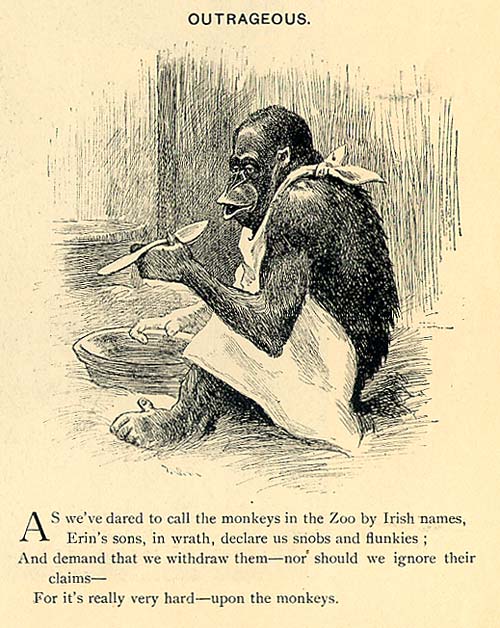
There are more where that came from. Does Brendan O’Neill of Spiked really want major media returning to the good old days of publishing insulting caricatures of Other racial and ethnic groups? Or is it just women, or just feminists, who are fair game for that kind of thing.
#mencallmethings
Brendan O’Neill sneers again – this time at women resisting misogynist silencing campaigns.
One of the great curiosities of modern feminism is that the more radical the feminist is, the more likely she is to suffer fits of Victorian-style vapours upon hearing men use coarse language. Andrea Dworkin dedicated her life to stamping out what she called “hate speech” aimed at women. The Slutwalks women campaigned against everything from “verbal degradation” to “come ons”. And now, in another hilarious echo of the 19th-century notion that women need protecting from vulgar and foul speech, a collective of feminist bloggers has decided to “Stamp Out Misogyny Online”. Their deceptively edgy demeanour, their use of the word “stamp”, cannot disguise the fact that they are the 21st-century equivalent of Victorian chaperones, determined to shield women’s eyes and cover their ears lest they see or hear something upsetting.
Like this, he or the Telegraph helpfully illustrates:

Oh yes, that’s it exactly – we’re all falling over, because we’re so fragile and stupid.
Would even Brendan O’Neill sneer in quite such a contemptuous way if the issue were racism instead of misogyny? Would he (or the Telegraph) include a cartoon like that, mocking the very idea of disliking and resisting racism? I do him the credit to doubt that he would, and the discredit to point out that he has no business having different standards for women.
…the most striking thing about these fragile feminists’ campaign is the way it elides very different forms of speech. So the Guardian report lumps together “threats of rape”, which are of course serious, with “crude insults” and “unstinting ridicule”, which are not that serious. If I had a penny for every time I was crudely insulted on the internet, labelled a prick, a toad, a shit, a moron, a wide-eyed member of a crazy communist cult, I’d be relatively well-off.
He says, missing the point by a mile. A toad, a shit, a moron, are all generic. It’s interesting that he didn’t include any anti-Irish epithets, but even if he had, at this point in history they don’t have the bite that racist or homophobic or sexist ones do. (But I’m not Irish. Correct me if I’m wrong and they still have all the old bite.)
He prides himself on being a libertarian contrarian. That’s nice, but he doesn’t get to ignore reality to shore up his case. Being called a cunt is not the same kind of thing as being called a shit.
For better or worse, crudeness is part of the internet experience, and if you don’t like it you can always read The Lady instead.
He says, exemplifying the problem himself. Either you put up with being called a cunt every time you say anything or you have to go read something called “The Lady.” Why would those be the only choices? Why does Brendan O’Neill feel so comfortable letting his contempt for women show?
Muddying the historic philosophical distinction between words and actions, which has informed enlightened thinking for hundreds of years, is too high a price to pay just so some feminist bloggers can surf the web without having their delicate sensibilities riled.
Of course it is true that the standard of discussion on the internet leaves a lot to be desired. There is a remarkable amount of incivility and abusiveness on the web. But that is no excuse for attempting to turn the internet into the online equivalent of a Women’s Institute meeting, where no one ever raises their voice or “unstintingly ridicules” another or is crude. I would rather surf a web that caters for all, from the clever to the cranky, rather than put up with an internet designed according to the needs of a tiny number of peculiarly sensitive female bloggers.
More easy contempt – ”their delicate sensibilities,” “a Women’s Institute meeting,” “peculiarly sensitive female bloggers.” And one of the tags on that piece is, incredibly – “wallflowers.”
It’s just unbelievable.
You may think it’s a cinch getting rid of misogyny. Turns out it’s not. Sady at Tigerbeatdown started out thinking it was (or more like assuming it was without noticing she was assuming it – we all know how that goes), and then she realized it’s not.
In 2009, I genuinely believed people were going to change their minds about being sexist, because they read my blog.
I know, right? If only someone had come up with this plan before! All I had to do was register a WordPress domain, compose some charmingly ironic yet pointed analyses of Ye Aulde Patriarchy, cite some academics so they knew I wasn’t stupid, throw a lot of jokes and references to oral sex in there to prove feminists weren’t “humorless” or “frigid,” and the sexists, they would be delighted. So delighted they decided to stop being sexists! “Hmmmm,” they’d say. “Sady sure doesn’t appreciate it when I do the sexism. Since she’s my new Internet Best Friend, I had better cut that shit out pronto! Then we can all join a bowling league!” BLAM. REVOLUTION ACCOMPLISHED. No more problems, for anyone, ever, because I blogged.
I hate to tell you this, friends. But I think my plan, it had a minor flaw. Which is: Misogynists don’t like women. It doesn’t matter how uniquely charming and witty and acquainted with various fine bourbons you are. Are you a woman? Then they don’t like you. And they especially don’t like you telling them what to do. By, for example, asking them to cut it out with the misogyny.
There may be one exception to that rule. It may be that if you are a woman who likes misogynists then they do like you – for now. But apart from that, no.
What I got, friends, were comments. Comments about myself. And blogs about myself. And message-board discussions, also about myself. And e-mails. What I got was what every woman (feminist or not) and openly anti-sexist person (woman or not) on this our Internet gets: I got targeted. With threats, with insults, with smear campaigns, with attempts to threaten my employment or credibility or just general ability to get through the day with a healthy attitude and a minimal amount of insult.
This is a recurring problem! Not a Special Sady Problem, but an Everyone Problem. And, increasingly, folks are identifying it as such.
Which means we can count on the threats and insults and smear campaigns to expand hugely, but it also means we can do a better job of resisting.
Laurie Penny knows about misogynist abuse of writers who have the effrontery to be women.
You come to expect it, as a woman writer, particularly if you’re political. You
come to expect the vitriol, the insults, the death threats. After a while, the
emails and tweets and comments containing graphic fantasies of how and where and with what kitchen implements certain pseudonymous people would like to rape you cease to be shocking, and become merely a daily or weekly annoyance…An opinion, it seems, is the short skirt of the internet. Having one and
flaunting it is somehow asking an amorphous mass of almost-entirely male
keyboard-bashers to tell you how they’d like to rape, kill and urinate on you.
This week, after a particularly ugly slew of threats, I decided to make just a
few of those messages public on Twitter, and the response I received was
overwhelming. Many could not believe the hate I received, and many more began to
share their own stories of harassment, intimidation and abuse.
Note to self: Follow Laurie Penny on Twitter.
Perhaps it should be comforting when calling a woman fat and ugly is the best
response to her arguments, but it’s a chill comfort, especially when one
realises, as I have come to realise over the past year, just how much time and
effort some vicious people are prepared to expend trying to punish and silence a
woman who dares to be ambitious, outspoken, or merely present in a public
space.
Quite. The time and effort create a very sinister impression of dedicated, indeed downright Spartan, rage and hatred. The lack of proportion is unnerving.
Many commentators, wondering aloud where all the strong female voices are,
close their eyes to how normal this sort of threat has become. Most mornings,
when I go to check my email, Twitter and Facebook accounts, I have to sift
through threats of violence, public speculations about my sexual preference and
the odour and capacity of my genitals, and attempts to write off challenging
ideas with the declaration that, since I and my friends are so very
unattractive, anything we have to say must be irrelevant.
And one starts to think it’s not worth it.
I’d like to say that none of this bothered me – to be one of those women who
are strong enough to brush off the abuse, which is always the advice given by
people who don’t believe bullies and bigots can be fought. Sometimes I feel that
speaking about the strength it takes just to turn on the computer, or how I’ve
been afraid to leave my house, is an admission of weakness. Fear that it’s
somehow your fault for not being strong enough is, of course, what allows
abusers to continue to abuse.I believe the time for silence is over. If we want to build a truly fair and
vibrant community of political debate and social exchange, online and offline,
it’s not enough to ignore harassment of women, LGBT people or people of colour
who dare to have opinions. Free speech means being free to use technology and
participate in public life without fear of abuse – and if the only people who
can do so are white, straight men, the internet is not as free as we’d like to
believe.
Well then, the internet is not as free as we’d like to believe.
So there’s this atheist comedian Kate Smurthwaite who did a BBC1 chat thing which went viral, and she got the kind of comments that women get. She posted a selection, and they’re…the kind of comments that women get. There was one about the trash-talking cunt getting her tongue ripped out, and more than one about how she needs to be gang-raped.
And she comments a little.
Interesting to see how a lot of people actually feel. I know almost no-one
would say these horrid things to my face. So in a sense it’s good that the
Internet lets women and other groups see how much some people really hate us.
In a sense, but only in a sense. It’s good to know but it’s also not good to know. If you were planning to be friends with anyone who says shit like that, it’s good to know, but otherwise…it’s probably better just to live out your life in sappy ignorance, happily thinking that most people don’t think or say shit like that. I don’t feel enriched by the squalid ugliness I’ve been seeing for the past few months.
Interesting and horrifying how quickly it all comes back to rape time after
time. There are also a fair few people complaining that the clip doesn’t show
the “bitch” actually getting slapped and posted by people who were clearly
looking for pornography. If anyone ever tells you we don’t live in a “rape
culture” world – show them this. It’s frightening but it does highlight the need
for action to bring about dramatic change.
Yes. And yet ignorance of this kind of thing does look so like bliss, at times.
A re-post from January 2010 – of quite startling relevance: about a pro-rape Facebook page and sexist epithets and…Rod Liddle saying a woman should be kicked in the cunt. How about that.
January 19, 2010
I did not know – some male students at St Paul’s College at the University of Sydney set up a pro-rape Facebook page.
The group, which was named “Define Statutory”, described its members as “anti-consent” and was listed in the sports and recreation section of the site…It was shut down at the end of [October], but had been live on Facebook since August, according to an investigation by the Sydney Morning Herald…The Sydney Morning Herald said the page was part of a broader culture at the residential colleges that “demeans women in a sexist and often sexually violent way”.
And here I was fuming (or should I say bitching?) about sexist epithets and men who type thousands of words insisting that ‘stupid bitch’ is not sexist. Kind of puts it all in perspective. Except actually I think it’s (broadly speaking) all part of the same thing. I think both items are part of a broader culture in a lot of places that demeans women in a sexist way. I think the bizarro phenomenon of men who ought to know better verbally spewing on women whenever they feel like it is pretty much by definition part of a broader culture that demeans women in a sexist way. That’s why it shocks me that men give themselves permission to do that – it reveals that contempt for women is commonplace in areas where I would have thought it had gone out of fashion decades ago.
But no – apparently it’s still seen as hip and edgy and funny to treat women like dirt. Apparently sexism is being defined downwards so that it isn’t really sexism unless, I don’t know, it comes with a signed affidavit stating This Is Sexism. Rod Liddle apparently is of that school, unless he really didn’t post this on a Millwall fans’ website:
Stupid bitch. A year eight sociology lecture from someone who knows fck all. You could equally say that we were similar to any group which disliked a certain aspect of society, felt estranged from it but were sure we were right. The logical extension of her argument is that the status quo is always right, which is absurd, because if that were true nothing would change. Someone kick her in the cnt.
He was there commenting right after I had, so I asked him if that one was his, saying bitches with cunts would like to know. He said
I don’t remember saying it and it certainly doesn’t read like me, but it’s quite possible that at some point I might use that temrinology to make a certain point, perhaps the opposite to the one you imagine. Just as you have done, right now. “Bitches with cunts would like to know” is a canny, sardonic pay off to your post. Take it out of context and what have you got?
I don’t know, but what you haven’t got is ‘I wouldn’t say shit like that in a million years.’ Instead you have men earnestly explaining the terrifically subtle and fascinating difference between saying ‘stupid nigger’ and saying ‘stupid bitch,’ a subtle difference that boils down to: the first is absolutely out and the second is really quite all right and you’re being a dreary fanatic if you say it isn’t. Which boils down to saying casual contempt for other races is not okay and casual contempt for women is fine.
Oh yay. One of many items I made a note to follow up from Cordelia Fine’s Delusions of Gender was an essay by Sally Haslanger, a philosopher at MIT, “Changing the Ideology and Culture of Philosophy: Not by Reason (Alone),” from Hypatia, 2008. Then yesterday I happened on and re-read an article by Julian Baggini on the scarcity of women in philosophy, and how does it start?
Sally Haslanger is angry. “I entered philosophy about 30 years ago,” she told me at the American Philosophical Association’s Eastern Division meeting in Boston. “I had a budding feminist consciousness, and I thought then that there weren’t enough women on the reading lists in my classes or among my teachers. But I thought things would certainly change, given the importance of the feminist movement. I’ve been though the profession now and worked hard on the Committee on the Status of Women. I’ve worked hard in other forums like SWIP – the Society for Women in Philosophy – that were trying to advance women’s interests. After 30 years I was seeing that there wasn’t really that much change, and that made me mad.”
So today I looked, figuring it would be unavailable online, but hey what do you know – it’s available. Probably everybody with any sense has already read it, but I missed it. I love that little thrill when you find something you expected not to find.
Why there aren’t more women of my cohort in philosophy? Because there were very few of us and there was a lot of outright discrimination…In graduate school I was told by one of my teachers that he had “never seen a first rate woman philosoph[er] and never expected to because women were incapable of having seminal ideas.” I was the butt of jokes when I received a distinction on my prelims, since it seemed funny to everyone to suggest I should get a blood test to determine if I was really a woman.
…
My point here is that I don’t think we need to scratch our heads and wonder what on earth is going on that keeps women out of philosophy. In my experience it is very hard to find a place in philosophy that isn’t actively hostile towards women and minorities, or at least assumes that a successful philosopher should look and act like a (traditional, white) man.
Does that sound familiar? It does to me. An outspoken atheist simply has to be a (traditional, white) man, because women just don’t do outspoken and atheism. Women do shoes and feelings…at best; at worst they do bitchy cunt things.
And here’s another one on the same theme. How women who play badminton really ought to do it in a skirt because…well you know.
May 7, 2011
What was that I was just saying about beauty pageants for little girls and hyper-sexualization of girls and women and the way that plays out in gymnastics and ballet and ice skating where men usually wear clothes while women always wear bathing suit equivalents?
The Badminton World Federation has made a new rule that women players have to wear skirts or dresses. Yes really – to play a sport, women have to wear skirts. Queen Victoria would so approve.

The BWF has received feedback from various parties with regards to the introduction of Rule 19.2 of the General Competition Regulations which require female players to wear skirts or dresses for Level 1 to 3 tournaments. This specific regulation has its genesis in the extensive review into the marketing and events structure conducted by an external international marketing agency in 2009.
Well why stop there then – if it’s a matter of marketing, why not make a new rule saying women have to wear makeup and long flowing hair and V-neck halter tops and stiletto heels along with their skirts? Why not tell them to stop playing and do a pole dance instead?
The BWF has developed guidelines to go alongside the new Regulation, to ensure that it will not in any way discriminate against any religious or other beliefs and respects women. Players will continue to wear shorts if they wish but simply wear a skirt over the top of the shorts, as is often practiced already by some players.
Oh isn’t that kind and sensitive and liberal – all women have to do is add an extra, bulky garment that won’t disadvantage them in any way at all apart from interfering with their freedom to move. It won’t degrade them in any way at all except for pointlessly and stupidly sticking a Gender Label on them at the behest of a marketing agency. It won’t treat them as second-class in any way at all except by ordering them to put their Gender Identity ahead of their athletic goals.
Deputy president of the WBF Paisan Rangsikitpho says it’s “never been the intention of the BWF to portray women as sexual objects,” it’s just that they’re trying to get more people to pay attention to badminton and they figure this is the way to do it.
Re-posting a pre-FTB item as it’s relevant to the gender delusion theme.
May 1, 2011
Oh yes child (that is, girl) beauty pageants, one of my favorite things. It’s so obviously a good idea to train girls from infancy to act, move, walk, and look as much like prostitutes as possible. Australia had, in its innocence, forgotten to have such things, but they are now on their way their thanks to the helpful interventions of US pageanters.
The anti-pageant groups claim pageants sexualise children
But the pro-pageant people, absurdly, say they don’t. No no, it’s
a positive and fun-filled family occasion that will boost participants’ self-confidence.

Annette Hill, owner of the Texas parent company Universal Royalty Beauty Pageant, who arrives in Australia a week before the pageant, said…”I don’t like golf but I am not going to go to a golf tournament and protest.”
Not relevant. It’s not about liking to do something oneself, it’s about doing things to very young children – very young girls.
”If you are looking at children in a sexual way, you should be ashamed of yourself and something is wrong with you. It’s all about a beautiful dress, a beautiful child with lots of personality performing on stage.”
Right, because the whole thing has nothing whatever to do with sex; the little girls are not dressed in a sexualized way, they are not loaded with makeup, they are performing on stage like any other child singing or reciting a poem.
However, Glenn Cupit, senior lecturer in child development at the University of South Australia, believes the young pageant participants are instructed to dress and behave in an adult way.
”The title is ‘child beauty pageant’ but if you look at the way the children are dressed and required to act, it’s actually a child sexualisation pageant,” he said. ”The children are put into skimpy clothes, they are taught to do bumps and grinds. It’s not looking at children’s beauty. It’s a particular idea of what beauty is, which is based on a highly sexualised understanding of female beauty.”
Exactly like the highly sexualized understanding of female beauty that mandates that female ballet dancers, gymnasts and ice skaters all have to wear the equivalent of bathing suits while male ballet dancers, gymnasts and ice skaters wear long tights and often long sleeves. Women have to look as naked and vulnerable as possible while men have to look as different from that as possible.
I’m off to play some golf.
Via Peteryxx, on the stereotype thread – an article on why so few movies pass the Bechdel test.
The “Dykes to Watch Out For” test, formerly coined as the “Mo Movie Measure” test and Bechdel Test, was named for the comic strip it came from, penned by Alison Bechdel…
To pass it your movie must have the following:
1) there are at least two named female characters, who
2) talk to each other about
3) something other than a man
I’m not sure I need to read any more to know why that’s not going to fly. It’s because movies are about men.
That was easy.
When I started taking film classes at UCLA, I was quickly informed I had what it took to go all the way in film…
I had to understand that the audience only wanted white, straight, male leads. I was assured that as long as I made the white, straight men in my scripts prominent, I could still offer groundbreaking characters of other descriptions (fascinating, significant women, men of color, etc.) – as long as they didn’t distract the audience from the white men they really paid their money to see.
Toldja. I knew that’s what they think, because it’s what movies and tv are like.
According to Hollywood, if two women came on screen and started talking, the target male audience’s brain would glaze over and assume the women were talking about nail polish or shoes or something that didn’t pertain to the story. Only if they heard the name of a man in the story would they tune back in. By having women talk to each other about something other than men, I was “losing the audience.”
Nothing much to say, is there.