Tag: Tim Hunt

  • Yes, it’s the Daily Mail, but

    The desperate reaction continues.

    The Daily Mail did a piece exposing major holes in Connie St Louis’s CV, and Dawkins is claiming that that means Tim Hunt has been “the victim of an injustice.” Of course it doesn’t mean that. If St Louis were the sole source for the story of what Tim Hunt said, then the Mail piece would throw everything in doubt – but she’s not, so it doesn’t.

    Richard Dawkins ‏@RichardDawkins 8 hours ago
    Yes, it’s the Daily Mail, but it’s the most thorough account I’ve seen of the Tim Hunt affair. Detailed & convincing. http://www.dailymail.co.uk/news/article-3141158/A-flawed-accuser-Investigation-academic-hounded-Nobel-Prize-winning-scientist-job-reveals-troubling-questions-testimony.html …

    Devastating dissection of the credentials of the only journalist still denying Tim Hunt’s “Now seriously . . .” http://www.dailymail.co.uk/news/article-3141158/A-flawed-accuser-Investigation-academic-hounded-Nobel-Prize-winning-scientist-job-reveals-troubling-questions-

    Admittedly it’s the Mail. But interesting dissection of the journalistic credentials of Tim Hunt’s main accuser. http://www.dailymail.co.uk/news/article-3141158/A-flawed-accuser-Investigation-academic-hounded-Nobel-Prize-winning-scientist-job-reveals-troubling-questions-testimony.html …

    Three tweets in a row, all saying the same thing. Dude’s excited.

    8 hours ago
    Please, no reverse witch hunt against Tim Hunt’s accusers. But it’d be nice if UCL reinstated him & the affair closed http://www.dailymail.co.uk/news/article-3141158/A-flawed-accuser-Investigation-academic-hounded-Nobel-Prize-winning-scientist-job-reveals-troubling-questions-testimony.html …

    No, it wouldn’t. It would not be nice if UCL did that. The provost and president of UCL explained why yesterday. He explained it carefully, with sympathy for Tim Hunt and Mary Collins and respect for both of them, while still saying that “reversing that decision would send entirely the wrong signal.” Dawkins would say the Mail story changes that – but he would be wrong, because St Louis is not the only source.

    Dawkins concludes that sequence with a truly infuriating claim.

    Richard Dawkins ‏@RichardDawkins 8 hours ago
    I am a social justice warrior: hate misogyny, all forms of bigotry & injustice. Tim Hunt’s silly joke made him the victim of an injustice.

    No. No he’s not and no he doesn’t. He wants to have it both ways, and he can’t. He wants to claim to hate misogyny while still flying into rages when women push back against sexism and misogyny. He can’t do both. It’s not honest and it doesn’t work.

    Note that I’m not defending Connie St Louis.

  • Our support for women in science was and is the ultimate concern

    The provost of UCL has issued a new statement.

    Does he apologize and offer to reinstate Tim Hunt as an honorary professor?

    No.

    UCL was the first University in England to admit women on equal terms to men. Equality between the sexes is one of our core values, yet this past fortnight our commitment to women and to women in science has been challenged, our reputation put under pressure and we have been part of an intense and uncomfortable media storm.

    The trigger for this was remarks about the place of women in science made by Sir Tim Hunt. I don’t intend to repeat or re-analyse who said what, where or when, and thereby provide more fuel for media speculation. I will simply restate that when on the 10th June Sir Tim sent in his resignation from his honorary position with UCL, as Provost I sanctioned acceptance of that resignation in good faith on the basis that it was his personal choice as the honourable thing to do.

    First let me say that I do regret that my acceptance of that resignation, and our announcement of it, has led to so much personal difficulty for Sir Tim and also for Professor Mary Collins, who is a highly respected and valued senior member of staff at UCL. I met with Mary last week and also spoke to Sir Tim by phone. Some regrets were expressed in both directions.

    There has been a great deal of comment, but I would point readers of this article to two very high quality blogs on this subject by eminent women scientists, one written by Dorothy Bishop that is supportive of UCL’s position and one, for balance, that is less supportive from Athene Donald.

    For both of these blogs it is worth reading the comments sections to see just how divided society and the world of science is about this problem. My own inbox has been full of that divided opinion both external and internal to UCL and after discussing the whole issue with our heads of departments and other leaders earlier this week, I felt that it was now important for me to make my views known to our UCL community and the world at large.

    What good can come of this episode and what ultimately is the big picture that UCL should now focus its energies and efforts on? Equality, diversity and the greatest good for the greatest number are enshrined in our Benthamite origins. Those values hold true to this day and we constantly try to live up to them.

    To a significant extent, we, like many other universities, have failed to achieve the level of equality and diversity that we aspire to. We have been self-critical in this regard and have identified the need to do better as a key part of our strategy, UCL 2034. We are making slow (some would say glacial) progress on gender equality and are working hard to tackle racialised inequalities (perhaps an even more complex issue) head on. Women now make up 33% of the senior academic and professional staff in grades 9 and 10.

    Because we are not satisfied with this level of progress, we have adopted the Athena Swan methodology widely across the institution and have now achieved more Athena Swan Silver awards than any other University and have just submitted our application for an institutional Silver award. We are also one of the pilot universities in the Race Equality Charter Mark scheme and have just submitted that too. Every faculty and professional service has an equality action plan that is being implemented and all members of the Senior Management Team have personal objectives with respect to equality and diversity.

    In other words Equality and Diversity is not just an aspiration at UCL but informs our everyday thinking and our actions. It was for this very reason that Sir Tim’s remarks struck such a discordant note. Our ambition is to create a working environment in which women feel supported and valued at work. To be frank, a reputation for such helps us attract the very best women to UCL, including women in science. Athene Donald’s blog contains some excellent practical suggestions for what we should actually do to improve things for women in science, all of which I agree with.

    There have been many calls for me to reverse my decision to accept Sir Tim Hunt’s resignation from his honorary post at UCL, but there have also been very significant representations to me not to do so, including, but not only, from women in science. Our view is that reversing that decision would send entirely the wrong signal and I have reason to believe that Sir Tim would also not want that to happen.

    An honorary appointment is meant to bring honour both to the person and to the University. Sir Tim has apologised for his remarks, and in no way do they diminish his reputation as a scientist. However, they do contradict the basic values of UCL – even if meant to be taken lightly – and because of that I believe we were right to accept his resignation. Our commitment to gender equality and our support for women in science was and is the ultimate concern.

    Professor Michael Arthur, UCL President & Provost

  • Ethics in journalism

    Relevant.

    Charles Seife ‏@cgseife 6 hours ago
    I asked EU official @marcinmonko if he was the source of #timhunt Times “transcript,” and if he was recording/taking notes. (1/2)

    His full response: “The document that the Times refers to is an internal report, not a verbatim transcript.” (2/2) #timhunt

    Not a verbatim transcipt.

  • Disparagement humor

    Drop everything and read this: “Just” Joking? Sexist Talk in Science by Hilda Bastian. She’s a scientist and a cartoonist. She has a cartoon at the top of three guys indulging in a spot of sexist “banter” – it’s amusing that all three of them could be Richard Dawkins.

    I want to talk about research and sexist jokes, and where that leads. It’s a response to a narrative about the Tim Hunt situation that goes something like this:

    It was just a joke. An unfortunate turn of phrase. It’s not that big a deal. He’s a nice guy who’s nice to many women – he didn’t mean to belittle anybody. It’s not demeaning if you don’t intend it to be. He’s eminent as well as nice, so give him a break. Lighten up. What has the world come to? Over the top social media firestorms are a worse threat than thoughtless remarks. Academic freedom/democracy is at stake.

    We’ve been seeing that narrative for two weeks, intensifying all the time, and it’s gone into high gear today thanks to the Times and the Daily Mail and their publication of breathless pieces saying “it turns out that Tim Hunt was joking and that changes everything!!!” We already knew he claimed he was joking (along with also saying he was serious about at least some of what he said), and it changes fucking nothing.

    I did a much shorter – about 12 words, I think – version of that narrative for the column I wrote for the Freethinker yesterday.

    “Sacked over a joke!” they cried. “No one is safe!”

    Only ten.

    Back to Bastian.

    In a 2004 review of empirical research, Thomas Ford and Mark Ferguson[PDF] point out:

    Disparagement humor (e.g., racist or sexist humor) is humor that denigrates, belittles, or maligns an individual or social group…[P]eople have become less willing to allow joke tellers “moral amnesty” for their derision of social out-groups through humor.

    Sexist and other discriminatory disparaging humor takes a code for granted: its funniness relies on people recognizing the stereotypes that are the basis for the joke. It asks us to not take discriminatory stereotyping seriously. That’s not going to take the sting out of it.

    In the right circumstances, among people who know and trust each other, parodic sexist disparaging humor can take the sting out of it, but that’s the only way it can. Hunt’s version met none of those criteria. (I’ve been seeing lots of the parodic kind on my Facebook wall, and indeed in comments here – but guess what, that’s not the same kind of thing as what Hunt did. At all.)

    Ford and Ferguson concluded that jokes don’t create hostility to the outgroup where it doesn’t already exist. But the evidence, they said, showed that joking reinforces existing prejudice. If you joke about women and get away with it, those who are hostile to women will see this as social sanction for their views and behavior. The joke tellers don’t themselves have to be actively misogynist to end up encouraging others to be.

    And haven’t we been seeing that as a result of Hunt’s “joke.”

    There’s a lot to Bastian’s piece; I don’t want to crowd it all into one piece. More later.

  • In SAME SPEECH

    Damn, I thought I was going to be able to drop it now but nooooooo, there’s too much new nonsense flying around – all in aid of the important cause of Doing Nothing when a celebrity scientist says sexist things at a science conference because hey he was only joking. Sexist jokes are never in any way any kind of problem at all whatsoever, just as racist jokes are not, just as anti-Semitic jokes are not, just as homophobic jokes are not. Jokes cannot ever be a problem because they are meant to be funny? Can’t you crazy social-justice warrior prude witches get that through your crazy lynch-mob heads?

    The Daily Mail does its more unbuttoned version of the Times story, with all caps and exclamation points.

    Revealed: ‘Sexist’ Nobel winner went on to praise women scientists in SAME SPEECH, continuing after criticised comments by saying ‘Now seriously…’

    The SAME SPEECH I tell you.

    And he said “now seriously” which PROVES that he was joking before and if you are joking THAT MEANS YOU’RE NOT BEING SEXIST BECAUSE IT’S A JOKE.

    A leaked report on the controversial speech that forced the resignation of Sir Tim Hunt suggests he also praised women scientists.

    The Nobel prize-winning scientist was castigated after he said women in laboratories either fell in love with their male colleagues or cried when criticised.

    Crucially, it now appears Sir Tim followed his jocular comments with the words ‘Now seriously…’ before heaping praise on women.

    “Crucially”? Please. “Jocular” comments can be just as sexist as serious comments. I could tell you about a “jocular” racist remark I heard someone make a few weeks ago, but it would make me want to heave.

    Following widespread criticism of his ‘sexist’ comments, he resigned from his honorary position at UCL and positions at the Royal Society and the European Research Council.

    But last night a report emerged that added crucial context to his remarks to the conference of female science journalists Seoul, South Korea.

    According to The Times, a report of the event by a European Commission official who was at the lunch was suppressed by the commission.

    He wrote: ‘This is the transcript of Sir Tim Hunt’s speech, or rather a toast, as precise as I can recall it: ‘It’s strange that such a chauvinist monster like me has been asked to speak to women scientists. Let me tell you about my trouble with girls. Three things happen when they are in the lab: you fall in love with them, they fall in love with you, and when you criticise them they cry. Perhaps we should make separate labs for boys and girls?’

    According to the official, Sir Tim immediately said after: ‘Now seriously, I’m impressed by the economic development of Korea. And women scientists played, without doubt an important role in it. Science needs women and you should do science despite all the obstacles, and despite monsters like me.’

    Note that the “transcript” isn’t really a transcript, because the mystery official said it was “as precise as I can recall it.” That applies to the account given by Blum and St Louis and Oransky too, as far as I know, but they at least were pooling three memories and not relying on just one. It’s not self-evident that the “suppressed” transcript trumps the first one.

    But that’s a quibble, because in any case the new version doesn’t make the huge difference that people are claiming. That’s especially true since he said afterwards that he was serious about some of it.

    The Daily Mail is hopeful about a rebellion:

    There are now over 2,000 signatures on an online petition to reinstate him to his post at UCL.

    Meanwhile, members of the university’s governing council are mounting a potential rebellion over the university’s handling of the affair – with it now being claimed that talks next month could lead to Sir Tim being reinstated.

    Many are said to feel that it over-reacted to the social media furore over his remarks in South Korea more than a fortnight ago.

    Claimed by whom? Who are the many? Said by whom?

    Who knows. Meanwhile BishopBlog has more details on how the media got a lot of the facts wrong.

    My concern is about the number of signatories of Ballentyne’s petition who have got themselves worked up into a state of indignation on the basis of wrong information. There are three themes that run through the comments that many people have posted:

    1. a) They think that Tim Hunt has been sacked from his job
    2. b) They think he is ‘lost to science’
    3. c) They think University College London (UCL) fired him in response to a ‘Twitter mob’.

    None of these things is true. (a) Hunt is a retired scientist who was asked to resign from an honorary position.  That’s shaming and unpleasant, but an order of magnitude different from being sacked and losing your source of income. (b) Hunt continues to have an affiliation to the Crick Institute – a flagship research centre that recently opened in Central London. (c) UCL are explicit that their acceptance of his resignation from an honorary position had nothing to do with the reaction on social media.

    There are people who insist that UCL is spinning – but I don’t see why they’re so sure that UCL is spinning while Tim Hunt is not. How do they know Tim Hunt is not spinning?

    So why do people think these things? Quite simply, this is the interpretation that has been put about in many of the mainstream media. The BBC has been particularly culpable. The Today programme on Radio 4 ran a piece which started by saying Hunt had ‘lost his job’. This was a couple of days after the UCL resignation, when any self-respecting journalist would have known this to be false. Many newspapers fuelled the flames. An interview with Boris Johnson on the BBC website added the fictitious detail that Hunt had been sacked by the Royal Society. He is in fact still a Fellow – he has simply been asked to step down from a Royal Society committee. It is interesting to ask why the media are so keen to promote the notion of Hunt as victim, cruelly dismissed by a politically correct university.

    It is interesting, isn’t it. I think it’s basically because so many people just don’t want to have to go to the trouble of ceasing to make contemptuous jokes about women. I think for a lot of people it’s a cherished part of their Traditional Culture.

    Some day this story will end. Some day.

  • Oh wait, it turns out he was joking!

    You think it can’t get any more ridiculous, but it keeps doing exactly that.

    This time? A “leaked” transcript of what Tim Hunt said at that conference in Korea supports his account that it was a joke, so it’s all good and he should be given all his honorary positions back. This is according to the Times, so I haven’t read the whole article because paywall. But even the first paragraph is absurd.

    A leaked EU report has increased the pressure for Sir Tim Hunt to be reinstated to his academic positions after it revealed a markedly different account of his speech about the “trouble with girls” in science.

    Has increased “the pressure”? What pressure? There are some aggrieved assholes complaining, but so what? Journalists do love those vague agent-free statements about bodiless “pressure” from no one in particular.

    Even more bizarrely, the Independent reports that Dawkins demands an apology from everyone in sight.

    Professor Richard Dawkins is demanding an apology from those who criticised Sir Tim Hunt over a leaked EU report he claims gives vital context to comments the Nobel laureate scientist made about his “trouble with girls” in laboratories.

    Oh yeah? Well I demand that Richard Dawkins apologize for a whole long list of things. Fat lot of good that will do me.

    Sir Tim left his position at the Royal Society and University College London (UCL) after telling an audience of female science journalists at the World Conference of Science Journalists in South Korea he found it difficult to work with girls.

    He also reportedly said: “Three things happen when they are in the lab: you fall in love with them, they fall in love with you, and when you criticise them they cry.”

    His remarks were condemned as sexist and unhelpful and he resigned shortly after the backlash. He also apologised publicly for his comments.

    Well, he apologized and then unapologized and complained and blamed and generally pitched a huge fit.

    Now, an account by a European Commission official printed in The Times expands on the comments he made during the conference.

    The official quotes Sir Tim as saying: “It’s strange that such a chauvinist monster like me has been asked to speak to women scientists. Let me tell you about my trouble with girls. Three things happen when they are in the lab: you fall in love with them, they fall in love with you, and when you criticise them they cry. Perhaps we should make separate labs for boys and girls?

    “Now seriously, I’m impressed by the economic development of Korea. And women scientists played, without doubt an important role in it. Science needs women and you should do science despite all the obstacles, and despite monsters like me.”

    Yes – so? How does that change anything? How is that a version that dramatically reveals that Tim Hunt didn’t act like a sexist jerk at that lunch?

    I don’t think anyone ever denied that he thought he was being facetious. Maybe this is news to Dawkins, but it’s not news to us: a hell of a lot of sexism is in the form of tedious, labored, unfunny “jokes.” Who hasn’t sat stony-faced through a million of them? Come on. Nobody thought Hunt was giving a serious scientific lecture on gender differences. We all knew he was “bantering.” That doesn’t change a thing.

    The official also claimed that Sir Tim did not “thank women for making lunch”, as was previously reported.

    Previously reported where? I don’t remember seeing that.

    Dawkins tweeted about this putative exoneration of Hunt.

    He told The Times: “This phrase […] is the final confirmation that Tim Hunt’s remark was light-hearted banter against himself.

    “Without wishing to join a reverse witch-hunt to root out the individuals responsible, I can’t help hoping Sir Tim will receive an apology.”

    An apology for what? For saying that a senior scientist should not be swanning around the world making contemptuous jokes about women scientists? I’m not going to apologize for that.

    UCL and the RS are also not impressed.

    A spokesperson for UCL declined to comment any further when contacted by The Independent. The Royal Society said it would not be commenting further on the matter at this stage.

    There’s nothing there.

  • When we do make a noise

    I missed one by Deborah Blum with a lot of important details. It was last Tuesday, so I was busy catching up after the conference.

    (I know I’m posting a lot about this, but it has many parts, and also many conflicting accounts. Plus I get like a dog with a bone, and we already know that.)

    Last week—along with science writers from more than forty countries—I flew to South Korea to participate in the 9th World Conference of Science Journalists. The conference had paired my lecture (Pulitzer Prize winner, 1992, beat reporting) with one by Sir Tim Hunt (Nobel Prize winner, 2001, Physiology or Medicine).

    There’s one thing I didn’t know – that their lectures were paired.

    Some media organizations have stepped in to defend Hunt’s comments, which he now claims were an attempt to be entertaining. As a co-panelist sitting next to him at the luncheon, I heard a different story. His speech, he told me, was rooted in “honesty,” not humor.

    I’m seeing people claiming UCL changed its story. Maybe UCL didn’t change its story; maybe Tim Hunt wasn’t telling the truth about UCL.

    The conference started out on a good note. Our lectures, or so I think, were solid. I talked about the importance of history in good journalism; Hunt talked about the importance of creativity in good science. The organizers regarded these parallel talks as a clever way to balance the contributions of science and journalism.

    Afterward, we were invited to a luncheon hosted by the Korea Federation of Women’s Science and Technology Associations. Female scientists in South Korea are a definite minority; a recent study found that they represent only 17 percent of the working researchers in the country. This is slightly less than the average across Asia of 20 percent.

    Ah, so that was the setup. Blum and Hunt gave twinned lectures, and then went to that lunch hosted by the female scientists.

    So they were very proud to have us there and to showcase their work. Because Hunt and I were the morning speakers, they also asked both of us to stand up during the lunch and make a few remarks.  Anyone who has done this knows that the operating principle is kindness. I talked about the ways that women make science smarter; Hunt began also by paying tribute to the capable female scientists that he knew.

    A few remarks. Not a talk, but a few remarks, and probably not prepared remarks. Hunt started well…but he didn’t finish well.

    Unfortunately, he decided that wasn’t enough. But “let me tell you about my trouble with girls,” he said.

    Why? Why did he? This wasn’t an evening at the Groucho with Kingsley and Conkers and the gang. Why did he do that?

    If you are a working woman, the word “girl” tends to be a signal flare, a red light warning of problems ahead. He continued. “Three things happen when they are in the lab: You fall in love with them, they fall in love with you, and when you criticize them, they cry,” he said. Next he made a case that science might work better if we separated researchers into single-sex laboratories. Of course, Hunt emphasized, he didn’t want to “stand in the way” of women.

    Of course not. He just wanted to portray them as fools and argue that they should be in separate labs by themselves.

    Blum and Connie St Louis and Ivan Oransky talked about how to report Hunt’s comments, and agreed on what they did: St Louis tweeted the story and Blum and Oransky retweeted her account.

    Our idea was just to get it on the record. In the week that followed—after the story simply exploded—Hunt would resign from an honorary professorship at University College London and from the advisory board of the European Research Council, which had sponsored his trip to Seoul.

    He would also tell The Guardian that he had been “hung out to dry.” He would insist that he had only been joking and that no one had asked him to explain his position. At which point, I jumped back in to counter those statements. Because, as I detailed here, I’d made a point of asking him for that very explanation.

    Hunt hasn’t been fully truthful, in short. That’s understandable, because it’s all very shaming, and people flail around in the face of shame. He’s been flailing. But unfortunately a lot of ill-disposed people have been treating his account as Definitely True and everyone else’s account as Obviously Lies, and a lot of others read the distorted accounts and believe them. A lot of people are convinced that Hunt was fired from a job as a professor at UCL. Not true.

    Some people have described all of this—the eruption across Twitter, the resulting storm of media attention—as taking on the shape of a kind of feminist witch-hunt. You’ll certainly see that in this opinion piece in Canada’s Globe and Mail.

    I could not disagree more.

    I do have sympathy for anyone caught in the leading edge of a media storm. But if we are ever to effect change, sometimes we need the winds to howl, to blow us out of our comfort zones.  Because the real point here isn’t about individuals, isn’t about Tim Hunt or me.

    The real point is our failure, so far, to make science a truly inclusive profession.

    Exactly. And wouldn’t it be nice if people like Brendan O’Neill and Brian Cox and Richard Dawkins could grok that and help instead of going into a panic about putative lynch mobs destroying Tim Hunt?

    The real point is that that telling a roomful of female scientists that they aren’t really welcome in a male-run laboratory is the sound of a slamming door.

    Yes it is – and yet so many of the pundits saved all their concern for the guy slamming the door, with none left over for the women on the wrong side of it.

    Let me quote now from a letter that the Korea Federation of Women’s Science and Technology Associations sent to Tim Hunt regarding his statement:

    “As women scientists we were deeply shocked and saddened by these remarks, but we are comforted by the widespread angered response from international social and news media: we are not alone in seeing these comments as sexist and damaging to science. Although Dr. Hunt is a senior and highly accomplished scientist in his field who has closely collaborated with Korean scientists in the past, his comments have caused great concern and regret in Korea.”

    That’s another thing I didn’t know about. I wonder if Dawkins considers the Korea Federation of Women’s Science and Technology Associations a lynch mob.

    I interrupted myself to tweet that question at him. He won’t answer, but it’s worth a try.

    They also noted that although Hunt belatedly called his remarks an attempt at humor, he had earlier defended them as “trying to be honest.” (That was certainly what he said to me among others.) His remarks, the letter said,  “show that old prejudices are still well embedded in science cultures. On behalf of Korean female scientists, and all Koreans, we wish to express our great disappointment that these remarks were made at the event hosted by KOFWST. This unfortunate incident must not be portrayed as a private story told as a joke”.

    They asked for an apology – and got it. Hunt stopped flailing and sent them a real apology.

    Hunt wrote that he regretted his “stupid and ill-judged remarks.” He added: “I am mortified to have upset my hosts, which was the very last thing I intended. I also fully accept that the sentiments as interpreted have no place in modern science and deeply apologize to all those good friends who fear I have undermined their efforts to put these stereotypes behind us.”

    Great. What a pity he’s letting people in the UK paint him as a martyr to baying witch-hunting lynch-mobs of PC feminists. He didn’t paint the Korea Federation of Women’s Science and Technology Associations that way, so why is he not protesting when his defenders do so?

    Blume ends with optimism.

    When we do make a noise, stand up for what’s right, have an open conversation about gender balance in science—even if that conversation is conducted as a virtual shouting match—we remind each other of the essential importance of equality. And we move, all of us, in a direction that matters.

    I wish. Not all of us do. The O’Neill-Dawkins faction doesn’t.

  • It’s given us the names of some surprisingly backward people

    I mentioned this public Facebook post by David Colquhoun from yesterday.

    When the Hunt affair first came to light, my first reaction (June 10, below), was to describe it as a “disaster for the advancement of women”.

    I was wrong.

    Women have come out of the affair very well. The light-hearted ‪#‎distractinglsexy‬campaign was a good start. Now we are seeing a backlash, mainly from more-or-less old men who think that UCL was wrong to accept Hunt’s resignation. That has only prolonged the unpleasantness for Hunt, but at least it’s given us the names of some surprisingly backward people.

    In the last few days I’ve had rather unpleasantly aggressive letters from a handful of people. telling me that I’m wrong to support UCL’s decision to accept Tim Hunt’s resignation. I can only speculate whether their motive is to defend academic freedom, as they claim, or whether their aggression stems from a well-hidden feeling that Hunt’s right.

    Guess what? They are all from senior men.

    I’ve had nothing but support from young people, men and women. I often urge them (in a different context) not to show respect to their elders, but not betters, when they get things wrong.

    I’m starting to hate these senior men, who are so very concerned about their own well-being and so very indifferent to that of everyone else.

  • UCL reserves the right

    I posted that absurd comment by the guy who drew up an even more absurd petition to rescue Tim Hunt from the consequences of his own actions, one Stephen Ballentyne, on Facebook. A journalist friend told me the reason people there are angry is that UCL sacked Hunt without hearing his side of the story, a denial of natural justice that I shouldn’t go along with.

    Well that’s certainly not the only reason for many people, but leaving that aside – is there any truth in the claim? I don’t know what the normal procedure is with honorary positions, so I crowd-sourced it and a friend found several universities that frankly say they can withdraw honorary positions at will. Knowing this improved my Google-fu so I found the right page at UCL – the page for honorary professorships and similar academic titles.

    At the bottom of the page:

    Honorary associations of this type are not employment relationships and UCL reserves the right to withdraw honorary status from an individual at any time.

    So that’s that issue settled.

    Unless, that is, you agree that there’s some issue of “natural justice” here. I don’t. An honorary professorship is an honor given by UCL, and UCL clearly says in writing that it reserves the right to withdraw honorary status from an individual at any time. I think that means what it says.

  • More unreconstructed every day

    The morning update. Dawkins is still raging at feminism, still whipping up hatred against women who object to Tim Hunt’s contemptuous remarks about women scientists.

    daw2

    Richard Dawkins ‏@RichardDawkins 8 hours ago
    “The Modern Witch-hunt.” @TheTimes letter: “Competitive condemnation.” “Ugly race to condemn.” The wish “to be in the front row of the mob.”

    Condemnation can be good. But Internet today makes it all too easy to whip up a baying mob & recapture the spirit of the playground bully.

    The bully here is Tim Hunt. The bully here is Richard Dawkins with his 1.2 million followers. The bully here is the consortium of Famous Pale Male Scientists trying to defend their right to express their contempt for women as colleagues.

  • Utterly ruined by sexist speaker

    Another item to include is Connie St Louis’s famous tweet, which broke the story:

    connie

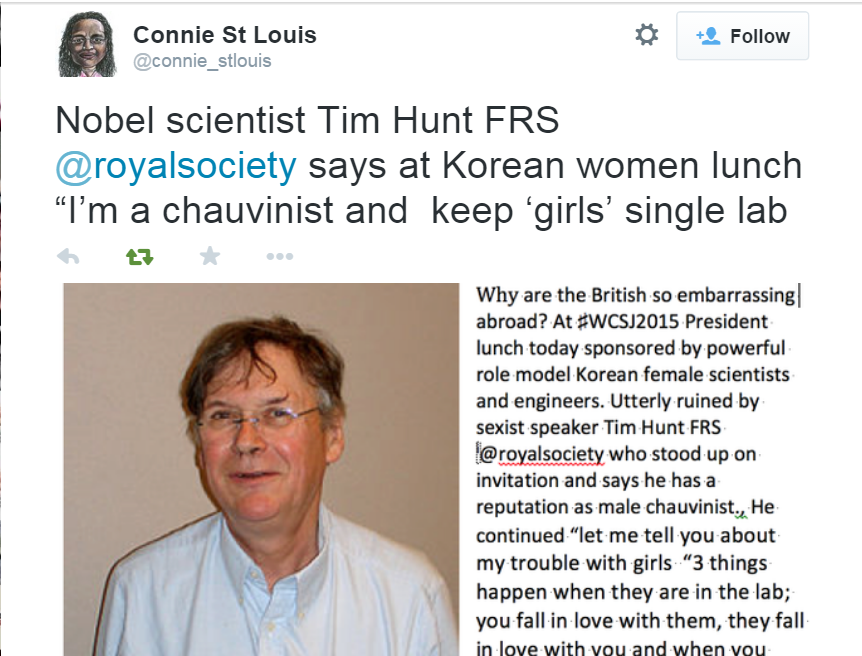
    Why are the British so embarrassing abroad? At #WCSJ2015 President lunch today sponsored by powerful role model Korean female scientists and engineers. Utterly ruined by sexist speaker Tim Hunt FRS @royalsociety who stood up on invitation and says he has a reputation as male chauvinist.

    Then she quotes the trouble with girls bit, the falling in love and they cry bit.

    not happy with the big hole he has already dug he continues digging “I’m in favour of single sex labs” BUT he “doesn’t want to stand in the way of women[“] Oh yeah! Sounds like it?

    Then she repeats that part, then

    Really does this Nobel laureate think we are still in Victorian times???

    There are interesting comments. Carl Zimmer for instance:

    carlzimmer ‏@carlzimmer Jun 9
    @2casey451 @connie_stlouis @royalsociety What kind of bad day is that? A day when he slips up & speaks his mind? A day possessed by demons?

    @2casey451 @connie_stlouis @royalsociety If he can run a lab, he can take responsibility for his own remarks in front of journalists.

    But that’s a witch-hunt.

  • An unreconstructed backwoodsman

    Because of all this nonsense talked by people like Dawkins and Brendan O’Neill and Dawkins and Brian Cox and Dawkins, I’m looking into the Tim Hunt question more than I did when it started. (That week was quite full of other things, what with going to a conference and a few other odds and ends.)

    So now I’ve read David Colquhoun’s take, or rather takes.

    15 June

    It’s now 46 years since I and Brian Woledge managed to get UCL’s senior common room, the Housman room, opened to women. That was 1969, and since then, I don’t think that I’ve heard any public statement that was so openly misogynist as Tim Hunt’s now notorious speech in Korea.

    Oh? But we’ve been assured it was just a joke, just a few thoughtless words, just a casual passing remark. We’ve been assured it was so tiny it can barely be detected at all.

    On the Today Programme, Hunt said “I just wanted to be honest”, so there’s no doubt that those are his views. He confirmed that the account that was first tweeted by Connie St Louis was accurate

    Inevitably, there was a backlash from libertarians and conservatives. That was fuelled by a piece in today’s Observer, in which Hunt seems to regard himself as being victimised. My comment on the Observer piece sums up my views.

    I was pretty shaken when I heard what Tim Hunt had said, all the more because I have recently become a member of the Royal Society’s diversity committee. When he talked about the incident on the Today programme on 10 June, it certainly didn’t sound like a joke to me. It seems that he carried on for more than 5 minutes in they same vein.

    Everyone appreciates Hunt’s scientific work, but the views that he expressed about women are from the dark ages. It seemed to me, and to Dorothy Bishop, and to many others, that with views like that. Hunt should not play any part in selection or policy matters. The Royal Society moved with admirable speed to do that.

    The views that were expressed are so totally incompatible with UCL’s values, so it was right that UCL too acted quickly. His job at UCL was an honorary one: he is retired and he was not deprived of his lab and his living, as some people suggested.

    Although the initial reaction, from men as well as from women, was predictably angry, it very soon turned to humour, with the flood of #distractinglysexy tweets.

    It would be a mistake to think that these actions were the work of PR people. They were thought to be just by everyone, female or male, who wants to improve diversity in science.

    The episode is sad and disappointing. But the right things were done quickly.

    Now Hunt can be left in peace to enjoy his retirement.

    And that will be fine, but some of his defenders are not very retired. I only wish they were.

    16 June 2015

    There is an interview with Tim Hunt in Lab Times that’s rather revealing. Right up to the penultimate paragraph we agree on just about everything, from the virtue of small groups to the iniquity of impact factors. But then right at the end we read this.

    In your opinion, why are women still under-represented in senior positions in academia and funding bodies?

    Hunt:  I’m not sure there is really a problem, actually. People just look at the statistics. I dare, myself, think there is any discrimination, either for or against men or women. I think people are really good at selecting good scientists but I must admit the inequalities in the outcomes, especially at the higher end, are quite staggering. And I have no idea what the reasons are. One should start asking why women being under-represented in senior positions is such a big problem. Is this actually a bad thing? It is not immediately obvious for me… is this bad for women? Or bad for science? Or bad for society? I don’t know, it clearly upsets people a lot.

    This suggests to me that the outburst on 8th June reflected opinions that Hunt has had for a while.

    Nooooooo, it’s not a bad thing. It’s natural and right that men should have all the senior positions, because it’s always been that way and what the hell, know what I mean? Why change it?

    19 June 2015

    Yesterday I was asked by the letters editor of the Times, Andrew Riley, to write a letter in response to a half-witted, anonymous, Times leading article. I dropped everything, and sent it. It was neither acknowledged nor published. Here it is [download pdf].

    One of the few good outcomes of the sad affair of Tim Hunt is that it has brought to light the backwoodsmen who are eager to defend his actions, and to condemn UCL.  The anonymous Times leader of 16 June was as good an example as any.
    Here are seven relevant considerations.

    1. Honorary jobs have no employment contract, so holders of them are not employees in the normal sense of the term.  Rather, they are eminent people who agree to act as ambassadors for the university,
    2. Hunt’s remarks were not a joke –they were his genuine views. He has stated them before and he confirmed them on the Today programme,
    3. He’s entitled to hold these views but he’s quite sensible enough to see that UCL would be criticised harshly if he were to remain in his ambassadorial role so he relinquished it before UCL was able to talk to him.
    4. All you have to do to see the problems is to imagine yourself as a young women, applying for a grant or fellowship, in competition with men, knowing that Hunt was one of her judges.  Would your leader have been so eager to defend a young Muslim who advocated men only labs?  Or someone who advocated Jew-free labs? The principle is the same.
    5. Advocacy of all male labs is not only plain silly, it’s also illegal under the Equalities Act (2010).
    6. UCL’s decision to accept Hunt’s offer to relinquish his role was not the result of a twitter lynch mob. The comments there rapidly became good humoured  If there is a witch hunt, it is by your leader writer and the Daily Mail, eager to defend the indefensible and to condemn UCL and the Royal Society
    7. It has been suggested to me that it would have been better if Hunt had been brought before a disciplinary committee, so due process would have been observed.  I can imagine nothing that would have been more cruel to a distinguished colleague than to put him through such a miserable ordeal.

    Some quotations from this letter were used by Tom Whipple in an article about Richard Dawkins surprising (to me) emergence as an unreconstructed backwoodsman.

    No surprise around here, I imagine.

    I’m pleased that he said this:

    Would your leader have been so eager to defend a young Muslim who advocated men only labs?  Or someone who advocated Jew-free labs? The principle is the same.

    I often make that argument when people blow off sexism as unimportant, but I get waved away a lot when I do. I’m pleased to see DC saying the same thing.

  • Always happy to be reminded

    Sean Carroll:

    Sean Carroll ‏@seanmcarroll Jun 9 Always happy to be reminded that there’s no sexism in science, just that those girls keep crying in the lab. Sean Carroll added,

    Connie St Louis @connie_stlouis
    Nobel scientist Tim Hunt FRS @royalsociety says at Korean women lunch “I’m a chauvinist and keep ‘girls’ single lab

    Uh oh, look out, witch hunt.

  • Tim Hunt signals Dawkins and co to pipe down

    This is an interesting twist: the Observer ran a piece on Tim Hunt yesterday in which the reporter, Robin McKie, said disgusting things but Tim Hunt said some good things. Tim Hunt arguably took a fairer view of the reaction to his remarks than did the science editor for the Observer.

    Robin McKie’s lead-in:

    The beleaguered UK scientist Sir Tim Hunt on Saturday thanked the hundreds of female scientists who have written to support him in the wake of the furore triggered by his controversial remarks about women in science.

    Hunt, who won the Nobel prize in 2001 for his work on cell biology, became the focus of furious online attacks earlier this month over comments about women in science being disruptive. He had to resign from several academic posts, including an honorary position at University College London (UCL).

    However, support for Hunt has since mushroomed, with fellow Nobel prize winners, senior academics and leading scientists and politicians – including Brian Cox, Richard Dawkins and Boris Johnson – lining up to denounce the treatment of the 72-year-old biologist.

    Nasty stuff. Starting with “beleaguered,” as if Hunt were a martyr. His “controversial remarks” – always a useful way to hide the actual nature of the remarks in question. He became “the focus of furious online attacks” – again, he’s a martyr and victim, while his critics are scarily enraged. And then McKie cheers on the Nobel prize winners, senior academics and leading scientists and politicians for trying to shout down the pesky insubordinate women.

    I wish these people would take a harder look at what they’re doing.

    Hunt says he has a long record of helping women colleagues.

    “I certainly don’t recognise myself as the horrible sexist portrayed in media reports, and I don’t think the women who have worked with me throughout my career do either,” said Hunt, who added that he was particularly upset by the journal Nature which accused him of “belittling women”, an accusation he flatly rejected.

    No, sorry, that won’t fly – the “joke” was a belittling joke. I’ll accept that he didn’t intend it to be, but not that it wasn’t. It was.

    Hunt also pointed out that, initially, his remarks about women in science and their alleged tendency to weep had not been fully reported. “Let me tell you about my trouble with girls,” he told delegates at the World Conference of Science Journalists in Seoul. “Three things happen when they are in the lab. You fall in love with them, they fall in love with you, and when you criticise them, they cry.”

    Crucially, Hunt said, he then added the words, “now seriously” before going on to praise the role of women in science and in Korean society. “The words ‘now seriously’ make it very clear that I was making a joke, albeit a very bad one, but they were not mentioned in the first reports and I was deluged with hate mail,” Hunt said.

    Sigh. That doesn’t matter. Imagine making a joke of that type about people from South Asia or the Caribbean. Saying it was a joke doesn’t rescue it.

    However, he did acknowledge that his “idiotic joke” had touched a nerve. “My comments have brought to the surface the anger and frustration of a great many women in science whose careers have been blighted by chauvinism and discrimination,” he said. “If any good is to come from this miserable affair, it should be that the scientific community starts to acknowledge this anger, recognise the problem and move a lot faster to remove the remaining barriers.”

    There. He said that. Exactly so. And that was what Anne Perkins was saying with her “Yet this is a moment to savour” that Dawkins, cluelessly, took to mean she was relishing Hunt’s plight. Nonsense: she was relishing the fact that his comments have brought to the surface the prejudice against women in science. Here’s what she wrote, in context:

    Even the response of the Royal Society suggests that the great institution doesn’t entirely get it. Science needs everyone regardless of gender, they said as they frantically pedalled away from one of their leading lights. How about, sexism is wrong, full stop?

    Yet this is a moment to savour. Hunt has at last made explicit the prejudice that undermines the prospects of everyone born with childbearing capabilities. It is not men who are the problem, it is women! Women are distracting. They provoke emotions. Worse even than that, they express emotions.

    And Hunt said the upshot of all this “should be that the scientific community starts to acknowledge this anger, recognise the problem and move a lot faster to remove the remaining barriers.” He said the scientific community should start to acknowledge this anger – which means it should not gasp in horror and call the anger “witch hunts” and “lynch mobs.”

  • Dawkins complains of a lynch mob

    The great man is still on the job.

    daw

    Richard Dawkins ‏@RichardDawkins
    Tim Hunt. Eight Nobel scientists condemn “lynch mob”
    http://www.thetimes.co.uk/tto/science/article4475398.ece … “Chilling effect on . . . academic freedom” #ReinstateTimHunt

    There is no lynch mob, not even in scare quotes. Tim Hunt hasn’t been harmed. He hasn’t been beaten or stabbed or dragged behind a truck or thrown in a river or hanged from a tree. He hasn’t lost a job. He lost honorary positions, and respect.

    On the other hand Dawkins later tweeted a different thought:

    Young woman at Doctor Who Cares asked me whether she should go into science. Yes yes yes yes YESS. Please do. We need more women scientists.

    That’s nice, but it’s also very easy. He says yes yes yes, but at the same time he calls women in science who protest against Tim Hunt’s public contempt for them a “lynch mob.” He calls them baying witch-hunters. He says yes women should go into science, but he also says no women should not publicly protest public contempt from senior male scientists. He says if they do he will call them names, not just on Twitter but also in letters to the Times.

    Those are arduous conditions, and they’re unfair. “You can work here, we want you to work here, but you have to put up with a hostile work environment. We want you to work here, but only if you smile politely when we up here at the top feel like throwing some shit down at you. We want you to work here, but only if you accept that we consider you our inferiors. We want you to work here, but if you talk back we will use our power to make your lives shitty.”

    Put it this way: “We need more women scientists” and “#ReinstateTimHunt” don’t go together.

  • UCL has a commitment to gender equality

    It seems timely and necessary to post UCL’s press release about Tim Hunt’s resignation.

    10 June 2015

    UCL can confirm that Sir Tim Hunt FRS has today resigned from his position as Honorary Professor with the UCL Faculty of Life Sciences, following comments he made about women in science at the World Conference of Science Journalists on 9 June.

    UCL was the first university in England to admit women students on equal terms to men, and the university believes that this outcome is compatible with our commitment to gender equality.

    See that? That’s important. The people squawking about witch hunts and packs of baying women with pitchforks seem to think that UCL pushed Tim Hunt out to punish him for expressing his contempt for “girls.” That’s fatuous. UCL didn’t want to keep an honorary professor who had expressed his contempt for “girls” to a group of women scientists at a professional conference. Of course it didn’t! If UCL had kept him on then it would have seemed to endorse, or at least refuse to reject, his publicly professionally expressed contempt for “girls” in the lab. That would be an abysmal outcome.

    The title of UCL Honorary Professor is reserved for individuals who are closely linked to one of UCL’s academic departments (or Institutes) and who are from a non-UCL academic/research institution. The appointee should be of an academic standing equivalent to that of Professor at UCL. It does not carry a salary, and does not ordinarily involve teaching or research at UCL, with activities undertaken in consultation with the relevant Department.

    Updated statement – 15th June 2015

    Sir Tim Hunt’s personal decision to offer his resignation from his honorary position at UCL was a sad and unfortunate outcome of the comments he made in a speech last week. Media and online commentary played no part in UCL’s decision to accept his resignation.

    Sir Tim held an honorary position at  UCL. He was not, and never has been, employed by UCL at any stage of his career and did not receive a salary from UCL.

    That’s important too. It was an honorary position. UCL didn’t fire him; he didn’t work for UCL.

    UCL sought on more than one occasion to make contact with Sir Tim to discuss the situation, but his resignation was received before direct contact was established.

    UCL accepted his resignation of his honorary position in good faith, and in doing so sent a clear signal that equality and diversity are truly valued at UCL. We continue to be open to engagement and dialogue on how we can best deliver on our commitment to these values.

    I think the part about “in good faith” must mean that they’re not happy about the way he’s whining and complaining now.

    UCL did the right thing. Tim Hunt is acting like an entitled petulant baby.

  • They warned of a chilling effect on academics’ freedom to speak their minds

    More from the “can’t somebody make those women shut up?” campaign, via the ever-reactionary Telegraph.

    Eight Nobel prizewinners have come to the defence of Sir Tim Hunt, the scientist at the centre of a sexism row following his comments on the “trouble with girls” in laboratories.

    They warned of a chilling effect on academics’ freedom to speak their minds after Sir Tim was forced to resign his honorary post at University College London amid pressure from social media users.

    UCL has said that social media users had nothing to do with it. The Telegraph doesn’t exactly say they did – “amid” is a very handy word for that purpose – but it certainly means the reader to get that impression.

    And then, this “freedom to speak their minds” shit. Nobody needs academics to feel free to say things like “we don’t want any Pakis in our labs” or “black people can’t do science anyway” or “girls are a nuisance in our labs.”

    Nobody needs academics to feel free to give bad comedy routines at professional conferences and nobody needs them to feel free to disparage and belittle groups of people who are below them on the stupid antiquated retrograde Great Chain of Being hierarchy that we need to get rid of. Academics have responsibilities as well as freedoms, and one of their major responsibilities is equal treatment. Academics who feel they desperately need freedom to “speak their minds” about the inferiority of Other races or genders or classes or ethnicities or orientations are doing academitude wrong. Universities are not there to be gentlemen’s clubs.

    Sir Andre Geim, of the University of Manchester who shared the Nobel prize for physics in 2010 said that Sir Tim had been “crucified” by ideological fanatics , and castigated UCL for “ousting” him.

    No he wasn’t. There was no cross. No torture, no execution, no stigmata, no death. And it’s not ideological fanaticism to object to a senior male scientist telling a group of women scientists at a professional event that he thinks “girls” are a problem in the lab.

    Sir Andre told The Times: “The saddest part is probably the reaction by the UCL top brass who forced Tim to resign. So much for the freedom of expression by the very people who should be guardians of academic freedom.”

    Bollocks. What if Tim actually had said all that dreck about “Pakis”? Would the eight Nobel laureates be defending him then? I can’t know the answer to a conditional, but I suspect they wouldn’t – because the not-okness would be too glaring even for them to miss. But when it’s just “girls”? That’s different. Why is it different? I guess it’s because women just don’t matter, plus if they get too comfortable in the labs maybe they won’t make the Nobel laureates’ dinner any more.

    Jack Szostak, of Harvard University, a Nobel prizewinning medical biologist, said that it was “frightening to see how one stupid comment can ignite a global firestorm of criticism”.

    Well dry yourself off, Dr Szostak, and deal with it. Put your big boy pants on. Stop crying every time someone criticizes you. If you really need to make stupid comments about women and other underlings, just save them for social occasions. Don’t barf them out in talks at professional conferences. That’s really not asking all that much.

    The other Nobel laureates who criticised the college’s treatment of Sir Tim included the medical academic Randy Schekman, of the University of California, Berkeley, and Sir Anthony Leggett, professor of physics at the University of Illinois.

    Avram Hershko, an Israeli scientist who won the 2004 Nobel prize in chemistry, said he thought Sir Tim was “very unfairly treated.”

    All the women discouraged and turned away by remarks of the kind Sir Tim made? Oh they don’t matter – they’re just peasants, and girl-peasants at that.

    In conclusion – no, we are not going to shut up.

    H/t Jennifer Phillips

  • His claims work to identify women as caste-inferiors

    Janet Stemwedel takes a different view of the reactions to Tim Hunt from that of Professor Richard Dawkins FRS. Her view is pretty much the opposite of his.

    The vigorous reactions to remarks by biochemist Tim Hunt about women in science on social media and elsewhere are being cast as “internet shaming.” That’s a mistake. The reactions are, in fact, exactly part of the way scientists engage with each other to build knowledge.

    Tim Hunt, winner (with Paul Nurse and Leland H. Hartwell) of the 2001 Nobel Prize in Physiology or Medicinemade news last week for remarks he made to members of the Korea Federation of Women’s Science and Technology Associations at a luncheon at the 2015 World Conference of Science Journalists…

    …Asked to clarify his position, Hunt asserted that he “meant the remarks to be humorous” but affirmed that he “just meant to be honest.” In the wake of the public criticism, Hunt resigned an honorary post (one with no salary, teaching responsibilities, or lab space) at University College London (UCL), though there are conflicting accounts of whether this resignation was voluntary or not. Now, the vocal criticism of Hunt’s remarks is being characterized using hyperbolic terms like “lynchmob,” “witch-hunt,” and “disemboweling.”

    Stemwedel cites Robert Merton’s “norms of science,” in particular universalism (everybody can contribute to science and social status is beside the point) and organized skepticism (is what Hunt said a crock of shit?).

    There’s another facet of the situation worth considering in the context of the norms of science: the content of Hunt’s controversial claims seem to reveal him to be falling short on the norm of universalism.

    Merton wrote about instances where members of the scientific community failed to live up to the norms of science, usually due to pressures from the larger societies in which the scientists were embedded. Writing in 1942, when pressures from the Nazi regime on German scientists were likely on his mind, Merton noted:

    Scientists may assimilate caste-standards and close their ranks to those of inferior status, irrespective of capacity or achievement. But this provokes an unstable situation. Elaborate ideologies are called forth to obscure the incompatibility of caste-mores and the institutional goals of science. Caste-inferiors must be shown to be inherently incapable of scientific work or, at the very least, their contributions must be systematically devalued. [3]

    It’s hard not to see Hunt’s remarks about “the trouble with girls” in the lab as suggesting that women as a group are inherently incapable of scientific work because of their emotions, or their tendency to provoke emotions in men (who are assumed to be capable of scientific work). His claims, in other words, work to identify women as caste-inferiors rather than to recognize them as equal members of the scientific community.

    Zing.

    But preemptively characterizing women scientists as a group as likely to cry, as Hunt did, falls down on universalism, writing them out of the knowledge-building conversation before they’ve even had a chance to be heard. (Writing women off like this is ironic in light of the contributions women made to the research for which Hunt shares a Nobel Prize with two other men.)

    Professor Richard Dawkins FRS please note.

  • Disproportionate to what?

    While we’re on the subject of Famous Pale Male Scientists Defending Other Famous Pale Male Scientists From Witchy Baying Feminists, there’s also Brian Cox.

    The scientist and broadcaster Prof Brian Cox has said it was wrong the way a Nobel laureate scientist was “hounded out” of his university post over controversial comments he made about women working in laboratories.

    Cox said the remarks by Sir Tim Hunt had been “very ill-advised” but that the response – which saw him give up positions at University College London (UCL) and the Royal Society – had been disproportionate.

    Disproportionate to what?

    UCL and the Royal Society want to attract women to science. They don’t want to repel women from science. They don’t want to alienate women already in science. So why is it disproportionate for them to dump a Famous Pale Male Scientist who goes to a conference in a foreign country and gives a talk in which he talks about women as if they were pets or small children?

    Here’s what the Royal Society said:

    Sir Tim Hunt has today contacted the Royal Society to offer his resignation from the Society’s Biological Sciences Awards Committee. The Society has accepted that resignation.

    It was an awards committee. Is it “disproportional” that they allowed him to resign from that? Is it “disproportional” if they nudged him to resign?

    Think about it. He’s on the committee, and he made those dismissive remarks about women…so how trustworthy does the committee appear? Not very. Maybe it would pass over women who should get awards, or maybe it would give awards to women who shouldn’t get them. It’s the wrong sort of committee for Sir Tim Hunt to be on.

    I don’t see the disproportion.

    The rest of what the RS said:

    Sir Tim Hunt’s recent comments relating to women in science have no place in science. The Royal Society believes that too many talented individuals do not fulfil their scientific potential because of issues such as gender discrimination and the Society is committed to helping to put this right.

    Sir Tim Hunt has made exceptional contributions to science in terms of his own research on the cell cycle and its implications for our understanding of cancer which led to the award of the Nobel Prize. Over the years he has also supported the careers of many young researchers, often travelling tirelessly to support young people all over the world. It is the great respect that he has earned for his work that has made his recent comments so disappointing, comments he now recognises were unacceptable.

    He hasn’t been sent to the North Pole, he’s simply resigned from a committee.

    Back to Brian Cox.

    Cox acknowledged that while there was a serious issue about the “perceived air of sexism” that deterred some women from pursuing careers in science, he said that he did not believe Hunt should have been treated in the way that he was.

    Cox said Hunt was “good person and a great scientist” and that as a man in his 70s, it was perhaps not surprising that Hunt was “slightly unreconstructed”.

    That’s not the issue. The point isn’t to punish him, it’s to make UCL and the RS not hostile to women in that particular way. That’s a sensible and reasonable goal. It’s a more important goal than protecting the feelings of Sir Tim Hunt in the wake of his dismissive remarks. I don’t think Brian Cox should be putting Hunt’s feelings ahead of efforts to remove obstacles to women in science.

    He told BBC Radio 4’s The World at One programme: “You can make the argument that senior figures in science have to be first of all aware that there is a central problem of women progressing up to the highest levels of science and secondly, therefore, have to be mindful of that and careful of their language.

    “On the other side of course, there is the wider problem of trial by social media. People do make ill-advised comments from time to time so is it appropriate to hound someone out of their position at a university or indeed is it appropriate for the university to react in the way UCL in this case did and ask someone to resign or threaten to sack them?”

    If it had been a spontaneous remark at the pub, no. But it wasn’t. It was a prepared talk at a professional conference. It’s extraordinary the way defenders of Hunt keep minimizing it. It’s extraordinary that Cox apparently can’t see the problem with Hunt’s saying essentially that women are a big pain in the ass in the lab and should be shunted off into their own labs by themselves. At a professional conference.

    “To have a Nobel prize winner – and by all accounts a great scientist and a good person – being hounded out of a position at UCL after all those years of good work and science, I think that’s wrong and disproportionate – with the caveats I mentioned.”

    Cox acknowledged that there were problems in getting young women to take up careers in science and engineering, and said there were “big problems” that needed to be addressed when it came to career progression for women.

    “There is a problem in science and engineering and the problem is that we don’t have enough women going into certain areas, particularly engineering,” he said.

    And blah blah blah blah, but having said that – Tim Hunt should still have those positions from which to make dismissive remarks about women at professional conferences.

    Why?

  • The Twitterstorm that wasn’t

    Rhiannon Lucy Cosslett, who started the #distractinglysexy hashtag, explains that she didn’t get Tim Hunt kicked out of anything and neither did the hashtag.

    Despite claims that the response to Hunt’s comments constituted an online “march of the feminist bullies”, no one who was part of this humorous attempt to highlight the varied and complex work of female scientists called for Hunt’s resignation or hounded him online, but that was the way it was framed.

    There were undoubtedly unpleasant people on social media crowing about the man’s downfall but as far as I could see the discussion was largely jocular and – owing to the fact that many of the female scientists were posting photos under their own names – mostly professional.

    The Hunt controversy continues to make headlines, with Boris Johnson and Brian Cox wading in this week as the backlash to the backlash. I even heard it said on Radio 4 this morning that “Tim Hunt was hounded from his job by a Twitterstorm”. This is patently not the case.

    I’ve seen serious people who should know better Twitter-moaning about the feminist “witch hunts” and the desecration of the memory of John Stuart Mill. But that’s not what happened.

    In actual fact it was clearly embarrassment on the part of the scientific community at his retrograde sexism, and that sexism being splashed across the media, which led to pressure on him to resign. University College London, where Hunt held a professorship before his resignation and which was the first university to admit women on the same terms as men, would have no truck with comments such as Hunt’s. No doubt concern about an international PR disaster played a part, but anyone who knows anything about the university’s founding principles would have expected this result, whether justified or not.

    And that’s just normal for people who have jobs and positions and titles. Tenure protects academics, but Hunt wasn’t pushed out of any tenured jobs – he has already retired from those.

    Twitter also gives the illusion of reversing the normal power dynamics. Suddenly powerful people – often men – and corporations, cannot ignore the outraged voices of the “rest” of the population. Yet this is an illusion. By blaming the downfall of Hunt on mobs of internet feminists, the media are ascribing them power, transforming everyone on social media with feelings about sexism into a dangerous monolith that threatens free speech. They must then be criticised and undermined, rendering them even less powerful than before.

    Heads we win, tails you lose, neener-neener.