Tag: Tim Hunt

  • How to silence the peasants

    Still at it. Still muddying the waters by saying Tim Hunt was sacked by UCL, when he was never employed by UCL in the first place. Simon Heffer in the Telegraph:

    How to silence Sir Tim’s bullies

    Except that it didn’t “sack” him.

    Also, the claim that “silly” dismissive contemptuous remarks about women are “entirely harmless” is highly debatable. (I think they’re just flat-0ut wrong, but then that’s what I think, and it’s debatable.)

    UCL acted after a particularly nasty display of mob rule by denizens of Twitter, where it is too easy to vent bovine opinions first and reflect later, rather than treat these grandstanding bullies and halfwits with the contempt they merit.
    No it didn’t. There hadn’t been any big Twitter uproar at that point. He’s just making it up as he goes.
    When will the Government defend Sir Tim? Now he is available, why don’t they give him a great position in the world of science or higher education, and show the bullies they can’t win?

    You know what I think he should do? Offer his services to do outreach to girls or young women or both, to encourage them to go into science. I think that would be great.

    And this business of calling it “bullying” when underlings push back against contempt from their upperlings – that’s a very ugly business indeed.

  • He did say some stupid things which cannot be supported

    Maybe this will persuade the ragers to shut up at last: Paul Nurse says what Tim Hunt said was not acceptable. Sarah Knapton, science editor at the Telegraph, reports.

    Sir Paul Nurse, a joint-Nobel Prize winner and friend of Sir Tim, told the Telegraph the embattled professor’s “chauvinist” comments had “damaged science”.

    He added that since Sir Tim stood down last month, Sir Paul has been sent hundreds of vicious letters. Some argue that the Royal Society has not gone far enough in its condemnation of the Noble Laureate, while others criticise the 350-year-old institution for not backing the beleaguered scientist.

    “Some have threatened to do things to my body parts,” said Sir Paul, in a weary tone. “The discussion has become totally polarised with extreme views on both sides. I have had hundreds of letters. I had five just this morning. It doesn’t seem to be going away.”

    Louise Mensch, for one, is determined not to let it go away.

    Sir Paul has stayed largely silent about the matter until now. He is a close friend of Sir Tim and they shared the 2001 Nobel Prize in recognition of their work on the cell cycle which hugely advanced cancer research. He describes him as ‘a lovely man’ who he has known since 1993.

    See I’ve never thought he wasn’t a lovely man. It seemed pretty clear that he is one – lots of people said so, including lots of the people who deplored his clumsy “jokes” in Seoul. Lovely men can screw up. Sexism and casual contempt for women are entrenched and pervasive, at the same time as they’re considered not ok by people who give a damn. This means that it’s pathetically easy to be both lovely and sexist.

    So Paul Nurse read about Hunt’s comments with a heavy heart.

    Sir Paul, 66, said the affair had been hugely damaging for science and the Royal Society.

    “Tim is a lovely man and I have known him a long time,” he said. “But there is no question about it, he did say some stupid things which cannot be supported and they had to be condemned. He said he was a chauvinist and that is not acceptable.

    “It is sad because since I started working as a researcher in the late 1960s there have been really significant improvements and this kind of thing tends to set things back.

    “The Royal Society can come across as old fashioned because you stay a member until you die so it can seem that we’re 30 years behind the times. But half of the Council are now women and we have a lot of initiatives to improve diversity. We have a Diversity Committee and allow mothers or fathers to work half time. Most other companies don’t do that.

    “So it’s frustrating when things like this happen which make the Society seem out of touch.”

    I wonder if Richard Dawkins will call Paul Nurse a witch hunter.

    On June 11 Sir Tim stepped down from his role on the Biological Science Awards Committee and the Royal Society issued a strong condemnation of his comments saying they had ‘no place in science.’ The statement also acknowledged that gender discrimination was still holding back too many talented scientists.

    Then it went further, announcing last week that it will replace portraits and busts of some of Britain’s most renowned male scientists at its London headquarters with artworks depicting leading women.

    However the furore shows no signs of diminishing, mainly because so many eminent scientists have now backed Sir Tim.

    And because Louise Mensch tweets about it nonstop (literally), and she has a column in the Sun.

    “The hate mail that I get is divided into those who don’t think we have done enough and we should be more extreme in our censorship of Tim, and those who think we have treated him badly,” added Sir Paul.

    “These are the extremes and it is sad that this is what the discussion has become. I have had physical threats. People feel very strongly on both sides. But I think it is right that Sir Tim resigned.

    “He did a really stupid thing and then went on the Today programme and made the whole thing worse. I don’t hold with people who say it has shone a light on the issue. It would have been better if it hadn’t happened. It hasn’t been good for science or the Royal Society.”

    Or for women in STEM or for women generally. It’s been bad for all four.

    Sir Paul, who was knighted in 1999, became President of the Royal Society in November 2010, succeeding Martin Rees, the Astronomer Royal.

    In addition to the Nobel Prize he has received a Royal Medal, the Copley Medal, the French Legion d’Honneur and in 2013 became the winner of the Albert Einstein World Award of Science. He holds honorary degrees at the University of Kent, Warwick and Worcester and is an Honorary Fellow of the Royal Academy of Engineering.

    Sir Paul, who is from Wembley, the son of a part-time cleaner and mechanic at Heinz, claimed his interest in science emerged on his long walks to school in north west London.

    Not a child of privilege then, not a product of posh prep schools and posh public schools. I wonder if that’s one reason he gets the point.

    H/t Maureen

  • Council unanimously supports the decision taken by UCL’s executive

    UCL has released the promised statement. It’s short and to the point.

    9 July 2015

    UCL Council, the university’s governing body, has today reviewed all of the circumstances of the resignation of Sir Tim Hunt as an Honorary Professor of the Faculty of Life Sciences on 10 June. Having seen the relevant correspondence, including the exchange of emails between Sir Tim and UCL, the Council is satisfied that his resignation was accepted in good faith. Council unanimously supports the decision taken by UCL’s executive to accept the resignation.

    The subsequent extent of media interest was unprecedented, and Council recognises the distress caused to Sir Tim and Professor Mary Collins. Council acknowledges that all parties agree that reinstatement would be inappropriate.

    Council recognises that there are lessons to be learned around the communication process. Consequently it has requested that the executive undertake a review of its communications strategy.

    Note the last sentence of the first paragraph –

    Council unanimously supports the decision taken by UCL’s executive to accept the resignation.

    That’s important, because Louise Mensch and her footsoldiers have been saying over and over that there’s a rebellion in the Council and that many members wanted to reinstate Hunt to his honorary professorship. It appears that Louise Mensch was wrong about that…at least, wrong that they wanted it badly enough to go to war over it.

  • Even if meant to be taken lightly

    UCL has had its ruling council meeting. It is not going to reinstate Tim Hunt. It would like to draw a line under the issue now (but here’s betting the enraged anti-feminists won’t observe that line).

    Hannah Devlin at The Guardian reports:

    Last week, the UCL provost, Michael Arthur, said the university would not back down, saying in a statement that reinstating Hunt would send out “entirely the wrong signal”. The remarks “contradict the basic values of UCL – even if meant to be taken lightly”, he added.

    Even if meant to be taken lightly – so all the enraged anti-feminists shouting that it was a joke are missing the point. This seems slightly dim of them, since sexist jokes have been well known to be an issue since the renaissance of feminism first drew breath.

    Although some of the 20 council members are understood to regret Hunt’s resignation, none are calling for the decision to accept it to be reversed and the council is expected to release a joint statement this evening aimed at drawing the affair to a close.

    Hunt attended a conciliatory meeting with Arthur on Monday, at which both parties discussed how they could move on from the controversy, which has dragged on for an entire month. The university said the two men may issue a joint statement following the council meeting, but that there was “no question” of this including an apology to the scientist.

    Because UCL doesn’t owe him an apology. He’s not a child and he hasn’t always lived in a cave; he should know perfectly well that his role at a conference is not to make patronizing “jokes” about and to underlings. As many people (including me) have pointed out, hardly anyone would disagree with that if he’d made “jokes” about Asians at that conference. Pretty much everyone would agree that was a terrible gaffe that put UCL in a supremely awkward position. But because it’s just women, we get all this enraged push back. Why does “jokey” or “ironic” contempt for women get so much more forbearance than jokey/ironic national or racial or ethnic contempt?

    A source told the Guardian that the issue is getting in the way of dealing with gender bias.

    “It’s the story that just kept on running, to the huge detriment of UCL,” the source said. “This touches a particularly raw nerve for UCL. We are particularly concerned to increase the numbers of women at the highest professorial level. We’re already under enormous pressure, and quite rightly so, because the pace of change is so glacial.”

    She added that while there was a spectrum of views within the council about Hunt’s comments, members were united in thinking the affair had been handled badly by UCL – “no-one thinks it’s been handled well – there’s a lot of dismay about that”.

    Criticisms included that no-one appeared to have established the precise content of Hunt’s speech or its context before coming to a judgement on the matter.

    I can guess why it happened that way. My guess is that people were thinking if they delayed, there would be a loud chorus (aka a “witch hunt”) about the failure to act. I’m guessing they acted [too] quickly because they were afraid of acting too slowly. Next time the powers will probably act too slowly, because that’s how these things work – we always correct the last mistake, which generally means getting it wrong the opposite way. I’m glad I don’t administer anything.

    Others said that those worst affected by the controversy were scientists – particularly younger women – who had expressed views that were critical of Hunt or his remarks.

    One female scientist who commented in the media after the story broke told the Guardian she had received “such a torrent of abuse” on social media and blogs that she could no longer face speaking publicly on the matter. Other female scientists who spoke out had received death threats, she said. “We’ve all been silenced. It’s quite shocking really,” she said. “It’s just not worth the aggro of waking up to calls for me to be sacked on Twitter and hundreds of messages. It was so frustrating to see the perpetrator becoming the victim.”

    Louise Mensch is personally responsible for a lot of that. She bullied and harassed people on Twitter herself, and she inspired others to do the same.

    The article concludes by quoting Professor Lewis Wolpert and Professor Martin Vessey saying UCL made way too much fuss about a little thing.

    Thanks, guys.

  • Tell the lie again and again

    The Big Lie is repeated yet again. The Washington Examiner this time. In the second sentence of the very first paragraph, so that readers will have the story wrong from the outset. Yay journalism.

    Professor Sir Tim Hunt had won every honor in his field, from Fellowship of the Royal Society to the Nobel Prize. But last month, the pioneering biochemist was dismissed from his post at University College, London (UCL).

    From “his post,” the one that didn’t exist. UCL has never employed Tim Hunt. Tim Hunt has never worked for UCL.

    The second paragraph introduces the lynch mob – instigated by a black woman, for extra points.

    One of the women present, a lecturer called Connie St Louis, complained on Twitter about his “sexism”, triggering the usual lynch mob. By the time the professor had returned to London, his career lay about him in broken shards.

    No, it didn’t. His career remains. The post-retirement portion of it got messed up, but the career itself remains. He’s still a Fellow of the Royal Society and still an emeritus at the Crick Institute.

    Then the writer – Dan Hannan, a British Conservative MEP – goes on to say what’s all this fuss about the confederate flag. Lynch mob!!

  • Universities are for men who like to dress down

    Damn, yet another one. Howard Jacobson has a nasty, inaccurate, reactionary column in the Independent about Tim Hunt. Defend to the death the right of important men to talk sexist shit to groups of women scientists at conferences!! The world will fall out of orbit if you don’t!!!

    Tim Hunt has the air of a man who doesn’t put his appearance first, a man who, whether calculatedly or otherwise, inhabits that sphere of extraterrestrial idiosyncrasy whose uniform is a cream linen jacket bought from one of those shops in Piccadilly where they come pre-battered, a fisherman’s smock (probably picked up in Cornwall), stained owlish spectacles, a cord that goes around the neck to hang them from (else they’d fall into a laboratory bath) and, yes, figurative tufts of nostril hair.

    Among the reasons universities exist is that such men should have a habitat. They are a dying species. When I went to university, there was almost no other way for a don to look. A few military men and dandies were the exception, but even their moustaches and cravats were mildewed and wouldn’t have passed muster anywhere but in the Fens. Otherwise, the Scarecrow look from The Wizard of Oz prevailed. Bicycle clips, one trouser leg still in the sock, ties unevenly knotted, hair growing out of their ears and from their noses, sometimes in odd fringes above their shirt collars, occasionally in tussocks on their cheeks.

    And on and on he goes. It’s all about men, you see – men as endearing disheveled nerds at universities, men with bicycle clips and sloppy ties, men men men. That’s their world; women are intruders. Women are this weird off eccentric little species that you hardly ever see, and they have no place at universities or much of anywhere else except kitchens and beds. Therefore, Tim Hunt wuz lynched.

    His next step is to say they all have terrible opinions, of course they do, what do you expect.

    There have to be places where people let nostril hair run wild, think differently from the rest of us, implicitly call into question and even deride everything we have made up our minds about, find wisdom through unconventionality, and say a lot of foolish things along the way. Universities are such places. Correction: universities should be such places.

    Show me a university which is a hotbed of thin-skinned offence-taking, where every unacceptable idea is policed and every person who happens to hold one is hounded out of a job, and I will show you a university that isn’t a university but an ideological prison camp and indoctrination centre.

    And there it is – that big lie, yet again. Tim Hunt was not hounded out of a job.

    Reaffirming the college’s pusillanimous decision to show Tim Hunt the door, the Provost of University College London said: “Our commitment to gender equality and our support for women in science was and is the ultimate concern.” Wrong, Mr Provost. The right of women to enjoy equal opportunities, receive equal pay and enjoy equal respect to men in science, or anywhere else come to that, is without doubt a matter of high importance. But it is not as high, if we are to talk of “ultimate concerns”, as the freedom to think freely and independently – a freedom which matters as much to women as to men, and without which equality must lose its savour.

    Tim Hunt wasn’t shown the door. He wasn’t inside to be shown the door. There was no door to show him. He wasn’t fired, he wasn’t sacked, he wasn’t hounded out of a job, he wasn’t shown the door. His honorary professorship, which is not like a real one, was withdrawn. That’s all.

  • Distortion up front, correction at the back

    The Guardian wrote an editorial on the Tim Hunt question…a shockingly misleading one for the first two paragraphs. Wouldn’t you think newspapers would manage to get the basic facts right, especially three weeks in?

    Those first two paras:

    It is three weeks since Sir Tim Hunt, a Nobel prize winner, shared his sexist opinion of female scientists – distractingly sexy, prone to weep when criticised and best segregated at work – with a room full of science writers. His remarks were relayed into the Twittersphere by several of those present, including British-based science writer Connie St Louis. At once, he came under global and sometimes viciously personal attack on social media. He delivered a non-apology on BBC radio. According to his wife, also a senior scientist at UCL, it was made clear to her that to protect UCL’s reputation, he had to resign.

    Within 24 hours of his after-dinner speech, he had gone. By the weekend, he was complaining to sympathisers that he had been hung out to dry, unleashing a wave of support that included famous colleagues such as Richard Dawkins and Brian Cox. Today Jonathan Dimbleby joined the protest. Next week, UCL’s council meets and the Hunt affair will once again be on the agenda. This bitter mix of resentments amplified by the polarising environment of social media should have met a calmer official response. But the professor still had to go.

    Unbelievable, isn’t it? It sounds as if UCL told Mary Collins that Hunt had to resign from an actual job at UCL. It sounds as if Tim Hunt had a regular academic job at UCL that he was forced to resign. No one who didn’t already know could possibly tell from that opening that the Guardian is talking about an honorary professorship, one explicitly held at the pleasure of UCL and subject to withdrawal at any time – not a regular tenured job with a contract and salary. It would be interesting to know how much of this ridiculous fuss has been caused by the abject failure of news organizations to make that clear from the beginning.

    Only in the third paragraph does the Graun admit that it was an honorary post that Hunt was pushed to resign (assuming it’s true that he was pushed). That’s three paragraphs too late.

    It goes on to say grudgingly that sexism in science is bad ok, but all the weight was put on the bogus claim that Hunt was forced to resign. Nice job, Guardian.

  • How The Times science journalism rolls

    Chapter 72 or thereabouts.

    Hilda Bastian ‏@hildabast 4 hours ago
    @deborahblum @david_colquhoun @David_Dobbs How The Times science journalism rolls http://www.thetimes.co.uk/tto/science/article4485280.ece … 1/2 #Yeesh

    Embedded image permalink

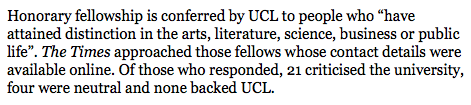
    Honorary fellowship is conferred by UCL to people who “have attained distinction in the arts, literature, science, business or public life”. The Times approached those fellows whose contact details were available online. Of those who responded, 21 criticised the university, four were neutral and none backed UCL.

    Notice the problems? How can they know “those who responded” were representative of anything? How can they know people who took the opposite view didn’t just decide not to give the Times any more oxygen? How can we know the Times really did approach “those fellows whose contact details were available online”? Haha we can’t, they didn’t even approach David Colquhoun, whose contact details are available online.

    David Colquhoun ‏@david_colquhoun 3 hours ago
    @whippletom @hildabast @thetimes I’m an Hon Fellow of UCL since 2004, and I wasn’t asked so even apart from lw response, it’s dodgy

    Hilda Bastian shared her comment on the Times article:

    Hilda Bastian ‏@hildabast 4 hours ago
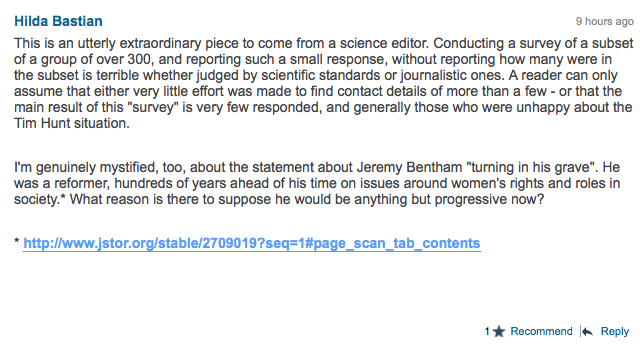
    @deborahblum @david_colquhoun @David_Dobbs And my comment in reply (the link in it: http://www.jstor.org/stable/2709019?seq=1#page_scan_tab_contents …) 2/2

    Embedded image permalink

    This is an utterly extraordinary piece to come from a science editor. Conducting a survey of a subset of a group of over 300, and reporting such a small response, without reporting how many were in the subset is terrible whether judged by scientific standards or journalistic ones. A reader can only assume that either very little effort was made to find contact details of more than a few – or that the main result of this “survey” is very few responded, and generally those who were unhappy about the Tim Hunt situation.

    I’m genuinely mystified, too, about the statement about Jeremy Bentham “turning in his grave”. He was a reformer, hundreds of years ahead of his time on issues around women’s rights and roles in society.* What reason is there to suppose he would be anything but progressive now?

    *

    Thank you Rupert Murdoch.

  • What’s next? Donating the proceeds from sale of his unicorn?

    A blistering explanation of what’s sexist about the backlash against the response to Tim Hunt’s day out by medical doctor Amy Tuteur.

    Tim Hunt made offensive comments about women scientists in front of a group of women scientists. He apologized and he resigned.

    Many men feel very bad about this.

    No, not bad about the fact that Hunt felt free to humiliate women at a meeting designed to honor them. Be serious! They felt bad that any male scientist should be held to account for his not so subtle put down.

    Maybe they wouldn’t mind it so much if he were a young bench scientist – but Tim Hunt is senior and important. Senior important guys shouldn’t be held to account, because not being held to account should be one of the perks of being senior and important.

    There are a few apologists that are willing to acknowledge the obvious, but then minimize its significance. Jonathan Dimbleby, a broadcaster and writer has resignedhis honorary appointment at University College of London, in solidarity with Tim Hunt.

    According to Dimbleby:

    This is not an offence that should be enough to ensure a distinguished scientist should be told to resign his position.

    Woah! What’s next? Donating the proceeds from sale of his unicorn? Nothing like demonstrating your support (resigning an honorary post) in a way that changes nothing and costs you nothing.

    I like the unicorn line.

    Moreover … and let me see if I can spell it in terms Hunt’s apologists can understand … the issue is not the joke. The issue is the gender bias behind the joke. Someone who feels free to make women the butt of his jokes at a conference designed to honor women may be so clueless about his own gender bias that he feels equally free to display and act on it in his treatment of his female graduate students.

    Tim Hunt was entirely free to make offensive remarks to women. Connie St. Louis was entirely free to report his remarks. UCL was entirely free to condemn him for it.

    The fact that apologists think there should be no consequences for Hunt’s speech, but condemnation and worse for those who were offended by it, is a classic tactic in dismissing gender bias, and it is unacceptable.

    Damn right.

  • Quite the rabbit hole

    Phil Plait says ALL the things.

    He starts with Tim Hunt’s day out.

    He made a series of sexist comments, saying that the problem with “girls” in science is that they fall in love with the men, the men fall in love with them, and when you confront them they cry. He then went on to suggest labs should be single-sex.

    He thought at first it was a very bad joke, but found there’s more to it than that.

    Many science journalists were at the lunch and witnessed the whole thing, including Deborah Blum, Ivan Oransky, Charles Seife, and Connie St. Louis. After discussing what they saw and heard, they decided St. Louis should write an article about it on her blog at Scientific American. What’s very important to note here is that both Blumand Oransky have corroborated St. Louis’s report, multiple times. Seife did as well. Blum asked Hunt about his comments, and he confirmed that he thought women were too emotional to work with men in labs.

    In other words, it’s clear that even if he framed it as a joke, he was being sincere in his meaning and intent.

    As is so often the case with jokes, especially with snotty put-down jokes like this one. The disingenuous claims of shock and disbelief about this strain my credulity until all the bolts pop out. You have to live inside a tree trunk to be unaware of people who use “jokes” as ways to get away with saying shitty things.

    Plait goes through the response, #distractinglysexy, the resignations from his honorary position at UCL and the board of the European Research Council and the Biological Science Awards Committee of the Royal Society, and reminds readers that these were all honorary positions and he lost no income by resigning them.

    At this point the backlash began. Richard Dawkins, who, honestly, should know better by now than to wade into controversies about sexism, defended Hunt against what he termed a “witch hunt.”

    He should know better, shouldn’t he. People keep telling him. He keeps ignoring those people.

    Hunt’s comments and the defense of them were bad enough, but the situation has taken an even worse turn.

    The execrable Daily Mail has waded into this. On Friday, it published what can only be called a hit piece on Connie St. Louis which, bizarrely, was endorsed by Dawkins.

    Bizarrely in some ways, but not in others. Bizarrely if you expect him to have standards, but not bizarrely if you know how intensely he hates feminism at this point.

    To say the article is problematic is to severely understate the case. It attacks St. Louis’s credentials; however, she is an award-winning journalist, former President of the Association of British Science Writers and was recently elected to the Board of the World Federation of Science Journalists. The City University London (where she is a Senior Lecturer) has publicly supported her after the Daily Mail article came out. St. Louis points out numerous errors in the article there as well.

    But at least its heart is in the right place.

    Hahahaha totally kidding.

    And now another attack piece on St. Louis has been posted on the far-right-wing Breitbart site, saying she has become immune from criticism because she’s black.

    Yes, you read that right. And that’s not all. In a sentence so tone deaf I’d swear it’s parody, the author, Milo Yiannopoulis, writes:

    St Louis is responsible for the sacking of Sir Tim Hunt, a Nobel prize-winning biochemist who became the target of an online lynch mob after his comments about women in science were taken out of context.

    Yes, again, you read that right. You might ignore the obviously incorrect statements in that one sentence (Hunt wasn’t sacked, he was asked to resign from an honorary position; and as we’ve seen his comments were not taken out of context), but it’s much harder to ignore that, in an article attacking a woman because she’s black, Yiannopoulis used the phrase “lynch mob.”

    Yikes.

    Yiannopoulis, for his part, is a vocal advocate for Gamergate, a movement that claims it’s  “actually about ethics in gaming journalism” (a phrase so thin it’s become a standard Internet joke), but which has also been viciously attacking women online. Yiannopoulis appeared on the British 24 hour news channel Sky News to “debate” this topic with Dr. Emily Grossman; while glib, his arguments were unconvincing, and unsurprisingly Grossman has been receiving misogynistic backlash for her appearance (that link also shines a light on more of Yiannopolous’s incorrect statements).

    Clearly, this is quite the rabbit hole.

    Isn’t it? Isn’t it just? It should have been over three weeks ago, and instead it’s grinding on like the mills of god.

    The good news is that at least this important issue is getting airtime, getting discussed. The problem is it’s also getting hijacked, distorted, and drowned out by nonsense. This happens every time institutionalized sexism is discussed.

    That’s the upside: lots of good writing, and lots of people better known.

    Thank you Phil Plait.

  • Thankfully former

    Tim Fenton at the blog Zelo Street has, like me, been watching the obsessive bullying by Louise Mensch of anyone who reported on Tim Hunt’s crappy sexist “jokes” at that fateful lunch in Seoul.

    [A]s the first paper to indulge in whataboutery over Hunt’s comments was the Murdoch Times, it should surprise no-one that (thankfully) former Tory MP Louise Mensch has gone off on one about the story – and is still at it, two and a half weeks later. “He said it in a very lighthearted manner with no outward hint of malice, condescension, or derision” she claims of Hunt’s remarks, omitting that this was someone’s opinion, delivered after the event.

    He shares a lot of her rude, aggressive, imperious, threatening tweets – a lot yet they are a fraction of the number she has sent. Stuff like this –

    – and my favorite for sheer peremptory issuing of orders yesterday, this –

    She talks like a cop or a prosecutor. On Twitter.

    And she wasn’t letting Ms Bishop off the hook: “answer the question did you personally demand his resignation before speaking to him or establishing the facts … did you personally speak to Connie St Louis whose account is a proven lie”. Ms St Louis might have something to say about that. But what Ms Mensch has to say about Tim Hunt will not move the story forward one millimetre.

    She’s been banging on about this for the last fortnight. Incessantly and obsessively. Nobody who matters will care what she writes.

    All that, in aid of saying sexist “jokes” weren’t sexist. What a noble cause.

  • Illustrious company

    Even someone who writes for the Telegraph thinks it’s bad and revealing that people are saying Tim Hunt did nothing wrong. Cathy Newman is a presenter for Channel 4 News and she thinks the “nothing wrong” claim is full of wrong.

    [A] week after the pro-Hunt bandwagon really started to gather speed, broadcaster and writer Jonathan Dimbleby has leapt aboard and resigned his honorary fellowship at University College London in protest at its treatment of the Nobel prize-winning scientist.

    He’s in illustrious company. The mayor of London Boris Johnson and fellow scientist Richard Dawkins have already publicly accused Sir Tim’s critics of a gross over-reaction.

    So have Brian Cox and Brendan O’Neill.

    Notice something? They’re all pale men – they’re all immune from the kind of casual contempt that Hunt expressed at that lunch, whether as a joke or not. They all have that in common with Tim Hunt, and all of them including Hunt do not have in common with their women colleagues the handicap of being subject to constant everyday sexism.

    It surprises me how many high-profile and highly intelligent men – and some women – seem to think a sexist joke about women crying and falling in love with their professional colleagues is just a bit of fun.

    While Sir Tim did make clear he meant his comments in jest – something which was overlooked in the initial reporting of the incident – he has fessed up to being a “chauvinist pig”, and lest Dimbleby et al forget, he’s also insisted that some of his remarks were meant in all seriousness, while others were ‘misinterpreted’.

    “I did mean the part about having trouble with girls,” he said on BBC Radio 4’s Today programme.

    And either way, joke or not joke, it’s still dismissive and belittling.

    Dimbleby, Johnson and Dawkins would surely never dare to weigh-in on behalf of someone who’d cracked a racist gag.

    So why is it still OK to be a little bit sexist – and Sir Tim has admitted as such – when society quite rightly has zero tolerance for other forms of discrimination?

    Politicians who say something racist are immediately shown the door.

    If sexism is their crime on the other hand, a raised eyebrow appears to suffice.

    That comparison shouldn’t be pushed too far, because it’s horrifyingly easy to flip it – to cite ways in which racism is ignored while sexism isn’t. But still, when it comes to certain kinds of casual everyday discourse, people who wouldn’t dream of babbling into a microphone about their “troubles with black people” have no such inhibition when it comes to talking about…girls.

    while wise-cracking men are tolerated, the women who call out sexism face a torrent of abuse for doing so.

    The woman who brought Sir Tim’s remarks to public attention, British academic Connie St Louis, has since faced a right-wing smear campaign about her own CV.

    No doubt simply writing this blog will earn me the “feminazi” badge again.

    Can’t we take a joke? Yes of course we can. It’s just that what Sir Tim said wasn’t particularly funny.

    Well, that plus the fact that it was casually sexist.

  • Jonathan Dimbleby

    Energizer bunny still going.

    Jonathan Dimbleby has resigned from his honorary fellowship at University College London in protest at its treatment of biologist Sir Tim Hunt after he made controversial remarks about women in science.

    The broadcaster and writer accused the college of a “disgraceful” rush to judgment in forcing the Nobel prize-winning scientist to quit his honorary fellowship at UCL and urged other fellows to help change the college’s mind.

    Dimbleby said: “The college has a long and honourable tradition of defending free speech, however objectionable it may be. Sir Tim made a very poor joke and it quite rightly backfired. He then apologised for that,” he told the Times.

    The principle of free speech does not mean you can say whatever you want to with no consequences. “Sir Tim” wasn’t cracking wise at the pub or at a friend’s dinner table – he was doing it at a professional event at a professional conference. He was doing it in his capacity as Big Top Nobel Science Poo-bah. He was doing it, in fact, as among other things an Honorary Professor at UCL. UCL gets to say it doesn’t want him doing that in UCL’s name. UCL says right on the page for honorary academics that it reserves the right to withdraw the honor at any time.

    “This is not an offence that should be enough to ensure that a distinguished scientist should be told to resign his position.”

    That’s easy for Jonathan Dimbleby to say. He’s not the kind of person who is damaged by entrenched contempt in the work place.

    Dimbleby said: “It seems to me the reaction of UCL was totally inappropriate. It was a rush to judgment led by a vociferous social media campaign and I think it is disgraceful.

    “The idea that serious grown-up women thinking of pursuing a science career, and thinking of going to UCL to do so, would be put off by an elderly professor saying something silly then apologising for it seems bizarre.”

    Boris Johnson, the mayor of London, and scientist Richard Dawkins have already attacked what they saw as an overreaction to Hunt’s remarks.

    As have Brendan O’Neill and Louise Mensch. There’s a whole army of reactionaries pitching a fit about this.

  • From an infinite supply

    Emily Willingham on those misappropriated metaphors for being sharply criticized:

    How many Nobel laureates does it take to screw up a position? By my current count, nine. I’m sure someone, somewhere, has already observed the rich irony of using the collective privilege and power of the Nobel to try to shut up the less-powerful by claiming that they’re going to chill freedom of expression. If not, consider that observed.

    The Tim Hunt story is redux redux, as though every time a stone is shifted from the power structure, another one simply takes its place from an infinite supply of the components of existing power.

    Well – there’s a sentence I wish I’d written.

    Just as nine Nobel laureates are evidently incapable of understanding how a man who calls for segregated labs might not be the best fit for an institution with a mission of diversity, many of their ilk also seem incapable of understanding the implications of the terms they select to attack those they wish to shut up. Herein, I offer a useful resource.

    Lynch mob: I’ve written about this before, so I’ll just paraphrase me: The phrase ‘lynch mob’ is a loaded one. Here’s what lynch mobs did and do. Charles Blow has written in depth about how indefensible it is to co-opt this term to characterize the by-any-measure relatively mild complaints about … well, anything. Meanwhile, women of Twitter get this.

    She goes through the whole list. It’s good.

  • Piled higher and deeper

    Louise Mensch (the Sun columnist and failed Tory MP) has been harassing people on Twitter for hours with grandiose claims about a story about to appear that would PROVE Tim Hunt really was joking. She tweeted this implausible promise at Deborah Blum and Connie St Louis and David Colquhoun among others – addressing DC as ‘Professor’ [in scare quotes], which is staggeringly rude even for the staggeringly rude Louise Mensch. She told all these people they would have to resign once the story appeared.

    Then the promised story appeared. It’s in the Sun, and it’s ludicrous.

    The headline and subhead:

    ‘Sexist’ Sir Tim WAS joking, photo shows
    Picture could prove top scientist was wrongly hounded out of his job

    Note the careful “could,” which is a lot more careful than Mensch has been. But note also the stunningly dishonest claim that Hunt was “hounded out of his job” when the Sun must know perfectly well by now that it was not his job.

    The supposedly dispositive photo:

    Sir Tim Hunt

    Yeaaaaaah that doesn’t “prove” anything. One woman who is looking away from Hunt is smiling slightly. That “proves” nothing whatsoever. You can’t tell what he was saying at that instant, obviously, and you can’t tell why the woman is smiling slightly, either.

    From the ridiculous sub-literate body of the story:

    THIS is the picture which proves scientist Tim Hunt was joking when he cracked the joke that ended his career — according to a Facebook poster who was there.

    The Nobel Prize winner was hounded out of his job after his comments about “the trouble with girls” sparked a sexism row on social media.

    It doesn’t prove anything. Hunt’s career has not been ended. He was not hounded out of his job.

    They can’t get the most basic things right. Mensch is a columnist for that rag, so that explains a lot.

    The outrage forced him to resign from his honorary position at University College London as well as other posts at the Royal Society and the European Research Council.

    But this picture appears to show a female conference delegate chuckling at Sir Tim’s humorous speech.

    Filippino science journalist Timothy Dimacali posted it on Facebook saying: “Nobel Laureate Sir Tim Hunt at the exact moment he gave his now-infamous ‘Let me tell you about my trouble with girls’ comment.”

    At least they finally got the “job” part right, but only after getting it wrong in two places – clearly deliberately, to amp up the fury. But the picture does not even appear to show a female conference delegate chuckling at Sir Tim’s humorous speech, because she looks as if she’s paying attention to something else.

    And Dimacali’s claim about the exact moment? I don’t believe he knows that – I think that’s post facto “memory.”

    Mr Dimacali added: “As I keep telling people, he said it in a very lighthearted manner with no outward hint of malice, condescension, or derision.

    “I’m not defending him, mind you; what he said was wrong and definitely deserved to be called out. But it was, more than anything else, a joke gone horribly wrong.”

    Sexist jokes are still sexist. Mensch is wrong about that too. She’s comprehensively wrong about this whole subject.

    One of Sir Tim’s most vocal critics was Connie St Louis, a lecturer in science journalism at City University in London, who insisted the comments were not a joke and left women horrified.

    She faced calls to resign herself today as the fresh evidence emerged Sir Tim was the victim of a witch hunt.

    Sun columnist and former MP Louise Mensch said: “This photo is proof positive that Sir Tim Hunt was falsely accused of being serious.

    “We were told nobody smiled and women were hurt, shocked and scandalized. On the BBC, Connie St Louis said ‘Nobody smiled, nobody laughed — everybody was stony faced’.

    “Now she should resign from City University — and the other journalists who misreported him should also resign.”

    Mensch and Dawkins should set up a Global Sexist Joke Council.

  • Just that little drop

    Uta Frith FRS has an excellent, hope-restoring article on the Royal Society’s science policy blog In Verba.

    Little did I know that, having just started as chair of our new Diversity Committee, that gender bias would suddenly come into the spotlight of public opinion. This followed the unacceptable remarks at a public event attributed to one of our most distinguished Fellows. Sir Tim Hunt was baffled by the effect of his words on others, and I admit that I too was baffled, but for very different reasons.

    His remarks at first seemed to me just a drop in the bucket of millions of similar ones made every day about women in the workplace, often by decent men who would be horrified to be regarded as misogynists. For me they confirmed an age old stereotype of women as trouble, so old that it goes back to Adam and Eve. But they were the drop that finally caused the bucket to flow over. They became a catalyst for a deep-seated bitterness to pour out of people, not only women, who simply felt that enough was enough. This was an outpouring waiting to happen. It needed just that little drop.

    It’s so true about that drop in the bucket observation. The only thing I would add is that it’s not just in the workplace, it’s everywhere – which of course is why it’s so pervasive in the workplace. And vice versa. There are millions of feedback loops re-enforcing the kind of thing throughout the culture.

    That of course – now I think of it – partly explains Tim Hunt’s bafflement and the bafflement of his enraged supporters like Dawkins and Cox. It was “just a joke” and it was just one of millions like it and it was trivial and it was totally normal so what is the big deal??

    You could agree with all that, as Dawkins and Cox and the rest of them do – you could agree that he shouldn’t be singled out for something at once so trivial and so normal. But you could also (instead) say yes but we’ve been trying to do away with that kind of “normal” belittling and dismissal for at least half a century. Half a fucking century, dude, don’t you think you could start to catch up by now? Yes, we know it’s an entrenched part of human history that people like to sneer at people below them in the pecking order, but that’s a bad feature of being human and we should change it.

    But also it was the setting. Getting up in front of a group of women scientists and telling one of those stupid tired jokes to them. That’s why the “joke” was the drop that finally caused the bucket to flow over.

    What is the bitterness about? Injustice, plain and simple. And it coincides with my own anxieties as chair of the Diversity committee. The bitterness is sustained by the strong feeling that women have not had a fair chance to succeed in science. This is a serious problem in science in general, but it is also a problem for the Royal Society. It is a fact that only 105 out of 1569 Fellows are women (6.7%). It is a fact that only 22 out of 106 of the awards and medals given by the Society over the last 5 years were given to women and that over those five years only 22% of the successful candidates on the Royal Society’s University Research Fellows and Sir Henry Dale Fellows were women.

    She goes on to say what the RS is doing to make things better.

    As the case of Tim Hunt has shown, prejudice is unacceptable even if meant in jest. The Royal Society as an institution quickly dissociated itself from his remarks. It was necessary to affirm the truth of its genuine wish to do away with the obstacles that stand in the way of women’s careers in science. To do nothing would send a signal that it is acceptable to trivialise women’s achievement in science.

    Once it was a story, at least. If there had been no story, the Royal Society’s doing nothing wouldn’t have sent any kind of signal – but there was a story. You could say it’s Tim Hunt’s bad luck that there was a story when there’s no story about the millions of other “jokes”…or you could say that given the setting and the audience, Tim Hunt made his own bad luck.

    How can we make science careers more attractive for talented and brilliant people who might be lost to science? What can we do to make labs and workplaces more supportive and the people in charge more accepting and respectful of people who are not currently part of the ingroup?

    A number of Fellows including Athene Donald, Dorothy Bishop and David Colquhoun have spontaneously written about their determination to work for the advancement of women. We now have a strategy for Diversity, and this does not only encompass women, but also other currently disadvantaged groups. For example, we have a series of case studies that showcase different roads to science and unusual role models.

    I believe that for us at the Royal Society the main problem is not overt prejudice, but the hidden anachronistic assumptions and attitudes, the sort that sometimes surface in jokes…[O]ur enlightened selves exert rather weak control on our everyday behaviour, and every one of us is only too ready to think of themselves as less prejudiced than the average person. It will be very difficult to root out the often subtle put-downs of women and other members of out-groups that slip into references or discussions. We can detect them more easily in others than in ourselves, and therefore we can help each other by calling them out. Calling out unacceptable remarks made by Fellows in public is a case in point.

    But only if you first hold diplomatic talks with Richard Dawkins in hopes of persuading him to stop shouting about “witch hunts” and “lynch mobs” whenever someone does call out a subtle put-down. Without that, I fear our two great peoples will forever be at war.

    At the Diversity Committee we are considering a number of activities that might tame our inner dinosaur and celebrate our enlightened phoenix. I will report on these activities as they happen, and they will actively involve the Fellowship, the grant holders, the alumni, the staff, in short, everybody connected with the Royal Society.

    All of us on the committee are determined that what we do is not merely a gesture. There will be no overnight solution. We are in it for the long haul.

    Good stuff. Sadly, the comments are full of people shouting about witch hunts.

  • Squirrel!

    And now Damian Thompson at the Spectator blog joins the fun and of course it’s the usual tangle of inaccuracies and hyperbole.

    Connie St Louis, director of City University’s Science Journalism MA, is the woman who brought Sir Tim Hunt’s career crashing down in flames by tweeting out allegedly sexist remarks that the Nobel Prize winner made at a conference in Seoul.

    She didn’t bring Hunt’s career crashing down in flames – his career is not down, let alone in flames. His research is still his research; he still has his Nobel; he’s still a Fellow of the Royal Society. Some of the pro bono work he was doing is closed off, but that is far from having his career down in flames. And Connie St Louis wasn’t acting alone, and other people in addition to Deborah Blum and Ivan Oransky have corroborated the account.

    He goes on to wonder why the Guardian/Observer and the BBC aren’t reporting on the Daily Mail’s big story about her exaggerated CV. My guess? It’s because they can tell that however puffed out Connie St Louis’s CV may be, that doesn’t make the several overlapping accounts of Tim Hunt’s sexist “jokes” go away.

  • It’s not all about him

    To counteract the bad taste left by Dawkins’s interventions (and if you want to feel even sicker you can always check out Louise Mensch on Twitter, who is in a positive lather of bullying), there is the very intelligent discussion on Athene Donald’s blog. She defends Hunt, but she does it reasonably as opposed to shoutingly. (Although she does use the phrase “lynch mob,” which I really wish people would stop doing.) In particular she says making a fuss about Tim Hunt is easy, and everyone should be doing the less easy things too. She gives a list:

    We should all be pro-active, not look the other way. Here’s an easy list to help people make that commitment. Everyone should be able to find one they are in a position to carry out.

    • Call out bad behaviour whenever and wherever you see it – in committees or in the street. Don’t leave women to be victimised;
    • Encourage women to dare, to take risks;
    • Act as a sponsor or mentor (if you are just setting out there will still always be people younger than you, including school children, for whom you can act);
    • Don’t let team members get away with demeaning behaviour, objectifying women or acting to exclude anyone;
    • Seek out and remove microinequities wherever you spot them;
    • Refuse to serve on single sex panels or at conferences without an appropriate level of female invited speakers;
    • Consider the imagery in your department and ensure it represents a diverse group of individuals;
    • Consider the daily working environment to see if anything inappropriate is lurking. If so, do something about it.
    • Demand/require mandatory unconscious bias training, in particular for appointment and promotion panels;
    • Call out teachers who tell girls they can’t/shouldn’t do maths, physics etc;
    • Don’t let the bold (male or female) monopolise the conversation in the classroom or the apparatus in the laboratory, at the expense of the timid (female or male);
    • Ask schools about their progression rates for girls into the traditionally male subjects at A level (or indeed, the traditionally female subjects for boys);
    • Nominate women for prizes, fellowships etc;
    • Tap women on the shoulder to encourage them to apply for opportunities they otherwise would be unaware of or feel they were not qualified for;
    • Move the dialogue on from part-time working equates to ‘isn’t serious’ to part-time working means balancing different demands;
    • Recognize the importance of family (and even love) for men and women;
    • Be prepared to be a visible role model;
    • Gather evidence, data and anecdote, to provide ammunition for management to change;
    • Listen and act if a woman starts hinting there are problems, don’t be dismissive because it makes you uncomfortable;
    • Think broadly when asked to make suggestions of names for any position or role.

    Hilda Bastian in particular (no permalink to comments, sorry) says useful things:

    It was what happened after he spoke that brings us to the crux of the problem, and why there has been a strong reaction. He had the opportunity to retreat from the position he had taken: he was, however, undeterred and continued to expand on these themes. And people have defended him by arguing, in effect, that demeaning speech is [not] only [not] unacceptable, but not harmful.

    Exactly. The incident itself could have been over quickly, but the nested backlashes have caused it to go on and on. I’m more fascinated and appalled by the backlash than I am by the original pedestrian “jokes.”

    This has not been an over-reaction to some regrettable gaffes: it’s about his, to use his word, “honest”, beliefs. Those views, and expressing them can do harm, whether or not he personally has discriminated against individual women. They can be hurtful to anyone exposed to them, they can encourage those who do discriminate (and worse) to think it’s socially acceptable to demean women, and they can encourage women to believe the climate in science is one where demeaning remarks are socially acceptable. As Zen Faulkes wrote, career choices can “hang on narrow threads”.

    Bolding mine. Again, that item is what makes Dawkins’s behavior so revolting: the way he’s encouraging those who do discriminate and stalk and harass to think it’s socially acceptable – indeed brilliantly clever – to do so. He’s a role model to people like that, and he’s being a horrifically bad one.

    The wording here seems to imply that unless it can be proven that there were harmful consequences to particular individual women, then he is not sexist. But many of us see someone speaking about women scientists as “the crying kind” or not when he’s discussing us is sexist behavior, and it’s not the consequences that determine whether or not it is.

    All the space devoted to the discussion is not devoted to “demonising” Tim Hunt. It’s largely to debate the issues this raises – how people feel about this climate, about women having pride in themselves and their contributions to the scientific workplace, and about the ugliness unleashed by all the people airing often misogynistic views.

    It’s not all about him, even though his comments are the catalyst for a discussion it seems to me more and more clear we need to have. It seems we do indeed have to have a discussion about whether or not demeaning remarks do damage. The concrete list of actions you delineate are fantastic – but we won’t get far if we don’t address the “mountain made up of molehills”, as Virginia Valian put it: “The effect of schemas in professional life is to cause us to slightly, systematically overrate men and underrate women.”

    That.

  • Charles Seife is telling the same story

    Then again…

    Charles Seife ‏@cgseife 17 hours ago
    .@guyadams Don’t find @connie_stlouis trustworthy? I’m telling the same story. Ad-hominem away.

    Guy Adams is the reporter who wrote the Daily Mail piece about Connie St Louis. Charles Seife is the guy who asked the EU official if he’d provided an actual transcript and got the answer “no.”

    Charles Seife ‏@cgseife 17 hours ago
    .@guyadams And, speaking of accuracy, I’m another journalist who’s given a “detailed account of the toast.” Your own paper quoted me.

    And then:

    Richard Dawkins ‏@RichardDawkins 13 hours ago
    Devastating dissection of the credentials of the only journalist still denying Tim Hunt’s “Now seriously . . .” http://www.dailymail.co.uk/news/article-3141158/A-flawed-accuser-Investigation-academic-hounded-Nobel-Prize-winning-scientist-job-reveals-troubling-questions-testimony.html …

    Charles Seife @cgseife
    .@RichardDawkins Now you’ve crossed the line into intellectual dishonesty. You know quite well that she’s not the only such journalist.

    And so the quest to be treated as equals ground on into another decade…

  • A member of the Royal Institution

    Now for the Daily Mail article itself. It’s damning.

    On the other hand it – of course – makes some mistakes of its own, such as the headline for instance:

    A very flawed accuser: Investigation into the academic who hounded a Nobel Prize winning scientist out of his job reveals troubling questions about her testimony

    Nobody hounded him out of his job. He didn’t have “a job”; he’s retired; he had honorary positions.

    Then there’s this in the body of the article:

    Then, early this week, the simmering dispute took a further, seismic twist.

    It came courtesy of The Times newspaper, which revealed the contents of a leaked report into Sir Tim’s fall from grace compiled by an EU official who had accompanied him to the Seoul conference.

    This individual, who has not been named, sat with him at the lunch and provided a transcript of what Sir Tim ‘really said’.

    No. He didn’t provide a “transcript.” He provided an account from memory, just as the account by Deborah Blum and Ivan Oransky and Connie St Louis was from memory. There is no transcript (so far).

    Supporters of Sir Tim felt he had been vindicated. Among them was Professor Richard Dawkins, the evolutionary biologist, who said the leaked memo’s contents showed Sir Tim to be ‘the reverse of a chauvinist monster’.

    But Dawkins took a side on this issue years ago, and he clings to it as if it were a life raft in the Bering Sea.

    However, Sir Tim’s critics remained unmoved and disputed the EU report’s contents. Importantly, given how the scandal had originally emerged, they were led by Connie St Louis.

    She stood by her remarks and told the Mail that she explicitly denied that the scientist’s toast ever contained the words ‘now seriously’.

    As a result, this explosive controversy now rests on a single, straightforward question: which of these two, first-hand versions of events is true? Either the anonymous EU official is telling the truth, in which case Sir Tim is a hapless victim, guilty of nothing more than telling a misjudged joke. Or Connie St Louis, the architect of the witch-hunt against him, is in the right. In that case, many will continue to argue that he got what he deserved.

    No, it doesn’t. That’s ludicrous. The possibility that it was hamfisted “humor” was there all along, and changes nothing. Sexist “jokes” are still sexist. Racist “jokes” are still racist. Homophobic “humor” is still homophobic. Women are very very familiar with “jokes” that are really veiled aggression. So very familiar.

    But we’ve been around this dance before; on to the substance about St Louis.

    Perhaps, therefore, we should ask two other related questions: who exactly is Connie St Louis? And why, exactly, should we trust her word over that of a Nobel laureate?

    A good place to start is the website of London’s City University, where St Louis has, for more than a decade, been employed to run a postgraduate course in science journalism.

    Here, on a page outlining her CV, she is described as follows:

    ‘Connie St Louis . . . is an award-winning freelance broadcaster, journalist, writer and scientist.

    ‘She presents and produces a range of programmes for BBC Radio 4 and BBC World Service . . . She writes for numerous outlets, including The Independent, Daily Mail, The Guardian, The Sunday Times, BBC On Air magazine and BBC Online.’

    The reporter Guy Adams dug, and found that all those claims are exaggerated or worse.

    For one thing, Connie St Louis does not ‘present and produce’ a range of programmes for Radio 4.

    Her most recent work for the station, a documentary about pharmaceuticals called The Magic Bullet, was broadcast in October 2007.

    For another, it’s demonstrably false to say she ‘writes’ for The Independent, Daily Mail and The Sunday Times.

    Digital archives for all three newspapers, which stretch back at least 20 years, contain no by-lined articles that she has written for any of these titles, either in their print or online editions. The Mail’s accounts department has no record of ever paying her for a contribution.

    Bad.

    Elsewhere on the City University web page, readers are led to believe that St Louis has either become, or is soon to become, a published author.

    ‘She is a recipient of the prestigious Joseph Rowntree Journalist Fellowship to write a book based on her acclaimed two-part Radio 4 documentary series, Raising Ham,’ it reads.

    But that is not the full story. In 2005, St Louis did, indeed, receive the liberal organisation’s ‘fellowship’. She was given £50,000, which was supposed to support her while she wrote the book in question.

    However, no book was ever published. Or, indeed, written. An entire decade later, the project remains a work in progress.

    Bad.

    Earlier this year, she stood, successfully, in an election to become a board member of the World Federation of Science Journalists (WFSJ). As part of the election process, St Louis was required to present a detailed CV to voters.

    This document, which stretches to six pages, is still on the WFSJ’s website. It contains several deeply questionable statements.

    In an early passage, she for example writes: ‘I am a regular contributor to ABC News Worldview TV programme.’ Yet ABC News Worldview has not aired for roughly five years. Factiva, an online search engine which carried transcripts of it, suggests that the last recorded contribution by Connie St Louis to the show was on May 31, 2006.

    In another early passage, St Louis writes that she has a second career working for quangos.

    ‘In November 2002, I was invited and subsequently appointed by the Minister responsible for media, sport and culture to be a board member of UK Sport (the former UK Sports Council) . . . My term of office ended last year but I continue to serve on the audit committee as an external member.’

    UK Sport describes things differently. A spokesman says St Louis was appointed to the board in November 2002 but she left in 2005.

    St Louis did not respond when asked by the Mail how she can, therefore, claim, in a CV published in 2015, to have been a board member of UK Sport until ‘last year’.

    Bad.

    Elsewhere in the six-page CV is a section devoted to ‘Qualification and Training’. In it, St Louis trumpets the fact that she is ‘a member of the Royal Institution’.

    Again, very prestigious. Or so it seems, until a spokesman for the Royal Institution told me: ‘Anyone can be a member. It’s simply a service you pay for which entitles you to free tickets to visit us and gives you a discount in our cafe.

    ‘It’s like having membership of your local cinema or gym.’

    Why would someone include such a thing on their CV?

    ‘Actually, that’s a bit of a problem,’ the spokesman added. ‘We have heard of a few people using membership on their CV to imply that they have some sort of professional recognition or qualification. But it means nothing of the sort. It’s very, very odd to see this on a CV.’

    St Louis did not respond when the Mail asked why she cited this membership as a ‘qualification’.

    You know what that reminds me of? The Templeton Foundation, which likes to create “Institutions” and the like in places like Cambridge and Oxford so that the unwary will think Templeton’s creations are part of the universities. It also reminds me of the “Global Secular Council.” It’s funny, in a way, but it’s also disgusting.

    Connie St Louis appears to be indefensible. Does it follow that Tim Hunt did not make sexist “jokes” at that lunch? No, it doesn’t.