Tag: Everyday sexism

  • These things happen

    Sympathies all around.

    A former UKIP councillor has been found guilty of murdering his wife, after he had an affair with their son’s partner.

    Stephen Searle, 64, strangled his wife Anne at their home in Stowmarket, Suffolk, on 30 December.

    Searle had previously told a jury his wife had uncovered his affair with Ms Pomiateeva, who is the mother to at least one of their grandchildren, months before she died.

    Following the verdict, former politician Bill Mountford told BBC Suffolk he still considered Searle “a friend”, adding “these things happen”.

    Mr Mountford, who was leader of UKIP at Suffolk County Council when Searle was a councillor, said: “I still regard Steve as fundamentally a decent man who has found himself in circumstances beyond his control.

    “I’m not condoning it in any way but I was very, very sad to hear of Steve’s conviction.

    “I’m well aware domestic disputes can get out of hand but I feel equally sorry for both Steve and his now deceased wife.”

    Yeah. It’s so sad for him, and she was probably a total bitch about it.

  • If it did happen, it would have been office banter

    The BBC followed up on that bound and gagged worker story.

    First Minister Nicola Sturgeon has told MSPs she is “absolutely horrified” by a photo of a woman allegedly taped to a chair and gagged by male colleagues.

    Ms Sturgeon said she had asked a top civil servant to conduct a full review into the circumstances and report to her personally as soon as possible.

    The BBC obtained the photo of DeeAnn Fitzpatrick being restrained.

    She claims it took place amid years of bullying and harassment at Marine Scotland’s Scrabster office.

    Ms Fitzpatrick, a Canadian national, said the incident happened in 2010 as a result of her blowing the whistle on a threatening and misogynistic culture at the Scottish government department’s base on the far north Caithness coast.

    A woman blows the whistle on a threatening and misogynistic culture in her workplace so the dudes in her workplace tie her up and tape her mouth shut.

    Highlands and Islands MSP Rhoda Grant, who has been supporting 49-year-old Ms Fitzpatrick, asked Ms Sturgeon at First Minister’s Questions whether she would now intervene in the case.

    The first minister said she was limited in what she could say because of an ongoing tribunal and internal investigation.

    However, she said: “I can tell the chamber I have this morning asked the permanent secretary of the Scottish government to conduct a full review of the circumstances of this case, a review of the actions already taken and a review of the actions proposed to be taken and to report to me personally on her conclusions as soon as possible.”

    H/t Skeletor

  • Words matter

    Me, yesterday morning, in the post titled It’s all because she said no:

    The people in charge of news headlines and first paragraphs and the like really need to stop doing this:

    Spurned advances provoked Texas school shooting, victim’s mother says

    “She provoked me so I killed her and nine other people.”

    Also? Simply saying no to a guy’s invitation or request is not “spurning” anything. It’s just not accepting an offer you don’t want. Women are allowed to do that. Women are allowed to say no. Women are allowed to say no without being killed or raped or beaten up or blamed for it. Women are not walking talking merchandise that is there for the use of other, more important people called “men” – women are themselves people, and they are allowed to determine for themselves whether they want to be friends or lovers with Mr X.

    Occasional drive-by commenter Skeletor commenting on the post:

    Ophelia, I’m not actually sure what your objection to the specific word “spurned” is. I thought maybe my understanding of the word was incorrect, so I looked it up, and the first definition (“to reject with disdain”) seems to fit the mother’s description of what happened.

    In general, spurning is definitely a thing. I’d guess most people know someone who asked someone out and got laughed at or ridiculed.

    To be absolutely clear, even the worst spurning does not justify a mass shooting. And this guy sounds like he had a spurning coming if he couldn’t take a polite no for an answer.

    And I certainly agree with your sentiment that writers should be careful not to blame others for inciting the killer.

    Phil Plait on Twitter yesterday afternoon:

    This headline/tweet is literally blaming women for men killing them. Words matter. Phrasing matters. This headline twists agency into a topological nightmare of social injustice.

    It’s not just me, ok? It’s not some funny eccentric womany quirk of mine to have seen that headline as obnoxiously blaming the murdered high school girl for having turned down a boy’s advances. Even manly science men can see it. And they’re right. Thank you Phil Plait.

  • Your sandwich awaits you

    Wanna sammich?

    At 16 years old, Australian explorer Jade Hameister is the youngest person to ever complete the polar hat-trick by reaching the North and South Poles and crossing Greenland, but even she has to deal with loudmouth critics who have opined that her place is in the kitchen. In 2016, after the then-14-year-old become the youngest person to ski to the North Pole from outside the last degree of latitude (a distance of about 60 miles), she gave a TEDx talk in Melbourne in which she encouraged young women to embrace an adventurous mindset, and to resist societal pressures that discourage them from their ambitions. Male YouTube commenters took offense to Hameister’s message, as users flooded the page with the phrase, “Make me a sandwich,” an internet meme that mocks women for having ambitions aside from making food for a man.

    Well let’s not be too restrictive about it. The meme mocks women for any form of doormat-status-refusal. The meme mocks women for having the bad taste to consider themselves fully human and not inferior to the male version.

    So a couple of weeks ago she posted on Facebook:

    We spent this morning cleaning out our sleds to be ready to fly out to Union Glacier tomorrow morning (depending on weather). Then we skied over to the Ceremonial South Pole (probably the Pole that everyone knows as the only South Pole – the barbers Pole with the flags) and the actual Geographic South Pole (which moves around 10m each year), which is marked separately. In the afternoon we were given a tour of the Amundsen-Scott South Pole Station. It is seriously as close to what a Base on another planet would be like than anything else on the planet – a mini-town based around the scientific work of the National Science Foundation. Tonight (it never gets dark this time of year) I skied back to the Pole again… to take this photo for all those men who commented “Make me a sandwich” on my TEDX Talk. I made you a sandwich (ham & cheese), now ski 37 days and 600km to the South Pole and you can eat it  @natgeo @natgeoau @australiangeographic

    Image may contain: 1 person

    Burn.

  • School for Girls has asked staff to not use the word “girls”

    BBC Northwest tells us:

    No “girls” at Altrincham Girls….
    Altrincham Grammar School for Girls has asked staff to not use the word “girls” when talking to pupils because they don’t want transgender pupils to be “misgendered”. But say there are no plans to drop the “Girls” from the school’s name.
    The plan was announced in a letter to parents from Principal Stephanie Gill. She said …” We have moved to using gender neutral language in all our communications with students and parents. We are working to break ingrained habits in the way we speak to and about students, particularly referring to them collectively as ‘girls’.”

    [takes deep breath]

    How can you possibly be a principal of a girls’ school while you are working to train your students (who are girls) to break ingrained habits such as talking about girls?

    How, in fact, can you have even basic rights-respecting attitudes to girls and women and yourself if you are busy trying to get rid of the word and category “girls”?

    Why would a woman whose career it is to teach and administer the teaching of girls decide that she and her school need to remove the word “girls” from their language?

    What the hell do they think they’re doing?

    Ok, I know, they think they’re being sensitive toward trans people (aka, for some reason, trans “folx”). But how can they possibly think that sensitivity to trans people requires them to erase the words for this whole massive subordinated group of people?

    Should we stop talking about workers in order to be sensitive to rich people?

    Should we stop talking about black people in order to be sensitive to white people who “feel black” inside?

    Should we stop talking about immigrants in order to be sensitive to people who like tamales?

    Look, if humans ever get to the point where women are not seen as inferior by anyone anywhere then maybe it would make sense to talk more about people and less about women and men (although the whole childbirth thing not to mention the whole procreation thing hinders getting rid of sexual differentiation entirely), but guess what, we are not there yet. We’re not in sight of there yet. We’re so far from there that it’s pathetic and ludicrous.

    I wonder how Altrincham Girls School is talking about #MeToo.

  • Known for edgy content

    Least surprising news ever: Vice is another hotbed of sexism. No, really?!

    One woman said she was riding a Ferris wheel at Coney Island after a company event when a co-worker suddenly took her hand and put it on his crotch. Another said she felt pressured into a sexual relationship with an executive and was fired after she rejected him.

    A third said that a co-worker grabbed her face and tried to kiss her, and she used her umbrella to fend him off.

    These women did not work among older men at a hidebound company. They worked at Vice, an insurgent force in news and entertainment known for edgy content that aims for millennial audiences on HBO and its own TV network.

    Wut? Is Emily Steel kidding? The “edgy” ones are the worst. The “edgy” ones think pushing women around is an important part of being “edgy.” (I think that’s what Al Franken was doing – not so much copping a feel as performing copping a feel, as part of his persona.) The “edgy” ones think women are the enemy of “edgy” and that cool rebellious dudes have to overturn all that Puritan shit about not grabbing people who haven’t asked to be grabbed…except not actually people of course, just women.

    But as Vice Media has built itself from a fringe Canadian magazine into a nearly $6 billion global media company, its boundary-pushing culture created a workplace that was degrading and uncomfortable for women, current and former employees say.

    Of course it did. So many men think of women as standing for “boundary” while they stand for boundary-pushing. Pushing boundaries is more of a guy thing, it doesn’t have that estrogen vibe.

    The settlements and the many episodes of harassment the women described depict a top-down ethos of male entitlement at Vice, where women said they felt like just another party favor at an organization where partying often was an extension of the job.

    What stands out about the women’s accounts — in the wake of a public reckoning over sexual assault and harassment by mostly older men — is that the allegations involve men in their 20s, 30s and 40s who came of age long after workplace harassment was not only taboo but outlawed.

    That might have surprised me around 2010 or so, but since then? No. We’ve seen far too much of the “edgy” bro culture to be surprised now. The fact that sexual harassment is taboo and outlawed is just all the more reason to push that boundary, mofo.

    “The misogyny might look different than you would have expected it to in the 1950s, but it was still there, it was still ingrained,” said Kayla Ruble, a journalist who worked at Vice from 2014 to 2016. “This is a wakeup call.”

    Wakeup call number 475,823,659.

  • The nearby men’s room had a fireplace

    A few years ago Soraya Chemaly pointed out that very mundane bit of everyday sexism, the long line to get into the women’s restroom.

    Faced with a long restroom line that spiraled up and around a circular stairwell at a recent museum visit, I opted not to wait. Why do we put up with this? This isn’t a minor pet peeve, but a serious question. Despite years of “potty parity” laws, women are still forced to stand in lines at malls, schools, stadiums, concerts, fair grounds, theme parks, and other crowded public spaces. This is frustrating, uncomfortable, and, in some circumstances, humiliating. It’s also a form of discrimination, as it disproportionately affects women.

    After counting the women, I tweeted, “Dear @britishmuseum there are FIFTY women and girls standing in line for the loo while the men’s room has zero line #everydaysexism.” Immediately, people responded with the suggestion that women use the men’s room. But even more responses were defensive, along the lines of “How on god’s green earth did you arrive at the conclusion that this was sexist?”

    Let me count the ways.

    Women need to use bathrooms more often and for longer periods of time because: we sit to urinate (urinals effectively double the space in men’s rooms), we menstruate, we are responsible for reproducing the species (which makes us pee more), we continue to have greater responsibility for children (who have to use bathrooms with us), and we breastfeed (frequently in grotty bathroom stalls). Additionally, women tend to wear more binding and cumbersome clothes, whereas men’s clothing provides significantly speedier access. But in a classic example of the difference between surface “equality” and genuine equity, many public restrooms continue to be facilities that are equal in physical space, while favoring men’s bodies, experiences, and needs.

    Everyday is every day – needing to pee while away from home does tend to occur several times every day for people who work, go to school, do sport, socialize, shop, visit theaters and libraries…the list is endless. New building design is starting to catch up but there are still quite a few old buildings around.

    In the United States, for example, women in the House of Representatives didn’t get a bathroom near the Speaker’s Lobby until 2011. Prior to that, the nearest women’s room was so far away that the time it took women to get to the bathroom and back exceeded session break times. The nearby men’s room, meanwhile, had a fireplace, a shoeshine stand, and televised floor proceedings.

    Close by and a fireplace.

    Additionally, old building codes required more space for men, as women’s roles were restricted almost entirely to the private sphere. That reality has often confused the “is” with the “ought.” As scholar Judith Plaskow noted in a paper on toilets and social justice, “Not only does the absence of women’s bathrooms signify the exclusion of women from certain professions and halls of power, but it also has functioned as an explicit argument against hiring women or admitting them into previously all-male organizations.” She cites examples, including Yale Medical School and Harvard Law School, both of which claimed that a lack of public facilities made it impossible for women to be admitted as students.

    We’d love to but we just ain’t got the terlets.

    And when things are fixed…men complain.

    When spaces are changed so that everyone experiences equal waiting time, backlash has been quick. In 2004, for example, new rules resulted in men waiting in line to use the bathrooms at Soldier Field in Chicago. They complained until five women’s rooms were converted to men’s. The result was that, once again, women’s wait times doubled. No protests have yielded a commensurate response to reduce them. That women are socialized to quietly deal with physical discomfort, pain, and a casual disregard for their bodily needs is overlooked in the statements, “No one is making them wait,” or “Why don’t they demand changes?”

    Yeah, why don’t women do more demanding? It’s not as if they ever get punished for doing that.

  • Far too much

    On the one hand:

    On the other hand:

    I attach “far too much significance” to it. One tweet, five words long – that’s “far too much significance.”

    Mansplainers; honestly.

  • Any offence caused

    More foolery.

    Usborne publishing has apologised and announced it will revise a puberty guide for boys that states that one of the functions of breasts is “to make the girl look grown-up and attractive”.

    Published in 2013, Growing Up for Boys by Alex Frith is described by Usborne as a “frank and friendly book offering boys advice on what to expect from puberty and how to stay happy and confident as they go through physical, psychological and emotional changes”. According to the publisher, it “covers a range of topics, including moods and feelings, what happens to girls, diet, exercise, body image, sex and relationships, self-confidence, alcohol and drugs”.

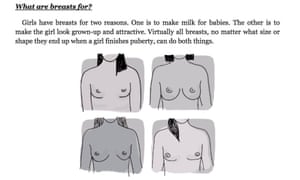
    It is the section on breasts that has drawn criticism, after writer and blogger Simon Ragoonanan, who blogs about fatherhood at Man vs Pink, posted a page from the book on Facebook. “What are breasts for?” writes Frith in the extract. “Girls have breasts for two reasons. One is to make milk for babies. The other is to make the girl look grown-up and attractive. Virtually all breasts, no matter what size or shape they end up when a girl finishes puberty, can do both things.”

    Reasons?

    Sure, and by the same token, humans have ears for two reasons: to hear, and to hang glasses on. We have feet for two reasons: to walk, and to wear Jimmy Choo shoes. We have elbows for two reasons: to connect the two bits of arm, and to prod people on crowded buses. That’s science.

    Page taken from Growing Up for Boys by Alex Firth

    After a campaign led by parent group Let Books Be Books three years ago, Usborne announced that it would discontinue publishing gendered titles, such as its pink Girls’ Activity Book and blue Boys’ Activity Book.

    I bet we can guess what those color-coded activities were like.

    A spokesperson from Usborne Publishing told the Guardian: “Usborne apologises for any offence caused by this wording and will be revising the content for reprinting.”

    Identical wording to that in the response from Tatton Park to the “future footballers wife” hat – “any offence” – which tidily avoids actually acknowledging what was wrong with the wording, and translates the objections into silly ruffled feelings as opposed to reasoned arguments against treating girls and women as stupid fluffy empty playthings for the real people, who are male.

  • Following your complaint

    Oh for FUCK’s sake.

    A pink hat bearing the slogan “FUTURE FOOTBALLERS[sic] WIFE”? Why on EARTH?

    That’s so intensely, even maliciously insulting that it makes my teeth hurt. “Hahaha toots, you’re not anything, you’ll never be anything, all you can aspire to is being somebody’s wife. Enjoy your visit to Tatton Park!”

    The Tatton Park people did remove it, but with an uncomprehending gloss.

    That’s just insulting all over again. One, the “any” – as if they were having a hard time figuring out what the problem was. And “offence” – it’s not just a matter of “offence.” The slogan on the hat is wildly insulting, yes, but that’s not the same thing as “offence,” and in any case it’s more than just insulting – it’s also belittling and destructive.

    Who comes up with these things? And why? They loll about the shop barnstorming ideas for this season’s tourist shop hats…and that’s what they come up with? How?

  • Even a woman could do it

    Updating to add: it’s now being reported that there are rumors this is a falsehood, originating perhaps with Boris Johnson.

    Some more banal sexism:

    Philip Hammond has provoked bewilderment and anger with his suggestion that driving a train is so easy that “even a woman could do it”. Theresa May has done little for women’s rights but even she was shocked, slapping down her Chancellor with a curt remark.

    Yet egregious as these ministerial reflections were – and we’ve had a few, in these grim Brexit times – they are not as out of tune with the age as we like to think.

    [T]ake Wimbledon. Female players have complained that men are more likely to be put on show courts, while Andy Murray had to correct a reporter who said that an American had not reached a Grand Slam semi-final since 2009 – overlooking the dozen major trophies placed on the mantelpiece since then by a certain Serena Williams.

    Oh but he said “an American.” Serena Williams is an American woman – whole different category. There are Americans, and there are American women. Let’s not get confused here.

    It is, of course, easy to dismiss this as trivial. Certainly anyone who complains of sexism is marked down as humourless. But the Conservatives can sometimes resemble the lower sixth of a 1950s public school. David Cameron told a female MP to “calm down, dear”, while Tory MPs have been accused of cupping their hands and mouthing the word “melons” when female MPs rise to speak. Nicholas Soames even described the “woof woof” noises he felt moved to make at a female MP as a “friendly canine salute”.

    In part this is offensive because no one in 2017 should have to work in an environment where sexism is apparently tolerated. But more importantly, politicians making these remarks are also making the rules for how the entire female population is treated.

    Because women are too stupid to do it, plus melons, phwoarrrr.

  • Embedded in the routines and language of everyday life

    Deborah Cameron suggests a category of “banal sexism” for the background noise of stale jokes and insults about women that most people don’t even notice.

    Sexism also has ‘hot’ forms, and those are the ones mainstream discourse finds it easiest to recognise and condemn. The western media have no difficulty in recognising the sexism of the Taliban and Boko Haram; the more liberal parts of the western media have no difficulty in recognising the sexism of Gamergaters and Donald Trump.  But what you might call ‘banal sexism’—ordinary, unremarkable, embedded in the routines and the language of everyday life—is a different story. It does often go unnoticed, and when feminists draw attention to it they’re accused of taking offence where none was intended or embracing ‘victim culture’. These knee-jerk defences are often delivered with an air of surprise—as if the people responsible hadn’t realised until that moment that anyone could possibly dissent.

    Dear Muslima innit – except it’s not irritable celebrity science dude on Twitter but nearly everybody all the time.

    Banal sexism doesn’t provoke outrage. It occupies the part of the spectrum that runs from ‘seen but unnoticed’ (like the ‘default male’ convention which I discussed in an earlier post) through to ‘annoying but not worth getting all fired up about’. You might shake your head, roll your eyes, post a photo with a scathing comment on Facebook, but most people wouldn’t bother to make a formal complaint.

    But we can also collect the photos with scathing comments on Facebook – and on blogs – and that’s a little more effective than just shouting at the tv. On the other hand there are also anti-feminists collecting their photos with scathing comments on Facebook and blogs, and at the moment they seem to be winning.

  • Where’s your sense of humor?

    Today in everyday misogyny:

    Ahaha. Haha. So funny.

    Woman 1: How can I get my stalker to lose interest in me?

    Woman 2: Marry him.

    Ahaha. Funny. Marriage=boredom; so funny, so fresh, so worth making a joke of stalking and its attendant terrorizing and violence.

  • Silver heart charm and glittery sock

    It’s everywhere. It’s in shoes – kids’ shoes. (“Ice cream, Mandrake? Children’s ice cream?”) Francesca Cambridge Mallen, chief campaigner for Let Clothes Be Clothes, went shopping for school shoes with her daughter age 8.

    Three shoes are available in her size: two pairs are slip-ons which with a knowing look from Grandma we dismiss immediately. After all, these are what Clarks describe as “sophisticated style” which makes me wonder how they could have missed the fact they are selling to kids, not office staff. When my daughter plunges over in a tangle of shoes and playground, I’ll be sure to console her with how classy she looked doing it.

    The third pair are the most common style in the girls range, with a bar across the middle. My daughter tries them on, but is not persuaded by the “you’ll wear them in” pitch and points to how the back of the shoe is jabbing her in the heel. “That’s all we have” we’re told with raised hands, but what about the shoes over there I ask, pointing to a huge display of school shoes. Its Clark’s boys section, but aren’t these just shoes too? I get the “oh how quirky” look from a neighbouring parent, but the first pair our of the mysterious backroom are perfect. BINGO.

    The back of the shoe is visibly wider with actual padding, despite the sizing being the same. The shoes are enclosed meaning the whole of my daughter’s foot is covered from the elements – a style not offered to girls at all. They are a trainer style, which any podiatrist would swoon at, and as she races past mountains of shoe boxes and meandering children, my daughter is clearly very happy.

    Clarks has made it easy for me to go to their website and see what the respective shoes look like.

    These girls’ school shoes from our Gloforms collection, complete with toy and torch, use a classic Mary Jane profile with bow detailing, silver heart charm and glittery sock. Black leather with a glossy trim is teamed with a durable rubber outsole with cleats for added grip, while the padded collar, riptape fastening and Agion linings are practical additions.

    These boys’ school shoes from our new Gloforms collection, complete with toy and torch, are perfect for being in the playground. Robust black leather, high abrasion band and cleated rubber outsole ensure durability and grip. The double riptape fastening and Agion linings are practical additions, while the Gloforms character on the heel and sole add fun.

     It could hardly be any more obvious, could it.

    Mallen concludes:

    At some point in the last 30 years Clark’s have changed their focus from comfortable and practical children’s shoes, to shoes marred by gender stereotypes. Check out the latest Gloforms campaign, the strong and assertive boy characters, ready for action, opposite the dreamy eyed female ones with heart, floral bow or crown. The latest tagline “lasting comfort so kids can be kids” doesn’t seem to apply to girls. Have they tried to kick a football in slip-on flats? Or walked to school in open bar shoes through mud and rain? Have they seen how girls climb, jump, swing and run too? As my daughter says when we leave, maybe its time Clarks went back to school and looked for themselves.

    A friend wrote recently about shopping for an infant and finding that nearly all the “girls’” clothes (there were none for just infants or babies) were pink, while “boys’” clothes were in a range of colors.

    Why did we even bother?

  • The idea of gendered brains

    Hm. Plates shifting just a bit. Maybe. Pink News reports:

    The Green Party has hit out at a Science Museum quiz that tells kids they have a “male or female” brain.

    Feminist campaigners hit out at London’s Science Museum on Twitter this week, after a woman was taken aback to see ‘girl’ brains coded in pink and ‘boy’ brains blue in the interactive exhibit.

    Well yes. I was taken aback by that exhibit too, as were a lot of my friends. We’ve all been a good deal taken aback by this whole claim that there are “girl brains” and “boy brains” because it sounds so very identical to the pseudo-scientific justifications for the subordination of women we could have sworn feminism had been disputing for decades. I have to say that in a scream like the Duchess because how can I say it calmly?

    The test, which cites its source as pop-up children’s psychology book ‘The Brain Pack’ by Ron Van Der Meer and A Dudink, claims to be able to tell the difference between the male and female brain.

    It says: “Generally males and females are very similar to each other in the way they think. Psychologists have developed tests to show up some differences between the sex[es].”

    But campaigners say it reinforces tired stereotypes.

    Ya think?


    Green Party’s equalities spokesperson Sarah Cope said: “It’s really disappointing to see the Science Museum reinforcing outdated gender stereotypes in this way.

    “The idea of gendered brains is dubious science at best, and this kind of sexism – telling girls at a young age that they have feminine brains – is part of the reason why boys still dominate STEM subjects and less than 10% of engineers in the UK are women.”

    This is what we keep saying.

  • A box marked “entitled”

    Rebecca Schiller points out that maternity rights aren’t some kind of posh luxury:

    The fact that three-quarters of women experience a negative or discriminatory effect of their pregnancy at work, as a report from the women and equalities select committee shows, isn’t a huge surprise to me…

    The committee estimates that 53,000 women each year are being discouraged from attending antenatal appointments by their employers, despite permanent employees having the right to time off for these crucial check-ups…

    Banging the drum for the rights of pregnant women is often portrayed as an occupation for the privileged. Defending women’s rights to choose how and where they give birth or insisting that employers make careers possible for working mothers has cleverly been placed in a box marked “entitled”.

    You know, those demanding bitches who think they get to have a job and children. Stupid women – only men get to do both.

    Four out of five women experience pregnancy and, whether we intend to use it or not, our capacity to become pregnant sits at the root of every woman’s unequal treatment in society. This is not a discussion that needs to stay in the boardroom. Without progress in pregnancy and childbirth we cannot make enough progress in women’s broader rights. And those made more vulnerable because of their precarious low-paid, low-status jobs will continue to find pregnancy a gateway to the food bank.

    It’s lose-lose innit. Women get pregnant so don’t hire them for the best jobs, and when women with their low-paid jobs do get pregnant…whoops, it turns out that they’re poor.

  • Man’s wife wins medal

    Even at the Olympics. Even when women win gold medals at the Olympics – still they are called “wife of Man” instead of their own damn name or their event is given a cutesy belittling label.

    Take judo. Majlinda Kelmendi made history when she became Kosovo’s first ever Olympic medallist – and a gold medallist to boot.

    Her triumph in the 52kg event against Italy’s Odette Giuffrid marked a huge moment for a war-torn country that declared independence from Serbia eight years ago, and was only admitted into the International Olympic Committee in 2014.

    And yet many viewers were taken aback as one BBC commentator described the contest – a sophisticated match-up of strength and guile – as a “catfight”.

    A catfight. Geddit? Two bitchy girls clawing each other, hahahahahahaha girls are so stupid.

    But sometimes they’re married to a man, so at least that helps them not be so insignificant and trivial.

    Corey Cogdell-Unrein won a bronze medal in the women’s trap shooting – the second for the US shooting team in Rio and her second Olympic medal.

    This is how the Chicago Tribune reported the news.

    Chicago Tribune ✔ @chicagotribune
    Wife of a Bears’ lineman wins a bronze medal today in Rio Olympics http://trib.in/2asmvvr
    2:33 PM – 7 Aug 2016

    A guy’s wife won a bronze medal. Nice job, honey. Congratulations, babe. Well done, sweetheart.

  • Illustrious company

    Even someone who writes for the Telegraph thinks it’s bad and revealing that people are saying Tim Hunt did nothing wrong. Cathy Newman is a presenter for Channel 4 News and she thinks the “nothing wrong” claim is full of wrong.

    [A] week after the pro-Hunt bandwagon really started to gather speed, broadcaster and writer Jonathan Dimbleby has leapt aboard and resigned his honorary fellowship at University College London in protest at its treatment of the Nobel prize-winning scientist.

    He’s in illustrious company. The mayor of London Boris Johnson and fellow scientist Richard Dawkins have already publicly accused Sir Tim’s critics of a gross over-reaction.

    So have Brian Cox and Brendan O’Neill.

    Notice something? They’re all pale men – they’re all immune from the kind of casual contempt that Hunt expressed at that lunch, whether as a joke or not. They all have that in common with Tim Hunt, and all of them including Hunt do not have in common with their women colleagues the handicap of being subject to constant everyday sexism.

    It surprises me how many high-profile and highly intelligent men – and some women – seem to think a sexist joke about women crying and falling in love with their professional colleagues is just a bit of fun.

    While Sir Tim did make clear he meant his comments in jest – something which was overlooked in the initial reporting of the incident – he has fessed up to being a “chauvinist pig”, and lest Dimbleby et al forget, he’s also insisted that some of his remarks were meant in all seriousness, while others were ‘misinterpreted’.

    “I did mean the part about having trouble with girls,” he said on BBC Radio 4’s Today programme.

    And either way, joke or not joke, it’s still dismissive and belittling.

    Dimbleby, Johnson and Dawkins would surely never dare to weigh-in on behalf of someone who’d cracked a racist gag.

    So why is it still OK to be a little bit sexist – and Sir Tim has admitted as such – when society quite rightly has zero tolerance for other forms of discrimination?

    Politicians who say something racist are immediately shown the door.

    If sexism is their crime on the other hand, a raised eyebrow appears to suffice.

    That comparison shouldn’t be pushed too far, because it’s horrifyingly easy to flip it – to cite ways in which racism is ignored while sexism isn’t. But still, when it comes to certain kinds of casual everyday discourse, people who wouldn’t dream of babbling into a microphone about their “troubles with black people” have no such inhibition when it comes to talking about…girls.

    while wise-cracking men are tolerated, the women who call out sexism face a torrent of abuse for doing so.

    The woman who brought Sir Tim’s remarks to public attention, British academic Connie St Louis, has since faced a right-wing smear campaign about her own CV.

    No doubt simply writing this blog will earn me the “feminazi” badge again.

    Can’t we take a joke? Yes of course we can. It’s just that what Sir Tim said wasn’t particularly funny.

    Well, that plus the fact that it was casually sexist.