Author: Ophelia Benson

  • Open season

    The NSS reports that Turkey is working on treating violence against women more gently, kindly, compassionately – to the perps, that is, not to the women.

    Proposals by the Turkish Ministry of Justice to treat sexual harassment and violence against women less severely have drawn widespread condemnation from campaigners.

    The Iranian and Kurdish Women’s Rights Organisation (IKWRO) is “deeply concerned” by the draft proposal and has warned that if passed the plans will allow perpetrators of crimes normally punishable by five years’ imprisonment “to engage in negotiations with prosecutors to reduce their sentence to one year, postpone their sentence, do community service or pay money to avoid jail time.”

    They note that the proposal “covers a number of crimes that predominantly affect women and girls including molestation, sexual abuse, threats and sex with minors. Victims and survivors will not even be consulted in the negotiations” and they stress a background of hundreds of murders of women in Turkey this year alone.

    That will happen when you teach people that this other set of people are inferior. It becomes open season.

    The BBC reported earlier this year that there has been a “dramatic rise in violence against women in Turkey”, linked by many to the ideology of the Islamist AKP.

    President Erdogan and senior members of his party have made repeated statements about women’s ‘traditional’ role in society. In November 2014 he denied that men and women should be on an “equal footing” and said it was “against nature”.

    In July the Turkish deputy prime minister told a female parliamentarian, “Madam be quiet! You as a woman, be quiet!”

    And if she won’t – punch her.

    In their statement the IKWRO note that “since only January 2015, 285 women have been murdered. Perpetrators of violence against women and girls already face minimal charges and often walk free under the outrageous ‘provocation’ rule, which allows perpetrators to argue that they were provoked by their victims.

    And that makes it no big deal to murder them?

    God people are terrible.

    H/t Bernard Hurley

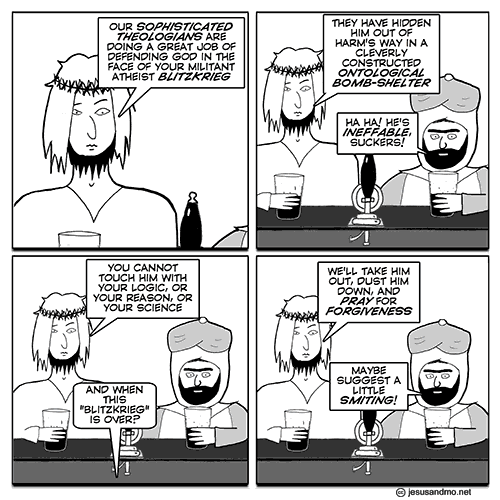
  • Out of harm’s way

    I’m going through the past three years of Jesus and Mo, so I thought you’d enjoy this one:

    dust2

    Ontological bomb-shelter – that’s so exactly right. You can’t see it or talk to it, you can’t get messages from it, you can’t register complaints with it – it’s beyond your reach. Permanently…Except after you’re dead, they say, but then that’s very easy to say, isn’t it – you’re not going to be able to show them wrong. It’s the perfect con, and most people fall for it.

    The Patreon is here.

  • Their purpose is genocide

    So this is where we are.

    genocide

    Morgan M Page ‏@morganmpage Nov 4

    TERFs are commiting acts of genocide against trans women under the UN’s definition of genocide.

    Shivoa Birch ‏@Shivoa Nov 4
    Imagine writing a piece telling queer/trans* youth to remember elders & saying “yes, call me a Terf or a Swerf” #ToneDeaf #TransGenocide

    Morgan M Page ‏@morganmpage Nov 4
    The entire anti-trans radical feminist agenda has always been upfront that their purpose is genocide. We need to start calling it that.

    Genocide.

    And they accuse other people of inciting hatred.


  • She reeks of “more Indian than thou”

    Kavin Senapathy on Vandana Shiva:

    Undoubtedly a controversial albeit prominent Indian public figure, the stately, self-proclaimed food activist and feminist rakes in big bucks to rival the incomes of doctors and business moguls, and does so on the premise of benevolence. Shiva’s website, which notes that Time Magazine honored the activist as an environmental “hero” in 2003, describes her as working alongside peasants; images of Shiva posing on Indian farms litter the internet.  Demanding $40,000 a pop and round trip business class air fare from New Delhi for her promotional talks, she has achieved the deplorable yet amazing feat of appropriating her own culture. Though defined in varying ways, the term “cultural appropriation” usually describes the use and adulteration of elements of one culture by another. In Shiva’s case, she has managed to exploit and demean her own culture under the guise of standing up for her countrymen, as a means to advance her anti-biotechnology agenda.

    40 k per talk?! Wow. And all she has to do is argue for less productive agriculture in India.

    Vandana Shiva’s exotification of the country and India-as-victim messaging does her few favors in the Indian community, while her butchering of science has seen her earn monikers like “Luddite”, “dangerous fabulist” and even part of the “lunatic fringe.”

    …

    To me, an Indian-American daughter of immigrants, Shiva’s appropriation of her own culture is among the most obscene, offensive tactics in the activist’s repertoire. She reeks of “more Indian than thou”, which colors her mannerisms and shapes her messaging, effectively endowing her with a je ne sais quoi, leaving many non-Indian westerners accepting her without question as the voice of the Indian David against the Big Bad Biotech Goliath, while others presumably refrain from doubting her seeming authority for fear of appearing racist. A clever tactic, indeed.

    This acceptance of Indian thieves of their own culture must stop. Farmers like Narhari Pawar, science advocates like Venkat Aditya, and scientists like Rajini Rao and Balasubramanian Ponnuswami are just a handful of folks fed up with the twisting of their culture by fellow Indians for no more than ideological, non evidence-based agendas. No doubt, they are but a representative sliver of those sharing the sentiment.

    I blame the hippies. They bought into that whole “India=spiritual” bullshit, and they passed it on to everyone else.

  • Strange allies

    Reason (the libertarian website) agrees with the libertarian feminists, of course. Elizabeth Nolan Brown says the usual things:

    In a recent interview with Time magazine, feminist icon Gloria Steinem—currently promoting a new travel memoir—says that the biggest threat to reproductive rights today is “patriarchy… the very definition (of which) is that men control women’s bodies in order to control reproduction.”

    The way johns do, for instance. But Brown isn’t having any of that, thanks.

    It’s a nice sentiment—but alas, Steinem’s concept of human rights and bodily integrity only applies to certain people. Steinem has been an outspoken proponent against sex workers’ right to bodily integrity.

    Over the summer, Steinem was one of a group of Hollywood celebrities and high-profile feminists condemning the human-rights group Amnesty International for its support of completely decriminalizalizing prostitution.

    Or rather, decriminalizing pimps, brothel owners and johns. They favor the decriminalization of prostitutes aka sex workers. So Steinem isn’t in fact “an outspoken proponent against” (i.e. an opponent of) sex workers’ right to bodily integrity.

    In 2014, Steinem said it was wrong to use the term “sex work,” a preferred term of many women who willingly work in the sex trade, because prostitution is merely “commercial rape”—a “body invasion” that is “not like any other work.” Never mind that a lot of grown women choose to be sex workers and do not experience prostitution as commercialized rape; that’s how Steinem sees it, and so pity the poor sex worker who thinks she gets to define her own experience.

    But by the same token a lot of grown women and underage girls do not choose to be sex workers; they are forced into it and/or trapped in it. Which group is more likely to have various kinds of privilege that should be checked? I say it’s the group that doesn’t choose. The more options you have (and privilege amounts to more options), the less likely you are to “choose” to be a chicken-processor or a coal miner or a prostitute. The more desperate you are, the more likely you are to do jobs that you wouldn’t touch if you could survive any other way. The fact that some women think prostitution is a fabulous way to get both sex and money is not all that relevant to the desperate ones.

  • Misogyny in feminists’ clothing

    Jindi Mehat at Feminist Current on liberal (what in the US would be called libertarian) feminism.

    She started out as a libertarian feminist herself.

    For me, then, and for liberal feminists today, the individual is queen. Any choice a woman makes is, by definition, a feminist choice because choosing is a feminist act. Even choices like pandering to the male gaze or self-objectifying must be applauded. As a result, I often engaged in decidedly unfeminist behaviour while uncritically wrapping myself in a comfortingly progressive label.

    The other really important word for this view is “agency.” If you question the “choices” of other women, you’re denying their “agency,” which is “paternalistic,” and thus the opposite of feminism.

    It’s a fatuous idea, because feminism is inherently all about questioning choices. All politics is about questioning choices. All critical thinking boils down to questioning choices. If you can’t question choices you can’t do anything but praise the status quo, and what’s the point of that?

    Uncritically worshipping individual choices ignores the structures and institutions that support patriarchy. Focusing narrowly on advancing in the public sphere ignores the oppression women face in our homes. More worryingly, refusing to examine the context and impacts of our choices allows men and women to continue reinforcing misogyny and male supremacy while patting themselves on the back and failing to work towards liberation for allwomen in any meaningful way.

    Supporting misogynist ideas, behaviours, and structures while declaring yourself a feminist requires a stunning lack of self-awareness and critical thinking, and an intricate set of unquestioned beliefs whose main purpose is to preserve a self-concept that’s allegedly based on beliefs in women’s rights, when in reality, that self-concept is based on an illusion.

    Nowhere is this creative ego preservation more evident than in the commonly used catchphrases liberal feminists recite en masse, mostly in response to critical thought and discourse from radical feminists who understand that examining our internalized misogyny, analyzing our choices and beliefs, and dismantling patriarchal institutions is essential work for feminists who are truly dedicated to the liberation of all women.

    Unless of course the status quo is already perfect, just as it is.

    So she’s doing a series called “Shit Liberal Feminists Say” and this is the first post in that series. First up: Sex Worker Exclusionary Radical Feminist (SWERF).

    Despite repeated evidence that women in prostitution are largely poor women of colour, many of whom were sexually abused as girls, entered prostitution while underage, and identify lack of housing as their main barrier to leaving prostitution, liberal feminists cling to the romanticized notions of “sex work” depicted in movies like Pretty Woman and, in doing so, literally whitewash reality. For liberal feminists, sex work is inevitable, voluntary, empowering and fun, and women who choose it should be unquestioningly celebrated.

    Which is strange, when they are (in my experience) all noisily proud “intersectional” feminists who can check their privilege, or at least tell other people to check their privilege, faster than anyone else on earth. What could smack more of privilege than extrapolating from one’s own joy in “sex work” to conclude it’s like that for everyone? Imagine you’re a prosperous middle-class educated presentable man with an eccentric taste for working in non-unionized chicken processing plants. Would it be reasonable for you to say it’s “paternalistic” for journalists to expose unsafe working conditions in chicken processing plants? (Spoiler: no.)

    In contrast, abolitionists see prostitution as male violence, as the sexualized practice of dominance and control over women who are coerced, with money, into sexual activity in which they wouldn’t otherwise participate.

    Contrary to liberal feminists, who demonstrably exclude most women in prostitution so they can uphold a uniformly empowery notion of “sex work,” abolitionists don’t exclude any women from our analysis. We acknowledge that some women choose to enter into prostitution. Understanding that patriarchy both limits and shapes women’s choices, abolitionists believe the context of more privileged women’s choices — and the impacts those choices have on marginalized women — must be scrutinized as part of the hard work needed to make sure our movement leaves no woman behind.

    But the libertarian view is that that’s just SWERFery, which is not just wrong but evil, and shun-worthy.

    Supporting an argument that excludes the majority of women in prostitution, while calling the very women who consider the whole picture “exclusionary,” shows how intellectually vapid and hypocritical so-called liberal feminism is. Just like calling support of prostitution, which exposes the most marginalized among us to increased levels of violence and abuse, a feminist position, this isn’t about women’s liberation, it’s about feeling good and progressive and not having to actually change anything.

    Supporting prostitution and screaming “SWERF” at abolitionists isn’t feminism, it’s capitulating to male supremacy and writing marginalized women off as collateral damage. It’s living in a dream world of consequence-free individual choices. It’s refusing to go beyond scratching the surface, and instead hiding behind buzzwords and tepid half-measures while trying to silence women who are willing to dive deep no matter the cost. Screaming SWERF at abolitionists is misogyny in feminists’ clothing, and it’s just some senseless shit that liberal feminists say.

    I’ve gotten very familiar with misogyny in feminists’ clothing lately, and I don’t admire it.

  • “We killed him because he was writing against us”

    In Pakistan too.

    A gunman on a motorbike shot dead a Pakistani journalist in the country’s restive northwest on Tuesday and hours later the Taliban claimed the killing, bringing to 71 the number of journalists and media workers killed in Pakistan since 2002.

    Zaman Mehsud, 38, was a journalist working for the Pakistani Urdu newspaper Daily Umet and SANA news agency, and also worked for the independent Human Rights Commission of Pakistan.

    A journalist and a human rights worker. Of course they killed him.

    Taliban commander Qari Saif Ullah Saif told Reuters: “We killed him because he was writing against us … we have some other journalists on our hit list in the region, soon we will target them.”

    The journalist’s brother Muhammed Aslam wept as he collected the body. “He left five children and a widow,” he said.

    …

    At least 67 journalists and media workers were killed between January 2002 and 2014, according to press freedom group Reporters Without Borders. Including Mehsud, another four have been killed this year.

    All but one were Pakistanis. The killers have been convicted in only two cases — that of American Wall Street Journal reporter Daniel Pearl and that of Geo reporter Wali Babar.

    Shoot the messenger.

  • The first impulse is to narrow the conversation

    Katha Pollitt on Germaine Greer and the fatuous attempt to no-platform her and the absurd demand that a feminist be 100% perfect (in the sense of: agrees with me in all particulars) or be banished.

    She starts with the fact that Greer has always been all over the place. There’s always plenty to disagree with in what she writes and says. Nobody could agree with everything she says.

    Still, when I was invited to interview her a few years ago about Shakespeare’s Wife, her biography of Anne Hathaway, I was delighted. I did not start a petition to have her invitation canceled on the grounds that anyone who approves of cutting off little girls’ clitorises has no place on a podium talking about any subject, even Elizabethan England. I thought: Here’s a woman who has lived a big life and, at 70, has written a book that tries to rescue one of history’s most famous wives from oblivion and misogyny. That’s feminism.

    Also, it’s interesting. Being interesting is a virtue. Greer is interesting. Few of her detractors are.

    (Do I mean none of them are? Yes, probably. But I haven’t examined them all, so I can’t be sure. On the other hand I can be pretty sure that the kind of person who thinks Greer should be shunned is not interesting. People who are interesting don’t think that way. It’s a crude way to think, and that’s not compatible with interesting thought.)

    Then Katha quotes from Rachael Melhuish’s petition.

    Where to begin? Violence against trans women is the fault of feminists? I doubt the brutal men who assault and murder trans women have even heard of Greer­­—or are likely to attend her proposed lecture on feminism in the 20th century (which, she says, will not touch on the subject of trans women at all). And if you believe that inviting someone to lecture on campus is an endorsement of their views—even on subjects they’re not lecturing about—it doesn’t sound as if you’re really all that keen on debate. It sounds more like you want the university to invite only people who think like yourself.

    Which would be a disaster, because they would all be so unlikely to be interesting.

    It’s both unfortunate and bizarre that at a moment when feminism is showing renewed signs of life, the first impulse is to narrow the conversation and throw rotten vegetables at everyone who isn’t singing 100 percent in unison. And did I mention ageism? That prejudice seems to be completely acceptable. A typical tweet: “Germaine Greer is an insane old woman. Just watched the interview, she should be in an old peoples home.”

    Feminism doesn’t apply to women over 40. Once you’re past 40 you’re in the wrong wave, and you should be locked up.

    In the UK, the National Union of Students has “no-platformed” (attempted to prevent from speaking anywhere) the lesbian feminist writer and activist Julie Bindel for “transphobia” stemming from a 2004 article in The Guardian in which she mocked the notion that having a sex change made someone a woman. (Although she’s apologized for the tone of that piece, it doesn’t matter: She questions the use of sex-reassignment surgery, especially for children, and that’s enough.) Transgender-rights activists argue that trans women are real women, irrespective of their physical attributes, and have always been so. But even if that view prevails, the movement has taken a wrong turn somewhere if Bindel—a decades-long campaigner for lesbian rights and against male violence toward women—is the misogynist, and the feminists include male “allies” screaming at her to shut up.

    Tell me about it. All those male “allies” screaming at feminist women to shut up – screaming it in full, throbbing confidence that they’re on the Right Correct Pure side, the social justice side, the intersectional side, the fight privilege side, the listen to marginalized people side. I could compile a list of those fuckers.

    Even abortion isn’t as divisive a subject as transgender rights: No one pickets a campus talk by Sister Helen Prejean because she belongs to a church that demands that raped 10-year-olds give birth. You don’t see anyone no-platforming conservatives who support cuts in government programs that devastate poor women and families, or foreign officials representing governments that deny women basic human rights. There’s a virtual standing army of prominent people—people with actual real-world power—who are more intimately connected with the subjection of women than Germaine Greer or Julie Bindel; to say nothing of the numerous people, like the classics scholar Mary Beard and the gay-rights campaigner Peter Tatchell, who have supported their campus appearances and found themselves in the same crosshairs.

    Strange, isn’t it. Counter-productive. Embarrassing. Narcissism of small differences.

  • Guest post: Reply to Consumers Union

    Guest post by Josh Spokes. An email from Consumers Union to members, and his reply.

    Policy and Action from Consumer Reports

    If you want the right to know, speak out now.

    Monsanto is telling Senators you don’t need to know about GMOs in your food. We think you have the right to make up your own mind! Tell your Senators to support GMO labeling.

    Take action

    Dear Joshua,

    If you want the right to know what’s in your food, now is the time to speak out. If you wait, you may forever be kept in the dark.

    As you read this, Senators are writing a bill that could determine the fate of GMO food labeling. They will decide whether you get to know that the tortilla chips or breakfast cereals you’re buying and eating are genetically engineered.

    Monsanto, DuPont, General Mills, Kellogg’s and other giant industrial food producers are telling Senators that you don’t need to know about GMOs in your food. We think you have the right to make up your own mind. If you agree, act now — once this bill is written it will be tough to change, and the vote will come soon.

    Tell your Senators to support mandatory GMO labeling! Don’t let Monsanto keep you in the dark about what you’re eating.

    The year-long Congressional fight over GMO labeling has come down to this moment. The House in July passed a horrible industry-backed bill that would ban federal GMO labeling and forever block your state from implementing its own labeling laws.

    But if you speak out, your Senators can change this. They can pass their own bill by the end of the year to make sure your choices and rights aren’t taken away. Just as you now know which foods have been frozen or come from concentrate, requiring GMO ingredients on the label simply lets you choose what you want to eat.

    And labeling is more important than ever: Now that the weed-killer associated with GMO crops has been designated as possibly causing cancer, don’t you think you have the right to make an informed choice about whether you want to eat GMO foods?

    Senators are writing the bill now. Tell them to make sure it doesn’t take away your right to know what’s in your food!

    After you act, please share this with others in your network so they can tell their Senators the same thing. And we will be back in touch soon to let you know how the bill turned out and next steps!

    Sincerely,

    Jean Halloran, Consumers Union
    Policy and Action from Consumer Reports

    Josh’s reply:

    As a longtime supporter of Consumers Union I am incredibly disappointed in your support for labeling GMOs. This is not an issue of “consumers’ right to know,” and I don’t think you’re that naive. This is a bogeyman issue that plays on legitimate consumer sentiment and twists it.

    Labeling GMOS—which isn’t even honest, since every domesticated crop
    is GMO, just not always by direct genetic manipulation—won’t give
    consumers any information that will allow them to make any choices that
    affect their health or safety. It will, however, give the government
    imprimatur to the idea that GMOs are scary, harmful, and only invented
    to make Monsanto rich, and that they have no benefits for ordinary
    people. Indeed, you make it seem like they’re not only no benefit to
    anyone, but that they’re actually a harm.

    What is wrong with you on this count? You have always been the most
    scrupulous researchers and consumer advocates, weighing evidence and
    presenting it so that people can make informed decisions. You’re one of
    the most powerful consumer organizations in the country, and everyone in
    the US owes you a huge debt for the work you’ve done not only helping us
    shop wisely, but holding product manufacturers accountable for dangerous
    items.

    I suspect you must think that, because your demographic is
    overwhelmingly liberal and left (I’m liberal and left, too, and I work
    for a nonprofit consumer watchdog organization) that we must all be
    scientifically ignorant. That we will support this issue because we
    culturally identify with it as part of our NPR/Whole Foods tribe. That’s
    insulting, and it’s cynical.

    How about spending some of your considerable expertise debunking the
    costly and often dangerous “health” bullshit that Whole Foods uses to
    bilk gullible consumers out of hundreds of millions of dollars?

    Do better. We have a right to expect it from you.

    And I’d actually like an explanation for your policy, a well-reasoned
    rationale. If you have published this somewhere, I’d be grateful for a
    reference.

    Joshua [Spokes]

  • After igniting a backlash

    Journalism again treating violent unreasonable reactions to other people’s reasonable actions as “provoked” or “sparked” or “ignited” by the people who did nothing wrong. Charlie Hebdo “sparked” the violence that left nine of them dead; Lars Vilks “set off” outrage; Raif Badawi “triggered” his own ferocious punishment.

    This one is the New York Times:

    An actress from Iran has gone on the run after igniting a backlash by posting photos of herself on social media showing her not wearing a hijab…

    Seriously: journalists need to be more careful with the way they write these stories. She didn’t “ignite” anything.

    Sadaf Taherian began posting the controversial photos on Facebook and Instagram over the last two weeks and the response from Iranians was as swift as it was extreme. In an interview with Masih Alinejad, a journalist who runs a Facebook page called “My Stealthy Freedom,” which features photos and videos of Iranian women walking in public with their heads uncovered, Taherian reportedly said she was initially “nervous” about the reaction the images might trigger. Indeed, many Iranians lashed out at Taherian with insults and called her “immoral.”

    That’s the way to say it. They lashed out at her; she didn’t do anything to them.

    Then, the Iranian government piled on, officially denouncing Taherian as an “offender.” When another popular actress came to Taherian’s defense on social media, a spokesman for Iran’s ministry of culture and lslamic guidance said the two actresses would be barred from acting. “As far as this ministry is concerned, these two individuals are no longer considered to be artists any more and do not have any right to act,” said Hossein Noushabadi. The popular TV show starring Taherian was abruptly pulled from the state television network schedule.

    Well, that’s “Islamic guidance” for you.

  • Insulting the holy cow

    In India: another Muslim killed by a mob because they thought or pretended to think he had been rude to a cow.

    [A] Muslim man was beaten to death on Monday by a mob of Hindus who suspected him of stealing a cow, a revered symbol in the Hindu religion. It was the fourth time in six weeks that Hindus had killed Muslims they suspected of slaughtering, stealing or smuggling cows.

    This isn’t animal rights; don’t be confused about that. This is about pretending one particular species is “sacred.”

    The recent killings are occurring against a backdrop of intensifying political conflict over laws and policies aimed at protecting cows from slaughter and consumption. Prime Minister Narendra Modi’s Hindu nationalist Bharatiya Janata Party, or B.J.P., has pushed aggressively to pass state beef bans. The Delhi police, controlled by Mr. Modi’s government, recently descended in force on a canteen after it posted beef on its menu. (It turned out to be buffalo meat.) On Wednesday, the B.J.P. ran campaign ads accusing its opponents of “insulting the holy cow.”

    Of insulting the cow – the holy cow. How ridiculous is it possible to get? Mobs in South Asia murder people for insulting a man who died 14 centuries ago, or “the holy cow.”

    Several recent cases of violence have involved Hindu nationalist vigilante groups dedicated to protecting cows. The groups, including some with ties to the B.J.P., mobilize members to confront those suspected of slaughtering, eating or stealing cows, sometimes with catastrophic results.

    There’s just nothing quite like religious feeling for getting people to commit atrocities.

    On Sept. 28, a Muslim family was attacked in a village outside Delhi by a Hindu mob that suspected the family of eating beef, an accusation the family denied. The father, Mohammed Ikhlaq, was killed, and his son seriously wounded. Weeks later, another Hindu mob in the Kashmir Valley in north India threw a homemade bomb at a truck suspected of carrying beef; a young Muslim trucker, most of his body burned, died days later. Then, on Oct. 14, a Muslim man was killed in the north Indian state of Himachal Pradesh when he was attacked by a group of Hindu activists who suspected him of smuggling cattle for slaughter.

    These and other recent outbreaks of violence by Hindu nationalists have provoked a vigorous cultural and political backlash across India. Dozens of leading authors returned India’s highest literary award in protest. Hundreds of scientists, academics, actors and filmmakers have signed petitions or spoken out. On Tuesday, Sonia Gandhi, the president of the Congress Party and Mr. Modi’s longtime political opponent, led a march in Delhi to condemn “the atmosphere of fear, intolerance and intimidation in the country.”

    But Modi and his pals brush all that off as a “manufactured controversy.”

  • Once queer meant that one could get outside of one’s own identity

    Suzanne Moore says remember who brung ya.

    Everyone now is bisexual, pansexual, agender (without a gender). It’s all so wild. Miley, Cara, various models. Young people are coming out of the closet into a hall of mirrors. For this “coming out” often says my insides feel different to my outsides. Hear me roar. Welcome to the world, friends, for who does not feel like that?

    Exactly. This isn’t some hot new thing, it’s just how people are. Granted it is more talked about now, but that doesn’t mean it’s a new invention.

    Now that there is a new set of identities for people to pick’n’mix, it would be gracious not to erase those who lived and died with more fixed identities. This is not melodrama, this is history as power. Laurie Penny recently came out as a genderqueer feminist but she differs from many of her genderqueer friends: “I still identify politically as a woman. My identity is more complex than female or male.” This I take for granted. So why does it need to be said? Penny is extremely smart and if she wants to present as a sexual outlaw that’s fine. Try being a “butch dyke” or is that not quite radical enough?

    Nah. *yawn* That’s so last year.

    The current preoccupation with being on the sexual edge and yes, call me a Terf or a Swerf or my own term Smurf (Some Made-Up Radical Feminist) if you like, but I don’t just check my privilege, I check our history. Because if sex is just something you do rather than something you are, then it is way easier to play with gender. Yet it has become so muddled that every identity must be proclaimed in a hierarchy of grievance. This fragmentation, which is not intersectionality, but rather an increasingly insular discussion about cis-ness, microaggressions and trigger warnings, runs in horrific parallel to images of women being raped and killed all over the world.

    Once, queer meant that one could get outside of one’s own identity. My male gay friends came on abortion marches with me. I went to Aids vigils with them. Even now I see that the fight about reproductive rights for women continues and while places such as Ireland can accept gay marriage and the decriminalisation of drugs, they still won’t decriminalise women’s bodies.

    But hey, we’re just cis women, we don’t own feminism.

  • Self-abnegation gets you negated

    I saw a very bizarre remark – by a woman – on Twitter today.

    Sick and tired of cis & white feminists thinking they own feminism.

    Leaving aside the “white” part, the remaining claim is pretty staggering. “How dare women think feminism is about women?!”

    What other oppressed class is subject to this kind of bullshit? What other oppressed class gets shouted at for thinking its own liberation movement is not “owned” by someone else?

    It’s only women who are willing – in fact eager – to erase themselves this way.

    Maybe that’s enough to tell me I’m not a woman after all. I’m not a fucking political masochist.

  • As the barrage of stones intensifies

    Another woman stoned to death in Afghanistan.

    The men surround the woman as she stands in a hole dug into the stony ground, only her head pokes above the surface. Then they begin to pick up rocks and hurl them at her again and again from close range.

    Her agonized cries grow louder as the barrage of stones intensifies.

    They like that. They like her agonized screams.

    The 19-year-old woman, identified as Rokhshana, had been forced to marry against her will and recently fled with another man, said Seema Joyenda, the governor of Ghor province. The couple were caught after two days, and the Taliban leader of the village ordered that Rokhshana be stoned to death for adultery, Joyenda said.

    Because men own women, and women don’t own themselves, and women who rebel in any way must be killed by torture.

    Attacks on women and disregard for their rights have been widely documented by international organizations in Afghanistan.

    “The prevalence of violence against women and harmful practices continues to be of serious concern,” said a report in April by the U.N. Assistance Mission in Afghanistan.

    A report in the same month by Amnesty Internationalraised concerns about the persecution of women’s rights activists in the country, not only by the Taliban and tribal warlords, but also by government officials.

    Women aren’t supposed to have rights. Women are property; property can’t have rights.

  • The Dalit question

    The Economist tells me something I didn’t know: Jeremy Corbyn is an advocate of justice for Dalits.

    Specifically, Mr Corbyn wants British law to prohibit discrimination on grounds of caste, a step which the government seems reluctant to take, and one which some prominent British Hindus adamantly oppose. These opponents insist that the existence of caste discrimination in Britain is unproven, and that outlawing it would be an insult to the Indian community.

    Except of course for the Dalit portion of “the Indian community.”

    All this matters more than ever because a political battle over the Dalit question may soon come to a head in Britain after simmering for a long time.  Arguments over whether Britain should explicitly outlaw maltreatment on grounds of caste have been in progress since at least 2010 when an Equality Act made it illegal to discriminate (in the treatment of employees and customers, or the provision of state services) on a familiar list of criteria, including race, ethnicity, religion and gender.

    In its initial version, the Act said that the government “may” add caste to the catalogue of protected characteristics if the need were to become obvious. Then in April 2013, after some lively debate in both Houses of Parliament, the government reluctantly agreed to a new forms of words, spelling out that it “must” add caste to the list.

    But they’re still talking about it, and dragging out the process. Mustn’t rush into these things.

    Meena Varma of the Dalit Solidarity Network says she believes that Hindu lobbyists are pressing the government “at the highest level” to drop the idea of legislating against caste discrimination. On the other other hand, the list of people and bodies who still think that Britain should outlaw caste discrimination is also quite impressive; not only Mr Corbyn but Anglican bishops, some respected Liberal Democratic and Conservative peers, the National Secular Society, the Equality and Human Rights Commission and Navi Pillay, who till recently was UN High Commissioner for Human Rights.

    So the Labour leader is not alone in his concern for the Dalits, whether in India or Britain. But as he may soon discover, people who speak out for the wretched of the earth can get themselves called all manner of unpleasant things, from neo-colonialist to Orientalist.

    Because only a neo-colonialist Orientalist would insult the Indian community by advocating the outlawing of caste discrimination. So Dalits are neo-colonialist Orientalists, so they can safely be forgotten.


  • Screamed at by the identifarians

    Julie Bindel and Rachel Jolley were on BBC Radio 3’s Free Thinking tonight talking about no-platforming and radical feminism – “not the fun kind that men love, pole dancing your way to liberation,” Julie said.

    Their segment starts at 30 minutes.

  • Rue Avijit Roy, Paris

    Via Riasat Ahsan on Facebook:

    Reporters sans frontières / Reporters Without Borders / RSF renamed the road of the Bangladeshi embassy in Paris to “RUE AVIJIT ROY” today, in honour of Avijit Roy, the first to be slain as part of a series of fatal attacks on outspoken secularists in Bangladesh this year, which still continues today.

    Congratulations you “soldiers of Allah”, members of Ansarullah Bangla Team! Thanks to you, whenever people think of Bangladesh, they’ll be reminded of a brave people, voices of dissent who were so powerful, the only thing you could do to stop people from listening was to silence them forever. But alas, they speak on! They live on. Thanks to you, their voices are more powerful than ever, their books, “The Virus of Faith”, “The Philosophy of Disbelief” recognized worldwide. We are no longer in the 7th century Arab dessert my friends. Striking our necks will no longer serve to silence us. Didn’t the Quran tell you that? Just like your beliefs, your actions will be relegated to the afterlife. This, the dunya, is our world. People will remeber the names of Avijit Roy, Humayun Azad, Washiqur Rahman, Ananta Das, Niloy Neel, and all the other people you’ve killed in order to protect your flimsy beliefs from criticism, as long as they remember Bangladesh. By their names and their writings, Bangladesh will be known. Not as an Islamic State. Bangladesh will never be an Islamic State. It will NEVER be governed by Islamic Sharia’. Nor will Pakistan. And your names and your beliefs will die in the shadows of great men and women.


  • Peak

    The Ansarullah Bangla Team has put out a new hitlist. Taslima’s name is at the top.

    The group reportedly put up a list of 14 names of bloggers and writers on social media on Sunday, which includes several Bangladeshi writers who are now living abroad.

    Taslima Nasreen has been living in the United States after threats to her life. She was moved to the US in May this year by the Center for Inquiry (CFI), which had said Nasreen was the ‘next target for murder by Al Qaeda-linked extremists’.

    Apart from Nasreen, , other bloggers and writers on the terror hit list are Farjana Kabir Khan and Asif Mohiuddin who are currently in Germany, and Arifur Rahman and Santanu Adib who are in the UK.

    I know Asif, too.

    Some of these names had also appeared in a previous hit list issued by Ansarullah Bangla Team in September, in which the militants had called them ‘enemies of Islam’ and threatened to kill them if their citizenship was not cancelled.

    Taslima tweeted:

    taslima nasreen ‏@taslimanasreen 14 hours ago
    Islamic killer group Ansarullah Bangla Team made a new hit list. My name is on the top of the list. 😱😫😡 https://shar.es/15qJSJ

    Bad.

  • Nobody has read the blogs

    In Dhaka today:

    About 1,000 Bangladeshi authors and teachers marched through the streets of the capital on Tuesday, asserting their right to free speech days after a suspected Islamist group attacked writers and publishers critical of religious militancy.

    That’s so brave of them. On protests here you know the police may be taking pictures. There you know guys with machetes may be taking pictures.

    Despite the climate of fear caused by the attacks that follow the killings of four secularist bloggers this year, writers turned out in large numbers for the rally in Dhaka.

    “No one is safe. First they killed bloggers. Now they are targeting publishers. Soon they will attack anyone who is progressive-minded,” said Khaledur Rahman, an author who is himself facing a death threat.

    They will kill everyone, until only fascists are left.

    Police joint commissioner Monirul Islam said investigators were looking closely at a home-grown group called Ansarullah Bangla Team (ABT) as the latest attacks bore the hallmarks of earlier killings of bloggers for which it took responsibility.

    The little-known Islamist group wants sharia rule in secular Bangladesh and has vowed to kill critics of extreme Islam.

    “They just tell these youth that the bloggers are the enemies of Islam. Nobody has read the blogs. They just blindly follow what the ABT says,” said a police investigator.

    Of course nobody has read the blogs; that would be haram.

  • A Pesticide as Medicine? Medicine as Poison? Or What is in a Name? 3

    The Type III (or Type IV) ranking of glyphosate was long ignored by the anti-biotech opponents of Ht cotton as was the assessment by WHO and various Cancer societies that it was not likely a carcinogen. Suddenly with the new findings, the same groups are now demanding policy actions based on the findings of a source which they long implicitly discredited by ignoring it. Any credible evidence that does not support their firmly held beliefs does not exist in their universe. Nor did they indicate any awareness of the array of more toxic pesticides that were replaced by glyphosate or the resulting significant improvement in the Environmental Impact Quotient (EIQ – “The EIQ impact assessment is based on the three principal components of agricultural production systems: a farm worker component, a consumer component, and an ecological component.”) and other measures of toxicity and environmental impact. (A Method to Measure the Environmental Impact of Pesticides – http://www.nysipm.cornell.edu/publications/eiq/ and
    http://cars.uark.edu/ourwork/Cotton%20Toxicity%20Final%20Report%203.3.10%20Project%2009-591.pdf, Glyphosate and Cancer and Why It’s Still Recommended for Weed Control – http://hyg.ipm.illinois.edu/article.php?id=657).
    In March 2015, the World Health Organization’s International Agency for Research on Cancer (IARC) convened 17 scientists from 11 countries to evaluate existing science on five pesticides, including glyphosate. The group deemed glyphosate “probably carcinogenic,” the second-highest designation given out by IARC behind “carcinogenic to humans.”  (https://news.vice.com/article/the-most-widely-used-herbicide-in-the-united-states-could-cause-cancer-in-humans-says-a-world-health-organization-study  see also   IARC Monographs Volume 112: evaluation of five organophosphate insecticides and herbicides – http://www.iarc.fr/en/media-centre/iarcnews/pdf/MonographVolume112.pdf  and Carcinogenicity of tetrachlorvinphos, parathion, malathion, diazinon, and glyphosate – http://www.thelancet.com/journals/lanonc/article/PIIS1470-2045(15)70134-8/fulltext  ) –This previously non-existent evaluation was suddenly noticed and its alleged conclusions spread at warp speed throughout the NGO even though the final report was not due out until July 2015.

    As would be expected, those who leaped on the initial report either did not read beyond the headlines or simply over-interpreted it to suit their ideological needs. The initial brief for glyphosate clearly distinguished between consumer use where there was no change from the previous conclusion of not being a hazard at the dosages encountered and occupational use, primarily in agriculture where there was a potential hazard  but a risk factor was not given.  It is important to note, that there were no new studies or data, just a re-evaluation of existing studies. It is understandable then that a number of regulatory agencies in U.S. and Europe quickly re-affirmed, in some case strongly re-affirmed their previous determination as to the safety of glyphosate.

    One of the worst distortions of the report was on VICE an HBO presentation that was offered as a balanced look at GMOs. The host of the program, Isobel Yeung interviewed critics of GMOs clearly with the questions that they wanted asked while aggressively questioning a distinguished scientist (and Monsanto vice-president) on a rather trivial point that she did not seem to understand.  The program was unbalanced throughout (Savior Seeds: VICE on HBO Debrief (Episode 31) Isobel Yeung, https://www.youtube.com/watch?v=aLYbnfz3OU4 –Unfortunately, the full program is available only to subscribers).

    Towards the end of her program, there are two brief snippets from an interview with Dr. John McLaughlin a member of the IARC committee that made the re-assessment of the toxicity of glyphosate and other chemicals. The snippets were either a case of creative editing – the video equivalent of cherry-picking – or extreme cleverness in asking questions that would only get the answers she sought.
    Fortunately, Dr. McLaughlin was on a long program with another scientist where the interviews were not edited (The Agenda with Steve Paikin: The Last Roundup Debate – http://tvo.org/video/212783/last-roundup-debate). He distinguished between hazard and risk and indicated that as a hazard, the new assessment was a worst case scenario and not a risk factor. Even for agriculture, the major potential occupational hazard, “McLaughlin says that if the glyphosate is used according to instructions given by Health Canada, it is not a health risk” (Video: Canadian scientists say glyphosate hazard but not health risk – http://www.geneticliteracyproject.org/2015/04/29/video-canadian-scientists-say-glyphosate-hazard-but-not-health-risk/  ).

    Agroecology is currently the rage among activists in developed countries simultaneously increasing yields and protecting the crop against pests of all kinds. It needs to be stated that all agriculturalists are agroecologists in that they recognize the agriculture takes place in differing environments which must be understood if one is to be successful in producing a crop and sustaining production through time. It is not a perspective invented by and unique to urban activists in developed countries who have never in out in the field and had to deal with real problems of producing a crop.

    It is easy for a representative from Consumer’s Union on a panel in Manhattan to proclaim “We favor a knowledge-based approach rather than a chemical-based approach to increasing production” without having to identify and implement these “knowledge-based’ solutions. Walter De Jong, a Cornell University agriculturalist on the same panel “was shocked at how people who don’t live near farms feel entitled to advise farmers, especially on environmental matters.” He adds that “There is a romantic notion of environmentalism, and then there is actual environmentalism.” In addition, “farmers are very conscious of the environment. They want to hand off their operation to their kids and their kids’ kids, so they maintain the land the best they can while doing what they need to do in order to sell their harvest,” (Contemporary Selective Breeding. Plant Edition. http://fafdl.org/blog/2015/06/06/contemporary-selective-breeding-plant-edition/, see also  The Return of a Simplot Conspiracy – http://www.cc.com/video-clips/ixxwbt/the-daily-show-with-jon-stewart-the-return-of-a-simplot-conspiracy ).
    No one would deny that an intensive study of agroecology as a scientific inquiry and discipline could yield many insights and make a substantive contribution to agricultural development throughout the world. The problem is that it has become a religion and not a science and is being offered in exclusion to other approach and not complementary to them. The larger problem is that as such, they don’t work except in the minds of urban activists mentally and physically divorced from the realities of agriculture.

    Nathanael Johnson asks the question – “Why aren’t  agroecological techniques farming spreading faster among poor farmers?” Johnson proceeds to list the many virtues of agroecology. Children in school and in 4H clubs are taught agroecology and organic methods. This has been going on for decades yet when they become adults and actually farm, they use pesticides. “It could be that organic methods just aren’t working for poor farmers”(Even this organic advocate thinks African farmers need herbicide by Nathanael Johnson – http://grist.org/food/even-this-organic-advocate-thinks-african-farmers-need-herbicide/ ).

    A title of paper by a dedicated scientist is revealing – “Facing food insecurity in Africa: Why, after 30 years of work in organic agriculture, I am promoting the use of synthetic fertilizers and herbicides in small-scale staple crop production” by Don Lotter.

    “Food insecurity and the loss of soil nutrients and productive capacity in Africa are serious problems in light of the rapidly growing African population. In semi-arid central Tanzania currently practiced traditional crop production systems are no longer adaptive. Organic crop production methods alone, while having the capacity to enable food security, are not feasible for these small-scale farmers because of the extra land, skill, resources, and 5–7 years needed to benefit from them—particularly for maize”

    Lotter further argues “Conservation Agriculture (CA) in Africa has two main categories—organic and herbicide-mediated. The organic version of CA, despite years of promotion, has had a low rate of adoption. Herbicide-mediated zero tillage CA via backpack sprayer can substantially increase conventional maize yields while at the same time nearly eliminating erosion and increasing rainwater capture up to fivefold.”

    And the pesticide that he advocates is Glyphosate a herbicide “which is a non-proprietary product produced in Africa and approved for small farm use. The systemic nature of glyphosate allows the killing of perennial grasses that would otherwise need deep plowing to kill. The rooted weed residues protect the soil from erosion. The risks of glyphosate use are substantially outweighed by the benefits of increased food security and crop system sustainability” (Agriculture and Human Values March 2015, Volume 32, Issue 1, pp 111-118 , http://link.springer.com/article/10.1007%2Fs10460-014-9547-x).

    They don’t work is a refrain I and others have often heard in the developing world.

    After World War II, antibiotics and pesticides such as DDT seemed like miracles saving lives and crops and killing disease vector insects such as malaria bearing mosquitoes. They were cheap and effective. We quickly learned how to use them but unfortunately, we did not at first know when not to use them. This could only be learned by making mistakes of overusing them.

    In many parts of the developing world, modern synthetic pesticides came in the 1960s with the Green Revolution. For those for whom losing a crop to disease or insects was a constant threat, pesticides had the same status as antibiotics and vaccines that also saved human lives.

    The time to spray again was defined by the calendar and not by objective conditions in the field. In the 1970s and beyond, when various IPM programs emerged to facilitate using less pesticide and using them more effectively, the task became one of convincing the farmer. To the farmer who as a child or young adult experienced the devastating effect of a crop lost, convincing them to use less pesticide was not an easy sell.

    A story that I have often told was about interviewing a farmer about his use of pesticides in growing cabbages. I asked him what would he say if I told him that a farmer across the valley harvested the same size crop that he did but used less than half the pesticide that he did. He very calmly and politely replied that he would not believe me.

    The following articles and the quotes from them might make some interesting reading for those who remain adamant that it is beyond the realm of belief that a pesticide could be anything other than a POISON.

    Glyphosate and AMPA inhibit cancer cell growth through inhibiting intracellular glycine synthesis by Li Q, Lambrechts MJ, Zhang Q, Liu S, Ge D, Yin R, Xi M, You Z, Journal of Drug Design, Development and Therapy, Vol. 7, July 24, 2013, pp. 635-643

    “This study provides the first evidence that glyphosate and AMPA can inhibit proliferation and promote apoptosis of cancer cells but not normal cells, suggesting that they have potentials to be developed into a new anticancer therapy.”

    http://www.ncbi.nlm.nih.gov/pmc/articles/PMC89043/

    Antimicrobial Agents Chemotherapy, Vol.43, No. 1, January 1999, Pp. 175–177.

    Targeting the Shikimate Pathway in the Malaria Parasite Plasmodium falciparum By Glenn A. McConkey. Antimicrobial Agents Chemotherapy, Vol.43, No. 1, January 1999, Pp.175–177.

    “The sensitivity to shikimate analogs suggests that the shikimate pathway is viable for malaria chemotherapy. The 50% inhibitory concentrations of these analogs are below those of some currently used antimalarial drugs (13). … Therefore, shikimate analogs may act as universal inhibitors of apicomplexan parasites, such as Toxoplasma gondii and Cryptosporidium parvum, which cause opportunistic infections in patients with AIDS.”

    “Based on the observations that mice were protected by 6-fluoro-shikimate from intraperitoneal bacterial infection (2) and that mice were cleared of Toxoplasma by treatment with a glyphosate-pyrimethamine formulation (13), the effectiveness of 6-fluoro-shikimate on malaria treatment awaits testing in rodent models.”

    Evidence for the shikimate pathway in apicomplexan parasites by Fiona Roberts1,2,3, Craig W. Roberts1,2,3,4, Jennifer J. Johnson3, Dennis E. Kyle5, Tino Krell6, John R. Coggins6, Graham H. Coombs6    Nature,  Volume 393 Number 6687, June 25, 1998, pp 801-805.

    “The discovery of the shikimate pathway in apicomplexan parasites provides new opportunities for the development of antimicrobial agents effective against these parasites. The inhibitor used in these studies, glyphosate, should be a valuable lead compound in this process. A variety of derivatives of glyphosate are currently being used to elucidate structure–function relationships for inhibitors of plant EPSP synthases18, and a similar approach could be useful for characterizing the active site of the parasite enzymes. Inhibitors of chorismate synthase19 and other enzymes within the shikimate pathway also are being developed in the search for new herbicides and antimicrobial agents effective against bacterial and fungal pathogens. These too may be useful against apicomplexan parasites. Indeed, because many other microbes that cause opportunistic infections of AIDS patients, including Pneumocystis carinii20 and Mycobacterium tuberculosis21, also have the shikimate pathway, there is now the exciting possibility that compounds with broad-spectrum activity could be useful against several opportunistic pathogens “

    —

    Could malaria be killed by a garden weedkiller? by Helen Phillips, Nature News, Volume 394, Number 6688, July 2, 1998, doi:10.1038/news980702-2.

    “The parasites that cause malaria, toxoplasmosis and cryptosporidiosis are all members of a group of microorganisms known as the Apicomplexa. This group of parasites kills well over one million people each year, and includes some of the most common opportunistic infections of AIDS patients. New medicines to treat these infections are needed urgently.

    “In the 25 June 1998 issue of Nature one team of researchers describe how they are well on the way to finding such a treatment. The downfall of the Apicomplexa might turn out to be a common herbicide.

    “A herbicide may sound like a strange treatment for a parasitic microorganism. But plants and many microorganisms share a common biochemical pathway that other living forms – notably humans – don’t have. An agent that disables this pathway will kill plants and microorganisms, but will be completely harmless to humans.

    ……..

    “The researchers conclude that ‘such combinations should be useful for the treatment of toxoplasmosis. Furthermore, they could also have applications against other diseases caused by apicomplexan parasites, such as malaria.”
    THE SHIKIMATE PATHWAY by Klaus M. Herrmann and Lisa M. Weaver, Annual Review of Plant Physiology and Plant Molecular Biology, Vol. 50, June 1999, pp. 473-503.

    Source

    Department of Biochemistry, Purdue University, West Lafayette, Indiana 47907; e-mail: Herrmann@biochem.purdue.edu, Monsanto Company, St. Louis, Missouri 63198; e-mail: Lisa.m.weaver@monsanto.com
    Abstract

    “The shikimate pathway links metabolism of carbohydrates to biosynthesis of aromatic compounds. In a sequence of seven metabolic steps, phosphoenolpyruvate and erythrose 4-phosphate are converted to chorismate, the precursor of the aromatic amino acids and many aromatic secondary metabolites. All pathway intermediates can also be considered branch point compounds that may serve as substrates for other metabolic pathways. The shikimate pathway is found only in microorganisms and plants, never in animals. All enzymes of this pathway have been obtained in pure form from prokaryotic and eukaryotic sources and their respective DNAs have been characterized from several organisms. The cDNAs of higher plants encode proteins with amino terminal signal sequences for plastid import, suggesting that plastids are the exclusive locale for chorismate biosynthesis. In microorganisms, the shikimate pathway is regulated by feedback inhibition and by repression of the first enzyme. In higher plants, no physiological feedback inhibitor has been identified, suggesting that pathway regulation may occur exclusively at the genetic level. This difference between microorganisms and plants is reflected in the unusually large variation in the primary structures of the respective first enzymes. Several of the pathway enzymes occur in isoenzymic forms whose expression varies with changing environmental conditions and, within the plant, from organ to organ. The penultimate enzyme of the pathway is the sole target for the herbicide glyphosate. Glyphosate-tolerant transgenic plants are at the core of novel weed control systems for several crop plants. “