Author: Ophelia Benson

  • Buy me shoooooooooooes

    Ok I put up the personal me me me me give it all to me PayPal buttons. They’re over there. On the left. Not as far down. Easy to spot.

    This is the perfect way to spite the harassers. They will be so disgusted their nostrils will ache, and I will treat myself to a package of Pepperidge Farm orange Milano cookies on sale this week at Safeway for ONLY TWO DOLLARS.

  • God is too old to continue at the age of infinity

    Well now really, the pope seems to have his theology all in a tangle. He says he’s resigning the pope job because he’s too old for it. How can that be possible? He’s god’s deputy! Why doesn’t god just make him not too old for it? Why doesn’t god just fix whatever age-related problems he has so that he can go on being god’s deputy until his “natural” death (“natural” apart from whatever secular medical interventions take place, of course)?

    Pope Benedict XVI is to resign at the end of this month after nearly eight years as the head of the Catholic Church, saying he is too old to continue at the age of 85.

    The unexpected development – the first papal resignation in nearly 600 years – surprised governments, Vatican-watchers and even his closest aides.

    Because always before until now god made the popes not too old to be pope until they were too dead to be pope.

    A Vatican spokesman, Father Federico Lombardi, said that even Pope Benedict’s closest aides did not know what he was planning to do and were left “incredulous”. He added that the decision showed “great courage” and “determination”.

    Of course! And if the pope had said he had considered resigning because old but had decided not to, that decision too would have  showed “great courage” and “determination.” Win-win. It’s actually pretty funny when a decision to quit is described as showing great courage and determination. Hmm let’s see – I won’t run a marathon today. That took great courage and determination. Are you impressed?

  • Or just put “na na na na na”

    Hey have you noticed that button way down in the left hand margin?

    button

    Feel free to use it. Don’t feel obliged, but do feel free. It’s like PBS and NPR, or like museums with those boxes for cash in the hall. If you feel like supporting FTB, there’s the button.

    We got a big donation the day before yesterday. From what it said in the line for “purpose” and from the timing, I strongly suspect it was motivated by the upsurge in harassment in the past few days. It would be a beautiful, a moving way to cause regret and disappointment to the harassers, if every time they ratcheted it upward, we got a surge in donations. They’ll be feeling it right now, because I’m saying this. Thanks, harassers!

    We would love to be able to drop advertising altogether and rely on donations and subscriptions instead. You can put “to say fuck you to the harassers” in the purpose line, if you want to.

    The button is for FTB as a whole, by the way. Some of us have individual tip jars too, but I haven’t done that yet.

    Update via Josh:

    You do not have to have a PayPal account to donate.

    You can just use your ordinary debit/credit card and PayPal will process it like a normal credit card transaction. PP makes it hard to notice, but go back to the donate button, click it, and you’ll see there are options to log in to PayPal or to simply pay with your credit card.

  • Witch Hunts in Papua New Guinea

    The news of the murder of a 20 year old woman from Papua New Guinea, Kepari Leniata,  for witchcraft has made headlines across the world.

    Leniata’s relatives accused her of killing a boy through sorcery. They ‘tortured her with a hot iron, stripped her naked, tied up her hands and legs and threw her into the fire in front of hundreds of people’. Police and firefighters were at the scene but couldn’t save her life. They were outnumbered by the lynch mob.

    In its reaction, the UN human rights office in Geneva said it was deeply disturbed by the killing of Leniata, which it said “adds to the growing pattern of vigilante attacks and killings of persons accused of sorcery in Papua New Guinea.” In its own statement, Amnesty International “cited reports that in July, the police arrested 29 members of a witch-hunting gang who were murdering and cannibalizing people they suspected of sorcery.”

    But issuing statements is not enough. It will not make the problem disappear. Witch hunting is a social disease, rooted in local superstitious and irrational beliefs, that is ravaging many parts of the world. Just condemning the attacks and killings of alleged witches makes little or no difference to the problem. Some urgent action is needed. Some firm global response is required. The international community must take a more proactive approach to addressing this problem.

    For a long time , the UN agencies and other international human rights bodies have kept silent and turned a blind eye on this burning issue, all in the name of ‘respecting’ the cultural beliefs of the people. The whole idea of accusing people of causing death and diseases through magic is a mistaken idea informed by fear and ignorance. This erroneous notion is at the root of witch crazes and hysteria. Witch hunting is a cultural practice that should be treated with uttermost contempt, not respect. Witch killing is a horrible criminal act that should not be condoned or tolerated anywhere in the world. The UN human rights office and other human rights agencies around the globe must speak out and act now!

    Belief in witchcraft and sorcery is very strong in Papua New Guinea. Witch killing is widespread in this former Australian colony. Every year, hundreds of people, mainly women, are murdered due to witch beliefs. Women are made scapegoats of the ills many people in the country suffer. These killings take place mainly in rural communities where belief in superstition and magic is very strong.

    Modern education and development, including the introduction in 1971 of the Sorcery Act by the Australian Colonial administration, have not succeeded in eradicating this harmful traditional practice. The government of Papua New Guinea lacks the political will to make witch hunts history in the Island. Like in India and in many countries in sub-Saharan Africa, the authorities in Papua New Guinea have caved in to pressures, threats and intimidation from witch hunting gangs in the country.

    Now, the government must rise up to its duty and responsibility. It needs to uphold the rule of law, provide protection and support to accused persons, and bring witch hunters to justice. The government needs to fulfill its responsibility to protect its citizens who are accused of sorcery from being abused or murdered by mobs and gangs. There is no excuse or justification for the government’s inability to tackle this problem.

    There is an urgent need for a campaign to stop witch hunts in Papua New Guinea and help bring to an end this wave of violence ravaging the country. Witch hunting starts in the mind and any efforts to stamp it out will target the mindset of the people.

    The notion of witchcraft evokes fear and panic in the minds of people who firmly believe in the magical cause of problems and misfortune. Any alleged witch is often perceived as an ‘enemy within’; as a wicked and evil person— as one who should be treated without mercy or compassion.

    Public education and enlightenment are needed to change the mentality of the people of Papua New Guinea and get them to abandon the beliefs that drive them to commit these atrocious and savage crimes. To this end we have contacted a number of NGOs in Papua New Guinea, including the Business and Professional Women’s Association, ChildFund Papua New Guinea, East Sepik Council of Women, Family Health & Rural Improvement Program, and Family Voice Inc., in order to explore ways of prosecuting this important campaign. I hope that critically minded individuals and groups in the country will come forward and volunteer to execute this important task.

    Skeptics and critical thinkers and all people of reason in Papua New Guinea need to rise up to the challenge of bringing end to witchcraft-related murders and other superstition-based abuses. Skeptics and critical thinkers in other parts of the world should support this initiative to ignite the flame of reason and scientific thinking in the country.

  • If the environment is sufficiently regular

    Lyanna pointed out that I was unclear about the boundaries of when expert judgment is better or worse than an algorithm. Kahneman gets into that in the next chapter. He collaborated with his main opponent to try to figure that out. The takeaway –

    At the end of our journey, Gary Klein and I agreed on a general answer to our initial question: When can you trust an experienced professional who claims to have an intuition? Our conclusion was that for the most part it is possible to distinguish intuitions that are likely to be valid from those that are likely to be bogus…If the environment is sufficiently regular and if the judge has had a chance to learn its regularities, the associative machinery will recognize situations and generate quick and accurate predictions and decisions. You can trust someone’s intuitions if these conditions are met. [p 243]

    There, that’s more tidy than the way I said it.

  • Experts try to be clever

    One terrific chapter in Thinking Fast and Slow is 21, Intuitions vs Formulas. There Kahneman tells us a brutal unsettling truth, which is that for certain purposes in certain situations, algorithms do better than expert judgement. Thick detailed rich experiential knowledge does worse than a boring quick little formula. A psychologist called Paul Meehl made this claim more than 50 years ago and the research he inspired is still pouring out. Clinical psychologists don’t like the claim! (You can see the insurance people licking their chops, although Kahneman hasn’t mentioned that as far as I’ve read.)

    This is about prediction, and for a moment I consoled myself with “oh well just for prediction…” but really, that won’t do. Prediction is the whole point of having a theory of mind, isn’t it.

    It’s what people mean when they complain about “scientism,” I think – they’re resisting the horrible idea that a few questions could get a better handle on them than years of experience and conversation and deep thinking. We all want to be Isabel Archer, not a handful of ticked boxes.

    Why are experts inferior to algorithms? One reason, which Meehl suspected, is that experts try to be clever, think outside the box, and consider complex combinations of features in making their predictions. Complexity may work in the odd case, but more often than not it reduces validity. Simple combinations of features are better. [p 224]

    Isn’t that awful? That’s awful! All our beautiful complicatedness, tossed out the window because simple combinations of features are better. We’re not so complicated! The final scene in the movie, when the cops have shot us down, is no longer “I ain’t so tough,” it’s “I ain’t so complicated.”

  • A lingering belief that intuition is magic

    I’m just going to keep quoting from Thinking Fast and Slow a lot, because it’s that good. So expect it as a regular thing.

    It is wrong to blame anyone for failing to forecast accurately in an unpredictable world. However, it seems fair to blame professionals for believing they can succeed in an impossible task. Claims for correct intuitions in an unpredictable situation are self-delusional at best, sometimes worse. In the absence of valid cues, intuitive “hits” are due either to luck or to lies. If you find this conclusion surprising, you still have a lingering belief that intuition is magic. Remember this rule: intuitions cannot be trusted in the absence of stable regularities in the environment. [p 241]

    Good, eh?

  • Communication and collaboration to expand the movement.

    Update: They’re choosing another date.

    Brilliant. Someone has scheduled a “Secular Leaders Summit” in Los Angeles for…May 17th.

    The secular movement made tremendous advances in 2012 as atheists, agnostics, humanists, freethinkers and skeptics came “Out” and identified against the traditional religious majority.  With the influx of prospective members, secular communities need to communicate and collaborate to manage the new opportunities and growing challenges.

    We need to make 2013 the year of “Organize.” Together we can establish linkages, share best practices and expand the universe of available opportunities. The focus is on communication and collaboration to expand the movement.

    Due to available space we ask you limit your representatives to two per group.

    Please save the date, bring your best practices and ideas for the future.

    Lunch will be provided.

    I like that “please save the date.” Dude (it is a dude), I did save the date. A long time ago. I did save the date, for a conference that’s already scheduled. Save the date yourself, bro. (Hint: there are some secular leaders attending that already-scheduled conference. Quite a few of them.)

    This was in a mass emailing from someone I don’t know; I don’t see anything about it online yet. I wonder if they’ll figure it out and change the date. Or perhaps it was deliberate.

    The focus is on communication and collaboration to expand the movement. Right. Good start.

  • Enormous splash damage

    On the rest of Christian Munthe’s post on internet harassment in Sweden and in general.

    The behaviour of the “net haters”, as the established term has come to be, is often equivalent or very close to criminal harassment, libel or threat. However, existing laws are obviously not constructed for a situation where these sort of patterns are the rule and occur in a systematic and coordinated (albeit perhaps not always in a specifically planned) way.

    That’s an interesting point. So a one-off is criminal but a systematic campaign is free speech?

    At the same time, as had it been pre-ordered, we have another sort of reaction – the idea of the haters themselves as either victims or, at least, guiltless due to structural forces that direct their actions. The former type of reasoning is, of course, a well known spineless tactic from the new racist movement – it’s your own fault that you’re being attacked, you should count on it when saying such things as you do. Not so little resembling the rapist’s or molester’s so-called defense that “her dress/smile/dance/intoxication made me do it” (surprisingly similar to the orthodox islamist motivation for obligatory veils for women, by the way).

    Well that certainly is their official view. I won’t let them post mildew here, therefore I deserve whatever they choose to dish out. They think I should stfu, so they try to make that happen.

    In conclusion:

    It is of extra importance to note that the institutions of free speech, opinion and expression in liberal democratic societies in fact rest on the presumption that people keep within the sort of moral limits just set out. It may of course, be debated exactly how harmful a behaviour needs to be for the limits to the just mentioned freedoms to be approached. But what in any other circumstance would be considered as unlawful threat, libel or harassment is clearly residing in this territory.

    It’s very important to note that, because in fact threats and libel and harassment do inhibit free speech, opinion and expression.

    In comments on a post of PZ’s about “the peace process” for instance, Cyranothe2d talked about that.

    I am really fucking tired of people who have harrassed, stalked and threatened women I look up to and love being treated (by people like you) like they have some rational points, and we are just having a jolly chummy academic argument. Ask Jen if she thinks being harassed off the internet was just a “difference of opinion about the roles of women”. Ask Ophelia. Ask Rebecca. Fucking ask any woman in this thread.

    Because this “fight” has been about and remains about my fucking dignity as a human being. My right to inhabit atheist spaces without fear of reprisal or attack because of my gender. My right to be represented by other women.

    I saw that comment late in the day yesterday, and it was helpful to me. I was feeling very over-harassed yesterday, and Cyrano’s second paragraph there reminded me that shit that’s done to me is also done to all the women who are aware of it. (Mind you, a few of the women who are aware of it are fine with it, I suppose because they think it will never happen to them, and perhaps it won’t.) Today Cyrano said, replying to me, how it does inhibit her free speech, opinion and expression.

    I really think that the reason you’re targeted is because you’re public. That’s it. Its nothing that you’ve done to bring it on. It could be any one of us. That’s why I say, “When they do it to you, they do it to us.” Because I’ve no doubt that they would harass, stalk and attempt to run ANY OF WE WOMEN off the internet if we dared to talk about sexual harassment or feminism on a popular blog. And the harassment, while targeted at you, has enormous splash damage. *I* am offended and angry and feel hated, trapped and afraid because of these people. *I* have decided not to go to conferences because of them. *I* have curtailed my net presence because of them.

    I can’t even imagine what it must be like to have it directed at myself, day after day.

    That shouldn’t be happening. It shouldn’t.

  • Maybe one day

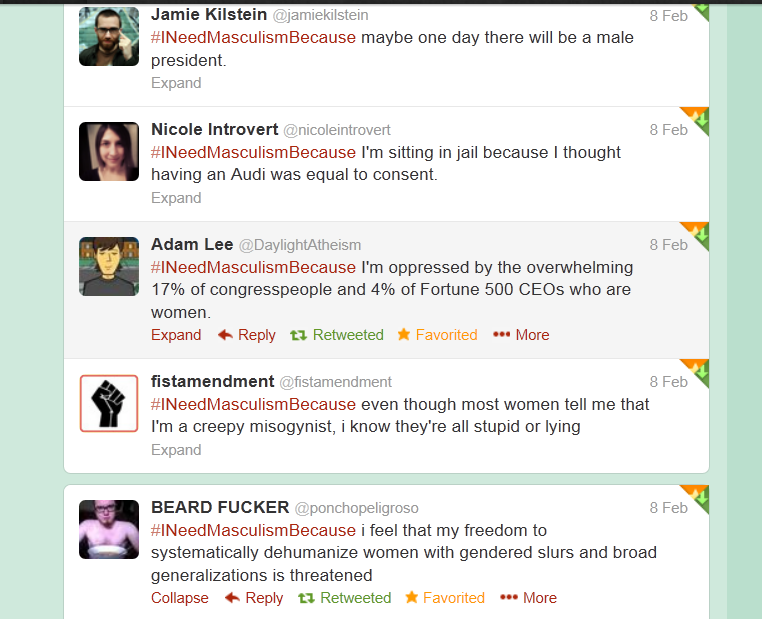
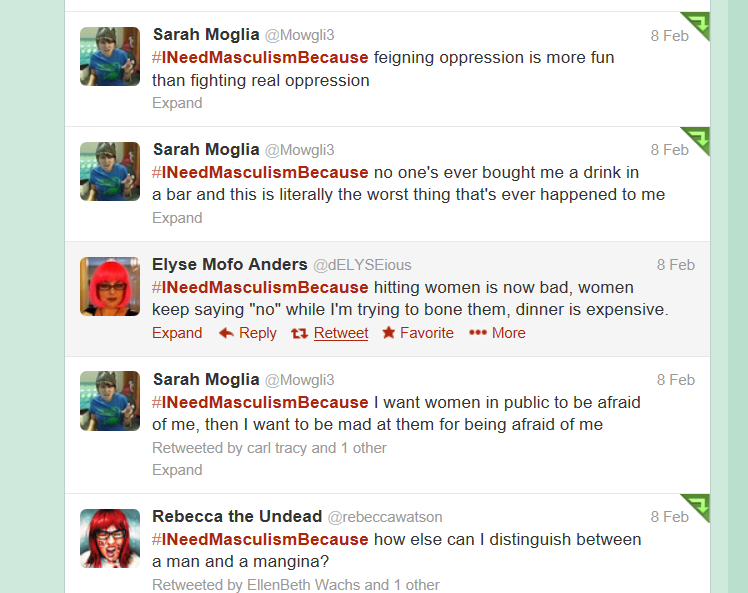
    Seen #INeedMasculismBecause? I saw it on Twitter an hour or two ago and clicked on the hashtag and laughed and laughed, because it’s all full of hilarious jokes by Elyse Anders and Sarah Moglia and Jamie Kilstein and other funny people.

    David Futrelle fills us in.

     a bunch of Men’s Rights Redditors and other MRAs, inspired by a post on 4Chan, decided to swarm Twitter with #INeedMasculismBecause tweets in response to the #INeedFeminismBecause hashtag. Feminists responded by outswarming the MRAs, flooding their new hashtag with often quite hilarious parodies of MRAspeak, as well as some just plain ridiculousness.

    Here are a few I collected from the top ones.

    masc

     There are a lot more.

    Update: Well I need to add a few more.

    elyse

  • Anne of Titty Gables

    Ok seriously now, I’ve been seeing outraged tweets about Anne of Green Gables with blonde?!!%* hair for a couple of days so I finally decided wtf and looked into it. I mean wtf, people – blonde hair? Hello? Her first conversation with Matthew, with her dreamy hope that her hair can be considered “auburn”? Her explosion of fury at Mrs Rachel Lynde for calling her homely and saying her hair was red as carrots? Her war with Gilbert after he called her Carrots? It’s half the damn book!

    I waggishly suggested that it had also been retitled Anne of Coney Island, but now that I’ve looked into it, the time for waggishness is over.

    Behold the new Anne.

    Anne of Green Gables

    Uh…different book, folks. I don’t know what book, but sure as hell not Anne of Green Gables.


  • Ireland: lost relatives

    A comment that was just posted on a 2005 post about Irish industrial schools. The commenter is looking for infomation, so I want her comment to get more eyes.

    Catherine Mitrenas writes:

    My Mother was incarcerated in this establishment from two years old until sixteen years old. Her brother went to a separate orphanage and they did not see each other again until they were sixteen years old. He was only one when they separated. Their Father was a sailor and their Mother died when they were infants. From what I have read recently I now wonder if my Mother’s mother did die as they do not know where her grave is, how she died or even a photograph. I would like anyone that knew my Mum or her family to get in touch with any information that would help me find some of her long lost family. I did not realise that this orphanage was so cruel. I now understand why my Mother has been the way she has. It has brought tears to my eyes for not understanding her pain. The Farrell family: Thomas Farrell. Two children Mary Bridgett and Thomas. Do not know the exact dates but must have been around 1936 onwards approx. This would be greatly appreciated.

  • And in Sweden

    Udo Schuklenk alerted me to a post by a philosopher at the University of Gothenburg on online hate harassment.

    In my country, there have been repeated public debates about the completely unacceptable and many times obviously criminal behaviour of some people when they use the anonymity of online resources to react to other people’s open and publicly expressed opinions. In particular against women, especially those who express some sort of view on gender, family or sexuality related policy issues.

    Yours too, huh? How about that. It’s the same here.

    Recently, these debates have received a renewed momentum, as a large group of Swedish female public figures, journalists, debaters, bloggers, etc. – but also ordinary women engaging themselves in public discussions online – have gone public with what sort of awful filth they are exposed to from a presumably minor but apparently very active group of people. Even our prime minister has publicly identified the problem as serious and said that steps need to be taken.

    That’s not so much the same here. I’ve never heard of Obama saying anything about online hate harassment of women.

    Most of his links are to Swedish sites, naturally, but he also includes a few in English. Like ‘I dream that my son has been butchered’ by journalist Åsa Linderborg.

    ”Can’t that disgusting whore Linderborg just lie down and die?”

    “She is such a whore, that bitch seems to be completely deranged. Lock the hooker in an mental asylum and throw away the key.”

    “Swedes hate you, you feminist communist asshole.”

    Then came the threats.

    “It wouldn’t surprise me if this whore ends up with a price on her head soon.”

    “Åsa Linderborg should be taken out of action. Permanently.”

    ”It’s happened before that a propagandizing cockroach or a pig who’s hostile to Swedes has been recognized on the street or in a department store”.

    (Editor’s note: Swedish Prime Minister Olof Palme was gunned down and killed in the street in 1986. Foreign Minister Anna Lindh was stabbed in a Stockholm department store in 2003 and died from her wounds.)

    Ulrika pointed out both places to me when we were walking to places in central Stockholm.

    Yet another person writes that it’s not difficult to find me, before posting my address: ”This is where she lives.”

    It is November 30th, 2012. The culture pages of the tabloid Aftonbladet, which I edit, have just begun publishing a series of investigative reports into far-right websites in Sweden.

    The threats start coming.

    My bosses tell me to go home and pack my bags. I tell my son we can’t live at home for a while. We take one bag each and head off. I leave my son with his father, I continue to a friend’s house.

    That night, I dream that my son has been butchered. He is sitting in an armchair and I’m picking up his severed limbs and putting them back together, hoping they will melt back into place.

    It is not the dream that wakes me, it’s an SMS from an untraceable pay-as-you-go mobile phone: ”Seriously sweetheart, when was the last time you got yourself off?”

    I go check out the sites we at Aftonbladet have been investigating. There are hundreds upon hundreds of comments: “I hope a Congo negro rapes and murders you, you little cunt. You’re worth less than a silverfish on the bathroom floor.”

    Free speech.

    That night I receive another SMS: ”I hope you’ve shaved down there because I really want to come over and fuck you hard in your fat ass and wrinkly cunt.”

    There are days when I cannot bring myself to talk about the threat, because I feel a bit silly and I don’t want to make myself out to be a martyr.

    Then there are days when I need to rant and dissect my anxiety over the fact that I’m still separated from my child, who has stayed on with his father. My anxiety over people wanting to hurt us. Over people maybe hurting us.

    To calm me down, and maybe to quell their own fears, my friends say there is no need to be scared of those kinds of people, because they’re not very smart.

    Because it takes brains to get violent? Please. I suppose that’s a variant of the just world fallacy, and perhaps also the kind of thinking that Hannah Arendt was addressing with Eichmann in Jerusalem – the idea that only significant people can do significant harm.

    “In Russia we also had a journalist like this,” one of them writes. “Her name was Politkovskaya. Now she is dead. Killed by patriots.”

    I am yet again awoken by an SMS: ”I assume it’s been a while since you got a bit of cock as you’re so old, but let me know if you want me to come over and fuck you properly.”

    Punitive pity sex. How alluring.

    I have several colleagues who live with these threats, but we don’t talk about it much. We carry it silently with us, as we don’t want to stick out. None of us is Salman Rushdie or Roberto Saviano.

    Or Anna Politkovskaya.

    Maybe we also keep quiet because we don’t want to appear weak.

    Do you have any colleagues who call you Professional Victims? Any who go on and on about how fabulous they are to have done what they’ve done without all this whining and drama and professional victiming? Any who post tweets about someone who has cancer and how it puts all this whining by journalists into perspective?

    I bet she doesn’t.

    We think the hatred and the threats are part and parcel of the job. But they don’t affect only us – the threats made against journalists and against politicians are a threat to democracy.

    And even against bloggers. Not as much so, but still some.

    I move home for a trial period. Yet again, an SMS wakes me up in the middle of the night. Yet again, the message is sexual.

    I get up and go to the bathroom to pee. I am plagued by a feeling that my private parts no longer belong to me, that they’ve been hijacked and turned into a stage where violent nationalist fantasies are played out.

    Ugh! I know that feeling. I feel as if everything about me has been hijacked to use as fodder for obsessed haters.

    The site Avpixlat starts a counter-campaign to Aftonbladet’s 30-day review of the nationalist sites. They say they are going to set up a register of every last one of what they call “politically correct journalists.”

    With their us-versus-them rhetoric, they write about us as though we are a cohesive group, yet I miss a strong counter-movement to the right-wing activists whom humanists and democrats should not take lightly.

    Yes to that too. It’s bizarre how familiar all this is.

    This is getting unwieldy, so part 2 will follow.


  • The Racist Sexist Homophobic Dipshit pledge drive

    John Scalzi has been studying our friend Bjarte Foshaug – he’s adopted Bjarte’s excellent wheeze of donating to rights groups by way of reply to haters.

    John Scalzi is the author of several books, including the Old Man’s War series and Redshirts, published in the States by Tor and the UK by Gollancz. He’s also the president of the Science Fiction and Fantasy Writers of America. Fed up of being constantly targeted on his website by one particular individual and his followers, Scalzi decided to take action, pledging US$5 every time “the Racist Sexist Homophobic Dipshit in question posts an entry on his site in which he uses my name (or one of his adorable nicknames for me)”.

    Scalzi put a ceiling on his “troll tip jar” of US$1,000, figuring that gave his bête noir 200 opportunities to abuse him over the coming year, and said he’d give the cash to four charities: RAINN, America’s largest anti-sexual violence organization; Emily’s List, dedicated to electing pro-choice Democratic women to office; the Human Rights Campaign, which works for Lesbian, Gay, Bisexual and Transgender Equal Rights; and NAACP: America’s oldest and largest civil rights organization.

    That’s the ticket!

    A novel enough way to tackle the trolls, for sure, but what happened next was somewhat astonishing: Scalzi’s friends, Twitter followers and readers asked if they could jump in with pledges too. Many of his friends are high-profile authors and industry types – Will Wheaton, the actor who played Wesley Crusher in TV’s Star Trek: The Next Generation, and a writer in his own right, was one of many who promised to match Scalzi’s US$1,000 pledge.

    By the early hours of this morning, UK time,  the pledges for Scalzi’s chosen charities had grown to US$50,000.

    Very good. Just one thing though – let’s not be thinking of this as a great way to raise money for rights organizations. I don’t volunteer to be a target for the purpose. Sorry, but no.


  • CNN on branding children as witches

    The reporter talks to Debbie Ariyo about the sources of witch-hunts against children.

  • So banal as to be parodic

    I’m reading a wicked review of Alain de Botton’s new book in The New Republic, by Victoria Beale. She explains about “The School of Life”…

    The self-declared mission of the School is to provide an enterprise that will “direct you toward a variety of useful ideas … guaranteed to stimulate, provoke, nourish and console.” The School’s shop has a few lightly stocked book-shelves (Oliver James, Paul Theroux, Italo Calvino, and, of course, the complete de Botton bibliography), while in its downstairs classroom, the School hosts talks that are a mixture of book-promos (“Steven Pinker on Violence and Humanity” to sell copies of The Better Angels of Our Nature), schedule fillers (an eight-week course on “Mindfulness,”), and champagne tastings…

    At a more moderate cost, the publications from The School of Life imprint further the same basic project: bring brisk, philosophically inflected practicality to universal dilemmas. There have been six books published in the series so far, one written by de Botton, the rest adopting his authorial technique. How to Stay Sane by Philippa Perry, epitomizes the worst tendencies of this formula: it amounts to little more than philosopher name-dropping with poorly written exegesis. “Socrates stated that ‘The unexamined life is not worth living,’” she writes. “This is an extreme stance, but I do believe that the continuing development of a non-judgemental, self-observing part of ourselves is crucial for our wisdom and sanity.” The whole book is composed of this kind of grinding obviousness, bizarrely sprinkled with a King Lear line, a Martin Buber quote, or a Wagner reference.

    Perry’s sentences are often so banal as to be parodic: “A group of people I find I always learn from are children, as they can offer us fresh eyes on the world and a new perspective”; “When I go away on holiday to a new place I feel refreshed by having been stimulated by new sights, smells, environments and culture”; “Each of us comes from a mother and a father, or from a sperm bank, and each of us was brought up by our parents or by people standing in for them.” The clunking truisms seem intended to give the book a straightforward tone, but instead leave the prose sounding lobotomized.

    I found that too funny not to share.


  • Tiny little princess

    I didn’t know that South Korea has the highest per capita rate of plastic surgery in the world. Somebody has to have that, naturally, but I’m slightly surprised that’s who does. I might have guessed the US does, if anyone had asked – I suppose because of lots of rich people and lots of advertising, lots of emulation and envy of movie stars and fashion models, lots of consumerism and the values that go with it, lots of reactionary bullshit about women floating around – reasons like that. But no, it’s South Korea.

    One in five women in Seoul have undergone some kind of procedure. Most popular: Eyelid surgery, to make the eyes “more Western,” and getting your jawbone shaved or chiseled down for a less-square and more V-shaped look.

    Sroll up and down that Jezebel post and look at the before and after photos.

    Notice something?

    The women all look much more delicate and fragile.

    Think about that.

  • Arithmetic via shopping

    Chris Chambers and Kate Clancy point out at the Guardian that pseudoscience and stereotyping won’t solve gender inequality in science, via what they call a “stereotype-enforcing guide to addressing the gender imbalance in science” also published by the Guardian.

    Sarah-Jayne Blakemore, a developmental neuroscientist at University College London, points out that finding reliable gender differences in the brain is complicated by individual differences: “There are a lot of girls who are better than boys at maths, for example, and a lot of boys who are better than girls at cooking. Therefore, these generalisations based on gender are unhelpful.”

    Two recent books – Cordelia Fine’s Delusions of Gender and Rebecca Jordan-Young’s Brain Storm – rigorously test many assumed sex differences, and find all of them lacking.

    Even in cases where gender differences in behaviour or brain function can be shown, where is the evidence that such distinctions can be applied usefully to tailor learning? How do we know, for example, that advice such as making “domestic scenario[s] more mathematic and scientific” wouldn’t apply equally to boys? As Blakemore puts it, “Making mathematics relevant to everyday life problems (e.g. cooking, supermarket shopping) is a good idea when teaching all children, not just girls.”

    Wait wait boys don’t relate to cooking and supermarket shopping because it’s only girls who grow up to be women and it’s only women who do cooking and supermarket shopping. Blakemore is so so so wrong to say that. Isn’t she?

    Yet where the article touches on such evidence, it remains not only gender-specific, but gender-conformist: “Research shows that as girls get older they retain their mathematical and scientific abilities when applied to domestic scenarios.”

    Right! That’s what I said! Oh, wait…is that gender-conformist? Sounds like radical feminism, that kind of talk. Radical gender feminism. Radical scary gender creepy castrating dyke feminism that’s only for ugly women.

    Finding ways for girls to integrate interests in science and shopping doesn’t work if girls think this is the only way to engage with it. Girls are not a monolithic, pink princess-loving entity that responds uniformly to the same siren calls of colour, shopping and cooking. None of these was present when we were evolving; none of this is universal, hard-wired, or intuitive.

    And if so many of these gender-conforming expectations are so harmful to boys’ and girls’ identities, why would we rely on them as a means through which to teach science?

    Becaaaaaaaaaaause, we like things the way they are and we don’t want people to shake free of gender-conformity. That’s why.

    We suggest an alternative to pseudoscientific list-making, and that is to identify and address structural inequality in our societies. There are two broad factors that drive our behaviours: our own individual agency, and the institutions around us. While it is useful to think about ways we can draw more girls into science by integrating it with their existing interests, it is also limiting. For instance, most adult women who hit the glass ceiling are just told to work harder, to be more pro-active, to seek more mentorship, and this can feel exhausting, especially if she already feels like she is doing those things without results. This is because it’s hard to win on agency if you’re not also winning on institution.

    The broader societal constraints that lead so few girls to consider themselves “science people” by middle school derive not from whether we push them into science, but what we value in girls as a culture. What gendered representations of science continue to exist in underperforming countries like the US and UK? What messages do we send about how we value intelligence and knowledge, about how girls contribute to society? And, what would it take to overcome these obstacles to produce a more egalitarian learning environment?

    Dropping the sarcasm now. Really. Adult women are also told to stop “complaining” or “whining” or being “professional victims.” We’re told the best way is just to put your head down and get on with it and be a role model for the three women who will ever be in a position to see what you’re doing. We’re told to shut up about institution because reasons. We’re told nice women don’t discuss broader societal constraints, because that’s radfem. We’re told only ugly women talk about broader societal constraints while pretty women are fully content with how things are because the vote.


  • More polio for Nigeria

    Nine women shot to death in Kano for attempting to prevent children from getting polio. Nine.

    In the first attack in Kano the polio vaccinators were shot dead by gunmen who drove up on a motor tricycle.

    Thirty minutes later gunmen targeted a clinic outside Kano city as the vaccinators prepared to start work.

    Some Nigerian Muslim leaders have previously opposed polio vaccinations, claiming they could cause infertility.

    On Thursday, a controversial Islamic cleric spoke out against the polio vaccination campaign, telling people that new cases of polio were caused by contaminated medicine.

    Such opposition is a major reason why Nigeria is one of just three countries where polio is still endemic.

    Nine women murdered, and who knows how many children doomed to get polio in the future.

    According to the Global Polio Eradication Initiative, there were 121 cases of polio in Nigeria last year, compared to 58 in Pakistan and 37 in Afghanistan.

    And compared to zero in the rest of the world.

  • Pseudoscience and stereotyping won’t solve gender inequality in science

    Finding ways for girls to integrate interests in science and shopping doesn’t work if girls think this is the only way to engage with it.