The lady car for ladies, the lady pen for ladies – Ellen DeGeneres has a funny bit on the lady pen.
“And they come in both lady colors: pink and purple.”
http://www.youtube.com/watch?v=eCyw3prIWhc

The lady car for ladies, the lady pen for ladies – Ellen DeGeneres has a funny bit on the lady pen.
“And they come in both lady colors: pink and purple.”
http://www.youtube.com/watch?v=eCyw3prIWhc
Something to think about…violence against women in Pakistan: 2,713 cases reported in 2012 so far, not in Pakistan, but just in southern Punjab. And those are only the reported ones. Something tells me that not all women subject to violence in Pakistan are able or willing to report it.
These include cases of aas-aaf custom (10) – in which women accused of ‘bringing shame to the family’ take an oath of innocence on the Holy Quran and then walk on burning coals spread over six metres–, abduction and torture after abduction (577), acid attacks (20), burning by throwing kerosene oil and petrol (17), kaala kaali (25), assault after divorce (45), assault by in-laws (100), ‘honour’ killings (112), murder and assault for contracting a marriage with their free will (114), murder (162), victims of panchayat decisions where women were either sold or killed (37), rape (304), assault by police (20), suicide in reaction to family pressure, rape or other forms of violence (444), torture leading to physical or mental disability (489), wani (37), watta satta (25) and cases of gender discrimination and disinheritance (175).
I hadn’t heard of that aas-aaf custom. That’s nice. Very 16th century Europe, where women accused of being witches might be thrown into a pond. If they drowned they were innocent. Yay.
Sometimes the violence is just grumpy neighbors.
Farkhanda, a second year student and a hafiz-i-Quran, had an argument with three women neighbours when she went to their house to collect her dupatta that had fallen into their house.
They said the women accused her of throwing the dupatta into their house on purpose.
They accused her of entering their house with an intention to steal from there. Some neighbours heard them arguing and intervened, police said.
The matter was resolved and Farkhanda returned home, they said.
However, later that night, police said, three youths, Ibrahim, Iqbal and Bilal, relatives of the women Farkhanda earlier had an argument with, went to her house while her family was away and beat her up. Police said they decapitated her with a butcher’s cleaver…
And then after a pause to catch their breath, they chopped off her arms and legs.
I’m still wondering about this question of what is “religious morality”? Most people seem to think it’s just plain morality that’s (partly or wholly) motivated or endorsed or decorated by religion.
I think that’s completely wrong. That’s not because I think nobody is really motivated by religion. It’s because that’s not enough to make morality religious.
I think morality is secular. I haven’t been able to think of any morality that isn’t secular – any moral content that is religious as opposed to secular.
Can you?
Religions have rules, but they’re not particularly moral. Rules about diet or what to wear or taking a day off to honor a god – those aren’t moral.
Morality applies to what people do to each other, and to animals, and perhaps to the planet. None of that has anything to do with a god or with another (different, non-material) world.
People try to go the other way around, and say the good is what pleases god and therefore morality is religious, but that falls afoul of the Euthyphro dilemma. What if what pleases god is parents dousing their daughters with acid? Then god would be bad! Therefore god would never do that. Ok but then you’re deciding what god is according to what you think is good, so it’s what you think is good that actually counts. See?
Is there anything we think is good that has nothing to do with the secular – nothing to do with humans and their needs or feelings, nothing to do with animals or the earth? If there is anything like that, maybe it’s religious, but I’ll be damned if I can think of anything.
Can you?
Don’t miss Andy Lewis’s long and thorough article What Every Parent Should Know About Steiner-Waldorf Schools.
Just one sample, to whet your appetite –
Far from Steiner’s views being seen as a historical anachronism, the text books are full of unreformed anthroposophical views on the world. The text books I have got hold of teach that the heart is not a pump but is forced to beat by the pulsing blood that is forced around the body by the spirit. We learn that humans are bipedal because it frees the arms to pray. Anatomy is treated as a spiritual subject and not a science. The British Humanist Association notes that the source of the curriculum at Hereford state funded Steiner schools is acknowledged to be based on a book by Martyn Rawson and Tobias Richter which teaches that Darwinism “is rooted in reductionist thinking and Victorian ethics and young people need to emerge from school with a clear sense of its limits”. Homeopathy, a most egregious form of quackery, is ‘a good example of an effect that cannot be explained by the dominant [atomic] model’. It is worth noting that Steiner stated that the British Isles floated on the sea held in place by cosmic forces. And he believed in the historical truth of the vanished continent of Atlantis…
That article needs to be published somewhere.
And speaking of going places and doing things – Veronica Abbass at Canadian Atheist has a post about what people are looking forward to at Eschaton in Ottawa next month. We’re all looking forward to meeting each other, is what it boils down to.
I hope there’s plenty of cat food.
From the Washington state Voters’ pamphlet, the section on Referendum Measure 74, which would allow same-sex couples to marry. From the Argument Against.
God’s creation of marriage as the union of one man and one woman is the foundation of society and has served us well for thousands of years.
Seriously?!
I shouldn’t be surprised. The statements are prepared by the people who prepare them. They can have batshit crazy stuff in them.
But I am suprised, all the same. ”God’s creation of marriage as the union of one man and one woman” doesn’t exist. One man often had lots of women in God’s old-timey world.
My “Promised Land” is a place where people don’t talk stupid shite like that.
Belatedly catching up with the Halloween Jesus and Mo.
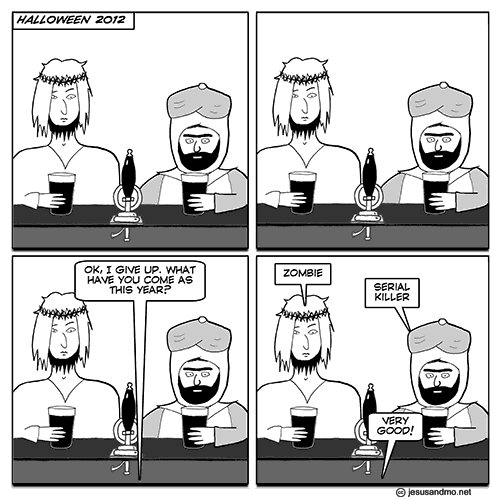
Is the barmaid praising their sense of humour, or their insight?
There’s a new group for liberal Muslims in Canada: Muslims Facing Tomorrow. There was a launch a couple of weeks ago.
I attended the launch of the Council of Muslims Facing Tomorrow at the invitation of Raheel Raza, journalist, author, public speaker and activist. She founded MFT to amplify the moderate Muslim voice at a time when it’s in danger of being lost in the clamor of extremist rhetoric.
An energetic advocate of women’s rights and social reform, Raheel wants the group to be unconstrained by religion and open to all who share a vision of tolerance and diversity. She sees it more as a movement than an organization, connecting and motivating people around the globe, holding conferences and workshops to educate and strengthen the progressive Muslim identity. Of particular concern to her is providing direction and support for Muslim youth.
Good good good. Support for the Malalas of the world, and the parents of the Malalas of the world.
As Raheel welcomed the audience and the cameras clicked and flashed, I glanced around the auditorium; half an hour in people continued to arrive. There were no hijabs or “Islamic” beards, no segregated seating. I heard the prophet mentioned without the suffix “Salallahu alayhi wasalam” (Peace be upon Him). I can’t tell you how comfortable that made me; dialogue with some Muslims can feel like a piety competition – the tension is palpable when you don’t couch your words in the correct phrases.
Let’s hope the group thrives.
Journalist and activist Raheel Raza founded MFT to amplify the liberal Muslim voice.
I forgot to say – I’m doing a talk at CFI Los Angeles on Sunday, so if you’re in that area and want to come along, now you know. 11 a.m. 4773 Hollywood Boulevard.
I’m going to talk about Reap Paden.
Kidding! Totally kidding.
I might eat some cat food though, as a kind of party trick.
I’m adding the thing. There’s a thing. A description type thing.
Another girls’ school set on fire in Pakistan.
A large number of people, including activists of religious parties, ransacked and set on fire a girls’ school in Lahore and clashed with police following reports that a question paper for a test had contained blasphemous references to the Prophet, police said today.
Reports, please note. Also known as rumors. Reports that something something, so whammo, set fire to a girls’ school.
Residents of Karim Park near Data Darbar began gathering outside the school yesterday morning following reports that its owner, Asim Farooqi, and teacher Arifa had committed blasphemy.
According to witnesses, the mob surrounded the three school buildings and forced their entry into the complex even after a large police contingent was deployed at the spot.
A sizeable number of activists of the Islami Jamiat Talba and JuD were part of the crowd and they demanded that the police should hand over the blasphemers to them.
The protesters subsequently forced their entry into the buildings after police used teargas in an attempt to disperse them. They let terrified students vacate the buildings and searched for the “blasphemers”.
So that they could beat them to death?
Legislators Mian Marghoob and Khawaja Imran Nazir of the PML-N that rules Punjab and senior police officers reached the spot and requested the protesters to go home so that police could investigate the matter.
“I assure you the government will thoroughly investigate the matter and will not spare those involved in blasphemy,” promised Nazir, who is the political secretary to Chief Minister Shahbaz Sharif.
Later, police claimed they had arrested both Farooqi and Arifa and booked them under the harsh blasphemy law.
A police official said that the private school’s administration had set a question paper for a test a few days ago that allegedly contained “indecent” remarks about the Prophet Mohammed.
I would say something harsh, but Chris Stedman might report me to the Huffington Post.
She was 15. They saw her talking to a boy. The father beat her up, and both parents poured acid over her.
There’s a lot of indignation about Bruce Gorton’s guest post about faitheists. People have been badgering Paul Fidalgo about it on Twitter merely because he linked to it in the Morning Heresy – he linked to it, he didn’t endorse it. James Croft has a long post on it. Vlad Chituc challenged me on it via Twitter, and we ended up having a decent discussion.
The indignation is about the claim that Chris Stedman “holds a degree of the basic unconscious racism that I find common in a lot of these arguments over religion.”
Part of the problem is just that people translated that into “Chris Stedman is a racist.”
Look closely at the two and you’ll see the difference. I pointed that out to Vlad yesterday, and I also pointed out that it’s pretty common to be told that one holds a degree of unconscious racism; he didn’t fully agree but he did at least see my point, which is how we ended up having a decent discussion.
So that’s one thing. It’s just the basic idea that no one is free of unconscious racism and other biases, or at least that it’s not safe to assume that anyone is. The charge can be annoying, certainly, but it’s not the same as just “you are a racist.”
So what about the merits? Bruce went on, first quoting Stedman:
“But how can we discount the role religious beliefs played in motivating the Reverend Dr. Martin Luther King Jr. or Mahatma Gandhi?”
Why do I say this is unconsciously racist? Gandhi and MLK Jnr were both fighting against social injustices they personally suffered – and they were fighting shoulder to shoulder with atheists to achieve it.
[snip]
I do not think religion was the motivating factor behind Martin Luther King Jnr, I think not wanting an America where the colour of his skin relegated him to third class status had a lot more to do with it. I do not think religion motivated Mahatma Gandhi, I think desiring an India free from colonial rule had a lot more to do with it.
I think that’s right. I also think it’s possible to find moral support and encouragement and so on from a selective use of religion – obviously King was not “motivated” by the same religion that “motivated” the white supremacists – but that’s not the same as being motivated by religion in general. I think Bruce is right that the real motivations for social justice campaigns like those of Gandhi and King are moral and thus secular. They are not rooted in ideas about obedience to God; they are rooted in ideas about equal treatment among human beings on planet Earth.
I think the idea of unconscious racism has to do with making special rules for other races, and that that’s patronizing and thus racist.
I think I’ve often found that idea somewhat persuasive, but I think I was probably wrong. I think what’s really going on is people trying to correct for their own privilege, and it seems pretty perverse to call that racist. I think the idea is, “it’s easy for me to give up religion, because I’m not shut out of nearly everything else, but it’s not so easy for people who are shut out of nearly everything else. That makes me hesitant about trying to talk them out of religion.”
See what I mean?
I could develop it more, but I’ll let you do the work.
There’s this scene with a belly dancer, see, and the music is a song that mentions Fatima. Blasphemy!
Muzaffarabad: A mother and father in Pakistan-administered Kashmir killed their 15-year-old daughter by dousing her with acid after seeing her talking to a young man, police said on Thursday.
By dousing her with acid. Can there be a worse way to die? Being set on fire, perhaps.
And for talking to a man. Parents. Their child. Acid. Talking to a man.
Local police officer Tahir Ayub told AFP the father, Mohammad Zafar, had had suspicions about his daughter Anvu Sha and became enraged when he saw her with a boy outside their home on Monday.
“Zafar beat her up and then poured acid over her with the help of his wife. She was badly burnt but they did not take her to hospital until the next morning, and she died on Wednesday,” Ayub said.
Doctor Mohammad Jahangir of the state run Kotli hospital confirmed the death, saying the girl was brought to hospital in a “very critical condition” with almost 70 per cent burns.
She must have been screaming with agony all night. Apparently they just sat around listening.
I kid, I kid.
He drops in here with his totally cool angry atheist avatar and his rapier wit, and he puts me in my place.
I apologize if someone has already made this point–
Ophelia I think I can speak on behalf of at least a whole hell of a lot of people when I ask “When are you going to deflate your head and come down for a landing?” Some of the incredible things I have seen you post lately make me wonder if you have been eating too much cat food or something.
I plan to make “I think I can speak on behalf of at least a whole hell of a lot of people” my new catchphrase.
Martin Pribble reminds us of the Montreal Massacre. On December 6 1989, a guy called Marc Lépine went into a classroom at the École Polytechnique in Montreal. Katherine Ramsland describes what he did there. [trigger warning]
In French, the young man asked the 10 female students to get up and move across the room. He then told the men to leave. No one moved. A few people laughed, as if this were some kind of joke. That was the worst thing they could have done. He had been humiliated enough in his 25 years. On this day, of all days, he was not going to be treated in that way.
Lifting his rifle, he shot twice into the ceiling. It was no joke.
“You’re all a of bunch of feminists!” the man shouted, his eyes now alight with anger. “And I hate feminists!”
This time, he ordered the women to get up from their seats and the men to leave. A few moved to obey, but others remained confused. They wondered whether they should try to overpower the gunman, protect the women, or leave. The choice as to what was best was unclear. But after a few moments, the male students and teachers walked outside. In weeks to come, many of them would have nightmares about this moment, reliving it over and over, wishing they had acted differently.
When the 10 women had moved into the specified corner, the gunman explained his reason for being there. According to survivors who spoke later to police or reporters, he told them that he was there on behalf of males. “I’m fighting feminism.” Women had been taking employment and opportunities away from men, he said, and feminists needed to be taught their place.
Nathalie Provost tried to tell him that they were not necessarily feminists, but this only enraged him. He lifted the rifle again and, as they screamed for mercy or tried to leap out of range, he methodically shot them from left to right. All were hit. Provost was shot three times.
Gendercide, Ramsland calls it.
Martin Pribble explains the aftermath.
The people of Canada were profoundly affected by this massacre, and as a direct result, a group of men initiated a campaign to urge men to speak out against violence to women, and to commemorate those hurt and killed by this awful event. On the second anniversary of the “Montreal Massacre” (as it came to be known), the first “White Ribbon Campaign” was held. The campaign sought to motivate men to stand up against, and speak up about, any forms of violence against women.
This year, the White Ribbon Campaign is now supported and represented by countries in every continent including Australia. The White Ribbon Campaign Australia is this year supported by an advertising campaign called “Hey Mate“, focusing on the attitude that many have about intervening when sexism and violence against women rears its ugly head. It is backed by a pledge that man can make, and publish, publicly proclaiming:
I swear never to commit, excuse or remain silent about violence against women. This is my oath.
Over 50,000 men have made this oath, and knowing that they “have got your back” helps enforce the attitude that men too, are sick of violence against women. The “Hey Mate” campaign is made up of four advertisements, and highlights four scenarios; “At the pub”, “At home”, “At work” and “At the party”. It highlights the fact that it is not only okay to point out when someone else is acting inappropriately or violently towards women, but that it is okay to intervene because men are not alone. These kinds of campaigns can only work if they have support of the people. In this case, over 50,000 men have made the oath, but with 22m people in the country, this is but a small percentage of the potential supporters of this campaign.
Good on you, Martin.
Thank goodness for Honda, you know, because without it, there wouldn’t be special cars for women only.
It’s nice of them to illustrate what kind of women the car is especially designed for – pretty, young, delicate, graceful, dainty, skirt-wearing, flower-carrying.
Embracing the design-for-women-only trend, Japanese automaker Honda has released a new car model designed especially for women.
The ‘Honda Fit She’s’ has a “Plasmacluster” air-conditioning system that the company claims can improve the driver’s skin quality, and a special windshield glass that blocks out 99% of UV rays—all aimed at lessening the chances of wrinkles.
It sports a pink exterior, pink stitching for its seats, steering wheel and floor mats, and metallic pink bezels around the shift and dashboard.
That’s great. It’s always worried me seeing women driving cars that are black, blue, grey, green – all kinds of stupid colors that aren’t specially meant for women only. It’s such a relief to see pink cars just for women at last.
That link to the “design for women only trend” (the what?) goes to another pink thing.
Japanese electronics brandFujitsu has launched a new computer that’s aimed at female users.
The ‘Floral Kiss’ Ultrabook is said to be developed “by a team of female engineers aiming to bring elegance to PCs”, according to the brand.
It comes in three colors of “Elegant White”, “Feminine Pink” and “Luxury Brown”.
The top casing has a gold trim an a flip latch that easily open the display, “even by users with long fingernails”, the company said in a statement.
The power status LED and Caps Lock key are decorated with diamond-cut stone, a gold ring frames each key on the transparent keyboard, and the outtake and intake vents feature a floral motif design.
Floral Kiss also features custom-designed apps for women, such as a Scrapbook, a Diary and Daily Horoscopes.
Aw, jeezis. End of sarcasm. That’s so fucking insulting.


