How dare a woman talk in public?
Author: Ophelia Benson
-
“Ugly girl”: growing up female
There is lip service to “you can be anything” but the real message is be hot or go away.
-
#justthewomen
The BBC’s Panorama was just on, and Twitter lit up like a plane with a wing falling off. It was about Jimmy Savile and how the Beeb looked the other way for a few decades.
I haven’t seen the episode, but I saw a lot of tweets about it, and then the hashtag, which led to some very pungent comments. I gather the gist of it is, the Beeb couldn’t (or wouldn’t?) do anything about it, because the sources were
just the women.
Ah.
-
Public figures who make their controversial opinions known to the world
After all these somber and/or infuriating items, a funny one. Justin Vacula on Facebook.
A lengthy post I authored months ago concerning what certain Freethought Bloggers are calling ‘stalking’ and ‘cyberstalking’ is below. This is especially relevant considering Ophelia Benson’s recent post “It’s all trolling, when you come right down to it” in which she claims that the “pro-misogyny crowd” stalks bloggers “day in and day out.”
TL;DR – criticism, even when it is excessive, isn’t stalking or cyberstalking. Public figures who make their controversial opinions known to the world will get responses. Reductio ad absurdum: Major cable news networks must be stalkers for their coverage of Obama and Romney.
Well thank you! That is very flattering. I’m as important as Obama. Who knew?!
But let’s be real. I’m not a “public figure.” That phrase doesn’t mean people like me. It means truly public; famous. I’m not famous by any stretch of the imagination.
And then, saying that people “will get responses” doesn’t mean that all responses are fine, or that there is no reason to say some responses are more reasonable or acceptable than others. It’s just a factual statement, so obvious that it’s almost empty. It amounts to “if you say something, you might get replies.” It says nothing about whether some kinds of reply are intrusive or aggressive or stalker-like.
What about this claim that excessive criticism isn’t cyberstalking? I think it’s dead wrong. I think highly excessive – indeed, obsessive – criticism is indeed cyberstalking. It’s cyber because it’s not literally someone following you down the street, so it is less scary than literal stalking. It’s mostly a lot less scary than that. But it is stalkerish in being obsessive out of all proportion to anything actually done or said or otherwise perpetrated. Having people posting and tweeting about you every day, repeating the same meagre list of offenses over and over again, monitoring every word you say – yes, that is stalkerish.
Another thing. What we get isn’t “coverage.” It isn’t journalism, it isn’t reporting, it isn’t news. It’s a campaign of vilification. That’s all it’s about; that’s its only purpose. It never stops. I posted a lot about Chris Mooney during the summer of 2009 – but that was because he kept writing articles for major media outlets, attacking “new” atheists. I posted about those articles. He stopped writing them, and I stopped writing about them and about him. I didn’t latch onto him like a lamprey and never let go.
So, no. None of what he said is right. I’m not talking about disagreement and discussion. I’m talking about non-stop monitoring and lying and smearing. I’m not a public figure, much less Obama or Romney, so no, the same rules don’t apply.
-
Flip the terms
The New Yorker has an article on billionaires who’ve convinced themselves they’re “victimized” by Obama.
A hedge-fund billionaire called Leon Cooperman wrote an open letter to Obama which has been “widely circulated in the business community.”
Evident throughout the letter is a sense of victimization prevalent among so many of America’s wealthiest people. In an extreme version of this, the rich feel that they have become the new, vilified underclass. T. J. Rodgers, a libertarian and a Silicon Valley entrepreneur, has taken to comparing Barack Obama’s treatment of the rich to the oppression of ethnic minorities—an approach, he says, that the President, as an African-American, should be particularly sensitive to. Clifford S. Asness, the founding partner of the hedge fund AQR Capital Management, wrote an open letter to the President in 2009, after Obama blamed “a small group of speculators” for Chrysler’s bankruptcy. Asness suggested that “hedge funds really need a community organizer,” and accused the White House of “bullying” the financial sector. Dan Loeb, a hedge-fund manager who supported Obama in 2008, has compared his Wall Street peers who still support the President to “battered wives.” “He really loves us and when he beats us, he doesn’t mean it; he just gets a little angry,” Loeb wrote in an e-mail in December, 2010, to a group of Wall Street financiers.
Oh lordy – it’s so funny and so disgusting, both at once.
It’s familiar, certainly. I’m distantly acquainted with some rich people who talk that way. Aggrieved; resentful; embattled…in their huge SUVs and their 14 expensive houses.
It’s also familiar from the way MRAs and white supremacists and the Vatican talk. We are the real victims around here – we the rich, we the white, we the men, we the priests and cardinals and popes. We are not the bullies, we are the ones who get bullied.
Nick Hanauer is a Seattle entrepreneur and venture capitalist who was one of the first investors in Amazon. In a book published this year, he argues that since the Reagan era American capitalists have enjoyed a uniquely supportive set of ideological, political, and economic conditions. Their personal enrichment came to be seen as a precondition for the enrichment of everyone else. Lower taxes for them were a social good, rather than a selfish perk.
“If you are a job creator, your fifteen-per-cent tax rate is righteous. If you aren’t, it is a con job,” Hanauer told me. “The idea that the rich deserve to be rich is a very comforting idea if you are rich.” Referring to Obama’s “You didn’t build that” remark, at a rally in Virginia in July, which became a flashpoint with the right, Hanauer said that “the notion that you built it yourself is what you need to believe to feel comfortable with yourself and your desire not to pay too much in taxes.”
I know people like that. They don’t just think all that, they even think everybody agrees with them. It’s bizarre.
-
Paul Kurtz
As you probably know already, Paul Kurtz is gone.
The Center for Inquiry marks with great sadness the passing of Paul Kurtz, founder and longtime chair of the Committee for Skeptical Inquiry, the Council for Secular Humanism, and the Center for Inquiry, who died at the age of 86. A philosopher, activist, and author, Kurtz was for a half-century among the most significant and impactful figures in the humanist and skeptic movements.
“Impactful”…ah well, I won’t do a fogeyism about it. Anyway yes, he was.
Kurtz’s legacy includes the above organizations, the creation of the skeptics’ magazine Skeptical Inquirer, the secular humanist magazine Free Inquiry, independent publisher Prometheus Books, and a library of books and scholarly articles that will continue to inform discussions of morality, ethics, reason, and religion for generations to come.
I knew him a little. I was at CFI Amherst for almost three weeks in 2007; I did a talk and hung out. PK was a fan of B&W at the time, and he was pleasant to me. He took a bunch of us to lunch one day and invited me to go in his car. We talked about B&W and he said (very flatteringly, so perhaps not truthfully) that he’d had thoughts of setting up a skeptical inquiry website but then decided it would just duplicate B&W so why bother.
Free Inquiry has been one of my favorite magazines for years and years, with Skeptical Inquirer close behind it. I have a lot of Prometheus books on my shelves. I’m not the only one.
I’m grateful for all of it. I’m not the only one.
-
Italy makes fallibility a major felony
Hey kids! Got dreams of being a scientist? Well don’t do it – because if you do, you risk being thrown in prison for six years, barred from public employment for life, and liable for court costs and damages, all because you failed to say exactly when an earthquake was going to happen.
Six Italian scientists and an ex-government official have been sentenced to six years in prison over the 2009 deadly earthquake in L’Aquila.
A regional court found them guilty of multiple manslaughter.
Prosecutors said the defendants gave a falsely reassuring statement before the quake, while the defence maintained there was no way to predict major quakes.
…
The seven – all members of the National Commission for the Forecast and Prevention of Major Risks – were accused of having provided “inexact, incomplete and contradictory” information about the danger of the tremors felt ahead of 6 April 2009 quake, Italian media report.
In addition to their sentences, all have been barred from ever holding public office again, La Repubblica reports.
…
The judge also ordered the defendants to pay court costs and damages.
The irrationality of it is frightening. Yes it was a really bad earthquake, but the badness of the earthquake doesn’t make scientists who failed to predict it more guilty. Jeezis. Wouldn’t you kind of expect a judge to realize that?
I have a prediction: Italy will suddenly find itself bereft of scientists.
-
Italy: earthquake scientists sentenced to 6 years in prison
All have been barred from ever holding public office again, and ordered to pay court costs and damages.
-
One step ahead of a mob
Tahrir Square. Another live broadcast, another reporter attacked and groped by a mob. The French journalist Sonia Dridi was the target this time.
A mob of about 30 men has turned “crazy” and groped and robbed a French television journalist near Tahrir Square in Cairo, in the latest case of violence against women at the epicentre of Egypt’s protests.
She’s ok now, but it was frightening and nasty.
Ashraf Khalil, a colleague who works with France 24′s English language service, said the crowd was closing in on him and Dridi while they were doing live reports on a side street off Tahrir.
…
Khalil said they retreated into a fast food restaurant called Hardee’s, which had a metal door, to keep her out of the reach of the attackers.
He told The Guardian: “What was depressing is that the employees inside Hardee’s knew exactly what to do because this seems to happen all the time. Some terrified woman running in one step ahead of a mob.”
That’s incredibly depressing.
Khalil said the doors were locked and when he later went out to hail a taxi and usher Dridi out, there were men banging on the bonnet of the car.
“Sexual harassment is a 20-year problem here, but now there’s a feeling of impunity and the knowledge that the police won’t do anything about it, it breeds this culture of lawlessness.
…
“Sexual violence is a way of denying women journalists access to the story in Egypt,” Logan said.
“It’s not accidental. It’s by design.”
British journalist Natasha Smith of the Fair Observer also reported being sexually assaulted by a mob near Tahrir Square.
The square has seen a rise in attacks against women since protesters returned this summer for new rallies, including incidents of attackers stripping women – both fellow demonstrators and journalists – of their clothes.
No official numbers exist for attacks on women in the square because police do not go near the area and women rarely file official reports on such incidents, but activists and protesters have reported an increase in assaults against women.
And although sexual harassment is not new to Egypt, suspicions abound that many of the recent attacks are organised by opponents of various protests in a bid to drive people away.
Amnesty International said in a report in June that such attacks appeared designed to intimidate women and prevent them from fully participating in public life.
That would do it, too.
-
Cairo: mob gropes reporter
Amnesty International said in a report in June that such attacks appeared designed to intimidate women and prevent them from participating in public life.
-
But we allow them to use the front door
CNN describes American Atheists as calling out religion; that term again.
American Atheists has a long history in using billboards to call out religion and get its message out. During the political conventions in August and September, the group put up billboards attacking Mormonism and Christianity, taking aim at the faith of both presidential candidates.
It’s such a standard idiom by now. I don’t think it can be seen as particularly ideological, let alone loony.
Anyway. The Mormons say it’s all a misunderstanding, of course.
The billboard, which American Atheists says will follow the Romney campaign for seven days, features two messages on Mormonism: “No Blacks Allowed (until 1978)” and “No Gays Allowed (Current).”
The first line is a reference to the church’s practice of denying lay priesthood to black male members until 1978.
Though the church did not allow black male members to be ordained before that year – when the church head says he received a revelation to reverse the policy – it did allow blacks and members of all racial and ethnic groups to be church members.
Ah yes but that sounds more liberal than it is, because all “worthy” white male members are lay priests, so excluding non-white males is pretty unmistakably racist.
This mobile billboard, however, is a departure from the standard American Atheist tactic of multiple billboards on multiple religions. According to Silverman, this is because Romney’s faith hasn’t been addressed enough in the 2012 election.
“We all understand the implications of having a Christian president. We do not understand the implications of having a Mormon president,” Silverman said. “We are not taking a position on the election, we are taking a stance on ignorance.”
Oh but we’re not supposed to decide on the basis of things like that. We’re supposed to figure out which one we want to have a beer with, and vote for him.
-
Another good visual
And speaking of posters and messages – American Atheists has a new one. It’s on wheels, and it’s going to follow Romney’s campaign throughout southern Florida. Yessss.

-
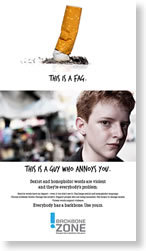
Backbone Zone
I hadn’t heard of Backbone Zone before. Ant Allan informed me via tumblr. They have some great posters.

You can order them at their site.
I like this one, too:
 I like it because I detest the “shame men by calling them girls” trope. It makes me feel murderous.
Another good one (they’re all good):
-
Golden Dawn and “blasphemy” prosecution
Greeks who are proud they live in a secular democracy protecting the freedom of speech discovered that the law against blasphemy has been strengthened.
-
OIC drops effort to get global anti-blasphemy law at UN
Blames pesky “Western” and Latin American opposition. (Latin America is in the Western hemisphere yo.)
-
Brady Judd in Gilead
About Polk County and the 14-year-old girl charged with first degree murder of her newborn…and about Amanda Todd, and many other people and incidents, and a way of thinking.
From the Handmaid’s Tale, chapter 13. The scene is a Testifying session during the re-education phase of Gilead.
It’s Janine, telling about how she was gang-raped at fourteen and had an abortion. She told the same story last week. She seemed almost proud of it, while she was telling. It may not even be true. At Testifying, it’s safer to make things up than to say you have nothing to reveal. But since it’s Janine, it’s probably more or less true.
But whose fault was it? Aunt Helena says, holding up one plump finger.
Her fault, her fault, her fault, we chant in unison.
Who led them on? Aunt Helena beams, pleased with us.
She did. She did. She did.
Why did God allow such a terrible thing to happen?
Teach her a lesson. Teach her a lesson. Teach her a lesson.
Aunt Helena, meet Brady Judd. You two will get along just fine.
-
Return to Polk County
A 14-year-old girl in Lakeland, Florida has been charged with first-degree murder and aggravated child abuse in the death of her newborn infant. You probably know the story: secret pregnancy, birth in the bathroom of mobile home with mother a few feet away, dead infant in shoebox under the bed.
They’re trying her as an adult, which is moronic, since that’s just what she isn’t. But no surprise – this is Lakeland, Florida. It’s Polk County. It’s Sheriff Grady Judd.
Polk County, where Cassidy attended high school, teaches community-based abstinence-only-until-marriage curricula in its schools. Nurse Jamie Kress facilitates Polk County’s Prevention Program that brings registered nurses to schools to cover a variety of subjects that might fall under the category of sex-ed.
According to Kress, contraception is only addressed within the context of marriage, and instead, the program promotes abstinence from all sexual contact as STD and teen pregnancy prevention. A student thinking about having sex, or who is already sexually active, would not be advised to use condoms or other forms of birth control.
If a student were already under the impression that she has committed the one act that runs contrary to the basis of everything she’s been taught in school, I would argue that she would be less willing to approach adults at school with concerns that she is pregnant. Although little has been said about Cassidy’s character, or her home life, the facts of the case demonstrate that she was in dire need of support outside of her family regarding her pregnancy.
According to Sheriff Grady Judd, Cassidy’s mother was “in denial,” ignoring family members who said that Cassidy might be pregnant and the bulge likely visible on Cassidy’s 100 pound, 5’3” frame.
Polk County. Home of Polk Under Prayer, as I wrote last March after the secularism event in Orlando.
One of the first talks was EllenBeth Wachs, who explained what’s been going on in Polk County, Florida. Theocracy, that’s what. The mayor of Lakeland and the Polk County sheriff are involved in something called Polk Under Prayer.
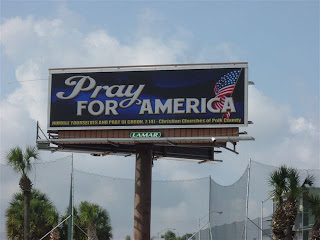
Grady Judd, the sheriff who arrested EllenBeth because she pissed him off. Lakeland, whose mayor is teamed up with Grady Judd to christianize everything they can get their hands on.
Naturally Cassidy Goodson didn’t get sex education in school. Naturally Polk County is trying her as an adult. This is what theocracy looks like.
-
This shit is sexist, and feminism is the fight against sexism
Soraya says hell yes she’s a feminist.
Remember the woman who asked Romney about the wage gap?
You know what she got for her efforts? A good and proper Slutshaming 101 from conservatives who dug up her Facebook page and her Twitter account to reveal that she has in the past used alcohol and maybe suggested her interest in sex. Like Sandra Fluke, she’s a whiny, entitled trollop who should shut up and go home. Now, Fenton might not have memorized the Slut Manifesto, but she sure as hell knows that a man asking this exact same question would not be treated this way. Just like Jim Lehrer’s weight hasn’t become an Internet discussion point, while Candy Crowley’s has. As Chloe Angyal so succinctly put it earlier today in Feministing, “This shit is sexist, and feminism is the fight against sexism.”
Furthermore, sexist shit is everywhere, so the fight against it is needed.
When people say “I’m not a feminist” or “I’m a feminist, but…” they invariably imply that it’s undesirable error made by an unhinged fringe. This is a testament to the success of at least 40 years of conservative backlash branding feminism the devilish work of man-hating, barren, aggressive, ugly (no greater sin), humorless, lesbian, she-devils.
Fucking fools who call people like me and my colleagues and friends “radfems” for example. This? This isn’t radfem, you clueless goons. It’s just fem. You sound like people who scream that Obama is a communist. Obama! For crying out loud.
…we don’t have one easily recognized national celebration or public marker of any kind testifying to the sacrifices made in the movement to secure women’s civil rights or to celebrate its achievements. Instead this history is buried under a thick tome of historical denial. We’ve left an entire generation bereft of the knowledge of a powerful legacy and sedated by the idea that, as XOJane put it, “anti-feminist behaviors are feminist because feminism is about choice.”
They think it’s all done and dusted. That’s so sad. They’ll learn better, but it will be sad.
-
Treasure found
This is a nice story. Huge map collection not thrown in the garbage, given to Los Angeles public library instead.
The occupant of the 90-year-old cottage had died in February. Greenberg’s job was to empty the home so it could be demolished and its 18,000-square-foot lot, near the top of Canyon Vista Drive, divided into two parcels. His clients had told him to rent a Dumpster and throw away whatever he found inside.
But Greenberg couldn’t bring himself to do that, especially after he read a recent Los Angeles Times article about the Central Library’s map collection. Instead, he invited its map librarian, Glen Creason, to Mount Washington to look at the trove.
Creason called the find unbelievable. “I think there are at least a million maps here,” he said. “This dwarfs our collection — and we’ve been collecting for 100 years.”
Creason returned to the home Thursday with 10 library employees and volunteers to box up the maps. The acquisition will give the city library one of the country’s top five library map archives, behind the Library of Congress and public libraries in New York, Philadelphia and Boston, he said.
One map is from 1592.
Feathers’ trove contained both run-of-the-mill gas station and Chamber of Commerce street maps as well as historic gems, Creason said.
“He has every type of map imaginable. There’s a 1956 pictorial map of Lubbock, Texas. He’s got a 1942 Jack Renie Street Guide of Los Angeles,” Creason said. “He has four of the first Thomas Bros. guides from 1946. Those are very hard to find. The one copy we have is falling apart because it’s been so heavily used. We had to photocopy it.”
Gingerly fingering an atlas-sized 1918 map with a faded blue cover, Creason opened it up to show the National Map Co.’s “Official Paved Road” guide to the United States. The tattered pages illustrated the location of paved roads with red and blue ink.
Creason was also enthralled by the discovery of several “Mapfox” Los Angeles street guides published in 1944. Creason said in his 32-year library career he had never seen one. Also tucked into Feathers’ collection was a pocket-size “Geographia Authentic Atlas and Guide to London and Other Suburbs,” showing streets, parks, lakes and rivers that Creason dated as pre-World War I.
I want that one.
-
Way back
Somebody asked me yesterday about the Library section of the first B&W, so I dug it up on the Wayback Machine and sent him the link. I was quite fond of that section, so I thought I would post a few items from Favourites.
Frederick Crews ed., Unauthorized Freud
Unauthorized Freud is a collection of excerpts from books and articles by eighteen writers, all of whom as the title hints are Freud-skeptics. The collection is edited and annotated by Frederick Crews, whose own article ‘The Unknown Freud’ in The New York Review of Books in 1993 generated a torrent of controversy. The authors include Frank Cioffi, Malcolm Macmillan, Frank Sulloway, Stanley Fish and Ernest Gellner. Crews’ Preface and Introduction give a useful guide to the chronology and character of recent revisionist scholarship on Freud, starting with Paul Roazen, Henri Ellenberger and Frank Cioffi in 1969 and 1970, and continuing with book after book by a variety of authors, especially during the 1990s. The aim, Crews points out, is merely to scrutinize Freud’s system of psychological presuppositions as one would that of any other science–a proceeding Freudian loyalists like to call “Freud-bashing”. Even some semi-critics, Crews says, admit certain of Freud’s mistakes but still avoid criticising the self-validating character of his method, what Crews calls “the black hole of circularity”. Freudians on the defensive, Crews points out (p. xxvii), say that critics “are ignorant of postmodern insights into the relativistic nature of science.” Such defenders treat us to a simplification of Thomas Kuhn on the incommensurability of competing paradigms and, ignoring Kuhn’s disclaimers, interpret this to mean that “evidence” is whatever a given paradigm-partisan says it is. Others give up the science ground altogether and say that psychoanalysis is not a science but a hermeneutic activity, which is all very well except that real world truth-claims are still made on the basis of Freudian “hermeneutics,” notions of repressed memory prominent among them. All of these arguments and counter-arguments make the subject a “paradigmatic” study in Fashionable Nonsense.
Frederick Crews ed., Unauthorized Freud, Viking: 1998.
Susan Haack, Manifesto of a Passionate Moderate: Unfashionable Essays
There’s nothing like a good witty oxymoron in the title to set the tone, and this one is well chosen. It makes the point, in a subtle, implicit way, that moderation doesn’t necessarily have to mean fence-sitting and bland and indifferent. Haack’s moderation consists in not pushing concepts or words to extremes of meaning, and she is far from indifferent. She casts a cold eye, for instance, on Richard Rorty’s way of stretching Pragmatism’s view of truth until it squeals, and provides some good laughs in the process. The second essay for example presents Rorty in conversation with Charles Peirce, juxtaposing quotations from each as if they were chatting; the effect is fairly hilarious. But Haack is not only witty, she is also admirably clear and clarifying, for instance on another concept stretched until it squeals: what she dubs the ‘passes for’ fallacy. This is a popular move in which critics of science observe that scientists sometimes (or often) allow their interpretations of the evidence to be shaped by pre-existing biases, and conclude from that not that they should do better, but that all interpretations of all evidence are so shaped and thus all knowledge is mere mud-wrestling. Haack give short shrift to this sort of fuzzy thinking; her Manifesto is both an indispensable tool and an excellent read.
Susan Haack, Manifesto of a Passionate Moderate: Unfashionable Essays, University of Chicago Press: 1998.
Susan Miller Okin et al., Is Multiculturalism Bad for Women?
Is Multiculturalism Bad for Women? consists of an essay by Susan Moller Olkin that first appeared in the Boston Review, along with fifteen replies, many of which also appeared in the Boston Review. In the title essay, Okin discusses ‘a deep and growing tension between feminism and multiculturalist concerns to protect cultural diversity’ and argues that ‘we,’ especially those of us who think of ourselves as progressives, have assumed that feminism and multiculturalism are two good things and so must be compatible. ‘I shall argue instead that there is considerable likelihood of tension between them–more precisely, between feminism and a multiculturalist commitment to group rights for minority cultures.’ She points out that most cultures are organized around the control of women by men, and that they ‘substantially limit the capacities of women and girls of that culture to live with human dignity equal to that of men and boys, and to live as freely chosen lives as they can.’ She cites a paper by Sebastian Poulter in which ‘Almost all of the legal cases discussed by Poulter stemmed from women’s or girls’ claims that their individual rights were being truncated or violated by the practices of their own cultural groups.’
The replies, some of which agree with Okin and offer supporting arguments and evidence, and others of which agree in part or disagree, are by among others Katha Pollitt, Martha Nussbaum, Homi Bhabha, and Cass Sunstein. Pollitt points out that ‘not just any immigrant’ can appeal to his culture to explain why he murdered his wife or married his twelve-year-old daughter. ‘A Russian, an Italian, could not justify beating his wife to death by referring to the customs of dear old Moscow or Calabria…That is partly because of multiculturalism’s connections to Third Worldism, and the appeals Third Worldism makes to white liberal guilt…The cultural rights argument works best for cultures that most Americans know comparatively little about: cultures that in our ignorance we can imagine as stable, timeless, ancient, lacking in internal conflict, premodern.’ But there are few such societies left. Furthermore, Pollitt adds, the excuse works with gender issues in a way that it wouldn’t with others, ‘due to the fact that gender and family are retrograde areas of most majority cultures, too: these are accommodations majority cultures have often been willing to make. How far would an Algerian immigrant get, I wonder, if he refused to pay the interest on his Visa bill on the grounds that Islam forbids interest on borrowed money?’
The subject is important, fascinating, and entirely unresolved and pressing. This book presents an excellent discussion and excellent arguments.
Susan Miller Okin et al., Is Multiculturalism Bad for Women?, Princeton University Press: 1999.
Carl Sagan, The Demon-Haunted World
The Demon-Haunted World was Carl Sagan’s last book (apart from the posthumously published book of essays Billions and Billions). It is an impassioned defense of science, aimed at the general reader, in which the opposition mostly consists not of Social Constructivism or the Strong Programme or Postmodernism (although Thomas Kuhn does get a mention) but fans of UFOs, alien abductions and John Mack their prophet, New Age, therapy and recovered memory, Satanic ritual abuse, faith healing, and similar popular and populist versions of pseudo-science. Sagan wrote a column for the US Sunday supplement Parade, and much of Demon-Haunted World is an expanded version of those columns, or is an outgrowth of responses to them. Sagan was a dedicated and tireless public educator, a mission that on the one hand made him rich and famous but on the other hand long prevented his election to the National Academy of Sciences.
But he persisted. He patiently and clearly explained how science works and how much less likely to claim certainty it is than pseudo-science. He mused on how struck he always was, when people asked him (as they did incessantly) whether he “believed” in UFOs, by the suggestion that this is a matter of belief not of evidence. He pointed out that religious and New Age people like to say that scientists think “what they find is all there is,” and how far this is from being the case. He explained that when we confuse wishes with facts, that is pseudo-science. He remarked that one of the great commandments of science is “Mistrust arguments from authority,” and added that as scientists are primates and so given to dominance hierarchies, they don’t always obey their own rule. In short he did his best to make it clear that evidence, testing, doubting, and questioning tend to get at the truth about the world better than credulity and blind leaps. As Richard Dawkins said in The Skeptical Inquirer after Sagan’s death, ‘It is hard to think of anyone whom our planet can so ill afford to lose.’
Carl Sagan, The Demon-Haunted World, Random House: 1995.
Alan Ryan, John Dewey and the High Tide of American Liberalism
Ryan’s study of Dewey is an intellectual biography, which keeps the parochial personal details to a minimum and concentrates on the ideas. Ryan carefully and delicately examines Pragmatism, analysing both strengths and weakenesses, and discussing the criticisms of thinkers hostile to Pragmatism. Ryan is particularly interesting on Bertrand Russell, since he has written a book about him as well, and also because he shares Russell’s experience of teaching at American universities and thus seeing American life and ideas at close range but as an outsider. (There are several dry asides about the shock of first encountering strange American institutions, such as multiple-choice tests.) Dewey’s ideas on truth were anathema to Russell, Ryan says, because ‘in a cold and Godless world the only objective value mankind had left was the belief that what is true is true because of the way the world is, whether we believe it or not, and whether we are helped by it or not’. There were also interesting differences (as well as similarities) in their ideas on education: Dewey wanted to integrate the child into society whereas Russell wanted to protect the child from society.
Dewey had a long life and was involved in many projects and currents of thought. He was a close friend of Jane Addams’, he helped to found the Laboratory School in Chicago, he wrote extensively for the New Republic, he had a very public quarrel with Randolph Bourne over his support for US entry into WWI and then backed the Outlawry of War movement, he headed a committee that investigated the Moscow Trials, and much more. This is a dense, rich book, full of implications and suggestions for thought.
Alan Ryan, John Dewey and the High Tide of American Liberalism, Norton: 1995.