
A newspaper accuses the companies of funding the journalist to denigrate critics of homeopathy, especially Edzard Ernst.
Author: Ophelia Benson
-
Liberating and life-enhancing
Ghaffar Hussain talks to Alom Shaha in The Commentator. Alom’s book The Young Atheist’s Handbook launches tomorrow, or launched yesterday, or last week (launches get confusing – they migrate).
Alom points out that he’s had different experiences from the horsemen, and he wants to show that atheism isn’t just for horsemen. Why promote atheism?
I believe that lots of people only follow a religion because of parental and cultural pressure and that they would be happier if they could be true to themselves and lead godless lives. Belief in god is not something that comes naturally to all of us; many of us find it impossible to believe in god and it can be liberating and life-enhancing to fully embrace this lack of belief and live our lives without religion.
Open the door.
-
Ghaffar Hussain talks to Alom Shaha
Many of us find it impossible to believe in god and it can be liberating and life-enhancing to fully embrace this lack of belief and live our lives without religion.
-
54% of Americans would vote for an atheist as president
Which is an improvement, but atheists still win the “would not vote for” poll at 43%, edging out Muslims at 40%.
-
Another woman in the crowd
There’s a very informative comment on Pamela Gay’s talk, by “Stella Luna.”
I was unable to attend TAM this year due to my work schedule, but I very much wanted to go because I enjoy it so much – and also to be another woman in the crowd. While I personally have not experienced a grab or offensive comment at TAM, I will absolutely make it clear that as a very experienced mid-level manager at the Fortune 500 company I work for, I am the target of off-color remarks, double entendres, “praise” for my skills that might add praise for my wearing a skirt that day, or even unwelcome hugs in lieue of handshakes from the program director. (I’ve yet to see the Chief Engineer receive a hug from the director…)
When it isn’t about me, it’s about some other woman. It’s public, and it’s always just right below the level of out and out harassment by being a joke, a chuckle, a good-natured little ribbing. You know, because we trust each other and all… But it is NEVER a joke made by us women, and never a joke made about a man or about a person’s religion or skin color or country of origin. It is the last haven for obnoxiousness.
My company spender millions of dollars a year on high-profile internal marketing campaigns about Respect, about Diversity, and about Inclusion – the payoff is meant to be higher retention rates of skilled employees and lower hiring and training expense overall. But I think we need to get much more specific about the “woman problem” because it isn’t sinking in that those little humorous punch lines are a significant source of anger, discomfort and reduced morale to those of us who, as a percentage of our baseline, are the most likely to leave this company.
And by the way, I have pointed out very directly to trusted male colleagues who DON’T behave this way that they are still part of the problem by looking away and being silent when it occurs. It is up to them, just as it is up to me, to at least have a side conversation later with the perpetrator and point out how their behavior conflicts with the company policies as well as basic decency. Peer pressure works; let’s harness it for the common welfare.
A significant source of anger, discomfort, reduced morale, and stereotype threat. All those little digs day after day, year after year, drip drip drip, are why members of despised groups are subject to stereotype threat. They’re not “just” annoying, they do damage. It’s seriously stupid (as well as wicked) to damage people (and their abilities and hence everyone’s overall prosperity and well-being) for the sake of a joke combined with a sense of superiority.
-
The ministry of truth
Kausik Datta has an incisive post on Ayesha Nusrat’s op-ed in the New York Times about how liberating it is to submit to a religious obligation to wrap your head and neck in a large bandage.
Clearly, to Ms. Nusrat, the hijab is merely a few yards of cloth. For far too many women in far too many countries (for instance, the Middle East, North Africa, Far East and the Southeast of Asia, not to mention, Europe), the hijab is an obligatory article of indenturement that permits no choice, but is to be worn on pain of punishment and/or death; to them, it is a symbol of systematic oppression.
A symbol and the reality, which is why it’s so infuriating when people try to dress it up as the opposite. A putative religious obligation can’t be liberating.
Has Ms. Nusrat ever considered how/why Islamic fundamentalists (be it Taliban, or Boko Haram, or the regime in Iran) ALWAYS impose the hijab, burqa or niqab on women at the first opportunity? Why does she think that is?
Because Islamic fundamentalists want to liberate women! Wait…
I find it odd that it seems to have never struck Ms. Nusrat that these inviolable mandates to cover up reflect the bleak reality of so many women’s lives. She glibly talks about a ‘misconception that Muslim women lack the strength, passion and power to strive for their own rights’; she frames it wrongly. As women, the Muslim women lack nothing; they are just as strong and passionate about striving for their own rights as women anywhere else. But Islam is something else. Islam, especially fundamentalist Islam, actively denies them the power, and would rather beat the women into submission than relinquish control – and that is not a misconception, judging by the experience of many, many women in the world. If Ms. Nusrat continues to dismiss their experience because of her beliefs, she is being dishonest.
Read the whole thing. It’s admirably indignant.
-
The hijab is not a symbol of freedom
For far too many women the hijab is an obligatory article of indenturement that permits no choice; to them, it is a symbol of systematic oppression.
-
Afghanistan: are reported poisonings mass psychogenic illness?
“Patient Zero” turned out to be a girl suffering from epilepsy. She apparently experienced a seizure while fetching water from the school’s well, which triggered mass panic.
-
Talking about rape jokes
The bro-code reaction speaks to uncomfortable fault lines around gender politics and unexamined power that comedians rarely like to acknowledge.
-
Toronto street imam wants law to force women to “cover up”
Convert to Islam says rapes “are continuously happening because of Canadian laws, which give too much freedom to women” in how they dress.
-
Proportions
Richard Dawkins asked a very interesting question on Twitter a couple of days ago (so I’m sure he wants our input).
Writing my autobiography and struggling to find the right balance. How much personal stuff to put in, how much purely intellectual memoir?
I say more of the latter than the former. 70/30, maybe.
Intellectual is personal to people who care about intellectual matters, so making it mostly intellectual needn’t mean it’s dry or Spockian. Mill’s autobiography is fascinating. So is Gibbon’s. And then, the point of RD is the intellectual stuff, so it makes sense not to skimp on it.
-
Acid in the face
Be sure you don’t miss Taslima’s post on acid attacks on women – unless you can’t stand it: warning: it is horrific; the pictures are horrific.
It’s terrible to look at the pictures and realize people must know this is what acid does, and that’s why they do it.
-
In your face
You know that T shirt that Harriet Hall wore?
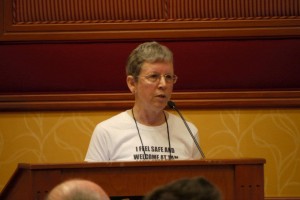
This is the back view

She wore it three days in a row, at least. My source didn’t see her on the fourth, but it seems likely she wore it then too.
I don’t understand this. I don’t understand people.
-
Dividing bridges
Kristjan Wager has a good post on the Deep Rifts. He’d rather have the rifts than no rifts at the price of entrenched sexism.
So, to sum it up, there are deep rifts in the movement, and I think it is fine. Not only that, I feel more comfortable being in a smaller community within the movement, which doesn’t include people whose opinions and behavior I find repugnant. I can still appreciate the good work done by those people (like I did with e.g. Hitchens) without wanting to be part of the same community.
Fewer but better Russians. (I kid, I kid.)
Massimo Pigliucci also has a good post, although he does do the “both sides” thing, which given what a big chunk of the other side is like, really isn’t as reasonable as it might sound to a novice.
Oh wait, no he doesn’t, or at least he clarifies in a comment that that’s not what he meant. I’ll leave the above paragraph because there are people who think that is what he meant, so this will perhaps help.
Here’s his clarification:
there may be a misunderstanding here about what my call for moderation concerns. Of course there is no moderate position to be held about sexism (or racism, for that matter): it’s bad, period.
But there is moderation to be called for in how we talk and act about it. The example in question here, discussed by Russell Blackford in the post I linked to above, is AA’s overly reaching “no-hugs” policy, which – it can be argued – doesn’t really address the actual issue and potentially undermines a sense of community by attempting to over-regulate normal human interactions.Sure. Specifics can be discussed, calmly and reasonably. (I’ve been staying out of those discussions, because honestly I don’t know enough about the subject to have a useful opinion. I was invited to participate in the conference call with American Atheists to discuss their policy, but I wasn’t available at the right time – which is just as well.) Specifics can be discussed, calmly and reasonably – which includes not calling people Talibanesque or Femistasi.
-
A few yards of cloth
A young woman finds an exciting new path to liberation. She takes to wearing the hijab.
…before you race to label me the poster girl for oppressed womanhood everywhere, let me tell you as a woman (with a master’s degree in human rights, and a graduate degree in psychology) why I see this as the most liberating experience ever.
We know. You’re taking control, you’re being seen for who you really are instead of as a female human being with hair and a neck.
My experience working as a Faiths Act Fellow for the Tony Blair Faith Foundation and dealing with interfaith action for social action brought me more understanding and appreciation of various faiths. I found that engaging in numerous interfaith endeavors strengthened my personal understanding about my own faith.
Do you think she uses the word “faith” enough times in that passage? Maybe a few hundred more would get her point across better?
Tony Blair, you have a lot to answer for.
I am abundantly aware of the rising concerns and controversies over how a few yards of cloth covering a woman’s head is written off as a global threat to women’s education, public security, rights and even religion. I am also conscious of the media’s preferred mode of portraying all hijabi women as downtrodden and dominated by misogynist mullahs or male relatives who enforce them into sweltering pieces of oppressive clothing. But I believe my hijab liberates me.
Despite the reality of the misogynist mullahs and the conservative male relatives – she “believes” the hijab liberates her, and faith can move mountains, so there you go.
For someone who passionately studied and works for human rights and women’s empowerment, I realized that working for these causes while wearing the hijab can only contribute to breaking the misconception that Muslim women lack the strength, passion and power to strive for their own rights.
No, that’s not accurate – that “only” is wrong. Working for women’s rights while wearing the hijab can also for instance send the message that you’re confused, or that your religion trumps your commitment to women’s rights, or other possibilities that you probably don’t like.
In a society that embraces uncovering, how can it be oppressive if I decided to cover up? I see hijab as the freedom to regard my body as my own concern and as a way to secure personal liberty in a world that objectifies women. I refuse to see how a woman’s significance is rated according to her looks and the clothes she wears. I am also absolutely certain that the skewed perception of women’s equality as the right to bare our breasts in public only contributes to our own objectification. I look forward to a whole new day when true equality will be had with women not needing to display themselves to get attention nor needing to defend their decision to keep their bodies to themselves.
Uh huh, but the hijab isn’t the opposite of baring your breasts, it’s the opposite of baring your hair and neck. Different thing. It’s very easy to refrain from baring your breasts without putting on a hijab. There are lots of ways you can attempt to secure personal liberty in a world that objectifies women without wearing a hijab, and wearing one is in many ways a very bad way to attempt to secure personal liberty.
-
Wearing hijab is the most liberating experience ever
“My experience working as a Faiths Act Fellow for the Tony Blair Faith Foundation and dealing with interfaith action brought me more appreciation of various faiths.”
-
Pall of uncertainty over NGO’s work after Afridi murder
The murder of rights activist Farida Afridi in Khyber Agency has driven the already dwindling number of female social workers towards more uncertainty.
-
Another wild attack on secularism
“The Freedom From Religion Foundation is, itself, a religion of self-exaltation and secularism, and a very aggressive one at that.”
-
Hamlet
A longish time ago we talked about the idea of doing book discussion threads, or was it Shakespeare threads. One of those. Inspired by Pamela Gay’s urgings to make the world better and do something, let’s get to it.
Let’s start at the top, with Hamlet.
We’ll talk until no one has anything left to say.
I’ll start.
Biggest thing: it’s not [just, or primarily] about A Guy Who Can’t Make Up His Mind. That’s become the boring soundbite about it, and it is very damn boring. That’s not what it’s about. It’s about a million things, and that one is more incidental than most of them.
It’s about everything. I think I mentioned when we were talking about Shakespeare before that I once developed a fascination with Hamlet, and spent several months reading/watching/listening to it and related things (the rest of the plays, other playwrights, Elizabethan writers in general, secondary stuff). That’s partly because it’s about everything.
Such as
Love
Betrayal
Time, and the erosion of love over time
Grief and loss, obviously
Revenge
Sex
Family, romance, friendship
Death
Epistemology
Truth
Appearances, and deception (or “seeming” as Shakespeare liked to call it). “A man may smile, and smile, and be a villain.”
Acting
Lies, deceit, trickery
Thinking
Words
—
Your turn.