How do you rise? You work very hard and you get yourself noticed. Science has an account of doing that by Eleftherios P. Diamandis.
Here’s how it worked for me. I arrived at the University of Toronto in 1982 as a postdoctoral diploma candidate in clinical biochemistry. Coming from a rather poor country—Greece—was a disadvantage, so I did all I could to adapt to the new environment, fill in my knowledge gaps, and make a good impression with hard work and dedication. When I finished the diploma training in 1984, the chair of the department showed interest in finding a job for me. But I had to go back to Greece first to complete my medical degree. I finished it in 1986.
He went back to Toronto. He got a job at a biotech company, which wasn’t what he most wanted but he gave it his all.
The job was good and challenging, but it was not what I was aiming for in the long term. Meanwhile, a new chair had taken over in the department, and I set out to persuade him to hire me as an academic clinician-scientist.
I worked 16 to 17 hours a day, not just to make progress on the technology but also to publish our results in high-impact journals. How did I manage it? My wife—also a Ph.D. scientist—worked far less than I did; she took on the bulk of the domestic responsibilities. Our children spent many Saturdays and some Sundays playing in the company lobby. We made lunch in the break room microwave.
My colleagues and I managed to publish numerous papers, and I was invited repeatedly to present at national and international conferences. I was able to demonstrate, in the department’s annual report, scientific productivity comparable in quantity and quality to the full-time academics in the department. I made sure these activities were noticed.
Did you see it? It went by quickly. His wife worked far less than he did and took on the bulk of the domestic responsibilities.
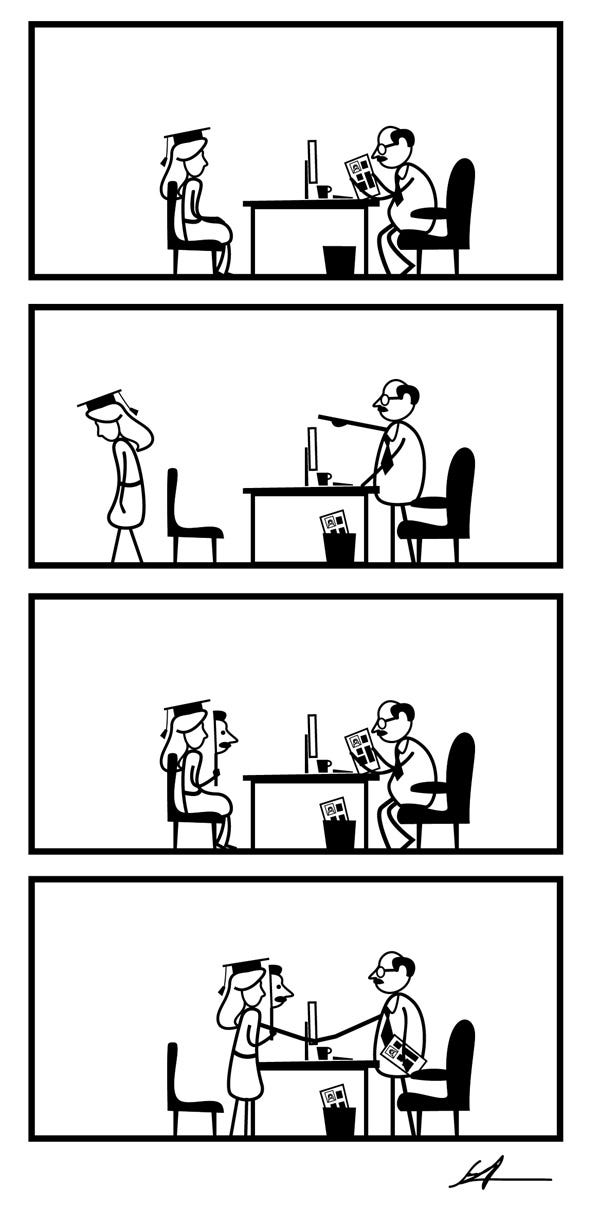
Remember Agata Hop’s cartoon?

H/t Jen Phillips
(This is a syndicated post. Read the original at FreeThoughtBlogs.)