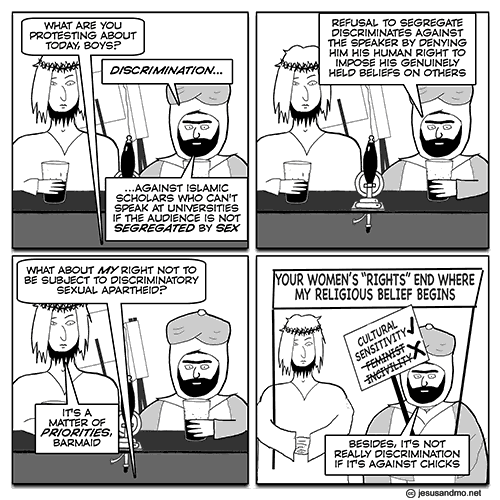
What a claustrophobic mind we see in this post claiming that Maryam’s petition against Universities UK’s guidelines that allow sexual segregation at the behest of guest speakers is “Islamophobic.”
Petition site Avaaz are running asking people to condemn Universities UK’s statement on sex segregation in events held on campus. Please DON’T sign it. It might use intellectual language, but its both factually dubious and distinctly Islamphobic.
First, its worth pointing out that the lectures and visiting lecturers being talked about are student-organised speaking events. They are not course lectures. Allowing such meetings to take place on campus is an important part of encouraging debate and widening participation in Higher Education. Furthermore, it allows Muslim women to meet and discuss their issues.
Wait. How does allowing sexual segregation at the behest of guest speakers “[allow] Muslim women to meet and discuss their issues”? Are Muslim women otherwise not allowed to meet and discuss their issues? Do UK universities forbid Muslim women to meet and discuss their issues at debates and lectures where the audience is not segregated? Of course they don’t. Muslim women are allowed to meet and discuss their issues on the same terms that anyone else is. Universities are not in the business of making special rules and exclusions for particular groups.
If Muslim women aren’t “allowed” to meet and discuss except when they are segregated from men then Muslim women also aren’t “allowed” to take buses or the tube, walk on the pavement, stroll through the park, shop at Waitrose or Boots, go to the pub or a café, go to concerts or plays or movies – have jobs, go to the hospital, have a bank account, have friends. On those terms they aren’t “allowed” to take part in contemporary life at all. They might as well be buried. Fortunately UK universities don’t impose such a regime.
I’m a graduate of the University of Bradford – I have attended lectures that were segregated. It was done in a very simple and largely organic way – I knew it was not appropriate to sit next to women, so I sat on the side of the central aisle where the men were congregating. We didn’t actually have curtains or anything, and in a culture where people socialise amongst their own sex, its not surprising that friends sitting together looks pretty segregated right away.
Way to internalize the viciously illiberal rules. It was not “appropriate” to sit next to women? A culture where people socialise amongst their own sex? Terrific: a world where women and men are strangers to each other, and women get less and worse of everything.
In allowing its website to be used to petition against the right of Islamic Societies to determine the running of their own meetings, Avaaz is endorsing cultural imperialism and side-lining of an entire culture within our Universities.
As I understand it the guidelines are not about meetings of societies but about public debates and lectures – debates and lectures that are open to anyone who wants to attend.
You can call it “cultural imperialism” to have one set of rules for everyone if you want to, but it’s a perverse and reactionary move. The expectation of equality doesn’t have much in common with imperialism.
The petition represents an attempt to force Western culture into the meetings and events of women and men who subscribe to another culture.
That assumes that all Muslims subscribe to gender segregation, which is complete bullshit. Not all Muslims do, and plenty of Muslims find that assumption highly insulting. Plenty of non-”Western” people find it massively insulting when Westerners put all the good things under the sign “Western” and assume that everyone in the east and south shares a monolithically reactionary culture.
Never underestimate the ability of White Men to use Women of Colour as a means to espouse racism and cultural superiority.
That’s cute, when it’s Maryam who drew up the petition. Ignore her why doncha.
Looking down the list of initial signatories, it is clear that this is an attempt at religion bashing by some of the most reactionary pupils of ‘Western Enlightenment’ thinking.
Oh right, such as Deeyah Khan, Gita Sahgal, Harsh Kapoor, Mina Ahadi, Nahla Mahmoud, Pragna Patel…
They are not the reactionaries here.