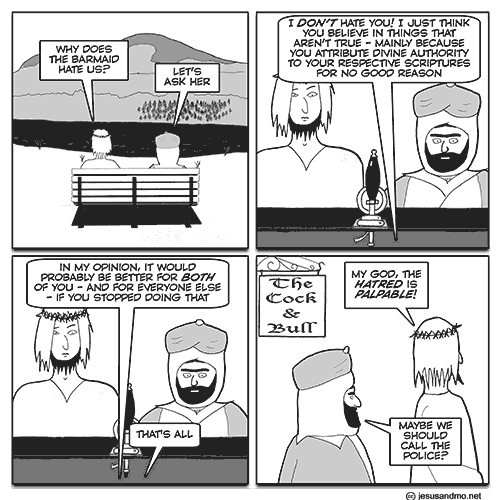
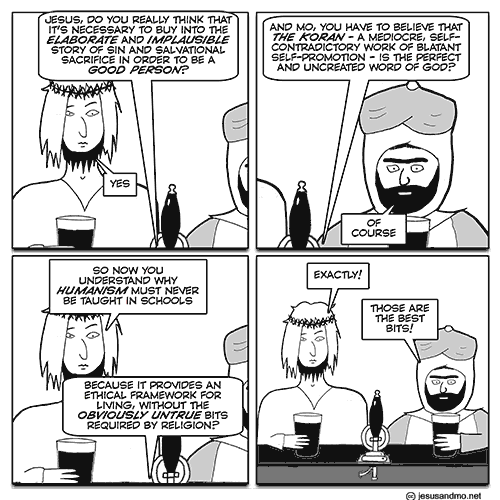
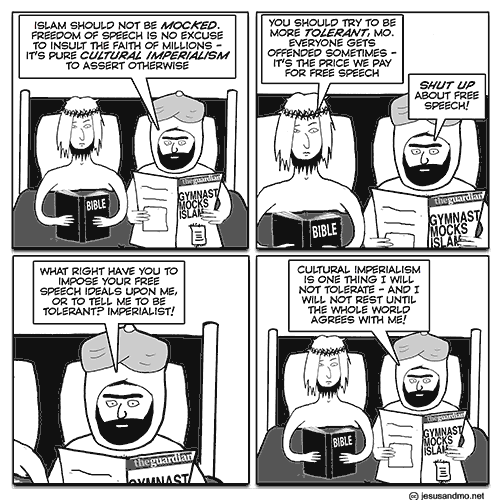
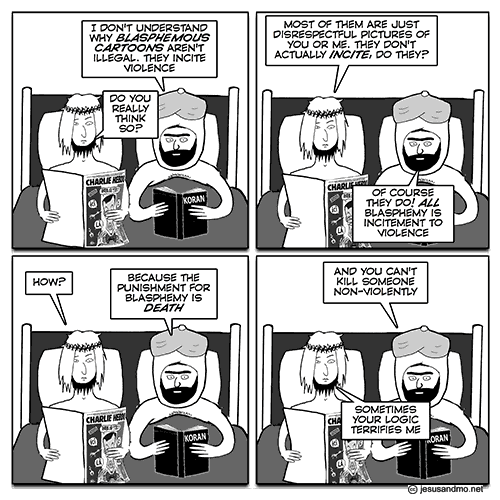
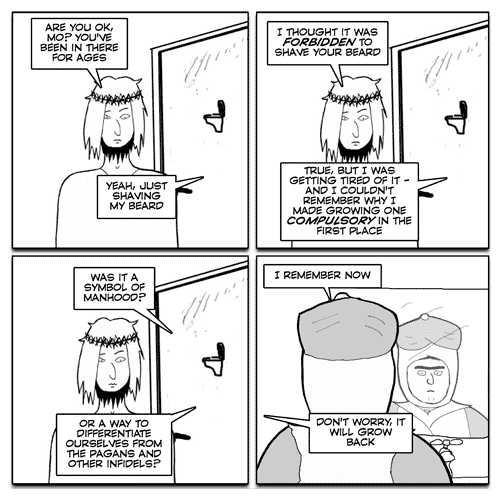
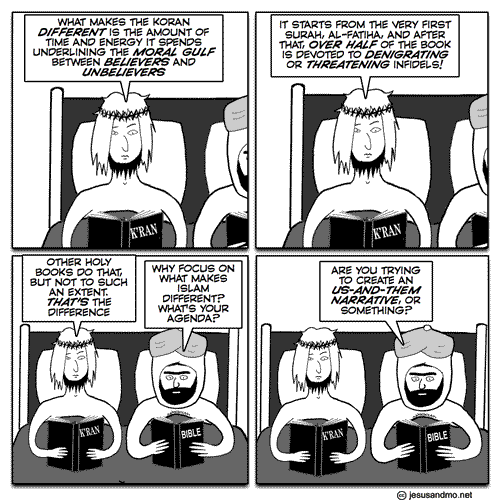
Jesus and Mo are fretting about epistemic violence too.
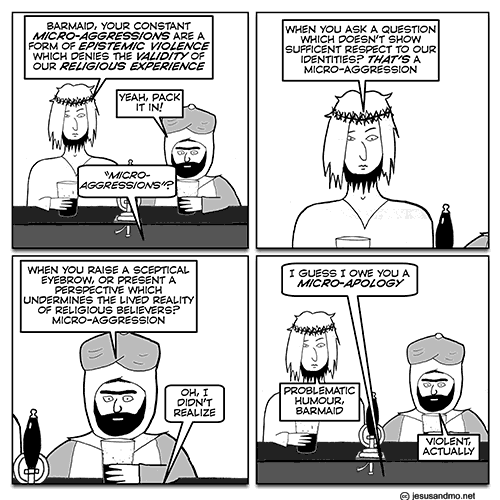

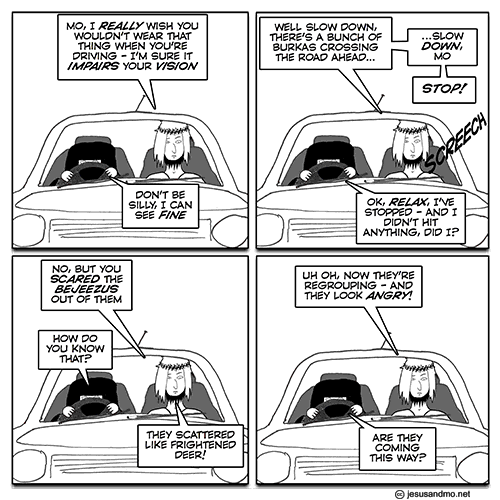
Prompted by Saudi Arabia’s announcement that they’ll let women drive – don’t get too excited.
You can support Jesus and Mo on Patreon.
The new Jesus and Mo considers a question that I often ask: whence came Mo’s reputation for being such a kind lovely fella?
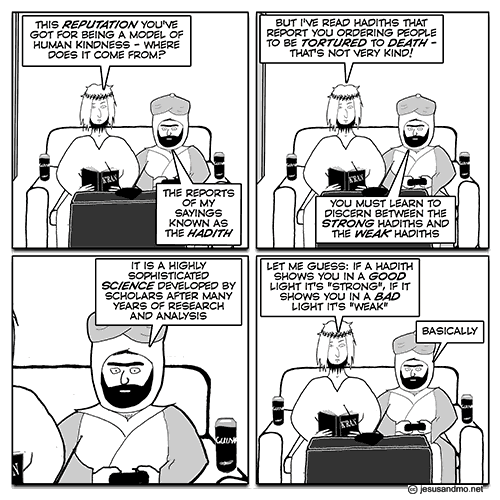
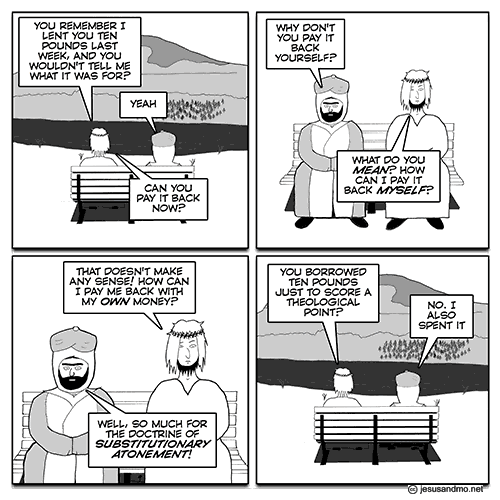
On beer, probably.
Don’t forget the book!
Wrong again, God boy – the 7th volume of J&M strips, with a foreword by Ophelia Benson.
Just in time for Christmas secular winter solstice shopping, the 7th collection of Jesus and Mo cartoons is published.
And guess what! I got to write the foreword for it!
Here it is:
We’re living in a time of flourishing, intensifying fanaticism, specifically religious fanaticism.
In a way that seems strange. You would think religious fanaticism would be on a steady downward trajectory as technology and communication proceed in an upward one. How can murderous devotion to an antique Holy Book co-exist with the Mars Rover and the iPad?
Jesus and Mo implicitly and slyly puts that question whenever we see the boys watching television or at a laptop or reading a wide assortment of newspapers. The core running joke of the strip is that here we have the two Mega-Prophets of their respective Mega-Monotheisms, zoomed intact from the 1st and 7th centuries to the 21st, entirely at home here while still peddling the past-its-sell-by-date ontology and epistemology of Back Then. The grinding as the two pass each other is an infinite source of pointed blasphemous jokes.
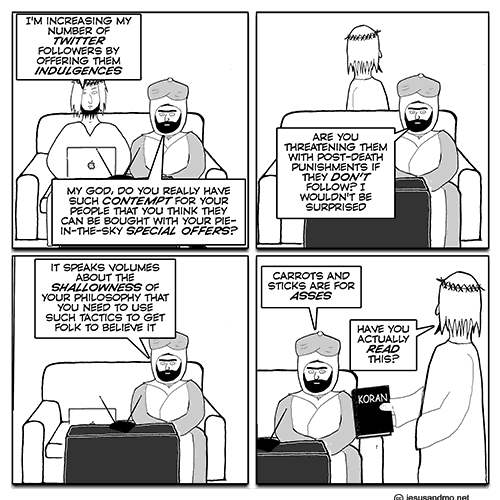
Then again maybe they’re not the actual Mega-Prophets, but a couple of random guys who think they are. Or maybe they’re a couple of random believer-guys named after the respective Mega-Prophets. According to Author, they’re two actors he pays to play the roles of Jesus and Mohammed; he pays them in beer. They make sense as any of those, because the point for all versions is that they’re stuck in the 1st and 7th centuries while more reasonable people have moved the fuck on.
It’s blasphemy to say that, and blasphemy to make jokes about it. The “respectful” view is that the Mega-Prophets and their sayings are timeless, and holy, and eternally true. The blasphemous view is that the sayings are human sayings like any other, and that some of them are eye-wateringly horrible. The blasphemous view is that we’re allowed to evaluate them on their merits, and reject the horrifiers.
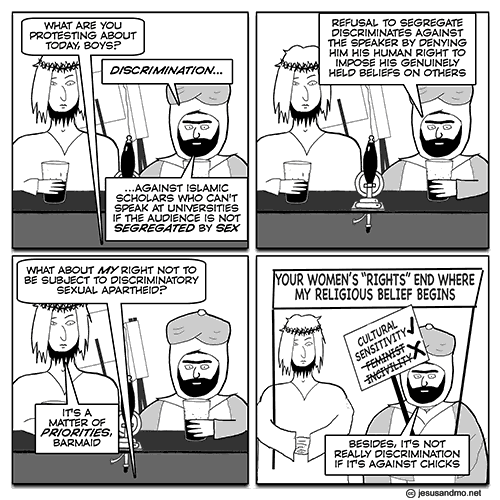
There’s a supporting character who expresses this blasphemous view, and that’s the barmaid. It’s an artful move to make it a woman who is always puncturing the Mega-Prophets’ balloon, who speaks for reason and skepticism, who is unimpressed by their authority. It’s poetic (or cartoonic) justice that she gets the part, since the Mega-Monotheisms have so ruthlessly excluded women from any authority while still telling them what to do down to the smallest detail.
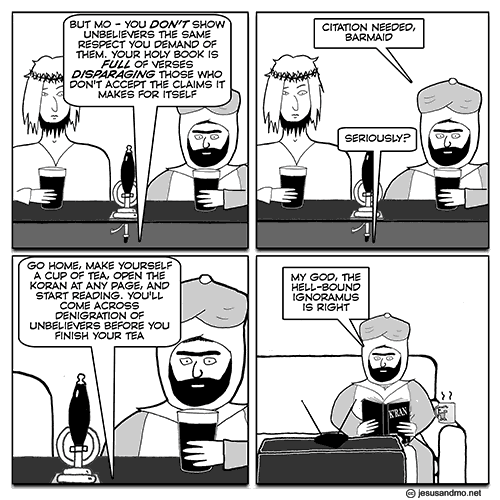
The barmaid stands in for us, the readers. She’s a wish-fulfillment for all of us who would just love to shoulder up to one of the Holy Boss Dudes to ask some sharp questions. If only we could hold those bastards to account. What’s the big idea with Islamic State, for instance? Who approved that?
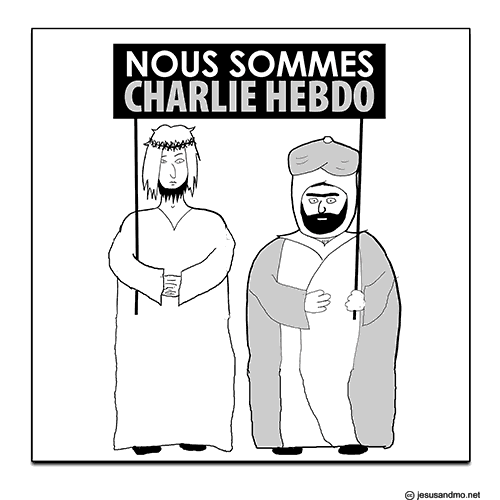
2015 has been a terrible year for blasphemers and jokers. The slaughter at Charlie Hebdo ushered in the year on January 7th when Islamist gunmen broke into their office and murdered eleven people – the editor, cartoonists and writers, and other staff.
Two days later Saudi Arabia publicly administered 50 lashes to Raif Badawi, with 950 more due to follow, along with ten years in prison and a massive fine, all for the “blasphemy” of running a website called Free Saudi Liberals.
On February 14th a gunman shot up a conference on free speech in Copenhagen, killing a Danish film director and injuring three others. The “blasphemous” Swedish cartoonist Lars Vilks was there but he escaped injury.
Less than a fortnight later, on February 26th, men with machetes killed the atheist blogger Avijit Roy and badly injured his wife Bonya Ahmed at a book festival in Dhaka. There is a list; people on the list are being hacked to death one by one. On March 30 it was blogger Washiqur Rahman. May 12 it was blogger Ananta Bijoy Das. August 7 it was Niladri Chattopadhyay Niloy, who used the pen name Niloy Neel. October 31 it was the publisher Faisal Arefin Dipan who was killed; another publisher and three writers were injured. We can be all too confident there will be more.
Grim times, and no sign that they’ll get any better soon – so we need blasphemous jokes more than ever. The blasphemy is crucial. The blasphemy is our goddam lifeline. In a time of fanaticism, blasphemous jokes are our ambassadors to the Court of Murderous Dogmatic Certainties. They are our means of dealing with the nightmare. Serious argument and persuasion, evidence and reason, are the essential underpinnings, but for keeping us going in a world where one fucking fool with a machete can cut us down at will, we need those blasphemous jokes.
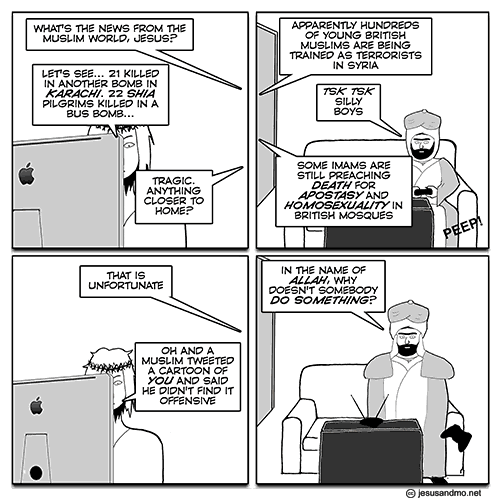
Blasphemous jokes are the deadly enemy of fanaticism; long live blasphemous jokes.
Kenan Malik wrote the introduction to a new Danish collection of Jesus and Mo cartoons and he has posted it on his blog.
One of my favourite cartoons shows Jesus and Mo explaining to the barmaid the Aristotelian idea, later picked up by both Islamic and Christian theologians, that ‘Everything that has a beginning must have a cause’ and ‘the universe has a beginning, therefore it must have a cause’. ‘Therefore?’, asks the barmaid. ‘Therefore no bacon’, replies Mo. ‘Or gay sex’, chips in Jesus. It is a typical dig at the illogicalities of religious faith. It also, in Jesus and Mo’s inimitable way, taps into one of the most difficult theological conundrums for believers, the tension between the idea of God as ‘first cause’, or as a ‘condition of being’, and the God of scriptures that does all the other things that religion requires of Him: perform miracles, answer our prayers, wrestle with the devil, set down moral law, punish sinners. And tell us to keep off the bacon sarnies and gay sex. I give an hour-long lecture on this topic. Jesus and Mo get to the heart of the matter in four frames.
I did a post about that years ago, in which I called it the theist four-step. The four get compressed into one by the interested parties: it’s just assumed that if you accept this idea that there’s a deity, then you also accept the idea that it’s good, and it gets to tell you what to do, and that you reliably know all three. That’s silly: the four are quite separate. I accept that it’s a fact that there’s a pope. The end. I don’t accept the claim that the pope is good, I don’t accept the claim that the pope gets to tell me what to do, I don’t know of any duty I have to the pope. Same for god (if I accepted that it’s a fact that god exists, which of course I don’t).
Nor is it just religion that Jesus and Mo cartoons dissect. They unpick many of the idiocies of liberal culture too. Another of my favourite cartoons shows Jesus and Mo sitting at the bar having ‘pledged not to say anything that might cause one of them to feel offended.’ They sit in silence. And still more silence. Until finally Mo says, ‘This is nice, isn’t it’. In one cartoon strip, getting to the fundamental problem with the liberal fear of giving offence.
Always relevant, alas.
Jesus must have been watching that video of the bashful young Catholics coming out homophobic.
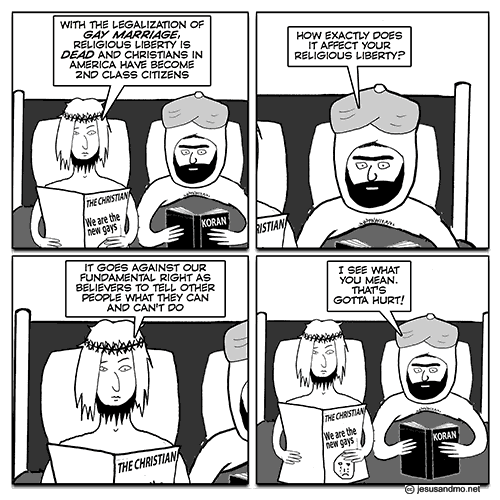
The Patreon in case you want to support blasfemious cartooning.
Adam Deen of the “Deen Institute” (he’s the founder and executive director) (of the “institute” he bashfully named after himself) is ranting at and about Maryam Namazie on Twitter. He’s ok with ex-Muslims, you see (for the purposes of this discussion), but not with ex-Muslim extremists. What’s that? One observer suggested “the difference is between silence and speech.”
Author of Jesus & Mo obliged with an illustration.
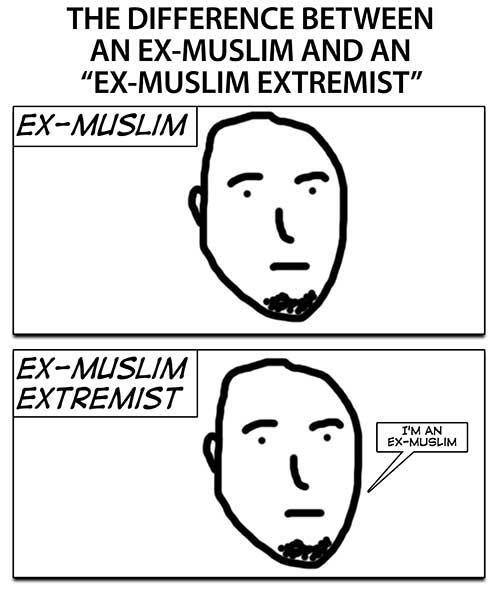
Adam Deen (of the eponymous “institute”) offered an amendment.

I see. Normal is moving on, extremist is criticizing what you left.
I don’t accept that definition of “extremist.”
Nick Cohen points out the very important difference between saying you are not showing a cartoon character named Mo out of respect, and saying you are not showing a cartoon character named Mo because you are afraid to.
When the BBC interviewed the artist behind Jesus and Mo, its editors told him privately they could not show his drawing of Jesus saying “Hey” and Mo saying “How ya’ doin’?” because jihadis might murder the corporation’s correspondents in Pakistan.
That’s a reason, but what a pity they didn’t say that during the interview. What a pity Jeremy Paxman did the very opposite, and insinuated that the cartoonist had done a bad wrong thing in drawing such a cartoon at all. What a lousy crappy rotten thing to do, Jeremy Paxman.
Fear may not be a noble reason for censoring, but it can be an honest one if you admit its existence. If I worked at the BBC and my colleagues told me that showing a bland cartoon might endanger lives in Pakistan, I wouldn’t broadcast it. If I worked at Channel 4 or edited a national newspaper, I wouldn’t put my colleagues’ safety at risk either. But I would also tell the viewers or readers that I was censoring out of fear: not respect or cultural sensitivity but pure fear. I would make it clear to them that freedom and secularism were in danger in Britain. I would say that the people who provoked the fear deserved no more true respect than a gangster did.
Instead of what the BBC and Channel 4 did, which was to make it seem as if the cartoonist and Maajid Nawaz are in the wrong, and the people threatening them are in the right. It’s dishonest and contemptible.
Not one editor has dared admit that he or she is afraid. The editor of Newsnight did not mention threats to his colleagues’ lives when he talked to the Independent about the Nawaz case. Rather he implied that he was a responsible journalist, while his critics, rather than, say, potential terrorists, were macho maniacs. “A lot of the people disappointed with us for not using it really wanted a demonstration of liberal virility rather than more informative journalism,” he said.
Cognitive dissonance anyone? It can’t be that the wonderful people at Newsnight hid the cartoon out of fear, therefore it must be that their critics wanted “a demonstration of liberal virility.”
If you admit to being afraid, you are acknowledging the scale of suppression. And it is only when you acknowledge that suppression exists that you can begin a campaign to challenge it. As it is, editors and senior journalists in the British media are not prepared to destroy their self-congratulatory image of brave “speakers of truth to power” by saying they are scared. The results are pernicious whichever way you cut them.
Quite: cognitive dissonance playing out as sheer vanity.
The liberal mainstream has abandoned liberal Muslims.
What is Maajid Nawaz meant to think? He says on a public platform that a bland cartoon is not offensive. He has rejected Koranic literalism, endorsed tolerance, and done everything the mainstream wants an integrated Muslim to do. And look at how the mainstream treats him. It agrees with his persecutors by ruling that the image is so shocking no national newspaper or broadcaster can show it. Meanwhile editors’ failure to level with their audience and admit that they are censoring because of a fear of violence, has the added malign consequence of diminishing the real threat that Nawaz and others face.
Expletive.
The coverage of the controversy over Maajid Nawaz and Jesus & Mo has done a consistently bad job of getting right the part about how and why Chris Moos and Abhishek Phadnis wore their J & M T shirts on The Big Questions and why they unzipped their jackets to reveal them toward the end of the programme.
They did both because the BBC asked them to.
Most of the coverage has implied or said that it was their idea and that they did it to provoke. Wrong.
The latest is an article today in the Independent by Archie Bland.
His account of the how and why is much more detailed than previous ones, but it’s hardly fair to Chris and Abhishek.
in January the company behind The Big Questions got in touch about participating. The question to be debated was: “Should human rights always outweigh religious rights?” According to Chris Moos, the two students had not intended to wear the T-shirts, but the production company researcher gave them a nudge. “If you wanted to wear your T-shirts on the show, that is fine – however, we would ask that you wear a shirt over the top that could be unbuttoned,” he wrote. “If Nicky would like to see the shirts, he can ask you to unbutton your shirt to show it and we can do a close-up and therefore promote discussion.”
“I was quite surprised,” says Moos. However, Mentorn insist that the idea of wearing the T-shirts was the students’ own; they go as far as to say that “any suggestion that the students were encouraged to wear the T-shirts is entirely unfounded”, which seems a bit odd, when you reread that email. Either way, towards the end of the show, their moment came.
“You guys wore some T-shirts?” said Campbell.
Moos nodded. “Would you like to see them?” he asked. Campbell certainly didn’t seem to know about his agreement with the researcher, and he hesitated. (Mentorn says that neither Campbell nor his editor were expecting the T-shirts; certainly it seems more like a cock-up than a conspiracy.) In the moment he took to say something, the two unzipped. Phadnis and Moos were not filmed in close-up, and the camera did not linger on them. But the cartoons were visible from an oblique angle.
Abhishek emailed Archie Bland to correct this account, and I have his and Chris’s permission to post his email here. They both would like to see the record set straight.
Chris also sent me the request in the email from the researcher to the two of them when arranging the programme:
If you wanted to wear your t-shirts on the show that is fine – however, we would ask that you wear a shirt over the top that could be unbuttoned. The reason why we’re asking this is merely because patterns or details (like cartoons) are distracting for the viewer at home and can appear fuzzy on camera (hence why we also ask that you don’t wear checked or striped clothing). Basically, if Nicky would like to see the t-shirts, he can ask you to unbutton your shirt to show it and we can do a close up and therefore promote discussion (does that make sense?).
And then afterwards the BBC can pretend we never did and look hard in the other direction and get Jeremy Paxman to prod Author repeatedly about why, why, WHY would you do such a thing. Does that make sense?
No, it doesn’t.
Dear Archie,
We read your report this morning. We had expected a fair representation of the facts of the case. Your report, however, makes it look like we smuggled the t-shirts in on the sly and produced them as a publicity stunt to take advantage of the producers’ naïveté and gratuitously cause offence to viewers or audience members.
You correctly point out that the producer actually suggested we wear the t-shirts, despite their assertions.
However, we would like to point out, that on January 5th, just before the recording began, we informed the producers that we were wearing the t-shirts. We were asked to sit in the middle of the first row and Nicky Campbell personally greeted us and said he was very keen to know more about our story. Given this attention, and our prominent placement in the first row, and the communication with the production company, it was perfectly reasonable to assume that he was aware about the t-shirts and about the interest in our story.
As for the recording itself, please watch this video again – http://www.youtube.com/watch?
v=LZ5X_lPXnvU – 51:21 – Nicky Campbell: There’s something else here as well … you guys wore some t-shirts
51:24 – (Phadnis and Moos make gestures, asking for permission to show the t-shirts)
51:26 – Phadnis: Would you like to see them?
51:27 – Nicky Campbell: Oh well! Yes (upon which we unzip our jackets to reveal the t-shirts)
We didn’t unzip “in the moment he took to say something”, as you put it – we gestured to him twice to ask for permission, then we asked “would you like to see them?” and he replied “oh well! yes” – only then did we begin to unzip my jackets.
We would be grateful if you could amend the piece to reflect the fact that Nicky Campbell explicitly gave us permission to show the t-shirts. At the moment the piece gives the impression to the unknowing reader that we uncovered the t-shirt against the will of Nicky Campbell and the BBC, that indeed we were using the programme to cause offence. As you know, in the current climate, this impression likely carries a risk to our personal safety.
Please amend the article to accurately reflect the facts and avoid any possibility of us suffering harm as a consequence of the publication of the article.
Thank you for your consideration.
Regards,
Chris Moos and Abhishek Phadnis
The National Secular Society shares the form letter it got in response to its open letter to Channel 4 about its wretched decision to paste a black egg over Mo when it reported on the childish fuss over Maajid Nawaz and Jesus & Mo.
The letter, from Steve Reynolds of Channel 4 Viewer Enquiries, reads:
As we are sure you can appreciate, this is a very sensitive subject for many viewers. Channel 4 News editorial staff gave great consideration to the issues involved and believe that they reached a fair and balanced judgement, weighing up the potential for offence to some viewers by showing the depiction of the Prophet Mohammed and the necessity of showing the cartoon in full.
But I don’t appreciate. I don’t think the “sensitivity” is legitimate, just as I don’t think the potential “hurt sentiments” of people in Bangladesh who might possibly maybe perhaps not like Taslima Nasrin’s tv serial were legitimate. By creasing their brows over the “potential for offence to some viewers” they gave in to emotional blackmail and encouraged more of it in the future, while also cutting the ground out from under Maajid Nawaz. I think that’s pathetic.
Whilst we acknowledge your views, we believe that on balance this was the correct decision and as a rule, where we consider the likelihood of significant offence to our audience, we will attempt to mitigate against that. As to not pixelating the image of Jesus, it was not felt that the same level of offence was likely to be provoked as the image is commonly depicted in cartoon form.
Aaaaaaaaaand there’s your problem right there.
Terry Sanderson, president of the National Secular Society, commented: “The claim that showing the entire illustration was ‘not integral to the story’ is ludicrous. It was the story. The truth is that Channel 4, like so many others, is intimidated and afraid of the reaction from violent extremists. Such extremists have got this country in a fearful stranglehold that is gradually destroying our commitment to freedom of speech. We may have abolished the blasphemy law, but who needs it when the same effect can be achieved by terrorising people?”
Mr Sanderson said that Channel 4 should be ashamed of itself for capitulating in this way to supposed ‘sensitivities’ that it does not respect in any other context. “Channel 4 does not hesitate to create controversy and offence in its other output, indeed it prides itself on doing so.”
Meanwhile, the Muslim Association of Britain is now attempting to work this controversy up into a similar level as the Danish cartoon controversy by issuing a condemnation of the cartoon.
Well of course they are. Look at all the encouragement they’re getting from the great and the good in UK media. Why wouldn’t they try to work the controversy up? It’s all good from their point of view.
Stephen Evans of the National Secular Society writes an excellent open letter to Channel 4 about the Black Egg censorship of the image of Mo, sending it via the Huffington Post UK.
We were surprised and extremely disappointed to see that Channel 4 News took the decision to cover up the image of Mohammed when showing the Jesus & Mo cartoon, and we are thus keen to elicit the rationale behind that particular editorial decision.
During the report, it was noted that this decision was taken so as not to cause offence to some viewers; however we would like to point out that by your making this decision you have effectively taken a side in a debate where a Muslim man has suffered violent death threats after he explicitly said he did not find the cartoons offensive. You have taken the side of the reactionaries – the side of people who bully and violently threaten Muslims, such as Mr Nawaz, online.
That’s exactly what they have done, and it’s disgusting. Why would anyone do that? I don’t buy the claim that it’s personal fear. I have to suspect it’s something more like a deeply entrenched assumption that the reactionaries are the more “authentic” Muslims and that therefore it’s more compassionate or progressive or postcolonialist or whatever to side with them instead of with not so “authentic” Muslims like Nawaz. It doesn’t take much thought to perceive how massively insulting that is to Muslims as a group – indeed, how “Islamophobic” it is.
Oh look, Evans says the same thing. I annotated as I went, so I hadn’t read that paragraph yet.
Given that your editorial decision seems to be have been weighted by a concern with offence, we might also note that you ended up with a report that was, in fact, very offensive to many; offensive to those who take seriously and cherish our basic freedom to speak and question, and offensive to many Muslims, whose voices you do not hear because you insist on placating the reactionary voices of people claiming to represent what it is to be an ‘authentic Muslim’.
Exactly. Well of course it’s not an original thought with either of us; we’ve been seeing it for years and years. People have been accusing Salman Rushdie of being “inauthentic” for decades because he’s a cosmopolitan.
Whilst we understand that you covered both sides of the issue through your report and subsequent interview, we were keen to highlight the dangerous precedent you have set by taking the editorial decision to censor the Jesus & Mo cartoon, and the deeply symbolic implications that decision has.
Really. Stop doing that. Stop making terrible decisions like that.
Nick Cohen has a piece in the Observer on censorship at UK universities. He starts, as he should, with Chris and Abhishek.
On the morning of 3 October, Chris Moos and Abhishek Phadnis put on joke T-shirts, of the kind students wear the world over, and went to man the Atheist, Secularist and Humanist Society stall at the London School of Economics freshers’ fair. The bullying the university authorities visited upon them for the next 36 hours should provoke the most important free speech court case to hit British universities in years. It certainly deserves to.
Damn right.
Both the left and the right complain about censorship, both engage in it, Nick points out.
The Moos and Phadnis case cuts through the hubbub of charge and counter-charge. It shows that authoritarians of all stripes share the same vices, and not just because you know without needing to wait for their careers to “progress” that today’s repressive student union politicians will be tomorrow’s repressive human resources managers and Labour home secretaries.
The students wore Jesus and Mo T-shirts with designs by a wonderfully acid British cartoonist, who wisely never discloses his real name. Jesus and Mo are holding a banner that says: “Stop drawing holy prophets in a disrespectful manner NOW!” Mo also has a placard that reads: “Religion is NOT funny” and is saying: “If this doesn’t work, I say we start BURNING stuff.”
Are you offended? Really? Oh dear that’s a pity, because if you cannot take a satirical reference to real religious censorship, your fragile sensibilities should be your problem and no one else’s.
To fill out the claim a bit more: there is such a thing as religious censorship; it’s active and widespread in the world right now; the cartoon skewers it neatly and economically; it’s a thing worth skewering, and skewering it causes real harm to no one. (What about religious censors?! Spare a thought for them. The cartoon might convince some people that what they do is not a good thing to do. Yes, it might. That form of “harm” is a risk of doing things that are not good things to do.)
The political hacks of LSE’s student union, who are studying at a university that Sidney and Beatrice Webb founded in 1894 to promote “modern” education on “socialist lines,” knew nothing of basic principles. They decided that the modern and socialist thing to do was silence freethinkers.
Student union officials told them to “lose the T-shirts” and pulled atheist literature from the stall. When the young atheists asked why they should submit to this impertinent demand, the hacks replied that the T-shirts were “of course, offensive”. They did not say why. The LSE’s security guards arrived and threatened to expel the atheists. Wearing the T-shirts was an act of “harassment” that could “offend others”, they said.
Student union officials and security guards teaming up against the atheists. Heart-warming, ain’t it.
The Independent reported on the LSE Student Union’s interference with the LSE Atheist, Secularist and Humanist Student society yesterday, including quoting one of Dawkins’s tweets.
It included one panel from the toon – an especially daring one.