Tag: Blasphemy

  • “Is this the right way to handle blasphemy?”

    The BBC reports on the response to its own horrible question:

    The BBC has apologised after a tweet from the Asian Network account asked, “What is the right punishment for blasphemy?”.

    The tweet provoked criticism that the BBC appeared to be endorsing harsh restrictions on speech.

    Well no. The BBC appeared to be endorsing the whole idea that dissent from religion should be impermissible and illegal and should be harshly punished. That’s what the BBC appeared to be doing.

    In an apology posted on Twitter, the network said it intended to debate concerns about blasphemy on social media in Pakistan.

    “We never intended to imply that blasphemy should be punished,” it said.

    The post on Twitter was intended to publicise the station’s Big Debate programme with presenter Shazia Awan.

    Fine but come on, they’re not children, they’re not Donald Trump. Surely the problem with phrasing the question that way should have been blindingly obvious. People get murdered for this fictional crime of “blasphemy.” The BBC shouldn’t be in the business of starting from the assumption that “blasphemy” is a real thing and also a crime.

    It was prompted by a BBC report that Pakistan had asked Facebook to help investigate “blasphemous content” posted on the social network by Pakistanis.

    In her opening script, presenter Shazia Awan said: “Today I want to talk about blasphemy. What is the right punishment for blasphemy?”

    Explaining the context of Facebook’s visit to Pakistan and Prime Minister Nawaz Sharif’s call for a social media crackdown, she asked: “Is this the right way to handle blasphemy? Or do you think that freedom of speech should trump all else?”

    Talk about loaded questions. The first question assumes that blasphemy is real and bad. The second assumes that blasphemy is real and among the worst things.

    Critics ranging from human rights campaigners to secularist organisations challenged the premise that it should carry any punishment.

    Iranian-born secularist and human rights campaigner Maryam Namazie said on Twitter: “Disgraceful that @bbcasiannetwork @ShaziaAwan would ask what ‘punishment’ should be for blasphemy. You know people get killed for it.”

    In Pakistan, blasphemy – the act of insulting or showing lack of reverence for God or a religion – can carry the death penalty and those accused can face intense public anger. Britain abolished its blasphemy laws in 2008.

    Apparently the BBC hasn’t learned to adjust to this new reality yet.

    The National Secularism Society described the tweet as “absolutely appalling”, while BuzzFeed science writer Tom Chivers said: “This feels a VERY odd question for the BBC to ask. Even ‘should blasphemy be punishable’ would be less when-did-you-stop-beating-your-wife”.

    It’s really quite horrifying, and the limp apology doesn’t reassure.
  • For women who dare to think for themselves?

    There were some responses to BBC Asian Network’s “What is the right punishment for blasphemy?” question.

    https://twitter.com/ChrisMoos_/status/843023114527297536

    I love that one – for not freely choosing to wear hijab. Ha!

    https://twitter.com/PTChambers1/status/842867688288501761

    There are many more.

  • “What is the right punishment for blasphemy?”

    The Times of India reports:

    H Farook, 31, from Bilal Estate in South Ukkadam here, was hacked to death by a four-member gang, late Thursday night. He was a member of Dravidar Viduthalai Kazhagam (DVK), and an atheist. According to police, Farook was administering a WhatsApp group where he posted rationalistic views against his religion. He also posted rationalistic messages on his Facebook page which came in for criticism by members of the community.

    Meanwhile, Ansath, 30, a Muslim realtor, surrendered before the judicial magistrate court -V on Friday evening in connection with the murder.

    “Farook’s anti-Muslim sentiments had angered people. This may be a possible motive for murder,” said S Saravanan, DCP, Coimbatore.

    Yesterday BBC Asian Network tweeted this:

    It has since apologized, but how clueless (or worse) do you have to be to say that in the first place?

    BBC News reports:

    Pakistan says it has asked Facebook to help investigate “blasphemous content” posted on the social network by Pakistanis.

    Facebook has agreed to send a team to Pakistan to address reservations about content on the social media site, according to the interior ministry.

    Blasphemy is a highly sensitive and incendiary issue in Pakistan.

    “Blasphemy” shouldn’t even be a meaningful concept in a reasonable world. We obviously don’t live in such a world, but we have our hopes and dreams.

    Earlier this week Pakistani Prime Minister Nawaz Sharif voiced his support for a wide-ranging crackdown on blasphemous content on social media.

    In a statement on his party’s official Twitter account, he described blasphemy as an “unpardonable offence”.

    Shame on him then. What theocratic zealots mean by “blasphemous content” is anything at all that questions supernaturalist claims. We should all be free to create and share that sort of content.

    Then on Thursday, Interior Minister Chaudhry Nisar reasserted Pakistan’s determination to tackle the issue, saying he would take “any steps necessary” to make sure Pakistan’s message got across.

    He said he had asked officials to liaise with the FBI in the US and with social media platforms on a daily basis.

    “Facebook and other service providers should share all information about the people behind this blasphemous content with us,” he is quoted as saying by the Dawn newspaper.

    There has been little official description of what blasphemous content has been found online so far, but in the past blasphemy accusations have ranged from depictions of the Prophet Muhammad to critiques and inappropriate references to the Koran.

    Nonsense. Absolute nonsense. The Koran presumes to tell everyone what to do, down to the smallest details of private life. Of course we get to talk back to the Koran. The Koran is not the boss of us.

  • Blasphemy in Viborg

    Denmark has decided it believes in something called “blasphemy,” and that people should be prosecuted and punished for it.

    Denmark is reactivating its ‘blasphemy’ law, for the first time in 46 years, charging a man for posting a video of himself burning a copy of the Quran.

    The accused (aged 42) posted the video clip entitled “Consider your neighbour: it stinks when it burns” to a Facebook group called “YES TO FREEDOM – NO TO ISLAM” (“JA TIL FRIHED – NEJ TIL ISLAM“) in December 2015.

    A spokesperson from the public prosecutor’s office in Viborg said: “It is the prosecution’s view that circumstances involving the burning of holy books such as the Bible and the Quran can in some cases be a violation of the blasphemy clause, which covers public scorn or mockery of religion.” The case will now be heard in court at Aalborg, and if found guilty the accused could face a prison sentence, though prosecutors say they will probably ask for a fine.

    Really. So it’s a crime to publicly scorn or mock religion?

    Religion is a big doody-head.

    There; I guess I’m a criminal in Denmark.

    The Danish Humanist Society, Humanistisk Samfund, said the use of the ‘blasphemy’ law was “scandalous” and that “Legislation should protect  the individual freedom of speech and individuals against hate-speech and hate-crimes. Hateful and critical utterances directed at ideas, religions and ideologies should be fought with words and debate.” Lone Ree Milkær, chairperson of the Danish Humanist Society, said:

    “Denmark should abolish the blasphemy law. We have freedom of religion and belief and it makes no sense to have a special protection of religions or worship. Imagine that we protected ideologies in the same way. In a secular democracy we should be able to tolerate utterances (and actions with no victims) that we dislike or disagree with and we should argue against them instead of punishing by law.”

    Notice that even Milo Yiannopoulos is not being punished by law. He’s being ostracized, which is itself not something people should do for trivial reasons, but he’s not being charged with a crime.

    Lone Ree Milkær spoke at the United Nations in Geneva last year, on behalf of the Danish Humanist Society and IHEU, as a guest of the IHEU delegation. She urged Denmark to abolish the ‘blasphemy’ law, citing Denmark’s “international responsibility to be at the forefront in promoting and protecting the right to freedom of expression”. She also noted that ‘hate speech’ as such was already covered in the penal code, and that that ‘blasphemy’ laws around the world are used to persecute minorities.

    IHEU and the Danish Humanist Society are among the partners in the End Blasphemy Laws campaign.

    Blasphemers of the world unite.

  • Not to be mocked

    Stephen Evans at the National Secular Society on the punishment of Louis Smith.

    The very public castigation of the British gymnast is illustrative of the troubling return of blasphemy. As the former Strictly Come Dancing winner has discovered – and to his immense cost – Britain’s bourgeoning ‘culture of offence’ is ensuring that any action deemed likely to offend religious sensibilities, but particularly Muslim sensibilities, is strictly taboo.

    The ‘offending’ footage, published by The Sun, shows him with fellow gymnast Luke Carson drunkenly goofing around yelling “Allahu Akbar” and mocking aspects of Islamic belief.

    Condemnation came swiftly from Mohammed Shafiq, the chief executive of the Ramadan Foundation, who asserted “our faith is not to be mocked” and called on Smith to “apologise immediately”.

    Or else what? One wonders. Because Mohammed Shafiq has form when it comes to whipping up hostility against people lawfully exercising their right to free expression. Back in 2014 when Maajid Nawaz tweeted a Jesus & Mo cartoon with a message saying he wasn’t offended by the depiction of Mohammad, Shafiq threatened to “notify all Muslim organisations in the UK of his despicable behaviour and also notify Islamic countries.”

    Mohammed Shafiq is a bully, and public policy should not be shaped by bullies.

    However well-intentioned, over-reactions like those we’ve seen this week to Louis Smith’s mockery of religion have a disastrously chilling effect on free speech. It plays into the hands of the Islamic world’s professional offence takers who would like nothing more than to see all criticism of Islam silenced once and for all.

    So let’s everybody stop doing that.

    Marina Hyde at the Guardian on the same subject.

    Perhaps, like me, you imagined gymnastics to be much as other sports, even if you do hold almost similar reservations about sports with human judges as you do about sports in which you can drink a pint while playing.

    Leaving those debates for another column (a column which I myself have written at least twice), sports are commonly agreed to be competitive physical activities. Capable of being inspiring, certainly, and frequently places where great spirit and whatnot is on display. But above all: sports. Not established value systems, and certainly not a forum for creating pseudo‑case law on free speech. To pretend otherwise is a dangerous category mistake.

    It’s not up to sporting organizations to impose blasphemy laws on their members.

    It goes without saying that there is an even higher authority for their actions – namely, UK Sport, the high‑performance agency whose rulebook states that athletes may be ineligible for funding if they are “derogatory about a person’s disability, gender, pregnancy or maternity, race, sexuality, marital status, beliefs or age (this is not an exhaustive list)”.

    Isn’t it? Because once it put “beliefs” in, it pretty much covered any possible base. What if an athlete was of the belief that The Life of Brian was an excellent movie, or that Father Ted was hilarious? Naturally, something tells me mocking mass would be rather less frowned upon than mocking the call to prayer. But why on earth can’t athletes be derogatory about people’s beliefs?

    Because some Beliefs are Sacred, and Sacred Beliefs must be protected from the profane mockery of mere human beings, especially mere human beings with large biceps.

    As for British Gymnastics, it doesn’t appear to be anywhere near learning any useful lessons – but then, it takes its lead from the benighted fools at UK Sport, who bang on about the privilege of representing a country at the same time as cravenly denying that country’s essential freedoms. In many ways, it’s an old hypocrisy. Governing bodies have long come down like a ton of bricks on any athlete who gets political – yet I can scarcely think of anything more absurdly political than British Gymnastics operating a blasphemy law.

    Maybe I’ll blaspheme about gymnastics for awhile. Gymnastics is silly. Gymnastics forgot where it put its keys. Gymnastics wears its underpants on its head. Gymnastics butters no parsnips.

  • Wrong again, God boy

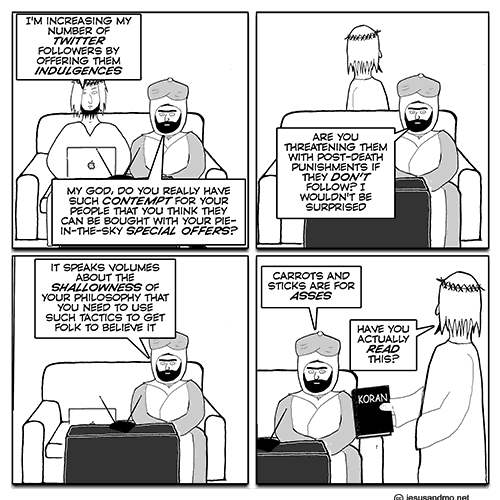
    Just in time for Christmas secular winter solstice shopping, the 7th collection of Jesus and Mo cartoons is published.

    And guess what! I got to write the foreword for it!

    Here it is:

    We’re living in a time of flourishing, intensifying fanaticism, specifically religious fanaticism.

    In a way that seems strange. You would think religious fanaticism would be on a steady downward trajectory as technology and communication proceed in an upward one. How can murderous devotion to an antique Holy Book co-exist with the Mars Rover and the iPad?

    Jesus and Mo implicitly and slyly puts that question whenever we see the boys watching television or at a laptop or reading a wide assortment of newspapers. The core running joke of the strip is that here we have the two Mega-Prophets of their respective Mega-Monotheisms, zoomed intact from the 1st and 7th centuries to the 21st, entirely at home here while still peddling the past-its-sell-by-date ontology and epistemology of Back Then. The grinding as the two pass each other is an infinite source of pointed blasphemous jokes.

    asses

    Then again maybe they’re not the actual Mega-Prophets, but a couple of random guys who think they are. Or maybe they’re a couple of random believer-guys named after the respective Mega-Prophets. According to Author, they’re two actors he pays to play the roles of Jesus and Mohammed; he pays them in beer. They make sense as any of those, because the point for all versions is that they’re stuck in the 1st and 7th centuries while more reasonable people have moved the fuck on.

    It’s blasphemy to say that, and blasphemy to make jokes about it. The “respectful” view is that the Mega-Prophets and their sayings are timeless, and holy, and eternally true. The blasphemous view is that the sayings are human sayings like any other, and that some of them are eye-wateringly horrible. The blasphemous view is that we’re allowed to evaluate them on their merits, and reject the horrifiers.

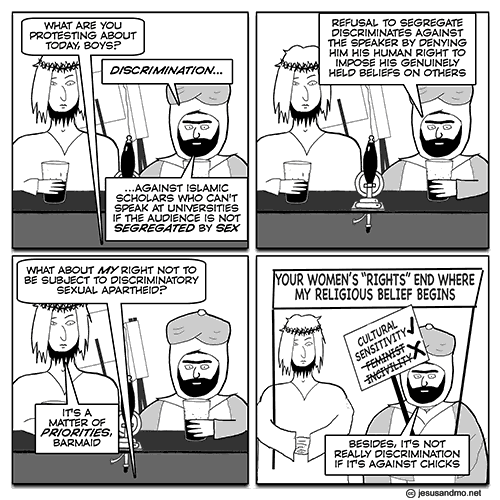
    rights

    There’s a supporting character who expresses this blasphemous view, and that’s the barmaid. It’s an artful move to make it a woman who is always puncturing the Mega-Prophets’ balloon, who speaks for reason and skepticism, who is unimpressed by their authority. It’s poetic (or cartoonic) justice that she gets the part, since the Mega-Monotheisms have so ruthlessly excluded women from any authority while still telling them what to do down to the smallest detail.

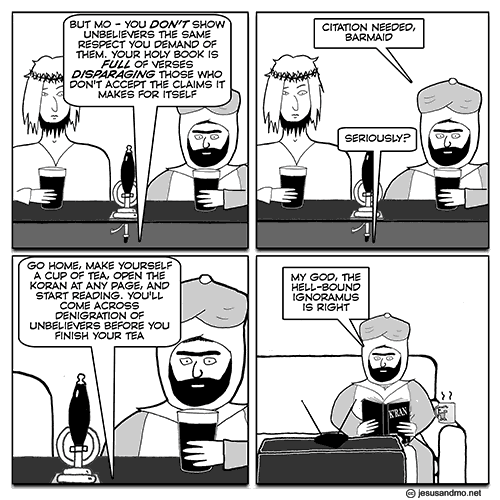
    tea

    The barmaid stands in for us, the readers. She’s a wish-fulfillment for all of us who would just love to shoulder up to one of the Holy Boss Dudes to ask some sharp questions. If only we could hold those bastards to account. What’s the big idea with Islamic State, for instance? Who approved that?

    2015 has been a terrible year for blasphemers and jokers. The slaughter at Charlie Hebdo ushered in the year on January 7th when Islamist gunmen broke into their office and murdered eleven people – the editor, cartoonists and writers, and other staff.

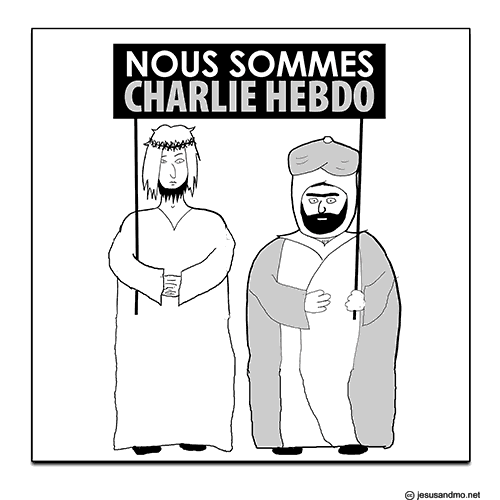
    nous

    Two days later Saudi Arabia publicly administered 50 lashes to Raif Badawi, with 950 more due to follow, along with ten years in prison and a massive fine, all for the “blasphemy” of running a website called Free Saudi Liberals.

    On February 14th a gunman shot up a conference on free speech in Copenhagen, killing a Danish film director and injuring three others. The “blasphemous” Swedish cartoonist Lars Vilks was there but he escaped injury.

    Less than a fortnight later, on February 26th, men with machetes killed the atheist blogger Avijit Roy and badly injured his wife Bonya Ahmed at a book festival in Dhaka. There is a list; people on the list are being hacked to death one by one. On March 30 it was blogger Washiqur Rahman. May 12 it was blogger Ananta Bijoy Das. August 7 it was Niladri Chattopadhyay Niloy, who used the pen name Niloy Neel. October 31 it was the publisher Faisal Arefin Dipan who was killed; another publisher and three writers were injured. We can be all too confident there will be more.

    Grim times, and no sign that they’ll get any better soon – so we need blasphemous jokes more than ever. The blasphemy is crucial. The blasphemy is our goddam lifeline. In a time of fanaticism, blasphemous jokes are our ambassadors to the Court of Murderous Dogmatic Certainties. They are our means of dealing with the nightmare. Serious argument and persuasion, evidence and reason, are the essential underpinnings, but for keeping us going in a world where one fucking fool with a machete can cut us down at will, we need those blasphemous jokes.

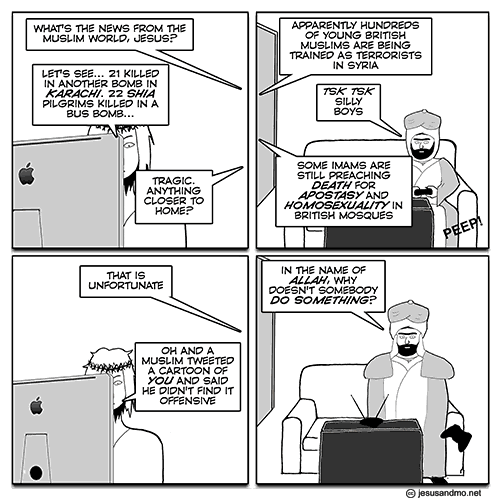
    home

    Blasphemous jokes are the deadly enemy of fanaticism; long live blasphemous jokes.

  • Blasphemy around the world

    The Washington Post notes that it’s International Blasphemy Day via Brandon G. Withrow at Religion News Service.

    “God is a lie.”

    In some countries, uttering, scribbling or texting that statement will get you thrown in jail, beaten with a rod or possibly killed. The “crime” is blasphemy and Wednesday (Sept. 30) is “International Blasphemy Rights Day,” set aside by human rights activists to highlight the blasphemy laws on the books in 22 percent of the world’s nations, according to the Pew Research Center.

    Withrow mentions China, Pakistan and Saudi Arabia. It could also have mentioned India, Bangladesh, Malaysia, Sudan…

    “Freedom of conscience is a fundamental right, and it must be valued, protected and advanced everywhere in the world,” says Michael De Dora, director of the Center for Inquiry’s Office of Public Policy — the organization behind Blasphemy Rights Day — and the center’s representative to the United Nations. The Center for Inquiry is a humanistic and First Amendment watchdog group based in Buffalo, N.Y.

    In response to foreign policies suppressing free expression, U.S. Reps. Joseph Pitts of Pennsylvania and Sheila Jackson Lee of Texas have proposed House Resolution 290, which calls for making the repeal of blasphemy laws a condition of U.S. cooperation. They urge that the label “country of particular concern” be applied to Saudi Arabia and Pakistan.

    “Fortunately, many governments have been strong in publicly condemning blasphemy laws, whether at the U.N., in public statements or in their softer diplomacy,” CFI’s De Dora said. “The problem is many of these condemnations are just words. What we could really use is more governments using the possibility of changing or pulling out of trade and other agreements to put some force behind these words.”

    But of course so many US legislators would themselves love to have laws against blasphemy on the books.

  • Pursue the blasphemers

    Ireland has ambitions to become another Pakistan, the Guardian reports.

    The sale of the Charlie Hebdo magazine published after the Paris atrocity is threatening to become the first major test of the Irish Republic’s blasphemy law, Muslim representatives and secularists have warned.

    Ireland’s Islamic Cultural Centre has said the presence of a depiction of the prophet Muhammad on the front page of the satirical publication, on sale now in Irish shops, is a clear breach of the country’s blasphemy legislation.

    The Irish Republic is the only nation in Europe to have introduced a blasphemy law in the 21st century.

    What a distinction, eh?

    Ahmed Hasain, the executive secretary of the Islamic Cultural Centre in Dublin, said: “In our view, the sale of this magazine is a breach in Irish law. It is blasphemous and it is illegal under the legislation. It’s against the law here in Ireland, that is quite clear.”

    Hasain said that while the centre has not decided whether or not to lodge a complaint to the Irish authorities, individuals or groups have the right under Irish law to use the legislation to prosecute those distributing the magazine since last week.

    That’s the part that makes Ireland more like Pakistan. It’s a ridiculous and dangerous provision of the already ridiculous and dangerous law. Does Ireland want people killing each other over religion? Again?

    He described the law introduced by the former Fianna Fáil justice minister, Dermot Ahern, as very helpful. “It’s good that the law is in place as it protects every faith,” he said.

    Nope, it’s bad, because no religion should be “protected” in that way.

    And what about this Islamic Cultural Center of Ireland? Is it the spontaneous product of Irish Muslims getting together and creating it?

    The Benefactor

    In 1992 Sheikh Hamdan Bin Rashid Al Maktoum (deputy ruler of Dubai) agreed to sponsor the construction and operation of the ICCI to provide new facilities for the Dublin Muslim community. A 4-acre site was purchased including a training-centre that had previously been a school. In 1993, this became the location of the Muslim National School. Construction of the Islamic Cultural Centre began in 1993.

    Well at least it wasn’t a Saudi sheikh.

  • Atheist Ireland at the Constitutional Convention

    Michael Nugent provides video and transcripts of three speeches Saturday at the Constitutional Convention meeting about blasphemy law.

    A bit from Michael’s:

    You have rights, your beliefs do not. That is the essence of freedom of conscience.

    You can respect my right to believe that there is no God, while not respecting the content of my belief. And I can respect your right to believe that there is a God, without respecting the content of your belief.

    But blasphemy laws discriminate against atheists. They treat religious beliefs and sensitivities as more worthy of legal protection than atheist beliefs and sensitivities.

    For example, we were recently at a conference in Limerick about religious pluralism in Irish schools, at which two Catholic theologians said that atheists are not fully human.

    A recent edition of the Catholic newspaper Alive quoted an article from the Telegraph that said that “atheists live short, selfish, stunted little lives, often childless, before they approach hopeless death in despair, and their worthless corpses are chucked in trench.”

    That’s pretty disgusting. In fact it’s incitement to hatred, and morally (as opposed to legally) speaking, it shouldn’t happen.

    Jane’s:

    Asia Noreen Bibi is the face of blasphemy laws. She is a 43-year-old Christian mother from Pakistan, who faces execution by hanging after being convicted of blasphemy. And two politicians who supported her have been murdered for doing so.

    In April 2009, Dermot Ahern told the Dail that the Irish Constitution obliged him to introduce a new law against blasphemy. Two months later, in June 2009, in Pakistan, Asia Bibi went to fetch water while picking fruits in the fields near her village.

    Some Muslim co-workers objected to Asia touching the water bowl because she was a Christian and therefore unclean. Five days later, her co-workers claimed that Asia had made critical comments about Muhammad, and a mob gathered to punish her.

    Asia was convicted of blasphemy, and sentenced to hang. When the Governor of Punjab questioned her conviction, he was murdered by one of his own bodyguards. The Minorities Minister in the Government, a Christian, defended her and he was murdered too.

    We in Atheist Ireland, along with other human rights campaigners, have sought the release of Asia Bibi, and other such victims. We are regularly told that we in Ireland have just passed our own new blasphemy law, so why are we complaining about theirs?

    During all of this, the Pakistani Government was leading the Islamic States at the United Nations in calling for an extension of blasphemy laws around the world, using wording taken directly from Ireland’s new blasphemy law.

    In today’s world, our actions in Ireland affect real people elsewhere. Please send a message to Asia Bibi, the face of blasphemy laws, and to her captors, by voting to remove the blasphemy clause from our Constitution.

    Please do, and without the blasphemy-by-another-name law either.


  • Loosen the screws, the better to tighten them

    Hmm, it’s good to get rid of a blasphemy law, but it’s not good to replace it with “a new general provision to include incitement to religious hatred” – meaning, apparently, to include something that forbids so-called incitement to religious hatred. Unfortunately that’s just what Ireland’s constitutional convention has recommended, according to the Irish Times.

    The constitutional offence of blasphemy should be replaced with a new general provision to include incitement to religious hatred, the constitutional convention has recommended.

    Voting today on whether the reference to the offence of blasphemy should be kept as it is in the Constitution, 38 per cent said Yes, 61 per cent said No and 1 per cent were undecided or had no opinion.

    In a follow-up question, 38 per cent of members believed the offence should be removed from the Constitution altogether, 53 per cent said it should be replaced with a new general provision to include incitement to religious hatred and 9 per cent had no opinion.

    A provision that would criminalize “incitement to religious hatred” is in effect a blasphemy law, ffs.

    But it appears that the problem with the law against blasphemy is that it’s drawn so narrowly that the “crime” can’t be prosecuted. It appears that the problem is not that “blasphemy” should not be a crime at all, anywhere, ever.

    Dr Neville Cox of Trinity College Dublin said the relevant part of the 2009 Defamation Act, which sets a maximum fine of €25,000 for those found guilty of publishing or uttering blasphemous material, was too tightly drawn to be applied in practice.

    He said the law’s requirement that a publisher must be proven to have intended to cause outrage among a substantial number of a religion’s adherents in effect meant “that will be very difficult successfully to prosecute the offence”.

    The law also makes it a defence to the crime to prove that a reasonable person would find genuine literary, artistic, political, scientific or academic value in the publication of the material. “It makes it so hard to operate the law… that I think the 2009 act effectively kills off the crime,” Dr Cox said.

    So the point of the provision that would criminalize “incitement to religious hatred” would be to make sure that “blasphemy” could be prosecuted after all, under a different name?

    Not progress.


  • I can apostasize if I want to, and so can you

    Sign up to Maryam’s call for action to defend apostates and blasphemers, if you haven’t already.

    More than two hundred individuals and organisations have already signed up to the call for action to defend apostates and blasphemers. Individuals include Iranian Campaigner Mina Ahadi, Lebanese writer and actress Darina al Joundi, Algerian author Djemila Benhabib, Scientist Richard Dawkins, Moroccan atheist Imad Iddine Habib, Algerian Secularist Marieme Helie Lucas, Iraqi Kurd women’s rights activist Houzan Mahmoud, Bangladeshi writer Taslima Nasrin, Iranian/German author Siba Shakib and writer Ibn Warraq amongst others. Supporting organisations include Atheist Alliance International, Atheist Foundation of Australia, Equal Rights Now – Organisation against Women’s Discrimination in Iran, Organisation of Women’s Freedom in Iraq, Polish Rationalist Society, and The Richard Dawkins Foundation for Reason and Science. The updated list of signatories can be found here.

    Strength in numbers!


  • It’s blasphemy to blaspheme against blasphemy laws

    Pakistan’s ambassador to the US, Sherry Rehman, has been accused of “blasphemy” for criticizing Pakistan’s blasphemy laws in a tv interview two years ago. There are a lot of people who take criticism to be blasphemy, aren’t there…

    Rehman has been a critic of the controversial laws, which have been widely condemned by rights organization and deemed discriminatory. In November, 2010, Rehman submitted a bill to parliament seeking to reform the blasphemy laws and an end to capital punishment. Rehman has since faced death threats from Islamist militants.

    Right. Gotta kill people who think “blasphemy” laws might need reform (notice she didn’t even say they should be eliminated) and that the state shouldn’t execute people. Anti-death people should be made dead.

    President Asif Ali Zardari’s government has come under sharp criticism from the country’s rights organizations and the West for refusing to reform the legislation despite the assassinations of Shahbaz Bhatti, a Christian cabinet minister, and Salman Taseer, the former governor of the Punjab province. The two politicians were brutally murdered by Islamists in 2011 because they had dared to speak out against the laws.

    Death to the anti-death blasphemers.

    Fatimah Ihsan, who teaches gender studies at Islamabad’s Quaid-i-Azam University, said that the apex court was “hounding” officials of the ruling Pakistan People’s Party (PPP).

    “I think the decision of the Supreme Court to accept the petition against Rehman is to target the PPP again, and to damage its reputation,” Ihsan told DW in an interview.

    Ihsan believed that instead of reforming the laws, they should be repealed completely.

    Quite so. But be careful where you walk, Fatimah Ihsan.


  • Insulting prophets

    Alber Saber has been sentenced to three years in prison for “blasphemy.”

    Alber Saber was arrested in September after neighbours accused him of posting links to a film mocking Islam that led to protests across the Muslim world.

    Neighbors accused him of posting links to something, and for that he gets three years in prison.

    Egypt? You’re doing it wrong.

    Mr Saber was initially accused of circulating links to a 14-minute trailer for the film, Innocence of Muslims, which denigrates the Prophet Muhammad.

    But he denied promoting the video and later faced charges relating to other statements critical of Islam and Christianity which police investigators allegedly found online and on his computer at his home.

    Oh right, the first charge fell apart so they dug up something else – “statements critical of Islam and Christianity.” Jeez. I wonder how many centuries in jail I would get if I were in Egypt.

    There has been a proliferation of prosecutions for blasphemy in Egypt in the nearly two years since Hosni Mubarak was overthrown. Many of those targeted are Copts, who make up about 10% of the population.

    Although blasphemy has long been a criminal offence, Article 44 of the draft constitution contains a specific article prohibiting insulting prophets.

    And “insulting prophets” means saying anything critical of guys who lived many centuries ago.

    Egypt you’re really really doing it wrong.


  • Apples but not bananas? What about pineapples?

    Hahahaha this is great – did you know the Apple logo is blasphemous?

    Yes well once you’re told of course you can see it. Apple; bite missing. But would you have thought of it if you hadn’t been told? Aha!!1! I thought not. You’re probably blasphemous yourself.

    In this case it’s a sect of ultra-Orthodox believers in Russia that are claiming that the Apple logo is indeed blasphemous:

    Radical orthodox Christians from Russia remove Apple logotype from the company’s products and put a cross sign instead of them. The orthodox find the half-bitten apple logotype anti-Christian and insulting their belief, something that may potentially cause serious problems for Apple’s products in the country.

    Interfax news-agency reports about “several” cases, where the radical orthodox, including priests, swapped the Apple logo for an image of the cross, the symbol of Jesus Christ. According to the ultra-radical orthodox activists, the bitten apple symbolizes the original sin of Adam and Eve and is generally anti-Christian.

    Of course. Because it couldn’t just be an apple, with a bite taken out. Plus the forbidden fruit isn’t an apple anyway. But whatever.

    …one of the results of the Pussy Riot controversy is that the Duma, the Russian Parliament, is considering laws to make offending religious feelings a criminal offence. The question, obviously, will be whose religious feelings? How large a group will have to be offended? My understanding of Russia is not what it once was (back when I lived there for example) but I would expect the law to really say that offending the hierarchy of the Orthodox Church will be an offence and offending anyone else won’t be. But that does assume that they write the law that way.

    It’s always possible that they’ll write it much more broadly and that any small group will be able to claim that pretty much anything at all is blasphemous according to their specific religious beliefs. Even the Apple logo.

    Or the apple. Or the apple plus all other kinds of fruit, to make sure.

    [Patiently: No, it’s not the same as “bitch” and “cunt.” Go away.]


  • Protect all the sentiments

    What goes around comes around department.

    Pakistan’s blasphemy laws may be used to punish Muslims suspected of ransacking a Hindu temple, an intriguing twist for a country where harsh laws governing religious insults are primarily used against supposed offenses to Islam, not minority faiths.

    And where the whole point of the country itself has always been that it’s not Hindu. That was the point of partition. India was secular but also majority-Hindu, so Pakistan was to be the opposite. How sad to see its laws used to protect Hindu “religious sentiments.”

    Police officer Mohammad Hanif said Sunday the anti-Hindu attack took place Sept. 21. The government had declared that day a national holiday — a “Day of Love for the Prophet” — and called for peaceful demonstrations against an anti-Islam film made in the U.S. that has sparked protests throughout the Muslim world. Those rallies took a violent turn in Pakistan, and more than 20 people were killed.

    Hanif said dozens of Muslims led by a cleric converged on the outskirts of Karachi in a Hindu neighborhood commonly known as Hindu Goth. The protesters attacked the Sri Krishna Ram temple, broke religious statues, tore up a copy of the Bhagavad Gita, a Hindu scripture, and beat up the temple’s caretaker, Sindha Maharaj.

    Nostalgia for 1947 was it?

    One wonders why the people in question couldn’t just be charged with vandalism and assault.

  • Couldn’t the UN just put a stop to it?

    Katha Pollitt on blasphemy. She starts with a public radio chat in which John Hockenberry said to BBC chief Jeremy Bowen:

    Hockenberry: I’m wondering if it’s possible for the United Nations to create an initiative that would talk about some sort of global convention on blasphemy, that would create a cooperative enterprise to control these kinds of incidents, not to interfere into anybody’s free speech rights but to basically recognize that there is a global interest in keeping people from going off the rails over a perceived sense of slight by enforcing a convention of human rights, only in this particular case it would be anti-blasphemy?

    So he wants a global convention to enforce an anti-blasphemy convention of human rights…not (of course) to interfere into anybody’s free speech rights, but to –

    Well how would you enforce an anti-blasphemy convention without interfering with free speech rights?

    So the only thing preventing some sort of international convention against “blasphemy” is that people can’t agree about what it is? Perhaps the UN could ask Vladimir Putin, who was eager to send three members of Pussy Riot to prison for appearing at Moscow’s Cathedral of Christ the Savior to perform an anti-Putin “punk prayer” to the Virgin Mary. Their crime: “hooliganism motivated by religious hatred.” The rise of the Russian Orthodox church in the former Soviet Union, and its connections to a corrupt authoritarian regime, shows that Islam has no monopoly on religious freakouts or their exploitation for political purposes.

    Quite. We also know that the only reason the Vatican doesn’t do the same thing is because it can’t. When it could, it did. It didn’t stop because it got nicer; it stopped because that wouldn’t fly any more.

    Sorry, John and Jeremy, there is just no way to “control these kinds of incidents” without suppressing free speech, because the very concept of “blasphemy” entails powerful clerics deciding what a religion “really” says, and what questions about that are legitimate. And why shouldn’t religion be fair game for rude remarks, mockery and humor, to say nothing of bold challenges and open expressions of disbelief? Ethnic attacks like Geller’s ad are disgusting—calling Muslims savages is like calling Jews subhuman—but I’d say on the whole “blasphemy” has been a force for good in human history. It is part of the process by which millions of people have come to reject theocracy and think for themselves.

    When it comes to ideas—and religions are, among other things, ideas—there is no right not to be offended.

    Happy blasphemy day.

  • Golden Dawn v Elder Pastitsios

    More on “Elder Pastitsios” and blasphemy laws in Greece. The links are to sites in Greek.

    Four days before the arrest on September 17, MP Christos Pappas from the neo-nazi Golden Dawn party had brought the page to the attention of the justice minister and submitted an official inquiry into why the Facebook page was not being addressed by the Eletronic Crimes Unit. According to site NewsIt*, the police claim they had already concluded their investigation two days before the question was raised in parliament. Following the publication of the arrest, Greece’s leftist primary opposition party SYRIZA strongly denounced* the arrest as did its offshoot and now ruling coalition junior partner Democratic Left as well as the Greek Communist Party. Center-left party PASOK – also a member of the ruling coalition – issued a more tepid response opposing the arrest but affirming the need to “protect religious and national identity”. Golden Dawn lauded the arrest stating* that their MP’s question “mobilized the government into taking action”.

    It’s International Blasphemy Day in two days. I trust you are preparing.


  • She wept and begged to be released

    Spare a thought for that little girl in Pakistan who is in jail for “blasphemy” because she (supposedly, allegedly, some asshole saidly) had some pages of the Koran in a bag of trash, or put some pages of the Koran in a fire along with other trash, or some such stupid meaningless unreasonable bit of nonsense. Spare a thought for her, because she wants to get out. She would probably prefer to be at home, with people who love her and take care of her.

    According to the BBC’s Orla Guerin in Islamabad, Rimsha’s lawyer said that when he saw her in jail over the weekend she wept and begged to be released.

    Her parents have been taken into protective custody following threats, and many other Christian families are reported to have fled the neighbourhood.

    There are fears that even if she is released, Rimsha’s family will not be safe in Pakistan. Others accused of blasphemy have been killed by vigilante mobs in the recent past.

    Human beings: finding shitty reasons to torment each other for 100,000 years.

  • As communal tensions continued to rise

    Can’t we all get along? No. Not in Islamabad, for instance, after that 11-year-old was accused by her neighbours of burning a few pages of a Koran.

    As communal tensions continued to rise, about 900 Christians living on the outskirts of Islamabad have been ordered to leave a neighbourhood where they have lived for almost two decades.

    One of the senior members of the dominant Muslim community told the Christians to remove all their belongings from their houses by 1 September.

    What an oddly respectful way of wording that – it makes him sound like a prime minister instead of a thug. If some male neighbor told me to get out of the neighborhood, I wouldn’t be thinking of him as one of senior members of the community. I do wish journalists would learn to stop dressing things up in that way. This isn’t some legitimate authority telling people what to do, it’s just criminal intimidation.

    The other point of general agreement is that “the law should be followed”. Unfortunately, the law in question is Pakistan’s blasphemy law, which has a proven track record of ensnaring people on the flimsiest of evidence and being cynically used to intimidate communities or settle quarrels over money and property.

    Even though no one has yet been executed for blasphemy in Pakistan, long prison terms are common – one Christian couple was sentenced to 25 years in 2010 after being accused of touching the Qur’an with unwashed hands.

    There have also been cases of people killed by lynch mobs demanding instant punishment. Daring to criticise the law is incredibly risky and few do it.

    In 2011, Salman Taseer, the former governor of Punjab province, was gunned down by his own bodyguard after he spoke out against the case of Aasia Bibi, another Christian woman accused of blasphemy.

    Humans: finding absurd reasons to make each other miserable for 100,000 years.