
Tag: Grenfell Tower

  • Hundreds of mattresses had been laid out

    People living in council flats in Chalcots estate on Adelaide Road in Swiss Cottage, London, were evacuated in the middle of the night last night after fire inspectors said five tower blocks were at risk of going up like torches the way Grenfell Tower did.

    Those affected described scenes of confusion as they were told the council was unable to guarantee residents’ safety, They are asked to find alternative accommodation or report to a local leisure centre, where hundreds of mattresses had been laid out. Others were offered hotel rooms for the night.

    Speaking on Saturday morning, the leader of Camden council, Georgia Gould, said: “We’ve had a huge effort overnight to evacuate people. We have had 650 households who have moved out of the tower blocks. We’ve had everyone, council staff, volunteers, different councillors, all coming together with the fire service to move people safely out of their accommodation.”

    It seems bizarre, not to wait until morning, but it’s a very human thing to react to the most recent disaster.

    She told BBC Radio 4’s Today programme: “The last thing I wanted to do was ask residents late on a Friday night to leave their homes. I have been with them all night and people are distressed, angry and scared. It’s such a difficult decision.

    “But I said to fire services, is there anything I can do to make this block safe tonight? I offered to pay for fire services to be stationed outside those blocks just so we could have a couple of days to get the works done, but the message was [that there was] nothing to do to make blocks safe that night.”

    I wondered that same thing, before I read the article – wouldn’t it be simpler to station fire trucks outside for the night? But then I remembered that the Grenfell fire was out of reach of the fire trucks, so no, I guess that wouldn’t be a useful response.

    Sajid Javid, the communities secretary, told Sky News early on Saturday morning that the evacuation was forced not by the cladding alone, but “multiple other fire safety failures”, including problems with insulation on gas pipes and missing fire doors.

    The council initially announced on Friday that only one tower, Taplow, which contains 161 households, was to be “temporarily decanted”. Within the hour, however, Gould said the decision had been taken to evacuate the whole estate.

    She said a rest centre for residents had been set up at Swiss Cottage library and efforts by council staff to process residents’ cases there were beginning immediately.

    That gives me a bit of a turn. I know that library. I had a bedsitter in Hampstead once, years ago, and had Camden library tickets; Swiss Cottage and Camden were the two largest branches, and I used the Swiss Cottage one a lot.

    The council earlier said it would immediately start preparing to remove cladding from five towers on the estate after an inspection ordered following the Grenfell disaster, which killed at least 79 people, found it could be a fire risk.

    Gould said residents had since shared fire safety concerns that she had not previously been aware of and experts who inspected the estate on Friday informed her they could not guarantee the tenants’ safety.

    “We realise that this is hugely distressing for everyone affected and we will be doing all we can, alongside London fire brigade and other authorities, to support our residents at this difficult time. The Grenfell fire changes everything, we need to do everything we can to keep residents safe,” she said.

    It’s just so awful that it took the Grenfell fire to change everything.
  • £2 cheaper per square metre

    The Guardian on that cheaper and more inflammable cladding chosen for the renovation of Grenfell Tower.

    Material used in the cladding that covered the Grenfell Tower was the cheaper, more flammable version of the two available options, an investigation of the supply chain has confirmed.

    Omnis Exteriors manufactured the aluminium composite material (ACM) used in the cladding, a company director, John Cowley, confirmed to the Guardian.

    He also said Omnis had been asked to supply Reynobond PE cladding, which is £2 cheaper per square metre than the alternative Reynobond FR, which stands for “fire resistant” to the companies that worked on refurbishing Grenfell Tower.

    But maybe that’s just normal? Everybody does it?

    No.

    German construction companies have been banned from using plastic-filled cladding, such as Reynobond PE, on towers more than 22 metres high since the 1980s when regulations were brought in to improve fire safety at residential blocks.

    Why 22 metres? Because of the ladders on fire trucks.

    Concerns that the panels could exacerbate the spread of fires led authorities to allow them only on buildings that can be reached by the fire brigade using fully-extended ladders from the ground. Taller buildings require panels with a more fire-resistant core and separate staircases for people to use if evacuation becomes necessary.

    Frankfurt’s fire chief, Reinhard Ries, said he was appalled at the fire at Grenfell Tower and said tighter fire-safety rules for tower blocks in Germany meant that a similar incident could not happen there. US building codes also restrict the use of metal-composite panels without flame-retardant cores on buildings above 15 metres.

    Now we have a very vivid demonstration of why.

    In the UK there are no regulations requiring the use of fire-retardant material in cladding used on the exterior of tower blocks and schools. But the Fire Protection Association (FPA), an industry body, has been pushing for years for the government to make it a statutory requirement for local authorities and companies to use only fire-retardant material. Jim Glocking, technical director of the FPA, said it had “lobbied long and hard” for building regulations on the issue to be tightened, but nothing had happened.

    Seraphima Kennedy had nightmares about it.

    In the aftermath of the Grenfell Tower disaster, a harsh light now shines on the organisation that managed the block, and others in the area, the Kensington and Chelsea Tenant Management Organisation (KCTMO).

    People have said that this was “a disaster waiting to happen”. I shared their concerns. I saw them from the inside.

    I remember the vote that led to the creation of KCTMO in 1996, because my mother was a tenant at the time and we received letters about it. I was born and brought up in the south of the Royal Borough of Kensington and Chelsea, on benefits, in an overcrowded council flat.

    She went to university and went to work for the KCTMO.

    Though I didn’t manage Grenfell Tower itself, I was responsible for day-to-day housing management services on surrounding estates with similar structures and communities. The policies and procedures were, to my knowledge, the same, and these included mandatory annual fire safety training for caretakers and neighbourhood officers. In this training, the stakes of failure were made very clear; we were told that the CEO could go to prison for corporate manslaughter in the event of a major incident. We were also told about some of the recommendations from the Lakanal House fire in 2009, which claimed six lives in Southwark, south London.

    But austerity steadily drained away their resources.

    Our foreboding about calamity loomed large; I used to have nightmares about blocks burning down. We carried out quarterly block inspections, and a huge part of that work was checking the fire-safety of each block. Were the exits clear? Were the emergency lights working? Were all the fire doors in operation? We’d send letters to residents who left bikes and buggies blocking the communal exits, because it was our responsibility to make sure the means of escape were clear. But still I’d wake up in the middle of the night, asking myself if I’d sent that letter to that resident in flat 17 asking her to move her buggy. Buggies are highly flammable and it only takes one cigarette to start a fire.

    When I heard how residents in Grenfell stayed put, I remembered one meeting with the residents on another of our estates who asked for information about their means of escape in the event of a fire. I was flabbergasted when our fire safety team confirmed the widely used “stay put” policy, confident in the belief that fire stops between each floor would prevent the flames from spreading, and that the fire doors fitted to every home in their block would give residents a full hour in which the fire brigade would rescue them. Thinking about it now brings a lump to my throat.

    £2 cheaper per square metre.

    H/t Gita Sahgal

  • Regressing

    Chris Brooke in a guest post at Crooked Timber:

    I spend my life shuttling back and forth on the train between Oxford and Cambridge. That means that twice a week I walk past the plaque at King’s Cross that memorializes the thirty-one dead of the fire of 18 November 1987. And when I walk past that plaque, I’m reminded of a distinctive moment in my younger life—not just King’s Cross, but also the fifty-six dead of the Bradford stadium fire disaster (11 May 1985), the one hundred and ninety-three who died on the Herald of Free Enterprise (6 March 1987), the thirty-five who were killed at Clapham Junction (12 December 1988), the ninety-six who were crushed at Hillsborough (15 April 1989), or the fifty-one who drowned on the Marchioness (20 August 1989).

    I’d forgotten about the Bradford stadium fire.

    https://youtu.be/W9ASOcxf1pk

    Perhaps it was coincidence that these catastrophes happened cheek by jowl, in a way that they just haven’t since. Or perhaps much of it was something to do with the ascendant political ideology of the time, that starved vital infrastructure of much-needed investment, and that celebrated the quick search for profit. One of the good things about living in England over the last quarter century is that this run of disasters came to an end, and things became quite a bit safer. But of course the predictable consequence of the politicians’ collective choice to embrace the economics of austerity over the last seven years—and even more so when it is conjoined with the Tory fondness for the execrable landlord class, a widespread dislike of safety regulations, the cuts in legal aid, and the politics of the majority on Kensington & Chelsea Council, especially when it comes to housing—is that we would regress in some measure to this second-half-of-the-1980s world, and everything that is coming out now about the Grenfell Tower saga suggests that we have so regressed.

    No smugness over here. One word: Katrina.

  • Guest post: Of course it happened because those people were poor

    Originally a comment by Steamshovel mama on Less than £5,000.

    they could only have used materials that met current safety standards

    Really?

    Because nobody has ever cut corners, bought cheap materials or employed under-educated, underpaid site workers who don’t know what they’re supposed to be using.

    The use of thermal cladding is covered by Regulation B4(1) of The Building regulations 2010. It states:

    The external walls of the building shall adequately resist the spread of fire over the walls and from one building to another, having regard to the height, use, and position of the building

    You know, so the building doesn’t go up like a fucking candle, exactly as we can all see happening in the video of Grenfell Tower. The dangers of external cladding contributing to flame spread resulting in multiple secondary fires is well known. You can check out Section 3 of BR135 – Fire Performance of External Thermal Insulation for Walls of Multistorey Buildings which goes into a great deal of detail about the mechanisms of this.

    The point is, we know what happens when inappropriate cladding is used. We also know how to prevent it.

    1. Use Materials of Limited Combustibility (MOLC) for all elements of the cladding system, including insulation, internal lining board, and external facing material. There is an official definition of MOLC.

    2. Buy and use a whole cladding system that has been assessed according to the acceptance criteria of BR135. Evidence must be presented that the system has demonstrated compliance with BS8414:1 or BS8414:2 which lay down the requirements fopr non-loadbearing or load-bearing walls. This test must be carried out by a UKAS accredited testing body and supported by a classification report.

    3. If no actual fire test data exist for a particular system, the client must submit a desktop study report from a suitably qualified fire specialist staing that in their opinion BR135 criteria would be met by the proposed system. This report must be backed by test data from a suitable UKAS testing body (BRE, Chiltern Fire, Warrington Fire etc). The report must specifically reference the tests that have been carried out.

    4. If none of the above options are possible a holistic fire engineered approach for the whole may be considered according to BS 7974.

    The last is usually used only in new builds and would not be considered suitable for a building like Grenfell Tower.

    And the point of all this is that if any of those approaches had been taken, the pattern of burning observed – where the cladding burned rapidly and spread laterally as well as vertically, creating secondary fire sources as it spread, would not have been possible. There would have been a slower vertical spread, resisted by the cladding, where the fire could not use the gap between the cladding and the building to travel.

    And, of course it happened because those people were poor. They have no power or influence and, if the government is more inclined to wink at dodgy landlords and builders than to protect them, they are disproportionately affected by poor building and rackrent practices. Even though tower blocks are council (social) accommodation and should be there as a way of supporting people on lower incomes.

    The whole thing stinks. And I don’t think the Indie is out of line. I think they’re being good journalists and raising an issue the government would really rather they didn’t.

  • Less than £5,000

    The Times at midnight:

    Grenfell Tower refurbishers would have needed less than £5,000 to upgrade the building’s external panels to a fire-resistant version thought not to have been used, The Times can reveal.

    Hundreds of aluminium panels, known as Reynobond, were installed on the 230ft west London property in a £8.6 million refurbishment. Witnesses described the building’s cladding, made up of the panels and an insulating underlayer, as going up like a “matchstick”.

    Reynobond offers three types of panel: a standard one with a polyethylene core (PE) and two with fire resistant or “non combustible” cores. Grenfell Tower had reportedly been fitted with the cheaper PE version.

    Well it was council flats you know. Not for People Like Us. No sense wasting £5,000 just for fire safety.

    Firefighters have stopped looking for bodies because they’re worried the building might collapse.

    The Labour MP David Lammy has called the Grenfell Tower blaze “corporate manslaughter” as police announced the number of dead had risen to 17 and warned it would rise further during a painstaking search of the remains of the building.

    Lammy, the Labour MP for Tottenham, whose friend Khadija Saye and her mother, Mary Mendy, lived on the 20th floor of Grenfell Tower and were missing, gave a voice to the growing anger in the community.

    “This is the richest borough in our country treating its citizens in this way and we should call it what it is. It is corporate manslaughter. And there should be arrests made; frankly, it is an outrage,” he said.

    An easy walk from Kensington Palace.

  • Like a nightdress by a fire

    The Independent says appearance was part of the reason for the new cladding on Grenfell Tower.

    The cladding that might have led to the horrifying blaze at Grenfell Tower was added partly to improve its appearance.

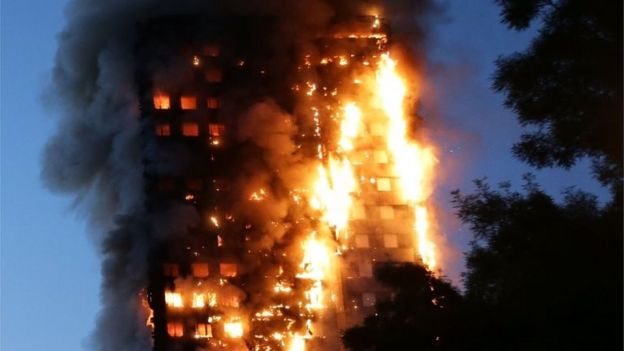
    During a refurbishment aimed at regeneration last year, cladding was added to the sides of the building to update its look. The cladding then seems to have helped the fire spread around the building, allowing it to destroy almost the entirety of the structure and kill people inside.

    And that cladding – a low-cost way of improving the front of the building – was chosen in part so that the tower would look better when seen from the conservation areas and luxury flats that surround north Kensington, according to planning documents, as well as to insulate it.

    “Due to its height the tower is visible from the adjacent Avondale Conservation Area to the south and the Ladbroke Conservation Area to the east,” a planning document for the regeneration work reads. “The changes to the existing tower will improve its appearance especially when viewed from the surrounding area.”

    The document, published in 2014 and providing a full report on the works, makes repeated reference to the “appearance of the area”. That is the justification for the material used on the outside of the building, which has since been claimed to have contributed to the horror.

    Of course there’s nothing wrong with wanting to improve its appearance in general; on the contrary. But if the cladding is why the building was apparently a box of matches…

    A statement from Rydon after the work was finished noted that “rain screen cladding, replacement windows and curtain wall façades have been fitted giving the building a fresher, modern look”.

    That statement included a quote from Nick Paget-Brown, the leader of the council, who remarked on how happy he was to see “first-hand how the cladding has lifted the external appearance of the tower”.

    That public statement after the completion made no reference to insulation, only discussing the change in the external appearance of the building.

    The refurbishment work that added the cladding cost £8.6m and finished in May last year. Both before and since that time, residents have repeatedly complained about the safety of the block, but were assured that there was no problem.

    Councillor Judith Blakeman said questions would now be asked in the wake of those assurances.

    “If the cladding was partly responsible for the fire we need to know what the specification for the cladding was and why it suddenly just went up (in flames) in about five minutes, because it should have been fire resistant, surely,” she said.

    Ms Blakeman lives across the road and said she heard about the fire at 5am on the radio.

    “I just rushed outside,” she said. “Neighbours had been watching it all night, they said the cladding went up like a nightdress by a fire – it just went whoosh.”

    Residential buildings shouldn’t just go whoosh like that.

  • Brutalism

    The unfortunate people who had to live in Grenfell Tower have been raising safety concerns for years.

    The residents of Grenfell Tower had reportedly raised fire safety concerns for several years before the blaze that engulfed the block of flats in west London on Wednesday, according to a community action group.

    The claim comes as London Fire Brigade said there had been a “number of fatalities” at the tower block.

    Grenfell Tower in north Kensington was completed in 1974 in the brutalist style of the era, comprising 120 flats over 24 storeys.

    Ah yes, the “brutalist” style – aka as cheap and unadorned and brutally ugly as possible. Calling it “brutalist” makes it sound artistic, I suppose. What it really is is a giant “fuck you” to people who aren’t rich.

    The company that did the renovations last year presumably didn’t actually soak the whole building in lighter fluid, so what I want to know is what kind of testing was ever done on the materials? How could a building go up like a torch that way?

    Grenfell Tower

    Getty Images

  • Trapped

    Meanwhile twelve people are known to have died so far in a horrific fire in a London block of flats. The number of deaths is expected to rise.

    Firefighters rescued 65 people from Grenfell Tower in north Kensington, after they were called at 00:54 BST.

    Eyewitnesses said people were trapped in tower block, screaming for help and yelling for their children to be saved.

    Policing and fire minister Nick Hurd said checks are now planned on similar tower blocks.

    Claire Heald reports from the scene.

    Fire crews are fewer, police remain in force. The local MP has been. NHS workers, counsellors, volunteers come and go.

    You hear snatched conversations – who is missing, who has news? And wails and crying.

    I talked to carers who worked in the tower – and were swapping anecdotes about the clients with limited mobility, agoraphobia even, or multiple children who they know would have struggled to manage escape.

    Some are really angry and have questions – whether they’re talking about inequality in London’s richest borough, or cladding and fire stairs.

    I read somewhere that the cladding, which was added in a recent renovation, was to make the tower more attractive to the rich neighbors. Grenfell Tower isn’t a posh block of condos, it’s council flats.

    The Guardian talked to an expert:

    “A disaster waiting to happen,” is how the architect and fire expert Sam Webb describes hundreds of tower blocks across the UK, after the fire at Grenfell Tower in Kensington that has left at least six people dead. “We are still wrapping postwar high-rise buildings in highly flammable materials and leaving them without sprinkler systems installed, then being surprised when they burn down.”

    Webb surveyed hundreds of residential tower blocks across the country in the early 1990s and presented a damning report to the Home Office, which revealed that more than half of the buildings didn’t meet basic fire safety standards. He said: “We discovered a widespread breach of safety, but we were simply told nothing could be done because it would ‘make too many people homeless’.

    “I really don’t think the building industry understands how fire behaves in buildings and how dangerous it can be. The government’s mania for deregulation means our current safety standards just aren’t good enough.”

    If you look at video of the fire it’s absolutely horrifying – the tower is blazing as if it were a torch soaked in gasoline.

    Webb advised the legal team for the families in the case of the last major tower block blaze in London, in July 2009, when a fire raged through Lakanal House, a 14-storey block built in 1958 in Camberwell, south-east London. Six people were killed, among them two children and a baby, when a fire caused by a faulty television in a ninth-floor home gutted the building.

    An inquest into the deaths found the fire spread unexpectedly fast, both laterally and vertically, trapping people in their homes, with the exterior cladding panels burning through in just four and a half minutes. As with Grenfell Tower, the official advice was for people to remain in their homes in the event of a blaze. The inquest concluded that years of botched renovations had removed fire-stopping material between flats and communal corridors, allowing a blaze to spread, and that the problem was not picked up in safety inspections carried out by Southwark council. The council was investigated over possible corporate manslaughter charges, but eventually fined £570,000 under fire safety laws.

    This is London. Not Lagos, not Dhaka, not New Orleans, but London.