The Hallmark soundtrack in the head
This is such a key point for the resistance to trans ideology and blurghy thinking generally.
“Hallmark soundtrack” is an excellent label for it.
I hate it, not in a calm all in the head way but viscerally – I hate slushy elevated pompous look at me wording the way I hate fat buzzing flies anywhere near me, or noisy crowded shouty spaces, or cigarette smoke. I hate self-conscious posturing look at me writing. I hate the substitution of manipulative drool for actual arguments and reasons. And of course trans ideology is riddled with it, for the obvious reason that it has nothing else.
Beware the Hallmark Effect.
The same goes for the glitter and rainbows that accompany the alphabet soup “community” activism. It’s cloying and infantilizing. It’s also camouflage, a surface image of fun and harmlessness designed to distract and deflect attention away from the authoritarian aspects of the movement, much like the continuing claims of powerlessness and marginalization belied by the degree of power and influence afforded the movement by its use of institutional capture. It’san iron fist in the rainbow glove. When banks fly your flag, you’re not helpless any more
My neighbourhood bank branch, as part of its Pride campaign, has big, heart shaped decals, featuring the Pride Progress colours surrounded by its corporate colours of green and white.(You can see the design here in an animated gif on TD Canada Trust’s website https://www.td.com/ca/en/about-td/diversity-and-inclusion/2slgbtq-community-commitment).
When I go into my bank, I want to be treated with courtesy and respect, not smothered in corporate-mandated hugs and kisses. I’m there to do business, not to be love bombed. But then, I’m not a part of the target audience that’s supposed to be receiving all this attention; I’m part of the target audience that’s supposed to be supplying it. Not only are the rainbow-heart decals a showy bit of virtue signaling, they are an exhortation for the rest of us to join in and centre, celebrate, elevate, and grovel at the feet of these Most Special Beings, whose red leather boots we are unworthy to lick. No thank you.
Oh, I absolutely know the “Hallmark soundtrack” mentality. Privately, I’ve always imagined it as the Sarah McLachlan soundtrack, in reference to a notoriously sappy old TV spot for the SPCA. It’s as if trans people are abandoned, wounded puppies who need your help.
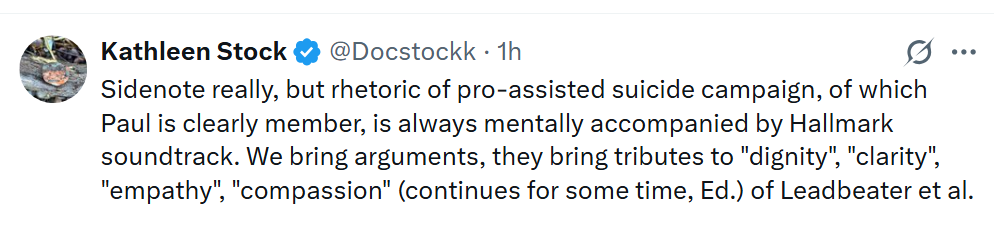
That said, I don’t know what the context was regarding Stock’s tweet, the person she mentioned, and assisted suicide. Personally, I’m an advocate for it, with the right checks and balances. Suicide isn’t illegal, and there are cases where it merits some medical assistance, particularly in those with ALS. And that said, I can certainly see the problems with it, too. It needs checks and balances, or can go too far, and there have been clear instances in Canada of assisted suicide advocacy collapsing into Sarah McLachlan soundtrack-ism, with overzealous sentimentalists advocating “noble” suicide for practically anyone whose condition evokes pity.
Yes, I’ve been staying out of that discussion entirely, because what you say.
For context, Kathleen’s tweet was in reply to this:
Which is in reference to a specific bill brought to UK Parliament by Labour. I don’t know about the bill so I’m not going to comment about it, but having witnessed the slow and agonising death typical to cancer, I’m thoroughly in favour of some form of legal assisted dying.
And as sappy and saccharine as the pro-euthanasia language can be, the other side’s language is downright poisonous. As a perfect example, in reply to the quoted tweet, someone posted an image of three faces (pro-euthanasia politicians associated with this bill) with the label “faces of Death”. Then a few replies down, we someone asks “This you?” with a picture of someone in an SS uniform.
As an aside, this approach to debate seems just as emotional as the ‘Hallmark’ approach, but leaning more towards anger and hatred.
I used to be strongly in favour of assisted dying. In a way I still am. But after the madness we have seen I no longer trust humans and human institutions to safely use that power. And as a disabled person I’m only too aware that I’m a member of a morally inferior class and thus in some deep (there’s that word again) way simply not competent to make my own life decision. I put two and two together and hate the answer I get.
Francis,
Except, medical aid in dying legislation ensures that you are allowed to make your own life decision!
Peter N: That’s the ideal, yes, but in practice things are often more muddled. There are several levers available to those who might want to pressure someone to ‘decide’ to opt for assisted suicide, and laws and policies not only need to be written with a degree of precision that is rare in the sausage-making business, but then must be strictly followed by those in the trenches.
I know I would want that option, were I in that state. But I can also see how some travesties would occur. I would note that medical care is often already distorted by race, sex and class in US and England–and probably elsewhere, too, though I’m less familiar with such–and that there’s little reason to believe this wouldn’t wash over to end-of-life care.
@Peter N
Two words “Stonewall law”.
Also everything Freemage said.