Author: Thomas R. DeGregori

  • In Defense of Modern Industrial Agriculture, Agribusiness and Our Food Supply: A Spirited Response to the Critics

    In some circles, there is now what appears to be an established, unquestioned and largely unchallenged consensus that modern agriculture is an unsustainable failure and responsible for any number of ills in our society. The media and our larger cultural discourse are riddled with well-orchestrated misinformation about our food supply and how it is produced. Every ill is blamed on modern food production. An outbreak of E coli 0157:H7 in spinach was widely blamed on industrial. Months later when the source was identified as being organically grown spinach and that the E coli probably came from free range cattle in a low density ranch across the river, it was old news and largely unreported. In fact, it is difficult to find any reporting of it in either mainstream media or alternative media. There are numerous other incidences such as avian influenza or swine flu where the initial news got it totally wrong. In the case of avian influenza, the mythologies cumulated through time from its origins to its transmission. The anti-modern agriculture ideologues know the cause of all our food ills before they happen and are quick to put in Op-Ed pieces (including in the Houston Chronicle, in this case via the L.A. Times) and otherwise voice their opinions blaming “industrial agriculture.”  Those who await the evidence from scientific inquiry will find that contrary opinions are again not accepted because they are no longer news. Unfortunately the internet and the abiding faith of the anti-modern true believers means that no matter how thoroughly the original myths are factually refuted, they tend to live on in cyberspace to be called forth years later as needed.

    All too often, what the critics propose would make our food less safe in the name of protecting us from the evils of industrial agriculture. A demagogic cooking program on a major television network initiated a tirade against “lean textured beef” (LTB) which was called pink slime. This was followed by news stories that were almost as bad on that same network, and by a national campaign led by a local activist that resulted in school districts across the country no longer serving it in school lunches, and supermarket chains no longer selling it. The local activists proudly wrote an op-ed piece for the Houston Chronicle which had an editorial praising it and endorsing her work. What the overall publicity succeeded in doing was closing three of the four meat processing plants that were considered by both industry and food safety experts as among the safest if not the safest in the country. A call to the Texas A&M Center for Food Safety or the A&M Department of Animal Science would have obtained an informed contrary view. If the local network affiliate, the Chronicle or the activist contacted A&M, it was lost to me in the voluminous noise on the subject. I have a huge file on this matter and I would both like to comment further and debate both the activist and the editorial writer when the libel suit filed against several of the parties including the network and the local activist is settled. To my knowledge, it has not been but I could be wrong.

    One of the proffered remedies for the alleged dangers of lean textured beef was for the consumer to pick out a cut of beef and either have the butcher grind it for you or for the consumer to grind it at home. Any food safety expert can see the real dangers in doing this and I will leave it to the reader to find out why. When confronted with the safety procedures at the LTB plants such as testing for toxins (STECs) not tested for by other producers, an activist dismissed this added safety procedure on the grounds that the 2011 sprouts outbreak in Germany that killed 53 and sickened 3,950 was caused by a previously unknown bacteria, E. coli 0104:H4. Somehow, we were confronted with the logic that because of the possibility of unknown bacteria lurking out there somewhere, food safety would be furthered by closing the safest plants. May I add that the sprouts were grown organically.

    Sprouts have been continuing source of E coli and salmonella. One national chain with local outlets had salmonella outbreak in one area of operation followed by an E coli outbreak in another. Following these and a multitude of other instances another chain also with local outlets suspended its offering of raw sprouts as did several grocery chains. Basically the humidity and temperature for sprouting seeds are almost perfect for culturing various harmful bacteria from even the slightest contamination. Most all known methods of cleaning them with solvents are not effective as there are a multitude of niches in which the bacteria can be safe. There is one sure safe way of cleaning sprouts – irradiation – but restaurants and food stores know the demagogic campaigns that will be waged against them if they offered them. Forget the dirty little secret that many spices have been irradiated and for very good food safety reasons. I will forego revealing which brands are irradiated and which are cleaned in other ways since it is likely that none of the readers could tell the difference.

    Let us step back a bit and look at some population data to get an idea of what modern agriculture has achieved. In other words, let us look at how many people are being fed today compared to previous times and how quickly this transformation has taken placed. These are numbers that I go over repeatedly in class because they are illustrative of the changes in food production that had to take place. Let us start about 500 years ago in 1500 in the Common Era when world population was around 400 million people. That number was to double to 800 million people in 1800 reaching 1 billion in 1830 and 1.6 billion in 1900. Population reached 2 billion in 1930 adding another billion to 3 billion in 1960 and doubling to 6 billion in 2000. Today, world population is between 7.2 and 7.4 billion. This means that world population has increased nine times in a little over 200 years. Even if one uses other population estimates for the pre-1900 populations such as population reaching 1 billion by 1800, it still means more than a seven fold increase in population in a little over two hundred years.

    Let me add as I will argue below, the world is better fed today than ever before. Let us look at the dates such as 1800. This was two years after the 1st edition of “An Essay on the Principle of Population” by Reverend Thomas Malthus which was first published in 1798. If someone in the 1790s had forecast a seven or nine fold increase in population in the next 200+, even William Godwin or the Marquis de Condorcet against whom Malthus was arguing would have had trouble being optimistic about the prospects of feeding 7+ billion people.

    From 1960 to 2000 when world population doubled, food supply increased 270% or 35% per capita with the largest increase in the developing world such as East Asia where the per capita increase was closer to 70%. In fact since 1960, per capita food production and availability has increased on every continent except Africa. Africa has seen a number of countries turn their food production around in the last decade. In the 1960s, we had Paul Ehrlich and others making wild predictions about famine and almost unimaginable mass deaths. Some of the doomsday forecasters are still around today, and remain unabashedly critics of the modern agriculture that helped us to avert the mass catastrophes that they so confidently expected.  None will ever admit that they were wrong.

    Looking more closely at the population data, historically, global population growth has been associated with declining death rates and not increasing birth or fertility rates. Some economists have looked at population growth in Europe and often found that countries with the fastest rates of population growth also had the highest rates of economic growth. It is not always clear in which direction the causality runs but it does show that the population issue is much more complicated than the catastrophists realize.

    Since 1950, it is certainly true – as one writer has claimed, mixing his metaphors – that global population has grown not because we are breeding like rabbits but because we are not dying like flies. From 1950 to the present, decade by decade data indicate the most rapid decline in the global birth rate that is known to us. In 1950, fifty million people died of all causes. For the next 30 plus years as world population was close to doubling from 2 ½ billion to close to 5 billion in the 1980s, the number of people dying each year was fifty million or below. Now with a population close to three times that of 1950, the number of people dying this year will likely be less than 60 million. An aging population is an important factor in the increase number of deaths in addition to an increase in population.  

    It should be noted that if the births and death rates of 1950 were projected to the year 2000, the population would have also reached just over 6 billion only with a lot more births and deaths along the way. Projecting these rates to 2050 would give us over 15 billion people. Current projections are for about 9 billion, possibly 10 billion for 2050 with some demographers predicting a declining population after 2050. In other words, the best way to control population is to bring down the infant and child deaths. Thus far, this has led people to want fewer children knowing that the smaller number will survive. Population programs promoting voluntary population control can be helpful maybe even essential but they work best when other factors such as declining death rates are operating.  To ignore these other factors dooms population control programs to likely failure.

    In other areas, the data is as spectacular. The infant mortality rate today is about 1/3rd of what it was in 1950. In 1960, the first year in which the under-five child mortality figures were calculated, close to 20 million children died. Than number fell to 12 million in 1990 and declined slowly until about 2004 when the decline accelerated reaching 6.9 million in 2011 and 6.6 million in 2012. That number is clearly lower today. If the 1990 rate prevailed currently, 14,000 more children would be dying each day. Maternal mortality has also accelerated in its decline being down 47% since 2000. Global life expectancy has increase more than 20 years since the 1950s.  One of the class projects for both of my classes this semester will be a presentation with graphs and charts etc. showing the number of people, adults, infants and children who are not dying each year because of the transformations of the last half century.

    There are many factors that account for these declines in death rates. Immunization and antibiotics clearly top the list. It is hard to imagine these interventions working their magic without an improvement in food availability beginning in the womb. This observation is re-enforced by the global increases in average height which require improved nutrition.

    In 1950, close to 60% of the world’s population was in hunger. In 1960, roughly 50% of the world’s 3 billion people were in hunger. Since then, there has been an almost continuous decline in in the rate of hunger reaching around 12 to 13% today.  These figures also reflect an absolute decline in people in hunger from 1.5 billion to just under 800 million today. Add in another 1.2 billion malnourished human beings and that gives us a total of 2 billion people malnourished with 800 million of them in hunger also. However, horrific these numbers maybe, they also mean that over 5 billion people are getting adequate food today – an extraordinary achievement!

    From the press release for the Human Development Report 2013 (I have read the entire report for which this release is accurate): “Over the past decades, countries across the world have been converging towards higher levels of human development, as shown by the Human Development Index,” says the 2013 Report. “All groups and regions have seen notable improvement in all HDI components, with faster progress in low and medium HDI countries. On this basis, the world is becoming less unequal (Human Development Report 2013: The Rise of the South: Human Progress in a Diverse World, UNDP, http://www.undp.org/content/undp/en/home/librarypage/hdr/human-development-report-2013/).

    However spectacular these trends maybe, they are not grounds for complacency. There is a critical need to understand the basis of these trends if we are to continue or even accelerate them. One would hope that in the lifetime of readers of this article that they will see the spectacular changes that I have been privileged to see and in a small way be involved in. With enough effort and understanding hunger, malnutrition and preventable deaths will be eliminated. It will not be achieved by shouting feel-good slogans or by romantic visions of nature and agriculture.

    Apart from the favorable trends just noted, at some level of discourse, one has to credit modern industrial agriculture with simply its ability to accommodate these increases in population without the predicted catastrophes and to ask whether there were alternate pathways that could have gotten us to the Twenty-first century. It would be naïve to believe that we could have achieved these levels of population growth and food supply increases without creating problems.  Contrary to fairy tales of living in harmony with nature, agriculture however it is carried out disrupts the environment. If we act intelligently, we can try to minimize the disruption and try as best as possible to work with various forces of the environment rather than against them. But some disruption is inevitable and the larger the change in population and food production, the greater the potential for disruptions that have to be corrected.

    If you look at the population growth data from 1500 to 1900, you will find that it was concentrated in two population groups, Chinese and Western European peoples in Europe and the areas of the world in which they colonized.  For the Chinese it was improved varieties of paddy rice that allowed for an additional crop each year and new crops such as sweet potatoes from the New World. For Europe and emigrants of European descent around the globe, it was as we will argue the rise of science, technology and the industrial revolution. For both the Chinese and the European populations, the addition of new crops from the New World was also important.

    Part of the transformation of European agriculture after 1500 was simply to catch up with agriculture as practiced in China for hundreds of years. In the European Middle Ages, China was obtaining about a ton of wheat per hectare while Europeans were generally getting about 500 pounds. For every wheat seed planted, Europeans were getting (by the best estimates available) about 4 ½ + seeds back. Needing to plant one meant that the farmer received a net of about 3 ½ seeds for eating. Plant breeding in the 17th and 18th centuries got the seed to yield ratio for wheat to about 1 to 7 or 8. For the activists with their slogans of save the seed and claims that farmers have been doing that since time immemorial, it should be noted that the 17th century English plant breeders were frequently criticized for replanting their own seeds instead of importing them from north England or Scotland.  Today, the seed to yield ratio for wheat is about 1 to 20.

    However important the plant breeding of the gentleman farmers was, even more important was the new crops that came to Europe.  Maize and potatoes came from the New World in what is called the Columbian Exchange. Though sugar cane came from India, Europeans would be getting it from the Caribbean at a critical time in their history. Corn (maize to the rest of the world), potatoes and later sugar cane have been demonized by the critics of modern agriculture yet they played an absolutely essential role in allowing the transformations in Europe in the four centuries from 1500 to 1900. Corn with its high yields per hectare or acre and its high sugar content made excellent silage for cows and its seeds for chickens increasing the milk, meat and eggs for the population. There is a growing literature in economics on potatoes with their high yields both for feeding animals and allowing fewer people on the land to feed a growing urban population not only allowing for the Industrial Revolution but also for the growth in Universities with their arts and music and their science. Urban life and all of its manifestations as it developed in Europe from the 17th and 18th century onward would not have been possible without corn and potatoes. As Robert Fogel has shown, by the end of the 18th century, much of the population received barely enough calories for basal metabolism and the work that they had to carry out. In the 19th century, sugar from the Caribbean, those proverbial empty calories, provided the additional energy to help drive the expansion in population and the economy.

    By the 19th century, Europe’s success in getting ever increasing amounts of food out of the same amount of land began to take its toll. If you grow food one place and eat it someplace else, you will be mining the soil. Farmers can use various strategies to try to mitigate the decline in fertility but eventually they will have to replenish the lost soil nutrient. Agriculture is not a form of magic though many seem to view it that way. Repeat it was the increasing success at growing more food to feed a rapidly growing population that created the potential crisis.

    Fortunately chemistry was able to provide new understandings that allowed for the emergence of modern agriculture and its ability to address these problems. It was believed that humans could not create organic compounds; only living matter could. In 1928, Friedrich Wöhler was able to synthesize urea providing at least some of the foundation for organic chemistry and signaling the end of vitalism. How and why he did it is a matter of some controversy but the fact is he did it. Justus von Liebig followed in the 1830s and 1840s analyzing the chemical constituents of plants and what chemicals were needed in the soil to grow them. He argued that minerals from non-living sources in the soil could be used to provide the required nutrients for plants.  He also posited his famed Law of Minimum stating that a plant or other organism was limited in its growth by the least available nutrient.

    In 1843, John Bennet Lawes founded the Rothamsted Experimental Station to study organic and inorganic fertilizers and their impact on crop yields. It is now the longest continuously operating agricultural station in the world. What Rothamsted showed and has continued to show was that Liebig was essentially correct and that non-living matter can provide plant nutrients.  

    Opposition to Liebig formed the basis of the modern organic or biodynamic (as it is called in Europe) movements. First it was argued that it would not work.  Rothamsted and the growing effective use of fertilizers proved the critics wrong. So others conceded that it would work but that the plants lacked vital properties. Currently the litany runs that these plants are less nutritious. Writers such as Michael Pollan seem almost obsessed with Liebig as they offer a gross distortion of his ideas.  In accusing him of “NPK mentality” reductionism, they clearly do not understand or maybe are not even aware of his Law of Minimum. Pollan’s work such as the “Omnivore’s Dilemma” is so riddled with basic errors of fact that it can best be described as empty calories for nutritionally deficient intellects.

    Chemistry was necessary but not sufficient to solve the problems of 19th century declining soil fertility in Europe and parts of North America. One of the most interesting chapters in world history was the mad rush by various countries including the United States to claim uninhabited islands for their guano. Guano was definitely a depletable resource but by the early 20th century, chemistry once again came to the rescue with the Haber-Bosch creation of synthetic fertilizer.  


    Modern Scientific Agriculture as land sparing


    Had crop yields had remained at the 1900 level, “the crop harvest in the year 2000 would have required nearly four times more land and its total (nearly 60 MKm2) would have claimed nearly half of all ice-free continental area rather than the less than 15% the agricultural lands claim today” ( “less than 15%” is actually about 12% agricultural land area would have had to more-than double its actual 1998 level of 12.2 billion acres to at least 26.3 billion in order to produce as much food as was actually produced. Thus, agricultural land area would have had to increase from its current 38 percent to 82 percent of global land area. Cropland would also have had to more than-double, from 3.7 to 7.9 billion acres. In effect, an additional area the size of South America-minus-Chile would have to be plowed under. Thus increased land productivity forestalled further increases in threats to terrestrial habitats and biodiversity” (http://goklany.org/library/Water%20International%202002.pdf , Comparing 20th Century Trends in U.S. and Global Agricultural Water and Land Use By Indur M. Goklany, Water International, Volume 27, Number 3, Pages 321–329, September 2002 , International Water Resources Association).

    Currently, about 12% of ice free land is being cultivated while another 24 to 26% is pasture for a total of circa 38%. Statements by Smil and Goklany about how much land that we would need to produce current output assume that the additional land would be of equal quality to that already in production. In other words, as these authors well know, their estimates of land needed are considerable understatements. At either 1900 or 1961 yields, it is quite likely that we could not produce today’s output.  In the U.S. today, we have less land under cultivation for corn than we did in 1925 yet our output is at least seven times higher.

    From my own article Green Myth vs. the Green Revolution (Butterflies and Wheels 2004): 

    The yield-increasing, land-saving nature of the Green Revolution has reduced the pressure to put more land under the plow. Indeed, the recent data bear out this interpretation: Indian food grain output has continued to grow at a healthy rate of 3 percent annually through … 1981-1991 while the land under cultivation has actually decreased annually (Nanda 2003, 243 citing Sawant and Achuthan 1995; Hanumantha Rao 1994). The enhanced Green Revolution yields in the primary food/calories source, makes more land available for a variety of other crops and greater diversity in the population’s diet. This is counter to the conventional wisdom about the Green Revolution and its impact upon diet and nutrition. Sawant and Achuthan found the “decisively superior performance of non-foodgrains vis-a-vis foodgrains” to be the “most striking feature of India’s agricultural growth in the recent period (Sawant and Achuthan 1995, A-3). For 1981-1992 in India, the compound annual growth rates (CAGR) of non-foodgrains of 4.3 per cent “exceeded significantly that of foodgrains” at 2.92 per cent. Though there was annual decline of O.26% in the area of food grain cultivation, “it is important to recognize that foodgrains output continued to grow at the rate of 2.92 per cent as the growth in yield per hectare exceeded 3 percent” for a CAGR of 3.19 per cent, all of which indicates an “an increasing shift of land from foodgrains to non-foodgrains” (Sawant and Achuthan 1995, A-3). “The entire output growth in this period can, therefore be attributed to the increase in yields per hectare” (Hanumantha Rao 1994, 12). –

    Hanumantha Rao, C. H. Agricultural Growth, Rural Poverty, and Environmental Degradation in India. Delhi and New York: Oxford University Press, 1994.

    Nanda, Meera. “Is Modern Science a Western Patriarchal Myth? A Critique of the Populist Orthodoxy.” South Asian Bulletin XI(1991):32-61.

    Nanda, Meera. Breaking the Spell of Dharma: A Case for Indian Enlightenment. Delhi: Three Essays Press, 2002.

    Nanda, Meera. Prophets Facing Backward: Postmodern Critiques of Science and Hindu Nationalism in India, New Brunswick, N.J.: Rutgers University Press, 2003

    Water and Fertilizer

    The modern rice varieties have about a threefold increase in water productivity compared with traditional varieties. Progress in extending these achievements to other crops has been considerable and will probably accelerate following identification of underlying genes…Genetic engineering, if properly integrated in breeding programs and applied in a safe manner, can further contribute to the development of drought tolerant varieties and to increase the water use efficiency…Overall, The best estimates are that “the water needs for food per capita halved between 1961 and 2001″ (FAO 2003 28). Higher yields “require” more fertilizer, as the more nutrient is extracted from the soil, the more it has to be replaced. Norman Borlaug in his Nobel Prize acceptance speech states: “If the high-yielding dwarf wheat and rice varieties are the catalysts that have ignited the Green Revolution, then chemical fertilizer is the fuel that has powered its forward thrust … The new varieties not only respond to much heavier dosages of fertilizer than the old ones but are also much more efficient in their use” (Borlaug 1970). The old tall-strawed varieties would produce only ten kilos of additional grains for each kilogram of nitrogen applied, while the new varieties can produce 20 to 25 kilograms or more of additional grain per kilogram of nitrogen applied (Borlaug 1970). Not only are the Green Revolution plants more efficient in fertilizer use, but equally important has been the improvement in the use and application of fertilizer. For example, there has been a 36% increase in “N efficiency use in maize” in the United States over the last 21 years as a result of improved knowledge and technology (Blair and Blair 2003). –

    Blair, Graeme and Nelly Blair. Fertilizer is Not a Dirty Word, Paper prepared at the IFA-FAO Agriculture Conference, “Global Food Security and the Role of Sustainable Fertilization,” Rome, Italy, March 26-28, 2003.

    FAO (Food and Agriculture Organization of the United Nations). Unlocking the Water Potential of Agriculture. Rome: Food and Agriculture Organization of the United Nations, 2003.  

    http://www.fao.org/ag/AGL/aglw/aquastat/kyoto/index.stm.  ftp://ftp.fao.org/agl/aglw/docs/unlocking_e


    Borlaug, Norman. The Green Revolution, Peace, and Humanity, Nobel Peace Prize Lecture, December 11, 1970. http://www.nobelprize.org/nobel_prizes/peace/laureates/1970/borlaug-lecture.html

    https://www.academia.edu/195371/The_environmental_impact_of_dairy_production_1944_compared_with_2007

    The environmental impact of dairy production: 1944 compared with 2007 by Jude Capper, Journal of Animal Science, Vol. 87, March, 2009, pp.2160-2167.

    ABSTRACT:

    “A common perception is that pasture-based, low-input dairy systems characteristic of the1940s were more conducive to environmental steward-ship than modern milk production systems. The objective of this study was to compare the environmental impact of modern (2007) US dairy production with historical production practices as exemplified by the US dairy system in 1944. A deterministic model based on the metabolism and nutrient requirements of the dairy herd was used to estimate resource inputs and waste outputs per billion kg of milk. Both the modern and historical production systems were modeled using characteristic management practices, herd population dynamics, and production data from US dairy farms. Modern dairy practices require considerably fewer re-sources than dairying in 1944 with 21% of animals, 23%of feedstuffs, 35% of the water, and only 10% of the land required to produce the same 1 billion kg of milk. Waste outputs were similarly reduced, with modern dairy systems producing 24% of the manure, 43% of CH 4, and 56% of N2O per billion kg of milk compared with equivalent milk from historical dairying. The carbon footprint per billion kilograms of milk produced in2007 was 37% of equivalent milk production in 1944. To fulfill the increasing requirements of the US population for dairy products, it is essential to adopt management practices and technologies that improve productive efficiency, allowing milk production to be increased while reducing resource use and mitigating environmental impact.”

    Part 2

    About the Author

    Thomas R. DeGregori is Professor of Economics at the University of Houston.
  • The cold fusion of autism therapies

    I thought “Facilitated Communication” had been killed once it was demonstrated to be a Clever Hans phenomenon, but how silly of me – of course it wasn’t. David Auerbach has a long, informative piece on the subject at Slate.

    FC has never been accepted by the medical or psychological communities (it’s been called the “cold fusion” of autism therapies). Dozens of professional organizationshave specifically issued statements against its use, including the American Psychological Association, the American Association on Intellectual and Developmental Disabilities, the American Academy of Pediatrics, the American Speech-Language-Hearing Association, and the International Society for Augmentative and Alternative Communication. Clinical psychologist Jerome Sattler categorically states in his standard Foundations of Behavioral, Social, and Clinical Assessment of Children: “Under no condition should you use facilitated communication to interview a child with ASD [autism spectrum disorder]” (emphasis mine).

    But FC found a home in education departments. Douglas Biklen’s Facilitated Communication Institute (recently renamed the Institute on Communication and Inclusion) at Syracuse, which offers training programs in FC, is the center of FC activity then and now. FC advocates are funded in large part by two private foundations that have each donated millions, the Nancy Lurie Marks Foundation and the John P. Hussman Foundation. Advocates have gradually penetrated into the public school system, the autistic community, and even the President’s Committee on Intellectual Disabilities. Biklen himself was appointed Dean of the School of Education at Syracuse in 2005—over strong objections from many academics—possibly relating to Syracuse’s then-Chancellor Nancy Cantor’s enthusiastic approval of FC. Non-academic support for FC is generated through sympathetic organizations such as the Association for Persons with Severe Handicaps (also known as TASH), the Autistic National Committee (AutCom), and the Autistic Self-Advocacy Network (ASAN), which all parrot the FC party line to varying degees, as well as propaganda films for FC like 2005’s Autism Is a World, co-produced by Biklen. Nonprofits help fund institutes like the one at Syracuse, while the FC supporters at those institutes serve on the boards of those nonprofits.

    What’s so creepy about this is that it’s not just that FC doesn’t work, it’s that it creates a situation in which the people who do the FC speak for the people they are facilitating, as opposed to making it possible for the locked-in people to speak for themselves.

    The science of FC remains as sketchy as ever: A comprehensive 2014 article confirms that little new evidence has emerged to support FC even as more has stacked up against it. Biklen pointed me to a 1996 study that claims to support FC’s effectiveness, but he grossly overstates its case. In an attempt to demonstrate “message passing,” researchers showed words to FC subjects that their facilitators could not see, then had the facilitators help the subjects report the word they had just been shown. As psychology professor James Todd points out, the overall failure rate is 90 percent, “suggesting that facilitators were guessing.” In response to criticisms, Biklen told me, “That could show the fragility of the method, but it could also show the fragility of the research situation.”

    Biklen’s Syracuse institute attempts to cast doubt on such methods of testing for “authorship,” or whether the disabled person being guided by a facilitator is really responsible for the content of FC messages. He insists, “it is crucial that the [FC subject] learns means of demonstrating authorship, for example by learning to pass messages,” even as he writes elsewhere, “Some of the so-called tests of authorship of FC have been oppressive to people with disabilities,” and “research tests could intrude upon and upset the communication process.” Such authorship tests are rarely performed rigorously, and such controlled experiments are even termed “inhumane” by FC advocates like Institute on Communication and Inclusion director Christine Ashby, Biklen’s protégé and successor. It remains an unanswered question why these tests are so difficult and oppressive when subjects like D.J. are supposedly writing papers and presenting them at conferences within a year or two of starting FC.

    Claims of “stressful environments” and “confrontational testing” are very much akin to the excuses psychics like Uri Geller use when they cannot replicate their spoon-bending feats under controlled laboratory conditions. In the early 1990s, skeptic James Randi performed his own tests on FC users at the University of Wisconsin–Madison, obtaining predictable results like a facilitated message saying, “I don’t like this man from Florida. He is upsetting my facilitator. Send him home.” Randi still has an unclaimed $1 million prize for a successful demonstration of FC.

    Ventriloquism isn’t good enough.

  • Shukira

    Hardeep Matharu in the Independent:

    Guards shot at protestors who had carried the coffin of a young girl to the Afghan president’s palace after she was found beheaded on Saturday.

    The girl was one of seven Hazaras – a minority group of Persian-speaking Shia Muslims – whose bodies were discovered in the country’s south-eastern Zabul province. It is believed that the group was taken hostage by militants about a month ago.

    No one has claimed responsibility for the killings, but Afghan officials have blamed extremists ranging from the Taliban to Isis.

    We know it was extremists of some sort. Non-extremist people don’t take hostages and they don’t murder.

    Female protestors carried the coffin of the youngest victim, named Shukira, through Kabul draped in a green flag representing Shia Muslims.

    The thousands marching called on President Ashraf Ghani to step up security in the country or to resign.

    Presidential guards opened fire at some of the protestors who tried to scale the walls, wounding 10 people, according to the president’s deputy spokesman.

    Shukira was beheaded.


    God is great.

  • A world sodden with violence against women

    Sarah Ditum connects a pornographic murder of a teenage girl to pornography.

    She starts with a character in Ali Smith’s novel How to be Both, a teenage girl named George who watches a pornographic clip over and over as a way of acknowledging what happened to the girl depicted in the clip.

    Most people, of course, do not watch pornography for the same high-minded reasons as George. Most of them watch it to get off, and most of them are men – pornography is produced by and for men, an orgiastic confirmation of the most brutal sexual and racial stereotypes. At this point, it’s habitual for pornography defenders to step in and muddy the waters. Not all porn is like that, you will be told, and anyway how can you define porn, and even if you could, how would you prove that pornography actually caused harm?

    One thing at a time. There is actually a perfectly good and workable definition of pornography – it’s from Dworkin and MacKinnon’s Antipornography Civil Rights Ordinance. This is it: “Pornography is the graphic sexually explicit subordination of women through pictures and/or words.” They also specify that in porn, women will be dehumanised as sexual objects, or shown to enjoy pain and humiliation, or to take pleasure in being raped, or shown tied or mutilated or injured, or presented in sexually submissive poses, or reduced to body parts.

    So the kind that’s erotic and mutual doesn’t qualify.

    It is not a question of whether pornography “caused” Matthews and Hoare to commit their crime. What matters is this: in a world sodden with violence against women, pornography is one more form of it. Matthews and Hoare apparently made no distinction between legal images and the video of the rape. All served the same need to see women (in Hoare’s case, other women besides herself) subordinated and dehumanised. Pornography is the propaganda of gender. Through it, men and women alike learn what women are supposed to be for: something to fuck, something to use, something to hurt if you’d like to, and something to dispose of when you’re finished. Matthews and Hoare dismembered Becky Watts with a circular saw.

    There are CCTV photos of them buying the equipment they needed to get rid of Becky Watts’s body. People are probably using them as porn now.

  • Time’s up

    Hatefulness in Utah:

    A judge in the US state of Utah has ordered that a foster child be removed from the care of a lesbian couple, and placed with a heterosexual family.

    The Utah Division of Child and Family Services is searching for ways to challenge to Tuesday’s decision.

    Without a challenge, the child will be removed from April Hoagland and Beckie Peirce’s care within a week.

    The decision, made by Judge Scott Johansen in the town of Price, has been criticised by gay rights groups.

    The judge wants the child removed because the foster parents are a lesbian couple. Not because they’re bad foster parents, but because they’re not straight.

    The decision to remove the child that the lesbian couple had been raising for three months, has drawn heavy criticism from gay rights groups.

    “Removing a child from a loving home simply because the parents are LGBT is outrageous, shocking, and unjust,” said president of the Human Rights Campaign, Chad Griffin. “All major studies on the matter show that parents’ sexual orientation is not related to a child’s mental health and social development.”

    It’s a terrible thing to do. Assuming the couple are good and affectionate foster parents, it’s a terrible thing to do. Children need security, and foster children have the least security of any children.

    The foster agency has said that it is unaware of any issues with Ms Hoagland and Ms Peirce’s performance as foster parents.

    The agency’s attorneys are now reviewing the decision to see what challenges might be mounted.

    “We just want sharing, loving families for these kids,” Sumner said. “We don’t really care what that looks like.”

    The agency is tasked with keeping children in one foster home for as long as possible, on the condition that the parents – who are all screened before becoming foster parents – are providing adequate care.

    As long as possible, because going from one to another to another is awful for children.

  • Now we don’t even get to be the default woman

    Another blasphemer: Penny White at Feminist Current on why she no longer hates “TERFs”:

    Women are socialized to be caretakers. We learn to put everyone else’s needs before our own and, likewise, we are socialized to believe that everyone else’s oppression is more important than ours — especially the oppression of biological males. The oppression of men of colour by whites, for example, has always been taken more seriously than the oppression of women of colour. Police violence against women of colour receives far less coverage than police violence against men of colour.

    Recently Caitlin Jenner was honoured at Glamour’s “Woman of the Year” awards, but Chaz Bono has yet to be nominated as “Man of the Year” by his brothers. The closest he got was a “Person of the Year” award at LA’s gay pride festival. I can only imagine how enthusiastically men would embrace an Esquire or GQ cover proclaiming Chaz Bono “Man of the Year…”

    Yet Caitlin Jenner, a conservative Republican and deadbeat dad, who used to hang out at the Playboy Mansion and who can’t even be bothered to support gay marriage (because it’s not “traditional”), is championed by women. We celebrate her even though she supports a political party that seeks to systematically eliminate the reproductive rights of women. Because Jenner is transgender, she’s understood to be a member of an oppressed group (despite her wealth and whiteness). We must consider her feelings and needs above our own because that’s what women are socialized to do. Is it impossible to understand why some women might be angry about this?

    She’s a member of an oppressed group who has a show about her on cable tv. Some oppression.

    Females have never been the “default” human — that honor has always gone to males. And now we don’t even get to be the default woman.

    That is a great line.

    We are now labeled non-trans or “cis” women. Some trans activists are even claiming it is “cissexist” or “transmisogynist” just to refer to pregnant women aswomen. The Midwives Association of North America (MANA) will no longer use the term “pregnant woman” because they have been informed this is transphobic. Instead, they will use the term “pregnant person,” because it is now considered bigoted to imply a direct connection between women and pregnancy. So “womanhood” has been erased from the language of midwives in order to protect the feelings of a tiny percentage of the trans community.

    But, we’re told, that’s not erasing women, it’s just including others (and doing so by not mentioning women).

    Is it really so unreasonable that many women are offended by their own erasure? What equivalent erasure are men asked to accept in deference to the trans or queer community’s feelings? I can’t think of a single one.

    When women of all ethnicities, abilities, and classes are referred to as “privileged” in relation to transwomen — even transwomen who are white and middle or upper class — it feels to many of us as though we are being erased, that the systemic oppression of women, based on sex, is being erased, and that still the default human is someone else. Is that concern really so hateful? So evil? So beyond understanding or empathy?

    Many liberal feminists and trans activists say yes. Even in the women’s rights movement, women’s oppression must never be centered.

    And if feminists don’t, nobody else is going to.

  • Simply by existing

    Huh. Assigned Male has a new strip out.

    Wednesday’s update is a collaboration I did with Eli Erlick. Don’t appropriate trans experience!

    So…trying to escape or reject or disavow gender altogether is appropriating trans experience?

    What does that mean, exactly? That everyone has to be either trans or cis? That choosing a third option is appropriating trans experience? That trans people have a monopoly on how we all think about gender? That trans people have a veto on what we say about gender?

    That’s not how any of this works.

  • The limits of internal self-perception as the sole arbiter of truth

    Glosswitch notes a certain lack of cordiality toward women who forget how to be young.

    Being an older women is, by all accounts, grim. It’s not just that women in their fifties are hit hardest by the gender pay gap, with most drives for pay parity aimed at their younger countertparts. Nor is it simply that, to quote a recent Guardian correspondent, older women “face daily insinuations in the media that we are ugly”. As women get old, their age is seen to cast a shadow over every contribution they make and every belief they hold.

    As shown by the recent furore over Germaine Greer lecturing at Cardiff University, it’s not enough to disagree with an older woman. One must cast her as “a dinosaur” facing “a slow and painful extinction”.

    True story. As I’ve mentioned before, all this disdainful use of the label “second-wave” is very thinly veiled “fuck off and die you disgusting old hag.”

    You would think, then, that younger feminists would champion the cause of older women. “Help the aged”, as Jarvis Cocker sang in a song only some people will remember, “’cos one day you’ll be older too”. To which, alas, the standard younger feminist response seems to be “no, I won’t. I’ll identify my way out of it.” Unfortunately older women have come to symbolise everything that contemporary feminism seeks to deny: biological necessity, the body, the limits of internal self-perception as the sole arbiter of truth. These women let themselves get old! How could they have been so stupid? Ageing is such a deeply unimaginative, essentialist thing to do!

    Right? Right? Why don’t people get to “identify as” young? Why is it that age is still taken as a brute fact while sex/gender is taken as the opposite? Why isn’t internal self-perception decisive for all categories?

    Asking that question is one of my Listed Crimes. I still don’t know the answer though.

  • Trying to figure this womanhood thing out

    Buzzfeed had an inspiring conversation with Caitlyn Jenner last night.

    Last night, Glamour magazine held its 25th annual Glamour Women of the Year Awards, celebrating powerful honorees like Caitlyn Jenner, Reese Witherspoon, Misty Copeland, Victoria Beckham, and more.

    Yeah, so powerful.

    We sat down with Caitlyn Jenner backstage at Carnegie Hall to hear her brilliant words of wisdom, and, unsurprisingly, it was incredibly inspiring. Here’s what we learned.

    Yay, brilliant words of wisdom! I can’t wait!

    Over the last six months it’s really been a progression. I have found that women have so much unleashed power that they don’t really utilize because they don’t have confidence in themselves about who they are, and what they can do. I have always actually been with and attracted to very strong women, and I think I’ve learned a lot from them. The power of the woman has just not even been unleashed around the world.

    Well thank god we finally have Caitlyn Jenner to tell us how to do it right.

    I think that’s to come, but I think that’s gonna come from confidence as these women grow up and get in better positions of authority — I think that will come. So, I am SO glad to be on this team and help it along!

    Thanks so much for the help, Caitlyn!

    Buzzfeed asked:

    What’s the hardest part for you about being a woman?

    Being dismissed? Being interrupted? Being patronized? Being underpaid?

    The hardest part about being a woman is figuring out what to wear. It’s always that way; I never thought it would come to this. I had really no sense of style. Everyone around me in my family had the sense of style — I learned as much as I possibly could.

    The hardest part about being a woman is figuring out what to wear.

    The hardest part about being a woman is figuring out what to wear.

    The hardest part about being a woman is figuring out what to wear.

    But it’s more than that. I’m kind of at this point in my life where I’m trying to figure this womanhood thing out. It is more than hair, makeup, clothes, all that kind of stuff. There’s an element here that I’m still kind of searching for. And I think that’ll take a while. Because I think as far as gender, we’re all on a journey. We’re all learning and growing about ourselves. And I feel the same way.

    It is more than hair, makeup, clothes! Who knew?! I literally had no idea of that. How lucky we all are that Caitlyn Jenner is going to figure this being a woman thing out for us.

  • Greta spots the obvious, months later

    And now for a bit of hilarity.

    Greta Christina has a new post at Freethought Blogs.

    Not everyone uses social media the same way.

    I would have thought this was obvious. But it seems not to be. So here comes the measured rant.

    There’s this pattern I’ve been seeing for a while. I keep seeing people pay intense, microscopically-close attention to other people’s behavior on social media. I don’t mean “things people say on social media”: I mean their behavior. Who are they friends with? Who are they not friends with? Who did they un-friend or un-follow or block? What posts did they like or share or re-Tweet? What posts did they not like or share or re-Tweet? A lot of people pay intense, microscopically-close attention to this social media behavior — and then tie it in with a micro-analysis of the thoughts and feelings and intentions that supposedly lie behind it. People make assumptions about shifting alliances, secretly-held opinions, behind-the-scenes machinations — based entirely on this friending and unfriending, this blocking and un-blocking, these likes and dislikes. I’ve started calling it “reading the Facebook tea leaves.”

    Why yes, yes they do.

    Like, for instance, the way they did that about me, just three short months ago – the way they went trawling through a large busy Facebook group to record the few comments I had made there, and even what I had Liked there, and used that as items in long wordy prosecutorial venomous accusations against me. Why, even some of Greta Christina’s very own friends and colleagues at Freethought Blogs did that. Greta herself blocked me on Facebook at that time, presumably partly because of that very trawling through my Facebook activity. Greta was vocally and explicitly happy to see the way our colleagues were trashing me on their blogs, partly on the basis of that creepy intrusive secret-police-like trawling through my Facebook. So this post strikes me as very funny – and, of course, disgusting.

    Not everyone uses social media the same way.

    Some people use social media more for their personal lives, to stay connected with friends and family. Some people use it more professionally, to promote their work or do research or maintain professional connections. Some people have a couple hundred friends, or fewer, mostly or entirely their actual friends. Some people have hundreds or thousands of “friends”: their actual friends, plus colleagues, neighbors, friends of friends of friends, people they met at a party or a conference that one time, people they friended because they made a funny comment on someone else’s page, pretty much anyone who sends a friend request.

    Some people “like” pretty much everything they see on their feed. Some people “like” only things they feel strong agreement or affinity with. Some people “like” posts to express agreement or support. Some people “like” posts to keep track of the thread, so they’ll get notifications when new comments appear. Some people share or re-Tweet only when they agree with something. Some people share or re-Tweet to increase the visibility of ugly opinions they think people are ignoring or denying.

    True. So where was all this last July and August? Nowhere, that’s where.

    So it’s a really, REALLY bad idea to make assumptions about people’s thoughts and feelings and intentions, their shifting alliances and secretly-held opinions and behind-the-scenes machinations, based solely on what they like or don’t like on social media, who they are and aren’t “friends” with, who they do and don’t “follow.”

    Uh huh. Well spotted. Shrewd observation. Cool that it’s safe for you to make it now.

    Again, I’m not talking about the things people actually say on social media. The words that come out of people’s mouths and fingers are, I think, a pretty reasonable guide to at least some of their thoughts and feelings and intentions. But when it comes to the other ways people use social media — liking and friending and following and blocking and the rest of it — can we please quit using it to decipher hidden meanings? Can we please quit trying to read the tea leaves? They’re a crappy news source, about as reliable as the National Enquirer. And trying to read them just adds more misinformation, more paranoia, more general noise, to an Internet that seriously doesn’t need any more.

    Well done, Greta. Really, really well done – saying it now, instead of saying it last summer when it might possibly have gotten through to some people. You self-important coward.

  • You’ve got to believe that God is the judge of the earth

    So there’s this fella Kevin Swanson. He’s the one who organized that National Religious Liberties Conference in Iowa where Ted Cruz said men have to start the day on their knees to qualify to be president. Miranda Blue at Right Wing Watch tells us about him:

    After yelling quite a bit about Leviticus, Swanson clarified on Saturday that he does not actually want the U.S. to implement the death penalty for gay people at the moment, but instead to wait and give them time to repent first.

    Then, in the same speech, Swanson declared that anyone who believes in God must see that there “might be a connection” between wildfires and flooding in Colorado and the state’s government refusing to enforce biblical law, and specifically a picture that ran on the front page of the Denver Post showing Colorado’s House speaker kissing his husband after a vote on civil unions.


    I watched a little of that and found it very disturbing. It’s disturbing that men who want to be elected president of the country perform at a National Religious Liberties Conference organized by him.

    That, by the way, is genuine hate speech, the real thing. Blaming sets of people for natural disasters and accusing them of insulting Almighty God – that’s hate speech, the kind that can incite violence.

    “You see, when this happens, it is the most egregious, the most abominable, the most arrogant insult to Almighty God,” Swanson said of the Denver Post photo. “And then, the very same year, we had the very worst fires, the most devastating fires we ever did in the state and the worst floods. In the very same year, we had the most devastating floods and the most devastating fires and the worst possible legislature in terms of well, any standard of God’s laws as conveyed in [the Bible].”

    “You’ve got to believe that God is the judge of the earth and indeed there might be a connection between the worst flood, the worst fires, and the worst government in the history of the state of Colorado,” he said.

    He then defended his statement that thanks to gay rights and pro-choice laws, Colorado might be becoming worse than North Korea, saying, “Well, they murder. We put homosexuals on the front page of newspapers.”

    Right – not equivalent then. Not equivalent, not related, not connected, not comparable in any way. Murder is bad. Having a picture of two men kissing on the front page of a newspaper is not bad.

    Kevin Swanson is one scary guy.

  • Every day on his knees

    Religion must never be free and voluntary; atheism must never be a viable option. On your knees, peasants.

    Presidential candidate Sen. Ted Cruz (R-Texas) said Friday that he believes anyone who wants to be president must fear God and pray daily.

    Speaking at the National Religious Liberties Conference in Iowa, Cruz joined other GOP presidential candidates for a discussion about the persecution of Christians in the U.S. and around the world. After some very extreme, very weird comments about homosexuality, right-wing pastor Kevin Swanson introduced Cruz to the stage to ask him how important it was for candidates to submit to Jesus Christ as “the king of the President of the United States.”

    “Any president who doesn’t begin every day on his knees isn’t fit to be commander-in-chief of this country,” responded Cruz.

    You have to be a man, first of all, and then you have to grovel on the floor first thing in the morning, declaring your submission to an imaginary god, in order to be in charge of the US military.

    I suppose it’s very wrong of me to expect people who want to be president to make efforts to be reasonable and grownup and decent.

  • Guest post: We are supposed to text them, tweet them, and friend them on Facebook

    Originally a comment by iknklast on 13 administrators.

    And does she think the professors are her substitute parents?

    In a word, yes. This is actually the message being given to many faculty. I have recently sat through a 2 day faculty meeting where the main message to professors at our school was to be “best friends” and “parents”. We talked a lot about making students happy, making them feel at home, about enhancing relationships, and zero about increasing the rigor of our courses, achieving high standards, or ensuring that our students got the education they came for. We are expected by our students and by our bosses to be substitute parents, substitute best friends, and personal life coaches/counselors. If we have any time left over, well, maybe we’ll get to teach them a thing or two before we leave. We are supposed to text them, tweet them, and friend them on Facebook.

    I have heard students complaining about one of the English professors here who tells them up front he is not their friend, he is their instructor. As far as I can see, he is accessible, helpful, and a good teacher. But this is too much for them. How dare he? The fact that I don’t put myself out there as surrogate parent also gets some bad vibes from my students occasionally, even though most acknowledge that I am friendly and approachable, and that I do a lot to help them survive my class (Survive is not overstating in their world; I am told my tests are lethal).

    The fact is, if education means being made a bit uncomfortable, we are supposed to move the other direction. After all, education is a business, and students are customers. That’s the current picture. Make the customers happy.

  • 13 administrators

    And then there’s Yale. Conor Friedersdorf at the Atlantic:

    [N]o fewer than 13 administrators took scarce time to compose, circulate, and co-sign a letter advising adult students on how to dress for Halloween, a cause that misguided campus activists mistake for a social-justice priority.

    It’s easy enough to think of costumes one would really prefer students not to wear – minstrel show type stuff, KKK sheets, Nazi uniforms, you know. But does it take 13 administrators to say that? “A word to the wise, students: no racist costumes. You know what we mean by that. Thank you.”

    Erika Christakis wrote and sent an email putting in a word for imagination and not stamping out every spark of it.

    I wanted to share my thoughts with you from a totally different angle, as an educator concerned with the developmental stages of childhood and young adulthood.

    As a former preschool teacher… it is hard for me to give credence to a claim that there is something objectionably “appropriative” about a blonde ­haired child’s wanting to be Mulan for a day. Pretend play is the foundation of most cognitive tasks, and it seems to me that we want to be in the business of encouraging the exercise of imagination, not constraining it.

    And more in the same thoughtful vein.

    That’s the measured, thoughtful pre-Halloween email that caused Yale students to demand that Nicholas and Erika Christakis resign their roles at Silliman college. That’s how Nicholas Christakis came to stand in an emotionally charged crowd of Silliman students, where he attempted to respond to the fallout from the email his wife sent.

    And the students lost their shit.

    “In your position as master,” one student says, “it is your job to create a place of comfort and home for the students who live in Silliman. You have not done that. By sending out that email, that goes against your position as master. Do you understand that?!”

    “No,” he said, “I don’t agree with that.”

    The student explodes, “Then why the fuck did you accept the position?! Who the fuck hired you?! You should step down! If that is what you think about being a master you should step down! It is not about creating an intellectual space! It is not! Do you understand that? It’s about creating a home here. You are not doing that!”

    She ended by screaming at him, “You’re disgusting!”

    She’s clearly correct that it’s not about creating an intellectual space. It should be though.

  • Ding ding ding went the trolley

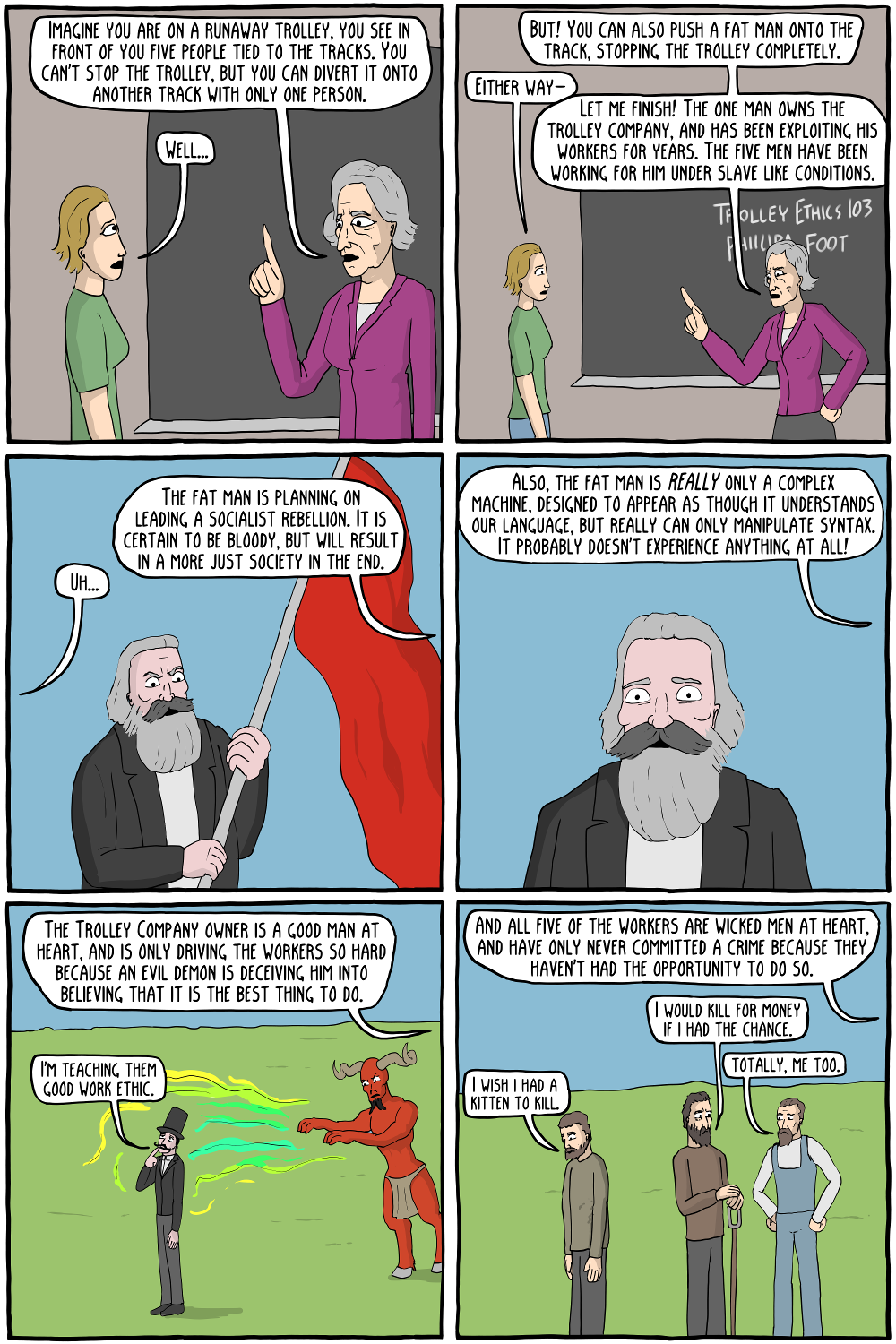
    The Trolley Problem, with extra bells and whistles.

    Plus there is like a 50/50 chance that you are just a brain in a vat, so none of this matters

    Philosophers in this comic: Philippa Foot

    Support the comic on Patreon

  • Hedy Lamarr

    Check out today’s marvelous Google doodle, stashed on YouTube

  • A smackdown for the BJP

    Very good news: elections yesterday in Bihar, India, were a resounding rejection of Modi and the BJP.

    Prime MinisterNarendra Modi of India suffered a severe political setback on Sunday when the voters of Bihar, the country’s third most populous state, overwhelmingly rejected his party in state assembly elections.

    Mr. Modi, who had eagerly cast the Bihar elections as a referendum on his first 17 months as India’s leader, acknowledged defeat shortly after noon.

    Recriminations were swift within his Bharatiya Janata Party, or B.J.P. Some party leaders questioned whether Mr. Modi had erred in the closing weeks of the Bihar campaign by elevating hard-right appeals to Hindu nationalism over his more unifying message of “vikas,” or development, for all Indians.

    Those appeals — in which Mr. Modi depicted his opponents as favoring Muslims and insulting cows, a revered Hindu holy symbol — fell flat in Bihar, a desperately poor state in eastern India where millions of people eke out a living as subsistence farmers without electricity, plumbing or even two meals a day.

    “Favoring Muslims and insulting cows” – would you believe it? Grown-up politics? It’s almost as embarrassing as US politics…and quite a lot more lethal. (People got killed over that bullshit about cows, you may remember.)

    The battle for Bihar, fought through five rounds of voting over the past five weeks, played out against a raging national debate over whether Mr. Modi’s India is becoming increasingly intolerant of secularists, Muslims and political dissent in general. According to the police, four Muslims were attacked and killed by mobs of Hindus in the past six weeks because they were suspected of stealing, smuggling or slaughtering cows.

    Hundreds of writers, filmmakers, scientists and academics have protested what they see as rising intolerance by signing petitions or returning awards they had received from government-supported bodies.

    I learned about this because Gita Sahgal posted a marvelous picture:

    Two writers – Nayantara Sahgal ( on right) and Kiran Nagarkar ( on left) watch Bihar election results at the home of Neelam Mansingh, one of India’s leading theatre directors. Hearts in mouth, waiting for fantastic election results.

    Congratulations, India.

  • Jingle jingle jingle

    I also like the Starbucks red cup.

    Starbucks Red Holiday Cups

    I like red, I like shades of red. It’s a nice cup.

    Apparently there’s a pretend-controversy about the cup as a new front in the war on Christmas.

    Ok so have this one then.

    Embedded image permalink

    Jamilah Lemieux

    Problem solved.

  • Pals

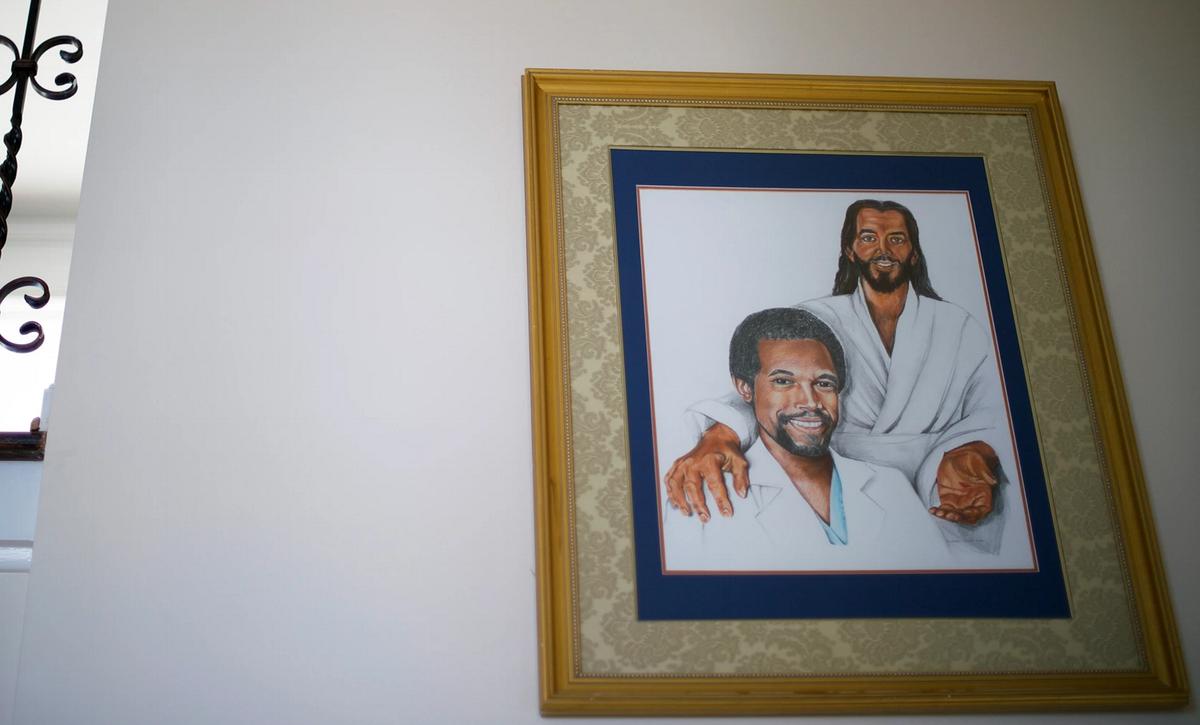
    I can’t help loving it that Ben Carson has a painting of himself with his buddy Jesus.

    Embedded image permalink

    Not just with Jesus, either, but with Jesus dropping a matey hand on his shoulder, and with the other hand telling the world, “Behold, here is my beloved Ben Carson, in whom I am well pleased.”

    Although…are they really sure that is Jesus? It’s not Ben Carson’s trainer? I’m not sure why Jesus would be wearing a snowy-white bathrobe, or sporting a ’70s goatee.

    But no, I’m just being blasphemous, I’m sure that’s the authentic Jesus, after a vigorous session on the elliptical.

  • They just started stabbing them

    The wife of one of the men injured in the Dhaka attack October 31st lives in Montreal. Nick Logan at Global News reported her story a few days ago. It includes gut-wrenching photos of him in the hospital.

    Monika Mistry said her husband, Tareq Rahim, was hacked multiple times in the head, hands and torso and was shot in the stomach. His condition has improved but he remains in critical condition, with a bullet still inside his body. Mistry’s afraid he could be attacked again.

    Rahim, she said, was meeting with writer friends Saturday afternoon in the office of Shuddhashar publishing house, in capital city Dhaka, when a purported group of Islamist extremists stormed in and began hacking them with machetes and cleavers. “They didn’t even talk. They just started stabbing them,” she said.

    Mistry had spoken with her husband just four hours before a friend in London, England called her in the middle of the night to let her know about the attack.

    She said she feels powerless to be on the other side of the world while her husband is fighting for his life. Mistry, a Bangladeshi who came to Canada in 2006 and now lives in Montreal with her daughter from a previous marriage, said she can’t afford to go back to Bangladesh to be with Rahim.

    In a way I’m glad she can’t afford to, because it would be dangerous for her.

    Mistry said she wants her 32-year-old husband to be in Canada, where interfaith marriage is more accepted; she’s from a Hindu family, he’s from a Muslim one.

    Something of an understatement there. Interfaith marriage is more accepted, secularism is more accepted, not being Hindu or Muslim or any other such label is more accepted.

    Mistry fears Rahim’s life will continue to be at risk because he survived the attack and the assailants are waiting to finish the job.

    “These killers, they’re on the street. You don’t know, maybe they’re walking around the hospitals because they couldn’t fulfill their mission. They wanted these people dead, but they’re not dead,” she said.

    Indeed. You never know. They can burst in anywhere.

    The Centre for Inquiry (CFI) Canada, a non-profit education organization, is leading calls for the newly elected Trudeau government to intervene in the case.

    “CFI Canada is making an appeal to the Canadian government, and certainly Justin Trudeau, to ask for some compassionate support for someone who would have likely been coming to Canada if they hadn’t been attacked by terrorists before getting a chance to do that,” said Executive Director Eric Adriaans.

    Well done CFI Canada.