Author: Ophelia Benson

  • Just two little tweaks

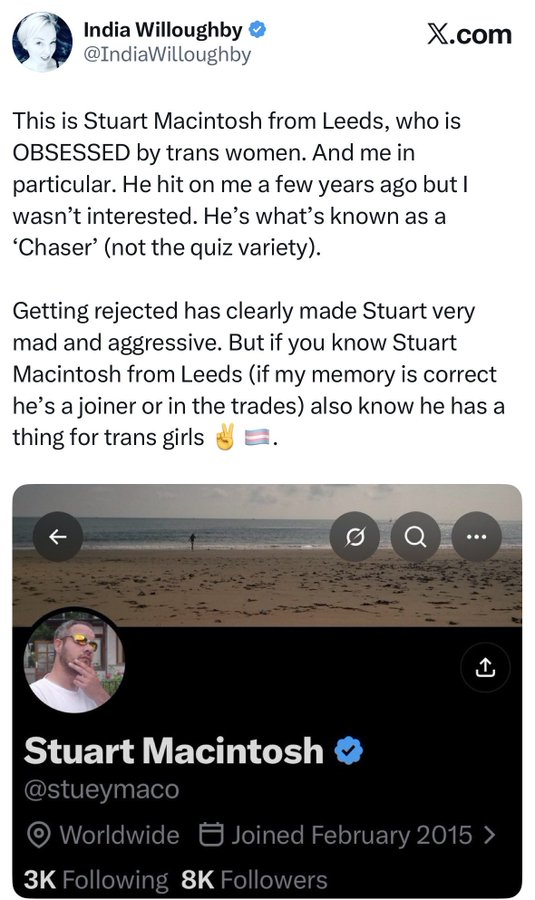
    Um…sir…there’s a lot more going on between those two photos than just hair and makeup.

    The tweaks are very many. The hairline is different. The eyes are very different. The mouth is different. The ears are all but invisible. The lower face and jaw are different. The length of the face is different. The Adam’s apple is deleted. The clothes are different. The black and white is made color. It’s a very very very fake photo there on the right.

    Here’s ChatGPT showing what he would have looked like if he had been a completely different person.

  • The relocation process

    Time to go.

    New Orleans is locked into a watery future which could see it surrounded by ocean as early as this century, according to a new expert analysis, which says the city must start the relocation process now to avoid chaos.

    The paper’s conclusions are stark, but it’s no secret that New Orleans is highly vulnerable to rising seas as the planet warms. Coastal Louisiana is one of the lowest lying regions in the world, and New Orleans, a city of 360,000 people, is particularly exposed. It sits in a bowl-shaped basin, mostly below sea level, in the middle of a rapidly shrinking delta.

    The region has “crossed the point of no return,” the paper’s authors wrote, adding New Orleans “may well be surrounded by the Gulf of Mexico before the end of this century.” They argue the city must seize the opportunity to develop strategies for relocation that could make it a model for places facing a similar fate.

    The thing is, though, “relocation” would be relocation of the people but not of the Nawlins. A city can’t be relocated, and that’s especially true when the site of the city is why it became a city in the first place and the reason it can’t stay where it is. N.O. is on the Mississippi and near the Gulf; there’s not going to be another city on the Mississippi and near the Gulf. See also New York City, and San Francisco, and Seattle.

    It’s possible to build new cities, far from major bodies of water, but they certainly won’t be clones of the old ones.

  • Pick your side of history

    The Times enters the ring with trans ideology. Rob Burley writes:

    When the new director-general of the BBC, Matt Brittin, introduced himself to staff last week it wasn’t long before he found himself addressing the handling of transgender issues by the corporation. “I’m not an expert,” he confessed, aware these were treacherous waters. “I’ve seen comments in the press over the weekend from Fran Unsworth [the BBC’s former director of news]. I’m not going to go into that. I don’t know the history.” Well, if you’re reading this, Matt, you’re in luck, because I do.

    Unsworth’s incendiary interview — part of my 10,000-word investigation into the capture of the BBC by trans activism, published by Unherd — was the first account of life at the top of the BBC during, for want of a better phrase, peak woke. Fran opened up about the way “progressive madness”, especially transgender rights, consumed the BBC and ultimately led her to end her 40-year BBC career.

    Only it’s not actually progressive. It puts on the skirts and lipstick of progressive but its beliefs and actions are very regressive indeed. The believers think trans ideology is progressive, of course, but they’re profoundly wrong. That’s the fight in a nutshell.

    For many of the BBC staff, if Stonewall thought something, it was probably right and supporting a vulnerable group such as trans people who were fighting for their rights was a no-brainer. If Stonewall says list your pronouns then that was the right thing to do.

    Reinforcing this was a desire not to be “on the wrong side of history”, a mantra BBC executives told me they recalled hearing time and time again from the growing number of true believers. This approach discouraged critical thinking and made the position on trans rights an article of faith, as witnessed by the repetitious insistence that “trans women are women”.

    But which was the wrong side of history? How was it so self-evident to so many people that the side of bulldozing women’s rights was the right side of history?

    As the groupthink started to be reflected in the output, numerous people refused to fall into line. People like the scriptwriter Cathy Leng, who told me how she had questioned the use of inaccurate pronouns and was ostracised by her peers and disciplined by her managers. And others, particularly women, who (anonymously) reported hatred directed at them for suggesting stories that were less than affirmative about trans rights.

    In this environment, in late 2017, Theresa May announced plans to introduce self-ID, making it much easier for people to legally change gender. The initiative enjoyed cross-party support. The women campaigners who feared that it would grant access to women’s-only spaces to biological men were largely ignored by the BBC.

    Largely ignored for ten long years.

    All of this raised serious questions for BBC management and it was frustrating that only one (Gavin Allen, the former head of programmes) would speak to me on the record. Knowing it was a long shot, I put in a speculative bid for Fran Unsworth, the former director of news. I didn’t expect her to say yes or, when she did, to be so candid. I called her in Australia where she spends part of the year and it quickly became clear that she believed she had reached the pinnacle of BBC News just as, in her view, the world went mad. “It was bullying,” she said, “but it wasn’t just the trans issue. There was lots and lots of bullying going on about all sorts of things: people didn’t want to hear from certain points of view; they’d ‘no platform’ them; all that safe spaces shit.”

    When I asked her about the BBC management’s failure to get a grip on the trans problem, her first instinct was to mitigate the charge. “I think you have to remember that this wasn’t something that just affected the BBC at this point,” she said, “The world went mad, and the BBC, because it is part of the world, went a bit mad with it. There was a sort of progressive madness going on.” I’d heard this argument before and I didn’t buy it.

    Yeah I don’t buy it either. The BBC didn’t just fall off the apple cart yesterday. The BBC has been around the block a few times, and should know how to look at a new and peculiar ideology with a skeptical squint.

    “It’s what you might expect of arts institutions or universities,” I said to Unsworth, “but we are journalists. Journalists are sceptical people. They don’t just lie down. They’re supposed to stand up there and think about it first. And there was an absolute absence of that, and just a complete caving.” I could tell this stung. “I don’t feel I completely caved. I really don’t. But I do think that it [the trans right issue] could have done with something more robust.”

    I put it to her that some BBC News journalists, including editors, thought that there was only one legitimate viewpoint on trans issues and that everyone else was wrong. “Yeah,” she says, “that was how it was.” And it affected everybody. “There was a sea in which we all swam,” she recalled “… an atmosphere. We need to be kind to transitioning people. It’s a social phenomenon. And I think this ‘be kind’ thing was at the heart of it.”

    But why? That claim explains nothing. Why was “be kind” suddenly the job? Why, especially, when the “be kind” actually meant “be kind to men who pretend to be women”? Why is the job to “be kind” to this one particular set of people at the expense of half of all humans?

    The most extraordinary part of our conversation came when we turned to discuss the question at the heart of all this: are trans women women? Unsworth told me that “impartiality only operates when you can look at evidence and facts and point to them as the basis of your reporting”. Until the Supreme Court ruling made clear last year that a woman — for the purposes of the Equality Act — meant a biological woman, she said, “the facts at this point were incredibly disputed”.

    No they weren’t. There was a noisy political campaign to try to make them disputed, but 99% of people still knew that men are not women. Noisy political campaigns aren’t necessarily the best source of truth.

  • Undermining the vis

    The struggle to erase women continues.

    Holyrood‘s new Presiding Officer has been urged to act after the Scottish Parliament removed information about the sex of MSPs from its website.

    Kenneth Gibson was told the decision “risks undermining the visibility of women’s representation in public life”.

    In the last session of the parliament, users of the website were able to filter MSPs by male or female.

    Yes but this is now, when we have realized that female people just don’t matter. Try to keep up.

    Two Conservative MSPs have written to Kenneth Gibson asking to explain the thinking behind the change.

    In the letter, Meghan Gallacher and Rachael Hamilton said: “As female MSPs, we believe it is important that women continue to be clearly and transparently represented within the Parliament’s official records and public-facing information.

    “The removal of female as a distinct category risks undermining the visibility of women’s representation in public life and makes it more difficult to accurately assess progress relating to female participation within Scottish politics.”

    Yes, it does, and that’s why they did it. Women must be erased and stifled and ignored.

    Dr Kath Murray, of policy collective Murray Blackburn Mackenzie, said the change had the effect of “obscuring” female representation.

    For Women Scotland said the only way to measure progress was “to count the number of women elected”.

    But the Scottish Parliament won’t be able to hear them. Women, you see – they’re inaudible. Much too loud of course, but nevertheless inaudible.

  • Anyone with any sense knows this

    So…

    So……? So women must be subjected to humiliation, abuse and violence instead. Obviously. Women must fall on the grenades to save the men who pretend to be women. Everyone knows this. It’s what women are for.

  • The consensus temptation

    Something Bjarte said that resonated with me:

    Once again, if the fate of Movement Atheism™ should have taught us any lessons, it’s that rejecting one particular subset of unjustified beliefs does not amount to rejection of bad ideas in general, nor does it imply that everyone who rejects said beliefs is doing so for the right reasons.

    It’s true, and the temptation to get it wrong is always there. We want everything to fit together. We want that kind of simplicity and coherence; we want one thingism. I oppose this and also that, and you have to do the same. It’s like having a bit of ash in your eye to bump up against someone being right (in your book) about one thing and wrong (in your book) about another.

    This is probably what Adam and Eve squabbling over an apple was all about. There they were, all happy and perfect, and then they had to go and disagree about something. Result: she tempted him and he fell. (The misogyny aspect is a separate issue.) Harmony over! Apple yes, apple no, apple yes or no sex for you.

    There’s agreement or there’s war; no in-between.

  • Shrinking

    As the brain rot deepens he admits more and more.

    He’s been doing this all along, of course – he thinks he’s funny and kind of adorable, a standup comic of thieving bullies. He’ll go on thinking it until his brain is 100 percent soup, but he’ll also admit more and more rebarbative malice and envy. Hur hur hur, so funny, he can’t stand to see a friend happy.

  • Speaking of rhetorically loaded lingo

    Apparently it’s a “trans panic”.

    I’m quoting in medias res because the first few paragraphs are too boring to share.

    The whole website brouhaha is another great example of For Women Scotland and the gender critical movement using rhetorically loaded lingo with a sprinkling of statistics to cover what is fundamentally a whiny moral-panic argument. 

    Objecting to men calling themselves women and stealing everything we have won is a “moral panic”? Men sandblasting women’s rights is no big deal?

    The real problem for women in Scottish politics is that, according to research by feminist group Engender, a record number of women MSPs chose not to stand for re-election this year. When asked why, two of the reasons for leaving were misogynistic abuse (including on social media) and threats to safety. None of their recommendations for dealing with the reasons women leave politics had to do with defining womanhood.

    The Jo Cox Foundation found that between 2023 and 2024, abuse towards women MSPs increased more than a hundred-fold, and in a 2025 survey, 84% of women councillors in England and Wales reported experiencing abuse or intimidation. Step back a bit further, and the wider reality is that domestic abuse incidents in Scotland surged 25% from 2024 to 2025, alongside a 21% rise in indecent communications and a 20% increase in indecent images of children.

    How does any of that mean or imply or hint that knowing men are not women is beside the point? If we’re not allowed to know which MSPs are women MSPs, how can we find out how much abuse toward women MSPs increased? Or anything else along those lines? Talking about abuse of women MPS becomes meaningless, so why is Marissa MacWhirter talking about it?

    For Women Scotland rhetorically claims to be “working to protect and strengthen women and children’s rights”, but in practice, its campaigns and legal actions focus largely on opposing trans inclusion. I scoured their website and statements in mainstream media and found no evidence of any campaign, statement, press release, or public condemnation specifically addressing online abuse, misogynistic trolling, threats, or harassment of women politicians in Scotland. Talk about invisible women – their silence is telling.

    See above. How can we talk about online abuse, misogynistic trolling, threats, or harassment of women politicians if we can’t say which people are women?

    How do they not get it? How do they not get that redefining women to include men who say they are women makes it impossible to track or prevent online abuse of women and all the rest of the armory against women?

    In March last year, sociologist Sally Hines published a peer-reviewed paper tracing the history of trans-exclusionary politics in the UK from the 1970s to the present. 

    Ah well. She cites Sally Hines. A hopeless case.

  • Guest post: Not as the side of truth but as the side of good

    Originally a comment by Artymorty on When the rights of one group are eroded.

    It is pathetic. And it’s a damn terrible shame that so many gender-critical groups didn’t have the foresight to stay away from the legitimately terrible right-wing orgs that wooed them. The Alliance Defending Freedom, the American College of Pediatricians, arrays of neocon/libertarian/Brexit groups, right-wing think tanks, and on and on.

    It’s very, very, very hard to get the message across that we’re the good guys when so many of the loudest voices on our side constantly, willingly align themselves with the bad guys.

    Whatever calculus people did in their heads to rationalize these dubious alliances, or to keep their objections quiet when they saw them, the math was wrong. It didn’t benefit these gender-critical groups to publicly align themselves with toxic right-wing organizations. And it hasn’t benefited the quiet majority of GC activists to not denounce those ill-advised ties more vocally.

    All the logic and reason in the world is on our side, but this war isn’t being fought in the domain of logic and reason. It’s about political image, identity, and tribal affiliation. The gender movement has sold itself not as the side of truth but as the side of good. It’s awfully hard to fight that when so many of its opponents really aren’t good. Tribal allegiance is instinctual, deep-rooted, and liable to shut down any challenge to it the instant it smells danger. Just one connection to the Alliance Defending Freedom is enough for most people to shut out someone who’s trying to get them to change their mind.

    I guess it’s a preaching-to-the-choir kind of phenomenon: the kinds of people who’ve already come over to the gender-critical side are the ones who don’t have such a strong tribalistic association with the gender movement, and who are therefore not as bothered by its association with toxic allies like the ADF. They were blind to the fact that to everyone else, that’s the most important thing that’s keeping them from buying into it. The GC early adopters have failed to see that they are the psychological outliers, and that’s why they’re not succeeding at selling their view to the people they most need to get through to — those who are tribally loyal to the left.

    It’s just made an already very difficult political pitch even harder to sell.

  • When the rights of one group are eroded

    Amnesty International UK:

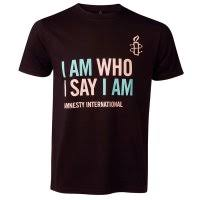
    NEW RESEARCH: Exposing the anti-trans networks

    A hostile environment against trans people did not emerge overnight.

    Amnesty’s new research traces the rise of the UK’s “gender critical” movement and the role the media have played in normalising anti-trans narratives.

    Anti-trans movements are increasingly connected to wider anti-trans networks like the US organisation the Alliance Defending Freedom which worked to overturn Roe vs Wade and access to abortion care.

    When the rights of one group are eroded, the consequences never stop there.

    Solidarity matters. For those who want to take our rights away, it’s their worst nightmare.

    Trans rights are human rights.

    Read the research.

    But what are “trans rights”?

    People who call themselves trans should have human rights of course, but if there are new rights that are specific to trans people, they may not be rights at all. There is no right to force people to agree with one’s personal fantasy idenniny. We can all daydream that we are magic or brilliant or supernatural or twenty feet tall or from a distant planet, but none of that generates a right to make other people endorse our daydreams.

    It’s pathetic to see Amnesty International recycling this fatuous bilge.

  • Highly unusual

    Shameless.

    On Tuesday, the Internal Revenue Service agreed to drop all pending probes of Trump over whether he’s paid his fair share of taxes, to settle a lawsuit brought by the president over a leak of his tax returns. That could include, assuming it was ongoing, a long-standing audit into a technique Trump reportedly used to avoid paying taxes years ago that could have hit him with an estimated $100 million bill if the IRS found wrongdoing.

    Seems fair.

    Details of IRS audits are not public and the merits of each side’s arguments are impossible to tell. But the way the president’s case against his own government’s IRS was resolved is highly unusual, experts say.

    Trump sued the IRS, a federal agency within his administration, putting him in the unusual position of challenging an agency overseen by the executive branch he leads — a rare move, experts say, and possibly unprecedented. Then that agency decided, in another unusual move, to grant him immunity.

    Unprecedented and, how shall I put this – flagrantly corrupt.

    Under the settlement to resolve Trump’s $10 billion lawsuit over the 2018 leak of his tax returns to The New York Times, the U.S. is “forever barred and precluded” from examining or prosecuting Trump, his sons and the Trump Organization’s current tax filings, according to a one-page document released Tuesday. That was quietly added to an original settlement establishing a $1.8 billion fund to compensate people who Trump thinks were improperly investigated by the government.

    Tax experts say this grant of immunity is shocking in the breadth of protection it offers the president and could undermine confidence in the fairness of the tax system.

    Why yes, it is shocking, and yes, it could, in fact inevitably will, cause people to think the system is not 100% fair.

    The IRS probe revolved around whether Trump doubled-dipped in cutting his taxes, according to a 2024 report by The New York Times and ProPublica — specifically whether he used the same losses from his Chicago skyscraper to cut them twice in future filings, a big no-no.

    The report said Trump could owe more than $100 million, including penalties, if he were to lose the audit battle.

    Now the Justice Department has moved to “wipe his slate clean,” said tax expert Brandon DeBot, calling that an “extraordinary action” in the message it sends to the country.

    You mean the message that Trump can do whatever he wants all the time? Yes, that is rather irritating.

    “This is the president trying to play every role in the system, acting as plaintiff, defendant, and his own judge and jury to extract extraordinary windfalls,” said New York University’s DeBot, adding that giving broad immunity “stretches beyond what DOJ actually has authority to do.”

    Isn’t Trump an adorable scamp?

  • Lower than a snake’s belly

    Kishwer Falkner responds to Bridget Phillipson’s insult.

    She certainly stoops low – and for the cause of diminishing women’s rights, at that. How does she sleep at night?

  • Clueless in Parliament

    Nadia Whittome MP writes:

    While it appears that the government has successfully pushed back on some particularly harmful elements in the previous draft, the new Code of Practice will still lead to the exclusion of trans people from services and facilities that they have used without issue for a very long time.

    Without issues, she means. Without issue=without offspring.

    Anyway, no they haven’t; of course they haven’t. Women have been pointing out and objecting to the “issues” for at least a decade. It is not the case that there was a peaceful utopia in which men used women’s toilets and rape crisis institutions and women were perfectly fine with it. Not listening does not mean the objection never happened.

    This will do nothing to improve women’s lives and the many struggles we face, but it will put trans people (and anyone perceived as trans) at increased risk of discrimination, harassment and violence.

    Letting men use women’s toilets and rape crisis institutions is increased discrimination, harassment and violence against women. It’s not hypothetical; making sure that women can’t avoid men in any circumstances=violence against women.

    The Code unfortunately still represents the culmination of years of anti-trans campaigning from a small, well-funded minority who have had outsized influence in the media and in politics, and have weaponised the courts for their own ends.

    It’s not anti-trans; we don’t care about trans; trans is meaningless. It’s anti-removal of all places of safety for women.

    The legal situation for trans people is now deeply incoherent and means that it is untenable for them to be able live their lives with dignity. This is completely out of line with the values of equality that a Labour government is meant to champion. Instead of making this Code statutory, the government should be legislating to clarify and protect trans people’s rights, privacy and inclusion.

    At the expense of women’s rights, privacy, and inclusion. How is that fair? Please remind.

  • Yes but no

    Well ok if you insist, but you can’t enforce it.

    New government guidance has said that transgender people should not be asked what sex they are before they use toilets or changing rooms.

    But what if it’s a man using a women’s toilet or changing room? Are women just supposed to shrug and give up?

    The long-awaited updated code of practice, from the Equality and Human Rights Commission (EHRC), confirms that single-sex space facilities in businesses and public buildings must be used based on biological sex.

    However, it also warns firms that it would not be “practical or appropriate” for staff to challenge individuals they suspected were using the wrong lavatory or changing room.

    So…we’re right back where we started, but with a little ribbon on top. Yes you can have your spaces for women, but no you can’t tell a man to get out. Contradiction much?

    The EHRC guidance, approved by Bridget Phillipson, the minister for women and equalities, was published on Thursday…

    Under the guidelines, businesses and public bodies must ensure that toilets, changing facilities and sports teams are segregated based on biological sex and not gender identity.

    The code makes clear that transgender people should instead be offered a third or gender-neutral space. Leaving a trans person without access to any facilities or services would be unlikely to be proportionate and could be discriminatory, the guidance warns.

    But a trans person in that scenario would have access to the facilities for her/his sex. It does not leave a trans person without access to any facilities.

    The guidance states: “It is unlikely to be either practical or appropriate to approach any particular individual to make enquiries about their sex in relation to facilities, such as toilets, which are incidental to the primary service.”

    Notice how this casually makes the victim the aggressor. The man in the women’s toilet is the one who has done the inappropriate “approaching” here. We do get to tell him to get out, and raise the alarm if he refuses.

    The code also says that if “individuals are asked about their sex in a way that requires them to disclose this information in public, or if the language or manner of a request is rude, combative or offensive”, this could be deemed as “discrimination or harassment”.

    Men intruding in women’s toilets are being rude, combative and offensive, and they are the ones doing the harassing.

    Maya Forstater, the chief executive of women’s rights charity Sex Matters, said: “The guidance could be clearer that service providers are entitled to ask people to state their sex, and to require an honest answer.

    “It’s absurd to say that it is ‘unlikely to be either practical or appropriate’ to ask an individual what sex they are in relation to facilities such as toilets: on the contrary, if a man walks into a women’s space it will be not just appropriate to challenge him, but essential.

    “Otherwise women’s rights to single-sex spaces cannot be enforced.”

    Precisely.

    A source close to the minister said: “Bridget believes firmly in the importance of protecting single sex spaces for women, but this can be done in a way that ensures dignity for trans people too: it is not an either-or.

    “Bridget has ignored the frothing on both sides of the culture war and encouraged EHRC to focus on what matters: the dignity of everyone in our country. She will take no lectures on the rights of women just as she will never punch down on any minority.”

    No, she’ll just punch down on women from her position as a government minister.

  • This statement of the blindingly obvious

    At long last, the guidance.

    Finally, the Government’s long-awaited guidance on protecting single-sex spaces has been published. And it’s a bit of an anti-climax. There are no suffragette banners or burning bras. Instead, after a 13-month wait, we’ve been treated to a bland written statement, delivered to Parliament by Bridget Phillipson wearing her Minister for Women and Equalities hat.

    So seemingly begrudging is Phillipson’s acknowledgement that she has “approved the draft code” that we can almost see the accompanying grimace. Turn to it, and it is easy to see why. It makes clear that sex “refers to a male or a female of any age” and that “in relation to a group of people it refers to either men and/or boys, or women and /or girls”. This statement of the blindingly obvious should not be radical. But it so terrifies Labour’s activist set that Phillipson, for months, sat on her hands.

    Labour’s trans-obsessed set, that is. Activism per se is not a bad thing; the issue is what the activism is in aid of.

    On Thursday, all out of excuses, Phillipson could dither no more. It has fallen to her to instruct those in charge of schools, hospitals, and prisons that “sex means biological sex for the purposes of the Equality Act 2010”, with the proviso “that trans people are still protected by the Act under the protected characteristic of ‘gender reassignment’”. But, crucially, “A Gender Recognition Certificate (GRC) does not change a person’s sex for the purposes of the Act”.

    Doesn’t change it for any other purposes either. Nothing changes a person’s sex. We can’t change species, and we can’t change sex. We can’t become rocks or planets or stars; we can’t become ducks or petunias or the Taj Mahal.

    Of course, it’s not just Phillipson. From the Prime Minister down, the entire Labour Party seems to have believed six impossible things about sex and gender before breakfast. With so many about-turns to make, it is hardly surprising that Phillipson has dithered, and guidance has been pushed out on the final day before Parliament breaks for recess.

    But this delay has had real consequences. Across Britain, hospitals have continued to allow trans-identifying biological males to use women-only spaces such as wards, changing rooms and lavatories. Nurses like those from Darlington have been forced to fight expensive legal battles to ensure access to single-sex changing rooms. In Yorkshire, a mother had to sue her daughter’s all-girls school after it “secretly” admitted a boy who identified as female.

    Yeah well. They’re all just women, so it doesn’t matter.

    Even now, Phillipson’s interference helps explain why the EHRC’s code of practice runs to many pages, with multiple examples and plentiful caveats. One of the “tweaks” she demanded was more examples of how organisations can be “inclusive” and ensure that trans people have access to toilets and changing rooms.

    And so we have bizarre details of the circumstances in which someone can be asked to clarify their sex. The code states: “Evidence of such concern might include the individual’s physique or physical appearance, behaviour or concerns raised by other service users.” In other words, if someone looks like a man, then they might be a man. Most four-year-olds know this!

    Playing dress-up is all very well, but when adults do it they can run into complications.

  • Long-awaited equality guidance

    Delay, deny, befuddle, make up problems, catastrophize, wring hands over hypotheticals, look under the sofa, have a headache, ask the police for advice, say maybe next year.

    Long-awaited equality guidance has warned that transgender people should not routinely be challenged over which lavatories they use, despite setting out how gyms, leisure centres and hospitals can lawfully restrict services on the basis of biological sex.

    Well now wait a minute. How are we using “routinely”? And what does that mean anyway? If a man is in a women’s lavatory, then women get to tell him to get out. If he goes into the women’s lavatory routinely then they get to tell him to get out routinely – and more. They get to make a complaint about his doing it routinely. The burden should be on the men, not the women. Women are not at fault for telling men to get out.

    The final version [of the guidance] includes stronger references to protecting the dignity and safety of trans people, new sections on discrimination protections, and more limited circumstances in which trans people could be excluded than the original document put forward. 

    In other words the guidance has been weakened. Those bitchy women don’t get to have things all to themselves just because they need them. Bitches.

    Bridget Phillipson, the women and equalities minister, said that the guidance ensures the protection of “people’s rights across our country”.

    Well it sounds as if it doesn’t.

    A government source insisted that any changes from the original submission were not designed to water down the guidance, but to ensure that it could withstand legal scrutiny and work in practice.

    They said that ministers had pushed the EHRC to carry out a full consultation rather than attempt to “fast-track” the guidance after the judgment and criticised Baroness Falkner, the EHRC’s previous chair.

    They said that the “grandstanding of the previous EHRC leadership made this process harder than it needed to be: if time had been taken in the preparation, this could have been delivered sooner” and added: “The government had to battle to get the EHRC to run a proper consultation rather than a fast-tracked version — a shorter consultation could have made successful legal challenge more likely. 

    Falkner disputed the characterisation and said that “consultation processes are frequently extended when there is considerable interest as we discovered there was”. She said that Phillipson had thanked her for providing the draft code of practice when she left the EHRC, and added that she appreciated Falkner’s dedication. Falkner said: “To now have me, and my entire board, discredited in this manner is shameful.”

    It just never ends. How dare women try to defend our rights?

    Among the changes from the previous version is new wording which warned that requiring transgender people to use facilities that match their biological sex “may cause safety risks and distress for trans users”.

    Letting men barge into women’s facilities may cause safety risks and distress for women, but apparently that’s just so much dandelion fluff.

    Another section, included in both versions, said that it was “unlikely to be either practical or appropriate” for providers of ordinary facilities such as bathrooms to ask people to prove their sex.

    Maya Forstater, the chief executive of Sex Matters, described the section as “absurd”. She said: “On the contrary, if a man walks into a women’s space, it will be not just appropriate to challenge him, but essential. Otherwise women’s rights to single-sex spaces cannot be enforced.”

    That’s clearly the goal of all these tutters and hang-wringers.

  • The permanent tangent

    You hadda be there.

    Trump spoke to the assembled graduates of the US Coast Guard Academy on Wednesday, offering advice, congratulating them on their success … and also commenting on their bodies and going off on a tangent about every political achievement he considers himself to have made.

    “Our country is hot,” Trump said, while “under the last administration, we were a dead country.” 

    That’s probably only about the 500th time he’s said that. Maybe.

    “I hate good-looking men,” the 79-year-old Trump said, unprompted, as a young man being recognized for his excellent academic record approached the stage. When the student who’d scored highest in the fitness test came up, he told the crowd: “I wanna check him out … Look at the muscles on this guy! I just hit him on the shoulder and hurt my hand, it’s like hitting a rock!”

    The reason Trump cares about this stuff, he added, is because “it’s competition for me too. I have to compete with you now!” What that means is anyone’s guess, but never mind, because the next name on the list was the class president, who just happened to be Trump’s Achilles’ heel: a woman.

    “If I didn’t invite her up, I’d be accused of discrimination,” was what the president said when he came to Savannah Riera’s name. If that line sounds familiar to you, it’s because he used it a few months ago for the gold medal-winning women’s Olympic hockey team, when he “joked” that he would have to invite them to the State of the Union alongside their male counterparts for the same reason.

    Well sure but it’s such a fabulous joke that it’s acceptable for him to bring it out again. What could be funnier than telling them he wouldn’t invite a woman up if he didn’t have to? Hahahahaha hilarious.

    After almost an hour, it seemed that he was ready to round off his speech: he announced that he was going to offer a few words of hard-won life advice to the graduates. And, despite it all, this is probably where it became most weird.

    We’ve all become accustomed to this way that Trump does political rhetoric — the ideological stream-of-consciousness, the personal and political attacks, and the bombastic self-congratulation. But what’s most shocking at this point is how little he has to say when he gets the opportunity to speak from the heart. Those final words of advice were so basic and cliched as to be effectively meaningless.

    “Never, ever give up,” the president of the United States said, as if he were imparting some closely guarded secret. Also: “think big.” And lastly, “work hard.” 

    The way he does? Running his mouth, telling underlings which insults to post on Truth Social, spitting insults at women journalists? That kind of hard work?

  • Wait who is the small well-funded minority?

    Female MP requests more and more and more trampling of women’s rights.

    From the top:

    While it appears that the government has successfully pushed back on some particularly harmful elements in the previous draft, the new Code of Practice will still lead to the exclusion of trans people from services and facilities that they have used without issue for a very long time.

    This will do nothing to improve women’s lives and the many struggles we face, but it will put trans people (and anyone perceived as trans) at increased risk of discrimination, harassment and violence. The Code unfortunately still represents the culmination of years of anti-trans campaigning from a small, well-funded minority who have had outsized influence in the media and in politics, and have weaponised the courts for their own ends.

    The legal situation for trans people is now deeply incoherent and means that it is untenable for them to be able live their lives with dignity. This is completely out of line with the values of equality that a Labour government is meant to champion. Instead of making this Code statutory, the government should be legislating to clarify and protect trans people’s rights, privacy and inclusion.

    She means without issues, not without issue, which is formalese for no offspring. Anyway, of course men haven’t been using women’s services and facilities without any issues! Men have been using them with lots and lots of issues; that’s how we got here.

    Yes, keeping men out of women’s spaces, jobs, prizes, organizations and so on will do a lot to improve the lives of women who have found men in their spaces, jobs, prizes, organizations and so on. That’s the point. Men do harm to women by invading spaces and taking jobs and prizes and so on that are meant for women. Saying it won’t is mindless dogma.

    Why is our influence outsized? Furthermore, what about the influence trans activists have exercised? Don’t they punch well above their weight when it comes to chat about rights and dignity and all the rest of it?

    The government should not be legislating to clarify and protect trans people’s rights, privacy and inclusion at the expense of women’s rights, privacy and inclusion. Men who pretend to be women are not, repeat not, more vulnerable or more dismissed or more bullied or more ignored than women. Quite the reverse.

  • More glaring manifestations

    How do we explain Trump?

    Does he have dementia? Or are we seeing more glaring manifestations of his legendary arrogance, which is rooted in his profound insecurity? Or is it merely the stupidity of a man who not only never reads a book but reportedly can’t even read one-page briefing papers?

    He can probably read them, i.e. he would be able to pronounce the words (haltingly) if necessary, but grasping their meaning is another matter.

    Whatever the explanation, the bottom line is sobering: The person with the power to sic the Justice Department on perceived political foes; to send masked, heavily armed, and poorly trained troops out among the populace; and to order a nuclear attack is slipping. Maybe fast. And the chance that his Cabinet or his party will do anything about it is zero, which means we’re going to have to survive two and a half more years of this.

    Assuming he lives that long.

    Trump shows his age the most in the apparently diminished functioning of his frontal cortex—the thin layer of gray matter that helps the brain make decisions and regulate itself, the part of the brain that prevents you from saying the unkind or insane thing. Trump appears unable to hold himself back. He called a reporter “piggy.” He called another a “fresh person.” He confuses Greenland (which he wanted to invade) with Iceland.

    Ruder and ruder with every day that passes. He started from Already Very Rude Indeed, so the daily increase is less than edifying.

    After the mainstream media picked up on how aggressively random and disjointed his stump speeches had become, Trump gave it a name, “The Weave,” and said it was all intentional. But the claim was nonsense. The pattern has continued into his second term—recently, for example, in a late-March Cabinet meeting about the war, when he got lost in a five-minute digression on how much money he’d saved by using Sharpies to sign legislation and executive orders.

    Now, there are people who can talk and/or write in such a way as to weave meaning from digressions, interpolations, followings up, and the like. Montaigne for example. There are good thinkers/writers who can loosen the reins on their minds with good results. Trump is not one of them.

    The third thing that caught Segal’s ear was that, on certain occasions, Trump said or posted something really shocking even for him: “The outlandish things he’s been saying when people died, right? Like Robert Mueller, I am glad he’s dead, or Rob Reiner.” Maybe that’s just an older man losing patience with decorum, Segal said; but “this feels a little bit more like dysregulation. Like, ‘I have a wildly aggressive thought, I am just going to say it.’”

    Yeah boy when you combine the sadism of a Trump with the dysregulation of a Trump you get this monstrosity we hear from every day.

    After Trump’s crazed post on Easter Sunday, Vin Gupta made national headlines by posting on X: “Erratic. Can’t finish sentences. Often confused. Illogical train of thought. Word finding difficulties. Developing and worsening gradually over time. The President is exhibiting all the signs of dementia.”

    In an interview, Gupta kept returning to the word “impulsivity.” Speaking the week after Easter, he said: “I think his impulsivity and his erratic behavior, as we’ve all seen just in the last two weeks, seems like it’s getting worse. Like he just has less of a filter. Even at baseline, he had no filter. But it seems like the disinhibition is worse. And when you think about the family history, I think reasonable people can ask reasonable questions.”

    Yeah imagine starting with no filter and then getting worse.

  • The level of urgency

    For once Congress may block some of the crazy.

    A bipartisan House effort is afoot to kill the $1.8 billion “anti-weaponization” fund created by the Justice Department that could pay allies of President Donald Trump, according to three people granted anonymity to discuss the effort ahead of a formal announcement.

    Reps. Brian Fitzpatrick (R-Pa.) and Tom Suozzi (D-N.Y.) have drafted text and are taking steps to unveil the legislation soon, the people said.

    Speaker Mike Johnson raised the level of urgency to block the fund among some congressional skeptics when he refused to say Wednesday whether violent Jan. 6 convicts should have access to the taxpayer money.

    I found that sentence slightly confusing. I think it means Johnson’s refusal prompted skeptics to act.

    Fitzpatrick said in an interview Wednesday he’s waiting to hear back from the Justice Department regarding a list of questions he sent Acting Attorney General Todd Blanche seeking more information about who will be able to access the fund, which was created pursuant to a settlement between Trump and the IRS.

    Fitzpatrick said his constituents and others “don’t want a DOJ slush fund that has not been described or explained to anybody.”

    Too much even for some Republicans. I wish there were more of them though.