
Only he can’t remember what they are.
Author: Ophelia Benson
-
EU withdraws its own film on Afghan women prisoners
Half of Afghanistan’s women prisoners are there for being victims of rape or forced marriage or violence or all three.
-
Not just making it up
Chris Bertram at Crooked Timber was on the trail of internet misogyny last week too.
Anyone who blogs regularly gets annoyed by commenters. We do our best to screen out the worst here at Crooked Timber, but inevitably some get through, and, just as inevitably, they can sometimes upset us. But though I’ve had my intelligence, good judgement and moral character questioned many times, I’ve never had to cope with the kind of abuse female bloggers sometimes get. And the women at CT have had that too, from behind the protective shield of anonymity (though I did work out who on one occasion and warned a fairly prominent academic about what would happen if he came back).
Many interesting comments. This one from Henry Farrell (of Crooked Timber) for instance:
…you folks are only seeing the comments that make it through. There is a steady-ish (it is a little slacker at the moment) trickle of nasty stuff which doesn’t. Most of it, but not all, is drive-by. And the really vicious stuff is aimed at our women posters. The shit that we guys get is mostly laughably generic – communist, socialist, idiot-professors etc. The comments that the women posters get are more intense, vicious and personalized.
And John Quiggin, also of CT:
My experience here and elsewhere is entirely in line with Chris’ post. Even when being deliberately provocative, I don’t get anything like the abuse directed at women bloggers even on posts that would seem unlikely to offend anybody.
It’s not our imagination.
-
Unconvincing claims of exercising free speech
A week ago the Paris correspondent of Time, Bruce Crumley, wrote an article on the firebombing of Charlie Hebdo, saying…that we journalists and beneficiaries of free speech stand shoulder to shoulder with Charlie Hebdo?
No actually. Not that. Something different.
Okay, so can we finally stop with the idiotic, divisive, and destructive efforts
by “majority sections” of Western nations to bait Muslim members with petulant, futile demonstrations that “they” aren’t going to tell “us” what can and can’t be done in free societies? Because not only are such Islamophobic antics futile and childish, but they also openly beg for the very violent responses from extremists their authors claim to proudly defy in the name of common good. What common good is served by creating more division and anger, and by tempting belligerent reaction?Oh gee, I don’t know. I ask myself the same question whenever I have the audacity to write something and then go ahead and click “Publish” so that it appears online. Surely I’m just begging for the very misogynist responses from misogynists that I claim to proudly defy in the name of common good. Amirite? I tempt belligerent reaction several times every day. What do I think I’m doing!?! What does anyone think she’s doing by writing down what she thinks about something when she knows full well that someone somewhere could disagree with it and be tempted into belligerent reaction?! It’s such a petulant, futile thing to do, to say something that somebody might dislike.
The difficulty in answering that question is also what’s making it hard to have
much sympathy for the French satirical newspaper firebombed this morning, after it published another stupid and totally unnecessary edition mocking Islam. The Wednesday morning arson attack destroyed the Paris editorial offices of Charlie Hebdo after the paper published an issue certain to enrage hard-core Islamists (and offend average Muslims) with articles and “funny” cartoons featuring the Prophet Mohammed—depictions forbidden in Islam to boot.Stupid and totally unnecessary – so is it Forbidden to publish anything that’s not necessary now? And what are the criteria for “necessary”? And is the fact that something is certain to enrage hard-core Islamists a good reason not to do it? Women going out in public is also certain to enrage hard-core Islamists; should they therefore stay at home? And is “forbidden in Islam” a good reason for the whole world to not do something? Charlie Hebdo isn’t in Islam, so why should it care what is forbidden in Islam? The prohibitions of religions don’t apply to people who don’t adhere to the religions, after all. I know this is old news, as well as obvious, but this Crumley fella seems to have missed the memo.
We, by contrast, have another reaction to the firebombing: Sorry for your loss,
Charlie, and there’s no justification of such an illegitimate response
to your current edition. But do you still think the price you paid for
printing an offensive, shameful, and singularly humor-deficient parody on the
logic of “because we can” was so worthwhile? If so, good luck with those
charcoal drawings your pages will now be featuring.Oh good god, what a horrible brainless thug. He’s right up there with Brendan O’Neill. Sorry for your loss, he says sneeringly, and there’s no justification but all the same I will tell you how very bad and wrong you are – you the one who just had your offices and equipment destroyed. It was offensive and shameful so nyah nyah good luck with the charcoal.
…rather than issuing warnings to be careful about what one asks for, the arson
prompted political leaders and pundits across the board to denounce the arson as an attack on freedom of speech, liberty of expression, and other rights central to French and other Western societies.Oh jeezis mary and joseph, the guy is a journalist and he said that – he wants political leaders and pundits issuing warnings to be careful about what one “asks for” by writing or drawing cartoons! He wants them to do that instead of defending freedom of speech!
In 2007, Charlie Hebdo re-published the infamous (and, let’s face it,
just plain lame) Mohammed caricatures initially printed in 2005 by Danish paper Jyllands-Posten. As intended, those produced outrage–and at times violent reaction–from Muslims around the world (not to mention repeated terror plots to kill illustrators responsible for the drawings). Apart from unconvincing claims of exercising free speech in Western nations where that right no longer needs to be proved, it’s unclear what the objectives of the caricatures were other than to offend Muslims—and provoke hysteria among extremists.He says the caricatures were intended to produce outrage and violent reaction, and terror plots to kill the very cartoonists who apparently intended all this. He attacks the very idea of free speech in the act of informing us that it no longer needs to be “proved” – well with people like him around it sure as hell does.
…it’s just evident members of those same free societies have to exercise a
minimum of intelligence, calculation, civility and decency in practicing their
rights and liberties—and that isn’t happening when a newspaper decides to mock an entire faith on the logic that it can claim to make a politically noble
statement by gratuitously pissing people off.A minimum of calculation. We’re allowed to have free speech but we have to exercise a minimum of calculation before we actually use it – so we’re not actually allowed to have it at all. “Let’s see, will this cause Islamists to blow us up? Will this cause misogynists to threaten to rape me? Hmmmmm yes maybe; I’ll just go get drunk, instead.” There’s your free speech.
-
Mississippi “personhood” measure failed resoundingly
Personhood Florida views the fight for the rights of zygotes as a historically significant civil rights struggle on par with the fight against slavery.
-
Monks should not run school with history of sex abuse
In 2009 Father David Pearce, the former head of St Benedict’s School in Ealing, was jailed for eight years for abusing five students.
-
In France, solidarity with Charlie Hebdo
Politicos from every quarter of the French establishment are rushing to defend Charlie, including some who have threatened the magazine with defamation suits.
-
It’s the victim’s fault so be quiet
It’s the misogynist men who make the comments in the first place. They have inflamed the situation, not the women who are fighting back.
-
L’amour plus fort que la haine
Via Maryam – Charlie Hebdo says love is stronger than hate. C’est vrai!

-
Quiverful Duggars to have child # 20
Quiverful wants to raise up a cultural army to roll back modernity, and transform the US into a conservative Christian theocracy.
-
18, 19, 20!
Oh hey, what exciting news, the Duggars are going to have child # 20 – that is, Michelle Duggar is pregnant with child # 20. Quiverfull strikes another blow for theocracy.
The Quiverfull movement places emphasis on the importance of women submitting to their husbands and fathers, and is often recognized as a backlash to the gains made in women’s rights by the feminist movement. It is an anti-feminist backlash that holds that gender equality is contrary to God’s law and that women’s highest calling is as wives and “prolific” mothers. In line with other fundamentalist Christians, they believe a woman’s place is in the home, breeding children and serving her husband.
The movement embraces misogyny as God’s law. Women are reduced to breeders. Children reduced to metaphorical cannon fodder in to be brainwashed and sent out as cultural warriors, fighting for Christian dominion over America.
Yes yes yes, but let’s don’t be a party-pooper – they’re going to have another baaaaaaaybeeeeeeeeeee for Americans to watch on tv. Isn’t that cute?
-
Brave contrarian Brendan O’Neill
Brendan O’Neill is happy to characterize feminists as stupidly and feebly delicate and hyper-sensitive, and to use (or to allow the Telegraph to use) a 19th century illustration of a vapid woman tipping over to underline his sneer.
Would he be equally happy to see other people characterize Irish people as stupid and otherwise contemptible and use a 19th century cartoon to illustrate the sneer? Like this one maybe?
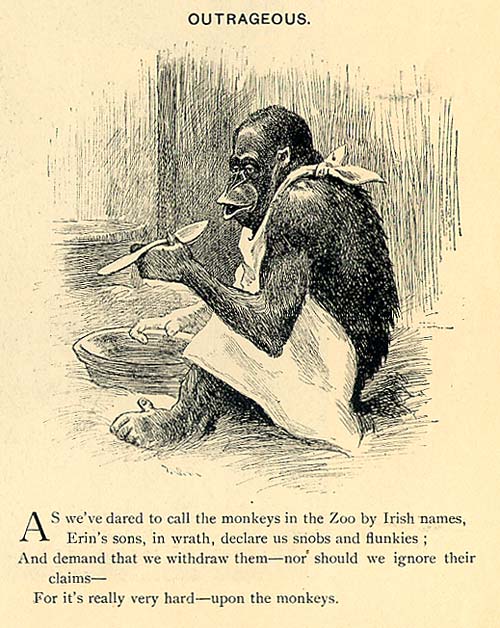
There are more where that came from. Does Brendan O’Neill of Spiked really want major media returning to the good old days of publishing insulting caricatures of Other racial and ethnic groups? Or is it just women, or just feminists, who are fair game for that kind of thing.
#mencallmethings
-
Anti-misogyny campaign goes viral
The standard policy of ignoring trolls is now being superseded by proposals that their comments be exposed to ridicule and rejection online to raise awareness of the issue.
-
Brendan O’Neill wins the sneering prize
Brendan O’Neill sneers again – this time at women resisting misogynist silencing campaigns.
One of the great curiosities of modern feminism is that the more radical the feminist is, the more likely she is to suffer fits of Victorian-style vapours upon hearing men use coarse language. Andrea Dworkin dedicated her life to stamping out what she called “hate speech” aimed at women. The Slutwalks women campaigned against everything from “verbal degradation” to “come ons”. And now, in another hilarious echo of the 19th-century notion that women need protecting from vulgar and foul speech, a collective of feminist bloggers has decided to “Stamp Out Misogyny Online”. Their deceptively edgy demeanour, their use of the word “stamp”, cannot disguise the fact that they are the 21st-century equivalent of Victorian chaperones, determined to shield women’s eyes and cover their ears lest they see or hear something upsetting.
Like this, he or the Telegraph helpfully illustrates:

Oh yes, that’s it exactly – we’re all falling over, because we’re so fragile and stupid.
Would even Brendan O’Neill sneer in quite such a contemptuous way if the issue were racism instead of misogyny? Would he (or the Telegraph) include a cartoon like that, mocking the very idea of disliking and resisting racism? I do him the credit to doubt that he would, and the discredit to point out that he has no business having different standards for women.
…the most striking thing about these fragile feminists’ campaign is the way it elides very different forms of speech. So the Guardian report lumps together “threats of rape”, which are of course serious, with “crude insults” and “unstinting ridicule”, which are not that serious. If I had a penny for every time I was crudely insulted on the internet, labelled a prick, a toad, a shit, a moron, a wide-eyed member of a crazy communist cult, I’d be relatively well-off.
He says, missing the point by a mile. A toad, a shit, a moron, are all generic. It’s interesting that he didn’t include any anti-Irish epithets, but even if he had, at this point in history they don’t have the bite that racist or homophobic or sexist ones do. (But I’m not Irish. Correct me if I’m wrong and they still have all the old bite.)
He prides himself on being a libertarian contrarian. That’s nice, but he doesn’t get to ignore reality to shore up his case. Being called a cunt is not the same kind of thing as being called a shit.
For better or worse, crudeness is part of the internet experience, and if you don’t like it you can always read The Lady instead.
He says, exemplifying the problem himself. Either you put up with being called a cunt every time you say anything or you have to go read something called “The Lady.” Why would those be the only choices? Why does Brendan O’Neill feel so comfortable letting his contempt for women show?
Muddying the historic philosophical distinction between words and actions, which has informed enlightened thinking for hundreds of years, is too high a price to pay just so some feminist bloggers can surf the web without having their delicate sensibilities riled.
Of course it is true that the standard of discussion on the internet leaves a lot to be desired. There is a remarkable amount of incivility and abusiveness on the web. But that is no excuse for attempting to turn the internet into the online equivalent of a Women’s Institute meeting, where no one ever raises their voice or “unstintingly ridicules” another or is crude. I would rather surf a web that caters for all, from the clever to the cranky, rather than put up with an internet designed according to the needs of a tiny number of peculiarly sensitive female bloggers.
More easy contempt – ”their delicate sensibilities,” “a Women’s Institute meeting,” “peculiarly sensitive female bloggers.” And one of the tags on that piece is, incredibly – “wallflowers.”
It’s just unbelievable.
-
Brendan O’Neill sneers at the campaign against misogyny
“The more radical the feminist is, the more likely she is to suffer fits of Victorian-style vapours upon hearing men use coarse language.”
-
Not as easy as you might think
You may think it’s a cinch getting rid of misogyny. Turns out it’s not. Sady at Tigerbeatdown started out thinking it was (or more like assuming it was without noticing she was assuming it – we all know how that goes), and then she realized it’s not.
In 2009, I genuinely believed people were going to change their minds about being sexist, because they read my blog.
I know, right? If only someone had come up with this plan before! All I had to do was register a WordPress domain, compose some charmingly ironic yet pointed analyses of Ye Aulde Patriarchy, cite some academics so they knew I wasn’t stupid, throw a lot of jokes and references to oral sex in there to prove feminists weren’t “humorless” or “frigid,” and the sexists, they would be delighted. So delighted they decided to stop being sexists! “Hmmmm,” they’d say. “Sady sure doesn’t appreciate it when I do the sexism. Since she’s my new Internet Best Friend, I had better cut that shit out pronto! Then we can all join a bowling league!” BLAM. REVOLUTION ACCOMPLISHED. No more problems, for anyone, ever, because I blogged.
I hate to tell you this, friends. But I think my plan, it had a minor flaw. Which is: Misogynists don’t like women. It doesn’t matter how uniquely charming and witty and acquainted with various fine bourbons you are. Are you a woman? Then they don’t like you. And they especially don’t like you telling them what to do. By, for example, asking them to cut it out with the misogyny.
There may be one exception to that rule. It may be that if you are a woman who likes misogynists then they do like you – for now. But apart from that, no.
What I got, friends, were comments. Comments about myself. And blogs about myself. And message-board discussions, also about myself. And e-mails. What I got was what every woman (feminist or not) and openly anti-sexist person (woman or not) on this our Internet gets: I got targeted. With threats, with insults, with smear campaigns, with attempts to threaten my employment or credibility or just general ability to get through the day with a healthy attitude and a minimal amount of insult.
This is a recurring problem! Not a Special Sady Problem, but an Everyone Problem. And, increasingly, folks are identifying it as such.
Which means we can count on the threats and insults and smear campaigns to expand hugely, but it also means we can do a better job of resisting.
-
What should we do about sexist abuse online?
Helen Lewis-Hasteley, Zoe Williams, Bella Mackie and Catherine Redfern offer suggestions.
