The exercise in narcissism

May 31st, 2014 12:42 pm | By

At The Federalist Society, Mollie Hemingway lets us know how much she hates #YesAllWomen. It’s the Federalist Society, so you know what to expect.

Elliot Rodger did what he did.

Social media responded by accepting the murderer’s hate-filled screed as a legitimate point of discourse and the starting point for a massive act of hashtag activism: #YesAllWomen. Traditional media followed suit: the narrative was found. Eleventy billion tweets describing how all women were victims of men spread throughout the U.S. and Europe and the media breathlessly covered the exercise in narcissism. They all agreed it was “powerful.”

Narcissism. That’s the kind of shit that makes me want to stab things. How is it fucking narcissism? I’m not the only woman in the world, so if I talk about issues that affect women, I’m not talking exclusively about myself, now am I. To repeat my questions of a few days ago, was it narcissism to see the bombing of the 16th Street Baptist Church as a racist attack? And to discuss it as such?

Narcissism would be, perhaps, taking a selfie of yourself crying or fuming, or perhaps tweeting “Never mind Elliot Rodger, what shoes shall I put on?” But talking about misogyny and misogynist culture? I don’t think so.

She goes on to give a list of “the ten most asinine things about #YesAllWomen”; take number 6 for example:

6) It’s A Mockery Of The Real Problems Women Face Throughout The World

As the #YesAllWomen craze spread, a woman was stoned by her family in Pakistan for marrying someone of her choice as opposed to someone of their arrangement. While the #YesAllWomen crowds talked about the unbearable horror of being whistled at on the street, annoyingly being told to smile, and being given gendered McDonald’s toys, more than 200 Nigerian girls remained in slavery to Islamist extremist rebels. While we turn the murder of six into a narcissistic contest of victimhood, a Sudanese Christian woman married to an American Christian man gave birth to a daughter in prison. She awaits her martyrdom for supposedly converting from Islam (because her father, who left her family, had been Muslim).

Oh yay, another Dear Muslima! Just what the world needs. Why? Because we can’t do both; we have to choose one; we can’t discuss both Islamist horrors and homegrown misognyist shooters. Except wait, what, why can’t we? No reason. Just a sneery snotty Dear Muslima from someone who hates feminism.


(This is a syndicated post. Read the original at FreeThoughtBlogs.)


Guest post by latsot on the Princess and pursuit

May 31st, 2014 11:15 am | By

Originally a comment on We are protagonists.

Prince Charming pursues The Princess(*). It is assumed that she wants this – regardless of her words or actions – and will eventually submit. Cinderella runs off at midnight but the prince decides to hunt her down like an animal declaring – without ever asking her – that he’ll marry the woman the slipper fits. If the prince wakes the princess with a kiss, it’s perfectly clear that she should be grateful to the point of *ahem* ‘marriage’. Then there’s the princess who only qualifies for marriage to the prince if she can pee through a dozen mattresses or something (**). He’s always the one setting the conditions and at the same time always assuming that the princess has no say in the matter. The reader is supposed to share that assumption.

Counter-examples? Well, the princess kisses the frog…. but the assumption is still that the princess automatically requires a prince. To the extent of going around kissing frogs. Which she presumably wouldn’t otherwise do.

I’m not convinced the counter-examples you’re thinking of are really counter, but by all means prove me wrong. Maybe it’s Beauty and the Beast? After all, The Beast is characterised and even *named* after his appearance and a person would have to be shallow not to see his inner beauty, right? Except that he *kidnaps* Beauty – who is also named after the one attribute that’s apparently important – until Stockholm Syndrome sets in, after which yet another ‘marriage’ occurs. I haven’t seen the movie but from what I understand, even the fucking candlesticks are complicit in this grooming and eventual rape.

But it’s just possible that fairy tales aren’t representative of literature and culture in general. Are there works of wider literature in which men have been objectified?

Sure.

Is this relevant to the discussion?

Nope.

We’re talking about the default. We’re talking about the bias we don’t notice but should. We’re talking about the biases people try to defend by citing (or in your case not even citing) exceptions as pertinent counter-examples.

Objectification in literature isn’t automatically bad. But I think it’s pretty much automatically bad when the bias in fucking fairy tales is indistinguishable from the bias we see in real life, don’t you?

(*) Interesting that the prince gets a name and the princess doesn’t. The prince’s name is about the attributes that are supposedly desirable to the princess. She wants a ‘charming’ prince, does she? She never said so. He told HER she did and his name exemplifies the attributes HE thinks SHE should value.

(**) H/T Terry Pratchett.

(This is a syndicated post. Read the original at FreeThoughtBlogs.)


Today she received the following threat

May 31st, 2014 9:42 am | By

Pamela Gay is being given a hard time again, a worse time than ever in fact.

She frames it as a mistake she made, a mistake in keeping quiet.

On Wednesday, I learned that there are at least two audio recordings of a meeting at a non-profit. In this meeting my mistake was discussed and now there is the chance that audio could go public.

And at this point, if it did, I’d support it because it would mean I could speak the truth frankly without fear of being sued for libel or slander by people with more resources than I have. It might mean that every few months, I wouldn’t have to deal with someone going, “there is this rumor” or getting out of the blue emails saying, “you know…”.

My mistake was not reporting that a drunken man in a prominent role tried to grab my breasts.

I’m writing this blog post to try and get out the truth, to get my story out before the internet gets ahold of this truth and of me, and before I am judged by the court of the blogosphere.

We know that happens. We’ve seen it happen.

This is what happened that night:

Dear friend X went to introduce me to famous person A in a bar at a science fiction convention. Famous Person A was quite intoxicated. Instead of shaking my hand, Famous Person A tried to grab my breasts. Another person I had just met, person B, intervened physically. My friend made excuses for the famous person. Person B became a new friend. There was at least one other witness. I moved on with my con.

There are many reasons I didn’t report it.

She explains the reasons. They all make sense. On the other hand there is fallout, and she has regrets.

The thing is, in all the years since 2008, I’ve had a stream of women coming to me saying, “Me too,” and sometimes they say, “Me too, only it was worse and no one intervened.” I have lived with that guilt – lived with knowing that I did nothing but maybe if I had done something …

And that, too, is a near-universal thing. Then on the other hand there are threats and intimidation. No wonder women sometimes don’t report it.

The only way I thought I could survive was to chew off my dignity. In order to succeed, I thought I had to make no waves and miss no opportunity. I don’t know if I was right or wrong about what would have happened to my career. I know that I am now a woman with a secure enough position to say, “No, more.”

I don’t write this lightly. This is a post that has been maturing inside me for 5 years as I worked to secure my future.

I touched on what happened during my 2011 [typo for 2012 - OB] TAM talk, in which I said: “Here in the skeptics community, we, like every other segment of society, have our share of individuals who, given the right combination of alcohol and proximity will grab tits and ass. I’ve had both body parts randomly and unexpectedly grabbed at in public places by people who attend this conference – not at this conference, but by people at this conference. Just like in astronomy, it’s a combination of the inebriated guys going too far – guys I can handle -  and of men in power being asses.” [link] While there were people in that audience who had successfully touched me without invitation or my desire, because someone intervened in 2008, at least Famous Guy A had only grabbed at me. But he could have done more – I was lucky. And, for the women who have said, “It was more with me,” I have mourned and regretted I didn’t do more. It was in part for them that I gave that talk.

She has written about the punishment she got for that talk.

And then things get truly ugly.

I touched on it again in this blog post when in October, Famous Person A emailed me out of the blue. He wrote, “This is a private email for you only. … I hate to disturb your day, but you should know that there are rumors flying about today generated by a woman named Y accusing me of groping a woman (specifically touching her breast) in public at either 1 or 2, and the rumor is that it is you. Y is posting on [social media] that she was specifically told this by B, who of course did no such thing since it isn’t true. … Thank you for keeping this email private.”

He has shared around my response.

I have PTSD. It’s origins are complex and old. I had put it behind me completely for years and forgot about this demon. But, after my TAM talk in 2012, I went thru a very special form of hell that brought it back. I got help, and it’s under control, but… there are days, and this email created a week of those days. I responded that it happened (including with the description above), ending it with this, “I appreciate you reaching out to me, and understand that you may have been drunk enough to have no memory of this event. If this is the case, I would strongly urge you to consider seeking help.“ He wrote back to me two more times, asking why I had never confronted him, urging me to talk with him on the phone, talking about how this could devastate his family, urging me to remain silent. I wrote back saying I didn’t want to talk.

But he didn’t leave it there.

I’ve since learned that Famous Person A has told people I contacted him out of the blue, saying I wanted to make it clear nothing happened. In other cases, he either forwarded my message or an edited version. I’ve seen parts of my message parroted back at me by people I never sent it to. I kept the bastard’s secret for fear of my career, and now I don’t use his name for fear of his attorneys… but my name?  That is something people are trying to harm.

That’s not yet the worst. It gets worse, and then worse again.

On Wednesday, I got an email indicating that there are recordings of B discussing what happened in his non-profit work place. I was cc’d on a chain of emails that resulted in person B denying my experience. I responded with the same “this is what happened” as above. I’ve gotten pages and pages back. And, person B started cc’ing Famous Person A,a man who is known to be litigious. It was clear these emails wanted me to retract my very simple account of what happened in 2008. I eventually wrote to the board of the non-profit because they need to know. If the audio of the recordings go public they’re going to have one hell of a mess, and … I’ve served on the board of enough non-profits to know that if there is even a perceived possibility of inappropriate behavior by organization members, that member needs dealt with before it effects the membership or organizational mission.

Today I received the following threat from the person I thought was my friend, the person who intervened for me, person B. It was in the context of trying to get me to say nothing ever happened. He wrote, “I will also publicly speak about this as necessary, providing all documentation as necessary, including photos, emails, etc., and contact all relevant employers, as well.” He cc’d Famous Person A.

Let me put that more clearly: someone who once prevented something that has been characterized as a potential sexual assault (that is what grabbing breasts is) threatened me while cc’ing the famous person he once protected me from.

So that’s where that is.

Share this widely if you can. Pamela wants it shared. They have all the power.

(This is a syndicated post. Read the original at FreeThoughtBlogs.)


Behold the false dichotomy

May 31st, 2014 8:13 am | By

JT Eberhard sees a mistake and comes to the rescue:

Elliot Rodger was mentally ill. That conversation needs to take place.

Huh. One, how does JT know that? Two, that conversation already is taking place, to put it mildly.

Ok so let’s read beyond the title.

There is a debate going on as to whether or not Elliot Rodger, the man who recently went on a killing spree in California, was mentally ill or if he was sane and driven by sexism.

No. That’s not the debate that’s going on. Hardly anyone is framing it as “either mentally ill or misogynist.” Also, the issue is not “driven by sexism” but “driven by misogyny” – intense, enraged hatred of women. What we see in Elliot Rodger along with far too many other men is beyond mere everyday sexism, which seems almost cozy in comparison, but inflamed rabid loathing of women as women.

When this all went down, it struck me that Elliot Rodger was probably suffering from some form of mental illness.

Whoa, how shrewd and percipient! Except that it struck everyone else in the population too, including people who know better than to take such snap judgments seriously. It’s not really worth mentioning that one’s first thought on hearing the news was “wo that dude was cray.” It’s certainly not worth treating it as a wise insight that should be followed up on.

Then JT tells us of his good fortune in having a friend who has a friend who wrote an article in Time minimizing the role of misogyny. Yes indeed, what a piece of luck. This two-degrees-of-separation friend is one Chris Ferguson – probably no relation to my friend Craig Ferguson, who is my friend because I watch his Late Late Show occasionally. Chris Ferguson hits the right patronizingly dismissive note:

Misogyny, in all forms, remains a significant problem for society. Women still don’t enjoy pay equity with men, and are underrepresented in core positions of power in business and politics. Violence toward women has thankfully dropped over the previous two decades, but remains intolerably high. The last election cycle brought us odd comments about “legitimate rape” and fights over women’s rights to contraception medical coverage. It’s not difficult to understand why women would perceive the deck being culturally stacked against them. That misogyny can, and certain does, spill over into violence in the case of (one hopes) a small percentage of men whose anger toward women is beyond control.

Linking cultural misogyny to a specific mass shooting is more difficult, however.

And so on. Take-away: don’t worry about it, laydeez. JT echoes the take-away.

Like Jaclyn said, this does not mean that sexism is not bad and that it should not be discussed.  Anybody saying that is wrong.  But by treating Rodger as sane so we can attribute the fullness of his rampage to our ideological enemies, we are missing the chance to get at the root cause of the mass murder (according to the psychological experts on mass murder).

Ahh yes, “our ideological enemies”; that’s what this is about. It’s about the same old shit – stop “dividing” the atheist “movement” laydeez, with your complaints about misogyny and harassment. Think of The Cause and shut up about it. We are all in this together and your concerns about misogyny and harassment don’t matter.

Nope.

(This is a syndicated post. Read the original at FreeThoughtBlogs.)


Why nine?

May 30th, 2014 5:39 pm | By

This is unusual – the BBC did a story on child (girl) marriage in Niger, and for once it actually said that religion backs the practice.

Niger also has one of the world’s highest rates of child marriage.

About 24% of girls will be married by the time they are 15. That rises to nearly 80% by the age of 18. It is a social phenomenon that affects all significant ethnic groups in Niger, including the majority Hausa community.

Hard-pressed families receive a “bride price” in return for their daughter’s hand in marriage. A girl married off is also one less mouth to feed.

(more…)

(This is a syndicated post. Read the original at FreeThoughtBlogs.)


We are protagonists

May 30th, 2014 4:44 pm | By

Yes this is what it is.

From Arthur Chu’s Your Princess Is in Another Castle: Misogyny, Entitlement, and Nerds at the Daily Beast.

(It’s about nerd sitcoms and the trope in which the “awkward but lovable [male] nerd has huge unreciprocated crush on hot non-nerdy popular girl.”)

He discusses some problems with that but then dives to the heart of it.

…the overall problem is one of a culture where instead of seeing women as, you know, people, protagonists of their own stories just like we are of ours, men are taught that women are things to “earn,” to “win.” That if we try hard enough and persist long enough, we’ll get the girl in the end. Like life is a video game and women, like money and status, are just part of the reward we get for doing well.

That. The failure to realize that women really are protagonists of their own stories, and the failure to give a shit even if you do realize it.

(This is a syndicated post. Read the original at FreeThoughtBlogs.)


Venn explains

May 30th, 2014 4:34 pm | By

Pliny the in-between’s take on the issue:

More.

(This is a syndicated post. Read the original at FreeThoughtBlogs.)


The land of denial

May 30th, 2014 3:31 pm | By

I finally did as I have seen many people urge everyone to do, and took a look at When Women Refuse on tumblr. It’s not fun or placid reading. Be warned.

Arthur Morgan III gets a life sentence for killing his 2-year-old daughter

Arthur Morgan III killed his 2-year-old daughter by throwing her into a creek while strapped into a car seat weighed down with a tire jack. He did it to get back at his ex for breaking off her relationship with him.

“It was because he wanted Imani and he couldn’t have her,” prosecutor Marc LeMieux said. “So he took away the one precious thing in her life.”

http://www.huffingtonpost.com/2014/05/28/arthur-morgan-iii-life-sentence_n_5403246.html

Principal murdered by husband

Two weeks after my son started kindergarten, the dynamic, amazing principal of his school was murdered by her husband after she told him that she wanted a divorce: http://www.post-gazette.com/local/city/2005/11/19/Flewellen-guilty-of-wife-s-murder/stories/200511190136.

(more…)

(This is a syndicated post. Read the original at FreeThoughtBlogs.)


Ask for the Harvey Milk stamps

May 30th, 2014 11:47 am | By

How completely disgusting.

The American Family Association. Daily Kos reports:

The American Family Association (a designatedhate group that still attracts genuflecting Republican politicians for some reason) is very,very angry that the United States Post Office saw fit to print a stamp honoring the late Harvey Milk, and they’re not going to take it anymore. To the crazymobile!

What you can do…1. Refuse to accept the Harvey Milk stamp if offered by your local post office. Instead, ask for a stamp of the United States flag.

2. Refuse to accept mail at your home or business if it is postmarked with the Harvey Milk stamp. Simply write ‘Return to Sender” on the envelope and tell your postman you won’t accept it.

ARE YOU KIDDING ME??

He was out and gay. He was elected a San Francisco Supervisor (their word for city council). He was murdered by a homophobic ex-cop who was also a supe.

How is any of that a reason to pitch a fit about his face on a stamp?

Harvey Milk forever stamp 2014

(This is a syndicated post. Read the original at FreeThoughtBlogs.)


Atheists who can’t see past that label

May 30th, 2014 11:28 am | By

Early this month Hemant posted a love note to the Secular Coalition for America.

I don’t love the SCA myself. I love it now a lot less than I did a week ago (which wasn’t much), because of its “Global Secular Council” and its way of responding to my questions about same. But Hemant, for some reason, is more gung ho about it. He did an email interview with Edwina Rogers that was worded in such a way as to indicate a certain amount of…distaste for her critics.

When you first took the position, the fact that you were a Republican was a point of controversy. Do you still get pushback from atheists who can’t see past that label? If so, how do you respond to it?

See there? Those atheists who thought a Republican lobbyist wasn’t an ideal choice for a secular organization “can’t see past that label.” It’s not that they have reasons for thinking there are tensions between the two, it’s that they can’t see past the label. How friendly.

As a female leader in our movement, what do you think are some of the biggest issues we must address as a community in regards to sexism?

We must continue to fight efforts to legislate away women’s rights on the basis of religion, especially the right of women to make their own health care decisions. Harmful legislation passed in many state legislatures this past year making it difficult or nearly impossible to get an abortion. Supporters claim they want to protect women, but in reality they are assaulting women’s bodily autonomy.

Our society needs to stop trying to control women’s sexuality. A woman’s right to a health care plan that includes contraception and abortion coverage is her choice, not her employer’s, not the government’s, and not the churches’. We also need to make sure we are teaching medically-accurate sexual education in our schools and eliminate the so called “slut-shaming” culture and damaging gender stereotypes that often come along with it.

Not a word about the sexism within the “community.” That’s not surprising, given how cozy the SCA is with Richard Dawkins and his eponymous foundation, but it’s cynical and annoying.

At the end Hemant sums up.

More importantly, I have yet to hear any reason that Rogers’ political affiliation has done any damage. While some of her responses still sound awkward (getting the attention of CPAC board members won’t win her many atheist fans…), I still believe there’s a benefit in getting Republicans to hear our message. It’s not like our side’s more progressive leaders will get GOP members to change their minds about atheists, so if anyone can, it’s her. (And if they don’t change their minds, well, it’s not like we were making any headway in the first place.)

I also appreciate that she hasn’t allowed herself to get dragged down by criticism that doesn’t affect her organization. She appears to be focused on her job — and doesn’t get distracted by commentary from Internet critics (for better or for worse). Her staff, in my experience, has worked in a similar way. They’re dedicated to their work and, while they hear what we’re saying, they won’t be getting into online wars anytime soon.

Another way of putting that would be “I also appreciate that she ignores all criticism from people outside her organization.” That’s a bizarre thing to appreciate. What’s so great about an organization’s ignoring criticism from its core demographic? The mere fact that people are on the Internet doesn’t magically turn them into aliens whose criticism is wholly irrelevant, especially if they criticize under their own names. I don’t think it’s clever of a secularist organization to display contempt for (let’s spell out what Hemant only implied) bloggers, since blogs can after all help with publicity and communication.

I’d love to hear from anyone who criticized Rogers’ appointment two years ago. Has your opinion changed since then? If not, what’s holding you back?

Yes my opinion has changed since then; it’s changed since last week; it’s gone way down.

(This is a syndicated post. Read the original at FreeThoughtBlogs.)


The people in the glossy photos

May 30th, 2014 10:17 am | By

Stephanie notices some things about the Secular Coalition for America and its brainchild The Global Secular Council (you know, the one that’s not the least bit global, in fact about as unglobal as you can get).

Will the people in the glossy photos do great work under the Global Secular Council banner? Hard to say. There are some people on that list who have done truly impressive work, but I find it a bit odd that they didn’t hold the launch of the website for the release of work from at least a few of them. I’d like to believe they had the time for that between dinner and going live. There had to at least have been work those people had done that they were willing to repurpose under the GSC banner, right?

Not as of launch, no. But maybe they’ll start producing their own content soon, something more than a blog, since that’s what they’ll need to influence government. They’ll have to produce in order to survive. Big names only bring in so many donations before people want them to do more than have dinners and get their pictures taken.

That seems plausible, although there do seem to be a surprisingly lot of people out there who are utterly entranced by people merely having dinners and getting their pictures taken.

This is particularly true when the parent organization has been the subject of financial mismanagement rumors for several months.

[Nope. I don't have anything but rumors on this one. They've come from multiple directions, which suggest they've gotten a lot of traction, but not necessarily that they're true. I have no idea what happened with SCA's finances, if anything, but that doesn't keep the rumors from making fundraising harder.]

So they’ll get productive, or they’ll sink. They don’t want my help with the first and wouldn’t need it with the second. Initiatives start and die every day.

Like restaurants and little shops selling silk scarves and crystal.

If SCA has some real challenges, they also have some outstanding assets, at least in potentia.

Speaking of those challenges–the lack of diversity, the huffiness and counterattacks in the face of criticism, the poor understanding of basic concepts revealed in that discussion–pulling those posts of Ophelia’s into one place finally made something click for me.

I was reminded of something I’d tweeted from Barbara Ehrenreich’s talk at Women in Secularism.

Barbara Ehrenreich recently invited to an atheism & science think tank a bit short on “ladies” to contribute on “women’s health”. 

I’d forgotten that. I took a lot of notes, because I forget everything, but I haven’t looked at the notes yet.

Then all this happened. Do I know that it was the GSC that invited Ehrenreich? No, but the description and timing sure fit.

Ohhh – I had not thought of that. If so…oy.

Here’s a piece of free advice for whomever is doing the invitations for the GSC: Don’t ever tell someone from an underrepresented group that you’re inviting them to help improve your representation.

No, I’m not telling you to lie by omission. I’m not telling you to cover up something that’s best not raised in polite company. I’m telling you inviting someone to help improve your representation is a crappy thing to do. Hell, it’s probably not even what you’re really doing anyway.

When you notice that your gender or other ratios are badly skewed, not at all representational of the community you claim to speak for (whether global or merely national), it’s a signal that your process was flawed. Maybe you’ve subconsciously been thinking that thinking in tanks is “more of a guy thing” or “more of a white thing”. Maybe the white men who fit your mission just get so much more press that they’re more easily called to mind when you’re brainstorming. Maybe the definition of “big-name atheist thinker” has been historically constructed in such a way that it largely excludes the thinking women and people of color do.

Or maybe you’ve had to take most of the outspoken feminists and anti-racists off your list for one political reason or another, and that made you shy about including marginalized people.

Whatever the reason, the fact that you’ve come up with a list of atheist thinkers and policy people that doesn’t include Barbara Ehrenreich should tell you that your process didn’t work right the first time. Your problem isn’t that you “don’t have enough ladies”. Your problem is that you left amazing talent on the table because your process failed you.

Yes, and yes, and yes. One after another. Especially Maybe the white men who fit your mission just get so much more press that they’re more easily called to mind – which is exactly what I thought when I saw the GSC’s list of “Experts,” and is exactly what I still think. It’s a list of mostly The Guys Who Come To Mind First – which, ironically (or is it ironic?), makes the list boring as well as contemptuous and insulting. Can you really not get away from DawkinsandKraussandHarris for even a second? Why Harris over and over and over and fucking over again, and Churchland never? Patricia Churchland is orders of magnitude more interesting than Harris, but we get Harris for breakfast lunch tea and dinner, year in and year out. And then to take up Steph’s point, why Harris rather than Ehrenreich? And to take up my points from last week, why Harris rather than Namazie or Nasreen or Sahgal? Why is Sam Harris thought to be infinitely interesting, so that people want to hear him talk again and again and again and again, while Ehrenreich and Namzie and Nasreen are thought to be not interesting at all, so that people don’t want to hear them talk even once?

I don’t know if it’s just laziness or just a brainless hero-worship, but either way, it’s deeply unimpressive.

(This is a syndicated post. Read the original at FreeThoughtBlogs.)


Guest post by Rob Tarzwell: #YesYouBuddy – Hopeful Confessions of a Recovering Misogynist

May 30th, 2014 9:20 am | By

Rob posted this on Facebook, following up on a comment he made on a Facebook thread of mine about Elliot Rodger and misogyny (one of many this past week). I and others suggested he expand on the comment and this is that expansion. He gave me permission to publish it.

On 6 December 1989, a 25 year old failing Engineering student in Montreal roamed the corridors of the Ecole Polytechnique.  He separated the male from the female students, screamed “I hate feminists!” and in 20 minutes, 27 women were shot or stabbed.  14 died.  He then killed himself.  His suicide note revealed he blamed women for his failures.  He had also intended to target a Quebec female union leader, firefighter, and police captain.

I don’t remember how I got that news.  As it spread, deathly silence was everywhere on my undergrad campus.  What few conversations occurred were whispered.  The atmosphere around the campus Women’s Centre was thick and tense.

Up to this point, I had viewed the Centre with disdain.  What do women need a centre for?  Why aren’t men permitted inside?  Why am I forced to subsidize a facility with my own student fees to which I have no access?  Of course, never once did it occur to me that I also did not have access to most science labs, engineering labs, faculty offices, janitorial closets, etcetera.  Even if it had, I’d have quickly rationalized that limited access as quite reasonable:  “I don’t know what I’m doing in there, and I could easily damage something.”  If you take that exact rationale and replace “something” with “someone,” it’s immediately clear why I didn’t belong in the Women’s Centre.  It’s also immediately clear I had more respect for glassware and microchips than for human beings.

That disdain was, furthermore, buttressed by fundamentalist Christian ideology.  I nodded along sagely when a woman in my church said, “See what happens when just one man turns on women?  Feminists have brought this upon themselves.  God has given women a place subordinate to men.  Feminists have moved outside the will of God, and this is his punishment.”  Somehow that never quite sat right with me.  Unfortunately, I never examined that inner discomfort and solved my own cognitive dissonance by simply pursuing my degree and preparing to head off to the Air Force.

At the same time, because of the 1982 Canadian Charter of Rights and Freedoms, a number of test cases established that women could not be denied access to combat roles.  Again, I justified my disapproval of this decision with thoughts like, “Who on earth would go to the Supreme Court to gain the right to fight in war?  Why renounce the ultimate get out of jail free card?”  The irony that I myself was preparing for a combat role in antisubmarine warfare, proudly and voluntarily, was completely lost on me.  Hypocrisy compartmentalizes the soul in fascinating ways.

The next disconfirmation of my self-satisfied sexism occurred during my operational tour.  By coincidence, a woman I had graduated from SFU with went through basic officer training at the same time I did, then air navigation school and operational training within a few months of one another, ultimately being posted to the same maritime patrol squadron, pursuing our craft essentially simultaneously.  On squadron, LCol (then Capt) Joy Klammer progressed much faster than me, and because of those Charter test cases, she became the first female TacNav (Tactical Navigator – the quarterback of the antisubmarine warfare mission, ultimately responsible for detecting, localizing, tracking and attacking an enemy submarine) in Canadian history.  And she was good – really good.  Of course, I’d only have grudgingly admitted that at the time:  vanity and sexism are highly assholeogenic.  Although Joy and I lost touch many years ago, I never once heard her brag about that achievement, and she even neglects to mention it in her military CV.

Luckily, reality is a relentless foe, and it became undeniable when I hit medical school.  Female extended family members reached out to me saying they’d been raped, asking how to get help.  I’d never have guessed.  One didn’t even have the language to articulate it:  “I don’t know.  Was it rape?  We were making out, which I liked, but it went too far.  I asked him to stop.  He apologized after, but every day I want to kill myself.  I think I need help, but then I think about how many people in the world have real problems.”

How do you not have the language to articulate when you’ve been raped?  How do you end up not being able to understand if your problem is a real problem?  It happens when you are inside a culture, one you are prevented from seeing, that equates your worth with your sex appeal yet simultaneously equates your worthlessness with actually having had sex, whether you wanted it or not.  It is a culture where young men genuinely feel ripped off when merely being a decent human being to a woman only results in gratitude, not sex.  When this, and a thousand other small and large systematic attitudes are pervasive, then everywhere you turn, the world looks the same, and that world is implicitly accepted as the norm.

So, of course, when an Elliot Rodger states that he killed because he did not get the sex he deserved, few notice or question his notion of “deserving” sex.  Few wonder how such a notion could arise, because so very many do not find the notion problematic.  Thus, if his stated rationale is not problematic, then his actions must surely have been driven by madness.

I agree, his actions were driven by madness.  But it is a madness in our culture, not a disease uniquely in Rodger’s mind.  It is a disease in you and in me, one which is stubborn and pernicious.  Getting rid of it is like scraping barnacles off a dock.  However, as long as you view those barnacles as just the nature of the world, then why would you ever start scraping?

Nathalie Provost, one of the Montreal survivors, in a bid to prevent violence, said to Lepine, “We are not feminists.”  He fired 3 rounds at her.  Two hit.  The third grazed her temple.  She said, from her hospital bed, “I ask every woman in the world who wants to be an engineer to keep this idea in their mind.

She is now a senior engineer in the Quebec civil service:  “I realized many years later that in my life and actions, of course I was a feminist.  I was a woman studying engineering and I held my head up.”

One day, I’d like to think I might earn the privilege of being able to look her in the eye.


(This is a syndicated post. Read the original at FreeThoughtBlogs.)


“I saw having a girlfriend as a status symbol”

May 29th, 2014 6:25 pm | By

Noodlemaz published a guest post in February 2013, Confessions Of A Former Misogynist. I find in it confirmations of what we’ve been saying in the wake of the Elliot Rodger murders. For instance, what really made him angry was

firstly, feminists challenging my point of view and, secondly, the fact that I found it really hard to get a girlfriend and, when I did, it usually ended abruptly with drama.

Getting and keeping a girlfriend was my ultimate goal, not because I genuinely loved any of the girls in question, but because I saw having a girlfriend as a status symbol. I could tell my friends that I had a girlfriend, was getting sex and that I wasn’t a failure as a man. I now realise that most of my friends wouldn’t care about my man status anyway, despite the lad banter, but this was what was going on in my head at the time. The feelings of the girls in question were irrelevant; to me girls were property that I had to cling on to and control. And if they dumped me, they deserved to be shamed in every way possible.

Disturbing, isn’t it.

When I inevitably got dumped, I’d tell my friends horror stories about how she’d said my depression was just a form of emotional blackmail, and make up lies to try to turn her friends against her. Being dumped, especially if we hadn’t had sex, was the worst thing that could happen. I wanted sex, and only women had the power to give or take it away, and in my mind this made them more powerful than anything else. Being dumped would push the anger button, because I ultimately couldn’t face the truth of looking at who I was and what I was doing.

And then it gets even more disturbing.

I remember when I first heard the word misogynist. I was talking to a friend about a girl who’d dumped me, and my feelings about feminists creating a society where nice men couldn’t get girlfriends, and he described me as “quite a misogynist”. I asked him what he meant, and he said “it’s simply hatred of women.” I instantly loved the term. I didn’t consider myself a sexist – I thought of Benny Hill as sexist – sexism was just silly but this was serious.

I very seriously thought women were irrational, mad, over-emotional and pseudo-intellectual creatures who would do anything, via new feminism, to crush weak men who suffered from depression, and I hated them. These days, I see a lot of people saying “I’m not a misogynist, but…”, because they don’t want to be called a misogynist, but not me. It was the term I’d been looking for, and I was proud to call myself a misogynist.

This was before the age of social media, but I know what I’d be doing if it was available at the time. I’d be following feminists and strong women on Twitter, combing their tweets for any kind of slip-up that I could use to ‘expose’ them. If I saw a blog or comment by a feminist that challenged my world view, my anger button would be pressed and, rather than responding rationally, I’d lash out with gendered insults, all while completely failing to empathise with them.

I’d be angrily commenting on blogs and YouTube videos about feminism, sticking up for the men who just want to get girlfriends and sex, but can’t because of this repellent radical feminism. And I would probably never change, because the large scale of social media has effectively provided a veritable support group of people who feel the same way, with the same irrational anger that prevents them from assessing their views.

Ok now I’m depressed.

There’s a lot more. Read it. It’s good.

(This is a syndicated post. Read the original at FreeThoughtBlogs.)


Guest post by Rabidtreeweasel on Entitlement: the Movie

May 29th, 2014 6:00 pm | By

Originally a comment on Not all directors of frat-boy movies

It seems like they, Apatow and Rogen, want some kind of special sticker that says that they are the exception to the rule that states that culture influences media which in turn further establishes cultural norms. But that is a silly exception to want if they expect their films to keep selling. The thing that keeps people going to see their stories is that they are culturally relevant.

On a slightly related personal note, I was watching Knocked Up with a good guy friend (a guy who actually IS a “nice guy”) who noticed I was becoming uncomfortable during the film. I hadn’t said anything, and even though I knew it was making me feel bad I was forcing myself to laugh at the parts that were clearly meant to be funny. About ten minutes in, he stopped the movie, and he asked me, “This is reminding you of your ex husband, isn’t it?” And I really had to consider it for a moment before I realized that yes, that was precisely why I was so unhappy. I didn’t want to watch Entitlement: The Movie because I had lived it. This friend realized why the movie was problematic, and as far as I know he’s stopped watching those types of movies. He told me the experience ruined it for him, in a good way, and that he didn’t know he’d have ever become aware of the problems in those films if he hadn’t watched me watch that movie.

(This is a syndicated post. Read the original at FreeThoughtBlogs.)


They talked about modernity and tradition

May 29th, 2014 5:45 pm | By

Soraya asks when we ask unpleasant truths in the wake of Elliot Rodger’s destruction.

I watched the media’s erasure of Rodger’s hatred of women and the depressingly predictable narrative of the lone, mentally ill mass shooter disconnected from it. Computer-less, I occasionally checked news on my phone and, not wanting to derail the morning, I tweeted.

image

She tried to get on with a Saturday with her daughters, but she

was quietly seething that the media was still not connecting the dots about male sexual entitlement, the hatred of women that men’s rights and PUA groups cultivate, the hegemonic masculinity that fuels a cruel, dangerous and corrupt gun culture. As women began to flood Twitter with this information the depressingly familiar #NotAllMen responses began. A woman on Twitter, in an effort to provide a space for women to describe what we live with, created #YesAllWomen. So I said very little and instead tweeted. 

Meanwhile, when a buggy full of Mennonites went by, we talked about modernity and tradition. I did not say anything about my friend, a survivor of childhood sexual abuse who grew up in a Mennonite community and understood that the veneer of justice, peace and non-violence did not apply to her or her mother, who’d been raped by her father. She has built a community for herself and many others previously smothered in damaging silence. None of this was evident in the buggy or its occupants, out for a lovely ride on a lovely day. It was not part of people’s consciousness as they tried to peek through the windows from afar or guess the vintage of the vehicle.

By noon I was having a loud and busy lunch with many relaxed people whose company I enjoy, who were saying the words “mass shooting,” but had never heard the term “aggrieved entitlement.” I could not explain that Rodger’s language and sentiments, while extreme, rippled through out media and women’s lives every single day. That women recognized in them and his actions the logical, sick efflorescence of the everyday culture Decoupling the actions of an isolated “madman” from this helps no one.

Except that it makes sociable lunches easier, because people don’t like to hear that things are desperately fucked up.

Complexity sucks for some people. I am frustrated with people willfully and destructively portraying mental illness and the hatred of women as mutually exclusive, binary, polarized and ranked. No one seems to care that a huge part of our issues treating mental illness is that it is feminized and that men, laboring with rigid gender norms, see admitting to this particular sickness as a sign of “female weakness.” These are marginalized issues, like women’s experiences.

But she kept trying, through the afternoon.

By dinner, I think, if Rodger was “just mentally ill,” what about all of the men who are using his language, trading in his fundamental ideas about deserving sex from women, and quietly believing that sexism and misogyny aren’t really all that bad? When someone suggests gender symmetry in violence I don’t have the energy to explain that there are 160 million missing women on the planet out loud.

There is a huge labor of education ahead of us all. Huge.

(This is a syndicated post. Read the original at FreeThoughtBlogs.)


A tale of love and hanging

May 29th, 2014 5:17 pm | By

Misogyny? What misogyny?

BBC News reports:

Two teenage girls found hanging from a tree in a village in the northern Indian state of Uttar Pradesh had been gang raped, police say.

A man has been held over the murders of the girls, who police said were 14 and 16.

Three policemen have been removed from duty for not registering cases when the girls were reported missing.

Violence and discrimination against women in India remains deeply entrenched.

Meanwhile, Farzana Parveen, the pregnant woman who was stoned to death in front of the court house for marrying a man her family hadn’t chosen? That man she married murdered his first wife in order to marry Farzana Parveen.

Muhummad Iqbal, the 45-year-old husband of Farzana Parveen, who was beaten to death by 20 male relatives on Tuesday, said he strangled his first wife in order to marry Parveen.

He avoided a prison sentence after his family used Islamic provisions of Pakistan’s legal system to forgive him, precisely those he has insisted should not be available to his wife’s killers.

“I was in love with Farzana and killed my first wife because of this love,” he told Agence France-Presse.

Police confirmed that the killing had happened six years ago and that he was released after a “compromise” with his family.

But none of this is anything to do with misogyny. It’s just weather, or gravity, or natural selection, or entropy. Nobody mention misogyny.


(This is a syndicated post. Read the original at FreeThoughtBlogs.)



The man had a handgun permit

May 29th, 2014 4:51 pm | By

Extra excitement at the Columbus, Indiana Wal-Mart last Saturday.

Police say a gunshot wounded a woman inside a central Indiana Wal-Mart store after a man’s handgun fell from his pants and fired.

Columbus police Lt. Matt Myers says the 26-year-old woman was treated for an upper arm wound by medics at the store but declined to go to a hospital.

Myers says a 56-year-old man told officers that his handgun was in a holster when it fell from his waistband. One bullet hit the woman who was pushing a shopping cart with her newborn son inside.

Myers says officers confirmed the man had a handgun permit and he wasn’t arrested.

And that’s the end of the story.

The guy had a permit, and he wasn’t arrested – even though he dropped his gun in a popular discount store; even though the gun fired and injured a woman; even though the woman injured had a newborn baby with her. All fine, because he had a permit.

Something not quite right here.

(This is a syndicated post. Read the original at FreeThoughtBlogs.)


The same battles over ideological purity

May 29th, 2014 1:18 pm | By

Christine Scheller reports at the Huffington Post’s Religion section on Women in Secularism…from the pov of someone not very keen on secularism.

When women leave moderate forms of religion, are their stories less interesting or was it a coincidence that all but one of the deconversion narratives I heard at the Women in Secularism III conference May 17 in Alexandria, Virginia, involved women leaving fundamentalist versions of faith? Because I’m a Christian, and I would leave those too.

So, she’s hinting, there should have been more about “moderate” forms of religion.

The question arose in light of these stories as to what keeps women in religion when it is so often hostile to us? Among the answers suggested were rationalization, a culturally imposed lack of self-confidence, the need for community, a lack of basic life skills and/or education and a longing for purity that also involves disdain for the body.

Missing from the discussion was the idea that other women have positive experiences with religion and/or have grappled with similar challenges and come to different conclusions.

Only Jones said it is important to draw a distinction between fundamentalism and more moderate and progressive traditions. She finds the same battles over ideological purity in the secular community that she found in fundamentalism, she said.

“I worry that we’re trying to single religion out as the scapegoat,” said Jones.

Of course one person’s “battles over ideological purity” may be someone else’s efforts not to lose the plot altogether.

In an email after the conference, Jones said it takes a great deal of work for her to admit that religion can be a force for good because she was “treated shamefully so many times by so many people who justified their actions by claiming that they were just following the Bible.”

“I’d be lying if I said that didn’t make me angry. It still makes me angry. I’m still in the process of recovering from that pain, and I have no idea how long that process will take,” said Jones.

Nonetheless, she sees parallels between hardline atheism (the perspective that the world would better if we were all atheists) and fundamentalist Christianity (the view that the world would be better if we were all fundamentalist Christians).

“Both are very rigid perspectives. And the world isn’t a rigid place,” said Jones. “There’s abuse in organized atheism — the church doesn’t have a monopoly on that.”

Because Jones had mentioned her involvement in interfaith work, I wondered if that work might inform her perspective. It taught her that there can be more than one philosophical justification for the same human rights principle, she said.

“I don’t care if someone supports gender equality, for example, because they believe it’s a religious tenet. I care that they support gender equality,” said Jones.

I on the other hand do care. Of course it’s better to have a religious believer who supports gender equality than to have one who doesn’t, but the religious believer remains vulnerable to being told by a religious authority that gender equality is not pleasing to god, and believing it. It’s an extra vulnerability in the commitment. That’s not an abstraction: most people have decidedly believed exactly that throughout recorded history.

As a storyteller, I understand that dramatic narratives can be the most compelling, but far too much public discourse about religion is driven by arguments with fundamentalism.

Really? Surely a great deal more public discourse about religion is driven by the assumption that religion is the source of goodness.

(This is a syndicated post. Read the original at FreeThoughtBlogs.)


Movies powerfully condition what we desire and feel we deserve

May 29th, 2014 12:05 pm | By

Ann Hornaday responded to the Rogen-Apatow outrage, again at the Washington Post blog.

I was surprised Monday morning to discover that an essay I’d written over the weekend – about the YouTube video posted by Elliot Rodger, who took six lives and his own in Isla Vista, Calif., on Friday – had earned the wrath of filmmaker Judd Apatow and his frequent collaborator, actor Seth Rogen. (Rogen turned down a request from The Post to film a video segment in response to the original column.)

As un-fun as it is to be slammed by famous people, I could understand Apatow and Rogen’s dismay. Why would a movie reviewer even weigh in on the Isla Vista tragedy in the first place? It happened that Rodger taped a somewhat rambling, 6-minute rant, during which he explained that a combination of social and sexual rejection, loneliness and chronic feelings of unfairness contributed to the murders he was about to commit.

The video was startlingly well-produced – featuring rich lighting, careful staging and a classic California backdrop of palm trees. That, combined with the fact that Rodger himself grew up surrounded by the film industry, led me to write about how Hollywood movies – specifically wish-fulfillment fantasies and revenge-driven vigilante thrillers – might have informed an unstable young man’s ideas about what his college years and life in general were supposed to look like. Movies aren’t accurate reflections of real life, as I wrote in the essay. But there’s no doubt they powerfully condition what we desire and feel we deserve from it.

Because why wouldn’t they? How would we go about being immune to their influence? How would that work? How can Rogen and Apatow possibly be certain that their movies have zero influence on any human beings? Advertising works, doesn’t it? It influences people. If it didn’t, at some point capitalists would have figured that out and stopped spending all this money on it. Does advertising work solely because it comes with a label “advertising” so that we know we’re supposed to be influenced, and we comply?

I say no. How are movies fundamentally different from advertising?

They’re not, except for being much longer and thus more so. Yes, Seth & Judd, movies have power over us. Yes, yours too. Yes, even the stupidest ones.

I was not using the grievous episode in Isla Vista to make myself more famous; nor was I casting blame on the movies for Rodger’s actions. Rather, in my capacity as a movie critic, I was looking at the video as a lens through which to examine questions about sexism, insecurity and entitlement, how they’ve threaded their way through an entertainment culture historically dominated by men and how they’ve shaped our own expectations as individuals and a culture. At a time when women account for less than 20 percent of filmmakers behind the camera and protagonists in front of it, I suggested that it’s long past time to expand and diversify the stories we tell ourselves.

And we get to do that, without entitled sexist thoughtless frat-boy moviemakers pitching rage-fits.

My observations struck a chord of recognition with University of Maryland graduate student Isabella Cooper:

I have taught Women’s Lit courses in the English Department several times, and did so this past semester. Sadly, I am never short on fodder to show the students how rampant misogyny and sexism still are in our culture, and this article gets right to the heart of the way Hollywood so often bolsters men’s sense of entitlement to women’s bodies, their belief that their sexual drive amounts to a right (as Adrienne Rich put it all the way back in the seventies!).

There’s plenty of fodder. I would happily do without the fodder for the sake of better stories, with women as central characters who have a place on the mattering map.

(This is a syndicated post. Read the original at FreeThoughtBlogs.)


Not all directors of frat-boy movies

May 29th, 2014 10:28 am | By

Among the NotAllMen crowd are those persecuted neglected deprived dudes Seth Rogen and Judd Apatow, who are furious that a movie critic – a woman – suggested that frat boy movies might have effects on some boys’ ideation about women. By a funny and startling coincidence, Rogen and Apatow specialize in frat-boy movies.

Actor Seth Rogen has taken issue with a suggestion, published in The Washington Post, that his films — most recently the frat-boy comedy “Neighbors” — contributed to Elliott Rodger’s bloody rampage in Isla Vista, Calif., on Friday.

Rogen was responding to film critic Ann Hornaday’s column, in which she wrote:

as important as it is to understand Rodger’s actions within the context of the mental illness he clearly suffered, it’s just as clear that his delusions were inflated, if not created, by the entertainment industry he grew up in.

“How dare you imply that me getting girls in movies caused a lunatic to go on a rampage,” Rogen tweeted to Hornaday. He added: “I find your article horribly insulting and misinformed.”

Oh yes? You know what? I find Seth Rogen’s entire view of and portrayal of women in his movies horribly insulting and misinformed. Mind you, his portrayal of men is equally insulting, but he does make men the center of the universe while women are the dim little satellites that hobble around them.

Rogen isn’t specifically named in the piece, but his movie “Neighbors” is.

Hornaday wrote that Rodger, who is the son of movie director and producer Peter Rodger, grew up in a world dominated by Hollywood visions of manhood and adolescence.

How many students watch outsized frat-boy fantasies like “Neighbors” and feel, as Rodger did, unjustly shut out of college life that should be full of “sex and fun and pleasure”? How many men, raised on a steady diet of Judd Apatow comedies in which the shlubby arrested adolescent always gets the girl, find that those happy endings constantly elude them and conclude, “It’s not fair”?

How many indeed; but you’re not allowed to ask questions like that. You’re allowed to treat movies as capable of influencing how people think about the world ONLY IF you are praising them. Doing it the other way around is heresy and blasphemy.

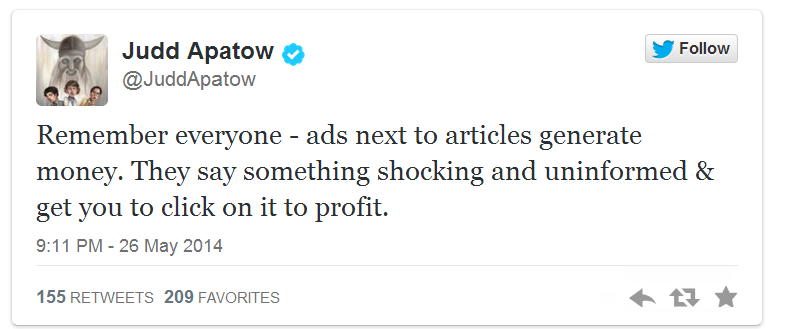
Apatow even trots out that old favorite about click bait.

apa

Judd Apatow @JuddApatow

Remember everyone – ads next to articles generate money. They say something shocking and uninformed & get you to click on it to profit.

Uh huh, and that applies to all material we don’t like, but not to material we do like. Also, Judd Apatow makes movies pro bono. He doesn’t take a dime for himself. This being so, he doesn’t the least bit tailor his material to a mass audience. Nope, not Judd Apatow.

#NotAllFratboys

(This is a syndicated post. Read the original at FreeThoughtBlogs.)