
Tag: Football

  • If your child does not own Patriots gear

    More obligatory Spirit and Loyalty and Enthusiasm:

    No, I did not send my four-year old to school in Patriots gear for “Super Bowl Spirit Day” on Friday.

    Earlier in the week, I’d gotten an email from the preschool that my kids — Leila, almost 5, and Mateo, almost 3 — have attended for the last couple of years. Wedged between a reminder to “bring your patience” to pick-up (bothersome snow in the parking lot) and a request for donations for cancer research was a New England Patriots logo with the following message:

    “In honor of the Patriots’ Super Bowl appearance, send your child to school in his or her Patriots gear! If your child does not own Patriots gear, send him or her to school wearing red, white, and blue. Go Patriots!”

    Why do people do that? Why assume that love of football is universal? Why make people feel weird if they don’t love football? Why on earth do it to four-year-olds?

    The author, Kate Mitchell, replied with a note pointing out the now well-known risks of football, and that the brain is quite a useful organ. The director replied politely but said they wouldn’t be changing their plans.

    I decided to follow up with a bit more information: several links to articles about the issue including a piece in that very day’s New York Times.

    I added:

    “I acknowledge your decision not to reconsider promoting the sport on Friday — and I respect that individuals make their own choices about whether to watch, play, or support football. However, when an institution chooses to support or endorse another institution, it sends a message (intended or not) about the values of the institution doing the supporting.

    And:

    Obviously, my concerns are not so much about whether or not the kids dress up in Patriots gear on Friday. I am more worried about whether we encourage fandom for the sport/league from a young age, whether kids should be playing tackle football, and how we as a society should be demanding that the NFL value the lives and well-being of young men (and families) in our society. I appreciate you hearing me out on the big picture.

    She decided to write to the teachers as well.

    “Our reasons for boycotting football have to do with the NFL’s rejection of science and the evidence that proves the link between tackle football and traumatic brain injuries, as well as our support for Colin Kaepernick and his efforts to call attention to police brutality. While those might seem like two separate issues, we see them as one: a decision not to value the lives of young men, especially young men of color.

    Leila will not be dressed in Patriots gear tomorrow. We will have a conversation with her tonight about our family’s values and how they square with football. We will also talk with her about the importance of being respectful of different points of view on this topic.”

    She explained her thinking to Leila, who picked out her own (non-football themed) clothes for the next day, including a tiara.

    As we entered her school, we stepped into a sea of Patriots gear. I felt my gut churn a bit. I felt like an outsider.

    Leila loves her school. We have found it to be an inclusive environment that lives up to its mission of creating a safe and nurturing environment for our children to learn and grow. I left my daughter, feeling confident that she felt right at home and that the teachers would make sure that she did not feel excluded.

    But I also left feeling incredibly confused. Of all the things that educators could be encouraging our children to care about and be interested in, is a sport that has been scientifically proven to cause routine traumatic brain injuries really one of those things? And does it really merit an entire “spirit day” in its honor at a school for toddlers and preschoolers?

    I get that for many, the Super Bowl is just pure fun. I get that we could all use common ground to rally around in times like these.

    I am just not willing to cheer a multi-billion dollar business that values profit over safety. And I am especially resistant to the idea of an educational institution enlisting my small kids in such fandom.

    Also how pure can the fun really be when the sport itself is built around deliberate violence? We frown on the Romans for going to see gladiatorial contests but we have lethal sports ourselves. It’s pathetic.

    H/t Sackbut
  • How widespread the problem is

    In the Times, Emily Kelly tells us about her husband, a former football player who took a lot of blows to the head.

    Professional football is a brutal sport, he knew that. But he loved it anyway. And he accepted the risks of bruises and broken bones. What he didn’t know was that along with a battered body can come a battered mind.

    For decades, it was not well understood that football can permanently harm the brain. Otherwise, many parents would most likely not have signed their boys up to play. But this reality was obscured by the N.F.L.’s top medical experts, who for years had denied any link between the sport and long-term degenerative brain diseases like chronic traumatic encephalopathy.

    Just as tobacco companies for years denied any link between tobacco and lung cancer.

    That started to change in late 2009 when, for the first time, the N.F.L. publicly acknowledged that concussions can have long-term effects. In 2016, a top league official admitted that there is a connection between football and C.T.E., which has now been found in the brains of more than 100 deceased players. But for Rob, and countless other players, those admissions came too late.

    And yet – people here still get wildly excited about football and expect everyone else to share their enthusiasm. I find that disturbing.

    It wasn’t until I joined a private Facebook group of more than 2,400 women, all connected in some way to current or former N.F.L. players, that I realized I wasn’t alone.

    Our stories are eerily similar, our loved ones’ symptoms almost identical: the bizarre behavior I had tried to ignore, the obsessive laundering of old clothes — our washing machine ran from morning till night.

    It was comforting and terrifying all at the same time. Why did so many of us see the same strange behaviors? “Our neurologist said they do it to calm their brains,” one friend told me.

    Symptoms consistent with C.T.E. are a recurring topic in the Facebook group. They include memory loss, confusion, impaired judgment, aggression, depression and anxiety. These problems become apparent sometimes years or even decades after a player hangs up his helmet.

    One woman may write a post, desperate and afraid of the man her husband is becoming — the rage, mood swings, depression, memory loss. A man so drastically different from the one she once knew. Hundreds of comments will follow, woman after woman confirming that she is going through the exact same thing.

    While the symptoms and behaviors are telling, C.T.E. can be conclusively diagnosed only posthumously, because it requires the close examination of brain tissue. But many of us, including me, are convinced our husbands suffer from the disease. We try to comfort one another with the same words: “Just know you’re not alone.”

    I don’t think the public has any idea how widespread this problem truly is. Rob and I hope that, in telling our story, we might help other families. There are likely to be hundreds of wives and partners of football players, maybe more, who live a life like mine. Sadly, there is a feeling of shame among those affected, in both the men and their families.

    But hey, the Super Bowl is tomorrow. Let’s focus on that instead.

  • He is guaranteed fawning media coverage

    Fox News, on the other hand, considers all this fuss about concussions to be more “political correctness.” Ok…so conservatives just power through their brain damage? It’s only sissies who find CTE to be an obstacle to normal functioning?

    Did you know who Ed Cunningham is? Probably not. Cunningham, a college football analyst for ESPN, was unknown to all but hardcore football fans. But by tying himself closely to a politically correct cause – in this case, resigning his position Wednesday, in a protest over concussions in football – he is guaranteed fawning media coverage.  The New York Times is leading the Cunningham canonization.

    Right? I bet he drinks lattes, and thinks racism is bad. What a pussy.

    With the new college football season for most teams starting this weekend, the resignation seems timed for maximum attention.  But the politically correct movement seems much more focused on opposing what is uniquely American than where players actually face the greatest risks of concussion.

    That’s right! It’s treason, is what it is.

    The opinionator, John Lott, goes on to say soccer football is more concussion prone. Then that’s a reason to fix that problem too – it’s not a reason to jeer at the idea that football is dangerous for players.

  • That cheerleader’s spot

    It’s football season! Woo-hoo!

    But one tv football commentator and former player has quit his commentator gig.

    [Ed] Cunningham, 48, resigned from one of the top jobs in sports broadcasting because of his growing discomfort with the damage being inflicted on the players he was watching each week. The hits kept coming, right in front of him, until Cunningham said he could not, in good conscience, continue his supporting role in football’s multibillion-dollar apparatus.

    “I take full ownership of my alignment with the sport,” he said. “I can just no longer be in that cheerleader’s spot.”

    Football has seen high-profile N.F.L. players retire early, even pre-emptively, out of concern about their long-term health, with particular worry for the brain. But Cunningham may be the first leading broadcaster to step away from football for a related reason — because it felt wrong to be such a close witness to the carnage, profiting from a sport that he knows is killing some of its participants.

    And killing them in a particularly nasty way.

    As a color analyst, primarily providing commentary between plays, Cunningham built a reputation among college football fans, and even coaches, for his pointed criticism toward what he thought were reckless hits and irresponsible coaching decisions that endangered the health of athletes. His strong opinions often got him denounced on fan message boards and earned him angry calls from coaches and administrators.

    Because football is so much more important than some guy’s brain.

    At first, Cunningham told ESPN executives that he was leaving to spend more time with his sons, ages 3 and 5, and because of his workload as a film and television producer. He was a producer for “Undefeated,” a documentary about an urban high school football team, and has a string of projects lined up.

    “Those are two of the issues,” Cunningham said. He waited weeks before he revealed the third. “The big one was my ethical concerns.”

    A football broadcaster leaving a job because of concerns over the game’s safety appears to have no precedent.

    “I’ve been in the business 20 years and it’s the first time I’ve ever heard of anything like that,” Fitting said. “But this is the world we live in now. More and more players are stepping away in a given season or a given year, and who knows. Are there other announcers out there who have been afraid to do this? I don’t know. Is he going to be a pioneer in this small niche? I don’t know. Who knows what the future holds.”

    I on the other hand find it pretty amazing that football just rolls on regardless, despite the growing evidence that it’s a very brain-trauma-prone sport.

    If nothing else, Cunningham’s decision could prompt some self-examination among those who watch, promote, coach or otherwise participate in football without actually playing it.

    Al Michaels, the veteran broadcaster who does play-by-play for NBC’s Sunday night N.F.L. broadcasts, said he did not see his role in the booth as an ethical dilemma.

    “I don’t feel that my being part of covering the National Football League is perpetuating danger,” he said in a phone interview. “If it’s not me, somebody else is going to do this. There are too many good things about football, too many things I enjoy about it. I can understand maybe somebody feeling that way, but I’d be hard-pressed to find somebody else in my business who would make that decision.”

    Yeah, that – that level of thoughtlessness surprises me. Yes, sure, let’s go on promoting football and cheering it on and advertising it and broadcasting it, so that more generations of players can end up with destroyed brains and slow miserable deaths.

  • Hilarious genocide joke enlivens football game

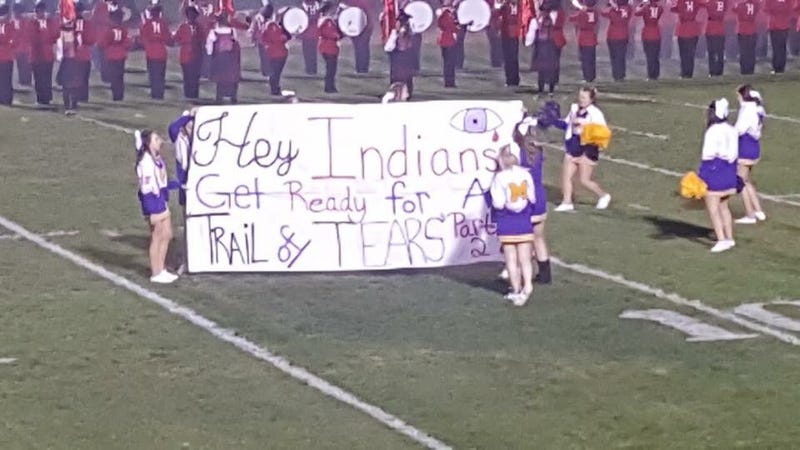
    This one made my eyes open wide in shock. A high school football game in Ohio between the Greenfield-McClain Tigers and the Hillsboro “Indians” (can we please retire all those names now?) – the cheerleaders for the not-“Indian” team made a banner saying

    Hey Indians Get Ready for A Trail of TEARS Part 2

    That’s as if the Greenfield-McClain Tigers were playing the Hillsboro “Jews” and the Tigers cheerleaders made a banner saying Hey Jews, get ready for a holocaust part 2. The Trail of Tears is what happened when Jackson kicked all the Native Americans out of desirable fertile land in the southeast and forced them to walk west until they got to a place nobody wanted. Many of them died. It’s a horror-name, like Tuskegee or Auschwitz or the Edmund Pettus Bridge. It’s not a joke for football fans to bandy about.

    Notice (as I just belatedly did) the eye in the corner, with the tear coming out.

  • Four players would hold a victim on the floor

    Many of the people in Sayreville – parents and students alike – don’t get it. There’s a lot of “it was just hazing” “it was no big deal” “why do you hate football?” “you ruined everything and we hate you” in response to the fact that reasonable people frown on sexual assault even when it’s football player seniors doing it to freshmen. The BBC takes a rather horrified look.

    Four players would hold a victim on the floor while two were on lookout, one parent told NJ.com after their son confided in them. One player would signal the start of the process with a howl, then turn off the lights and assault the freshman.

    Two victims interviewed by the New York Times, including one who said he was digitally penetrated from behind, said they were wearing football pants at the time and didn’t consider what happened to be that serious.

    Stories of older members of the team pinning down freshmen team-mates and assaulting them in a dark locker room as others cheered initially shocked the community. But after superintendent of schools Richard Labbe cancelled the rest of the team’s season, many students and parents defended the programme and criticised what they saw as a punishment that extended to players who were not involved.

    “If freshman thought we hated them before, we sure as hell hate them now,” one 16-year-old student wrote on Twitter shortly after the season was cancelled.

    This is a school we’re talking about. A school. Not a professional football team but a school. A “football season” should be – at most – a recreational extra, not a core entitlement, let alone THE core entitlement. If it turns out the football team is fucked up, then it’s not a bad idea to suspend operations until things are improved. That’s not punishing anyone.

    During a school board meeting, according to Sports Illustrated, dozens of players and parents protested against the decision to cancel the season.

    “They were talking about a butt being grabbed,” one player’s mother, Madeline Thillet, said. “That’s about it. No one was hurt. No one died.”

    That’s an extremely warped attitude. Bullying and assault should not be treated as acceptable provided no one died. Football shouldn’t be treated as more important than decent behavior.

    Gary Phillips of the Journal News, a newspaper in the Lower Hudson River Valley of New York, says he has a problem with how many people have been referring to what happened as hazing at all. He writes that hazing is a part of team culture, but it is too often an excuse to bully or cause suffering.

    What happened in Sayreville was not hazing, he says. What happened had nothing to do with initiation or building camaraderie.

    “By calling sexual abuse hazing, society grants those perpetrators a free pass and downplays the brutality of their actions,” he writes. “What is actually a very serious crime is passed off as a ‘rite of passage’ ritual that went too far.”

    Exactly. We all really really need to stop doing that. We need to stop normalizing abusive behavior by giving it fun playful names.

    Michael Kasdan says there’s another word for what happened.

    “It’s rape,” he writes for the Good Men Project. “Yes, it occurred as part of a football team hazing program, and it is boys acting against other boys, but – if the allegations are true – it is rape just the same.”

    Kasdan says that what happened in Sayreville was abuse, with the sexual aspect being another way to assert dominance.

    While the stories are disturbing, they are far from uncommon, says Robert Silverman of the Daily Beast. It’s a part of a larger issue across the country and at all levels of the sport.

    He says that there is a direct connection between the stories in Sayreville, bullying in the Miami Dolphins locker room, the Steubenville, Ohio, rape case and the Pennsylvania State University child sex abuse scandal. In all of these cases, the perpetrators had been told that they weren’t beholden to the regular rules that all other members of society have to follow.

    And what Ray Rice did to Janay Palmer, AND to the people who think it’s funny to dress up as Ray Rice for Halloween and drag around a blow-up doll dressed to look like Janay Palmer. This stuff is all connected and it’s all sick.

  • Guest post: It’s a sport that really rewards the worst human beings

    Originally a comment by PZ Myers on That was before the money went into it.

    It’s been this way since I was in high school.

    Our football coach was a psychopath.

    He took pride in his collection of paddle boards; every session of our gym class was accompanied by someone, or multiple someones, getting hacked for trivial infringements of his rules: you forgot your jock strap. You weren’t lined up with everyone right at the instant the bell rang. You came in last when running laps. If he was feeling punitive, the last ten kids would get wacked.

    He was the football coach. He got away with it. Grading gym was easy, too: if you were varsity on one of the teams, you got an A; JV, a B; everyone else, a C.

    Members of the football team were his favorites. He loved to set up games of dodgeball, where one side was the football squad, and everyone else was on the other. It was always that way — we’d have a day of basketball, and the teams were the football players vs. the “pussies”.

    That’s how I got out of gym for one full year: playing basketball against the football assholes, and when I started scoring well (probably because as the unathletic guy on the other team, they kept ignoring me), one of them decided to take me out…by tackling me at the knees. In basketball. Completely wrecked my left knee, got to spend 6 months in a hip-to-ankle cast. The guy didn’t even get a rebuke.

    We didn’t have any incidents of sexual violence, at least. The closest we came was that he liked to stroll around the showers and ask the football players about their sexual activities — details about the girls at school were always welcome.

    Fucking pervert and violent psychopath. I still seethe when I think of that jerk. He got his comeuppance, though: his son was a star quarterback in high school, and when he moved up to the University of Washington, his dad got promoted to a coaching position on that team. I think he also got another bump upwards when his son went pro. It’s a sport that really rewards the worst human beings.

  • That was before the money went into it

    The New York Times has a whole lot more on the Sayreville football team and the “bullying and harassment” that got the season shut down. Seven players are accused of “hazing of a sexual nature.” It also has more on the pathetic football-worship in Sayreville and the way it motivates grown-ass adults to minimize the hazing.

    The charges were announced by Andrew C. Carey, the Middlesex County prosecutor, in a joint statement with Chief John Zebrowski of the Sayreville Police Department.

    Richard Labbe, the district superintendent, released a statement.

    “As should be evident by now, the Sayreville Board of Education takes this matter extremely seriously,” Mr. Labbe said, “and thus will continue to make the safety and welfare of our students, particularly the victims of these horrendous alleged acts, our highest priority.”

    But around town, there were questions about the four separate attacks that the police said occurred from Sept. 19 to Sept. 29. Were they isolated events this season, or had hazing been a ritualistic part of Coach George Najjar’s team, known as the Bombers?

    The accusations alone were “absolutely shocking” to Robert Keating, 52, who was walking through Kennedy Park with his two children.

    “What were those kids thinking?” he said, shaking his head. “I went to this high school. I don’t remember any trouble like this every happening. But the football team was never very good then. That was before the money went into it and people started making such a big deal out of it.”

    Ah now why did that happen? Why is football made such a big deal? Especially high school football? Some people in Sayreville wonder the same thing.

    Inside Angelo’s, a pizzeria on Main Street, that was what baffled John Shara, 56, a 20-year Sayreville resident. He motioned to the store owner at the counter and said: “They play a game on Friday night and he tells me that no one comes in here because everyone’s at the field. They play on Saturday, you go into the diner down the street and you’ve got all these 50-year-old men in their Bombers caps and sweatshirts.

    “Honestly, I don’t get it. I understand if you’re in Texas, or Iowa, in a town where there’s nothing else around for 20 miles.”

    Even in Texas, or in Iowa, why not do something that a lot more kids can participate in, and a lot less violent? Drama, music, singing, dance?

    “I hear people from here calling up radio stations and saying it’s just a little hazing and screaming about losing the season,” Mr. Shara said. “Hazing is hitting a kid with a towel or jockstrap. What we’re talking about here is not hazing, it’s criminal. If it’s true, they should shut it down for five years. I mean, how do you leave 60 or 70 kids alone in a locker room?”

    Earlier in the week, Mr. Labbe said that coaches were unaware of any incidents, which Stuart Green, the director of the New Jersey Coalition for Bullying Awareness and Prevention, considered excuse-making, if not exoneration.

    “At any level, even the N.F.L, with the question of bullying and abuse, the media focuses on the players and not enough on the culture,” Mr. Green said in a telephone interview. “Not to excuse the behavior, but it’s the job of the adults to not put these kids in that kind of environment and expect them to police themselves.”

    I would like to see everyone focus a whole lot more on the culture. The culture sucks.

  • Guest post: That was the sort of mindset this “game” created

    Originally a comment by Blanche Quizno on But football is a necessity of life.

    My 6’4″ son went out for football last year and, when he realized how much time it would require, he voted for his studies instead and quit the team. A half a dozen other young men then quit the team – it’s like they didn’t realize they COULD quit or something. In fact, one of his friends, who had just the week before talked of hoping to be team captain that year, quit a few days after my son did. That really shocked me – “football player” had been a huge part of his apparent identity/persona. I remember him telling me that, at the end of a tackle, if someone from the other team were slow in getting up, he’d gladly stomp his hand as hard as he could with his cleats. This kid is a devout Christian hoping for a career in youth ministry, BTW. When he was talking about quitting the team, he said that football brought out the worst in him, aggression-wise. I reminded him of the hand-stomping comment. He agreed that was the sort of mindset this “game” created, and that he’d realized he didn’t want to be that guy – he wanted to “love on” people instead.