Trump on “Truth Social” two days ago:
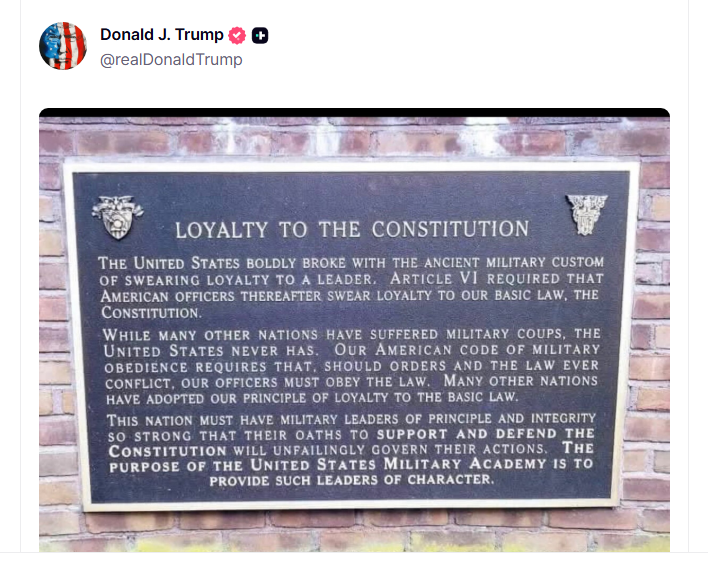
Why yes, exactly. The US military doesn’t swear an oath to you, it swears an oath to the Constitution.
You didn’t read it, did you. Somebody told you to post it and you did. Not the sharpest tool in the shed.

Trump on “Truth Social” two days ago:
Why yes, exactly. The US military doesn’t swear an oath to you, it swears an oath to the Constitution.
You didn’t read it, did you. Somebody told you to post it and you did. Not the sharpest tool in the shed.
Comments
16 responses to “Loyalty to the law”
“Our American Code of Military Obedience requires that, should orders and the law ever conflict, our officers must obey the law. Many other nations have adopted our principle of loyalty to the basic law.”
Couldn’t be clearer. Unless he thinks that “the law” means “what Trump says”.
Well, yes, the words on the plaque sound reassuring but it is attached to the wall of the same United States Military Academy that trained most of the officer class of the Confederate Army?
Any bets on how long that plaque stays up?
The plaque looks a good deal more recent than the Civil War. I could be wrong.
AI gives me this about the treason question:
But the Confederates considered themselves citizens of the CSA and fighting for a whole separate nation. It would be like calling Mexicans or Canadians (or whoever considers their nation not part of the US citizenry) treasonous. The US itself separated from England, which also wasn’t considered treason. I know it’s hairsplitting, but there is a difference,
Uh, no. Mexico was never part of the US. The rebel states were. And they weren’t fighting for a nation, either, they were fighting to keep slavery. The pseudo-idealistic window-dressing was just that.
Er, the signers of the Declaration were definitely committing treason, it’s just that it worked out in the end.
How wide does an ocean have to be before cutting ties becomes not treason?
Wasn’t Texas part of Mexico?
In 1965-75, the US fought what was in reality a colonial war (taken over after the French colonialists were defeated in 1954) in Vietnam, in which there were about 5 million Vietnamese dead and maybe three times that number seriously wounded; all without the Presidents involved (JFK, Johnson, Nixon) ever realising the irony in the fact that Ho Chi Minh was the George Washington of Vietnam.
Ophelia @7 Yes but the CSA also considered themselves as seperate from the USA, and were intent to form a separate nation, which is seditious and treasonous on the face of it, but was an effort to form an independent nation, whiich is why it wasn’t cnosidered treason *as such*, unllike traitors or subversive defectors. They were treasonous in light of their collective nationality, but they rejected their nationality, so it was more of a rebellioous defection rather than a treasonous one. You could see the rejection o f the USA being subject to the monarchy as treasonous to England, but it wasn’t treason exactly. It’s not quite the same thing.
Treason doth never prosper: what’s the reason? Why, if it prosper, none dare call it treason.
If the Revolutionary War had failed, the founding fathers would have been judged for treason.
The leaders of the Confederacy were only banned from holding public office, not convicted. Lincoln chose reconciliation over retribution, and all those trials would have bogged down the whole government for a decade. The 14th Amendment only passed at all because, when the 39th Congress convened in 1865 the clerk of Congress, Thaddeus Stevens, refused to read the names of the Members-elect sent by the Confederate states, and so nobody was seated from there. Those states wouldn’t have ratified the amendment at that point, and the right (which took another century to actually enforce) of suffrage for Black Americans would not have been established. None of that was passed without struggle; President Johnson tried to veto every reconstruction-oriented bill Congress passed. Some were overridden, for example a bill that meant the Confederate states had to ratify the 14th Amendment before they would regain representation in Congress. Johnson ended up getting impeached and removed.
They considered it a rebellious defection, but it was treason, as defined by the Constitution. Since the south lost, and since treason is defined by the winners, it is proper to say they committed treason. The founders knew they were committing treason, and would all hang if England won. That is common. So why weren’t the CSA leaders executed? Part of that was the reason Papito stated, the desire at reconciliation, but part of it was something worse…when Lincoln died, his ideas and plans died with him, replaced by a pandering to southern landowners that led to a lot of what we see today in this divided country – a way of looking at the world that can in many ways be equally attributed to the south and to Hollywood (John Wayne and all that, though it started long before John Wayne – he’s just the most familiar face of the image).
For much of my life, it was common knowledge that it was impossible to win the Presidency if you didn’t win the south. Much of the Democratic party’s wishy-washy behavior has been attributed to that common knowledge. Really, though, Obama did it, so we need to stop saying that now. The south was red in his run, and he didn’t have a southerner on the ticket. Things have changed. But one thing remains the same: The CSA committed treason, and escaped any of the traditional penalties for doing so.
@Papito #13
Johnson was impeached but not removed. He simply did not win the 1868 election.
…and Johnson was replaced by Grant whose stance on the treason issue was constrained by his personal sense of honour as having accepted the surrender of the Confederate army in the field and issued parole terms to its officers.