“It seemed completely obvious to me that the butt of the joke here is people who say such things about women.”
Author: Ophelia Benson
-
Dhaka: 5 arrested in murder of blogger Ahmed Rajib Haidar
All 5 are students at North South University and all confessed to involvement, police say.
-
How to read satire
Stacy alerted me to a good (feminist) analysis of the Onion tweet.
First of all, she says, Quvenzhané Wallis is terrific, no question.
But you know what? All of the women at the Oscars last night are awesome. Just to have survived to that level in an industry that, at best, ignores women, and, at worst, actively despises them means they have to be awesome. Maybe they’re not awesome in ways that everyone sees or acknowledges. But in their own way, they’re fierce and strong and bursting with personality in an industry that is designed not to see women that way…
The best examples of how Hollywood hates women were supplied by Oscar host Seth MacFarlane himself. He sang an entire gleeful song about how he saw famous actresses’ breasts in movies, as if he were 12 years old and had no hope of seeing breasts in real life (maybe, with his attitudes, he doesn’t), including movies in which their characters are abused, even gang-raped. (Yup, so sexy, getting a glimpse of nipple as a woman is being brutally attacked.) He degraded women left and right by reducing all their immense talents to how “beautiful” they are or how human carbuncle Rex Reed might insult their body size.
Hollywood and pop culture — including most pop culture watchers, such as the mostly male ranks of film critics and the mostly rank roster of “serious” film fans who populate movie sites from the IMDb to Rotten Tomatoes – is absolutely vile to women, with extra bile if they’re famous and don’t give that particular boy a boner.
And the Onion tweet was parodying that. Not echoing it but parodying it. I saw that as one possible reading at the time, but I saw the shock-horror about the tweet before I saw the content of the tweet, so I was primed not to see the parody reading as clearly as the echo reading. Or I was just stupid. One of those.
Or maybe a third possibility, which is that so much humor these days turns out to include misogyny, to have a misogynist edge, to be compatible with misogyny, to be the product of people (mostly men) who are misogynist. I occasionally watched Family Guy for awhile because I found Stewie and Brian hilarious. I find parts of The Big Bang Theory hilarious. I find Jon Stewart sexist quite often. I’m used to discovering that something hilarious turns out also to be misogynist and/or sexist as well.
It was probably all three of those. Anyway, the parody reading seems like a better fit now – but Twitter can be a bad medium for jokes like that. I know this. People mis-read my jokes aimed at myself as jokes aimed at someone else, and then ignore my corrections. Twitter can be a dangerous toy.
But the point was a good one.
What highlights how outrageous is the loathsome treatment of women on the Web?
Everyone else seems afraid to say it, but that Quvenzhané Wallis is kind of a cunt, right?
That gets attention in a way that calling a famous adult woman the same thing never does. Because it’s clearly outrageous in a way that, apparently, isn’t quite so clear-cut when it comes to an adult woman. But she asked for it by wearing that dress. She’s an attention whore. She likes being in the spotlight. She can stop being famous any time if she can’t take it. We should see such rationales as ridiculous. We can see it when they’re applied to a nine-year-old. But we don’t see it in general.
Well. Okay. Feminist pop-culture watchers see how all women are treated in pop culture as outrageous. But we feminists are still a minority. That Onion tweet was not directed at feminists. It was directed at a general readership that probably has not yet internalized that it’s just plain wrong to talk about women like this, but might possibly understand that it’s just plain wrong to talk about a little girl like this. And might possibly start to get an inkling of a clue.
God damn that sounds familiar. She’s an attention whore. She likes being in the spotlight. She can stop being famous any time if she can’t take it.
She’s a professional victim. She engages in drama for the blog hits. She can stop blogging any time if she can’t take it.
So the point was a good one.
The Onion likely demonstrated some tone-deafness when it comes to issues that some online feminists I respect immensely pointed out, like how women of color come in for extra bonus disrespect and misogyny, and how little girls are inexcusably oversexualized.
But that’s not what this tweet was about. As I think many of my readers would attest, I am attuned to misogyny in pop culture, even the point at which I see it when others don’t. And still, I didn’t see it here. I didn’t see Wallis as the butt of this joke. It seemed completely obvious to me — to the point that I didn’t even have to think about it — that the butt of the joke here is people who say such things about women.
But she reads the Onion much more regularly than I do, so she had a better sense of their overall attitudes than I do. I’ve learned to expect to be suddenly disappointed.
-
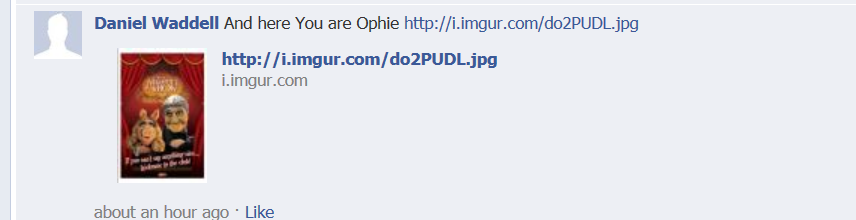
Muppets are always boys
As I mentioned, I’m not familiar with Statler and Waldorf. So here, via a Facebook friend, is a selection.
http://www.youtube.com/watch?v=14njUwJUg1I
-
Imagine
Michael Nugent asks what if Ireland discriminated for atheism instead of for religion?
Imagine if 96% of our primary schools were run with an explicitly atheist ethos – not a neutral, secular ethos, but an explictly atheist ethos – where children were taught that there is no god, and that ethos was permeated throughout the entire curriculum.
The idea seems bizarre, doesn’t it. Surplus to requirements, just as god is. It would be odd to have schools run with an explicitly atoothfairy ethos, too. Secular is all that’s needed. Don’t teach math with extra added gremlins, don’t teach biology with added ghosts, don’t teach geography with added atheism. Just skip it. Don’t pack more than you’ll need. That bag will get heavy, so don’t pack a big coat if it’s not going to be cold.
Imagine if our hospitals were run with an explicitly atheist ethos, with signs on the walls saying that there is no god, and with atheist ethics committees, and with the danger of a dying patient being told ‘this is an atheist country’.
And yet without the danger of a dying patient being told ‘this is an atheist country’ as justification for refusing to prevent the patient from dying by completing a miscarriage, because it’s so very difficult to get from atheism to stupid arbitrary cruel anti-human “rules.” For that you need a Holy Superior Being, and atheism is Un that.
I walked up a trail through a park this afternoon and saw on the wide board at the top of the railing a small written message: “All praises for Allah.” What a nasty message, if you think about it. All praises for the imagined entity, so no praises for any real ones. The hell with that, I thought. Save your praises for real achievement.
That’s another one where atheism has no counterpoint. “All praises for no god”? Yeh, nobody would come up with that. Which is Michael Nugent’s point, of course: swapping atheism makes the absurdity of all the deference and knee-bending obvious.
Imagine if an atheist group that runs most of our schools had been found by various tribunals to have been abusing children, and covering up the abuse of children, for decades.
Imagine if an international atheist group, to which that atheist group was affiliated, that acted as if it was also a state, had been involved in moving atheists who abused children from country to country to avoid facing up to the legal responsibilities of their actions.
Imagine if our state continued to have diplomatic relations with that association, and exchanged ambassadors with it as if it were a legitimate State.
Imagine, further, if an atheist group had special magical men – men only – at the top of the group, special magical men who had a special magical connection to…to no-god. And those special magical men were the ones abusing children, and being protected by other special magical men with a special magical connection to no-god. And they all got away with it because the surrounding society is so deferential to atheism and to no-god that it lets these groups act like a law unto themselves. Imagine all that.
It’s hard to do, isn’t it.
Imagine if there was even one explicitly atheist school in Ireland – not a secular school, but an atheist school, that explicitly taught that there was no god.
Imagine that even one set of religious parents was forced by circumstances to send their child to that school.
We would never hear the end of it until it was resolved.
But in Ireland we have multiple times that discrimination continuing without anyone even thinking that it is a problem.
Why do you believe that your religion is more important than our atheism?
The State certainly should not believe that.
Because a special magical god trumps a special magical no-god.
Yes but why does it?
Ah, that’s a tough one.
-
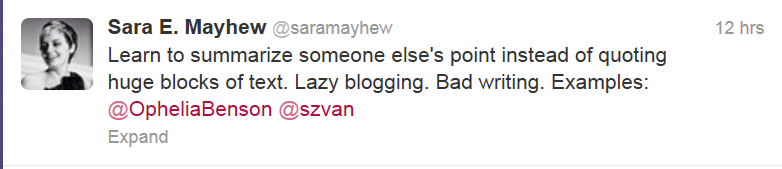
Lazy blogging. Bad writing.
Sara Mayhew must have wanted more attention, because as tonyinbatavia pointed out in a comment, she posted another random tweet about Stephanie and me, apropos of nothing.
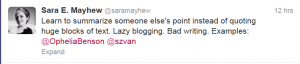
Learn to summarize someone else’s point instead of quoting huge blocks of text. Lazy blogging. Bad writing. Examples: @OpheliaBenson @szvan
She’s weirdly persistent about picking fights with me. I don’t know why, apart from wanting more attention (but then there are billions of people in the world, and I don’t know why she wants attention from me in particular). I don’t know her. I haven’t written about her here (except about these bizarre random fight-pickings). I haven’t interacted with her. But pick pick pick.
She did a more extended version (less lazy! less bad!) on Facebook, too. It’s a public post. (We’re not Friends, needless to say.)
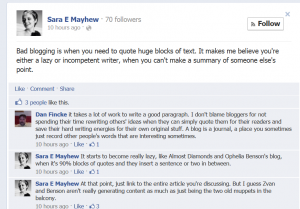
The post:
Bad blogging is when you need to quote huge blocks of text. It makes me believe you’re either a lazy or incompetent writer, when you can’t make a summary of someone else’s point.
Her comments, following one by Dan Fincke:
Dan Fincke it takes a lot of work to write a good paragraph. I don’t blame bloggers for not spending their time rewriting others’ ideas when they can simply quote them for their readers and save their hard writing energies for their own original stuff. A blog is a journal, a place you sometimes just record other people’s words that are interesting sometimes.Sara E Mayhew It starts to become really lazy, like Almost Diamonds and Ophelia Benson’s blog, when it’s 90% blocks of quotes and they insert a sentence or two in between.12 hours ago · Like · 1Sara E Mayhew At that point, just link to the entire article you’re discussing. But I guess Zvan and Benson aren’t really generating content as much as just being the two old muppets in the balcony.So I’m a lazy bad writer, so let’s see what content Sara generates. Her latest post is……four photos, of four dresses. And some writing.
Strapless dresses from SammyDress! This wholesale Hong Kong fashion site has incredibly cheap clothing prices, but my experience has been that what you save on items is made up for with very expensive shipping. Quality is typical of Chinese produced fashion—cute on the outside but low quality is seen on the inside of the dresses with imperfect stitching. Petite sizes. I haven’t yet bought a dress from them I didn’t like.
That’s good hardworking writing.
Having conceded that point, I’ll say a few words – of my very own writing, that I wrote myself! – about Mayhew’s claim that quoting is lazy and bad compared to summarizing.
The first word I’ll say about that is “horseshit.” That’s horseshit. It’s not true, not as a generalization. Sometimes summarizing is preferable to quoting, but certainly not always. If it were always preferable, why would the Daily Show use so many clips? The Daily Show is quite popular, and also well thought of. It’s both. It’s considered good tv, good commentary, good humor, good news analysis. Part of what’s good is the use of video clips that show people saying things, so that we can all see exactly what they say and how they say it. A summary would not be better than that for the purposes of the show. The same goes for the Rachel Maddow show and plenty of other shows. The same goes for many many blogs that quote extensively. Some websites do nothing but link to others’ material with a headline and a teaser – like Arts and Letters Daily for example. That’s different from writing a book or an article, but that doesn’t make it worthless.
I’m interested in language and rhetoric, in the words people use and the possible reasons why they use them and the likely effects the words will have. When I’m looking at that I don’t want to summarize, I want to give the actual words, so that readers can see exactly what I’m talking about. This is a new genre that blogging makes possible in a way it wasn’t before. I like the genre, and I use it a lot. It would have been useless to “summarize” what Rod Liddle wrote, for instance; it was necessary to give a good sample of it so that people could see his particular brand of smug laddish dismissiveness.
I don’t consider that a whole lot more lazy than posting four photos of dresses.
-
Oh that Resistance
Via Bad Science Watch on Twitter, via Crommunist – Simon Fraser University is hosting the “Vaccine Resistance Movement” on March 12.

Crommunist points out that British Columbia has had recent outbreaks of measles and whooping cough. What the hell are you doing, SFU?
-
It’s all so easy
Rod Liddle is going for the contemptuously sexist asshole prize again. All this fuss about Rennard and his way of pestering women; pish tosh, old bean, what a lot of bother about nothing.
I don’t doubt that it is sometimes unpleasant for women to work in some male-dominated trades and professions, because of the behaviour and attitudes of some of the majority gender. Nor do I doubt that plenty of professions are still rife with sexism and discrimination, politics almost certainly being one of them. But I am not convinced that Rennard’s alleged crimes give us much evidence of this. One of the accusations against Rennard is that he ‘propositioned’ a couple of women, despite apparently being aware that they were in long-standing relationships.
Now, it may slightly turn the stomach to be propositioned by a sweating Europhile lardbucket with breath that could stun a badger at 30 paces, but — hell — a cat can look at a king. If you don’t ask, you don’t get, etc. Sometimes if you ask you also don’t get. All the time, it would seem, in the case of Lord Rennard. But the poor bloke should be allowed to ask, shouldn’t he? Over the past 30 years the workplace has become the venue within which we meet our sexual mates, as Chris Huhne will confirm for you. Obviously these relationships have to start, you know, somehow, don’t they? And asking nicely seems to me a reasonable means of finding out if they are going to start at all.
I have the distinct suspicion that Lord Rennard’s overtures might have been considered less obnoxious if he more closely resembled, say, Orlando Bloom or Joaquin Phoenix than Jabba The Hutt. And a similar suspicion that the anger of the women would have been less deeply felt if they hadn’t discovered he’d tried it on with loads of others and that they weren’t special after all. The hand-on-the-knee business is not especially pleasant, for sure; but is it too antediluvian, too chauvinistic, to suggest that it might easily be brushed off?
Give that man the prize.
-
Anti-gay Muslim cleric’s Reading university talk cancelled
Adam Goodkin, of the Atheist Humanist Secularist Society at the university, which had planned to protest, said: “We’re firm believers in freedom of expression and free speech.”
-
The wonders of anti-vaxxing
A measles outbreak in South Wales: 189 cases.
Parents are being urged to make sure their children receive the measles, mumps
and rubella (MMR) vaccination.So that they won’t get measles.
Dr Marion Lyons, director of health protection for Public Health Wales (PHW), said: “We continue to be concerned at the number of cases of measles we are seeing in the Swansea and Neath Port Talbot areas.
“We cannot emphasise enough that measles is an illness that can kill, or leave patients with permanent complications including severe brain damage, and the only protection is two doses of the MMR vaccination.”
She added that people most at risk of catching measles are children of school age who have not had two doses of MMR.
Get the vaccination.
H/t Roger
-
189 cases of measles reported in South Wales
“Measles is an illness that can kill, or leave patients with permanent complications including severe brain damage, and the only protection is two doses of the MMR vaccination.”
-
Reputation management instructions
Justin Vacula has a typically clueless video responding to Stephanie’s post on his “advice” to feminists being harassed on the internet. Stephanie and athcyo combined to produce a transcript. I started emitting steam before I was halfway through the transcript. I want to say why.
My recommendations here, for people who face criticism and hate to reduce the criticism and hate, are very reasonable things people can do. It’s what Karla Porter refers to–and I’m sure many others–as reputation management. The way people present themselves [image of a tweet by Amanda Marcotte] has something to do with their perception, with the criticism they receive.
After all, as I’ve pointed out on many occasions, there are many women on the internet–there are many feminists on the internet, some of them including men, who write about feminism, who write about women’s issues, who write about anything given in the world, and they don’t receive the level of criticism, negative feedback, what Stephanie Zvan calls harassment and cyberstalking. [image of a Twitter exchange with EllenBeth Wachs] They don’t receive this.
So the situation is that some people negative criticism and pushback on the internet while other don’t. So there has to be some kind of reason why this is the case. Magical harassment fairies, magical cyberstalking fairies, magical negative dissenters–whatever you want to call them–don’t just appear out of thin air and criticize people on the internet. It doesn’t happen that way.
There’s a lot that’s wrong with that, and the commenters on Stephanie’s post do a good job of spelling it out. But one thing that particularly generated steam in my locality is the fact that the harassment we get is not remotely in proportion to anything we do. Not even close. Yet Vacula never even approaches an admission of that fact. He does the opposite. He claims there “has to be some kind of reason” that we get epic levels of harassment while others – nameless others, nonspecified others, conveniently vague and general others – don’t. Then he claims that harassment and cyberstalking fairies don’t just appear out of thin air and criticize people on the internet.
Oh yes they fucking do.
They do appear out of thin air and join an existing swarm of bullies harassing people – not “criticizing” them as Vacula yet again translates it, harassing them – on the internet. That swarm did form out of thin air when a few thugs who like to call women cunts and twats found each other on Abbie Smith’s blog. Yes it was out of thin air in the sense that what they claimed or pretended to be enraged about was always way too small and minor to warrant their rage and obsession.
There is no logic to it. It is not a product of reason, and there is no genuine “reason” for it. There’s just a large bunch of people having themselves a good time harassing a small number of other people. That’s it. They’re not “critics,” they’re not thoughtful, they don’t have good ideas, they don’t have anything.
But there has to be some reason behind it, right? These people aren’t just going to randomly pop up. So I give some advice for people. [image of a tweet from EllenBeth Wachs] And I really think that if you’re going to be on the internet, you’re going to be talking a big game, you’re going to be saying really nasty things about people–calling people “sexist”, calling people “misogynsist”–instead of approaching the situation in a different manner and being charitable and saying, “Well, maybe what you have to say there could have been reframed differently.” Instead of engaging in a call-out culture in which you’re going to talk about how your ideological opponents or whomever said this nasty thing–this alleged nasty thing–you can use the moment as an instructional tool [image of Vacula’s advice] and say something like, “Well, here’s how I would have said it. Here’s the message I think that’s being conveyed by this piece.” Not making it nasty; not saying nasty things about the people.
But Stephanie Zvan, Ophelia Benson, Greta Christina, PZ Myers—they don’t do that. They’re very often very uncharitable, and they reach the worst conclusions possible. And I believe (and this is just my hypothesis) that the reason they receive the negative pushback is because of the way they present themselves on the internet.
And the reason that puny ugly little kid gets all the “negative pushback” is because she’s so puny and ugly. The reason that faggot gets all the “negative pushback” is because he’s a faggot. The reason that abortion doctor got all the “negative pushback” is because he was an abortion doctor. These people aren’t just going to randomly pop up. They’re going to pop up because you wrote something that they don’t like, and that entitles them to pursue you and harass you until the end of time. It happens that way.
-
Reading University is disappoint
Reading University issued a statement on the cancellation of the talk by Thahabi, that is, a joint statement from Reading University Muslim Society, Reading University Students Union (RUSU) and the University of Reading.
Reading University Muslim Society, Reading University Students Union (RUSU) and the University of Reading are in agreement that the laudable aims of the Muslim Society’s Discover Islam Week are undermined by the increasing threat of violent protest from extremist groups outside the University community.
A careful assessment of the threat to the events on Wednesday and Thursday evening have led all three organisations to reluctantly agree to the cancelation of these talks. Our priority is to the safety of all those who had planned to attend or to peacefully protest outside the talk and we are very disappointed that we have had to take this course of action. However, the safety of our students, members, staff and visitors is of paramount importance.
Notice the complete absence of any mention of what was problematic about the talks. Note the complete absence of any substance, any particulars, anything one can grasp in order to understand wtf the issue may be. Note the hollow at the center. On the one hand threat of violence from outside extremist groups (extremist in exactly what sense? Extreme left-wing? Extreme feminist? Extreme what?), on the other hand concern for safety of our people. No particulars about who the outside groups are and what it is they would be protesting, no particulars about what the talks were supposed to be about and what in them was worth protesting.
Both the University and RUSU are committed to supporting the Muslim Society in its aims of raising awareness of Islam and building mutual understanding. We are delighted that other events in the week’s programme will be going ahead as planned.
As part of the review of these events, the University has agreed to work with RUSU to ensure its policies reflect the need to protect the principles of freedom of speech in balance with the rights of all constituent parts of the student community. The University is committed to upholding both the right to free speech and the right to lawful protest within an environment that guarantees the safety of all users of our campuses.
Once again, as so often with these things, the University wants to do the impossible. It wants to combine the principles of freedom of speech with the rights of all constituent parts of the student community, when the problem is that Thahabi, at least, is on record as being inimical to the rights of some constituent parts of the student community. He has said they should be thrown off a mountain.
You can’t have everything. Sad but true.
-
More news from Reading University
I found an interesting update from Adam Goodkin of the Reading University student atheist humanist secularist society on Facebook this morning: an event they were protesting has been called off. I bet you can guess what kind of event it was before I quote from Pink News on the subject.
Homophobic cleric Abu Usamah at-Thahabi will no longer be visiting the University of Reading tomorrow after the event he was due to attend was cancelled because of fears of violent protests.
The cleric has advocated that gay men should be thrown off a “mountain” and previously referred to gay people as “perverted, dirty, filthy dogs who should be murdered”.
Thahabi was due to attend Reading University’s Muslim Society on Thursday as part of a series of talks designed to raise awareness of Islam as a faith.
So the question becomes, why was Thahabi due to attend Reading University’s Muslim Society on Thursday as part of a series of talks designed to raise awareness of Islam as a faith? Why doesn’t Reading University’s Muslim Society have a filter that excludes clerics who say that gay men should be thrown off a mountain and that gay people are “perverted, dirty, filthy dogs who should be murdered”? Why don’t they want clerics who respect human rights as opposed to clerics who don’t?
-
Audible gasps in the Supreme Court’s lawyers’ lounge
Scalia thinks protection of the right to vote is a “perpetuation of racial entitlement,” at least he does when the right being protected is the one being protected by the Voting Rights Act.
There were audible gasps in the Supreme Court’s lawyers’ lounge, where audio of the oral argument is pumped in for members of the Supreme Court bar, when Justice Antonin Scalia offered his assessment of a key provision of the Voting Rights Act. He called it a “perpetuation of racial entitlement.”
Yeah we don’t want that. We want more rugged independence and pulling self up by own bootstraps around here, not this pesky Nanny State coddling of people by making it illegal to keep them from voting. Why if this goes on pretty soon voters of That Other Color will become downright Professional Victims. It’s got to stop. Having to overcome obstacles in order to vote builds character. It was dangerous and sometimes fatal for black people to register to vote in Mississippi in 1964, so why should black people in Mississippi have it easy now? It was difficult for them then so it should be difficult for their grandchildren now, because.
From the transcript:
JUSTICE SCALIA: Well, maybe it was making that judgment, Mr. Verrilli. But that’s — that’s a problem that I have. This Court doesn’t like to get involved in — in racial questions such as this one. It’s something that can be left — left to Congress.
The problem here, however, is suggested by the comment I made earlier, that the initial enactment of this legislation in a — in a time when the need for it was so much more abundantly clear was — in the Senate, there — it was double-digits against it. And that was only a 5-year term.
Then, it is reenacted 5 years later, again for a 5-year term. Double-digits against it in the Senate. Then it was reenacted for 7 years. Single digits against it. Then enacted for 25 years, 8 Senate votes against it. And this last enactment, not a single vote in the Senate against it. And the House is pretty much the same. Now, I don’t think that’s attributable to the fact that it is so much clearer now that we need this. I think it is attributable, very likely attributable, to a phenomenon that is called perpetuation of racial entitlement. It’s been written about. Whenever a society adopts racial entitlements, it is very difficult to get out of them through the normal political processes.
Racial entitlements. Like public schools, and admission to law school, and being able to vote. Those Other Races are being spoiled! Scalia never got any special help to vote, so why should anyone have it? Buncha princesses.
-
The experimenter said “you should make some effort”
Jadehawk has a useful post about what psychology considers harassment. Just imagine: there is research. It’s possible to find out what harassment does to people.
Because certain entities on the web feel like redefining all forms of internet harassment and threat as “trolling” just because it happens online or via unusual media, I decided to look at what actually qualifies as harassment in psychology (rather than in law, since we’re talking about whether it affects people, not whether it’s illegal).
Wait, let me guess first – it doesn’t affect people at all unless they’re Professional Victims or Drama Queens or Special Snowflakes. Right?
No.
For subjects in the Harassment condition, the procedure for the first four TAT cards was identical to that just described for subjects in the Nonharassment condition. Before the fifth card, however, the experimenter said that the last four stories had been “somewhat boring,” and that the subject should try harder to make the next few stories interesting. After the fifth card, the experimenter said “you still do not have it right.” After the sixth and seventh cards, the experimenter again indicated that the stories were inadequate, and said “I cannot see what the problem is,” and that “you should make some effort” to improve them. During the eighth story, the experimenter interrupted the subject with a critical comment.
Result? Physical effects. Read Jadehawk’s post to see what effects.
Conclusion: Even mild interruption, ridicule, and criticism elicits stress responses, and all these mild stress-response-elicitors count as harassment in psychology. That doesn’t mean we should stop criticizing people, and it doesn’t mean that people who want to be skeptics, scientists and/or activists don’t need to learn to deal with a certain degree of both criticism and “trolling”. However, as with microaggressions, a constant barrage of aggression (some low-grade some decidedly less so) is typically more wearying/damaging than the occasional blatant, massive outburst. Consequently, telling a person who’s subjected for months to non-stop criticism, “satire”, parody, “trolling”, and plain old “as defined by every college campus everywhere” harassment* on multiple fronts that they aren’t being harassed is pure, unadulterated bullshit. Even the thickest skin will eventually be worn down** my months, or even years, of this sort of thing.
What this means in effect is that even harassment that doesn’t quite live up to persecutable legal standards*** still causes harm to people. Real, measurable harm.Is interesting. Thanks to TL for the link.
-
Throw the rock overhand, like this
There’s an Islamist Facebook page that posted a set of graphics showing how to stone someone to death. The graphics were originally published by the National Post on November 20 2010.
The Facebook graphics are below the fold. Trigger warning, obviously.
The National Post article was illustrating the horror. The Facebook page is apparently giving instructions.
People (including me) have been reporting it, but it’s still there.
U

Update: Facebook reported on their response to my report: they said this doesn’t violate their community standards so they’re not removing it.
-
What you see
Reading Michael Kimmel’s The Gendered Society. His argument is that the genders aren’t unequal because different, but different because unequal. The inequality is always justified on the basis of difference, but the inequality itself makes the genders different.
What’s different over the past thirty years – now forty: the book was published in 2000 – is making gender visible.
We now know that gender is one of the central organizing principles around which social life revolves. Until the 1970s, social scientists would have listed only class and race as the master statuses that defined and proscribed social life. [p 5]
Gender became visible because women became visible. That was the “radical” in the radical feminism of the 70s. In that sense I am a radical feminist and always have been. But are the women who oppose “radical feminism” really opposed to that? The visible ones, I mean? It’s hard to believe they are, given how visible they are themselves. It’s rather like Schlafly, out there speaking up in public and being intellectually active about it and all that – all in the name of keeping women subordinate to men. Hmm.
In a seminar on feminism in the 80s, Kimmel observed a black woman and a white woman talking about what they did or didn’t have in common.
The white woman asserted that the fact that they were both women bonded them, in spite of racial differences. The black woman disagreed.
“When you wake up in the morning and look in the mirror, what do you see?” she asked.
“I see a woman,” replied the white woman.
“That’s precisely the problem,” responded the black woman. “I see a black woman. To me, race is visible every day, because race is how I am not privileged in our culture. Race is invisible to you, because it’s how you are privileged. It’s why there will always be differences in our experience.” [p 6]
Privilege or its absence determines what is visible.
Mind you, so do other things. Strangeness, for instance – being a foreigner in some way. It’s possible to be privileged as a foreigner while still being foreign – an outsider – not the norm. But still the idea seems like a useful heuristic.
-
Makers
There was a pretty good documentary on the recent history of the women’s movement in the US on PBS last night. It featured Pat Schroeder a lot, which was fun, because she was at Moving Secularism Forward last year (and I got her name tag as a souvenir).
The last hour, on the most recent history, spent too much time on pop culture figures as opposed to political ones, but the first two hours were good. We got the anti-feminist views of Phyllis Schlafly. You know what she said? That feminism teaches women to be victims. Oh, so that’s where Paula Kirby gets her lines! She channels Phyllis Schlafly! I knew that was a familiar, and indeed stale, line of bullshit, but I didn’t know it went back to Schlafly. Now there’s a proud heritage.
http://video.pbs.org/video/2336932877