
Tag: Maya Forstater

  • Women are to be colonised, erased, silenced and put at risk

    Graham Linehan on JK Rowling and The Outrage:

    The response to Rowling’s statement demonstrates what women with less power, but just as much compassion and sense, have been trying to tell us for a number of years. Namely, that gender ideology is bad for women. That it erases them and insults them and endangers them, and when they dare to discuss this issue—and ONLY this issue—they are subject to disproportionately severe penalties. Maya Forstater lost her job, remember.

    Rowling chose her words carefully. The first four sentences are almost an apology for speaking out at all, because she knows how her support for Maya will be received. She front loads the statement with mollifying phrases to protect her central point, which is inarguable.

    But as these women know, and the response to the tweet proves, it’s never enough. Women are to be colonised, erased, silenced and put at risk, and if they protest in any way, even in the most careful and civil terms, they are putting their faces to a blowtorch.

    It’s never enough, and it’s never over. The demands keep ratcheting up and up and ever up. Five years ago we weren’t being told that we had to rejoice when men who claim to be women started stealing athletic prizes from women, but we are now. What will the demands be this year, and five years from now? What will be grabbed away from women amid a torrent of threats and abuse next?

    The current fashion amongst celebrities who like being invited to parties is to dismiss and deride the women who dare step up. Men like Jon Ronson, Jolyon Maugham, Michael Cashman and Owen Jones, and women like Dawn Butler, Mhairi Black and Alice Roberts, the Professor of Public Engagement in Science who blocks everyone, have all been disappointing.

    The most ironic thing about trans activists is that they are depending on women to act according to their gender ‘role’; to be nice, to budge up, to quietly accept the destruction of their sports, their safe spaces and even the language they use to describe themselves.

    And! And! The men are acting according to their gender “role” happily, eagerly, with vindictive joy: entitled, intrusive, domineering, seething with hatred of women.

    So if 2020 is the year you decide to step in to this debate, to risk the blowtorch to the face, remember the lessons of the Rowling tweet.

    If no amount of capitulation is enough, why capitulate at all? Stand firm, speak out and let’s begin the process of winning back what has already been lost.

    It’s the truth. No surrender ever is enough in this dispute, so why bother?
  • Do you believe in magic

    “Charlotte” Clymer, who gained fame as a patronizing male “feminist” under the name Charles Clymer, has a piece in the Washington Post telling JK Rowling what to do.

    Woven throughout the narrative is an insistence on love and community and integrity and inclusion, which is why it has broken my heart in recent years to see Rowling’s inexplicable replacement of justice-minded imagination with a bigotry-driven rejection of science and reality.

    So Team Trans gets to claim both imagination and science & reality, while taking them away from Rowling?

    In her tweet, Rowling effectively dismissed [the judge’s ruling in Maya Forstater’s suit], suggesting that Forstater was being fired for “stating that sex is real,” a common transphobic assertion that has been dismissed by medical experts and other scientists.

    It’s transphobic to say sex is real? So sex is not real? What is it then? And medical experts and other scientists agree that sex is not real?

    I naively held out hope that Rowling was probably confused about transgender identities and simply needed someone to clue her into the reality of our lives, helping her cut through the disinformation pushed by bigots. I have seen people with impeccable progressive credentials somehow be unaware of basic facts about the trans community; was it not possible that the most beloved children’s author of my generation, someone who consistently seemed to operate from a place of empathy, simply needed better friends who could help allay her lack of knowledge?

    But it isn’t a matter of disinformation and lack of awareness of basic facts and lack of knowledge. It’s a matter of having a different understanding of information and facts and knowledge, different from the jargon-spouting fanatics like Clymer.

    I couldn’t concede that a writer famous for creating space for marginalized people in an imaginative world (even if it was often retroactive, as when she belatedly announced that Dumbledore was gay after finishing the series) could ignore the universal consensus of medical experts and other scientists, from the World Health Organization to the American Medical Association to the Royal Society of Medicine, validating and affirming trans people in our authenticity.

    Like that. That’s what I mean. It’s just jargon. “Validating and affirming trans people in our authenticity” – that’s not medical expertise or science, it’s just political jargon.

    I was left realizing that transgender people embody the magical world of Harry Potter better than almost anyone.

    Indeed! The magical, fictional world of Harry Potter. That’s rather our point.

  • Kinder about gender

    Basic fairness in reporting the issue? Oh don’t be silly, that would never do.

    She means “not all men are rapists,” not “all men aren’t rapists” which is a far broader claim (wouldn’t you think journalists of all people would get that right?), but that pales next to the hostile hyperbole of the next clause. Who the hell claims that trans women should be regarded as walking sex offenders?!

    So let’s read Sarah Baxter on being kinder.

    The author of the Harry Potter novels has frequently been damned as a snooty elitist for being pro-Labour and anti-Brexit and for turning Dumbledore gay.

    What? It’s snooty and elitist to be pro-Labour? What universe is this exactly?

    At any rate, she goes on to explain about Rowling and That Tweet.

    [S]he has also been denounced as a bitch, trash, Terf (trans-exclusionary radical feminist) and worse, for concluding her tweet with the words, “But force women out of their jobs for stating that sex is real? #IStandWithMaya”.

    By sex, Rowling didn’t mean bonking, but the sex into which you are born — or, as the transgender movement would have it, into which you are “assigned” at birth but that might not represent the real you. There are few more divisive issues. The novelist nobly flung herself into a pit of seething abuse in defence of Maya Forstater, 45, a tax expert who lost her job at the Centre for Global Development think tank over “offensive and exclusionary” language. Or, in Forstater’s words, for arguing firmly that “men cannot change into women”.

    Tribunal, judge, ruling.

    “It is a core component of her belief that she will refer to a person by the sex she considered appropriate even if it violates their dignity and/or creates an intimidating, hostile, degrading, humiliating or offensive environment,” he said. “The approach is not worthy of respect in a democratic society.”

    Of course I back Rowling and “stand with Maya” on the grounds of free speech. It was preposterous of Tayler to pronounce so blithely on what is or isn’t respectful in a democratic society.

    In fairness, Forstater has stated that she would “respect anyone’s self-definition of their gender identity in any social and professional context”. That alone suggests to me that she was unfairly dismissed. But she has frequently engaged in disputes on social media that have shed more heat than light on transgender issues. I can see why she might have got up the noses of more courteous colleagues.

    That’s a swift turnaround. On the one hand she’s right and I stand with her of course, on the other hand I’ll just condemn her anyway.

    The ferocious trans wars echo the debates of the 1980s, when some feminists insisted that all men were rapists. Yes, there are perverts out there, but I don’t regard every trans woman as a walking sex offender, as Forstater appears to.

    Ah so that’s how it’s done. You make shit up and attribute it to the person you want to trash even though you concede that she’s right. Forstater “appears” to do no such thing, and it’s shit journalism to pretend she does.

    And how does Baxter attempt to back up that absurd claim? By quoting someone else and attributing the quotation to Maya. Maya has told her she didn’t say it, and told her who did, and Baxter has apologized, but the piece has not been corrected.

    “Pronouns are Rohypnol,” she once claimed, referring to the date-rape drug. “They change our perception, lower our defences . . . alter the reality in front of us. They numb us. They confuse us. They remove our instinctive safety responses. They work.”

    Except that she didn’t.

    But did she correct the article? No she did not.

    Posting a comment under the article is not the same thing as correcting THE MISTAKE in the article.

    But hey, everybody be kinder, yeah?

  • That’s not what the law says

    Gaby Hinsliff says a thing about the law and the ontology of women that brought me up short.

    This ruling was purely about whether Forstater’s views count as a so-called protected belief, like religious faith, which employers can’t discriminate against someone for holding. And while she met four of five legal tests for that, the sticking point was her insistence that a trans woman is still a man even if she holds a GRC confirming her legal status as a woman.

    That’s what Forstater thinks. It might be what a number of other people think. But it’s not what the law says and the judge ruled that Forstater’s desire to be able to refer to someone by the sex she felt appropriate, even if that created an “intimidating, hostile, degrading, humiliating or offensive environment”, failed the fifth test – that a protected belief can’t violate human dignity or conflict with fundamental rights.

    Emphasis mine.

    What I’m left wondering – does she mean the law says trans people are in a legal sense the sex they say they are, or does she mean the law says they are the sex they say they are?

    If it’s the second…is that real? Can laws do that? Can laws create reality in that way? Does a false claim become true because the law says it’s true? Can legislators just say “men are women if they identify as women” and lo it becomes true?

    I think people are losing their grip on the difference between claims and reality.

    Hinsliff finds it all very reassuring, but I don’t share her enthusiasm.

    Put simply, those seeking the protection of the law can’t ignore the protection it affords others. Even the vulnerable must acknowledge that others can be vulnerable too.

    Crucially, that doesn’t mean women can now be sacked just for criticising self-identification or for objecting to trans women having automatic access to women’s prisons and domestic violence shelters. But what it means is objections shouldn’t be based on arguing that trans women are men really.

    So we “shouldn’t” argue that Rachel McKinnon/Veronica Ivy is a man really, even though he transparently is one, and acts like one, and bullies women like one. We shouldn’t argue that even though it’s true.

    The grip, it is lost.

  • About dignity

    CNN reported on the Forstater ruling and Rowling’s shock-horror tweet.

    LGBT rights charity Stonewall declined to comment on Rowling’s statement, but addressing Forstater’s case, a spokesperson told CNN: “This case was about the importance of dignity and respect in the workplace. Trans people are facing huge levels of abuse and discrimination with one in eight (12%) having been attacked while at work in the last year.”

    What about dignity and respect for women in the workplace? Have we just forgotten all about that whole thing entirely? If so, could that perhaps explain why women aren’t entirely ecstatic about the “women are people who identify as women” cult?

    More chilling though is what one of the lawyers says:

    Commenting on the implications of the ruling, Louise Rea, senior associate at law firm Bates Wells, who advised Forstater’s former employers,said in a statement to CNN: “A number of commentators have viewed this case as being about the claimant’s freedom of speech.

    “Employment Judge Tayler acknowledged that there is nothing to stop the claimant campaigning against the proposed revisions to the Gender Recognition Act or, expressing her opinion that there should be some spaces that are restricted to women assigned female at birth.

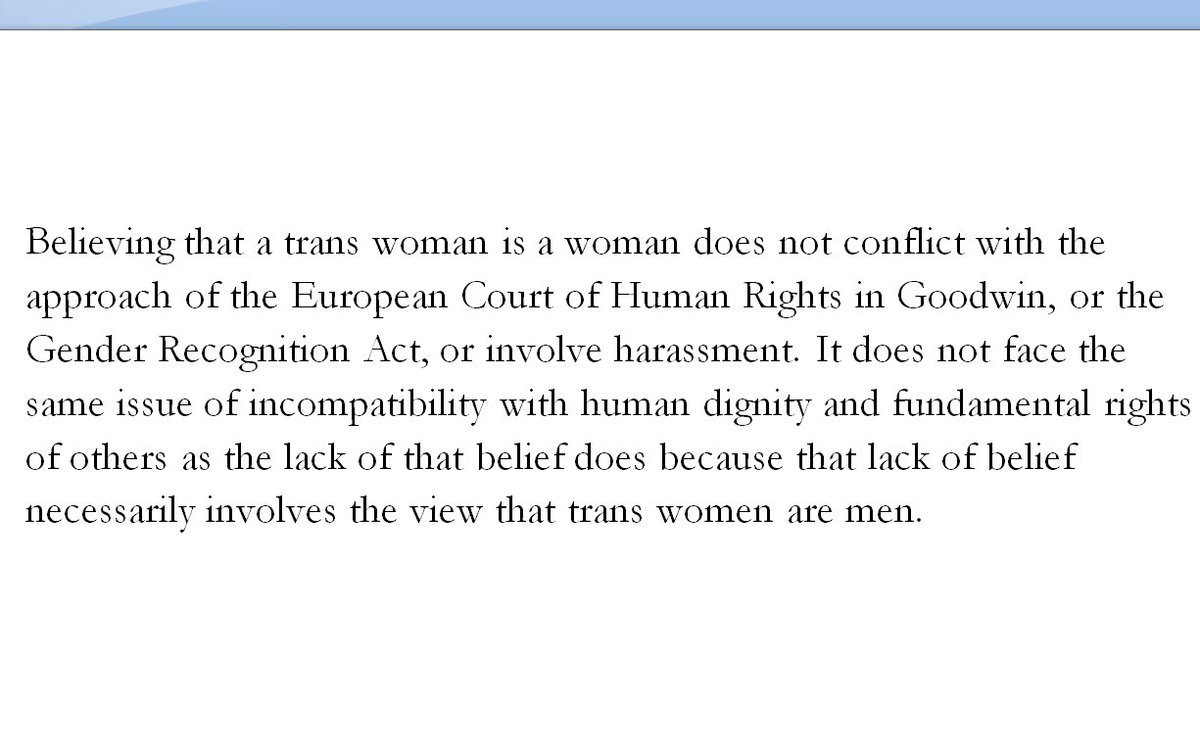
    “However, she can do so without insisting on calling transwomen men. It is the fact that her belief necessarily involves violating the dignity of others which means it is not protected under the Equality Act 2010.”

    But trans women are men. Why can’t we say so? Why is it called “insisting” when we say so? Why are we being told, by lawyers, that we can’t say a true thing about a category of men? How is it that it necessarily violates the dignity of men who “identify as” women to say that they are not in fact women? What about violation of the dignity of women at the hands of men who “identify as” women and force women to agree in the workplace on pain of losing their jobs? Why does the dignity of the men who are saying a thing that is not true matter so much more than the dignity of the women who are saying a thing that is true? Why their dignity at the expense of our dignity?

  • A male’s wish is his, and our, command

    A thread by Alessandra Asteriti:

    Short thread on Forstater case. I am not going to examine the law, I leave that to experts of equality law. I’ll focus on the language used by the judge, as revealing of male supremacy and incapacity to adopt the female point of view, or empathise with it.

    In para 92, the judge states as follows

    What is he saying here? He is saying that saying ‘transwomen are women’ is not harassment of women, but saying ‘transwomen are men’ is harassment of transwomen. He is saying what men want always takes precedence over what women want, or even need. He is saying men are offended if women point out that they are not women, even if biologically they are not, so women are only telling the truth. But women cannot be offended if men tell them woman is just a word invented by men and that can be modified by men.

    Women’s lived reality means nothing, and any man can erase it by getting a certificate, or even by self-declaring that he is now also a woman. We cannot be offended by a man reducing all our lives to a wish in his head, but men can be offended if we remind him that his wishes (even ‘enshrined’ in law) do not change material reality. Especially because women’s reality is a reality of oppression. TW do not want to partake of the oppression and do nothing to minimise it. They tell us they are women because they ‘present as women’. We are women because we are women.

    We are women in the world, because we were girls, and if we survived selective abortion, female infanticide, lack of care, FGM, period huts, childbirth deaths, rapes, dowry deaths, we become adults. In one simple sentence, the judge ignored the reality of women’s existence and elevated the wish of a subsection of men to demand we submit to their vision of who they are, thereby negating our very existence. If any male can declare himself a woman, what is a woman? Who am I, and how am I different from the men who abused me, belittled me, discriminated against me, scared me, pursued me, cursed me? The judge does not care, a male’s wish is his, and our, command.

    Very crisply put, I think.

  • Oh THAT guy

    Ohhh I’ve just been reminded who Gregor Murray is – the guy Maya Forstater “misgendered” so outrageously that she lost her contract. I was reminded by Jarvis Dupont at The Spectator:

    Yesterday we witnessed a stunning and brave victory of tolerance over reality. Vile TERF, Maya Forstater lost her case at an employment tribunal for, amongst other things, referring to former SNP councillor and non-binary transgender individual, Gregor Murray as ‘he’…

    … Before quitting the party, Gregor had been suspended for ‘abusing a woman on Twitter’. They has obviously been targeted because in my opinion, calling an ignorant TERF a ‘cunt’ is a perfectly legitimate way for a non-binary politician to behave.

    Oh, thought I, that’s familiar, thought I, didn’t I once…

    So I looked it up and yes, I did. We’ve met Gregor Murray before. It was July 12, 2018:

    The pitfalls of being woke:

    The pitfalls of being woke:

    Dundee’s children and families convener has apologised after being blasted over a series of expletive-laden outbursts on social media.

    Not just expletives though. “Expletive” is a bit of a euphemism, as so many words that name this behavior are. There is swearing, and then there is…that thing there is no one word for, that is about expressing hatred of people for being female or not white or lesbian or gay or foreign and so on. Saying fuck is one thing, and calling people cunts or niggers is another. The Dundee guy did both.

    You’ll never guess.

    The councillor, who identifies as gender non-binary, described a group of women blocking the front of the march as “utter cunts” and asked a fellow Twitter user, “where’s your fucking solidarity you transphobic b*****?”. Cllr Murray added: “Get to fuck with your medieval views, you horrible bigot. Stonewall started with trans people. Don’t you fucking dare sully it with your anti-trans bullshit.”

    So that’s who he is. Yet he gets solemn sympathy from a judge because a woman “misgendered” him.

    Cllr Murray, the authority’s equality spokesperson, was also called out last year by then Scottish Labour Kezia Dugdale for “blatant sexism” after he branded a women’s group campaigning for equal representation as “absolute roasters”.

    Which means nothing to Americans, but in Scotland is much the same as “cunts.”

    He also called it a load of piss when First Minister Alex Salmond suggested a 40% female quota in boardrooms.

    James Kirkup in the Spectator last year also noticed the surprisingly tactful way the BBC and others reported on Murray’s views on women:

    Cllr Murray of Dundee identifies as non-binary and prefers “they” as a pronoun. Cllr Murray recently quit as convenor of children and family services, and as SNP equal opportunities spokesman.

    “Trans councillor leaves roles after ‘threats to life’” was the BBC headline on the story about this last week.

    A casual reader might have taken the impression that this was a simple, sad tale of bigotry in modern Britain, a transgender person hounded out of a prominent public role by the nasty prejudice that too many trans people do indeed suffer. What that reader would not have learned is that Cllr Murray’s resignation came about after a series of incidents in which Cllr Murray published obscene and offensive comments about women who disagreed with him. Among those comments, he described a group of lesbians who took part in a public protest as “utter c***s”.

    Yet the BBC looked carefully in the other direction.

    I’m not sure Gregor Murray is the ideal poster child for Why Everyone Must Use the Mandated Pronouns.

  • Peak veronica

    Veronica Ivy (formerly known as Rachel McKinnon) has another piece on How Evil Are The Feminists. It’s almost as if this trans thing is an excellent grift for Veronica Rachel.

    Still full of lies though. Lies are not a great look on a philosopher.

    Hate speech has no place in a free and democratic society. Freedom of speech doesn’t mean freedom from the consequences of that speech. And yet, constantly, people in a position of relative power or authority seem to be saying that they should have the right to say or write rude, vile, violent or discriminatory things about their fellow citizens. But even more, they think that they should be legally protected from any and all consequences of those actions, even if their speech has negative consequences on the people to whom it is addressed.

    By “rude, vile, violent or discriminatory things” he of course means things like “he.”

    In early September 2018, Forstater had been a consultant to the Center for Global Development, which focuses on economic inequality, when she began using her personal Twitter account to tweet about her opposition to potential changes to the U.K.’s Gender Recognition Act, writing, “I share the concerns of @fairplaywomen that radically expanding the legal definition of ‘women’ so that it can include both males and females makes it a meaningless concept, and will undermine women’s rights & protections for vulnerable women & girls.”

    He actually thinks (or is pretending to think, which would be much less surprising) he’s presenting an example of “rude, vile, violent or discriminatory things.”

    Later that month, in a long series of tweets, she repeatedly misgendered Credit Suisse senior director Pips Buncewho identifies as gender fluid, referring to her as “a man who likes to express himself part of the week by wearing a dress,” “a part-time cross dresser” and “a white man who likes to dress in women’s clothes.” As part of that discussion, she also tweeted, “I think that male people are not women.”

    How is that misgendering? What’s the pronoun for gender-fluid? Is there one? How many pronouns do we have to memorize, and how many rules for knowing who is what?

    He goes on to say that Bunce has said he “defaults to” she, but if he expects us to think that’s a binding law that applies to all of us, he expects in vain.

    This, then, is what Forstater wanted the courts to uphold: Her right to make her co-workers uncomfortable; her right to place her nonprofit organization in an untenable position vis-à-vis potential donors (like Credit Suisse senior directors); her right to be, even as she defines it, rude and disrespectful in social and professional contexts; and her right to disrespect U.K. law, which defines transgender women as women and transgender men as men if they jump through the right legal hoops. (As Judge James Tayler noted in his ruling against her: “If a person has transitioned from male to female and has a Gender Recognition Certificate that person is legally a woman. That is not something that the Claimant is entitled to ignore.”)

    The judge said we’re not entitled to ignore other people’s “Gender Recognition Certificates”? We’re not? So because people have a certificate, we’re required to believe or pretend to believe they are the sex we don’t perceive when we perceive them?

    Well, I guess I’ll have to become an anarchist now.

    Courts, of course, tend to look askance at being asked to rule that an employee should be allowed to harm their employers and co-workers based on “philosophical beliefs” they’ve decided are both “biological truths” and tantamount to religious canon.

    What? They do? It comes up that often? I’m betting it doesn’t come up at all, this case excepted. McKinnon does make such sloppy claims for a philosopher. If he’d stopped at “co-workers” he’d have had a point, but the rest of it is just absurd.

    Then he rants about Rowling for a few paragraphs, and sums up:

    So, J.K. Rowling: Write whatever you please. Call yourself “gender critical,” if you like. Support any transphobic adult who’ll discriminate with you. Live your best life with your piles of Muggle money. But force cis, trans or intersex women to live with hostile work environments because of the fairytales that transphobes tell themselves? No. #TransRightsAreHumanRights #WhatDrillAreYouTalkingAbout

    Ah yes the fairytales that people who don’t believe men can become women tell ourselves – we’re the ones living on fantasies.

  • For non-example

    DOCTOR McKinnon did a piece for Vice attacking Rowling yesterday, because of course he did. The byline is Veronica Ivy, and a sentence at the end says:

    Veronica Ivy, PhD, is a philosophy professor and athlete who has previously gone by Rachel McKinnon.

    Before that he went by Rhys McKinnon. Anyway – the usual lies are summoned.

    “Gender critical” is a neologism that refers to a loose collection of people focused on opposing equal rights for trans people, and specifically trans women.

    Big lie. We do not oppose equal rights for trans people.

    They claim that, for example, trans women are really male/men and should be excluded from women-only spaces, and should not have the legal protections against discrimination on the basis of being women.

    And that’s not equal rights, is it, so it’s not “for example,” it’s “for non sequitur.” It is true that we say men should not have legal protections against discrimination on the basis of being women, any more than white people should have legal protections against discrimination on the basis of being black people. That’s what “discrimination” means.

    The U.K. has had a recent rash of news media, demonstrations, and events targeting the rights of trans women.

    What rights though? The “rights” of trans women to demand all the protections in theory offered to women (though we often have a struggle to find them) while retaining all the entitlement and aggression of men?

    Some “gender critical” people have tried to claim that trans women are male and, as Forstater claimed, that sex is immutable, or unchangeable. They use phrases like “biological reality” and “sex matters” to express this sentiment. Their view is that since trans women are really “male,” then allowing trans women equal rights as women removes the rights of cisgender women to be in female-only spaces.

    But this is, of course, nonsense. Legally and medically speaking, trans women are women; trans men are men.

    Spoken like a true philosopher: if the legal and medical disciplines label men as women then that’s the end of it; there are no other categories. Similarly, if priests and rabbis say there is a god, it is nonsense to say there isn’t. Nonsense of course.

    J.K. Rowling’s use of the hashtag #IStandWithMaya, expresses Rowling’s support for Forstater’s legal battle for her right to express anti-trans hate speech.

    Another obvious, vulgar lie.

    I would go so far as to say that Rowling, who claims she wants people to “live your best life in peace and security,” is contributing to a violation of trans people’s basic human dignity, and creating an intimidating, hostile, degrading, humiliating, and offensive environment, like Forstater. And as Judge Tayler put it, “The approach is not worthy of respect in a democratic society.”

    What kind of environment has Veronica Ivy-Rachel McKinnon been creating for female athletes, I wonder.

  • But the law does not protect our right to call men men

    This bit of the ruling – the most crucial bit, probably – seems to have some ambiguity to it.

    The total of what Forstater is saying there seems to be that she called Gregor Murray “he or him” on a particular occasion because she forgot that he was “non-binary” and wants to be called “they/them,” and that she doesn’t consider it “transphobic” to see men as men, and that she shouldn’t be punished for calling men “he or him” in general.

    The judge says he concludes from that that she will refer to men as men even if it violates their dignity and/or creates an intimidating, hostile, degrading, humiliating, or offensive environment.

    But those are not the same thing. Forstater is saying she called a man “him” on one occasion because she forgot he was “non-binary” and that she doesn’t see that as a punishable crime, but she’s not saying she will call all men “him” on all occasions. She should be able to say that without punishment, but the point is, she didn’t say it, but the judge “concluded from this” that she did. But she didn’t. But he decided she did. But she didn’t.

    I’m not sure why the judge gets to interpret what she said more broadly than she in fact said it.

  • A perplexing inability to pipe down

    Another Witchfinder General points and hisses at Rowling.

    It starts badly.

    J.K. Rowling spent Thursday once again demonstrating a perplexing inability to pipe down and enjoy her millions. 

    Why the hell should she “pipe down”? Why should anyone? I bet Rachelle Hampton (the witchfinder in this instance) doesn’t want to be told to pipe down, so where does she get off telling Rowling to do so? What’s perplexing about the fact that Rowling, like god knows how many other people, says things on Twitter?

    Rowling tweeted her support for Maya Forstater, a tax expert whose firing from a think tank over transphobic comments and subsequent court battle has generated a great deal of controversy in the U.K. In so doing, Rowling seemed to align herself with a virulently anti-trans group of otherwise liberal women, most often referred to as trans exclusionary radical feminists or TERFs.

    Wait. One, calling Forstater’s comments “transphobic” is well-poisoning. Two, “generated controversy” is meaningless, and an only slightly more subtle brand of well-poisoning. Lots of things “cause controversy,” including good things that people oppose for bad reasons. Three, “virulently” is intense well-poisoning. Four, “anti-trans” is more well-poisoning and also a lie. Five, “otherwise liberal” is another lie. Six, “most often referred to” is chickenshit, since the word is a harsh pejorative and we reject it. That’s a lot of bad wording for two sentences from the opening paragraph.

    Rowling’s tweet was immediately met with disappointment and anger, with critics pointing out that she fundamentally misrepresented the Forstater case.

    Rowling’s tweet was also immediately met with admiration and celebration. Hampton doesn’t bother to mention that part.

    Forstater’s contract with the Center for Global Development was not renewed due to a series of transphobic comments made in multiple forums. She repeatedly tweeted statements like, “I think that male people are not women. I don’t think being a woman/female is a matter of identity or womanly feelings. It is biology.”

    This is the problem right here: those three sentences are not transphobic.

    It’s not legitimate to make up new meanings for words, such as turning “phobic” into “stating material facts,” and then do your best to trash people’s lives by branding those phony new definitions.

    It’s not any kind of “phobic” to say that men are not women. It’s just reality. It’s also, by the way, not any kind of “philic” (opposite of phobic, i.e. loving) to say that men are women. It’s not particularly loving to encourage adults to live in a fantasy world, and it’s certainly not loving to attack people who refuse to give up their grip on the truth.

    In short, there is nothing in any way “phobic” about saying ” I think that male people are not women.” It’s ludicrous that we’ve arrived at a place where adults are claiming it is, with menaces.

    In a workplace Slack she wrote, “But if people find the basic biological truths that ‘women are adult human females’ or ‘transwomen are male’ offensive, then they will be offended.” 

    And? Still not seeing the phobia.

    Forstater also purposefully misgendered a nonbinary councilor on Twitter, and when they complained, she wrote, “I reserve the right to use the pronouns ‘he’ and ‘him’ to refer to male people. While I may choose to use alternative pronouns as a courtesy, no one has the right to compel others to make statements they do not believe.”

    Still not seeing the phobia. “Non-binary” doesn’t even mean anything. “Woman” is just wrong when it’s a man, but “non-binary” is just blather.

    And in conclusion:

    Rowling’s support of Forstater and apparent endorsement of her anti-trans views isn’t as surprising as it might seem at first glance. As Katelyn Burns noted in a March 2018 them.article, Rowling has liked tweets that refer to trans women as “men in dresses” and arguably trafficked in anti-trans tropes in books she wrote under her pen name Robert Galbraith. Thursday’s tweet was her most overt example of transphobia to date and demonstrates that, despite previously positioning herself as an ally, Rowling cannot be considered a friend of the LGBTQ community.

    It does no such thing. Pipe down.

  • That turning of the tide has been slow

    James Kirkup points out that many people have been staying quiet despite concerns, some even despite having plenty of money and clout.

    Yet slowly, slowly, things are starting to change. More people are starting to talk, calmly and sensibly, about a matter of policy and culture that needs more discussion. Bit by bit, more people are starting to see that this is an issue that can and should be talked about.

    That turning of the tide has been slow and modest, but today the pace quickened, a lot. The gender debate has seen an event that many people have been waiting for. JK Rowling has spoken.

    In a single tweet, the woman who gave us Harry Potter, has quite deliberately entered a debate that many people have avoided for too long.

    And she did so why? Because of the outrageous ruling in Maya Forstater’s case, that we are required to refer to other people by their special chosen reality-contradicting pronouns, or risk losing our jobs.

    In narrow terms, the judgment might well have a chilling effect on that debate. But the broader effect of the Forstater case is that issues of sex and gender, the implications of transgenderism for society and individuals, are now going to be talked about by more people.

    Because JK Rowling, lovely JK Rowling, is involved. JK Rowling who has 14 million followers on Twitter and a good claim to being one of the most popular and even beloved women in the world today. And as a result, people are going to talk about this, and about her.

    I do not underestimate the courage it has taken for Rowling to do this. It’s easy to say ‘well, she’s got billions and a huge platform – what took her so long?’ but I think that’s unfair. With that fame comes pressure and scrutiny that the rest of us cannot imagine. By entering this arena, she is exposing herself to significant risks, volumes of criticism beyond anything most of humanity will ever experience. I applaud her.

    Words matter, and with just a few words, JK Rowling has changed the gender debate for the better. The tide is turning, the waves are getting bigger. Thank you, JK.

    Words matter, and truth matters.

  • Her opinions were deemed to be “absolutist”

    Even The Guardian doesn’t seem entirely convinced by the judge’s ruling in Maya Forstater’s case.

    A researcher who lost her job at a thinktank after tweeting that transgender women cannot change their biological sex has lost a test case because her opinions were deemed to be “absolutist”.

    You can read that as straight-up reporting, but you can also think there may be a hint of skepticism that it’s really “absolutist” to think that people can’t literally change sex any more than they can change age or species.

    In a keenly anticipated judgment that will stir up fresh debate over transgender issues, Judge James Tayler, an employment judge, ruled that Maya Forstater’s views did “not have the protected characteristic of philosophical belief”.

    Is that because it’s too obvious to be a philosophical belief? Or is it because it’s (in the judge’s view) too wrong to be a philosophical belief?

    [I]n a 26-page judgment released late on Wednesday, Tayler dismissed her claim. “I conclude from … the totality of the evidence, that [Forstater] is absolutist in her view of sex and it is a core component of her belief that she will refer to a person by the sex she considered appropriate even if it violates their dignity and/or creates an intimidating, hostile, degrading, humiliating or offensive environment. The approach is not worthy of respect in a democratic society.”

    But how do we know that referring to people by their actual physical sex (not, as the judge tendentiously puts it, “by the sex she considered appropriate”) violates anyone’s dignity or creates an intimidating, hostile, degrading, humiliating or offensive environment?

    Also, is there any possibility that it violates people’s dignity and creates an intimidating, hostile, degrading, humiliating or offensive environment when bosses force employees to call other employees something they are not?

    There certainly are ways of referring to other people that violate their dignity and create a hostile degrading environment – I could sum them up with the single word “trump.” Sexist epithets, racist epithets, generalized epithets like “ugly,” “fat,” “stupid,” “old,” “worthless,” – you can see there’s a large supply. Some of them can refer to true or plausible facts, and still be hostile and degrading – the aforementioned “trump” gives many examples.

    But does pronoun use fit in that category? I’m not convinced.

    Louise Rea, a solicitor at the law firm Bates Wells which advised the CGD in the case, said: “Judge Tayler held that ‘the claimant’s view, in its absolutist nature, is incompatible with human dignity and fundamental rights of others’. He observed that the claimant was not entitled to ignore the legal rights of a person who has transitioned from male to female or vice versa and the ‘enormous pain that can be caused by misgendering a person’.

    But what fundamental right is that, exactly? How fundamental can it really be when no one had ever heard of it fifteen years ago? How was it overlooked so long if it’s really fundamental?

    I don’t think there is such a thing as a fundamental right to be called the sex you are not. It may be a courtesy, a kindness, an agreement among friends, a generosity – but not a fundamental right.

  • Incompatible with human dignity

    Kathleen Stock on the judge’s ruling in Maya Forstater’s case:

    Today, an UK employment tribunal judge ruled that the belief that biological sex is immutable, and that it is impossible to change one’s sex, is “incompatible with human dignity and fundamental rights of others”.

    He writes: “I do not accept the Claimant’s contention that the Gender Recognition Act produces a mere legal fiction. It provides a right, based on the assessment of the various interrelated convention rights, for a person to transition, in certain circumstances, and thereafter to be treated for all purposes as the being of the sex to which they have transitioned.” Please note: all purposes. The judge has therefore apparently ruled that there are no contexts whatsoever in which it may be permissibly denied that a person with a gender recognition certificate is the sex they say they are.

    In other words in the UK people are required by law to agree that men are women if they say they are.

    This judge has concluded that nothing illegal happened when Maya Forstater lost employment at the Centre for Global Development for stating these beliefs. The precedent is now set, and a message sent to UK employees: don’t express the view that people can’t change sex. Your job will not be protected if you do.

    That is, for stating beliefs that contravene the judge’s ruling.

    As I say, I am a professor of philosophy and I share Maya’s belief. I think it is perfectly true. My grounds are summarised in this short article. I have also written about why this belief qualifies as a philosophical belief.

    I too share the belief that biological sex is immutable and that it is impossible to change it. In addition I believe that humans can’t become giraffes or geckos or hummingbirds. Go ahead, fire me.

    Over the past year and a half, I have encountered many academics and public figures who have scornfully dismissed my and others’ claims that women, in particular, are losing their legal capacity to discuss what they see as their distinctive nature and interests, in certain important political contexts. This is happening because of well-funded lobbying groups like Stonewall, and their incredible reach on institutions and employers (including Universities).

    We all know it’s the mantra, the mandatory imposed enforced mantra: trans women are women, trans women are women, trans women are women. It’s forbidden to deny or question that, and punishment for doing so is instant and harsh. This is ironic because women have never enjoyed that kind of swift and forceful solidarity, but for men who decide they are women it’s there at the flip of a switch. It’s almost as if men get better treatment than women do, and that remains true even after they decide they are women, it remains true even as they bully women for not agreeing that they are women just as the women they are bullying are, only better. Can you say “entitlement”?

    Stonewall explicitly yet tendentiously interpret the Equality Act as saying that organisations should allow transwomen into every single space where women are present, and into every single resource already specially devoted to women.

    Because trans women are women, trans women are women, trans women are women. Now do you understand?

    Kathleen calls on philosophers to stand up.

    I therefore call upon the British Philosophical Association, all learned Philosophical societies in the UK, and all British academic philosophers working in UK departments, to stand up and say out loud — or better, write it down where members of the public can read it: people should be legally permitted to believe that biological sex is immutable and cannot be changed, without fear of losing their jobs. You are philosophers. This is your moment. If not now, then when?

  • A particularly interesting case

    A feminist barrister has been attending Maya Forstater’s tribunal and livetweeting it; Thread Reader has stitched it together.

    I’m at the Employment Tribunal this morning to watch closing submissions for the #MayaForstaterCase2019. It’s a particularly interesting case on whether a) gender critical beliefs and / or b) a belief in innate gender identity are protected philosophical beliefs.

    Does there have to be a belief in innate gender identity in order for absence of belief to be protected? Possibly not, say the judge and counsel for the Respondent (employer)

    Respondent kicks off with the assertion that MF’s beliefs fail on Grainger 5: that they are incompatible with human dignity.

    She explains Grainger later on. Meanwhile, note the claim that it’s incompatible with human dignity to fail to believe that men can become women. I think you could make a case that it’s the other way around – that if you think sex is that fungible, that easy to swap, that loosely worn – then we become something more like dolls than complex beings with biology and history and life experience. I don’t particularly want to make that case (because it’s beside the point, for one thing), but I would if the law started telling us we have to believe the “you can change sex at will” nonsense.

    She argues that MF’s belief in biological sex do not reach a minimum level of coherence to satisfy Article 9 (freedom of belief). Many beliefs fit this category – eg an architect who refused to sign up to architect association, anti-vaccination, someone who wanted to marry an underage girl, refusal to wear a seatbelt. None of these were protected by Art 9 and she argues that MF’s belief in biological sex is in the same category.

    The architect is a wild card; I don’t see how that fits so let’s ignore it (no doubt it was explained in the hearing). The other three have to do with harms to others – definite, clear, specifiable harms. The harms that result from failure to believe that men can become women are not like that at all – they’re notional, projected, guessed-at, attributed. One can argue that the harms of sexism and racism are like that too, but on the other hand women and brown people are real, while the designation “trans” points to something unreal.

    Counsel for Respondent says almost all of MF’s beliefs stray into Art 9(2) territory – not protected because they are offensive in a democratic society, and should be suppressed for protection and freedom of trans women.

    Let’s be charitable about the word “offensive” here; let’s read it as meaning “an offense to a democratic society because the basis of unjust discrimination” as opposed to merely referring to worked-up outrage. Even then, is it true? It’s not true if you don’t consider it unjust discrimination to fail to believe that men become women by saying so. I don’t think we have to accept other people’s accounts of themselves in every particular in order to treat them as equals and deserving of respect.

    Jumping ahead:

    Comparison to anorexia is an odious view. Anorexics are ill, while trans people are trying to make the outside match the inside. Can’t be a protected view.

    In x-x MF insisted that Pips Bunce is male, even though in fact he is gender-fluid. [pronoun counsel’s own, if I heard that correctly]

    Oops. How odious.

    In x-x she also said she would not accept a panel made up of men and trans women was a mixed panel, and that demonstrates the absurdity of her beliefs. They are not worthy of respect in a democratic society bc that panel would be legally mixed.

    Ah yes, how “absurd” for women to believe that a panel made up of men, some of whom called themselves women, was a panel made up of men. What possible reason could we have to object to such an arrangement, and to the insistence that we have to believe the claims behind it ourselves, and endorse them, and say nice things about them?

  • You or your oppressive views

    Madigan is busy covering himself with glory as Labour Student Women’s Officer.

    https://twitter.com/realLilyMadigan/status/1125388875877244930

    https://twitter.com/realLilyMadigan/status/1125422347215888384

    But he’s Labour Student Women’s Officer. Surely he’s supposed to represent (or advocate for or whatever it is that a student women’s officer does) her regardless of her views.

    https://twitter.com/realLilyMadigan/status/1125438712429649921

    I don’t know that that’s true, and I have my doubts, but even if it is true – what a rotten, psychopathic way to look at it. “There is no explicit rule against the Labour Student Women’s Officer telling women to go fuck themselves, so I as the Labour Student Women’s Officer am going to feel entirely free and entitled to tell women to go fuck themselves whenever I dislike what they think.”

    https://twitter.com/realLilyMadigan/status/1125457954940039168

    That’s not what Maya Forstater is doing. She’s bringing a case against her firing from a job for tweets arguing that men are not women. That has nothing to do with “discriminating against” Madigan and people like Madigan. There is no “right” to force everyone to agree that men are women if they say they are. Refusing to agree that men are women if they say they are is not “discriminating against” those men.

  • A fine old conflict

    Labour Students National Women’s Officer in solidarity with Maya Forstater:

  • Protected beliefs under equality law

    Speaking of firing people for not believing that men are women

    An internationally renowned researcher on tax avoidance is believed to be the first person in Britain to lose her job for saying that transgender women are not women.

    Maya Forstater, 45, was told by her managers that she had used “offensive and exclusionary” language.

    Forstater has begun employment tribunal proceedings against her former employer, the London office of the Centre for Global Development (CGD) think tank. She hopes it will be a test case establishing that “gender-critical” views — which hold that being a woman is a biological fact, not a feeling — are protected beliefs under equality law. She is starting an appeal on the Crowdjustice website to raise £30,000 for the action.

    It’s beyond me how people can justify firing a woman for holding that being a woman is a biological fact, not a feeling.

    She is backed by Index on Censorship, whose director, Jodie Ginsberg, said: “From what I have read of her writing, I cannot see that Maya has done anything wrong other than express an opinion that many feminists share — that there should be a public and open debate about the distinction between sex and gender.”

    In an email, a CGD manager said: “You stated that a man’s internal feeling that he is a woman has no basis in material reality. A lot of people would find that offensive and exclusionary.”

    CGD said it could not discuss staffing matters, but all staff “are expected to uphold our respectful workplace policy”.

    It’s true that a lot of people would find that offensive and exclusionary, but then it’s also true that lot of people would find pretty much anything you can think of offensive and [insert relevant second problematico-word here]. It should take more than that to justify firing anyone.